
- Fossil fuels’ diminishing energy return on investment makes complete transition to renewable energy a matter of survival for human civilization.
- Despite several decades of development and investment, few technologies meet maturity and scalability requirements of this transition.
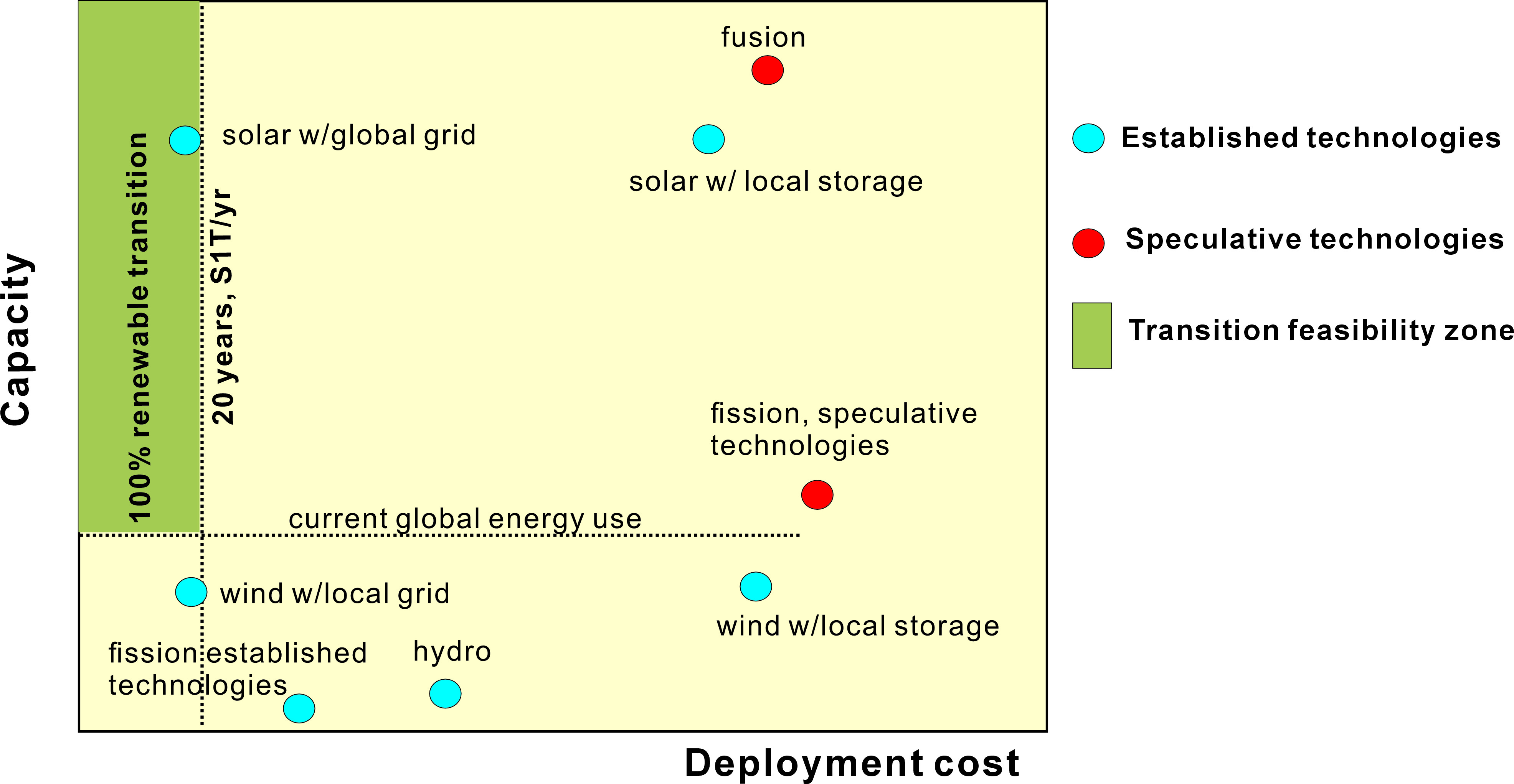
- Of these, solar with global power grid appears the most feasible, followed by solar with local thermal energy storage.
- Open Access
- Article
Powering Human Civilization beyond the Fossil Fuels Era
Author Information
Received: 01 March 2026 | Revised: 01 May 2026 | Accepted: 18 May 2026 | Published: 29 May 2026
Highlights
Abstract
In approximately four decades, extracting a barrel of oil or a cubic foot of gas will cost as much energy as they contain. Thereafter, the net contribution of fossil fuels to the humanity’s energy budget will be negative. Meanwhile, over 80% of that budget currently comes from fossil fuels, despite five decades of substantial investment in renewable alternatives. Production of cement, steel, plastics, and fertilizer, as well as nearly all of transportation, construction and agricultural machinery still completely depend on fossil fuels. Within the lifetimes of billions of people already born, these fundamentals of human civilization will become unavailable, unless human civilization accelerates replacing fossil fuels with sustainable alternatives two-to-eleven-fold, depending on the chosen approach. If it fails to decisively and strategically invest its remaining net-energy-positive fossil fuels into this transition, human civilization appears likely to collapse. Making this transition on time and on (energy) budget presents an unprecedented challenge. All earlier energy transitions (dung to firewood, firewood to coal, etc.) involved minuscule energy fluxes compared to the current global human energy consumption. Still, their global completion took much longer than the four decades available now. Accelerating the transition calls for focusing efforts and investment on the best available options. This study presents a coherent set of criteria to determine what “best” means, along with a comparative review of the options based on that set. The criteria include technology maturity and scalability of both the total resource and its flux (power). From this analysis, solar energy (coupled with either local thermal energy storage or with global electric grid) appears to be the most realistic option for the energy transition. Either local storage or the global grid can mitigate the intermittency of solar energy so it can be used as a reliable baseload power source. However, the estimated investment needed to complete the global transition is $701 trillion for local storage vs. $127 trillion for the global grid. The collaborative global grid approach is far more affordable than energy separatism. In turn, constructing global power infrastructure will increase demand for international cooperation and human labor, helping resolve many of humanity’s immediate problems: geopolitical rivalry, the risk of resource wars, technological unemployment etc.
Graphical Abstract
Keywords
fossil fuel | primary energy options | comparative analysis | local storage | global power grid | policy implications
References
- 1.
Kardashev, N.S. Transmission of information by extraterrestrial civilizations. Sov. Astron. 1964, 8, 217–221.
- 2.
Smil, V. Energy and Civilization: A History; MIT Press: Cambridge, MA, USA, 2017.
- 3.
Rhodes, C.J. Solar energy: principles and possibilities. Sci. Prog. 2010, 93, 37–112.
- 4.
Zhang, A.; Yang, J.; Yangcheng, L.; et al. Forecasting the progression of human civilization on the Kardashev Scale through 2060 with a machine learning approach. Sci. Rep. 2023, 13, 11305.
- 5.
Jackson, R.B.; Ahlstrom, A.; Hugelius, G.; et al. Human well-being and per capita energy use. Ecosphere 2022, 13, e3978.
- 6.
Our World in Data. Annual Change in Primary Energy Consumption. Available online: https://ourworldindata.org/grapher/change-energyconsumption (accessed on 1 May 2026)
- 7.
Shenderov, A. Homo Exploratoris: Is Humanity an Apprentice God? SacraSage Press: Sacramento, CA, USA, 2022.
- 8.
Boretti, A.; Rosa, L. Reassessing the projections of the World Water Development Report. npj Clean Water 2019, 2, 15.
- 9.
Shorey, P.; Abdulla, A. Liquid solvent direct air capture’s cost and carbon dioxide removal vary with ambient environmental conditions. Commun. Earth Environ. 2024, 5, 607.
- 10.
Zheng, Y.; Wan, Y.; Zhang, Y.; et al. Recovery of phosphorus from wastewater: A review based on current phosphorous removal technologies. Crit. Rev. Environ. Sci. Technol. 2022, 53, 1148–1172.
- 11.
IEA. Global Energy Review 2026; IEA: Paris, France, 2026. Available online: https://www.iea.org/reports/global-energy-review-2026 (accessed on 1 May 2026).
- 12.
Furnival, L. Prospects for Orbital Data Centers. Available online: https://www.thespacereview.com/article/4806/1 (accessed on 1 May 2026).
- 13.
Space Calcs. O’Neill Cylinder. Available online: https://spacecalcs.com/calcs/oneill-cylinder/ (accessed on 1 March 2026).
- 14.
Savin, I.; van den Bergh, J. Reviewing studies of degrowth: Are claims matched by data, methods and policy analysis? Ecol. Econ. 2024, 218, 108324.
- 15.
Jones, C. The end of economic growth? Unintended consequences of a declining population. Am. Econ. Rev. 2022, 112, 3489–3527.
- 16.
Bergmann, T.; Kalkuhl, M. Decoupling economic growth from energy use: The role of energy intensity in an endogenous growth model. Ecol. Econ. 2025, 230, 1–16.
- 17.
Energy Institute. Statistical Review of World Energy 2025; Energy Institute: London, UK, 2025. Available online: https://assets.kpmg.com/content/dam/kpmg/sk/pdf/2025/Statistical-Review-of-World-Energy-2025.pdf (accessed on 1 May 2026).
- 18.
Smil, V. The Modern World Can’t Exist without These Four Ingredients. They All Require Fossil Fuels. Time, 12 May 2022.
- 19.
Schreyer, F.; Ueckerdt, F.; Pietzcker, R.; et al. From net-zero to zerofossil in transforming the EU energy system. Nat. Commun. 2025, 16, 10700.
- 20.
Energy Institute. Statistical Review of World Energy 2024; Energy Institute: London, UK, 2024. Available online: https://assets.kpmg.com/content/dam/kpmg/pe/Campa%C3%B1as-2025/enero/Statistical-Review-of-World-Energy.pdf (accessed on 1 May 2026).
- 21.
Ember. Global Electricity Review 2024; Ember: London, UK, 2024. Available online: https://ember-energy.org/latest-insights/globalelectricity-review-2024/ (accessed on 1 May 2026).
- 22.
BP. Statistical Review of World Energy 2021; BP: London, UK, 2021. Available online: https://www.bp.com/content/dam/bp/businesssites/en/global/corporate/pdfs/energy-economics/statisticalreview/bp-stats-review-2021-full-report.pdf (accessed on 1 May 2026).
- 23.
IEA. Renewables 2023; IEA: Paris, France, 2024. Available online: https://www.iea.org/reports/renewables-2023 (accessed on 1 May 2026).
- 24.
Laherr´ere, J.; Hall, C.A.; Bentley, R. How much oil remains for the world to produce? Comparing assessment methods, and separating fact from fiction. Curr. Res. Environ. Sustain. 2022, 4, 100174.
- 25.
Rist, C. Why we’ll never run out of oil. Discover 1999. Available online: https://www.discovermagazine.com/why-well-never-runout-of-oil-2627 (accessed on 1 May 2026).
- 26.
Delannoy, L.; Longaretti, P.-Y.; Murphy, D.J.; et al. Peak oil and the low-carbon energy transition: A net-energy perspective. Appl. Energy 2021, 304, 117843.
- 27.
Guilford, M.; Hall, C.; O’Connor, P.; et al. A new long term assessment of energy return on investment (EROI) for U.S. oil and gas discovery and production. Sustainability 2011, 3, 1866–1887.
- 28.
Malthus, T. An Essay on the Principle of Population; J. Johnson: London, UK, 1798.
- 29.
Howe, J.G. The End of Fossil Energy and Per Capita Oil; McIntire Publishing Services: Boulder, CO, USA, 2016. Available online: https://revolutionbooks.org/book/9780996205450 (accessed on 1 May 2026).
- 30.
Syvitski, J.; Waters, C.; Day, J.; et al. Extraordinary human energy consumption and resultant geological impacts beginning around 1950 CE initiated the proposed Anthropocene Epoch. Commun. Earth Environ. 2020, 1, 32.
- 31.
Jackson, T.J.A. Modelling energy transition risk: The impact of de-clining energy return on investment (EROI). Ecol. Econ. 2021, 185, 107023.
- 32.
Reinders, L.J. The Fairy Tale of Nuclear Fusion; Springer: Cham, Switzerland, 2021.
- 33.
Messinger, J. Fusion Breakeven is a Science Breakthrough. Available online: https://thebreakthrough.org/issues/energy/fusionbreakeven-is-a-science-breakthrough (accessed on 20 March 2025).
- 34.
Turrell, A. The Carbon-Free Energy of the Future: This Fusion Breakthrough Changes Everything. Support The Guardian. 22 December 2022. Available online: https://www.theguardian.com/commentisfree/2022/dec/13/carbon-free-energy-fusion-reactionscientists (accessed on 1 May 2026).
- 35.
Tang, L.; Noll, B.; Panda, A.; et al. Fusion power experience rates are overestimated. Nat. Energy 2026, 1–9. https://doi.org/10.1038/s41560-026-02023-8
- 36.
Stefansson, V. World geothermal assessment. In Proceedings of the World Geothermal Congress 2005, Antalya, Turkey, 24–29 April 2005; pp. 24–29.
- 37.
Kishore, R.A.; Priya, S. A review on low-grade thermal energy harvesting: Materials, methods and devices. Materials 2018, 11, 1433.
- 38.
Guti´errez Negr´ın, L.C.A. Evolution of worldwide geothermal power 2020–2023. Geotherm. Energy 2024, 12, 14.
- 39.
Tefera, W.M.; Kasiviswanathan, K.S. A global-scale hydropower potential assessment and feasibility evaluations. Water Resour. Econ. 2022, 38, 1–18.
- 40.
Hunt, J.; Byers, E.; Wada, Y.; et al. Global resource potential of seasonal pumped hydropower storage for energy and water storage. Nat. Commun. 2020, 11, 947.
- 41.
NEA. Uranium 2022: Resources, Production and Demand; OECD Publishing: Paris, France, 2023. Available online: https://www.oecdnea.org/jcms/pl 79960/uranium-2022-resources-production-anddemand?details=true (accessed on 1 May 2026).
- 42.
Bardi, U. Extracting minerals from seawater: An energy analysis. Sustainability 2010, 2, 980–992.
- 43.
Wang, B. Uranium from Seawater Is Getting Cheaper than Mined Uranium. Available online: https://www.nextbigfuture.com/2024/12/uranium-from-seawater-is-getting-cheaper-than-mineduranium.html (accessed on 22 March 2025).
- 44.
Jyothi, R.; De Melo, L.; Santos, R.a.Y.H.-S. An overview of thorium as a prospective natural resource for future energy. Front. Energy Res. 2023, 11, 1132611.
- 45.
Cochran, T.B.; Feiveson, H.A.; Patterson, W.; et al. Fast Breeder Reactor Programs: History and Status; International Panel on Fissile Materials: Princeton, NJ, USA, 2010. Available online: https://www.shturl.cc/eILIYzHCwiqPFtRVqI5WnnystiDxeD9Q2bS (accessed on 1 May 2026).
- 46.
Patel, P. China’s New Breeder Reactors May Produce More Than Just Watts. Available online: https://spectrum.ieee.org/chinabreeder-reactor (accessed on 1 May 2026).
- 47.
Eurek, K.; Sullivan, P.; Gleason, M.; et al. An improved global wind resource estimate for integrated assessment models. Energy Econ. 2017, 64, 552–567.
- 48.
Miller, L.M.; Brunsell, N.A.; Mechem, D.B.; et al. Two methods for estimating limits to large-scale wind power generation. Proc. Natl. Acad. Sci. USA 2015, 112, 11169–11174.
- 49.
Adams, A.S.; Keith, D.W. Are global wind power resource estimates overstated? Environ. Res. Lett. 2013, 8, 015021.
- 50.
Mockert, F.; Grams, C.M.; Brown, T.; et al. Meteorological conditions during periods of low wind speed and insolation in Germany: The role of weather regimes. Meteorol. Appl. 2023, 30, e2141.
- 51.
Andlinger Center for Energy and the Environment. Article 8: Managing a Grid When Variable Wind Is Prominent. Available online: https://acee.princeton.edu/wp-content/uploads/2019/04/AndlingerDistillateArticle8.pdf (accessed on 17 April 2026).
- 52.
U.S. Dept. of Energy. Concentrating Solar-Thermal Power Basics. Available online: https://www.energy.gov/eere/solar/concentratingsolar-thermal-power-basics (accessed on 16 April 2026).
- 53.
Tong, D.; Farnham, D.; Duan, L.; et al. Geophysical constraints on the reliability of solar and wind power worldwide. Nat. Commun. 2021, 12, 6146.
- 54.
IHA. The world’s water battery: Pumped hydropower storage and the clean energy transition; IHA: London, UK, 2018. Available online: https://www.hydropower.org/publications/the-world-e2-80-99s-water-battery-pumped-hydropower-storage-and-the-cleanenergy-transition (accessed on 1 May 2026).
- 55.
IEA. Batteries and Secure Energy Transitions; IEA: Paris, France, 2024. Available online: https://www.iea.org/reports/batteries-andsecure-energy-transitions (accessed on 1 May 2026).
- 56.
Hicks, W. Solution to Energy Storage May Be Beneath Your Feet. Available online: https://www.nlr.gov/news/detail/features/2024/solution-to-energy-storage-may-be-beneathyour-feet (accessed on 25 January 2026).
- 57.
Brown, T. Ammonia for Energy Storage: Economic and Technical Analysis. Available online: https://ammoniaenergy.org/articles/ammonia-for-energy-storage-economic-and-technicalanalysis/(accessed on 2 February 2026).
- 58.
U.S. Dept. of Energy. Hydrogen Storage. Available online: https://www.energy.gov/eere/fuelcells/hydrogen-storage (accessed on 25 April 2026).
- 59.
Parkinson, G. World’s Largest Solar Thermal Plant with Storage Comes On-line. Available online: https://reneweconomy.com.au/worlds-largest-solar-thermal-plant-with-storage-comes-on-line-63533/ (accessed on 20 December 2025).
- 60.
Spanish Wind Energy Association. Cerro Dominador concentrated solar power plant inaugurated in Chile. Available online: https://evwind.aeeolica.org/2021/06/09/cerro-dominadorconcentrated-solar-power-plant-inaugurated-in-chile/81175 (accessed on 25 April 2026).
- 61.
De Carne, G.; Maroufi, S.M.; Beiranvand, H.; et al. The role of energy storage systems for a secure energy supply: A comprehensive review of system needs and technology solutions. Electr. Power Syst. Res. 2024, 236, 110963.
- 62.
BloombergNEF. A Power Grid Long Enough to Reach the Sun Is Key to the Climate Fight. Available online: https://about.bnef.com/insights/clean-energy/a-power-grid-longenough-to-reach-the-sun-is-key-to-the-climate-fight/ (accessed on 25 April 2026).
- 63.
IEA. Electricity Grids and Secure Energy Transitions; IEA: Paris, France, 2023. Available online: https://www.iea.org/reports/electricity-grids-and-secure-energytransitions (accessed on 25 April 2026).
- 64.
Statista. Electric Transmission Projects Completed in the United States from 2019 to 2024, by Voltage. Available online: https://www.statista.com/statistics/551519/us-line-length-ofelectricity-transmission-projects-completed/ (accessed on 25 April 2026).
- 65.
Potter, B. How to Save America’s Transmission System. Available online: https://ifp.org/how-to-save-americas-transmissionsystem/ (accessed on 17 April 2026).
- 66.
America Is Running Out of Power, Are Data Centers to Blame? The Washington Post 2024, 7 March 2024. Available online: https://www.datacenterknowledge.com/energy-powersupply/america-is-running-out-of-power-are-data-centers-to-blame- (accessed on 1 May 2026).
- 67.
Dora, B.; Bhat, S.; Mitra, A.; et al. The global electricity grid: A comprehensive review. Energies 2025, 18, 1152.
- 68.
World’s Biggest Ultra-High Voltage Line Powers Up Across China. Available online: https://www.tdworld.com/overheadtransmission/article/20972092/worlds-biggest-ultra-high-voltageline-powers-up-across-china (accessed on 30 April 2026).
- 69.
Patel, S.C. Viking Link: The Epic Build of the World’s Longest Onshore and Subsea HVDC Interconnector. Available online: https://www.powermag.com/viking-link-the-epic-build-of-the-worldslongest-onshore-and-subsea-hvdc-interconnector/ (accessed on 30 April 2026).
- 70.
Brockway, A.; Callaway, D.; Elmallah, S. Can distribution grid infrastructure accommodate residential electrification and electric vehicle adoption in northern California? Environ. Res.: Infrastruct. Sustain. 2022, 4, 045005.
- 71.
Ghadim, H.V.; Haas, J.; Breyer, C.; et al. Are we too pessimistic? Cost projections for solar photovoltaics, wind power, and batteries are over-estimating actual costs globally. Appl. Energy 2025, 390, 1–16.
- 72.
Chen, Z.; Kleijn, R.; Lin, H. Metal requirements for building electrical grid systems of global wind power and utility-scale solar photovoltaic until 2050. Environ. Sci. Technol. 2023, 57, 1080–1091.
- 73.
IEA. World Energy Investment 2025; IEA: Paris, France, 2025. Available online: https://www.iea.org/reports/world-energy-investment-2025 (accessed on 1 May 2026).
How to Cite
Shenderov, A. D. Powering Human Civilization beyond the Fossil Fuels Era. Earth Systems, Resources, and Sustainability 2026, 1 (3), 320–331. https://doi.org/10.53941/esrs.2026.100019.
RIS
BibTex
Copyright & License

Copyright (c) 2026 by the authors.
This work is licensed under a Creative Commons Attribution 4.0 International License.
Contents
References
