
- A provincial GF development index is constructed using the entropy method based on green credit, green bonds, and green investment indicators.
- Environmental regulation is identified as the most significant and robust driver of GF development.
- Environmental regulation and market forces jointly drive GF development in eastern China.
- Economic development and R&D investment are key determinants in central China, while environmental regulation dominates in western China.
- Policy recommendations are proposed to strengthen environmental governance, optimize industrial transformation, improve regional coordination, and enhance green financial market mechanisms.
- Open Access
- Article
Measuring the Development Level and Influencing Factors of Green Finance under the Context of a Low-Carbon Economy
- Heyu Qi 1 and
- Guoqing Zhai 2,*
Author Information
Received: 05 June 2026 | Revised: 25 June 2026 | Accepted: 18 July 2026 | Published: 24 July 2026
Highlights
Abstract
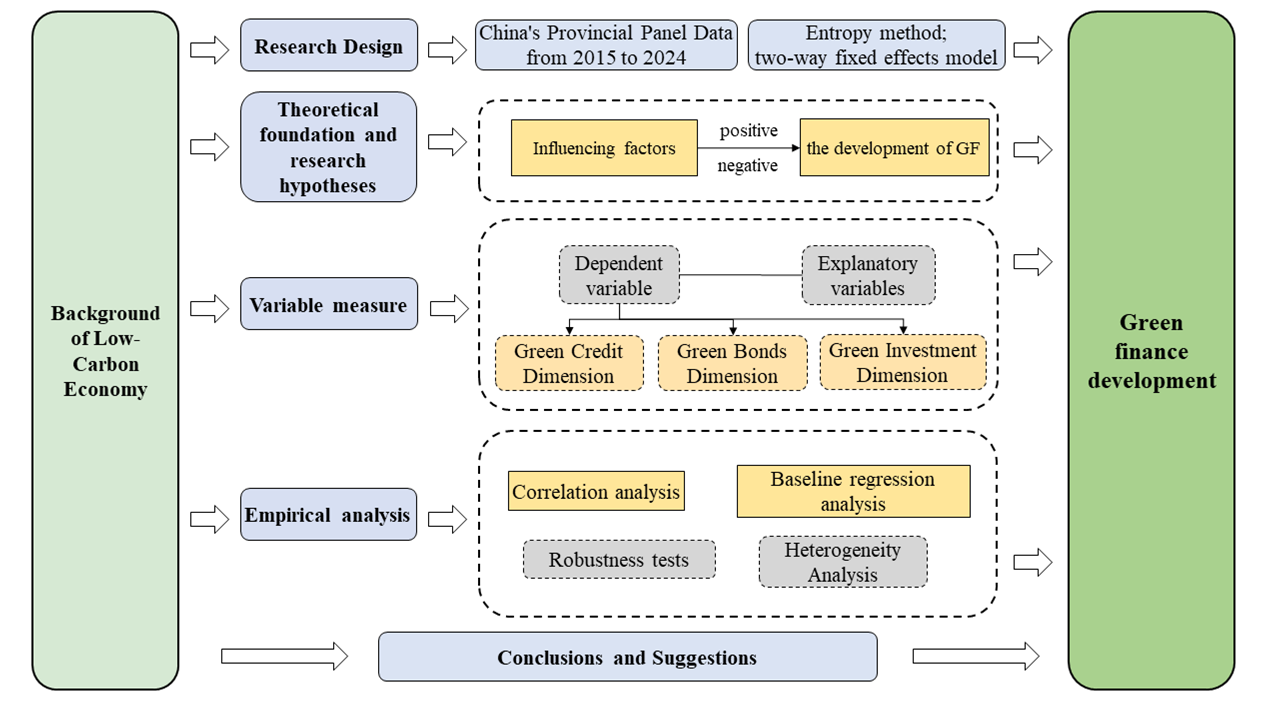
Green finance (GF) is increasingly recognized as a critical instrument for facilitating the low-carbon economic transition. This study utilizes panel data of 30 Chinese provinces from 2015 to 2024, comprising 300 observations. First, an index system for assessing the level of green finance (GF) development is established using the entropy-weighting method. Subsequently, fixed-effects model is applied to examine the direct effects of per capita GDP, industrial structure upgrading, and the intensity of environmental regulation on GF development. To assess the robustness of the findings, a series of robustness checks are conducted. In addition, regional heterogeneity is examined by comparing the effects across eastern, central, and western China. The findings indicate that environmental regulation intensity exerts a substantial and robust positive effect on GF development; the negative impact of industrial structure upgrading aligns with expectations but fails to reach statistical significance; and the effects of openness to foreign trade and the share of fiscal expenditure on environmental protection are not significant. Regional differences present a more complex picture. In the eastern region, GF development is jointly driven by environmental regulation and market forces. In the central region, economic development and R&D investment play a more important role, while environmental regulation remains the dominant driving force in the western region. The study, therefore, after the analysis, suggests policy measures including promoting substantive industrial upgrading, strengthening environmental regulatory frameworks, enhancing interregional cooperation, and improving green financial market mechanisms. The findings provide empirical evidence for advancing high-quality GF development. They also contribute to achieving low-carbon economic goals.
Graphical Abstract
Keywords
low-carbon economy | green finance | entropy method | panel data | two-way fixed effect model
References
- 1.
Zhang, D.; Mohsin, M.; Rasheed, A.K.; et al. Public spending and green economic growth in BRI region: Mediating role of green finance. Energy Policy 2021, 153, 112256.
- 2.
Zhang, Y.; Gao, K.; Wang, T.; et al. The development, regional differences, and dynamic evolution of China’s Green Finance in the context of “Carbon Peaking and Carbon Neutrality”. Int. Rev. Econ. Finance 2025, 100, 104100.
- 3.
Qiao, Q.; Fan, J.; Sun, Y.; et al. Research on the measurement and influencing factors of green finance in the provinces along “the belt and road” in China. J. Ind. Technol. Econ. 2021, 40, 120–126. https://doi.org/10.3969/j.issn.1004-910X.2021.07.015. (In Chinese)
- 4.
Liu, R., Wang, D., Zhang, L.; et al. Can green financial development promote regional ecological efficiency? A case study of China. Nat. Hazards 2019, 95, 325–341.
- 5.
Li, C.; Bao, Y.; Li, Y.; et al. Assessment of the coupling coordination relationship between the green financial system and the sustainable development system across China. Sci. Rep. 2024, 14, 11534.
- 6.
Wang, T.; Wang, D.; Zeng, Z. Research on the construction and measurement of digital governance level system of County rural areas in China—Empirical analysis based on entropy weight TOPSIS model. Sustainability 2024, 16, 4374.
- 7.
Shi, D.; Shi, X. Green finance and high-quality economic development: Mechanisms, characteristics and empirical study. Stat. Res. 2022, 39, 31-48. https://doi.org/10.19343/j.cnki.11-1302/c.2022.01.003. (In Chinese)
- 8.
Guo, X. Impact mechanisms and empirical testing of green finance in promoting low-carbon economic transition. South. Finance 2022, 52–67. https://link.cnki.net/urlid/44.1479.F.20220312.1529.006. (In Chinese)
- 9.
Xu, S.; Zhao, X.; Yao, S. Analysis on the effect of green credit on the upgrading of industrial structure. J. Shanghai Univ. Finance Econ. 2018, 20, 59–72. https://doi.org/10.16538/j.cnki.jsufe.2018.02.004. (In Chinese)
- 10.
Wang, S.; Liu, X.; Xing, G. Green finance, industrial structure upgrading and high-quality economic development—Empirical study based on panel fixation effect and threshold effect. For. Econ. Relat. Trade 2025, 120–125. (In Chinese)
- 11.
Caetano, R.V.; Marques, A.C.; Afonso, T.L. How can foreign direct investment trigger green growth? The mediating and moderating role of the energy transition. Economies 2022, 10, 199.
- 12.
Wei, L.; Lin, B.; Zheng, Z.; et al. Does fiscal expenditure promote green technological innovation in China? Evidence from Chinese cities. Environ. Impact Assess. Rev. 2023, 98, 106945.
- 13.
Li, L.; Ma, X.; Ma, S.; et al. Role of green finance in regional heterogeneous green innovation: Evidence from China. Humanit. Soc. Sci. Commun. 2024, 11, 1011.
- 14.
Xie, X.; Fu, H.; Zhu, Q.; et al. Integrated optimization modelling framework for low-carbon and green regional transitions through resource-based industrial symbiosis. Nat. Commun. 2024, 15, 3842.
- 15.
Muhammad, S.; Pan, Y.; Agha, M.H.; et al. Industrial structure, energy intensity and environmental efficiency across developed and developing economies: The intermediary role of primary, secondary and tertiary industry. Energy 2022, 247, 123576.
- 16.
Li, L.; Shen, Z.; Song, M.; et al. Public expenditure, green finance, and environmental governance: Evidence from China. Environ. Model. Assess. 2023, 28, 859–873.
How to Cite
Qi, H.; Zhai, G. Measuring the Development Level and Influencing Factors of Green Finance under the Context of a Low-Carbon Economy. Earth Systems, Resources, and Sustainability 2026, 1 (3), 332–346. https://doi.org/10.53941/esrs.2026.100020.
RIS
BibTex
Copyright & License

Copyright (c) 2026 by the authors.
This work is licensed under a Creative Commons Attribution 4.0 International License.
Contents
References
