
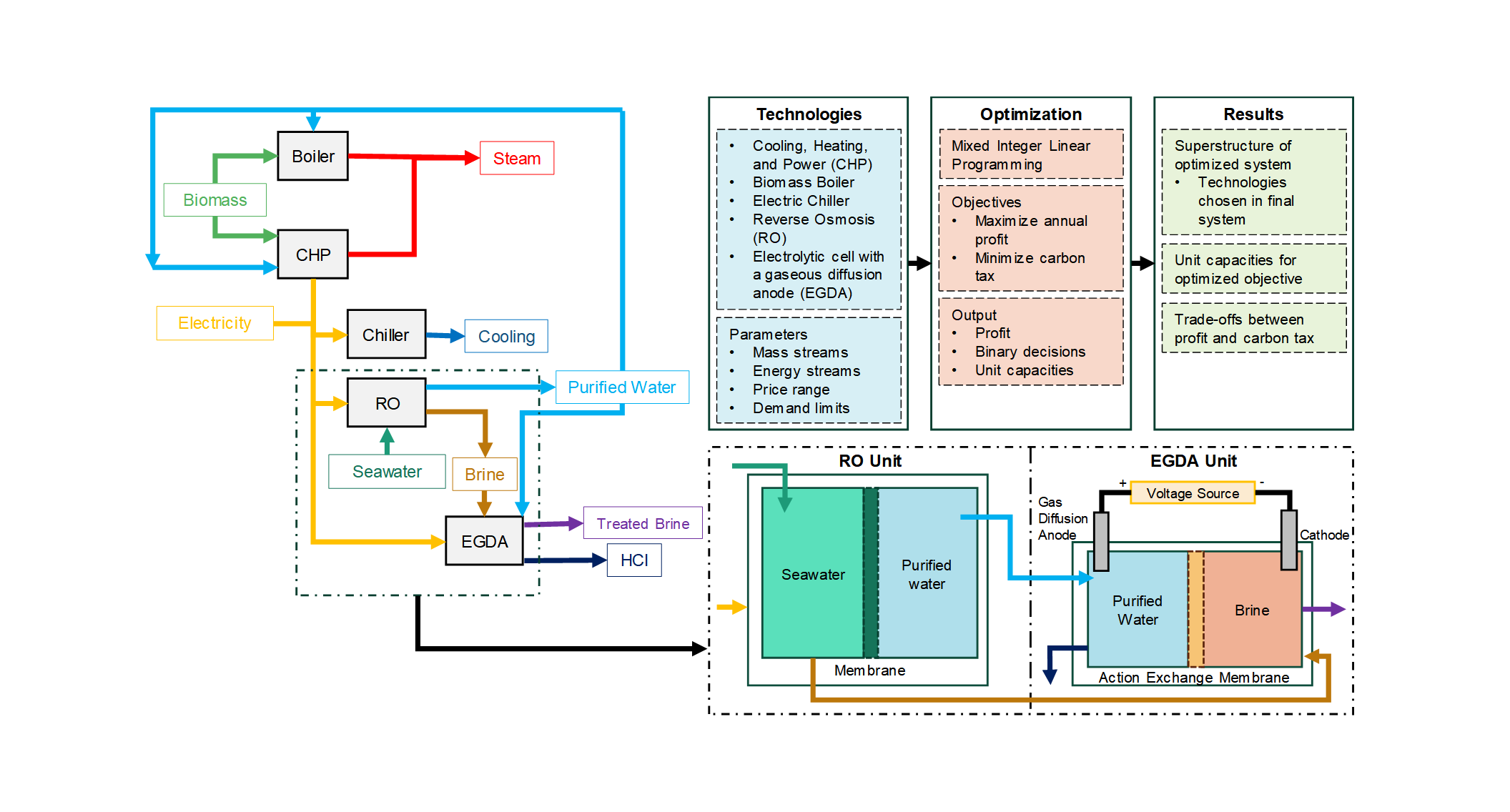
With increasing carbon dioxide emissions from power and heat generation, various decarbonization strategies are being explored to produce clean energy. Polygeneration systems are a promising approach to supply the energy needed. These systems incorporate numerous processes and technologies to convert various raw materials into multiple energy streams. To capitalize on the vast ocean resources worldwide, reverse osmosis desalination (ROD) and indirect ocean capture (IOC) technologies are considered within polygeneration system. This study focuses on optimizing an ROD/IOC process unit incorporated in a polygeneration system that produces heating, cooling, purified water, and hydrochloric acid (HCl) according to demand. The optimization approach employs a mixed integer linear programming (MILP) model that considers net output, capacity, demand, and binary variable vectors. The model aims to maximize the profit while minimizing the carbon-associated price. The optimal results indicate the selection of a combined heat and power (CHP) unit operating at 7500 kW, the chiller at 1500 kW, the reverse osmosis desalination (ROD) unit at 130.5 tons per hour, and the electrolytic cell with a gaseous diffusion anode (EGDA) operating at 80 tons per hour. The system achieves a net positive profit between €447,000 to €4,691,000 per year depending on the carbon-associated price. A trade-off between the profitability and the carbon-associated price was established. This study contributes to the field of negative emission technologies (NETs) and emphasizes the importance of optimizing polygeneration systems for sustainable energy transition.
- Open Access
- Article
Optimization of a Reverse Osmosis Desalination and Indirect Ocean Capture for a Polygeneration System
- Maxine Camille O. Mallari 1, 2,
- Aristotle T. Ubando 1, 2, 3, *
Author Information
Received: 29 Apr 2025 | Revised: 04 Sep 2025 | Accepted: 05 Sep 2025 | Published: 10 Sep 2025
Abstract
Graphical Abstract
Keywords
polygeneration | desalination | optimization | low-carbon emissions | profitability | carbon-associated price
References
- 1.
Ritchie, H.; Roser, M. CO2 emissions. Our World in Data. 2024. Available online: https://ourworldindata.org/co2-emissions (accessed on 26 April 2025).
- 2.NASA. Carbon Dioxide. 2025. Available online: https://climate.nasa.gov/vital-signs/carbon-dioxide (accessed on 26 April 2025).
- 3.International Energy Agency. Renewables 2024. 2024. Available online: https://www.iea.org/reports/renewables-2024 (accessed on 26 April 2025).
- 4.
Haszeldine, R.S.; Flude, S.; Johnson, G.; Scott, V. Negative emissions technologies and carbon capture and storage to achieve the Paris Agreement commitments. Philos. Trans. R. Soc. A Math. Phys. Eng. Sci. 2018, 376, 20160447. https://doi.org/10.1098/rsta.2016.0447.
- 5.
de Lannoy, C.-F.; Eisaman, M.D.; Jose, A.; Karnitz, S.D.; DeVaul, R.W.; Hannun, K. Indirect ocean capture of atmospheric CO2: Part I. Prototype of a negative emissions technology. Int. J. Greenh. Gas Control 2018, 70, 243–253. https://doi.org/10.1016/j.ijggc.2017.10.007.
- 6.
Eisaman, M.D.; Rivest JL, B.; Karnitz, S.D.; de Lannoy, C.-F.; Jose, A.; DeVaul, R.W.; Hannun, K. Indirect ocean capture of atmospheric CO2: Part II. Understanding the cost of negative emissions. Int. J. Greenh. Gas Control 2018, 70, 254–261. https://doi.org/10.1016/j.ijggc.2018.02.020.
- 7.Davies, P.A.; Yuan, Q.; de Richter, R. Desalination as a negative emissions technology. Environ. Sci. Water Res. Technol. 2018, 4, 839–850. https://doi.org/10.1039/C7EW00502D.
- 8.Tan, R.R.; Aviso, K.B.; Foo DC, Y.; Lee, J.-Y.; Ubando, A.T. Optimal synthesis of negative emissions polygeneration systems with desalination. Energy 2019, 187, 115953. https://doi.org/10.1016/j.energy.2019.115953.
- 9.
Shahabuddin, M.; Alim, M.A.; Alam, T.; Mofijur, M.; Ahmed, S.F.; Perkins, G. A critical review on the development and challenges of concentrated solar power technologies. Sustain. Energy Technol. Assess. 2021, 47, 101434. https://doi.org/10.1016/j.seta.2021.101434.
- 10.
Luo, J.; Zhu, Q.; Morosuk, T. Advanced Exergy-Based Optimization of a Polygeneration System with CO2 as Working Fluid. Entropy 2024, 26, 886. https://doi.org/10.3390/e26100886.
- 11.Lainfiesta, M.; Zhang, X.; Wu, J.; Song, H. Developing a Decision Support System for the Optimal Operating Strategies of a Polygeneration Facility. In Proceedings of the 2019 IEEE Innovative Smart Grid Technologies—Asia (ISGT Asia), Chengdu, China, 21–24 May 2019. https://doi.org/10.1109/ISGT-Asia.2019.8881736.
- 12.
Fachrizal, R.; Shepero, M.; van der Meer, D.; Munkhammar, J.; Widén, J. Smart charging of electric vehicles considering photovoltaic power production and electricity consumption: A review. eTransportation 2020, 4, 100056. https://doi.org/10.1016/j.etran.2020.100056.
- 13.Urbanucci, L. Limits and potentials of Mixed Integer Linear Programming methods for optimization of polygeneration energy systems. Energy Procedia 2018, 148, 1199–1205. https://doi.org/10.1016/j.egypro.2018.08.021.
- 14.Aviso, K.B.; Sy, C.L.; Tan, R.R.; Ubando, A.T. Fuzzy optimization of carbon management networks based on direct and indirect biomass co-firing. Renew. Sustain. Energy Rev. 2020, 132, 110035. https://doi.org/10.1016/j.rser.2020.110035.
- 15.Belmonte, B.A.; Benjamin MF, D.; Tan, R.R. Optimization-based decision support methodology for the synthesis of negative-emissions biochar systems. Sustain. Prod. Consum. 2019, 19, 105–116. https://doi.org/10.1016/j.spc.2019.03.008.
- 16.Aviso, K.B.; Belmonte, B.A.; Benjamin MF, D.; Jia, X.; Zhang, Y.; Tan, R.R. Optimal Integration of Polygeneration with Carbon Dioxide Removal. Chem. Eng. Trans. 2022, 94, 385–390. https://doi.org/10.3303/CET2294064.
- 17.Kaim, A.; Cord, A.; Volk, M. A review of multi-criteria optimization techniques for agricultural land use allocation. Environ. Model. Softw. 2018, 105, 79–93. https://doi.org/10.1016/j.envsoft.2018.03.031.
- 18.Olabi, V.; Alhajeri, A.; Jouhara, H. Designing a sustainable hydrogen supply chain network in the Gulf Cooperation Council (GCC) region: Multi-objective optimisation using a Kuwait case-study. Int. J. Hydrogen Energy 2025, 142, 994–1013. https://doi.org/10.1016/j.ijhydene.2025.03.296.
- 19.Cheng, J.; Cheng, J.; Lin, Y.; Lu, S.; Wu, P. MILP models and effective heuristic for energy-aware parallel machine scheduling with shared manufacturing. Expert Syst. Appl. 2025, 271, 126681. https://doi.org/10.1016/j.eswa.2025.126681.
- 20.Yilmaz, H.; Yagmahan, B. Optimization of the electric vehicle charging strategy problem for sustainable intercity travels with multiple refueling stops. Sustain. Energy Grids Netw. 2024, 40, 101546. https://doi.org/10.1016/j.segan.2024.101546.
- 21.Grossmann, I.E.; Santibanez, J. Applications of mixed-integer linear programming in process synthesis. Comput. Chem. Eng. 1980, 4, 205–214. https://doi.org/10.1016/0098-1354(80)85001-0.
- 22.Al-attab, K.A.; Zainal, Z.A. Externally fired gas turbine technology: A review. Appl. Energy 2015, 138, 474–487. https://doi.org/10.1016/j.apenergy.2014.10.049.
- 23.Ibishova, B.; Misund, B.; Tveterås, R. Driving green: Financial benefits of carbon emission reduction in companies. Int. Rev. Financ. Anal. 2024, 96, 103757. https://doi.org/10.1016/j.irfa.2024.103757.
- 24.Trinks, A.; Mulder, M.; Scholtens, B. An Efficiency Perspective on Carbon Emissions and Financial Performance. Ecol. Econ. 2020, 175, 106632. https://doi.org/10.1016/j.ecolecon.2020.106632.
- 25.Pratama, M.R.; Muthia, R.; Purwanto, W.W. Techno-economic and life cycle assessment of the integration of bioenergy with carbon capture and storage in the polygeneration system (BECCS-PS) for producing green electricity and methanol. Carbon Neutrality 2023, 2, 26. https://doi.org/10.1007/s43979-023-00069-1.
- 26.Yang, S.; Zhang, X. Study on the U-shaped relationship of carbon constraint on the large thermal power plants’ profitability. Nat. Hazards 2017, 89, 1421–1435. https://doi.org/10.1007/s11069-017-3028-7.
- 27.Bartolini, A.; Mazzoni, S.; Comodi, G.; Romagnoli, A. Impact of carbon pricing on distributed energy systems planning. Appl. Energy 2023, 301, 117324. https://doi.org/10.1016/j.apenergy.2021.117324.
- 28.De Souza, R.J.; Reini, M.; Serra, L.M.; Lozano, M.A.; Nadalon, E.; Casisi, M. Multi-Objective Optimization of an Energy Community Powered by a Distributed Polygeneration System. Energies 2024, 17, 3085. https://doi.org/10.3390/en17133085.
- 29.Pinto, E.S.; Serra, L.M.; Lázaro, A. Energy communities approach applied to optimize polygeneration systems in residential buildings: Case study in Zaragoza, Spain. Sustain. Cities Soc. 2022, 82, 103885. https://doi.org/10.1016/j.scs.2022.103885.
- 30.Fayyaz, S.; Masjedi, S.K.; Kazemi, A.; Kahki, E.; Moeinaddini, M.; Olsen, S.I. Life cycle assessment of reverse osmosis for high-salinity seawater desalination process: Potable and industrial water production. J. Clean. Prod. 2023, 382, 135299. https://doi.org/10.1016/j.jclepro.2022.135299.
- 31.
Straatman, P.J.T.; van Sark, W.G.J.H.M. Indirect air CO2 capture and refinement based on OTEC seawater outgassing. iScience 2021, 24, 102754. https://doi.org/10.1016/j.isci.2021.102754.


This work is licensed under a Creative Commons Attribution 4.0 International License.

 Suite 4002 Level 4, 447 Collins Street, Melbourne, Victoria 3000, Australia
 General Inquiries: info@sciltp.com