
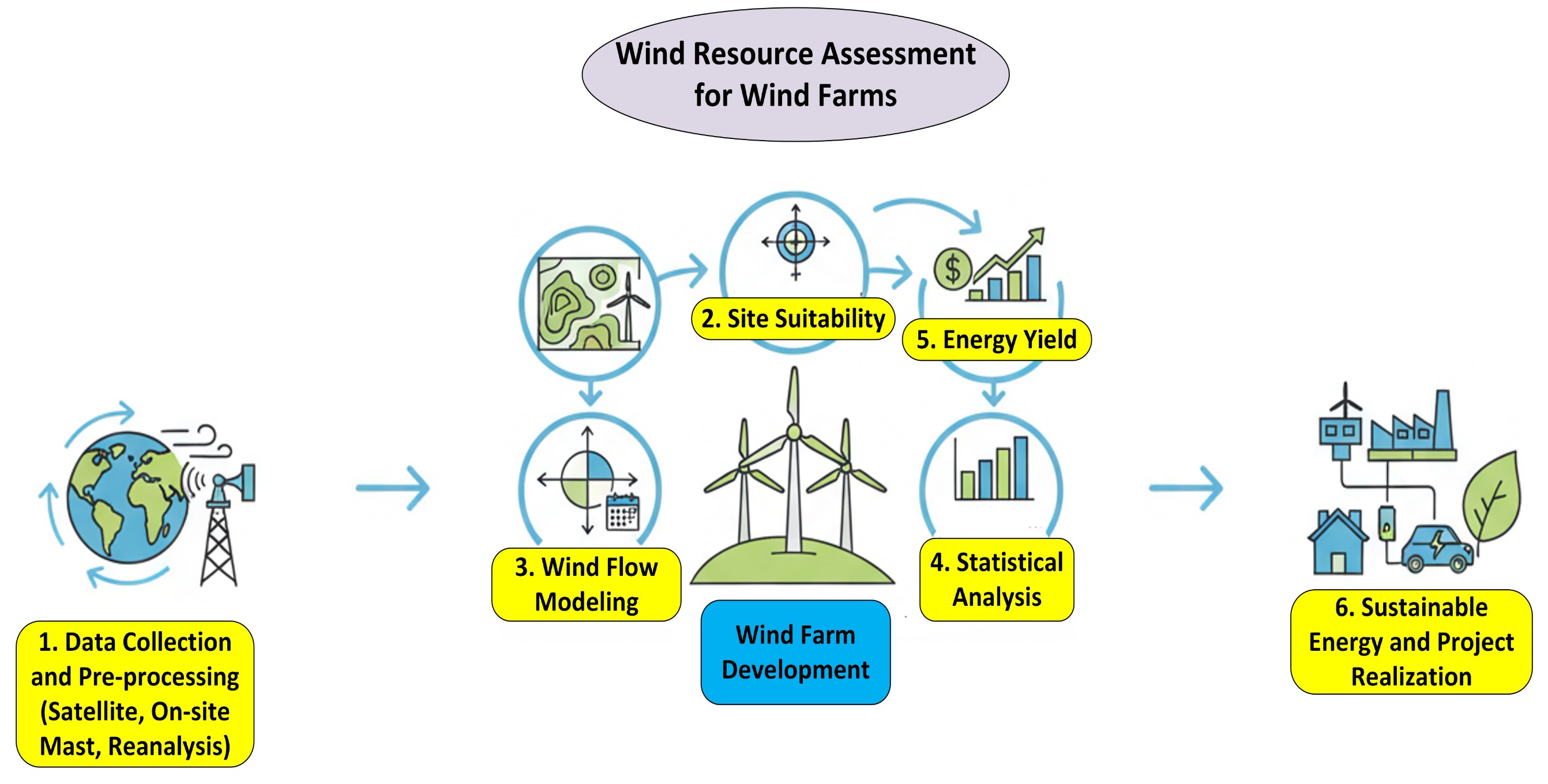
The less promising but still feasible sites for wind farm development are the areas between the State of Santa Catarina and the State of Rio Grande do Sul, Brazil. To better understand the available wind energy potential in the region, a wind resource assessment was carried out for Phases I and II wind farms in Santa Vitoria do Palmar, Brazil. The data used for wind analysis were collected from April 2007 to March 2008 at a meteorological mast height of 101 m. Ten-minute data on wind speed, standard deviation, wind direction, relative humidity, environmental temperature, and pressure were recorded. Analytical estimation models were employed to determine the Weibull parameters necessary for calculating the annual average wind speed, mean power density, cumulative distribution, and probability density functions of the wind regime. The probability density function statistical results were analyzed at two different heights—the reference height of 101 m and the hub height of 80 m. The outcomes were then compared with the WAsP numerical output. The analysis showed that the energy pattern factor method has a confidence level above 97.5% with a correlation coefficient of 100%. The calculation results indicated that the annual mean wind speed at 80 m hub height was 8.10 m/s. This suggests that the site is suitable for IEC 61400-1 Ed.3 Class II wind turbine generators. The characteristic wind turbulence at a reference height of 101 m was classified as IEC Subclass C. Among the selected wind turbine generators, the 2.5 MW AV928 has the highest capacity factor at 41.22% and the lowest levelized energy cost of US$44.36 per MWh. Additionally, WAsP was utilized to numerically estimate the net annual energy production for the locality. Based on the proposed arrangement of wind turbines, the predicted net annual energy production, considering the wake loss effects, is expected to be 104.92 GWh/year for Phase I and 456.89 GWh/year for Phase II of the wind farms.
- Open Access
- Article
Identification of Wind Power Potential for Phases I and II Wind Farms in Brazil Using Various Statistical Estimation Models and WAsP
- Gerardo L. Augusto 1, 2, *,
- Laurence A. Gan Lim 1, 2,
- Keith Lam 3
Author Information
Received: 19 May 2025 | Revised: 18 Aug 2025 | Accepted: 15 Sep 2025 | Published: 19 Sep 2025
Abstract
Graphical Abstract
Keywords
wind resource assessment | statistical estimation models | annual energy production | cost analysis | WAsP analysis
References
- 1.Nugent, D.; Sovacool, B.K. Assessing the lifecycle greenhouse gas emissions from solar PV and wind energy: A critical meta-survey. Energy Policy 2014, 65, 229–244.
- 2.IRENA. Renewable Capacity Statistics 2025; International Renewable Energy Agency: Abu Dhabi, United Arab Emirates.
- 3.Pereira, E.B.; Martins, F.R.; Pes, M.P.; et al. The impacts of global climate changes on the wind power density in Brazil. Renew Energy 2013, 49, 107–110.
- 4.Hayashi, T.; Liu, W.; Sassa, K. A preliminary investigation of low-cost SODAR anemometry. Wind. Eng. 2003, 27, 285–297.
- 5.Ormel, F.T.; Herman, S.A.; Eecen, S.A. Comparative Measurements with SODAR Systems Correlation with Meteorological Masts for Onshore and Offshore. Available online: https://www.osti.gov/etdeweb/biblio/20376551 (access on 19 June 2025).
- 6.Chaurasiya, P.K.; Warudkar, V.; Ahmed, S. An onsite demonstration and validation of LiDAR technology for wind energy resource assessment. Int. J. Sustain. Energy 2019, 38, 701–715.
- 7.Asian Development Bank. Guidelines for Wind Resources Assessment: Best Practices for Countries Initiating Wind Development; Asian Development Bank: Mandaluyong City, Philippines, 2014; pp. 1–49.
- 8.de Araujo Lima, L.; Bezerra Filho, C.R. Wind resource evaluation in São João do Cariri (SJC)—Paraiba, Brazil. Renew. Sustain. Energy Rev. 2012, 16, 474–480.
- 9.Silva dos Santos, A.T.; Santos e Silva, C.M.; Faro do Amaral Lemos, D.; et al. Assessment of wind resources in two parts of Northeast Brazil with the use of numerical models. Meteorol. Appl. 2016, 23, 563–573.
- 10.González MO, A.; Santiso, A.M.; de Melo, D.C.; et al. Regulation for offshore wind power development in Brazil. Energy Policy 2020, 145, 111756.
- 11.Vinhoza, A.; Schaeffer, R. Brazil’s offshore wind energy potential assessment based on a Spatial Multi-Criteria Decision Analysis. Renew. Sustain. Energy Rev. 2021, 146, 111185.
- 12.Dos Reis, M.M.L.; Mazetto, B.M.; Da Silva, E.C.M. Economic analysis for implantation of an offshore wind farm in the Brazilian coast. Sustain. Energy Technol. Assess. 2021, 43, 100955.
- 13.IEC 61400-1; International Standard Norme Internationale Wind Turbines-Part 1: Design Requirements Eoliennes-Partie 1: Exigences de Conception. International Electrotechnical Commission: Geneva, Switzerland, 2005.
- 14.IEC 61400-12-1; International Standard IEC 61400-12-1 Wind Turbines Part 12-1: Power Performance Measurements of Electricity Producing Wind Turbines. International Electrotechnical Commission: Geneva, Switzerland, 2005.
- 15.Mathew, S. Wind Energy: Fundamentals, Resource Analysis and Economics; Springer: Berlin, Germany, 2006.
- 16.Veritas, D.N. Guidelines for Design of Wind Turbine; Jydsk Centraltrykkeri: Viby, Denmark, 2002.
- 17.Germanischer Lloyd, GL. Guideline for the Certification of Wind Turbine 2003 with Supplement 2004; Germanischer Lloyd, GL: Hamburg, Germany, 2003.
- 18.Bowden, G.J.; Barker, P.R.; Shestopal, V.O.; et al. The Weibull distribution function and wind statistics. Wind. Eng. 1983, 7, 85–98.
- 19.Kreyszig, E. Advanced Engineering Mathematics; John Wiley & Sons, Inc.: Boston, MA, USA, 2011.
- 20.Balouktsis, A.; Chassapis, D.; Karapantsios, T.D. A nomogram method for estimating the energy produced by wind turbine generators. Sol. Eng. 2002, 72, 251–259.
- 21.Mengelkamp, H.T. On the energy output estimation of wind turbines. J. Energy Res. 1988, 12, 113–123.
- 22.Chang, T.J.; Wu, Y.T.; Hsu, H.Y.; et al. Assessment of wind characteristics and wind turbine characteristics in Taiwan. Renew. Energy 2003, 28, 851–871.
- 23.Stevens, M.J.M.; Smulders, P.T. The Estimation of the Parameters of the Weibull Wind Speed Distribution for Wind Energy Utilization Purposes. Wind. Eng. 1979, 3, 132–145.
- 24.Hulio, Z.H.; Jiang, W. An assessment of effects of non-stationary operational condition on wind turbine under different wind scenario. J. Eng. Des. Technol. 2020, 18, 102–121.
- 25.Hulio, Z.H. Assessment of Wind Characteristics and Wind Power Potential of Gharo, Pakistan. J. Renew. Energy 2021, 2021, 8960190.
- 26.NREL. 2022 Cost of Wind Energy Review; NREL: Washington, DC, USA, 2023.

How to Cite
Augusto, G. L.; Gan Lim, L. A.; Lam, K. Identification of Wind Power Potential for Phases I and II Wind Farms in Brazil Using Various Statistical Estimation Models and WAsP. Green Energy and Fuel Research 2025, 2 (3), 218–238. https://doi.org/10.53941/gefr.2025.100016.
RIS
BibTex
Copyright & License

Copyright (c) 2025 by the authors.
This work is licensed under a Creative Commons Attribution 4.0 International License.
Article Metrics
173
Article Views
0
Citations
Contents
References

 Suite 4002 Level 4, 447 Collins Street, Melbourne, Victoria 3000, Australia
 General Inquiries: info@sciltp.com