
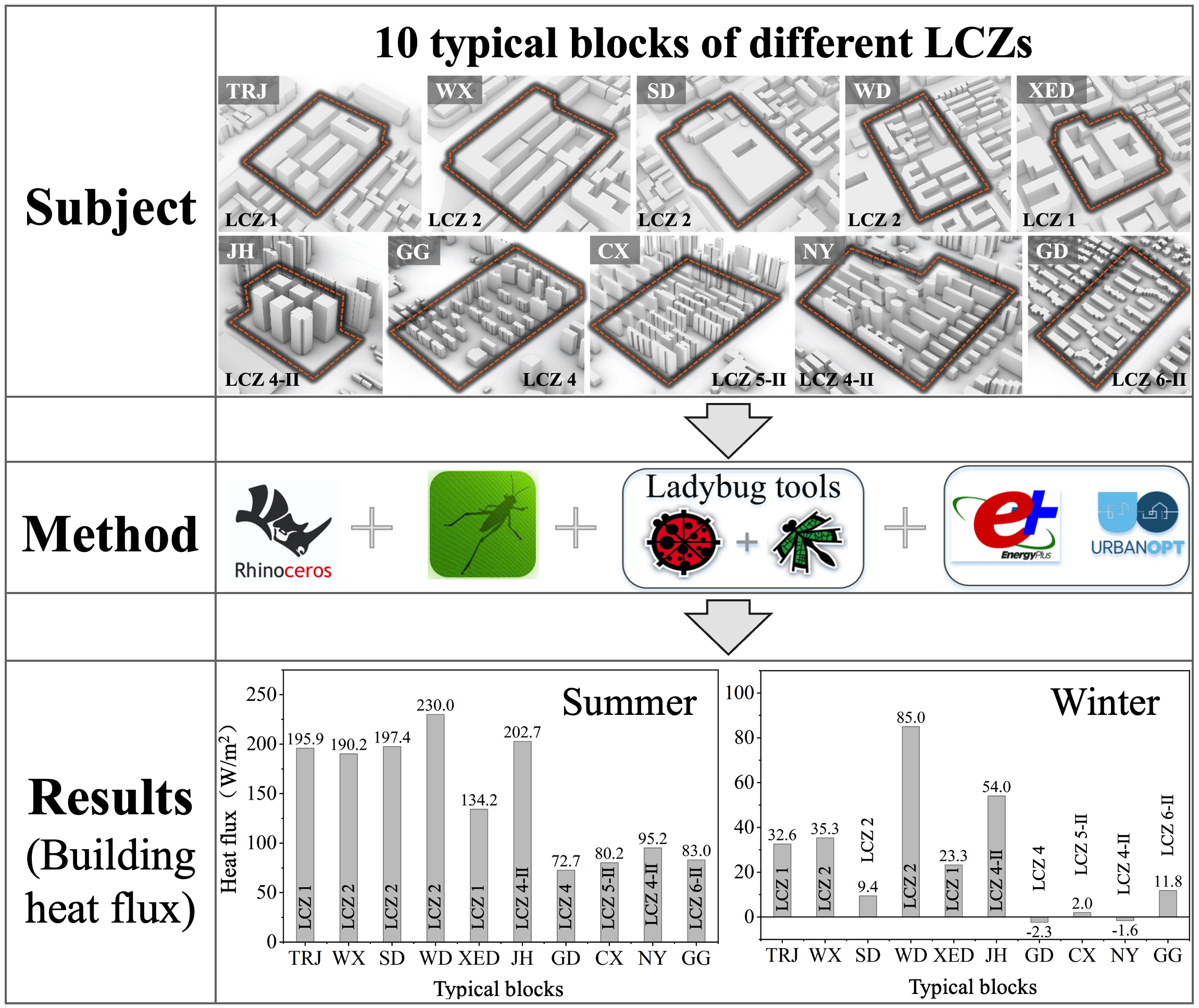
Under global warming and rapid urbanization, anthropogenic heat emission from buildings (AHEb) has become a key driver of urban thermal environments. However, most studies approximate AHEb using building energy consumption, which limits the accurate representation of block-scale heat release and its variability across urban forms. This study examines typical urban blocks representing different Local Climate Zone (LCZ) types in Xi’an, China. Using building energy simulations, we quantify the spatiotemporal characteristics of AHEb and their component mechanisms across LCZs. Results show that in summer, compact high-density blocks (LCZ 1–2) exhibit daily mean heat emission intensities of 134.2–230.0 W/m2, significantly higher than those of open blocks (LCZ 4–6-II; 72.7–202.7 W/m2). Peak heat emissions lag solar radiation by approximately 3 h and are 1.7–4.5 times higher than building energy use intensity. In winter, overall heat emissions decrease markedly, with peak values of 101.5–243.9 W/m2 in compact blocks and 39.4–98.3 W/m2 in open blocks, while inter-block differences are more strongly influenced by dominant building functions. Component analysis indicates that in summer, HVAC systems and building envelopes contribute 43–68% and 17–53% of total heat emissions, respectively. In winter, relief air dominates heat emissions in commercial and office blocks (29–80%), whereas residential blocks are mainly governed by envelope heat release and air infiltration. These findings demonstrate that equating building energy consumption with heat emissions substantially underestimates actual urban heat release. Integrating the LCZ framework enables more refined and function-sensitive assessments of urban thermal environments.
- Open Access
- Article
Anthropogenic Heat Emissions and Energy Use in Buildings at the Block Scale: Differences across Local Climate Zones and Component Contributions
- Yuan Chen,
- Xilian Luo,
- Yupeng Wang *
Author Information
Received: 15 Oct 2025 | Revised: 22 Dec 2025 | Accepted: 23 Dec 2025 | Published: 24 Dec 2025
Abstract
Graphical Abstract
References
- 1.
United Nations Department of Economic and Social Affairs. World Urbanization Prospects 2018: Highlights; United Nations: New York, NY, USA, 2019.
- 2.
Soon, W.W.-H.; Connolly, R.; Connolly, M. Comparing the Current and Early 20th Century Warm Periods in China. Earth-Sci. Rev. 2018, 185, 80–101.
- 3.
Yan, X.; Luo, X.; Wang, Y. Integrating Environmental and Energy Justice into Climate-Adaptive Urban Planning: A Systematic Review. Green Energy Fuel Res. 2025, 2, 293–302.
- 4.
Oke, T.R.; Mills, G.; Christen, A.; et al. Urban Climates; Cambridge University Press: Cambridge, UK, 2017.
- 5.
Wang, H.; Yang, J.; Chen, G.; et al. Machine Learning Applications on Air Temperature Prediction in the Urban Canopy Layer: A Critical Review of 2011–2022. Urban Clim. 2023, 49, 101499.
- 6.
Stewart, I.D.; Oke, T.R. Local Climate Zones for Urban Temperature Studies. Bull. Am. Meteorol. Soc. 2012, 93, 1879–1900.
- 7.
Vahmani, P.; Luo, X.; Jones, A.; et al. Anthropogenic Heating of the Urban Environment: An Investigation of Feedback Dynamics between Urban Micro-Climate and Decomposed Anthropogenic Heating from Buildings. Build. Environ. 2022, 213, 108841.
- 8.
Kikegawa, Y.; Tanaka, A.; Ohashi, Y.; et al. Observed and Simulated Sensitivities of Summertime Urban Surface Air Temperatures to Anthropogenic Heat in Downtown Areas of Two Japanese Major Cities, Tokyo and Osaka. Theor. Appl. Climatol. 2014, 117, 175–193.
- 9.
Niu, Q.; Nie, C.Q.; Lin, F.; et al. Model Study of Relationship between Local Temperature and Artificial Heat Release. Sci. China Technol. Sci. 2012, 55, 821–830.
- 10.
Zheng, Y.; Weng, Q. High Spatial- and Temporal-Resolution Anthropogenic Heat Discharge Estimation in Los Angeles County, California. J. Environ. Manag. 2018, 206, 1274–1286.
- 11.
Luo, X.; Vahmani, P.; Hong, T.; et al. City-Scale Building Anthropogenic Heating during Heat Waves. Atmosphere 2020, 11, 1206.
- 12.
Quah, A.K.L.; Roth, M. Diurnal and Weekly Variation of Anthropogenic Heat Emissions in a Tropical City, Singapore. Atmos. Environ. 2012, 46, 92–103.
- 13.
Lu, Y.; Wang, Q.; Zhang, Y.; et al. An Estimate of Anthropogenic Heat Emissions in China. Int. J. Climatol. 2016, 36, 1134.
- 14.
Hou, H.; Su, H.; Liu, K.; et al. Driving Forces of UHI Changes in China’s Major Cities from the Perspective of Land Surface Energy Balance. Sci. Total Environ. 2022, 829, 154710.
- 15.
Takane, Y.; Kikegawa, Y.; Hara, M.; et al. A Climatological Validation of Urban Air Temperature and Electricity Demand Simulated by a Regional Climate Model Coupled with an Urban Canopy Model and a Building Energy Model in an Asian Megacity. Int. J. Climatol. 2017, 37, 1035–1052.
- 16.
Ahmad, M.W.; Mourshed, M.; Yuce, B.; et al. Computational Intelligence Techniques for HVAC Systems: A Review. Build. Simul. 2016, 9, 359–398.
- 17.
Hong, T.; Ferrando, M.; Luo, X.; et al. Modeling and Analysis of Heat Emissions from Buildings to Ambient Air. Appl. Energy 2020, 277, 115566.
- 18.
Ferrando, M.; Hong, T.; Causone, F. A Simulation-Based Assessment of Technologies to Reduce Heat Emissions from Buildings. Build. Environ. 2021, 195, 107772.
- 19.
Alhazmi, M.; Sailor, D.J.; Anand, J. A New Perspective for Understanding Actual Anthropogenic Heat Emissions from Buildings. Energy Build. 2022, 258, 111860.
- 20.
Chen, W.; Zhou, Y.; Xie, Y.; et al. Estimating Spatial and Temporal Patterns of Urban Building Anthropogenic Heat Using a Bottom-Up City Building Heat Emission Model. Resour. Conserv. Recycl. 2022, 177, 105996.
- 21.
Yang, J.; Yu, W.; Baklanov, A.; et al. Mainstreaming the Local Climate Zone Framework for Climate-Resilient Cities. Nat. Commun. 2025, 16, 5705.
- 22.
Liu, Z.N.; Yin, X.J. Urban Heat Island Effect and Meteorologic Factors in Xi’an. J. Arid Land Resour. Environ. 2008, 22, 87–90.
- 23.
Xu, D.; Zhou, D.; Wang, Y.; et al. Temporal and Spatial Variations of Urban Climate and Derivation of an Urban Climate Map for Xi’an, China. Sustain. Cities Soc. 2020, 52, 101850.
- 24.
Richard, Y.; Emery, J.; Dudek, J.; et al. How Relevant are Local Climate Zones and Urban Climate Zones for Urban Climate Research? Dijon (France) as a Case Study. Urban Clim. 2018, 26, 258–274.
- 25.
Zheng, Y.; Ren, C.; Shi, Y.; et al. Mapping the Spatial Distribution of Nocturnal Urban Heat Island Based on Local Climate Zone Framework. Build. Environ. 2023, 234, 110197.
- 26.
Liu, L.; Lin, Y.; Xiao, Y.; et al. Quantitative Effects of Urban Spatial Characteristics on Outdoor Thermal Comfort Based on the LCZ Scheme. Build. Environ. 2018, 143, 443–460.
- 27.
Lehnert, M.; Geletič, J.; Dobrovolný, P.; et al. Temperature Differences among Local Climate Zones Established by Mobile Measurements in Two Central European Cities. Clim. Res. 2018, 75, 53–64.
- 28.
Zheng, Y.; Miao, S.; Li, J.; et al. Climate-Adaptive Neighborhood Planning Strategies for High-Temperature Response in Hong Kong. Planner 2024, 40, 99–107.
- 29.
JGJ 26-2018; Design Standard for Energy Efficiency of Residential Buildings in Severe Cold and Cold Zones. China Architecture & Building Press: Beijing, China, 2018.
- 30.
GB 50189-2015; Design Standard for Energy Efficiency of Public Buildings. China Architecture & Building Press: Beijing, China, 2015.
- 31.
JGJ/T 449-2018; Standard for Green Performance Calculation of Civil Buildings. China Architecture & Building Press: Beijing, China, 2018.
- 32.
Ge, J.; Wang, Y.; Guo, Y.; et al. Multiple-Scale Urban Form Renewal Strategies for Improving Diffusion of Building Heat Emission—A Case in Xi’an, China. Energy Build. 2025, 328, 115160.


This work is licensed under a Creative Commons Attribution 4.0 International License.

 Suite 4002 Level 4, 447 Collins Street, Melbourne, Victoria 3000, Australia
 General Inquiries: info@sciltp.com