
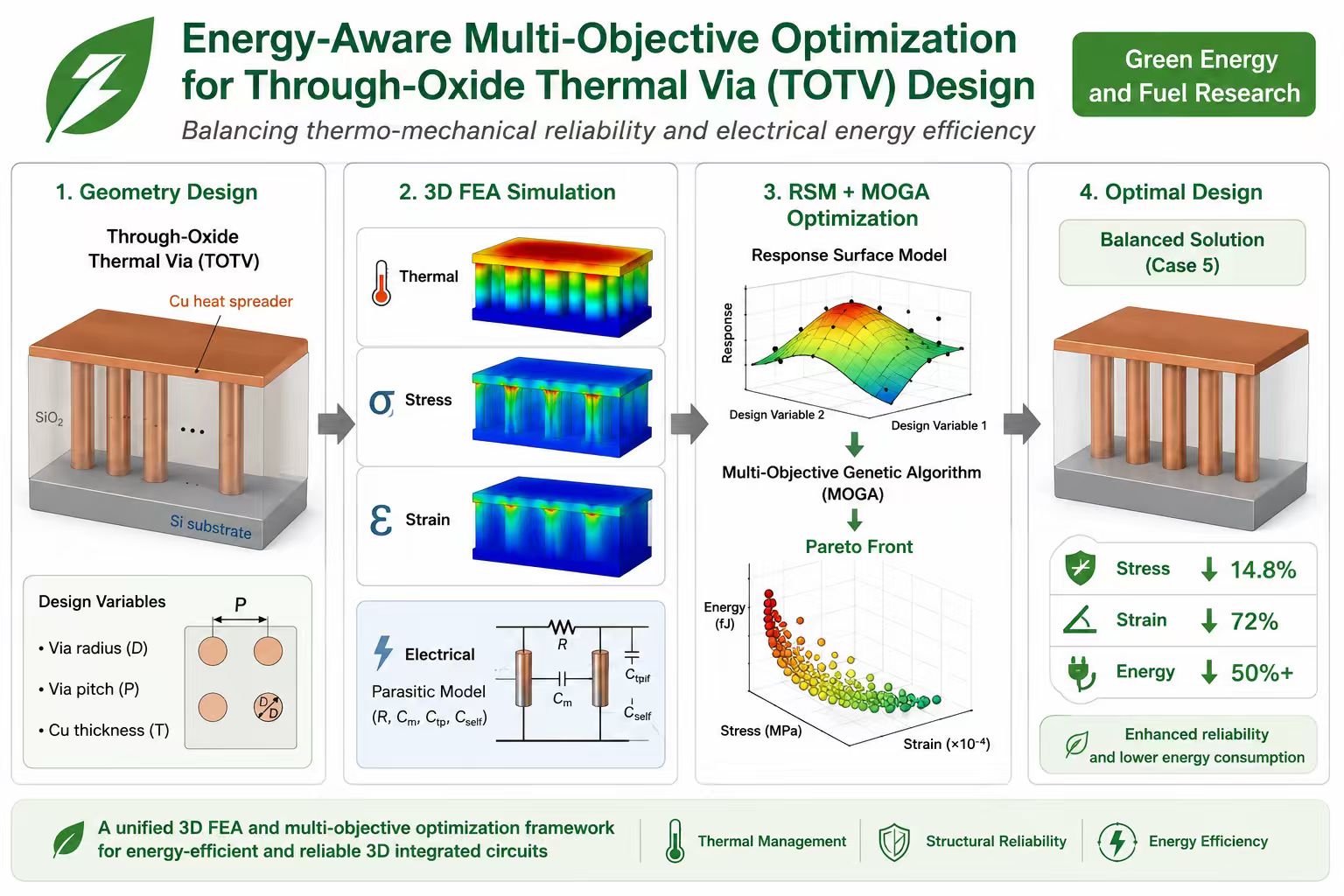
This study employs three-dimensional finite element analysis (FEA) to investigate the coupled thermo-mechanical behavior and electrical energy characteristics of Through-Oxide Thermal Via (TOTV) structures under thermal cycling conditions, with an emphasis on quantifying trade-offs between mechanical reliability and electrical efficiency. A unified three-dimensional thermo-mechanical and electrical modeling framework is established to capture stress concentration, deformation behavior, and geometry-dependent parasitic effects in a physically consistent manner, with observed trends showing qualitative agreement with prior TOTV-related studies. Single-objective optimization results indicate that geometric refinement can reduce the maximum principal stress from 119.54 MPa to 97.64 MPa, corresponding to an 18.3% relative improvement within the adopted modeling assumptions. However, such mechanically optimized configurations are accompanied by increased parasitic capacitance, leading to higher dynamic energy consumption. This observation quantitatively highlights the inherent conflict between structural integrity and electrical energy efficiency in dense TOTV arrays. To systematically explore this trade-off, a Multi-Objective Genetic Algorithm (MOGA) is employed to construct a Pareto-optimal design set. A representative compromise solution—characterized by a via radius of 21.246 µm, pitch of 69.172 µm, and copper thickness of 1.011 µm—achieves a 14.8% reduction in maximum principal stress and a 72% reduction in axial deformation (0.0156 µm), while avoiding the severe energy penalties observed in reliability-only optimizations. Rather than emphasizing absolute performance prediction, the proposed framework serves as an energy-aware design-space exploration methodology, providing quantitative insight into the relative severity of mechanical–electrical trade-offs for future high-density 3D integrated circuits and silicon photonics applications.
- Open Access
- Article
Energy-Aware Design and Performance Analysis of Through-Oxide Thermal Vias (TOTVs) via Finite Element Analysis and Driven Optimization
- Cheng-Chi Wang 1,*,
- Yeong-Jyh Lin 2,
- Jiří Ryšavý 3,
- Jakub Čespiva 3,
- Masahide Oshima 4,
- Chia-Hung Lai 1
Author Information
Received: 02 Dec 2025 | Revised: 29 Jan 2026 | Accepted: 02 Feb 2026 | Published: 06 Feb 2026
Abstract
Graphical Abstract
Keywords
energy loss reduction | through-oxide thermal via (TOTV) | multi-objective optimization | finite element analysis (FEA) | 3D integrated circuits
References
- 1.
Patti, R.S. Three-Dimensional Integrated Circuits and the Future of System-on-Chip Designs. Proc. IEEE 2006, 94, 1214–1224.
- 2.
Topol, A.W.; La Tulipe, D.C.; Shi, L.; et al. Three-Dimensional Integrated Circuits. IBM J. Res. Dev. 2006, 50, 491–506.
- 3.
Knickerbocker, J.U.; Andry, P.S.; Dang, B.; et al. Three-Dimensional Silicon Integration. IBM J. Res. Dev. 2008, 52, 553–569.
- 4.
Banerjee, K.; Souri, S.J.; Kapur, P.; et al. 3-D ICs: A Novel Chip Design for Improving Deep-Submicrometer Interconnect Performance and Systems-on-Chip Integration. Proc. IEEE 2001, 89, 602–633.
- 5.
Benali, A.; Faqir, M.; Bouya, M. Analytical and finite element modeling of through glass via thermal stress. Microelectron. Eng. 2016, 151, 12–18.
- 6.
Lai, Y.; Pan, K.; Park, S. Thermo-mechanical reliability of glass substrate and through glass vias (TGV): A comprehensive review. Microelectron. Reliab. 2024, 161, 115477.
- 7.
Cho, J.; Kim, K.; Baek, S. Thermal Via Optimization for High-Power Electronic Packaging. IEEE Trans. Compon. Packag. Manuf. Technol. 2015, 5, 1756–1764.
- 8.
Yepez, P.A.K.; Scholz, U.; Caspers, J.N.; et al. Novel Measures for Thermal Management of Silicon Photonic Optical Phased Arrays. IEEE Photonics J. 2019, 11, 1–14.
- 9.
Cho, H.H.; Lee, J.H.; Lim, S.K. Experimental Demonstration of the Effect of Copper TPVs on Thermal Performance of Glass Interposers. In Proceedings of the 2014 IEEE 64th Electronic Components and Technology Conference (ECTC), Orlando, FL, USA, 27–30 May 2014.
- 10.
Zhao, J.; Chen, Z.; Qin, F.; Yu, D. Thermo-Mechanical Reliability Study of Through Glass Vias in 3D Interconnection. Micromachines 2022, 13, 1900.
- 11.
Savidis, S.; Friedman, E.G. Electrical Modeling and Characterization of Through-Silicon Vias. IEEE Trans. Electron Devices 2009, 56, 1873–1881.
- 12.
Zhang, Y.; Zhang, X.; Liu, Y. Analytical Modeling of TSV Capacitance in 3D Integrated Circuits. Microelectron. J. 2014, 45, 732–739.
- 13.
Deng, Q.; Zhang, M.-X.; Zhao, Z.-Y.; et al. A Precise Model of TSV Parasitic Capacitance Considering Temperature for 3D IC. In Proceedings of the International Conference on Applied Modeling and Computations in Engineering (AMCCE), Online, 3–7 July 2015; pp. 306–310.
- 14.
Black, J.R.; Banerjee, K.; Mehrotra, A. Coupling Noise and Signal Integrity Analysis of TSV-Based Interconnects. IEEE Trans. Adv. Packag. 2010, 33, 878–885.
- 15.
Xu, K.; Friedman, E.G. Scaling Trends of Power Noise in 3D Integrated Circuits. Integr. VLSI J. 2015, 51, 139–148.
- 16.
Chandrakasan, A.P.; Bowhill, W.J.; Fox, F. Design of High-Performance Microprocessor Circuits; Wiley-IEEE Press: Hoboken, NJ, USA, 2000.
- 17.
Lim, S.K. Design for High Performance, Low Power, and Reliable 3D Integrated Circuits; Springer Science & Business Media: Berlin, Germany, 2012.
- 18.
Sun, B.; Zhu, Z.; Wang, J. Energy Transfer and Power Consumption Analysis of Coaxial Ring TSV. Energy Rep. 2022, 8, 192–198.
- 19.
Liu, L.; Wang, Y.; Li, X. Energy-Efficient Design of TSV-Based Interconnects in 3D ICs. Microelectron. J. 2019, 88, 45–53.
- 20.
Chen, W.-H. Progress in Green Energy and Fuel for Sustainability. Green Energy Fuel Res. 2024, 1, 13–22.
- 21.
Sun, B.; Zhu, Z.; Wang, J. Energy-Aware Interconnect Design in 3D ICs. Discov. Energy 2023, 2, 15.
- 22.
Boundless. Capacitors and dielectrics. In Physics; Boundless: Boston, MA, USA, 2020.


This work is licensed under a Creative Commons Attribution 4.0 International License.

 Suite 4002 Level 4, 447 Collins Street, Melbourne, Victoria 3000, Australia
 General Inquiries: info@sciltp.com