
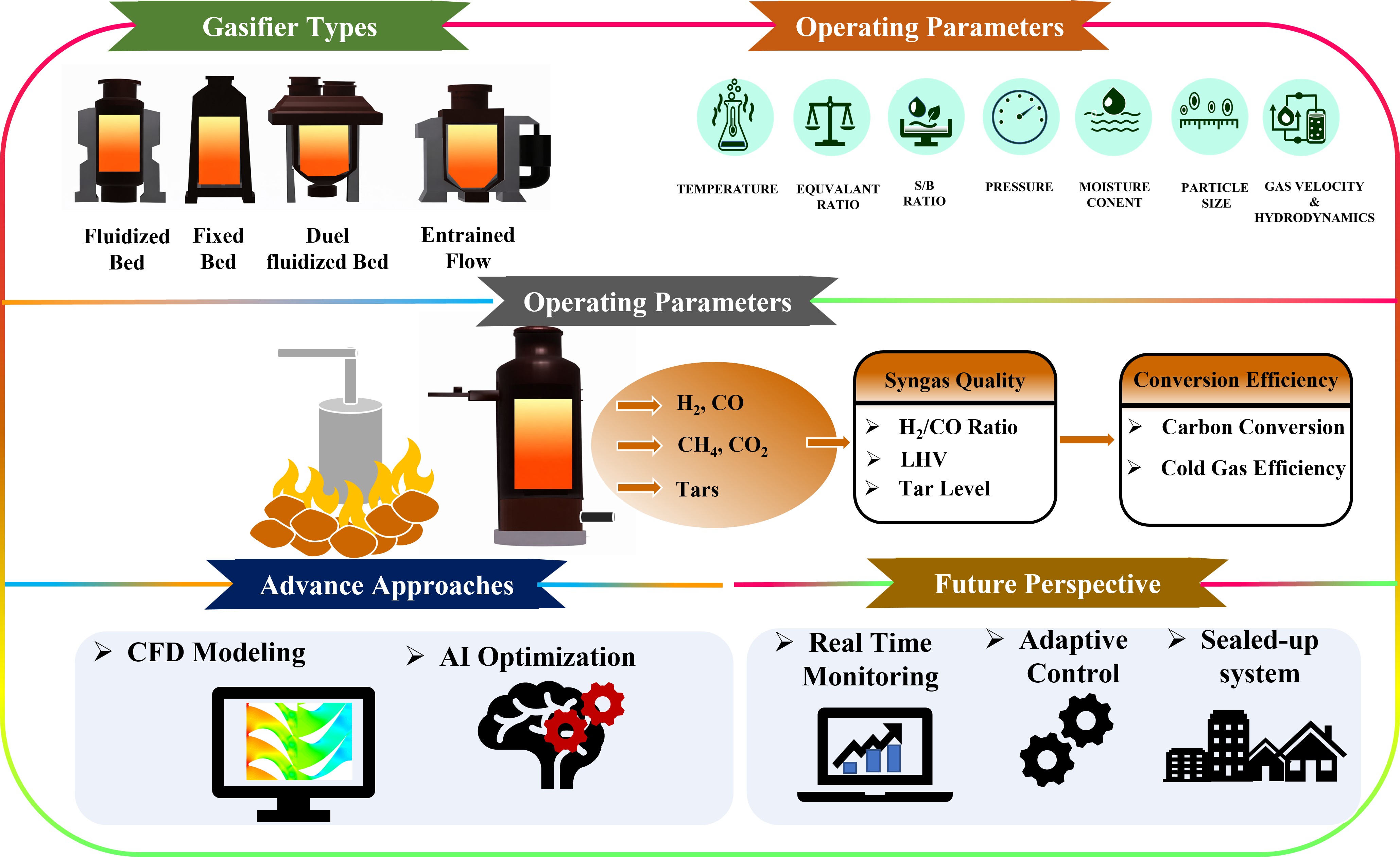
This mini-review provides a focused overview of configuration-dependent and multi-parameter optimization in biomass gasification systems. Rather than broadly summarizing biomass gasification, it examines how key operating variables, including temperature, equivalence ratio, and steam-to-biomass ratio, interact across different gasifier configurations and influence syngas composition, tar formation, and process efficiency. Major reactor types, including fixed-bed, fluidized-bed, dual fluidized-bed, entrained-flow, and supercritical water gasifiers, show different sensitivities to these parameters because of differences in hydrodynamics, heat transfer, and reaction environments. Based on a comparative assessment of recent studies, the review discusses configuration-specific trends, parameter trade-offs, and the limited transferability of operating conditions between systems. Emerging data-driven approaches, including computational fluid dynamics, machine learning, and hybrid modeling, are also considered in the context of multi-parameter optimization. Although these approaches have shown potential for improving hydrogen yield, carbon conversion, and cold-gas efficiency, their current limitations related to data availability, model generalizability, and industrial implementation are also discussed. Overall, the review indicates a gradual shift from fixed operating windows toward more adaptive and condition-responsive gasification strategies. Future research needs include improved data consistency, integrated multi-parameter optimization, real-time process monitoring, and further evaluation of AI-assisted approaches for scalable biomass gasification systems.
- Open Access
- Mini Review
Configuration-Dependent Multi-Parameter Optimization in Biomass Gasification: From Operating Windows to AI-Assisted Control
Author Information
Received: 15 Jan 2026 | Revised: 25 Mar 2026 | Accepted: 26 Mar 2026 | Published: 27 Mar 2026
Abstract
Graphical Abstract
Keywords
biomass gasification | operating parameters | syngas | hydrogen production | CFD
References
- 1.
Makepa, D.C.; Chihobo, C.H. Sustainable pathways for biomass production and utilization in carbon capture and storage—A review. Biomass Convers. Biorefinery 2025, 15,11397–11419.
- 2.
Matta, G.; Semaan, D.; Harb, R. Simulation of olive pomace gasification for hydrogen production using aspen plus: Case study Lebanon. Energies 2024, 17, 1621.
- 3.
Maitlo, G.; Ali, I.; Mangi, K.H.; et al. Thermochemical conversion of biomass for syngas production: Current status and future trends. Sustainability 2022, 14, 2596.
- 4.
Schmid, J.C.; Benedikt, F.; Fuchs, J.; et al. Syngas for biorefineries from thermochemical gasification of lignocellulosic fuels and residues—5 years’ experience with an advanced dual fluidized bed gasifier design. Biomass Convers. Biorefinery 2021, 11, 2405–2442.
- 5.
Sethi, H.; Ahmad, I.; Khan, M.M.; et al. Applications of Computer Intelligence in Hydrogen Production. ACS Omega 2025, 10, 33982–33998. https://doi.org/10.1021/acsomega.5c01602.
- 6.
Siddiqui, M.Z.; Sheraz, M.; Toor, U.A.; et al. Recent approaches on the optimization of biomass gasification process parameters for product H2 and syngas ratio: A review. Environ. Dev. Sustain. 2025, 27, 22605–22633. https://doi.org/10.1007/s10668-022-02279-6.
- 7.
Al-Yafei, H.; Aseel, S.; AlNouss, A.; et al. Driving Green: A Comprehensive Sustainability Analysis of Natural Gas-to-Methanol and Methanol-to-Gasoline Supply Chains. Sustainability 2026, 18, 527.
- 8.
Dai, F.; Zhang, S.; Luo, Y.; et al. Recent progress on hydrogen-rich syngas production from coal gasification. Processes 2023, 11, 1765.
- 9.
Zhu, M.; Wang, Q.; Wang, S. Recent Advances and Future Perspectives in Catalyst Development for Efficient and Sustainable Biomass Gasification: A Comprehensive Review. Sustainability 2025, 17, 7370.
- 10.
Kumar, R.; Panwar, N.L.; Kumar, V.; et al. Recent advances and computational approaches in biomass gasifier modeling: From thermodynamics to AI-driven techniques. Sustain. Energy Fuels 2025, 9, 4858–4881.
- 11.
Hervy, M.; Remy, D.; Dufour, A.; et al. Air-blown gasification of Solid Recovered Fuels (SRFs) in lab-scale bubbling fluidized-bed: Influence of the operating conditions and of the SRF composition. Energy Convers. Manag. 2019, 181, 584–592.
- 12.
Oliveira, M.; Monteiro, E.; Rouboa, A. Integrative and systematic review on biomass and waste co-gasification: Challenges, trends, and future perspectives. Energy Convers. Manag. 2026, 356, 121309. https://doi.org/10.1016/j.enconman.2026.121309.
- 13.
Wang, L.; Zhou, T.; Hou, B.; et al. A Comprehensive Review of Biomass Gasification Characteristics in Fluidized Bed Reactors: Progress, Challenges, and Future Directions. Fluids 2025, 10, 147.
- 14.
Mekonen, T.N.; Delele, M.A.; Gizaw, A.M.; et al. Key challenges in CFD modeling of biomass gasification in fluidized-bed reactors: A review. Biomass Bioenergy 2026, 209, 108893. https://doi.org/10.1016/j.biombioe.2025.108893.
- 15.
Sánchez-Ramírez, E.; Juarez-García, M.; Huerta-Rosas, B.; et al. Waste Gasification for Hydrogen Production: Regional Challenges, Sustainability Pathways, and Future Research Directions. BioEnergy Res. 2026, 19, 34. https://doi.org/10.1007/s12155-026-10971-y.
- 16.
Gao, Y.; Wang, M.; Raheem, A.; et al. Syngas production from biomass gasification: Influences of feedstock properties, reactor type, and reaction parameters. ACS Omega 2023, 8, 31620–31631.
- 17.
Saleh, S.; Samad, N.A.F.A. Effects of gasification temperature and equivalence ratio on gasification performance and tar generation of air fluidized bed gasification using raw and torrefied empty fruit bunch. Chem. Eng. Trans. 2021, 88, 1309–1314.
- 18.
Kirsanovs, V.; Žandeckis, A.; Rochas, C. Biomass gasification thermodynamic model including tar and char. Agron. Res. 2016, 14, 1321–1331.
- 19.
Salem, A.M.; Paul, M.C. Effects of throat sizing and gasification agents in a biomass downdraft gasifier: Towards CO2-free syngas production. RSC Adv. 2023, 13, 10221–10238.
- 20.
Loha, C.; Chatterjee, P.K.; Chattopadhyay, H. Performance of fluidized bed steam gasification of biomass–modeling and experiment. Energy Convers. Manag. 2011, 52, 1583–1588.
- 21.
Zha, Z.; Ge, Z.; Ma, Y.; et al. Hydrogen-rich syngas production and insight into morphology-kinetics correlation for furfural residue steam gasification in a bubbling fluidized bed. Chem. Eng. J. 2023, 477, 147151.
- 22.
Karl, J.; Pröll, T. Steam gasification of biomass in dual fluidized bed gasifiers: A review. Renew. Sustain. Energy Rev. 2018, 98, 64–78.
- 23.
Benedikt, F.; Schmid, J.; Fuchs, J.; et al. Fuel flexible gasification with an advanced 100 kW dual fluidized bed steam gasification pilot plant. Energy 2018, 164, 329–343.
- 24.
Xie, S.; Li, X.; Li, T.; et al. Experimental and numerical study on the laminar burning velocities of n-decane/toluene/air mixtures at elevated temperatures. Fuel 2022, 322, 124176.
- 25.
Schneider, J.; Grube, C.; Herrmann, A.; et al. Atmospheric entrained-flow gasification of biomass and lignite for decentralized applications. Fuel Process. Technol. 2016, 152, 72–82.
- 26.
Okolie, J.A.; Rana, R.; Nanda, S.; et al. Supercritical water gasification of biomass: A state-of-the-art review of process parameters, reaction mechanisms and catalysis. Sustain. Energy Fuels 2019, 3, 578–598.
- 27.
Lee, C.S.; Conradie, A.V.; Lester, E. Review of supercritical water gasification with lignocellulosic real biomass as the feedstocks: Process parameters, biomass composition, catalyst development, reactor design and its challenges. Chem. Eng. J. 2021, 415, 128837.
- 28.
Neves, F.; Soares, A.A.; Rouboa, A. Systematic review of biomass supercritical water gasification for energy production. Energies 2025, 18, 5374.
- 29.
Quintero-Coronel, D.; Lenis-Rodas, Y.; Corredor, L.; et al. Co-gasification of biomass and coal in a top-lit updraft fixed bed gasifier: Syngas composition and its interchangeability with natural gas for combustion applications. Fuel 2022, 316, 123394.
- 30.
Havilah, P.R.; Sharma, A.K.; Govindasamy, G.; et al. Biomass gasification in downdraft gasifiers: A technical review on production, up-gradation and application of synthesis gas. Energies 2022, 15, 3938.
- 31.
Kaneesamkandi, Z.; Rehman, A.U.; Usmani, Y.S.; et al. Methodology for Selecting an Ideal Thermal Gasification Technique for Municipal Solid Waste Using Multi-Criteria Decision Analysis. Appl. Sci. 2023, 13, 12675.
- 32.
Antıl, S.; Sachdeva, G.; Sharma, A. Advancements and challenges in the fluidized bed gasification system: A comprehensive review. J. Therm. Eng. 2023, 9, 233–246.
- 33.
Liu, N.; Liu, Z.; Wang, Y.; et al. Clean and efficient thermochemical conversion technologies for biomass in green methanol production. Biomass 2025, 5, 13.
- 34.
Wang, L.; Du, X.; Xu, L.; et al. Numerical simulation of biomass gasification process and distribution mode in two-stage entrained flow gasifier. Renew. Energy 2020, 162, 1065–1075.
- 35.
Kushwah, A.; Reina, T.; Short, M. Modelling approaches for biomass gasifiers: A comprehensive overview. Sci. Total Environ. 2022, 834, 155243.
- 36.
Maitlo, G.; Mahar, R.B.; Bhatti, Z.A.; et al. A comprehensive literature review of thermochemical conversion of biomass for syngas production and associated challenges. Mehran Univ. Res. J. Eng. Technol. 2019, 38, 495–512.
- 37.
Sharma, A.; Nath, R. Chemical Kinetic Modeling of Air–Steam Gasification of Eucalyptus Wood Sawdust for H2-Rich Syngas Production. ACS Omega 2023, 8, 13396–13409.
- 38.
Cerone, N.; Zimbardi, F. Effects of oxygen and steam equivalence ratios on updraft gasification of biomass. Energies 2021, 14, 2675.
- 39.
He, J.; Göransson, K.; Söderlind, U.; et al. Simulation of biomass gasification in a dual fluidized bed gasifier. Biomass Convers. Biorefinery 2012, 2, 1–10.
- 40.
Sidek, F.; Samad, N.A.; Saleh, S. Review on effects of gasifying agents, temperature and equivalence ratio in biomass gasification process. In Proceedings of the Symposium on Energy Systems 2019 (SES 2019), Kuantan, Malaysia, 1–2 October 2019.
- 41.
Chyou, Y.-P.; Chang, D.-M.; Chen, P.-C.; et al. Development of biomass gasification technology with fluidized-bed reactors for enhancing hydrogen generation: Part I, hydrodynamic characterization of dual fluidized-bed Gasifiers. Appl. Sci. 2019, 10, 2.
- 42.
Pala, L.P.R.; Wang, Q.; Kolb, G.; et al. Steam gasification of biomass with subsequent syngas adjustment using shift reaction for syngas production: An Aspen Plus model. Renew. Energy 2017, 101, 484–492.
- 43.
Siwal, S.S.; Zhang, Q.; Sun, C.; et al. Energy production from steam gasification processes and parameters that contemplate in biomass gasifier–A review. Bioresour. Technol. 2020, 297, 122481.
- 44.
Das, K.; Kumar, S.; Bhattacharya, S. Biomass gasification in an industrial-scale entrained flow gasifier and effects of various parameters on gasification performance: An approach based on numerical models. Fuel 2026, 405, 136537.
- 45.
Puri, L.; Hu, Y.; Naterer, G. Critical review of the role of ash content and composition in biomass pyrolysis. Front. Fuels 2024, 2, 1378361.
- 46.
Ramaswamy, M.D.k.; Nedunchezhiyan, M.; Sampath, S.; et al. Advances, challenges, and future directions in biomass gasification: A critical review of feedstock, reactor designs, and process optimization. Chem. Eng. J. Adv. 2026, 26, 101107. https://doi.org/10.1016/j.ceja.2026.101107.
- 47.
Ghanbarzadeh, S.; Yuan, Y.; Koupaie, E.H. Energy Recovery from Biowaste and Biomass via Gasification: A Modelling Approach. BioTech 2025, 15, 1.
- 48.
Kumar, S.; Palange, R.; De Blasio, C. Advancements in gasification technologies: Insights into modeling studies, power-to-X applications and sustainability assessments. Sustain. Energy Fuels 2025, 9, 4793–4831.
- 49.
Bartoli, M.; Pirri, C.F.; Bocchini, S. A Comprehensive Review on Hydrogen Production from Biomass Gasification. Molecules 2025, 31, 99.
- 50.
Wang, J.; Liu, Z.; Zhang, H.; et al. Simulation and Optimization of Biomass Gasification Process in Fluidized Bed Coupled with Entrained-Flow Bed. Energies 2025, 19, 37.
- 51.
Armanu, E.-G.; Secula, M.S.; Tofanica, B.-M.; et al. The impact of biomass composition variability on the char features and yields resulted through thermochemical processes. Polymers 2024, 16, 2334.
- 52.
Mohanty, R.; Mahanta, P.; Sharma, R.P. Recent Advances in Biomass Gasification to Improve the Quality of Syngas: A Comprehensive Review. Ind. Eng. Chem. Res. 2025, 64, 13950–13965. https://doi.org/10.1021/acs.iecr.5c01388.
- 53.
Gesese, T.N.; Admase, A.T.; Asrade, E.D.; et al. Biomass Gasification for Sustainable Energy Production: Effect of Operational Parameters on Product Gas. In Gasification—Current Technologies and Future Prospect; IntechOpen: London, UK, 2025.
- 54.
Trejo, F. Review of Biomass Gasification Technologies with a Particular Focus on a Downdraft Gasifier. Processes 2025, 13, 2717.
- 55.
Unsomsri, N.; Kaewkungam, P.; Sriromreun, P.; et al. Performance and characteristics of updraft gasifier integrated with cyclonic syngas burner for clean hot gas production from biomass pellets. Energy Sources Part A Recovery Util. Environ. Eff. 2025, 47, 5755–5770.
- 56.
Ngamsidhiphongsa, N.; Limleamthong, P.; Prasertcharoensuk, P.; et al. A review on computational fluid dynamics modeling of fixed-bed biomass gasifiers: Recent advances and design analysis. Int. J. Hydrog. Energy 2025, 130, 654–671.
- 57.
Ouedraogo, H.; Richardson, Y.; Zoungrana, L. Optimizing gasification in downdraft fixed-bed gasifier through experimental and kinetic modeling. Case Stud. Therm. Eng. 2025, 68, 105910.
- 58.
Jayanarasimhan, A.; Pathak, R.M.; Shivapuji, A.M.; et al. Tar Formation in Gasification Systems: A Holistic Review of Remediation Approaches and Removal Methods. ACS Omega 2024, 9, 2060–2079. https://doi.org/10.1021/acsomega.3c04425.
- 59.
Velandia, L.C.G.; Garcia-Freites, S.; Sanjuan, M.; et al. Data-driven model for the prediction of syngas composition and end-use application from gasification of residual biomass. Biomass Bioenergy 2026, 209, 108931. https://doi.org/10.1016/j.biombioe.2026.108931.
- 60.
Alfarra, F.; Ozcan, H.K.; Cihan, P.; et al. Artificial intelligence methods for modeling gasification of waste biomass: A review. Environ. Monit. Assess. 2024, 196, 309.
- 61.
Baruah, D.; Baruah, D. Modeling of biomass gasification: A review. Renew. Sustain. Energy Rev. 2014, 39, 806–815.
- 62.
Deepankumar, S.; KL, S.K. Hydrothermal liquefaction and gasification of industrial waste algae: Experimental and AI-Assisted optimization for biofuel and hydrogen production. Biomass Convers. Biorefinery 2026, 16, 125.
- 63.
Wang, H.; Cao, Y.; Huang, Z.; et al. Recent advances on machine learning for computational fluid dynamics: A survey. arXiv 2024, arXiv:2408.12171.
- 64.
Zhang, J.; Yang, L. Aspen simulation study of dual-fluidized bed biomass gasification. Energies 2024, 17, 2381.
- 65.
Nicolucci, E.; Palone, O.; Colozzi, M.; et al. A novel model of a double fluidized bed steam gasifier for biomass and solid recovered fuel co-gasification. Int. J. Hydrog. Energy 2025, 177, 151620.
- 66.
Castro, J.; Leaver, J.; Pang, S. Modelling of enhanced dual fluidized bed steam gasification with integration of biomass-specific devolatilization. Biomass Bioenergy 2026, 204, 108445.
- 67.
Liu, Y.; Wang, F.; Chen, S.; et al. Experimental investigation of operation characteristics of a lab-scale dual fluidized bed by calcium looping process. Chem. Eng. Sci. 2024, 287, 119771.
- 68.
Dai, J.; Whitty, K.J. Chemical looping gasification and sorption enhanced gasification of biomass: A perspective. Chem. Eng. Process. -Process Intensif. 2022, 174, 108902.
- 69.
Saha, N.; Klinger, J.; Fillerup, E.; et al. Enhancing biomass flowability for entrained flow Gasification: The role of densification and torrefaction. Biomass Bioenergy 2025, 202, 108238.
- 70.
Castillo Santiago, Y.; Henao, N.C.; Venturini, O.J.; et al. Techno-economic assessment of producer gas from heavy oil and biomass co-gasification aiming electricity generation in rankine cycle. Processes 2022, 10, 2358.
- 71.
Liu, Z.; Yang, Y.; Chen, Y.; et al. A review on catalytic hydrogen production from supercritical water gasification of biomass. Biomass Bioenergy 2024, 190, 107422.
- 72.
Thanikodi, S.; Sagade, A.A. Utilizing supercritical water gasification for hydrogen production combined with a waste heat recovery system for domestic households. Results Eng. 2024, 24, 103432.
- 73.
Knez, Ž.; Markočič, E.; Hrnčič, M.K.; et al. High pressure water reforming of biomass for energy and chemicals: A short review. J. Supercrit. Fluids 2015, 96, 46–52.
- 74.
Senthilkumar, V.; Prabhu, C. Optimization of design and development of a biomass gasifier—A review. Biofuels 2024, 15, 1079–1097.
- 75.
Lewandowski, W.M.; Ryms, M.; Kosakowski, W. Thermal biomass conversion: A review. Processes 2020, 8, 516.
- 76.
Sakheta, A.; Raj, T.; Nayak, R.; et al. Improved prediction of biomass gasification models through machine learning. Comput. Chem. Eng. 2024, 191, 108834.
- 77.
Dhrioua, M.; Ghachem, K.; Hassen, W.; et al. Simulation of biomass air gasification in a bubbling fluidized bed using aspen plus: A comprehensive model including tar production. ACS Omega 2022, 7, 33518–33529.
- 78.
Báez-Barrón, G.; Lopéz-Flores, F.J.; Rubio-Castro, E.; et al. Biomass Gasification for Waste-to-Energy Conversion: Artificial Intelligence for Generalizable Modeling and Multi-Objective Optimization of Syngas Production. Resources 2025, 14, 157.
- 79.
Zaman, S.A.; Roy, D.; Ghosh, S. Process modeling and optimization for biomass steam-gasification employing response surface methodology. Biomass Bioenergy 2020, 143, 105847. https://doi.org/10.1016/j.biombioe.2020.105847.
- 80.
Fang, Y.; Ma, L.; Yao, Z.; et al. Process optimization of biomass gasification with a Monte Carlo approach and random forest algorithm. Energy Convers. Manag. 2022, 264, 115734.
- 81.
Cihan, P. Bayesian Hyperparameter Optimization of Machine Learning Models for Predicting Biomass Gasification Gases. Appl. Sci. 2025, 15, 1018.
- 82.
Peng, H.; Cai, W.; Huang, M.; et al. Advancing biomass gasification by the dry and wet torrefaction pretreatment. Energy 2025, 324, 136118.
- 83.
Kumar, B.; Mendoza-Martinez, C.; Ferenczi, T.; et al. An experimental study to investigate the impact of solar drying on emission products of woody biomass in the torrefaction process. Energy Ecol. Environ. 2025, 10, 307–323.
- 84.
Li, Z.; Li, J.; Yu, T.; et al. Chemical looping gasification of high-moisture content biomass: The interactions between H2O and oxygen carrier. Appl. Energy 2024, 368, 123529.
- 85.
Ren, J.; Yang, K.; Li, Y.; et al. Catalytic gasification of large particle-size biomass with loaded AAEMs under oxygen-steam atmosphere. Fuel 2024, 357, 130019.
- 86.
Gomes, H.G.; Lopes, D.V.; Moura, J.M.; et al. Biomass fly ash granules as a promising catalyst to promote producer gas quality from residual forest biomass steam gasification. Energy 2025, 319, 134889.
- 87.
Soprych, P.; Czerski, G. The Use of Biomass Ash as a Catalyst in the Gasification Process—A Review. Energies 2025, 18, 5653.
- 88.
Cao, Y.; Bai, Y.; Du, J. Parametric study on biomass gasification by using air, oxygen-enriched air, air/steam and oxygen-enriched air/steam agents: An ASPEN plus modeling. Int. J. Hydrog. Energy 2024, 73, 265–273.
- 89.
Gomes, H.G.; Matos, M.A.; Tarelho, L.A. Influence of oxygen/steam addition on the quality of producer gas during direct (air) gasification of residual forest biomass. Energies 2023, 16, 2427.
- 90.
Khodabandehlou, R.; Norouzi, H.R.; Larimi, A.; et al. Analysis of biomass gasification in a fluidized bed using CFD-DEM. Energy 2025, 320, 135395.
- 91.
Banik, R.K.; Das, H.J.; Kalita, P. Numerical investigation of bed hydrodynamics for biomass-coal blending in a dual fluidized bed system. Powder Technol. 2025, 456, 120807.
- 92.
Majoe, N.; Patel, B.; Gorimbo, J.; et al. Catalytic influence of alkali and alkali earth metals in black liquor on the gasification process: A review. Biomass Convers. Biorefinery 2025, 15, 31317–31335.
- 93.
Lin, F.; Xu, M.; Ramasamy, K.K.; et al. Catalyst deactivation and its mitigation during catalytic conversions of biomass. Acs Catal. 2022, 12, 13555–13599.
- 94.
Ouedraogo, H.; Sidibe, S.D.S.; Richardson, Y. Advancing small-scale biomass gasification (10–200 kW) for energy access: Syngas purification, system modeling and the role of artificial intelligence-A review. Energy Convers. Manag. X 2025, 27, 101059.
- 95.
Sison, A.E.; Etchieson, S.A.; Güleç, F.; et al. Process modelling integrated with interpretable machine learning for predicting hydrogen and char yield during chemical looping gasification. J. Clean. Prod. 2023, 414, 137579.
- 96.
Jadoon, U.K.; Díaz, I.; Rodríguez, M. Machine learning-driven modeling framework for steam co-gasification applications. Fuel Process. Technol. 2025, 278, 108340.
- 97.
Graf, C.; Coors, F.; Marx, F.; et al. Development of a CFD-DEM Model for a 1 MWth Chemical Looping Gasification Pilot Plant Using Biogenic Residues as Feedstock. Energy Fuels 2024, 38, 18660–18673.
- 98.
Von Berg, L.; Anca-Couce, A.; Hochenauer, C.; et al. Multi-scale modelling of a fluidized bed biomass gasifier of industrial size (1 MW) using a detailed particle model coupled to CFD: Proof of feasibility and advantages over simplified approaches. Energy Convers. Manag. 2023, 286, 117070.
- 99.
Larsson, A.; Kuba, M.; Vilches, T.B.; et al. Steam gasification of biomass–Typical gas quality and operational strategies derived from industrial-scale plants. Fuel Process. Technol. 2021, 212, 106609.
- 100.
Bizon, K.; Skrzypek-Markiewicz, K.; Prończuk, M. Numerical Investigation of Process Enhancement Using a Bifunctional Catalyst in a Dual Fluidized-Bed Reactor. Catalysts 2021, 11, 530.
- 101.
Huber, M.; Benedikt, F.; Karel, T.; et al. Tar conversion and recombination in steam gasification of biogenic residues: The influence of a countercurrent flow column in pilot-and demonstration-scale. Fuel 2024, 364, 131068.
- 102.
Zapater, D.; Kulkarni, S.R.; Wery, F.; et al. Multifunctional fluidized bed reactors for process intensification. Prog. Energy Combust. Sci. 2024, 105, 101176.
- 103.
Cortazar, M.; Santamaria, L.; Lopez, G.; et al. A comprehensive review of primary strategies for tar removal in biomass gasification. Energy Convers. Manag. 2023, 276, 116496.
- 104.
Prasetiyo, D.H.T.; Sanata, A.; Sholahuddin, I.; et al. Comprehensive analysis of tar reduction method in biomass gasification for clean energy production: A Review. Mech. Eng. Soc. Ind. 2024, 4, 556–569.
- 105.
Gao, B.; Cao, G.; Feng, Y.; et al. CO2 Reforming of Biomass Gasification Tar over Ni-Fe-Based Catalysts in a DBD Plasma Reactor. Molecules 2025, 30, 1032.
- 106.
Santana, H.E.; Jesus, M.; Santos, J.; et al. Lignocellulosic biomass gasification: Perspectives, challenges, and methods for tar elimination. Sustainability 2025, 17, 1888.
- 107.
Stanger, L.; Bartik, A.; Binder, M.; et al. Gaussian Process Regression-Based Control of Solids Circulation Rate in Dual Fluidized Bed Gasification. IEEE Access 2024, 12, 138535–138546.
- 108.
Baldelli, M.; Bartolucci, L.; Cordiner, S.; et al. Fluidized Bed Reactors for energy recovery from biomass and wastes: A data-driven approach towards the development of digital twins for real time control and monitoring. In Proceedings of the 79th ATI Annual Congress, Genoa, Italy, 4–6 September 2024.
- 109.
Ascher, S.; Sloan, W.; Watson, I.; et al. A comprehensive artificial neural network model for gasification process prediction. Appl. Energy 2022, 320, 119289.
- 110.
Wu, K.; Francia, V.; Jiang, S.; et al. An experimental flow regime map to dynamically structure gas–solid bubbling fluidized beds. AIChE J. 2025, 71, e18681.
- 111.
Cortazar, M.; Santamaria, L.; Lopez, G.; et al. Fe/olivine as primary catalyst in the biomass steam gasification in a fountain confined spouted bed reactor. J. Ind. Eng. Chem. 2021, 99, 364–379.
- 112.
Cavalli, A.; Tetteroo, R.; Graziadio, M.; et al. Catalytic reforming of acetic acid as main primary tar compound from biomass updraft gasifiers: Screening of suitable catalysts and operating conditions. Biomass Bioenergy 2021, 146, 105982.
- 113.
Pissot, S.; Faust, R.; Aonsamang, P.; et al. Development of oxygen transport properties by olivine and feldspar in industrial-scale dual fluidized bed gasification of woody biomass. Energy Fuels 2021, 35, 9424–9436.
- 114.
Kuba, M.; Skoglund, N.; Öhman, M.; et al. A review on bed material particle layer formation and its positive influence on the performance of thermo-chemical biomass conversion in fluidized beds. Fuel 2021, 291, 120214.
- 115.
Fernandez, E.; Santamaria, L.; Artetxe, M.; et al. Conditioning the volatile stream from biomass fast pyrolysis for the attenuation of steam reforming catalyst deactivation. Fuel 2022, 312, 122910.
- 116.
Al-Moftah, A.M.S.; Marsh, R.; Steer, J. Thermogravimetric kinetic analysis of non-recyclable waste CO2 gasification with catalysts using coats–redfern method. ChemEngineering 2022, 6, 22.
- 117.
Dang, Q.; Zhang, X.; Zhou, Y.; et al. Prediction and optimization of syngas production from a kinetic-based biomass gasification process model. Fuel Process. Technol. 2021, 212, 106604.
- 118.
Gao, H.; Chen, Z.; Zhang, Q.; et al. Insights into gas-solid flow structures in fluidized beds up to 1600° C via analysis of gas residence time distributions. Powder Technol. 2025, 449, 120426.
- 119.
Suparmin, P.; Purwanti, N.; Nelwan, L.O.; et al. Biomass Gasification Modelling Development: A Review. In Proceedings of the 5th International Conference on Agricultural Engineering for Sustainable Agriculture Production (AESAP 2023), Bogor, Indonesia, 14–15 November 2023; Volume 1386.
- 120.
Banik, R.K.; Das, H.J. MFIX–DEM simulation of gas-solid flow dynamics in a dual fluidized bed system. In Proceedings of the International Conference on Sustainable Energy and Green Technology, Ho Chi Minh City, Vietnam, 10–13 December 2023; Volume 1372.
- 121.
Costa, P.; Pinto, F.; André, R.N.; et al. Integration of Gasification and Solid Oxide Fuel Cells (SOFCs) for Combined Heat and Power (CHP). Processes 2021, 9, 254.
- 122.
Detsios, N.; Maragoudaki, L.; Atsonios, K.; et al. Design considerations of an integrated thermochemical/biochemical route for aviation and maritime biofuel production. Biomass Convers. Biorefinery 2024, 14, 27537–27555. https://doi.org/10.1007/s13399-023-03754-4.
- 123.
Bobadilla, L.F.; Azancot, L.; González-Castaño, M.; et al. Biomass gasification, catalytic technologies and energy integration for production of circular methanol: New horizons for industry decarbonisation. J. Environ. Sci. 2024, 140, 306–318. https://doi.org/10.1016/j.jes.2023.09.020.
- 124.
Pratama, M.R.; Muthia, R.; Purwanto, W.W. Techno-economic and life cycle assessment of the integration of bioenergy with carbon capture and storage in the polygeneration system (BECCS-PS) for producing green electricity and methanol. Carbon Neutrality 2023, 2, 26. https://doi.org/10.1007/s43979-023-00069-1.
- 125.
Lourinho, G.; Alves, O.; Garcia, B.; et al. Costs of Gasification Technologies for Energy and Fuel Production: Overview, Analysis, and Numerical Estimation. Recycling 2023, 8, 49.
- 126.
Estevez, R.; Aguado-Deblas, L.; Bautista, F.M.; et al. A Review on Green Hydrogen Valorization by Heterogeneous Catalytic Hydrogenation of Captured CO2 into Value-Added Products. Catalysts 2022, 12, 1555.


This work is licensed under a Creative Commons Attribution 4.0 International License.

 Suite 4002 Level 4, 447 Collins Street, Melbourne, Victoria 3000, Australia
 General Inquiries: info@sciltp.com