
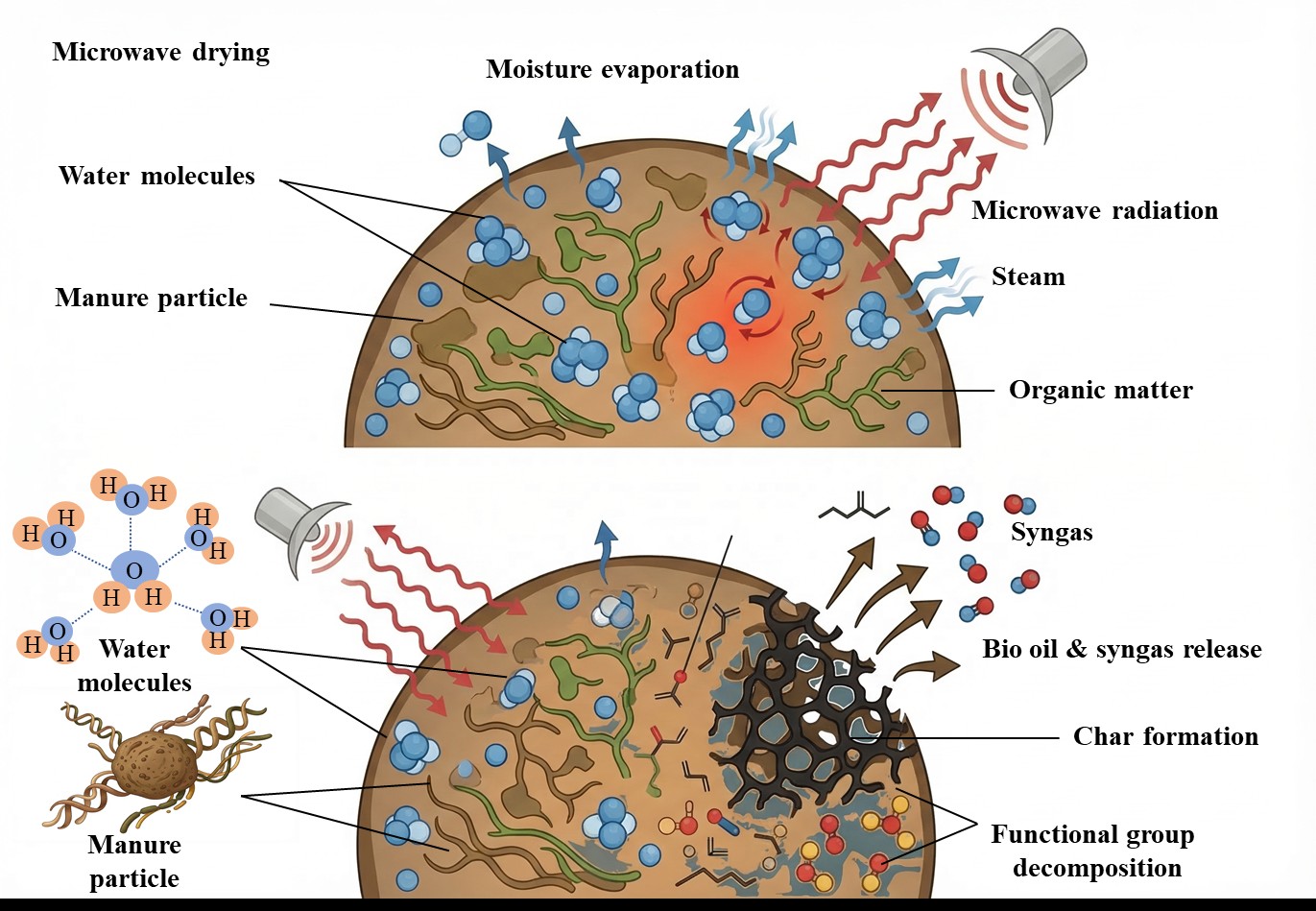
The sustainability of thermochemical conversion processes is required to be enhanced by energy efficiency of drying of high-moisture biomass. This paper examines the microwave-assisted drying of dairy manure at different microwave power levels (400–800 W), temperatures (110–150 °C) and feedstock loads (10–50 g). Microwave power increased heating rate dramatically in the preheating phase, increasing the heating time of 503 s at 400 W to 162 s at 800 W (67.8% decreases) with no significant rise in total energy use. The sample temperature leveled at 95–100 °C during the drying process, which was the constant-rate evaporation stage. The rise in feedstock load, conversely, decelerated the heating and drying process because of lowered energy input per unit mass and a rise in internal transport resistance. The ratio of the power to mass was important in shaping the drying behavior. Apparently, volumetric microwave heating produces a high degree of internal vapor pressure that causes rapid mass loss at 700 W and 30 g and promotes the migration of moisture. But at high power (800 W) the surface became hard, and the transfer of mass was slowed down in the subsequent drying phase. A power of 700 W and a weight of 30 g gave the optimal drying performance.
- Open Access
- Article
Efficient Microwave-Assisted Drying of Dairy Manure towards Biofuel Potential
- Yifan Wang 1,2,
- Noor Ul Huda Altaf 1,
- Tirto Prakoso 3,
- Muhammad Yasin Naz 4,
- Yaning Zhang 1,2,*
Author Information
Received: 03 Apr 2026 | Revised: 13 May 2026 | Accepted: 14 May 2026 | Published: 22 May 2026
Abstract
Graphical Abstract
Keywords
References
- 1.
Wang, J.; Chen, S.; Lai, F.; et al. Microwave-assisted hydrothermal carbonization of pig feces for the production of hydro-char. J. Supercrit. Fluids 2020, 162, 104858.
- 2.
Luo, T.; Wang, Y.; Pandey, P. The removal of moisture and antibiotic resistance genes in dairy manure by microwave treatment. Environ. Sci. Pollut. Res. 2021, 28, 6675–6683.
- 3.
Gao, Y.; Liu, Y.; Zhu, G.; et al. Microwave-assisted hydrothermal carbonization of dairy manure: Chemical and structural properties of the products. Energy 2018, 165, 662–672.
- 4.
Zhang, Y.; Fu, W.; Cui, L.; et al. Experimental microwave-assisted air gasification of biomass for syngas production. Fuel 2023, 339, 126954.
- 5.
Zhang, Y.; Zhao, W.; Xie, K.; et al. Studies on microwave heating performances of biomass. Energy Conserv. Technol. 2026, 44, 3–7.
- 6.
Lozano, A.S.; Lozada, J.J.; Guerrero, C.A. Application of microwave energy to biomass: A comprehensive review of microwave-assisted technologies, optimization parameters, and the strengths and weaknesses. J. Manuf. Mater. Process. 2024, 8, 121.
- 7.
Guo, J.; Zheng, L.; Li, Z. Effect and interrelationship of different influencing factors on drying performance and energy analysis of cow manure in microwave drying at pilot scale. J. Clean. Prod. 2023, 413, 137407.
- 8.
Moukazis, I.; Gidarakos, E. Microwave-assisted hydrothermal carbonization of rabbit manure. Waste Manage. 2025, 203, 114836.
- 9.
Palla, S.; Surya, D.V.; Pritam, K.; et al. A critical review on the influence of operating parameters and feedstock characteristics on microwave pyrolysis of biomass. Environ. Sci. Pollut. Res. 2024, 31, 57570–57593.
- 10.
Cui, L.; Zhang, Y.; Shi, C.; et al. Describing the microwave heating performances of the main constitutes of biomass. Energy 2024, 302, 131873.
- 11.
Dehghannya, J.; Habibi-Ghods, M. Microwave Drying of Food Materials: Principles, Hybrid Techniques, Modeling Approaches, and Emerging Innovations. Compr. Rev. Food Sci. Food Saf. 2025, 24, e70312.
- 12.
Divyabharathi, R.; Komalabharathi, P.; Subramanian, P. Microwave-assisted hydrothermal carbonization for biochar production: Potential application and limitations. In Biochar Production for Green Economy: Agricultural and Environmental Perspectives; Elsevier: Amsterdam, The Netherlands, 2024; pp. 43–56.
- 13.
Mahmoud, A.; Mohamed, N.; Mahmoud, A.; et al. The effect of microwave drying pretreatment on dry torrefaction of agricultural biomasses. Bioresour. Technol. 2019, 286, 121400.
- 14.
Wulyapash, W.; Phongphiphat, A. Comparative study of hot air drying and microwave drying for dewatered sludge. Clean Technol. Environ. Policy 2022, 24, 423–436.
- 15.
Cui, Y.; Zhang, Y.; Cui, L.; et al. Microwave-assisted fluidized bed reactor pyrolysis of polypropylene plastic for pyrolysis gas production towards a sustainable development. Appl. Energy 2023, 342, 121099.
- 16.
Huang, G.; Han, L.; Yang, Z.; et al. Evaluation of the nutrient metal content in Chinese animal manure compost using near infrared spectroscopy (NIRS). Bioresour. Technol. 2008, 99, 8164–8169.
- 17.
Zhao, W.; Cao, W.; Cui, L.; et al. Energy and exergy performances of corn straw and SiC during the microwave heating process. J. Therm. Sci. 2025, 34, 1857–1866.
- 18.
Wang, G.; Zhang, K.; Huang, B.; et al. Microwave drying of sewage sludge: Process performance and energy consumption. Processes 2024, 12, 432.
- 19.
Fu, W.; Zhang, Y.; Liu, Z.; et al. Kinetic and thermodynamic insights into the catalytic pyrolysis of PP with Fe/Ni catalysts. Energy 2025, 330, 136809.
- 20.
Khodifad, B.C.; Dhamsaniya, N.K.; Rathod, P.J. Effect of microwave drying on sensory attribute of coriander leaves. Int. J. Chem. Stud. 2020, 8, 1618–1623.
- 21.
Xie, K.; Liu, Z.; Zhang, M.; et al. Understanding the Transient Microwave Drying Performances of Industrial Sewage Sludge Towards Green Fuel and Energy. Green Energy Fuel Res. 2025, 2, 174–186.
- 22.
Liu, Z.; Luo, W.; Zhang, M.; et al. Evaluating the potential environmental impact of biomass combustion methods using quantitative universal exergy method. Energy Environ. Nexus 2026, 2, e005.
- 23.
Dumpler, J.; Moraru, C.I. A process optimization approach for microwave vacuum drying of concentrated skim milk. J. Dairy Sci. 2022, 105, 8765–8781.
- 24.
Srinivas, G.; Radhika, G.B.; Praveen, B.V. Experimental study on the effect of microwave heating power on the drying behavior of onion slices. MethodsX 2025, 15, 103479.
- 25.
Wang, F.; Tian, N.; Ren, L.; et al. Quantitative investigation of moisture migration during microwave drying of coal slime dough through simulation and tracer analysis. Sci. Rep. 2025, 15, 11308.
- 26.
Ling, W.; Feng, W.; Xing, Y.; et al. The impact of ambient-temperature deep drying on the surface characteristics of sewage sludge. Dry. Technol. 2025, 43, 980–992.
- 27.
Li, J.; Tan, J.; Zhang, B.; et al. Microwave assisted pretreatment of urban green waste with more efficiency and less energy cost. Int. J. Environ. Sci. Technol. 2025, 22, 1107–1122.


This work is licensed under a Creative Commons Attribution 4.0 International License.

 Suite 4002 Level 4, 447 Collins Street, Melbourne, Victoria 3000, Australia
 General Inquiries: info@sciltp.com