
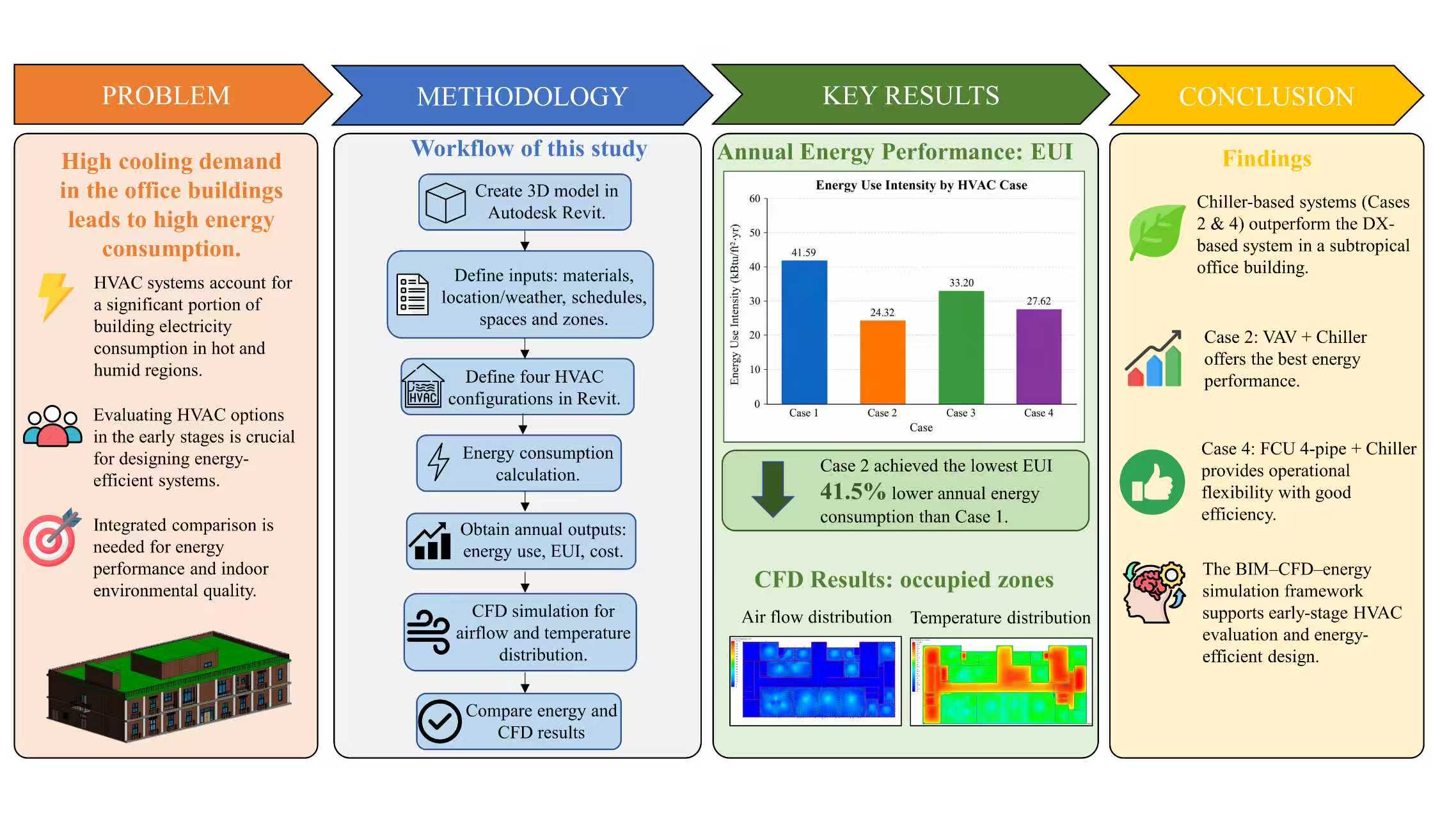
Improving energy efficiency in office buildings is key to achieving net-zero carbon emissions targets, particularly in hot and humid subtropical regions where cooling demand dominates. This study suggests an integrated framework that combines building information modeling (BIM), computational fluid mechanics (CFD), and energy simulation to evaluate the energy performance and indoor environmental conditions of various heating, ventilation, and air conditioning (HVAC) system configurations in an office building in Taiwan. An office building was created with Autodesk Revit. Annual energy simulations were carried out in accordance with ASHRAE Standard 90.1-2019. Four HVAC cases were analyzed, including variable air volume (VAV) with direct expansion (DX), VAV with a chiller, variable refrigerant flow (VRF), and a four-pipe fan coil unit (FCU) with a chiller. The energy performance of the four HVAC systems was evaluated using energy use intensity (EUI), together with CFD analysis of airflow and temperature distribution in the occupied zones. The comparison showed that the system configuration had a clear influence on overall performance. Case 2 produced the lowest EUI, with annual energy consumption 41.5% lower than that of Case 1, and its performance met the ASHRAE benchmark. Case 4 also showed favorable performance with high operational flexibility, while Case 3 showed intermediate efficiency. Case 1 demonstrated the highest energy consumption and lowest efficiency. CFD results under the prescribed boundary conditions indicate that the simulated occupied zones maintained acceptable temperature and airflow distributions. The findings show that chiller-based HVAC systems perform more effectively than DX-based systems in subtropical office buildings. The BIM–CFD–energy simulation framework developed in this study provides a useful basis for early-stage HVAC system comparison and selection, particularly for energy-efficient building design in high-cooling-demand climates.
- Open Access
- Article
Comparative Energy Consumption and Indoor Airflow Analysis of Four HVAC Systems in an Office Building Using Revit-Based Modeling and CFD Simulation
- Ivana Amelia Tamba 1,
- Chong-Kai Wang 2,
- Yean-Der Kuan 2,3,4,*
Author Information
Received: 14 Mar 2026 | Revised: 21 May 2026 | Accepted: 26 May 2026 | Published: 15 Jun 2026
Abstract
Graphical Abstract
Keywords
building information modeling (BIM) | heating, ventilation, and air conditioning (HVAC) | energy use intensity (EUI) | flow simulation
References
- 1.
Liu, L.; Huang, Y. HVAC Design Optimization for Pharmaceutical Facilities with BIM and CFD. Buildings 2024, 14, 1627. https://doi.org/10.3390/buildings14061627.
- 2.
Hong, D.; Cheng, R.; Lei, H.; et al. Comprehensive Review on the Impact of Building Envelopes on Indoor Thermal Comfort in Office Buildings: Balancing Occupant Comfort and Energy Efficiency. Build. Environ. 2026, 289, 114018. https://doi.org/10.1016/j.buildenv.2025.114018.
- 3.
Huang, K.T.; Flowers, B. Parametric Optimisation of Building Envelopes for Energy Efficiency in Taiwanʼs Cooling-Dominated Climates. Int. J. Sustain. Energy 2025, 44, 2560863. https://doi.org/10.1080/14786451.2025.2560863.
- 4.
Jang, E.; Heo, Y. A New Plenum-Based Dual-Mode Passive Cooling System Enabling Naturally Ventilated Core Zones in Office Buildings. Build. Environ. 2026, 289, 114026. https://doi.org/10.1016/j.buildenv.2025.114026.
- 5.
Khdair, A.I.; Aburumman, G.A.; Tahmasbi, F.; et al. Advancing Natural Ventilation in Sustainable Architecture: Mechanisms, Innovations, and Climate-Responsive Design for Energy-Efficient Buildings. Renew. Sustain. Energy Rev. 2026, 226, 116314. https://doi.org/10.1016/j.rser.2025.116314.
- 6.
Moharrami, M.; Sadeghifam, A.N.; Golzad, H.; et al. The Hybrid Attic Ventilation Technique as a Sustainable Strategy for Thermal Comfort Improvement and Energy Saving in Tropical Residential Buildings. Energy Convers. Manag. X 2025, 26, 100944. https://doi.org/10.1016/j.ecmx.2025.100944.
- 7.
Gonzalez-Caceres, A.; Karlshøj, J.; Arvid Vik, T.; et al. Evaluation of Cost-Effective Measures for the Renovation of Existing Dwellings in the Framework of the Energy Certification System: A Case Study in Norway. Energy Build. 2022, 264, 112071. https://doi.org/10.1016/j.enbuild.2022.112071.
- 8.
Ciccozzi, A.; Santavicca, A.; deRubeis, T.; et al. BIM-BEM Interoperability for Energy Analysis: A Comparative Study of Different Strategies. Energy Rep. 2025, 13, 4705–4718. https://doi.org/10.1016/j.egyr.2025.04.027.
- 9.
Shalabi, F.; Turkan, Y. BIM-Energy Simulation Approach for Detecting Building Spaces with Faults and Problematic Behavior. J. Inf. Technol. Constr. 2020, 25, 342–360. https://doi.org/10.36680/J.ITCON.2020.020.
- 10.
Al-Saeed, Y.W.; Ahmed, A. Evaluating Design Strategies for Nearly Zero Energy Buildings in the Middle East and North Africa Regions. Designs 2018, 2, 35. https://doi.org/10.3390/designs2040035.
- 11.
Numan, M.; Saadat, U.; Farooq, M.U. BIM and Sustainable Design: A Review of Strategies and Tools for Green Building Practices. J. Eng. Res. Sci. 2024, 3, 1–7. https://doi.org/10.55708/js0302001.
- 12.
Elnabawi, M.H. Building Information Modeling-Based Building Energy Modeling: Investigation of Interoperability and Simulation Results. Front. Built Environ. 2020, 6, 573971. https://doi.org/10.3389/fbuil.2020.573971.
- 13.
Ahmed, W.; Heywood, C.; Holzer, D. BIM-Enabled Energy Retrofitting: A Critical Review of Current Status and Future Prospects. Energy Build. 2025, 348, 116478. https://doi.org/10.1016/j.enbuild.2025.116478.
- 14.
Stegnar, G.; Cerovšek, T. Information Needs for Progressive BIM Methodology Supporting the Holistic Energy Renovation of Office Buildings. Energy 2019, 173, 317–331. https://doi.org/10.1016/j.energy.2019.02.087.
- 15.
Veerendra, G.T.N.; Dey, S.; Mantle, E.J.; et al. Building Information Modeling—Simulation and Analysis of a University Edifice and Its Environs—A Sustainable Design Approach. Green Technol. Sustain. 2025, 3, 100150. https://doi.org/10.1016/j.grets.2024.100150.
- 16.
Salem, E.; Elwakil, E. Optimizing Building Energy Performance Using BIM and Climate-Driven Site Data. Innov. Infrastruct. Solut. 2025, 10, 435. https://doi.org/10.1007/s41062-025-02221-5.
- 17.
Hong, T.; Langevin, J.; Sun, K. Building Simulation: Ten Challenges. Build. Simul. 2018, 11, 871–898. https://doi.org/10.1007/s12273-018-0444-x.
- 18.
Lin, K.L.; Jan, M.Y.; Liao, C. Sen. Energy Consumption Analysis for Concrete Residences—A Baseline Study in Taiwan. Sustainability 2017, 9, 257. https://doi.org/10.3390/su9020257.
- 19.
Kang, K.Y.; Wang, X.; Wang, J.; et al. Utility of BIM-CFD Integration in the Design and Performance Analysis for Buildings and Infrastructures of Architecture, Engineering and Construction Industry. Buildings 2022, 12, 651. https://doi.org/10.3390/buildings12050651.
- 20.
Albatayneh, A.; Alterman, D.; Page, A.W.; et al. Warming Issues Associated with the Long Term Simulation of Housing Using CFD Analysis. J. Green Build. 2016, 11, 57–74. https://doi.org/10.3992/jgb.11.2.57.1.
- 21.
Liu, W.; Lian, S.; Fang, X.; et al. An Open-Source and Experimentally Guided CFD Strategy for Predicting Air Distribution in Data Centers with Air-Cooling. Build. Environ. 2023, 242, 110542. https://doi.org/10.1016/j.buildenv.2023.110542.
- 22.
William, M.A.; Suárez-López, M.J.; Soutullo, S.; et al. Multi-Objective Integrated BES-CFD Co-Simulation Approach towards Pandemic Proof Buildings. Energy Rep. 2022, 8, 137–152. https://doi.org/10.1016/j.egyr.2022.06.091.
- 23.
Ismail, N.; Ouahrani, D. A Comprehensive Optimization Study of Personal Cooling Radiant Desks Integrated to HVAC System for Energy Efficiency and Thermal Comfort in Office Buildings. Int. J. Refrig. 2023, 156, 54–71. https://doi.org/10.1016/j.ijrefrig.2023.09.023.
- 24.
Mahecha Zambrano, J.; Baldini, L. Integrating CFD and Thermoregulation Models: A Novel Framework for Thermal Comfort Analysis of Non-Uniform Indoor Environments. Energy Build. 2025, 335, 115570. https://doi.org/10.1016/j.enbuild.2025.115570.
- 25.
Chung, W.; Hui, Y.V.; Lam, Y.M. Benchmarking the Energy Efficiency of Commercial Buildings. Appl. Energy 2006, 83, 1–14. https://doi.org/10.1016/j.apenergy.2004.11.003.
- 26.
Syarifudin, S.; Saputra, A.; Siswosukarto, S. An Analysis of Energy Consumption in the Campus Buildingʼs Operation (Case Study: The Building of Faculty of Engineering and Department of Civil and Environmental Engineering, Universitas Gadjah Mada). J. Civ. Eng. Forum 2018, 4, 67–78. https://doi.org/10.22146/jcef.27642.
- 27.
Mogili, S.; Avvari, H.V.; Appecharla, V.K. Energy Consumption Analysis of Residential Building Using Autodesk Revit. IOP Conf. Ser. Earth Environ. Sci. 2022, 1086, 012056. https://doi.org/10.1088/1755-1315/1086/1/012056.
- 28.
Dwivedi, E.; Kashyap, R.; Kumar, R.R. Evaluating the Effectiveness of Energy-Efficient Design Strategies in Achieving Net Zero Energy Building through Reduced Energy Consumption. Int. J. Res. Appl. Sci. Eng. Technol. 2023, 11, 1766–1779. https://doi.org/10.22214/ijraset.2023.49774.
- 29.
Akhilesh, U.S.; George, D.G. Energy Analysis & Optimization of a Residential Structure. Int. J. Sci. Res. Eng. Manag. 2024, 8. https://doi.org/10.55041/ijsrem37231.
- 30.
Raftery, P.; Li, S.; Jin, B.; et al. Evaluation of a Cost-Responsive Supply Air Temperature Reset Strategy in an Office Building. Energy Build. 2018, 158, 356–370. https://doi.org/10.1016/j.enbuild.2017.10.017.
- 31.
Muta, L.F.; Melo, A.P.; Lamberts, R. Enhancing Energy Performance Assessment and Labeling in Buildings: A Review of BIM-Based Approaches. J. Build. Eng. 2025, 103, 112089. https://doi.org/10.1016/j.jobe.2025.112089.
- 32.
Kulthanaphanich, Y.; Permata, R.; Lin, S.Y. Life Cycle Assessment of Integrated Energy and Seismic Retrofits for Existing Buildings. J. Build. Eng. 2025, 108, 112967. https://doi.org/10.1016/j.jobe.2025.112967.
- 33.
Taheri, S.; Norouzijajarm, E.; Athar, A.A. Technical, Economic, and Environmental Assessment of Energy Audit and Optimization in the Mechanical Room of an Office Building. Energy Sustain. Dev. 2025, 87, 101717. https://doi.org/10.1016/j.esd.2025.101717.
- 34.
U.S. Department of Energy. Preliminary Energy Savings Analysis: ANSI/ASHRAE/IES Standard 90.1-2019; U.S. Department of Energy: Washington, DC, USA, 2021.
- 35.
Nambiar, C.; Hart, R.; Rosenberg, M.; et al. End Use Analysis of ANSI/ASHRAE/IES Standard 90.1-2019. ASHRAE J. 2023, 65, 34–42.


This work is licensed under a Creative Commons Attribution 4.0 International License.

 Suite 4002 Level 4, 447 Collins Street, Melbourne, Victoria 3000, Australia
 General Inquiries: info@sciltp.com