
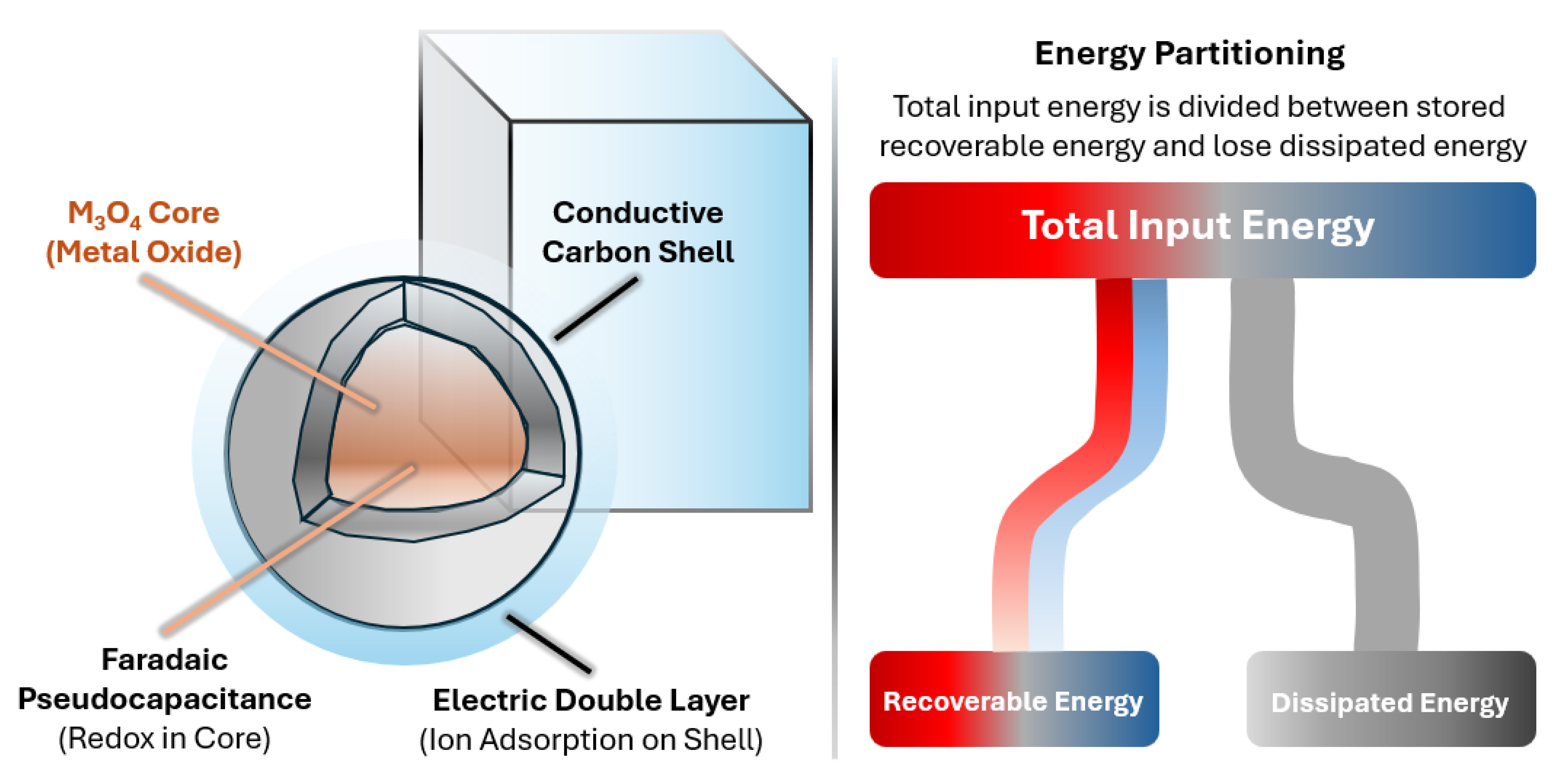
Capacitive deionization (CDI) is increasingly regarded as an energy-efficient desalination technology, and numerous studies have explored transition-metal oxide-carbon composites as pseudocapacitive CDI electrodes, typically reporting salt adsorption capacities of about 8–15 mg/g and energy-recovery efficiencies of 60–80%. However, most previous studies provide limited insight into how the supplied electrical energy is partitioned into recoverable and dissipated components during CDI operation, and a unified thermodynamic framework remains lacking. In this work, Mn3O4@C, Co3O4@C, and Fe3O4@C core-shell nanoparticles were incorporated into activated carbon to fabricate Mn3O4@C/AC, Co3O4@C/AC, and Fe3O4@C/AC composite electrodes. Under identical CDI conditions of 3000 mg/L NaCl and an applied charging voltage of 0.6 V, AC, Mn3O4@C/AC, Co3O4@C/AC, and Fe3O4@C/AC exhibited salt adsorption capacities of 6.7, 12.5, 10.8, and 9.3 mg/g, respectively. Under the same operating conditions, the three composite electrodes exhibited energy storage efficiencies of approximately 84 to 89%, compared with 54% for AC, with Mn3O4@C/AC showing the highest energy storage performance. Representative GCD measurements of Mn3O4@C/AC and open-circuit voltage-retention measurements of Mn3O4@C/AC and Co3O4@C/AC provided supporting operational information, whereas the cross-electrode energy metrics were derived from a common CDI charging and discharging protocol applied to all electrodes. Energy analysis showed that increasing the charging voltage systematically decreased energy storage efficiency because a smaller fraction of the supplied electrical energy was recovered during discharge. These findings provide a thermodynamic basis for designing energy-recoverable CDI systems with potentially lower net electrical energy demand.
- Open Access
- Article
Thermodynamic Evaluation of Energy Storage and Recovery in Capacitive Deionization with Synergistic Faradaic Double Layer Electrodes
- Po-An Chen 1,*,
- Kuan-Ting Lee 2,
- H. Paul Wang 3,
- Chiao-Yu Chang 1,
- Ji-Nien Sung 2
Author Information
Received: 24 May 2026 | Revised: 08 Sep 2026 | Accepted: 14 Sep 2026 | Published: 17 Sep 2026
Abstract
Graphical Abstract
References
- 1.
Mishra, B.K.; Kumar, P.; Saraswat, C.; et al. Water Security in a Changing Environment: Concept, Challenges and Solutions. Water 2021, 13, 490. https://doi.org/10.3390/w13040490.
- 2.
Voulvoulis, N. Water reuse from a circular economy perspective and potential risks from an unregulated approach. Curr. Opin. Environ. Sci. Health 2018, 2, 32–45.
- 3.
Liu, S.Y.; Wang, Z.Y.; Han, M.Y.; et al. Energy-water nexus in seawater desalination project: A typical water production system in China. J. Clean. Prod. 2021, 279, 123412. https://doi.org/10.1016/j.jclepro.2020.123412.
- 4.
Chen, T.H.; Kao, Y.H.; Shen, Y.Y.; et al. Pilot-scale membrane capacitive deionization for water reclamation: Commissioning, performance benchmarking, and long-term assessment. Desalination 2025, 599, 118428. https://doi.org/10.1016/j.desal.2024.118428.
- 5.
Okampo, E.J.; Nwulu, N. Optimisation of renewable energy powered reverse osmosis desalination systems: A state-of-the-art review. Renew. Sustain. Energy Rev. 2021, 140, 110712. https://doi.org/10.1016/j.rser.2021.110712.
- 6.
Ligaray, M.; Kim, N.; Park, S.; et al. Energy projection of the seawater battery desalination system using the reverse osmosis system analysis model. Chem. Eng. J. 2020, 395, 125082. https://doi.org/10.1016/j.cej.2020.125082.
- 7.
Alsarayreh, A.A.; Al-Obaidi, M.A.; Patel, R.; et al. Evaluation and minimisation of energy consumption in a medium-scale reverse osmosis brackish water desalination plant. J. Clean. Prod. 2020, 248, 119220. https://doi.org/10.1016/j.jclepro.2019.119220.
- 8.
Bartholomew, T.V.; Mey, L.; Arena, J.T.; et al. Osmotically assisted reverse osmosis for high salinity brine treatment. Desalination 2017, 421, 3–11. https://doi.org/10.1016/j.desal.2017.04.012.
- 9.
Qin, M.; Deshmukh, A.; Epsztein, R.; et al. Comparison of energy consumption in desalination by capacitive deionization and reverse osmosis. Desalination 2019, 455, 100–114. https://doi.org/10.1016/j.desal.2019.01.003.
- 10.
Kim, J.; Park, K.; Yang, D.R.; et al. A comprehensive review of energy consumption of seawater reverse osmosis desalination plants. Appl. Energy 2019, 254, 113652. https://doi.org/10.1016/j.apenergy.2019.113652.
- 11.
Wei, Q.; Hu, Y.; Wang, J.; et al. Low energy consumption flow capacitive deionization with a combination of redox couples and carbon slurry. Carbon 2020, 170, 487–492. https://doi.org/10.1016/j.carbon.2020.07.044.
- 12.
Liu, E.; Lee, L.Y.; Ong, S.L.; et al. Treatment of industrial brine using capacitive deionization (CDI) towards zero liquid discharge—Challenges and optimization. Water Res. 2020, 183, 116059. https://doi.org/10.1016/j.watres.2020.116059.
- 13.
Chen, Y.W.; Chen, J.F.; Lin, C.H.; et al. Integrating a supercapacitor with capacitive deionization for direct energy recovery from the desalination of brackish water. Appl. Energy 2019, 252, 113417. https://doi.org/10.1016/j.apenergy.2019.113417.
- 14.
Tian, X.; Bao, S.; Zhang, Y. Selective adsorption mechanism of resin-activated carbon composite electrode for capacitive deionization. Colloids Surf. A Physicochem. Eng. Asp. 2021, 610, 125935. https://doi.org/10.1016/j.colsurfa.2020.125935.
- 15.
Abi Jaoude, M.; Alhseinat, E.; Polychronopoulou, K.; et al. Morphology-dependent electrochemical performance of MnO2 nanostructures on graphene towards efficient capacitive deionization. Electrochim. Acta 2020, 330, 135202. https://doi.org/10.1016/j.electacta.2019.135202.
- 16.
Li, Y.; Chen, N.; Li, Z.; et al. Frontiers of carbon materials as capacitive deionization electrodes. Dalton Trans. 2020, 49, 5006–5014. https://doi.org/10.1039/d0dt00684j.
- 17.
Liu, T.; Serrano, J.; Elliott, J.; et al. Exceptional capacitive deionization rate and capacity by block copolymer–based porous carbon fibers. Sci. Adv. 2020, 6, eaaz0906. https://doi.org/10.1126/sciadv.aaz0906.
- 18.
Xu, X.; Yang, T.; Zhang, Q.; et al. Ultrahigh capacitive deionization performance by 3D interconnected MOF-derived nitrogen-doped carbon tubes. Chem. Eng. J. 2020, 390, 124493. https://doi.org/10.1016/j.cej.2020.124493.
- 19.
Yasin, A.S.; Mohamed, A.Y.; Mohamed, I.M.A.; et al. Theoretical insight into the structure-property relationship of mixed transition metal oxides nanofibers doped in activated carbon and 3D graphene for capacitive deionization. Chem. Eng. J. 2019, 371, 166–181. https://doi.org/10.1016/j.cej.2019.04.043.
- 20.
Kim, M.; Lim, H.; Xu, X.; et al. Sorghum biomass-derived porous carbon electrodes for capacitive deionization and energy storage. Microporous Mesoporous Mater. 2021, 312, 110757. https://doi.org/10.1016/j.micromeso.2020.110757.
- 21.
Huo, S.; Zhao, Y.; Zong, M.; et al. Boosting supercapacitor and capacitive deionization performance of hierarchically porous carbon by polar surface and structural engineering. J. Mater. Chem. A 2020, 8, 2505–2517. https://doi.org/10.1039/c9ta12170f.
- 22.
Eguchi, T.; Tashima, D.; Fukuma, M.; et al. Activated carbon derived from Japanese distilled liquor waste: Application as the electrode active material of electric double-layer capacitors. J. Clean. Prod. 2020, 259, 120822. https://doi.org/10.1016/j.jclepro.2020.120822.
- 23.
Shu, T.; Gao, H.; Li, Q.; et al. One-step phosphating synthesis of CoP nanosheet arrays combined with Ni 2 P as a high-performance electrode for supercapacitors. Nanoscale 2020, 12, 20710–20718. https://doi.org/10.1039/d0nr05406b.
- 24.
Wang, F.; Cheong, J.Y.; He, Q.; et al. Phosphorus-doped thick carbon electrode for high-energy density and long-life supercapacitors. Chem. Eng. J. 2021, 414, 128767. https://doi.org/10.1016/j.cej.2021.128767.
- 25.
Jiang, Y.; Jin, L.; Wei, D.; et al. Energy Consumption in Capacitive Deionization for Desalination: A Review. Int. J. Environ. Res. Public Health 2022, 19, 10599. https://doi.org/10.3390/ijerph191710599.
- 26.
Długołęcki, P.; van der Wal, A. Energy recovery in membrane capacitive deionization. Environ. Sci. Technol. 2013, 47, 4904–4910. https://doi.org/10.1021/es3053202.
- 27.
Chen, P.A.; Liu, S.H.; Wang, H.P. Pseudocapacitive Deionization of Saltwater by Mn3O4@C/Activated Carbon. ACS Omega 2023, 8, 13315–13322. https://doi.org/10.1021/acsomega.3c00673.
- 28.
Chen, L.; Yin, X.; Zhu, L.; et al. Energy recovery and electrode regeneration under different charge/discharge conditions in membrane capacitive deionization. Desalination 2018, 439, 93–101. https://doi.org/10.1016/j.desal.2018.04.012.


This work is licensed under a Creative Commons Attribution 4.0 International License.

 Suite 4002 Level 4, 447 Collins Street, Melbourne, Victoria 3000, Australia
 General Inquiries: info@sciltp.com