
- Paternal running and ball sports before pregnancy was related with reduced childhood wheeze risk
- Maternal preconceptional nigh walking and exercise were related with reduced childhood asthma risk
- Maternal long duration of meditation in utero was associated with increased childhood wheeze risk
- Childhood exercise in long duration and daytime was negatively related with asthma and wheeze
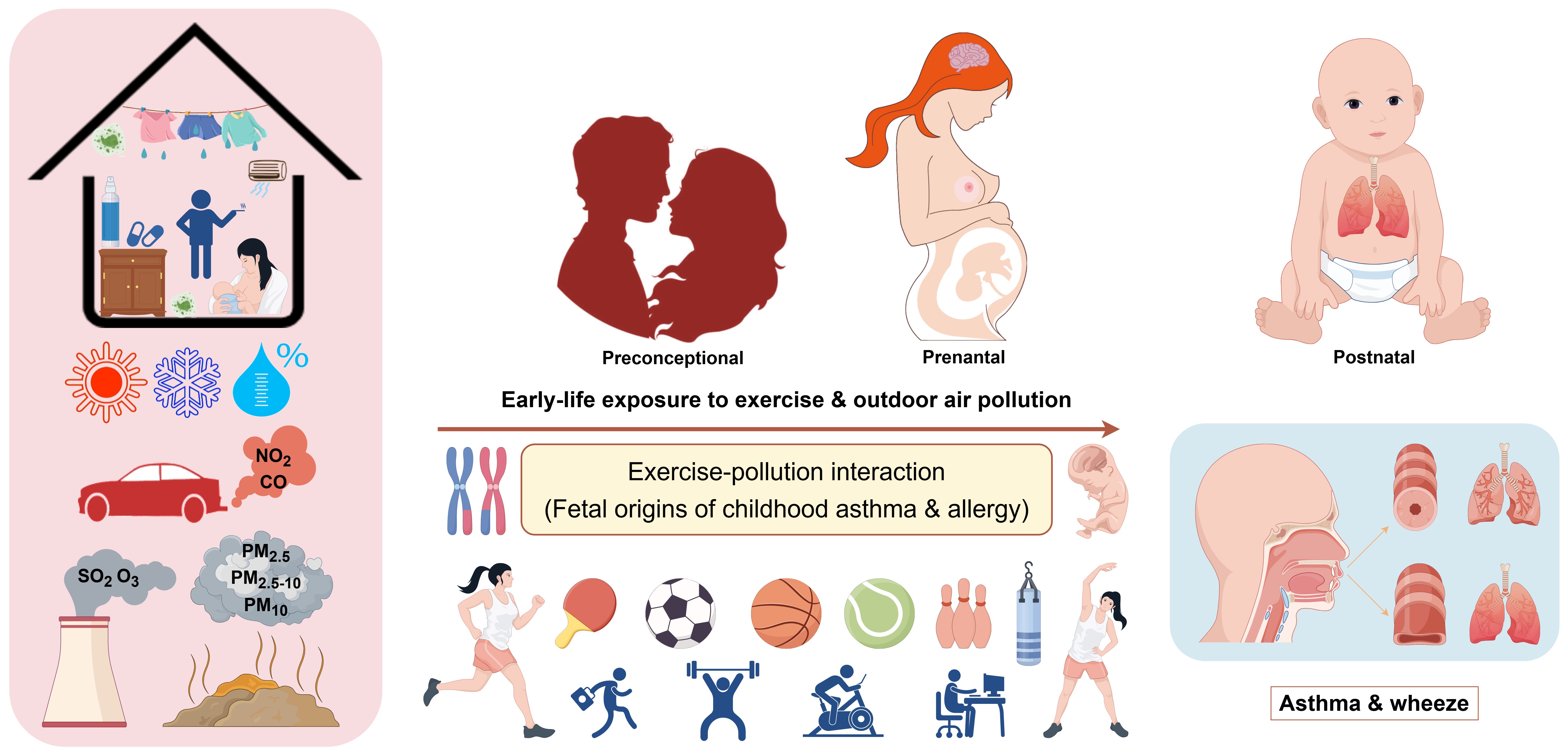
- Early-life “exercise-pollution interaction” affects children’s asthma and wheeze
- Open Access
- Article
Combined Effects of Parental and Childhood Physical Activity and Air Pollution on Childhood Asthma and Wheezing
- Chan Lu 1,2,3,*,†,
- Yuanqi Li 1,†,
- Zhangxiong Guo 1,†,
- Xianglong Xiao 1,
- Lin Wang 1,
- Wenying Sun 1,
- Zipeng Qiao 1
Author Information
Received: 15 Sep 2025 | Revised: 28 Oct 2025 | Accepted: 11 Dec 2025 | Published: 01 Apr 2026
Highlights
Abstract
The combined effects of early-life exercise and air pollution on childhood asthma and wheeze remain unclear, particularly during and after the COVID-19 epidemic. We aim to examine the joint impacts of paternal, maternal, and childhood exercise habits and air pollutant exposures on asthma and wheeze in children. We analyzed 20,730 valid questionnaires from five Chinese cities (2022–2023), covering individual characteristics, health outcomes, and household environments. Multilevel (city-family) logistic regression assessed the associations of paternal (preconceptional), maternal (preconceptional and prenatal), and childhood (postnatal) exercise, along with early-life air pollution exposure, with childhood asthma and wheeze. We found that paternal running and ball sports before conception reduced offspring’s wheeze risk (OR [95% CI] = 0.70 [0.54–0.91] and 0.47 [0.23–0.97]). Maternal walking before pregnancy was linked to reduced asthma risk (0.37 [0.16–0.85]); however, maternal daytime exercise and prolonged meditation increased asthma/wheeze risk, while exercise during periods typically characterized by lower pollution levels (such as afternoon and nighttime in our study setting) was associated with reduced risk. Childhood exercise decreased asthma and wheeze risk (0.29 [0.14–0.63] and 0.57 [0.36–0.90]), especially when performed longer and during the day. Exposure to PM2.5–10 in the first trimester and PM2.5 in the second trimester were associated with asthma, while exposure to NO2 before pregnancy and PM10 in the third trimester were associated with wheeze. Particulate matter exposure modified the effects of parental and childhood exercise, suggesting a potential “exercise–pollution interaction”. This study indicates that exercise habits across preconceptional, prenatal, and postnatal periods, combined with air pollution exposures, independently and interactively may influence childhood asthma and wheeze.
Graphical Abstract
Keywords
childhood asthma and wheeze | early-life exposure | physical activity | ambient air pollution | exercise-pollution interaction
References
- 1.
Wang, Z.; Li, Y.; Gao, Y.; et al. Global, regional, and national burden of asthma and its attributable risk factors from 1990 to 2019: A systematic analysis for the Global Burden of Disease Study 2019. Respir. Res. 2023, 24, 169.
- 2.
Momtazmanesh, S.; Moghaddam, S.S.; Ghamari, S.-H.; et al. Global burden of chronic respiratory diseases and risk factors, 1990–2019: An update from the Global Burden of Disease Study 2019. EClinicalMedicine 2023, 59, 101936.
- 3.
Norbäck, D.; Lu, C.; Zhang, Y.; et al. Sources of indoor particulate matter (PM) and outdoor air pollution in China in relation to asthma, wheeze, rhinitis and eczema among pre-school children: Synergistic effects between antibiotics use and PM10 and second hand smoke. Environ. Int. 2019, 125, 252–260.
- 4.
Stern, D.A.; Morgan, W.J.; Halonen, M.; et al. Wheezing and bronchial hyper-responsiveness in early childhood as predictors of newly diagnosed asthma in early adulthood: A longitudinal birth-cohort study. Lancet 2008, 372, 1058–1064.
- 5.
Ly, N.P.; Gold, D.R.; Weiss, S.T.; et al. Recurrent wheeze in early childhood and asthma among children at risk for atopy. Pediatrics 2006, 117, e1132–e1138.
- 6.
Guthold, R.; Stevens, G.A.; Riley, L.M.; et al. Global trends in insufficient physical activity among adolescents: A pooled analysis of 298 population-based surveys with 1.6 million participants. Lancet Child Adolesc. Health 2020, 4, 23–35.
- 7.
Lee, I.M.; Shiroma, E.J.; Lobelo, F.; et al. Effect of physical inactivity on major non-communicable diseases worldwide: An analysis of burden of disease and life expectancy. Lancet 2012, 380, 219–229.
- 8.
Carson, K.V.; Chandratilleke, M.G.; Picot, J.; et al. Physical training for asthma. Cochrane Database Syst. Rev. 2013, 9, CD001116.
- 9.
Kawahara, J.; Tanaka, S.; Tanaka, C.; et al. Daily inhalation rate and time-activity/location pattern in Japanese preschool children. Risk Anal. 2012, 32, 1595–1604.
- 10.
Lochte, L.; Nielsen, K.G.; Petersen, P.E.; et al. Childhood asthma and physical activity: A systematic review with meta-analysis and Graphic Appraisal Tool for Epidemiology assessment. BMC Pediatr. 2016, 16, 50.
- 11.
Mancuso, C.A.; Sayles, W.; Robbins, L.; et al. Barriers and facilitators to healthy physical activity in asthma patients. J. Asthma 2006, 43, 137–143.
- 12.
Feng, G.; Xia, J.; Wang, X.; et al. Assessing the disease burden of air pollution on children and adolescents in China from 1990 to 2019. Innov. Med. 2024, 2, 100057.
- 13.
Leon Hsu, H.H.; Mathilda Chiu, Y.H.; Coull, B.A.; et al. Prenatal particulate air pollution and asthma onset in urban children. Identifying sensitive windows and sex differences. Am. J. Respir. Crit. Care Med. 2015, 192, 1052–1059.
- 14.
Weinmayr, G.; Romeo, E.; De Sario, M.; et al. Short-term effects of PM10 and NO2 on respiratory health among children with asthma or asthma-like symptoms: A systematic review and meta-analysis. Environ. Health Perspect. 2010, 118, 449–457.
- 15.
Liu, X.; Fu, L.; Yang, X.; et al. Exposure to O3 during pregnancy and offspring asthma induced by OVA: Sensitive window identification. Environ. Pollut. 2021, 270, 116297.
- 16.
Carthy, P.; Ó Domhnaill, A.; O’Mahony, M.; et al. Local NO2 concentrations and asthma among over-50s in Ireland: A microdata analysis. Int. J. Epidemiol. 2021, 49, 1899–1908.
- 17.
Bowatte, G.; Lodge, C.J.; Knibbs, L.D.; et al. Traffic-related air pollution exposure is associated with allergic sensitization, asthma, and poor lung function in middle age. J. Allergy Clin. Immunol. 2017, 139, 122–129.
- 18.
Mendola, P.; Wallace, M.; Liu, D.; et al. Air pollution exposure and preeclampsia among US women with and without asthma. Environ. Res. 2016, 148, 248–255.
- 19.
Bigazzi, A.Y.; Figliozzi, M.A. Review of urban bicyclists’ intake and uptake of traffic-related air pollution. Transp. Rev. 2014, 34, 221–245.
- 20.
Giles, L.V.; Koehle, M.S. The health effects of exercising in air pollution. Sports Med. 2014, 44, 223–249.
- 21.
McConnell, R.; Berhane, K.; Gilliland, F.; et al. Asthma in exercising children exposed to ozone: A cohort study. Lancet 2002, 359, 386–391.
- 22.
Andersen, Z.J.; de Nazelle, A.; Mendez, M.A.; et al. A study of the combined effects of physical activity and air pollution on mortality in elderly urban residents: The Danish Diet, Cancer, and Health Cohort. Environ. Health Perspect. 2015, 123, 557–563.
- 23.
Fisher, J.E.; Loft, S.; Ulrik, C.S.; et al. Physical activity, air pollution, and the risk of asthma and chronic obstructive pulmonary disease. Am. J. Respir. Crit. Care Med. 2016, 194, 855–865.
- 24.
Lu, C.; Deng, W.; Qiao, Z.; et al. Effects of early-life air pollution exposure on childhood COVID-19 infection and sequelae in China. J. Hazard. Mater. 2025, 491, 137940.
- 25.
Wang, F.; Wang, L.; Jiang, Y.; et al. Early-life exposure to outdoor temperature and the risk of childhood allergic diseases: A multicentre retrospective cohort study. Build. Environ. 2025, 267, 112317.
- 26.
Lu, C.; Jing, Y.; Deng, W.; et al. Early-life nutritional additives, household environment, and air pollution in relation to childhood food allergies: A multi-city mother-child study in China. Environ. Int. 2025, 203, 109774.
- 27.
Lu, C.; Liu, Z.; Yang, W.; et al. Early life exposure to outdoor air pollution and indoor environmental factors on the development of childhood allergy from early symptoms to diseases. Environ. Res. 2023, 216, 114538.
- 28.
Musakka, E.R.; Ylilauri, M.P.T.; Jalanka, J.; et al. Maternal exercise during pregnancy is associated with reduced risk of asthma in the child: A prospective birth cohort study. Med 2024, 6, 100514.
- 29.
Chen, Y.; Lyu, J.; Xia, Y.; et al. Effect of maternal sleep, physical activity and screen time during pregnancy on the risk of childhood respiratory allergies: A sex-specific study. Respir. Res. 2020, 21, 230.
- 30.
Gudmundsdóttir, H.K.; Carlsen, O.C.L.; Bains, K.E.S.; et al. Infant lung function and maternal physical activity in the first half of pregnancy. ERJ Open Res. 2022, 8, 00172–02022.
- 31.
Clapp, J.F., III; Kim, H.; Burciu, B.; et al. Beginning regular exercise in early pregnancy: Effect on fetoplacental growth. Am. J. Obstet. Gynecol. 2000, 183, 1484–1488.
- 32.
Chae, S.A.; Son, J.S.; Du, M. Prenatal exercise in fetal development: A placental perspective. FEBS J. 2022, 289, 3058–3071.
- 33.
Acosta-Manzano, P.; Coll-Risco, I.; Van Poppel, M.N.; et al. Influence of a concurrent exercise training intervention during pregnancy on maternal and arterial and venous cord serum cytokines: The GESTAFIT project. J. Clin. Med. 2019, 8, 1862.
- 34.
Del Giacco, S.R.; Firinu, D.; Bjermer, L.; et al. Exercise and asthma: An overview. Eur. Clin. Respir. J. 2015, 2, 27984.
- 35.
Ownby, D.R.; Peterson, E.L.; Nelson, D.; et al. The relationship of physical activity and percentage of body fat to the risk of asthma in 8 to 10 year-old children. J. Asthma 2007, 44, 885–889.
- 36.
Guo, J.; Xia, F.; Zhang, Y.; et al. Impact of diurnal variability and meteorological factors on the PM2.5-AOD relationship: Implications for PM2.5 remote sensing. Environ. Pollut. 2017, 221, 94–104.
- 37.
DeGaetano, A.T.; Doherty, O.M. Temporal, spatial and meteorological variations in hourly PM2.5 concentration extremes in New York City. Atmos. Environ. 2004, 38, 1547–1558.
- 38.
Liu, J.; Wang, S.; Zhu, K.; et al. Spatial patterns of the diurnal variations of PM2.5 and their influencing factors across China. Atmos. Environ. 2024, 318, 120215.
- 39.
Gu, Z.; Feng, J.; Han, W.; et al. Diurnal variations of polycyclic aromatic hydrocarbons associated with PM2.5 in Shanghai, China. J. Environ. Sci. 2010, 22, 389–396.
- 40.
Zhu, Y.; Kuhn, T.; Mayo, P.; et al. Comparison of daytime and nighttime concentration profiles and size distributions of ultrafine particles near a major highway. Environ. Sci. Technol. 2006, 40, 2531–2536.
- 41.
Sharma, A.; Kumar, P. Quantification of air pollution exposure to in-pram babies and mitigation strategies. Environ. Int. 2020, 139, 105671.
- 42.
Garcia-Algar, O.; Canchucaja, L.; D’Orazzio, V.; et al. Different exposure of infants and adults to ultrafine particles in the urban area of Barcelona. Environ. Monit. Assess. 2015, 187, 4196.
- 43.
Harr, L.; Sinsel, T.; Simon, H.; et al. PM2.5 exposure differences between children and adults. Urban Clim. 2022, 44, 101198.
- 44.
Lu, C.; Wang, L.; Liao, H.; et al. Impacts of intrauterine and postnatal exposure to air pollution on preschool children’s asthma: A key role in cumulative exposure. Build. Environ. 2023, 245, 110874.
- 45.
Kajekar, R. Environmental factors and developmental outcomes in the lung. Pharmacol. Ther. 2007, 114, 129–145.
- 46.
Jung, C.R.; Chen, W.T.; Tang, Y.H.; et al. Fine particulate matter exposure during pregnancy and infancy and incident asthma. J. Allergy Clin. Immunol. 2019, 143, 2254–2262.
- 47.
Pedersen, C.E.; Eliasen, A.U.; Ketzel, M.; et al. Prenatal exposure to ambient air pollution is associated with early life immune perturbations. J. Allergy Clin. Immunol. 2023, 151, 212–221.
- 48.
Yue, H.; Ji, X.; Li, G.; et al. Maternal exposure to PM2.5 affects fetal lung development at sensitive windows. Environ. Sci. Technol. 2019, 54, 316–324.
- 49.
Yang, M.; Chu, C.; Bloom, M.S.; et al. Is smaller worse? New insights about associations of PM(1) and respiratory health in children and adolescents. Environ. Int. 2018, 120, 516–524.
- 50.
Anenberg, S.C.; Mohegh, A.; Goldberg, D.L.; et al. Long-term trends in urban NO2 concentrations and associated paediatric asthma incidence: Estimates from global datasets. Lancet Planet. Health 2022, 6, e49–e58.
- 51.
Deng, Q.; Lu, C.; Norbäck, D.; et al. Early life exposure to ambient air pollution and childhood asthma in China. Environ. Res. 2015, 143, 83–92.
- 52.
Hehua, Z.; Qing, C.; Shanyan, G.; et al. The impact of prenatal exposure to air pollution on childhood wheezing and asthma: A systematic review. Environ. Res. 2017, 159, 519–530.
- 53.
Vieira de Sousa Neto, I.; Fontes, W.; Prestes, J.; et al. Impact of paternal exercise on physiological systems in the offspring. Acta Physiol. 2021, 231, e13620.
- 54.
Kusuyama, J.; Alves-Wagner, A.B.; Makarewicz, N.S.; et al. Effects of maternal and paternal exercise on offspring metabolism. Nat. Metab. 2020, 2, 858–872.
- 55.
Marmett, B.; Pires Dorneles, G.; Böek Carvalho, R.; et al. Air pollution concentration and period of the day modulates inhalation of PM2.5 during moderate- and high-intensity interval exercise. Environ. Res. 2021, 194, 110528.
- 56.
Daigle, C.C.; Chalupa, D.C.; Gibb, F.R.; et al. Ultrafine particle deposition in humans during rest and exercise. Inhal. Toxicol. 2003, 15, 539–552.
- 57.
Tainio, M.; de Nazelle, A.J.; Götschi, T.; et al. Can air pollution negate the health benefits of cycling and walking? Prev. Med. 2016, 87, 233–236.
- 58.
Chekroud, S.R.; Gueorguieva, R.; Zheutlin, A.B.; et al. Association between physical exercise and mental health in 1·2 million individuals in the USA between 2011 and 2015: A cross-sectional study. Lancet Psychiat. 2018, 5, 739–746.
- 59.
Ni, X.F.; Peng, S.C.; Wang, J.Z. Is morning or evening better for outdoor exercise? An evaluation based on nationwide PM2.5 data in China. Aerosol Air Qual. Res. 2019, 19, 2093–2099.
- 60.
Bové, H.; Bongaerts, E.; Slenders, E.; et al. Ambient black carbon particles reach the fetal side of human placenta. Nat. Commun. 2019, 10, 3866.
- 61.
Bhattacharya, S.; Mariani, T.J. Systems biology approaches to identify developmental bases for lung diseases. Pediatr. Res. 2013, 73, 514–522.
- 62.
Donald, K.; Finlay, B.B. Early-life interactions between the microbiota and immune system: Impact on immune system development and atopic disease. Nat. Rev. Immunol. 2023, 23, 735–748.
- 63.
Cai, Y.; Hansell, A.L.; Granell, R.; et al. Prenatal, early-life, and childhood exposure to air pollution and lung function: The ALSPAC cohort. Am. J. Respir. Crit. Care Med. 2020, 202, 112–123.
- 64.
Pakhale, S.; Luks, V.; Burkett, A.; et al. Effect of physical training on airway inflammation in bronchial asthma: A systematic review. BMC Pulm. Med. 2013, 13, 38.
- 65.
Kubesch, N.J.; de Nazelle, A.; Westerdahl, D.; et al. Respiratory and inflammatory responses to short-term exposure to traffic-related air pollution with and without moderate physical activity. Occup. Environ. Med. 2015, 72, 284–293.
- 66.
Stanford, K.I.; Rasmussen, M.; Baer, L.A.; et al. Paternal exercise improves glucose metabolism in adult offspring. Diabetes 2018, 67, 2530–2540.
- 67.
McPherson, N.O.; Owens, J.A.; Fullston, T.; et al. Preconception diet or exercise intervention in obese fathers normalizes sperm microRNA profile and metabolic syndrome in female offspring. Am. J. Physiol. Endocrinol. Metab. 2015, 308, E805–E821.
- 68.
Dieberger, A.M.; Obermayer-Pietsch, B.; Harreiter, J.; et al. Physical activity and sedentary time across pregnancy and associations with neonatal weight, adiposity and cord blood parameters: A secondary analysis of the DALI study. Int. J. Obes. 2023, 47, 873–881.
- 69.
Ferrante, G.; Mollicone, D.; Cazzato, S.; et al. COVID-19 pandemic and reduced physical activity: Is there an impact on healthy and asthmatic children? Front. Pediatr. 2021, 9, 695703.
- 70.
Clapp, J.F. III. The effects of maternal exercise on fetal oxygenation and feto-placental growth. Eur. J. Obstet. Gynecol. Reprod. Biol. 2003, 110, S80–S85.
- 71.
Prather, H.; Spitznagle, T.; Hunt, D. Benefits of exercise during pregnancy. PM&R 2012, 4, 845–850.
- 72.
Eichenberger, P.A.; Diener, S.N.; Kofmehl, R.; et al. Effects of exercise training on airway hyperreactivity in asthma: A systematic review and meta-analysis. Sports Med. 2013, 43, 1157–1170.
How to Cite
Lu, C.; Li, Y.; Guo, Z.; Xiao, X.; Wang, L.; Sun, W.; Qiao, Z. Combined Effects of Parental and Childhood Physical Activity and Air Pollution on Childhood Asthma and Wheezing. Global Environmental Science 2026, 2 (2), 107–127. https://doi.org/10.53941/ges.2026.100009.
RIS
BibTex
Copyright & License

Copyright (c) 2026 by the authors.
This work is licensed under a Creative Commons Attribution 4.0 International License.
Article Metrics
286
Article Views
2
Citations
Contents
References

 Suite 4002 Level 4, 447 Collins Street, Melbourne, Victoria 3000, Australia
 General Inquiries: info@sciltp.com