
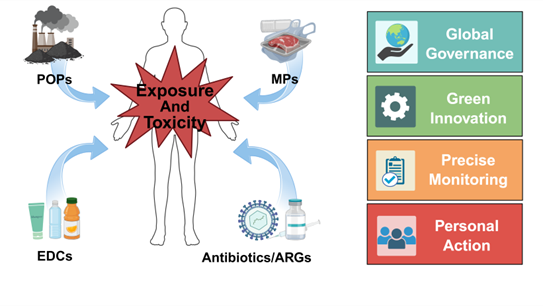
- ECs include four major classes: microplastics, POPs, EDCs, antibiotics and other PPCPs
- Exposure to ECs by ingestion, inhalation, dermal contact and maternal-fetal transfer
- Long-term low-dose exposure threatens endocrine, reproductive, immune systems
- Comprehensive management of ECs from source prevention to personal action
- Open Access
- News & Views
Exposure to Emerging Contaminants and Health Effects: A Stealthy Health Challenge
- Yinfeng Zhou 1,2,†,
- Xiang Yang 1,2,†,
- Yuan Zhang 1,2,
- Jun Ouyang 1,2,
- Yan Xia 1,2,
- Yingxin Yu 1,2,*
Author Information
Received: 08 Dec 2025 | Revised: 21 Jan 2026 | Accepted: 20 Mar 2026 | Published: 02 Apr 2026
Highlights
Abstract
Emerging contaminants have become a major global environmental and health challenge in the 21st century. Based on their core characteristics, they are systematically categorized into four major classes including microplastics, persistent organic pollutants, endocrine disrupting chemicals, antibiotics and other pharmaceuticals and personal care products. This article provides a detailed information on the classification, characteristics, and sources of these pollutants, highlighting their significant cross-cutting nature. It discusses the multi-pathway exposure modes through which they transfer to humans via environmental media and food chains as well as maternal-fetal transfer. Furthermore, it delves into the multiple health threats posed by long-term, low-dose exposure, including impacts on the endocrine, reproductive, developmental, and immune systems, as well as threats arising from the induction of antibiotic resistance. Finally, the article proposes strategies for building a comprehensive “source prevention-process control-end-of-pipe treatment-personal action” management framework from multiple dimensions, including global governance, green innovation, precise monitoring, and personal protection. The results enhance public awareness and provide a scientific perspective and actionable guidance for addressing this stealthy threat. This work serves as an accessible introduction and invaluable resource from a science popularization perspective for individuals at a pivotal stage in their academic or research careers, including senior-year undergraduates, new graduate students, and early-career professionals in connected fields.
Graphical Abstract
Keywords
antibiotics | antibiotic resistance genes | endocrine disrupting chemicals | health risk | microplastics | persistent organic pollutants
References
- 1.
Grennfelt, P.; Engleryd, A.; Forsius, M.; et al. Acid Rain and Air Pollution: 50 Years of Progress in Environmental Science and Policy. Ambio 2020, 49, 849–864.
- 2.
Dameris, M. Depletion of the Ozone Layer in the 21st Century. Angew. Chem. Int. Ed. 2010, 49, 489–491.
- 3.
Schuur, E.A.G.; McGuire, A.D.; Schädel, C.; et al. Climate Change and the Permafrost Carbon Feedback. Nature 2015, 520, 171–179.
- 4.
Diamanti-Kandarakis, E.; Bourguignon, J.P.; Giudice, L.C.; et al. Endocrine-Disrupting Chemicals: An Endocrine Society Scientific Statement. Endocr. Rev. 2009, 30, 293–342.
- 5.
Davies, J.; Davies, D. Origins and Evolution of Antibiotic Resistance. Microbiol. Mol. Biol. Rev. 2010, 74, 417–433.
- 6.
Jones, K.C.; de Voogt, P. Persistent Organic Pollutants (POPs): State of the Science. Environ. Pollut. 1999, 100, 209–221.
- 7.
Li, Y.; Zhang, J.J.; Xu, L.; et al. Leaf Absorption Contributes to Accumulation of Microplastics in Plants. Nature 2025, 641, 666–673.
- 8.
Richardson, S.D. Environmental Mass Spectrometry: Emerging Contaminants and Current Issues. Anal. Chem. 2002, 74, 2719–2741.
- 9.
Yang, H.H.; Kong, L.H.; Chen, Z.Y.; et al. Effect of Functional Groups of Polystyrene Nanoplastics on the Neurodevelopmental Toxicity of Acrylamide in the Early Life Stage of Zebrafish. Aquat. Toxicol. 2025, 278, 107177.
- 10.
Zhang, Q.Q.; Ying, G.G.; Pan, C.G.; et al. Comprehensive Evaluation of Antibiotics Emission and Fate in the River Basins of China: Source Analysis, Multimedia Modeling, and Linkage to Bacterial Resistance. Environ. Sci. Technol. 2015, 49, 6772–6782.
- 11.
Daughton, C.G.; Ternes, T.A. Pharmaceuticals and Personal Care Products in the Environment: Agents of Subtle Change? Environ. Health Perspect. 1999, 107, 907–938.
- 12.
Aoki, Y. Polychlorinated Biphenyls, Polychloronated Dibenzo-p-Dioxins, and Polychlorinated Dibenzofurans as Endocrine Disrupters—What We Have Learned from Yusho Disease. Environ. Res. 2001, 86, 2–11.
- 13.
McKinney, J.D.; Waller, C.L. Polychlorinated Biphenyls as Hormonally Active Structural Analogs. Environ. Health Perspect. 1994, 102, 290–297.
- 14.
Daghrir, R.; Drogui, P. Tetracycline Antibiotics in the Environment: A Review. Environ. Chem. Lett. 2013, 11, 209–227.
- 15.
Debora, J.J.; Vijayalakshmi, V.; Rajaguru, P.; et al. Antibiotic Resistance Genes—An Emerging Genetic Pollutant of LFL. Water Air Soil Pollut. 2024, 235, 348.
- 16.
Eze, C.G.; Nwankwo, C.E.; Dey, S.; et al. Food Chain Microplastics Contamination and Impact on Human Health: A Review. Environ. Chem. Lett. 2024, 22, 1889–1927.
- 17.
Teymourian, T.; Teymoorian, T.; Kowsari, E.; et al. A Review of Emerging PFAS Contaminants: Sources, Fate, Health Risks, and a Comprehensive Assortment of Recent Sorbents for PFAS Treatment by Evaluating Their Mechanism. Res. Chem. Intermed. 2021, 47, 4879–4914.
- 18.
Yu, Y.X.; Pang, Y.P.; Li, C.; et al. Concentrations and Seasonal Variations of Polybrominated Diphenyl Ethers (PBDEs) in In- and Out-House Dust and Human Daily Intake via Dust Ingestion Corrected with Bioaccessibility of PBDEs. Environ. Int. 2012, 42, 124–131.
- 19.
Belleau, P.; Deschênes, A.; Scott-Boyer, M.P.; et al. Inferring and Modeling Inheritance of Differentially Methylated Changes Across Multiple Generations. Nucleic Acids Res. 2018, 46, e85.
- 20.
Mennigen, J.A.; Thompson, L.M.; Bell, M.; et al. Transgenerational Effects of Polychlorinated Biphenyls: 1. Development and Physiology Across 3 Generations of Rats. Environ. Health 2018, 17, 18.
- 21.
Zhang, X.L.; Cheng, X.M.; Lei, B.L.; et al. A Review of the Transplacental Transfer of Persistent Halogenated Organic Pollutants: Transfer Characteristics, Influencing Factors, and Mechanisms. Environ. Int. 2021, 146, 106224.
- 22.
Chaturvedi, P.; Shukla, P.; Giri, B.S.; et al. Prevalence and Hazardous Impact of Pharmaceutical and Personal Care Products and Antibiotics in Environment: A Review on Emerging Contaminants. Environ. Res. 2021, 194, 110664.
- 23.
Petrie, B.; Barden, R.; Kasprzyk-Hordern, B. A Review on Emerging Contaminants in Wastewaters and the Environment: Current Knowledge, Understudied Areas and Recommendations for Future Monitoring. Water Res. 2015, 72, 3–27.
- 24.
Wu, Y.; Jin, R.H.; Chen, Q.Q.; et al. Organic Contaminants of Emerging Concern in Global Estuaries: Environmental Occurrence, Fate, and Bioavailability. Crit. Rev. Environ. Sci. Technol. 2022, 53, 550–575.
- 25.
Ministry of Ecology and Environment of the People’s Republic of China (MEE PRC). Priority Control List of Emerging Contaminants (2023 Version, in Chinese) 2022. Available online: https://www.mee.gov.cn/gzk/gz/202212/t20221230_1009192.shtml (accessed on 17 November 2025).
- 26.
UNEP/POPS/CONF/2. Text of the Stockholm Convention on Persistent Organic Pollutants for Adoption by the Conference of Plenipotentiaries. Stockholm Convention on Persistent Organic Pollutants; 9 March 2001. Available online: https://www.pops.int/Portals/0/docs/from_old_website/documents/meetings/dipcon/meetingdoclist_en.htm (accessed on 17 November 2025)
- 27.
Steenland, K.; Fletcher, T.; Savitz, D.A. Epidemiologic Evidence on the Health Effects of Perfluorooctanoic Acid (PFOA). Environ. Health Perspect. 2010, 118, 1100–1108.
- 28.
Kudo, N.; Kawashima, Y. Toxicity and Toxicokinetics of Perfluorooctanoic Acid in Humans and Animals. J. Toxicol. Sci. 2003, 28, 49–57.
- 29.
Vaalgamaa, S.; Vähätalo, A.V.; Perkola, N.; et al. Photochemical Reactivity of Perfluorooctanoic Acid (PFOA) in Conditions Representing Surface Water. Sci. Total Environ. 2011, 409, 3043–3048.
- 30.
Kelly, B.C.; Ikonomou, M.G.; Blair, J.D.; et al. Food Web-Specific Biomagnification of Persistent Organic Pollutants. Science 2007, 317, 236–239.
- 31.
Miller, M.E.; Hamann, M.; Kroon, F.J. Bioaccumulation and Biomagnification of Microplastics in Marine Organisms: A Review and Meta-Analysis of Current Data. PLoS ONE 2020, 15, e0240792.
- 32.
Moody, C.A.; Martin, J.W.; Kwan, W.C.; et al. Monitoring Perfluorinated Surfactants in Biota and Surface Water Samples Following an Accidental Release of Fire-Fighting Foam into Etobicoke Creek. Environ. Sci. Technol. 2002, 36, 545–551.
- 33.
Evenset, A.; Carroll, J.; Christensen, G.N.; et al. Seabird Guano Is an Efficient Conveyer of Persistent Organic Pollutants (POPs) to Arctic Lake Ecosystems. Environ. Sci. Technol. 2007, 41, 1173–1179.
- 34.
Fernández, P.; Grimalt, J.O. On the Global Distribution of Persistent Organic Pollutants. Chimia 2003, 57, 514–521.
- 35.
Gong, P.; Xu, H.; Wang, C.F.; et al. Persistent Organic Pollutant Cycling in Forests. Nat. Rev. Earth Environ. 2021, 2, 182–197.
- 36.
Corsolini, S.; Kannan, K.; Imagawa, T.; et al. Polychloronaphthalenes and Other Dioxin-Like Compounds in Arctic and Antarctic Marine Food Webs. Environ. Sci. Technol. 2002, 36, 3490–3496.
- 37.
Ma, J.M.; Hung, H.L.; Tian, C.G.; et al. Revolatilization of Persistent Organic Pollutants in the Arctic Induced by Climate Change. Nat. Clim. Chang. 2011, 1, 255–260.
- 38.
Aimuzi, R.; Huang, S.Y.; Luo, K.; et al. Levels and Health Risks of Urinary Phthalate Metabolites and the Association Between Phthalate Exposure and Unexplained Recurrent Spontaneous Abortion: A Large Case-Control Study from China. Environ. Res. 2022, 212, 113393.
- 39.
Cao, Z.X.; Dai, L.L.; Li, J.L.; et al. Reproductive and Germ-Cell Mutagenic Effects of Poly- and Perfluoroalkyl Substances (PFAS) to Caenorhabditis Elegans After Multigenerational Exposure. Sci. Total Environ. 2024, 954, 176224.
- 40.
Tang, Y.; Rong, J.H.; Guan, X.F.; et al. Immunotoxicity of Microplastics and Two Persistent Organic Pollutants Alone or in Combination to a Bivalve Species. Environ. Pollut. 2020, 258, 113845.
- 41.
UNEP/POPS/COP.4/17. Recommendations of the Persistent Organic Pollutants Review Committee of the Stockholm Convention to Amend Annexes A, B or C of the Convention. Stockholm Convention on Persistent Organic Pollutants; 4 February 2009. Available online: https://chm.pops.int/portals/0/repository/cop4/unep-pops-cop.4-17.english.pdf (accessed on 17 November 2025)
- 42.
UNEP/POPS/COP.4/38. Report of the Conference of the Parties of the Stockholm Convention on Persistent Organic Pollutants on the Work of Its Fourth Meeting. Stockholm Convention on Persistent Organic Pollutants; 8 May 2009. Available online: https://chm.pops.int/portals/0/repository/cop4/unep-pops-cop.4-38.english.pdf (accessed on 17 November 2025)
- 43.
UNEP/POPS/COP.9/30. Report of the Conference of the Parties to the Stockholm Convention on Persistent Organic Pollutants on the work of its ninth meeting. Stockholm Convention on Persistent Organic Pollutants; 27 June 2019. Available online: https://chm.pops.int/Portals/0/download.aspx?d=UNEP-POPS-COP.9-30.English.pdf (accessed on 17 November 2025)
- 44.
UNEP/POPS/COP.10/33. Report of the Conference of the Parties to the Stockholm Convention on Persistent Organic Pollutants on the work of its tenth meeting. Stockholm Convention on Persistent Organic Pollutants; 25 August 2021. Available online: https://chm.pops.int/Portals/0/download.aspx?d=UNEP-POPS-COP.10-33.English.pdf (accessed on 17 November 2025)
- 45.
Cao, J.; Ma, W.H.; Gao, Y.P.; et al. Derivation of the Oral Reference Dose (RfD) for Bisphenol S and Bisphenol F Based on Epidemiological and Experimental Studies. Ecotoxicol. Environ. Saf. 2025, 293, 118045.
- 46.
Sánchez-Ocaña, M.; de Porras, V.R. Environmental Endocrine Disruptors and Breast Cancer: The Role of Bisphenols, Polychlorinated Biphenyls, Parabens, and Dioxins. Environ. Toxicol. Pharmacol. 2025, 119, 104834.
- 47.
Pan, K.; Xu, J.; Li, F.; et al. The Relationship Between Metabolic Syndrome and Environmental Endocrine Disruptors: A Systematic Review and Meta-Analysis. iScience 2025, 28, 112907.
- 48.
Dhar, S.; Das, A.; Bhattacharjee, P. A Population-Based Study to Understand the Association Between Bisphenol-A (BPA) and Polycystic Ovarian Syndrome (PCOS): Correlating with Anthropometric Parameters and Clinical Features. Environ. Geochem. Health 2025, 47, 277.
- 49.
Reyaz, A.; Javaid, D.; Qadri, S.S.; et al. Bisphenol A and Reproductive Health: A Comprehensive Overview of Toxicological Effect. Toxicol. Res. 2025, 41, 553–567.
- 50.
McLachlan, J.A. Environmental Signaling: What Embryos and Evolution Teach Us About Endocrine Disrupting Chemicals. Endocr. Rev. 2001, 22, 319–341.
- 51.
Zhang, J.L.; Zhang, N.; Mai, Q.Y.; et al. Mechanisms and Rescue Measures of Female Ovarian Dysfunction Induced by Environmental Endocrine Chemicals: A Review. Reprod. Toxicol. 2025, 135, 108954.
- 52.
Silori, R.; Shrivastava, V.; Singh, A.; et al. Global Groundwater Vulnerability for Pharmaceutical and Personal Care Products (PPCPs): The Scenario of Second Decade of 21st Century. J. Environ. Manag. 2022, 320, 115703.
- 53.
Fleming, A. On the Antibacterial Action of Cultures of a Penicillium, With Special Reference to Their Use in the Isolation of B. Influenzae. Br. J. Exp. Pathol. 1929, 10, 226–236.
- 54.
Sköld, O. Resistance to Trimethoprim and Sulfonamides. Vet. Res. 2001, 32, 261–273.
- 55.
Tatsuta, K. Total Synthesis of the Big Four Antibiotics and Related Antibiotics. J. Antibiot. 2013, 66, 107–129.
- 56.
Li, L.; Wang, Q.Y.; Zhang, H.; et al. Sensor Histidine Kinase Is a β-Lactam Receptor and Induces Resistance to β-Lactam Antibiotics. Proc. Natl. Acad. Sci. USA. 2016, 113, 1648–1653.
- 57.
Hoffman, L.R.; D’Argenio, D.A.; MacCoss, M.J.; et al. Aminoglycoside Antibiotics Induce Bacterial Biofilm Formation. Nature 2005, 436, 1171–1175.
- 58.
Nguyen, F.; Starosta, A.L.; Arenz, S.; et al. Tetracycline Antibiotics and Resistance Mechanisms. Biol. Chem. 2014, 395, 559–575.
- 59.
Masadeh, M.M.; Alzoubi, K.H.; Al-azzam, S.I.; et al. Ciprofloxacin-Induced Antibacterial Activity Is Attenuated by Pretreatment with Antioxidant Agents. Pathogens 2016, 5, 28.
- 60.
Achermann, S.; Bianco, V.; Mansfeldt, C.B.; et al. Biotransformation of Sulfonamide Antibiotics in Activated Sludge: The Formation of Pterin-Conjugates Leads to Sustained Risk. Environ. Sci. Technol. 2018, 52, 6265–6274.
- 61.
Hamid, I.; Khanday, W.A. Recent Advances in Antibiotic Removal Methods from Wastewater: A Comprehensive Review. Sep. Purif. Technol. 2025, 381, 135478.
- 62.
de Kraker, M.E.A.; Stewardson, A.J.; Harbarth, S. Will 10 Million People Die a Year Due to Antimicrobial Resistance by 2050? PLOS Med. 2016, 13, e1002184.
- 63.
Fan, L.; Chen, C.; Zhang, H.J.; et al. Atmospheric Detection, Prevalence, Transmission, Health and Ecological Consequences of Antibiotic Resistance Genes and Resistant Bacteria: A Comprehensive Review. Emerg. Contam. 2025, 11, 100514.
- 64.
Lertcanawanichakul, M.; Bhoopong, P.; Horpet, P. Mangrove Ecosystems as Reservoirs of Antibiotic Resistance Genes: A Narrative Review. Antibiotics 2025, 14, 1022.
- 65.
Ukachi, U.O.; Rajasekar, A.; Gao, B.; et al. Dynamics and Mitigation of Antibiotic Resistance Genes During Manure Composting: A Comprehensive Review. Ecotoxicol. Environ. Saf. 2025, 304, 119152.
- 66.
Zhu, Y.G.; Johnson, T.A.; Su, J.Q.; et al. Diverse and Abundant Antibiotic Resistance Genes in Chinese Swine Farms. Proc. Natl. Acad. Sci. USA 2013, 110, 3435–3440.
- 67.
Kazemzadeh, S.; Korneeva, O.; Shabunin, S.; et al. Antibiotic Resistance in Mastitis-Causing Bacteria: Exploring Antibiotic-Resistance Genes, Underlying Mechanisms, and Their Implications for Dairy Animal and Public Health. Open Vet. J. 2025, 15, 3980–4006.
- 68.
Li, J.P.; Li, W.; Liu, K.; et al. Global Review of Macrolide Antibiotics in the Aquatic Environment: Sources, Occurrence, Fate, Ecotoxicity, and Risk Assessment. J. Hazard. Mater. 2022, 439, 129628.
- 69.
Zeng, Y.B.; Chang, F.Q.; Liu, Q.; et al. Recent Advances and Perspectives on the Sources and Detection of Antibiotics in Aquatic Environments. J. Anal. Methods Chem. 2022, 2022, 5091181.
- 70.
Carpenter, E.J.; Anderson, S.J.; Harvey, G.R.; et al. Polystyrene Spherules in Coastal Waters. Science 1972, 178, 749–750.
- 71.
Thompson, R.C.; Olsen, Y.; Mitchell, R.P.; et al. Lost at Sea: Where Is All the Plastic? Science 2004, 304, 838.
- 72.
Canga, E.M.; Gowen, A.; Xu, J.L. Assessing the Inconsistency of Microplastic Measurements in Foods and Beverages. Compr. Rev. Food Sci. Food Saf. 2024, 23, e13315.
- 73.
Keller, A.S.; Jimenez-Martinez, J.; Mitrano, D.M. Transport of Nano- and Microplastic Through Unsaturated Porous Media from Sewage Sludge Application. Environ. Sci. Technol. 2020, 54, 911–920.
- 74.
Leslie, H.A.; van Velzen, M.J.M.; Brandsma, S.H.; et al. Discovery and Quantification of Plastic Particle Pollution in Human Blood. Environ. Int. 2022, 163, 107199.
- 75.
Yang, S.Y.; Lu, X.H.; Peng, Y.F.; et al. Microplastic Emission from Soil-Air Interface. Environ. Sci. Technol. Lett. 2024, 11, 1207–1213.
- 76.
Arthur, C.; Baker, J.; Bamford, H. NOAA Technical Memorandum NOS-OR&R-30. In Proceedings of the International Research Workshop on the Occurrence, Effects, and Fate of Microplastic Marine Debris; Tacoma, WA, USA, 9–11 September 2008.
- 77.
Thompson, R.C.; Courtene-Jones, W.; Boucher, J.; et al. Twenty Years of Microplastic Pollution Research-What Have We Learned? Science 2024, 386, eadl2746.
- 78.
de Bruin, C.R.; de Rijke, E.; van Wezel, A.P.; et al. Methodologies to Characterize, Identify and Quantify Nano- and Sub-Micron Sized Plastics in Relevant Media for Human Exposure: A Critical Review. Environ. Sci. Adv. 2022, 1, 238–258.
- 79.
Ali, N.; Khan, M.H.; Ali, M.; et al. Insight into Microplastics in the Aquatic Ecosystem: Properties, Sources, Threats and Mitigation Strategies. Sci. Total Environ. 2024, 913, 169489.
- 80.
Li, M.Z.; Ma, W.H.; Fang, J.K.H.; et al. A Review on the Combined Toxicological Effects of Microplastics and Their Attached Pollutants. Emerg. Contam. 2025, 11, 100486.
- 81.
Wu, J.; Lu, J.; Wu, J. Effect of Gastric Fluid on Adsorption and Desorption of Endocrine Disrupting Chemicals on Microplastics. Front. Environ. Sci. Eng. 2022, 16, 104.
- 82.
Napper, I.E.; Davies, B.F.R.; Clifford, H.; et al. Reaching New Heights in Plastic Pollution-Preliminary Findings of Microplastics on Mount Everest. One Earth 2020, 3, 621–630.
- 83.
Peng, X.; Chen, M.; Chen, S.; et al. Microplastics Contaminate the Deepest Part of the World’s Ocean. Geochem. Perspect. Lett. 2018, 9, 1–5.
- 84.
D’Angelo, A.; Trenholm, N.; Loose, B.; et al. Microplastics Distribution Within Western Arctic Seawater and Sea Ice. Toxics 2023, 11, 792.
- 85.
Yoo, H.; Park, P.; Le, Y.T.H.; et al. Characterization of Tire and Road Wear Microplastics and Phthalates in Inhalable PM10 Road Dust: Implications for Urban Air Pollution. Environ. Pollut. 2025, 384, 126991.
- 86.
Zhang, Y.Y.; Li, G.Y.; Gu, J.W.; et al. Advancing Health Risk Assessment: Integrating Exposure Routes and Bioavailability to Quantify Internal Dose. Glob. Environ. Sci. 2025, 1, 157–163.
- 87.
Sharma, B.M.; Bharat, G.K.; Tayal, S.; et al. Environment and Human Exposure to Persistent Organic Pollutants (POPs) in India: A Systematic Review of Recent and Historical Data. Environ. Int. 2014, 66, 48–64.
- 88.
Di Duca, F.; Montuori, P.; De Rosa, E.; et al. Occurrence of Volatile Organic Compounds (VOCs) and Phthalate Acid Esters (PAEs) in Recycled PET: Implications for Food Packaging Materials. J. Chromatogr. A 2025, 1763, 466433.
- 89.
Munguía-López, E.M.; Gerardo-Lugo, S.; Peralta, E.; et al. Migration of Bisphenol A (BPA) From Can Coatings into a Fatty-Food Simulant and Tuna Fish. Food Addit. Contam. Part A 2005, 22, 892–898.
- 90.
Christou, A.; Agüera, A.; Bayona, J.M.; et al. The Potential Implications of Reclaimed Wastewater Reuse for Irrigation on the Agricultural Environment: The Knowns and Unknowns of the Fate of Antibiotics and Antibiotic Resistant Bacteria and Resistance Genes—A Review. Water Res. 2017, 123, 448–467.
- 91.
Shamsizadeh, Z.; Ehrampoush, M.H.; Nikaeen, M.; et al. Antibiotic Resistance and Class 1 Integron Genes Distribution in Irrigation Water-Soil-Crop Continuum as a Function of Irrigation Water Sources. Environ. Pollut. 2021, 289, 117930.
- 92.
Ali, I.; Ding, T.D.; Peng, C.S.; et al. Micro- and Nanoplastics in Wastewater Treatment Plants: Occurrence, Removal, Fate, Impacts and Remediation Technologies—A Critical Review. Chem. Eng. J. 2021, 423, 130205.
- 93.
Li, J.C.; Zhao, L.; Feng, M.B.; et al. Abiotic Transformation and Ecotoxicity Change of Sulfonamide Antibiotics in Environmental and Water Treatment Processes: A Critical Review. Water Res. 2021, 202, 117463.
- 94.
Zhang, J.J.; Peng, M.; Lian, E.K.; et al. Identification of Poly(Ethylene Terephthalate) Nanoplastics in Commercially Bottled Drinking Water Using Surface-Enhanced Raman Spectroscopy. Environ. Sci. Technol. 2023, 57, 8365–8372.
- 95.
Zhu, X.; Huang, W.; Fang, M.Z.; et al. Airborne Microplastic Concentrations in Five Megacities of Northern and Southeast China. Environ. Sci. Technol. 2021, 55, 12871–12881.
- 96.
Borthakur, A.; Leonard, J.; Koutnik, V.S.; et al. Inhalation Risks of Wind-Blown Dust from Biosolid-Applied Agricultural Lands: Are They Enriched with Microplastics and PFAS? Curr. Opin. Environ. Sci. Health 2022, 25, 100309.
- 97.
Mohankumar, T.; Venugopal, D.; Beerappa, R.; et al. Assessment of Polychlorinated Biphenyls (PCBs) in Ambient Air and Its Health Risk Evaluation in an Urban City, Bangalore, India. Atmos. Environ. X 2025, 28, 100371.
- 98.
Sangkham, S.; Phairuang, W.; Pansakun, N.; et al. Specific Ambient PM2.5-Bound Perfluoroalkyl and Polyfluoroalkyl Substances (PFAS): A Prominent Human Health Risk Issue That Deserves Attention? Environ. Sci. Technol. 2025, 59, 14780–14783.
- 99.
Li, H.R.; Zhou, L.; Ren, M.; et al. Levels, Profiles and Gas-Particle Distribution of Atmospheric PCDD/Fs in Vehicle Parking Lots of a South China Metropolitan Area. Chemosphere 2013, 94, 128–134.
- 100.
Liao, C.Y.; Kannan, K. High Levels of Bisphenol A in Paper Currencies from Several Countries, and Implications for Dermal Exposure. Environ. Sci. Technol. 2011, 45, 6761–6768.
- 101.
Ugranli, T.; Gungormus, E.; Kavcar, P.; et al. POPs in a Major Conurbation in Turkey: Ambient Air Concentrations, Seasonal Variation, Inhalation and Dermal Exposure, and Associated Carcinogenic Risks. Environ. Sci. Pollut. Res. 2016, 23, 22500–22512.
- 102.
Thayer, K.A.; Taylor, K.W.; Garantziotis, S.; et al. Bisphenol A, Bisphenol S, and 4-Hydroxyphenyl 4-Isoprooxyphenylsulfone (BPSIP) in Urine and Blood of Cashiers. Environ. Health Perspect. 2016, 124, 437–444.
- 103.
Weschler, C.J.; Bekö, G.; Koch, H.M.; et al. Transdermal Uptake of Diethyl Phthalate and Di(n-Butyl) Phthalate Directly from Air: Experimental Verification. Environ. Health Perspect. 2015, 123, 928–934.
- 104.
Poothong, S.; Padilla-Sánchez, J.A.; Papadopoulou, E.; et al. Hand Wipes: A Useful Tool for Assessing Human Exposure to Poly- and Perfluoroalkyl Substances (PFASs) Through Hand-to-Mouth and Dermal Contacts. Environ. Sci. Technol. 1999, 53, 1985–1993.
- 105.
Watkins, D.J.; McClean, M.D.; Fraser, A.J.; et al. Exposure to PBDEs in the Office Environment: Evaluating the Relationships Between Dust, Handwipes, and Serum. Environ. Health Perspect. 2011, 119, 1247–1252.
- 106.
Tang, J.; Lin, M.Q.; Ma, S.T.; et al. Identifying Dermal Uptake as Significant Pathway for Human Exposure to Typical SVOCs in an E-Waste Dismantling Site: The Relationship of Contaminant Levels in Handwipes and Urine Metabolites. Environ. Sci. Technol. 2021, 55, 14026–14036.
- 107.
Tang, J.; Ma, S.T.; Hu, X.; et al. Handwipes as Indicators to Assess Organophosphate Flame Retardants Exposure and Thyroid Hormone Effects in E-Waste Dismantlers. J. Hazard. Mater. 2022, 443, 130248.
- 108.
Sadique, S.A.; Konarova, M.; Niu, X.F.; et al. Impact of Microplastics and Nanoplastics on Human Health: Emerging Evidence and Future Directions. Emerg. Contam. 2025, 11, 100545.
- 109.
Li, X.Y.; Sun, H.W.; Yao, Y.M.; et al. Distribution of Phthalate Metabolites Between Paired Maternal-Fetal Samples. Environ. Sci. Technol. 2018, 52, 6626–6635.
- 110.
Pacifici, G.M. Placental Transfer of Antibiotics Administered to the Mother: A Review. Int. J. Clin. Pharmacol. Ther. 2006, 44, 57–63.
- 111.
Zhang, B.; He, Y.A.; Zhu, H.K.; et al. Concentrations of Bisphenol A and Its Alternatives in Paired Maternal-Fetal Urine, Serum and Amniotic Fluid from an E-Waste Dismantling Area in China. Environ. Int. 2020, 136, 105407.
- 112.
Yu, Y.X.; Li, X.J.; Hu, J.J.; et al. Mechanisms of Transplacental Transport and Barrier of Polybrominated Diphenyl Ethers: A Comprehensive Human, Sprague-Dawley Rat, BeWo Cell and Molecular Docking Study. Environ. Pollut. 2021, 270, 116091.
- 113.
Dai, Y.H.; Han, R.; Yao, Z.M.; et al. Intergenerational Transfer of Micro(Nano)Plastics in Different Organisms. J. Hazard. Mater. 2025, 488, 137404.
- 114.
Ragusa, A.; Svelato, A.; Santacroce, C.; et al. Plasticenta: First Evidence of Microplastics in Human Placenta. Environ. Int. 2021, 146, 106274.
- 115.
Merzenich, H.; Zeeb, H.; Blettner, M. Decreasing Sperm Quality: A Global Problem? BMC Public Health 2010, 10, 24.
- 116.
Giannandrea, F.; Gandini, L.; Paoli, D.; et al. Pesticide Exposure and Serum Organochlorine Residuals among Testicular Cancer Patients and Healthy Controls. J. Environ. Sci. Health Part B 2011, 46, 780–787.
- 117.
Holmboe, S.A.; Beck, A.L.; Andersson, A.M.; et al. The Epidemiology of Cryptorchidism and Potential Risk Factors, Including Endocrine Disrupting Chemicals. Front. Endocrinol. 2024, 15, 1343887.
- 118.
Knez, J. Endocrine-Disrupting Chemicals and Male Reproductive Health. Reprod. Biomed. Online 2013, 26, 440–448.
- 119.
Thacharodi, A.; Hassan, S.; Acharya, G.; et al. Endocrine Disrupting Chemicals and Their Effects on the Reproductive Health in Men. Environ. Res. 2023, 236, 116825.
- 120.
Colino, S. Girls Are Going Through Puberty Much Earlier. There May Be Several Reasons Why. 2024. Available online: https://www.nationalgeographic.com/science/article/early-puberty-mental-physical-health (accessed on 19 November 2025).
- 121.
Eve, L.; Fervers, B.; Le Romancer, M.; et al. Exposure to Endocrine Disrupting Chemicals and Risk of Breast Cancer. Int. J. Mol. Sci. 2020, 21, 9139.
- 122.
Palioura, E.; Diamanti-Kandarakis, E. Polycystic Ovary Syndrome (PCOS) and Endocrine Disrupting Chemicals (EDCs). Rev. Endocr. Metab. Disord. 2015, 16, 365–371.
- 123.
Zhu, X.D.; Liu, M.X.; Dong, R.X.; et al. Mechanism Exploration of Environmental Pollutants on Premature Ovarian Insufficiency: A Systematic Review and Meta-Analysis. Reprod. Sci. 2024, 31, 99–106.
- 124.
Lismer, A.; Shao, X.J.; Dumargne, M.C.; et al. The Association Between Long-Term DDT or DDE Exposures and an Altered Sperm Epigenome-a Cross-Sectional Study of Greenlandic Inuit and South African VhaVenda Men. Environ. Health Perspect. 2024, 132, 017008.
- 125.
Wilkinson, J.L.; Hooda, P.S.; Barker, J.; et al. Ecotoxic Pharmaceuticals, Personal Care Products, and Other Emerging Contaminants: A Review of Environmental, Receptor-Mediated, Developmental, and Epigenetic Toxicity with Discussion of Proposed Toxicity to Humans. Crit. Rev. Environ. Sci. Technol. 2016, 46, 336–381.
- 126.
Govarts, E.; Nieuwenhuijsen, M.; Schoeters, G.; et al. Birth Weight and Prenatal Exposure to Polychlorinated Biphenyls (PCBs) and Dichlorodiphenyldichloroethylene (DDE): A Meta-Analysis Within 12 European Birth Cohorts. Environ. Health Perspect. 2012, 120, 162–170.
- 127.
Lee, D.H.; Porta, M.; Jacobs, D.R.; et al. Chlorinated Persistent Organic Pollutants, Obesity, and Type 2 Diabetes. Endocr. Rev. 2014, 35, 557–601.
- 128.
Yang, C.X.; Kong, A.P.S.; Cai, Z.W.; et al. Persistent Organic Pollutants as Risk Factors for Obesity and Diabetes. Curr. Diabetes Rep. 2017, 17, 132.
- 129.
Ghassabian, A.; Trasande, L. Disruption in Thyroid Signaling Pathway: A Mechanism for the Effect of Endocrine-Disrupting Chemicals on Child Neurodevelopment. Front. Endocrinol. 2018, 9, 204.
- 130.
Morales-Grahl, E.; Hilz, E.N.; Gore, A.C. Regrettable Substitutes and the Brain: What Animal Models and Human Studies Tell Us About the Neurodevelopmental Effects of Bisphenol, Per- and Polyfluoroalkyl Substances, and Phthalate Replacements. Int. J. Mol. Sci. 2024, 25, 6887.
- 131.
Yeo, K.E.; Lim, S.; Kim, A.; et al. Association Between Endocrine-Disrupting Chemicals Exposure and Attention-Deficit/Hyperactivity Disorder Symptoms in Children with Attention-Deficit/ Hyperactivity Disorder. J. Korean Acad. Child Adolesc. Psychiatry 2025, 36, 18–25.
- 132.
Inta, I.; Hoffmann, G.F.; Bettendorf, M. Pediatric Use of Tetracyclines: Focus on Neurodevelopmental Effects. Pediatr. Res. 2017, 82, 725–726.
- 133.
Ehrlich, V.; Bil, W.; Vandebriel, R.; et al. Consideration of Pathways for Immunotoxicity of Per- and Polyfluoroalkyl Substances (PFAS). Environ. Health 2023, 22, 19.
- 134.
Yang, W.J.; Jannatun, N.; Zeng, Y.Q.; et al. Impacts of Microplastics on Immunity. Front. Toxicol. 2022, 4, 956885.
- 135.
Lacaze, E.; Pédelucq, J.; Fortier, M.; et al. Genotoxic and Immunotoxic Potential Effects of Selected Psychotropic Drugs and Antibiotics on Blue Mussel (Mytilus Edulis) Hemocytes. Environ. Pollut. 2015, 202, 177–186.
- 136.
Yeoh, C.S.L.; Alrazihi, L.A.; Wong, S.T.; et al. Per- and Poly-Fluoroalkyl Substances (PFAS) and Human Health: A Review of Exposure Routes and Potential Toxicities Across the Lifespan. Environ. Toxicol. Chem. 2025, 44, 2754–2786.
- 137.
Blumenthal, K.G.; Peter, J.G.; Trubiano, J.A.; et al. Antibiotic Allergy. Lancet 2019, 393, 183–198.
- 138.
Casas, M.; Gascon, M. Prenatal Exposure to Endocrine-Disrupting Chemicals and Asthma and Allergic Diseases. J. Investig. Allergol. Clin. Immunol. 2020, 30, 215–228.
- 139.
Zhang, L.; Chen, W.Q.; Han, X.Y.; et al. Benzo(a)Pyrene Exposure During Pregnancy Leads to Germ Cell Apoptosis in Male Mice Offspring via Affecting Histone Modifications and Oxidative Stress Levels. Sci. Total Environ. 2024, 952, 175877.
- 140.
Im, H.; Lee, J.; Oh, J.E.; et al. Epigenetic and Gene Expression Responses of Daphnia Magna to Polyethylene and Polystyrene Microplastics. Molecules 2025, 30, 1608.
- 141.
International Agency for Research on Cancer (IARC). List of Classifications by Cancer Sites with Sufficient or Limited Evidence in Humans, IARC Monographs Volumes 1–140. Available online: https://monographs.iarc.who.int/wp-content/uploads/2019/07/Classifications_by_cancer_site.pdf (accessed on 19 November 2025).
- 142.
Founou, L.L.; Founou, R.C.; Essack, S.Y. Antibiotic Resistance in the Food Chain: A Developing Country-Perspective. Front. Microbiol. 2016, 7, 1881.
- 143.
Rehman, S.U.; Tariq, H.; Evans, A.; et al. Reduction of Salmonella Gallinarum in Poultry with Phage-Based Interventions. Sci. Rep. 2025, 15, 35617.
- 144.
World Health Organization (WHO). Newsroom: Urgent Health Challenges for the Next Decade; 13 January 2020; WHO: Geneva, Switzerland, 2020.
- 145.
Zhou, R.; Cheng, W.; Feng, Y.; et al. Interactions Between Three Typical Endocrine-Disrupting Chemicals (EDCs) in Binary Mixtures Exposure on Myocardial Differentiation of Mouse Embryonic Stem Cell. Chemosphere 2017, 178, 378–383.
- 146.
Yap, J.K.Y.; Tan, S.Y.Y.; Tang, S.Q.; et al. Synergistic Antibacterial Activity Between 1,4-Naphthoquinone and β-Lactam Antibiotics Against Methicillin-Resistant Staphylococcus Aureus. Microb. Drug Resist. 2021, 27, 234–240.
- 147.
Yoshinori, N. Mechanisms of Bacterial Resistance to Macrolide Antibiotics. J. Infect. Chemother. 1999, 5, 61–74.
- 148.
Hamid, N.; Junaid, M.; Pei, D.S. Combined Toxicity of Endocrine-Disrupting Chemicals: A Review. Ecotoxicol. Environ. Saf. 2021, 215, 112136.
- 149.
Cedergreen, N.; Christensen, A.M.; Kamper, A.; et al. A Review of Independent Action Compared to Concentration Addition as Reference Models for Mixtures of Compounds with Different Molecular Target Sites. Environ. Toxicol. Chem. 2008, 27, 1621–1632.
- 150.
Ermler, S.; Kortenkamp, A. Declining Semen Quality and Polybrominated Diphenyl Ethers (PBDEs): Review of the Literature to Support the Derivation of a Reference Dose for a Mixture Risk Assessment. Int. J. Hyg. Environ. Health 2022, 242, 113953.
- 151.
Shah, A.; Coburn, C.G.; Watson-Siriboe, A.; et al. Altered Cardiovascular Reactivity and Osmoregulation During Hyperosmotic Stress in Adult Rats Developmentally Exposed to Polybrominated Diphenyl Ethers (PBDEs). Toxicol. Appl. Pharmacol. 2011, 256, 103–113.
- 152.
Zhang, Y.; Xie, J.H.; Ouyang, Y.X.; et al. Adverse Outcome Pathways of PBDEs Inducing Male Reproductive Toxicity. Environ. Res. 2024, 240, 117598.
- 153.
Ministry of Ecology and Environment of the People’s Republic of China (MEEPRC). Action Plan for the Management of Emerging Contaminants. 2022. Available online: https://www.mee.gov.cn/zcwj/gwywj/202205/t20220524_983032.shtml (accessed on 17 November 2025).
- 154.
Bridges, J.W.; Greim, H.; van Leeuwen, K.; et al. Is the EU Chemicals Strategy for Sustainability a Green Deal? Regul. Toxicol. Pharmacol. 2023, 139, 105356.
How to Cite
Zhou, Y.; Yang, X.; Zhang, Y.; Ouyang, J.; Xia, Y.; Yu, Y. Exposure to Emerging Contaminants and Health Effects: A Stealthy Health Challenge. Global Environmental Science 2026, 2 (2), 128–144. https://doi.org/10.53941/ges.2026.100010.
RIS
BibTex
Copyright & License

Copyright (c) 2026 by the authors.
This work is licensed under a Creative Commons Attribution 4.0 International License.
Article Metrics
333
Article Views
7
Citations
Contents
References

 Suite 4002 Level 4, 447 Collins Street, Melbourne, Victoria 3000, Australia
 General Inquiries: info@sciltp.com