
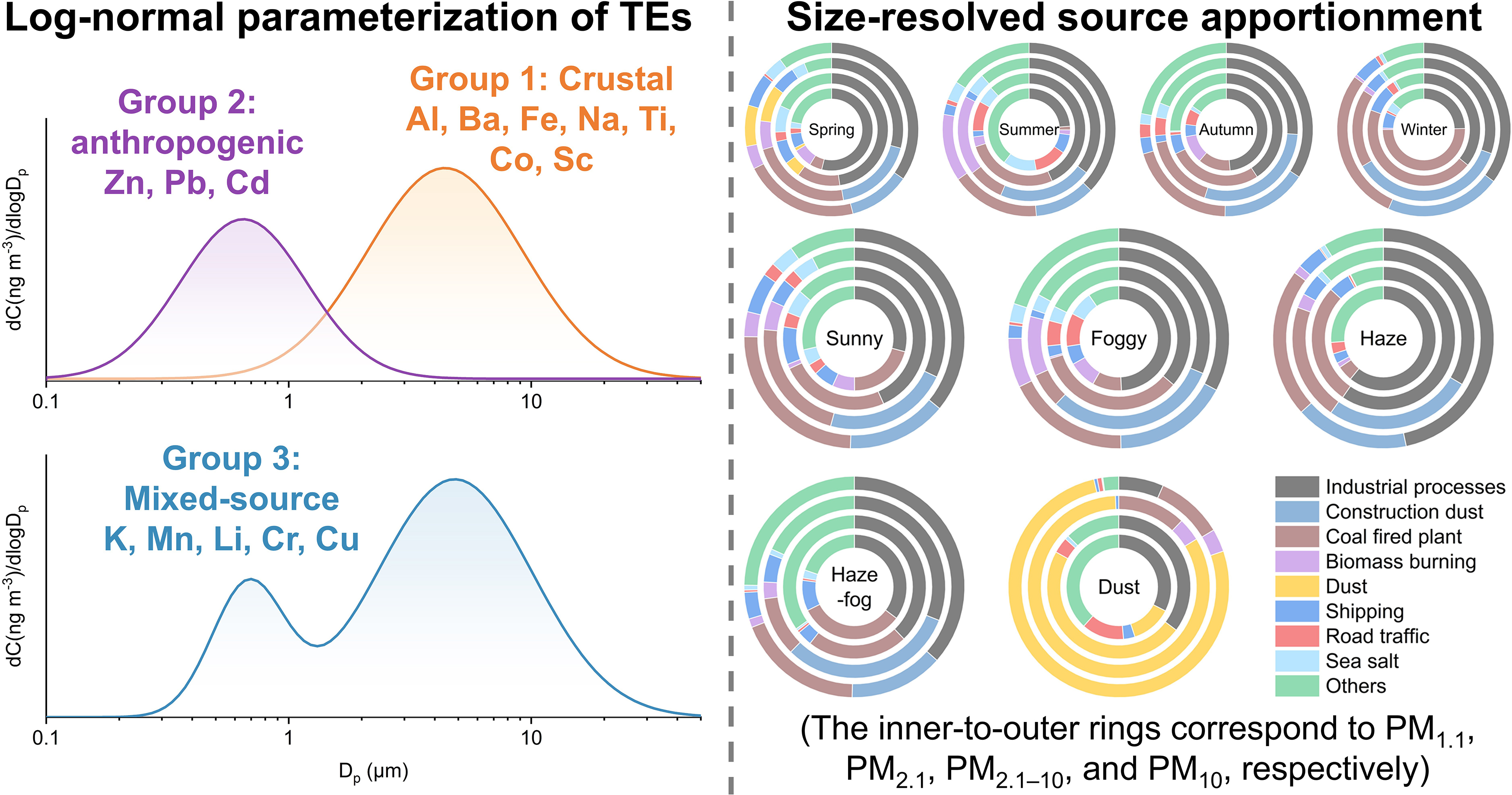
- Metals from crustal, anthropogenic and mixed source exhibited distinct size distributions
- Crustal and mixed-source metals exhibit greater seasonal variability in size distributions than anthropogenic metals
- Dust had the greatest impact on the metal particle size distribution
- Primary sources contributions for PM varied with particle size, season and weather conditions
- Open Access
- Article
Size Distribution and Source Apportionment of Trace Metal Elements in the Atmospheric Aerosols in a Coastal City, Northern China
- Ziyan Xi 1,2,
- Jianhua Qi 3,4,*,
- Yuanzhe Ni 1,3,
- Zengjie Zuo 5,
- Xuehui Lin 6
Author Information
Received: 17 Dec 2025 | Revised: 09 Mar 2026 | Accepted: 01 Apr 2026 | Published: 13 Apr 2026
Highlights
Abstract
Size-resolved aerosol samples of trace elements (TEs) were measured in a Chinese coastal city, from May 2015 to April 2016. Based on enrichment factors and positive matrix factorization (PMF), TEs were grouped into crustal (Al, Ba, Fe, Na, Ti, Co, Sc), anthropogenic (Zn, Pb, Cd), and mixed-source elements (K, Mn, Li, Cr, Cu). Crustal elements generally dominated the coarse mode (3.3–4.7 μm), with a notable shift toward larger particles (4.4–7.0 μm) in winter. Na exhibited seasonal distributions: tri-modal in summer (0.65–1.1, 3.3–4.7, and 7.0–11 μm), broad unimodal in spring (2.1–7.0 μm), and bimodal patterns in fall (2.1–3.3 and >11 μm) and winter (3.3–4.7 and 7.0–11 μm). Anthropogenic metals (Pb and Cd) generally peaked at 0.43–0.65 μm, with the peak shifting to 0.65–1.1 μm in summer. Mixed-source elements (K, Mn, Li) maintained a stable bimodal distribution (0.43–0.65 μm, 3.3–4.7 μm) across seasons. Dust events shifted peak positions and elevated overall loadings, while haze-fog (HF) conditions predominantly enhanced TEs concentrations in the fine mode. Chemical Mass Balance (CMB) model identified primary sources for PM1.1, PM2.1, PM2.1–10 and PM10, including industrial processes, construction dust, coal-fired plants, biomass burning, dust, shipping, road traffic, sea salt, and other unidentified sources, with contributions varying with particle size, season and weather conditions. Our results demonstrated that TEs size distribution were shaped by the combined effects of source and meteorology, and that derived log-normal parameterizations provided size-resolved constraints for aerosol transport, deposition, and health risk assessments.
Graphical Abstract
Keywords
metal | size distribution | seasonal variation | pollution event | source apportionment
References
- 1.
Lelieveld, J.; Evans, J.S.; Fnais, M.; et al. The Contribution of Outdoor Air Pollution Sources to Premature Mortality on a Global Scale. Nature 2015, 525, 367–371.
- 2.
Roy, A.; Mandal, M.; Das, S.; et al. Non-Exhaust Particulate Pollution in Asian Countries: A Comprehensive Review of Sources, Composition, and Health Effects. Environ. Eng. Res. 2023, 29, 230384.
- 3.
Leng, W.; Li, L.; Liu, H.J.; et al. Source-Specific Risks of Heavy Metals in Urban–Agricultural Soils and Implications for Human Health in a Liver Cancer High-Incidence Area of Central China. J. Clean. Prod. 2026, 554, 148109.
- 4.
Calderón-Garcidueñas, L.; Herrera-Soto, A.; Jury, N.; et al. Reduced Repressive Epigenetic Marks, Increased DNA Damage and Alzheimer’s Disease Hallmarks in the Brain of Humans and Mice Exposed to Particulate Urban Air Pollution. Environ. Res. 2020, 183, 109226.
- 5.
Zhang, S.; Li, D.; Ge, S.; et al. Elucidating the Mechanism on the Transition-Metal Ion-Synergetic-Catalyzed Oxidation of SO2 with Implications for Sulfate Formation in Beijing Haze. Environ. Sci. Technol. 2024, 58, 2912–2921.
- 6.
Lin, M.; Yu, J.Z. Oxidative Potential of Atmospheric Particulate Matter: A Review of the Role of Metal-Organic Interactions, Mechanistic Insights, and Key Determinants. Environ. Sci. Technol. 2026, 60, 1546–1559.
- 7.
He, L.; Wang, S.; Liu, M.; et al. Transport and Transformation of Atmospheric Metals in Ecosystems: A Review. J. Hazard. Mater. Adv. 2023, 9, 100218.
- 8.
Lampe, R.H.; Coale, T.H.; McQuaid, J.B.; et al. Molecular Mechanisms for Iron Uptake and Homeostasis in Marine Eukaryotic Phytoplankton. Annu. Rev. Microbiol. 2024, 78, 213–232.
- 9.
Deng, S.; Wang, W.-X. Copper Toxicity in Acidic Phytoplankton: Impacts of Labile Cu Trafficking and Causes of Mitochondria Dysfunction. Environ. Sci. Technol. 2024, 58, 16142–16152.
- 10.
Hua, K.; Chen, R.; Zhang, B.; et al. Metal Bioaccessibility in Size-Resolved Atmospheric Particles: Source and Aging Impacts. Environ. Int. 2025, 198, 109425.
- 11.
Cao, R.; Meng, F.; Mila, A.; et al. Size Distribution and Source-Specific Risks of Atmospheric Elements in Dalian, a Coastal City in North China. Atmos. Environ. 2024, 326, 120456.
- 12.
Boreddy, S.K.R.; Hegde, P.; Aswini, A.R. Geochemical Characteristics of Trace Elements in Size-Resolved Coastal Urban Aerosols Associated with Distinct Air Masses over Tropical Peninsular India: Size Distributions and Source Apportionment. Sci. Total Environ. 2021, 763, 142967.
- 13.
Gregoris, E.; Morabito, E.; Barbaro, E.; et al. Chemical Characterization and Source Apportionment of Size-Segregated Aerosol in the Port-City of Venice (Italy). Atmos. Pollut. Res. 2021, 12, 261–271.
- 14.
Fomba, K.W.; Muller, K.; van Pinxteren, D.; et al. Aerosol Size-Resolved Trace Metal Composition in Remote Northern Tropical Atlantic Marine Environment: Case Study Cape Verde Islands. Atmos. Chem. Phys. 2013, 13, 4801–4814.
- 15.
Allen, A.G.; Nemitz, E.; Shi, J.P.; et al. Size Distributions of Trace Metals in Atmospheric Aerosols in the United Kingdom. Atmos. Environ. 2001, 35, 4581–4591.
- 16.
Jin, T.; Qi, J.; Xi, Z.; et al. Impact of a Dust Event on the Size Distribution of Metal Elements in Atmospheric Aerosols at a Coastal Region and over the Ocean. Environ. Sci. 2019, 40, 1562–1574. (In Chinese)
- 17.
Yang, Y.; Wang, Y.; Xu, H.; et al. Characterization of Metallic Elements of Atmospheric Aerosols at the Summit of Mount Tai. J. Instrum. Anal. 2008, 27, 390–395. (In Chinese)
- 18.
Wang, J.; Xu, M.; Lou, T.; et al. Size Distribution and Health Risk Assessment of Heavy Metals in Atmospheric Particulate Matter during Heating Period in the Suburb of Cangzhou. Environ. Pollut. Control 2022, 44, 335–341. (In Chinese)
- 19.
Xu, Y.; Li, Q.; Xie, S.; et al. Composition and Sources of Heavy Metals in Aerosol at a Remote Site of Southeast Tibetan Plateau, China. Sci. Total Environ. 2022, 845, 157308.
- 20.
Shang, T.; Kong, L.; Qi, J. Metal Elements in Atmospheric Aerosols during Different Pollution Events in the Coastal Region of the Yellow Sea: Concentration, Solubility and Deposition Flux. Mar. Pollut. Bull. 2024, 206, 116711.
- 21.
Seibert, R.; Kotlík, B.; Kazmarová, H.; et al. Regional and Seasonal Drivers of Metals and PAHs Concentrations in Road Dust and Their Health Implications in the Czech Republic. Heliyon 2024, 10, e40725.
- 22.
Kasongo, J.; Alleman, L.Y.; Kanda, J.M.; et al. Metal-Bearing Airborne Particles from Mining Activities: A Review on Their Characteristics, Impacts and Research Perspectives. Sci. Total Environ. 2024, 951, 175426.
- 23.
Badami, M.M.; Tohidi, R.; Farahani, V.J.; et al. Size-Segregated Source Identification of Water-Soluble and Water-Insoluble Metals and Trace Elements of Coarse and Fine PM in Central Los Angeles. Atmos. Environ. 2023, 310, 119984.
- 24.
Hsu, C.-Y.; Chauhan, A.; Chen, Y.-W.; et al. Unveiling the Source Contributions of Fine and Coarse Particulate Matter Using PM-Bound Metals and PMF-AI Modeling. Atmos. Pollut. Res. 2025, 16, 102529.
- 25.
Zhu, Y.; Liu, C.; Huo, J.; et al. A Novel Calibration Method for Continuous Airborne Metal Measurements: Implications for Aerosol Source Apportionment. Sci. Total Environ. 2024, 908, 168274.
- 26.
Geng, H.; Li, X.; Jung, H.J.; et al. An Ephemeral Increase in Organic Carbon, Ion Ratios, and Heavy Metal-Containing Fine Particles Was Screened in a Maritime Demarcation Zone between North and South Korea. Atmos. Environ. 2023, 310, 119950.
- 27.
Nicolás, J.F.; Yubero, E.; Pastor, C.; et al. Influence of Meteorological Variability upon Aerosol Mass Size Distribution. Atmos. Res. 2009, 94, 330–337.
- 28.
Marsay, C.M.; Kadko, D.; Landing, W.M. Bulk Aerosol Trace Element Concentrations and Deposition Fluxes during the U.S. GEOTRACES GP15 Pacific Meridional Transect. Global Biogeochem. Cycles 2022, 36, e2021GB007122.
- 29.
Qi, J.H.; Gao, H.W.; Yu, L.M.; et al. Distribution of Inorganic Nitrogen-Containing Species in Atmospheric Particles from an Island in the Yellow Sea. Atmos. Res. 2011, 101, 938–955.
- 30.
Taylor, S.R. Abundance of Chemical Elements in the Continental Crust: A New Table. Geochim. Cosmochim. Acta 1964, 28, 1273–1285.
- 31.
Chen, P.; Wang, T.; Lu, X.; et al. Source Apportionment of Size-Fractionated Particles during the 2013 Asian Youth Games and the 2014 Youth Olympic Games in Nanjing, China. Sci. Total Environ. 2017, 579, 860–870.
- 32.
Bi, X.; Dai, Q.; Wu, J.; et al. Characteristics of the Main Primary Source Profiles of Particulate Matter across China from 1987 to 2017. Atmos. Chem. Phys. 2019, 19, 3223–3243.
- 33.
Dai, Q.; Bi, X.; Huangfu, Y.; et al. A Size-Resolved Chemical Mass Balance (SR-CMB) Approach for Source Apportionment of Ambient Particulate Matter by Single Element Analysis. Atmos. Environ. 2019, 197, 45–52.
- 34.
Zheng, L.; Wu, D.; Chen, X.; et al. Chemical Profiles of Particulate Matter Emitted from Anthropogenic Sources in Selected Regions of China. Sci. Data 2024, 11, 1206.
- 35.
EPA. Chemical Mass Balance (CMB) Model. Available online: https://www.epa.gov/scram/chemical-mass-balance-cmb-model (accessed on 3 April 2026).
- 36.
Yang, L.; Zhang, Q.; Zhang, Y.; et al. Real-World Emission Characteristics of an Ocean-Going Vessel through Long Sailing Measurement. Sci. Total Environ. 2022, 810, 152276.
- 37.
Bray, C.D.; Strum, M.; Simon, H.; et al. An Assessment of Important SPECIATE Profiles in the EPA Emissions Modeling Platform and Current Data Gaps. Atmos. Environ. 2019, 207, 93–104.
- 38.
Li, T.; Yuan, C.; Huang, H.; et al. Clustered Long-Range Transport Routes and Potential Sources of PM2.5 and Their Chemical Characteristics around the Taiwan Strait. Atmos. Environ. 2017, 148, 152–166.
- 39.
Wu, C.; Yuan, C.; Yen, P.; et al. Diurnal and Seasonal Variation, Chemical Characteristics, and Source Identification of Marine Fine Particles at Two Remote Islands in South China Sea: A Superimposition Effect of Local Emissions and Long-Range Transport. Atmos. Environ. 2022, 270, 118889.
- 40.
Brown, S.G.; Eberly, S.; Paatero, P.; et al. Methods for Estimating Uncertainty in PMF Solutions: Examples with Ambient Air and Water Quality Data and Guidance on Reporting PMF Results. Sci. Total Environ. 2015, 518–519, 626–635.
- 41.
Hopke, P.K. Review of Receptor Modeling Methods for Source Apportionment. J. Air Waste Manage. Assoc. 2016, 66, 237–259.
- 42.
Hsieh, C.-C.; You, C.-F.; Ho, T.-Y. The Solubility and Deposition Flux of East Asian Aerosol Metals in the East China Sea: The Effects of Aeolian Transport Processes. Mar. Chem. 2023, 253, 104268.
- 43.
Zhang, S.; Zhang, X.; Zhang, L.; et al. Atomistic Insights into the Carbonation Behavior of Olivine Minerals: Role of Metal Cation Composition. Solid State Ionics 2025, 423, 116845.
- 44.
Sami, M.; Mahdy, N.M.; Ntaflos, T.; et al. Composition and Origin of Ti–Nb–Ta–Zr Bearing Minerals in the Abu Diab Highly Evolved Granite from the Central Eastern Desert of Egypt. J. Afr. Earth Sci. 2020, 165, 103808.
- 45.
Xue, Q.; Liu, X.; Tian, Y.; et al. Variations of Inhalation Risks during Different Heavy Pollution Episodes Based on 3-Year Measurement of Toxic Components in Size-Segregated Particles. Sci. Total Environ. 2023, 880, 163234.
- 46.
Kandler, K.; Schütz, L.; Deutscher, C.; et al. Size Distribution, Mass Concentration, Chemical and Mineralogical Composition and Derived Optical Parameters of the Boundary Layer Aerosol at Tinfou, Morocco, during SAMUM 2006. Tellus B 2009, 61, 32–50.
- 47.
Fomba, K.W.; van Pinxteren, D.; Müller, K.; et al. Assessment of Trace Metal Levels in Size-Resolved Particulate Matter in the Area of Leipzig. Atmos. Environ. 2018, 176, 60–70.
- 48.
Wang, X.; Sato, T.; Xing, B. Size Distribution and Anthropogenic Sources Apportionment of Airborne Trace Metals in Kanazawa, Japan. Chemosphere 2006, 65, 2440–2448.
- 49.
Pan, Y.; Tian, S.; Li, X.; et al. Trace Elements in Particulate Matter from Metropolitan Regions of Northern China: Sources, Concentrations and Size Distributions. Sci. Total Environ. 2015, 537, 9–22.
- 50.
Gietl, J.K.; Lawrence, R.; Thorpe, A.J.; et al. Identification of Brake Wear Particles and Derivation of a Quantitative Tracer for Brake Dust at a Major Road. Atmos. Environ. 2010, 44, 141–146.
- 51.
Kinase, T.; Adachi, K.; Hayashi, M.; et al. Characterization of Aerosol Particles Containing Trace Elements (Ga, As, Rb, Mo, Cd, Cs, Tl, and Others) and Their Atmospheric Concentrations with a High Temporal Resolution. Atmos. Environ. 2022, 290, 119360.
- 52.
Bhuyan, P.; Deka, P.; Prakash, A.; et al. Chemical Characterization and Source Apportionment of Aerosol over Mid Brahmaputra Valley, India. Environ. Pollut. 2018, 234, 997–1010.
- 53.
Wang, J.; Pan, Y.; Tian, S.; et al. Size Distributions and Health Risks of Particulate Trace Elements in Rural Areas in Northeastern China. Atmos. Res. 2016, 168, 191–204.
- 54.
McInnes, M.L.; Covert, D.S.; Quinn, P.K.; et al. Measurements of Chloride Depletion and Sulfur Enrichment in Individual Sea-Salt Particles Collected from the Remote Marine Boundary Layer. J. Geophys. Res. Atmos. 1994, 99, 8257–8268.
- 55.
Luo, C.; Mahowald, N.; Bond, T.; et al. Combustion Iron Distribution and Deposition. Global Biogeochem. Cycles 2008, 22, GB1012.
- 56.
Sycheva, D.; Kosheleva, N. Accumulation of Metals and Metalloids in Soil Cover, Road Dust, and Their PM₁₀ Fraction in Ulan-Ude: Spatial Variation and Source Apportionment. Appl. Soil Ecol. 2025, 205, 105769.
- 57.
Reinard, M.S.; Adou, K.; Martini, J.M.; et al. Source Characterization and Identification by Real-Time Single Particle Mass Spectrometry. Atmos. Environ. 2007, 41, 9397–9409.
- 58.
Witt, M.L.I.; Mather, T.A.; Baker, A.R.; et al. Atmospheric Trace Metals over the South-West Indian Ocean: Total Gaseous Mercury, Aerosol Trace Metal Concentrations and Lead Isotope Ratios. Mar. Chem. 2010, 121, 2–16.
- 59.
Chang, M.B.; Huang, C.K.; Wu, H.T.; et al. Characteristics of Heavy Metals on Particles with Different Sizes from Municipal Solid Waste Incineration. J. Hazard. Mater. 2000, 79, 229–239.
- 60.
Li, Q.; Cheng, H.; Zhou, T.; et al. The Estimated Atmospheric Lead Emissions in China, 1990–2009. Atmos. Environ. 2012, 60, 1–8.
- 61.
Ny, M.T.; Lee, B.K. Size Distribution and Source Identification of Airborne Particulate Matter and Metallic Elements in a Typical Industrial City. Asian J. Atmos. Environ. 2010, 4, 9–19.
- 62.
Alves, C.A.; Vicente, A.M.P.; Calvo, A.I.; et al. Physical and Chemical Properties of Non-Exhaust Particles Generated from Wear between Pavements and Tyres. Atmos. Environ. 2020, 224, 24–35.
- 63.
Kuerban, M.; Maihemuti, B.; Waili, Y.; et al. Ecological Risk Assessment and Source Identification of Heavy Metal Pollution in Vegetable Bases of Urumqi, China, Using the Positive Matrix Factorization (PMF) Method. PLoS ONE 2020, 15, e0230191.
- 64.
Jiang, H.H.; Cai, L.M.; Wen, H.H.; et al. Characterizing Pollution and Source Identification of Heavy Metals in Soils Using Geochemical Baseline and PMF Approach. Sci. Rep. 2020, 10, 6460.
- 65.
Natori, S.; Fujiwara, M.; Kurisu, M.; et al. Speciation and Isotopic Analysis of Zinc in Size-Fractionated Aerosol Samples Related to Its Source and Chemical Processes. Atmos. Environ. 2023, 294, 119504.
- 66.
Liu, J.; Peng, J.; Men, Z.; et al. Brake Wear-Derived Particles: Single-Particle Mass Spectral Signatures and Real-World Emissions. Environ. Sci. Ecotechnol. 2023, 15, 100240.
- 67.
Viana, M.; Rivas, I.; Querol, X.; et al. Partitioning of Trace Elements and Metals between Quasi-Ultrafine, Accumulation and Coarse Aerosols in Indoor and Outdoor Air in Schools. Atmos. Environ. 2015, 106, 392–401.
- 68.
Andreae, M.O. Emission of Trace Gases and Aerosols from Biomass Burning—An Updated Assessment. Atmos. Chem. Phys. 2019, 19, 8523–8546.
- 69.
Rahim, M.F.; Pal, D.; Ariya, P.A. Physicochemical Studies of Aerosols at Montreal Trudeau Airport: The Importance of Airborne Nanoparticles Containing Metal Contaminants. Environ. Pollut. 2019, 246, 734–744.
- 70.
Tusher, T.R.; Piash, A.S.; Latif, M.A.; et al. Soil Quality and Heavy Metal Concentrations in Agricultural Lands around Dyeing, Glass and Textile Industries in Tangail District of Bangladesh. J. Environ. Sci. Nat. Resour. 2017, 10, 109–116.
- 71.
Corbin, J.C.; Mensah, A.A.; Pieber, S.M.; et al. Trace Metals in Soot and PM2.5 from Heavy-Fuel-Oil Combustion in a Marine Engine. Environ. Sci. Technol. 2018, 52, 6714–6722.
- 72.
Budakoti, S. Multi-Step Evaluation Framework for Analyzing Mineral Dust Transport and Meteorological Impacts over Northern India. J. Arid Environ. 2025, 229, 105389.
- 73.
Kok, J.F. A Scaling Theory for the Size Distribution of Emitted Dust Aerosols Suggests Climate Models Underestimate the Size of the Global Dust Cycle. Proc. Natl. Acad. Sci. USA 2011, 108, 1016–1021.
- 74.
Taiwo, A.M.; Beddows, D.C.; Shi, Z.; et al. Mass and Number Size Distributions of Particulate Matter Components: Comparison of an Industrial Site and an Urban Background Site. Sci. Total Environ. 2014, 475, 29–38.
- 75.
Charron, A.; Harrison, R.M. Fine (PM2.5) and Coarse (PM2.5–10) Particulate Matter on a Heavily Trafficked London Highway: Sources and Processes. Environ. Sci. Technol. 2005, 39, 7768–7776.
- 76.
Jones, A.M.; Harrison, R.M.; Baker, J. The Wind Speed Dependence of the Concentrations of Airborne Particulate Matter and NOx. Atmos. Environ. 2010, 44, 1682–1690.
- 77.
Ma, X.; Gao, Q.; Jiang, X.; et al. Direct Effects of Air Humidity on Dust Aerosol Production: Evidences for the Surprising Role of Electrostatic Forces. Geophys. Res. Lett. 2023, 50, e2023GL103639.
- 78.
Zhou, X.; Huang, J.; Wang, T.; et al. Application Status and Development Trend of Road Snow Melting Agent in China. Liaoning Chem. Ind. 2019, 48, 920–922,925. (In Chinese)
- 79.
Querol, X.; Viana, M.; Alastuey, A.; et al. Source Origin of Trace Elements in PM from Regional Background, Urban and Industrial Sites of Spain. Atmos. Environ. 2007, 41, 7219–7231.
- 80.
Lu, M.; Liu, R.; Shen, M.; et al. Enrichment Characteristics, Volatilization Properties, Speciation Transformation, and Environmental Implications of Trace Elements during Coal Combustion from Huaibei Coalfield, Anhui, China. Int. J. Coal Geol. 2025, 312, 104911.
- 81.
Dai, S.; Finkelman, R.B.; French, D.; et al. Modes of Occurrence of Elements in Coal: A Critical Evaluation. Earth Sci. Rev. 2021, 222, 103815.
- 82.
Riemer, N.; Ault, A.P.; West, M.; et al. Aerosol Mixing State: Measurements, Modeling, and Impacts. Rev. Geophys. 2019, 57, 187–249.
- 83.
Ding, J.; Zhang, Y.F.; Zhao, P.S.; et al. Comparison of Size-Resolved Hygroscopic Growth Factors of Urban Aerosol by Different Methods in Tianjin during a Haze Episode. Sci. Total Environ. 2019, 678, 618–626.
- 84.
Kang, H.; Jung, C.H.; Lee, B.Y.; et al. Aerosol Hygroscopicity Influenced by Seasonal Chemical Composition Variations in the Arctic Region. J. Aerosol Sci. 2025, 186, 106551.
- 85.
Zou, S.; Chen, L.; Xu, H.; et al. Observed Size-Dependent Effect of the Marine Air on Aerosols Hygroscopicity at a Coastal Site of Shenzhen, China. Atmos. Res. 2025, 315, 107830.
- 86.
Lu, Y.W.; Chen, Y.K.; Wang, X.; et al. Hygroscopic Growth and Collision Studies of Atmospheric Aerosols across Scaled Particle Sizes. Powder Technol. 2024, 433, 119258.
- 87.
Pant, P.; Baker, S.J.; Goel, R.; et al. Analysis of Size-Segregated Winter Season Aerosol Data from New Delhi, India. Atmos. Pollut. Res. 2016, 7, 100–109.
- 88.
Geng, G.; Liu, Y.; Liu, Y.; et al. Efficacy of China’s Clean Air Actions to Tackle PM2.5 Pollution between 2013 and 2020. Nat. Geosci. 2024, 17, 987–994.
- 89.
Duan, J.; Tan, J.; Wang, S.; et al. Size Distributions and Sources of Elements in Particulate Matter at Curbside, Urban and Rural Sites in Beijing. J. Environ. Sci. 2012, 24, 87–94.
- 90.
Mai, T.; Ny, B.K.; Lee, B.K. Size Distribution of Airborne Particulate Matter and Associated Metallic Elements in an Urban Area of an Industrial City in Korea. Aerosol Air Qual. Res. 2011, 11, 643–653.
- 91.
Harrison, R.M.; Jones, A.M.; Gietl, J.; et al. Estimation of the Contributions of Brake Dust, Tire Wear, and Resuspension to Nonexhaust Traffic Particles Derived from Atmospheric Measurements. Environ. Sci. Technol. 2012, 46, 6523–6529.
- 92.
Long, X.; Tie, X.X.; Cao, J.J.; et al. Impact of Crop Field Burning and Mountains on Heavy Haze in the North China Plain: A Case Study. Atmos. Chem. Phys. 2016, 16, 9675–9691.
- 93.
Zhou, Y.; Xing, X.; Lang, J.; et al. A Comprehensive Biomass Burning Emission Inventory with High Spatial and Temporal Resolution in China. Atmos. Chem. Phys. 2017, 17, 2839–2864.
- 94.
Pio, C.; Mirante, F.; Oliveira, C.; et al. Size-Segregated Chemical Composition of Aerosol Emissions in an Urban Road Tunnel in Portugal. Atmos. Environ. 2013, 71, 15–25.
- 95.
Qi, J.H.; Yu, Y.; Yao, X.H.; et al. Dry Deposition Fluxes of Inorganic Nitrogen and Phosphorus in Atmospheric Aerosols over the Marginal Seas and Northwest Pacific. Atmos. Res. 2020, 245, 105076.
- 96.
Qi, J.; Liu, X.; Yao, X.; et al. The Concentration, Source and Deposition Flux of Ammonium and Nitrate in Atmospheric Particles during Dust Events at a Coastal Site in Northern China. Atmos. Chem. Phys. 2018, 18, 571–586.
- 97.
Chen, C.; Chen, T.; Hung, H.; et al. The Influence of Upslope Fog on Hygroscopicity and Chemical Composition of Aerosols at a Forest Site in Taiwan. Atmos. Environ. 2021, 246, 118150.
- 98.
Gilardoni, S.; Massoli, P.; Giulianelli, L.; et al. Fog Scavenging of Organic and Inorganic Aerosol in the Po Valley. Atmos. Chem. Phys. 2014, 14, 6967–6981.
- 99.
Zieger, P.; Väisänen, O.; Corbin, J.C.; et al. Revising the Hygroscopicity of Inorganic Sea Salt Particles. Nat. Commun. 2017, 8, 15883.
- 100.
Hsu, S.-C.; Wong, G.T.F.; Gong, G.-C.; et al. Sources, Solubility, and Dry Deposition of Aerosol Trace Elements over the East China Sea. Mar. Chem. 2010, 120, 116–127.
- 101.
Fan, S.; Zhang, F. Analysis of a Sandstorm and Its Components in Urumqi City Using Atmospheric Super Station. Arid Environ. Monit. 2021, 35, 15–22. (In Chinese)
- 102.
Wang, H.; Huang, L.; Bai, H.; et al. Types, Distribution, Development and Utilization of Lithium Mineral Resources in China: Review and Perspective. Geotecton. Metallog. 2022, 46, 848–866. (In Chinese)
- 103.
Huang, K.; Zhuang, G.; Li, J.; et al. Mixing of Asian Dust with Pollution Aerosol and the Transformation of Aerosol Components during the Dust Storm over China in Spring 2007. J. Geophys. Res. Atmos. 2010, 115, D00K13.
- 104.
Yang, L.; Zou, J.; Ding, Z.; et al. Climate Change Characteristics of Foggy Days in Qingdao and Jinan. Shandong Sci. 2024, 37, 128–135. (In Chinese)
- 105.
Zhang, Q.; Zheng, Y.; Tong, D.; et al. Drivers of Improved PM2.5 Air Quality in China from 2013 to 2017. Proc. Natl. Acad. Sci. USA 2019, 116, 24463–24469.
- 106.
State Council of the People’s Republic of China. Notice of the General Office of the State Council on Issuing the Three-Year Action Plan for Winning the Blue Sky Defense Battle. Available online: http://www.gov.cn/zhengce/content/2018-07/03/content_5303158.htm (accessed on 30 June 2021).
- 107.
Huang, J.; Qi, J. Key Drivers of PM2.5 in Qingdao from 2013 to 2023 Using an Interpretable Machine Learning Model. Environ. Sci. 2026, 47, 673–681. (In Chinese)
- 108.
Liu, S.; Tian, H.; Zhu, C.; et al. Reduced but Still Noteworthy Atmospheric Pollution of Trace Elements in China. One Earth 2023, 6, 536–547.
- 109.
Hao, Y.; Guo, Z.; Yang, Z.; et al. Seasonal Variations and Sources of Various Elements in the Atmospheric Aerosols in Qingdao, China. Atmos. Res. 2007, 85, 27–37.
- 110.
Chen, X.; Qi, J.; Liu, N.; et al. Concentration Distribution of Metal Elements in Atmospheric Aerosol under Different Weather Conditions in Qingdao Coastal Region. Environ. Sci. 2014, 35, 3651–3662. (In Chinese)
- 111.
Dong, X.; Zhang, Y.; Yu, G.; et al. Environmental and Health Impacts of Reduced PM2.5 and Trace Metals from Ship Emissions under Low-Sulfur Fuel Oil Policy in Shanghai, China. Environ. Pollut. 2025, 377, 126409.
- 112.
Gao, Y.; Yu, S.; Sherrell, R.M.; et al. Particle‐Size Distributions and Solubility of Aerosol Iron Over the Antarctic Peninsula during Austral Summer. J. Geophys. Res. Atmos. 2020, 125, e2019JD032082.
- 113.
Li, X.R.; Wang, G.A.; Li, D. Particle Size Distribution and Source Analysis of Inorganic Elements in Atmospheric Aerosol in Xinglong Base Station. J. Cap. Norm. Univ. (Nat. Sci. Ed.) 2018, 39, 45–51. (In Chinese)
- 114.
Lin, C.C.; Chen, S.J.; Huang, K.L.; et al. Characteristics of Metals in Nano/Ultrafine/Fine/Coarse Particles Collected Beside a Heavily Trafficked Road. Environ. Sci. Technol. 2005, 39, 8113–8122.
- 115.
Xu, H.H.; Wang, Y.S.; Wen, T.X.; et al. Size Distributions and Vertical Distributions of Water Soluble IONS of Atmospheric Aerosol in Beijing. Environ. Chem. 2007, 28, 14–19. (In Chinese)
How to Cite
Xi, Z.; Qi, J.; Ni, Y.; Zuo, Z.; Lin, X. Size Distribution and Source Apportionment of Trace Metal Elements in the Atmospheric Aerosols in a Coastal City, Northern China. Global Environmental Science 2026, 2 (2), 145–171. https://doi.org/10.53941/ges.2026.100011.
RIS
BibTex
Copyright & License

Copyright (c) 2026 by the authors.
This work is licensed under a Creative Commons Attribution 4.0 International License.
Article Metrics
289
Article Views
0
Citations
Contents
References

 Suite 4002 Level 4, 447 Collins Street, Melbourne, Victoria 3000, Australia
 General Inquiries: info@sciltp.com