
- Tea plants hyperaccumulate fluoride (F) from acidic soils, posing significant health risks through brick tea consumption.
- Advanced analytical techniques reveal F speciation and real-time transport dynamics in soil–tea plant systems.
- Soil pH, organic matter, and exchangeable ions critically regulate F bioavailability and uptake in tea plantations.
- Key transporters (CsFEX, CsALMT6, ABC proteins) mediate F absorption, and translocation in tea plants.
- Precision fertilization can effectively reduce F accumulation without compromising tea quality.
- Open Access
- Review
Fluoride Accumulation in Tea Plants: Soil-Plant Interactions, Health Risks and Mitigation Strategies
- Xin Wang 1,†,
- Jiali Tian 2,†,
- Nayab Gull 3,
- Imran Ahammad Siddique 4,5,
- Yizhi Zhou 2,
- You Li 2,
- Chengwen Shen 2,
- Minghan Wang 1,2,*,
- Huaqin Xu 1,*,
- Yi Xu 6,7
Author Information
Received: 26 Feb 2026 | Revised: 05 Apr 2026 | Accepted: 16 Apr 2026 | Published: 23 Apr 2026
Highlights
Abstract
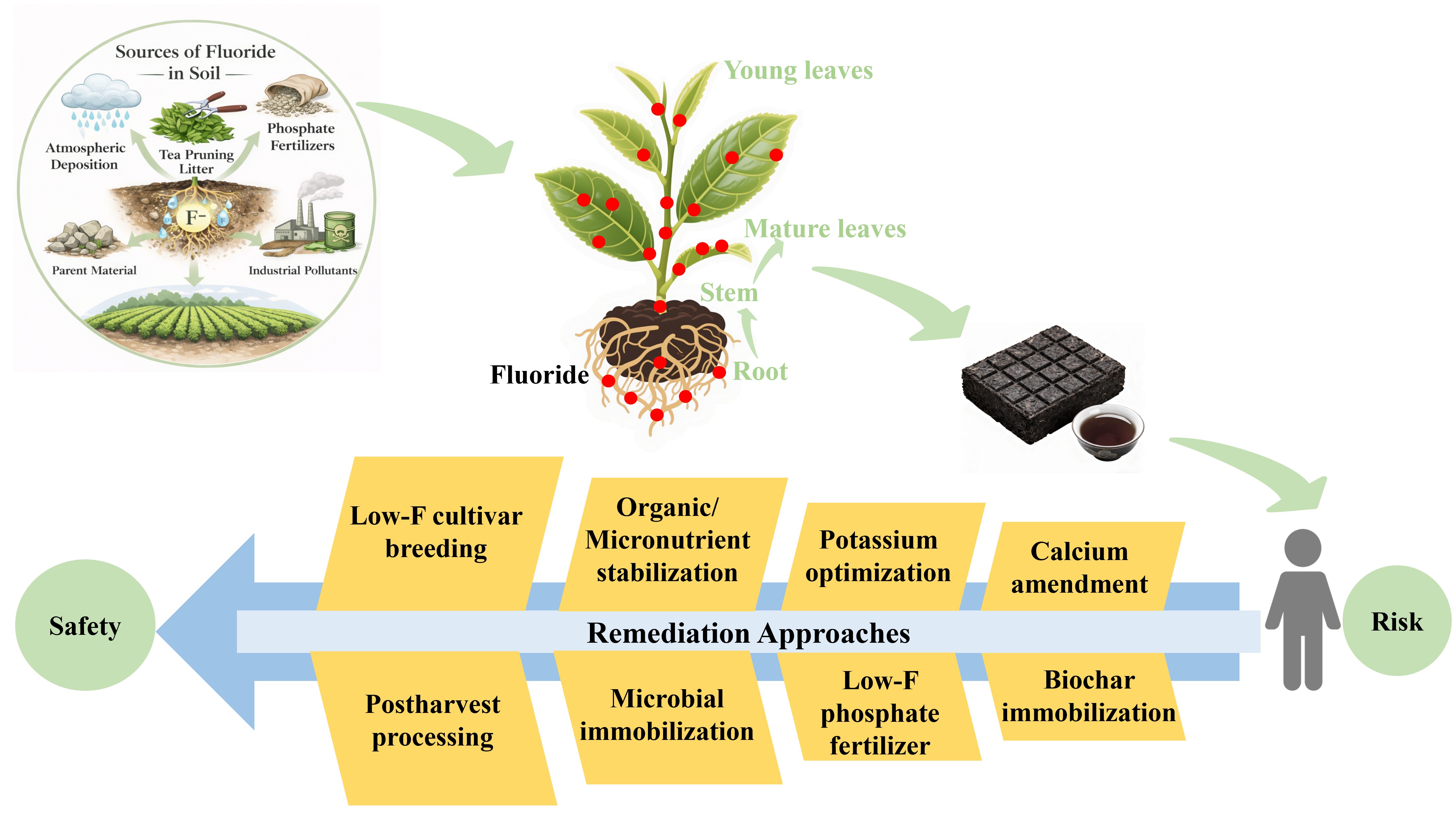
Camellia sinensis (tea plant) is a notable fluoride (F) accumulator, with mature leaves typically containing 2000–3000 mg F kg−1, significantly higher than common crops like rice and wheat. This accumulation links soil geochemistry with dietary F exposure and associated fluorosis risk. However, the processes governing F mobility in soils and its transfer to tea plants remain insufficiently explored. This review summarizes current knowledge on F accumulation in tea production systems, focusing on the geochemical forms and bioavailability of F in tea-growing soils. We examine the roles of soil acidity, mineral composition, and organic matter in regulating F mobility. Mechanisms of F uptake, translocation, and preferential accumulation in mature leaves are discussed based on recent physiological and molecular studies. Human exposure risks from tea consumption, particularly in high-F soil regions, are evaluated. We review integrated mitigation strategies, including soil amendments, nutrient management, low-F cultivars, and optimized processing techniques. Among these, nutrient-based management, especially using low-F phosphate fertilizers and optimized potassium supply, is a promising approach for reducing F accumulation in tea plants. Targeted nutrient regulation can effectively limit F mobility and uptake, offering a sustainable strategy for mitigating F exposure through tea consumption. These findings emphasize the importance of soil chemical conditions in controlling F transfer from soil to tea plants and provide a scientific foundation for developing effective strategies to reduce F accumulation in tea production systems.
Graphical Abstract
Keywords
fluorine | tea leaves | soil chemistry | bioaccumulation | brick tea
References
- 1.
Ghosh, A.; Mukherjee, K.; Ghosh, S.K. Sources and Toxicity of Fluoride in the Environment. Res. Chem. Intermed. 2013, 39, 2881–2915.
- 2.
Kabir, H.; Gupta, A.; Tripathy, S. Fluoride and Human Health: Systematic Appraisal of Sources, Exposures, Metabolism, and Toxicity. Crit. Rev. Environ. Sci. Technol. 2020, 50, 1116–1193.
- 3.
NIH Office of Dietary Supplements. Fluoride—Health Professional Fact Sheet. Available online: https://ods.od.nih.gov/factsheets/Fluoride-HealthProfessional/ (accessed on 20 March 2026).
- 4.
Cao, W.; Zhang, Z.; Guo, H. Spatial Distribution and Controlling Mechanisms of High Fluoride Groundwater in the Coastal Plain of Bohai Rim, North China. J. Hydrol. 2023, 617, 128952.
- 5.
Li, Y.; Zhang, M.; Mi, W. Spatial Distribution of Groundwater Fluoride and Arsenic and Its Related Disease in Typical Drinking Endemic Regions. Sci. Total Environ. 2024, 906, 167716.
- 6.
Waldbott, G.L. Fluoride in Food. Am. J. Clin. Nutr. 1963, 13, 393.
- 7.
Niu, H.; Zhan, K.; Xu, W. Selenium Treatment Modulates Fluoride Distribution and Mitigates Fluoride Stress in Tea Plant (Camellia sinensis (L.) O. Kuntze). Environ. Pollut. 2020, 267, 115603.
- 8.
Li, Q.S.; Lin, X.M.; Qiao, R.Y. Effect of Fluoride Treatment on Gene Expression in Tea Plant (Camellia sinensis). Sci. Rep. 2017, 7, 9847.
- 9.
Miao, S.; Wei, Y.; Chen, J. Extraction Methods, Physiological Activities and High Value Applications of Tea Residue and Its Active Components: A Review. Crit. Rev. Food Sci. Nutr. 2023, 63, 12150–12168.
- 10.
Li, W.; Cheng, H.; Mu, Y. Occurrence, Accumulation, and Risk Assessment of Trace Metals in Tea (Camellia sinensis): A National Reconnaissance. Sci. Total Environ. 2021, 792, 148354.
- 11.
Jayasinghe, S.L.; Kumar, L. Causes of Tea Land Dynamics in Sri Lanka Between 1995 and 2030. Reg. Environ. Chang. 2023, 23, 127.
- 12.
Pattaravisitsate, N.; Phetrak, A.; Denpetkul, T. Effects of Brewing Conditions on Infusible Fluoride Levels in Tea and Herbal Products and Probabilistic Health Risk Assessment. Sci. Rep. 2021, 11, 14115.
- 13.
Zhang, D.; Xu, X.; Wu, X. Monitoring Fluorine Levels in Tea Leaves from Major Producing Areas in China and the Relative Health Risk. J. Food Compos. Anal. 2023, 118, 105205.
- 14.
Yi, X.Y.; Qiao, S.; Ma, L.F. Soil Fluoride Fractions and Their Bioavailability to Tea Plants (Camellia sinensis L.). Environ. Geochem. Health 2017, 39, 1005–1016.
- 15.
Ozsvath, L.D. Fluoride and Environmental Health: A Review. Rev. Environ. Sci. Biotechnol. 2009, 8, 59–79.
- 16.
Zhang, C. Spatial and Vertical Distribution and Pollution Assessment of Soil Fluorine in a Lead-Zinc Mining Area in the Karst Region of Guangxi, China. Plant Soil Environ. 2010, 56, 282–287.
- 17.
Wang, M.; Li, X.; He, W. Distribution, Health Risk Assessment, and Anthropogenic Sources of Fluoride in Farmland Soils in Phosphate Industrial Area, Southwest China. Environ. Pollut. 2019, 249, 423–433.
- 18.
Huang, X.; Chen, K.; Wang, C. Characteristics of Fluoride Adsorption in Different Soil Types: Potential Factors and Implications for Environmental Risk Assessment. Environ. Pollut. 2025, 367, 125537.
- 19.
Shu, W.; Zhang, Z.; Lan, C. Fluoride and Aluminium Concentrations of Tea Plants and Tea Products from Sichuan Province, PR China. Chemosphere 2003, 52, 1475–1482.
- 20.
Zhang, L.; Li, Q.; Ma, L.F. Characterization of Fluoride Uptake by Roots of Tea Plants (Camellia sinensis (L.) O. Kuntze). Plant Soil 2013, 366, 659–669.
- 21.
Peng, C.Y.; Xu, X.F.; Ren, Y.F. Fluoride Absorption, Transportation and Tolerance Mechanism in Camellia Sinensis, and Its Bioavailability and Health Risk Assessment: A Systematic Review. J. Sci. Food Agric. 2021, 101, 379–387.
- 22.
Wu, Z.; Xing, A.; Chu, R. The Fluoride Exporter (CsFEX) Regulates Fluoride Uptake/Accumulation in Camellia Sinensis Under Different pH. Ecotoxicol. Environ. Saf. 2024, 278, 116407.
- 23.
Yang, J.; Liu, C.S.; Li, J.L. Critical Review of Fluoride in Tea Plants (Camellia sinensis): Absorption, Transportation, Tolerance Mechanisms, and Defluorination Measures. Bever. Plant Res. 2024, 4, e019.
- 24.
Luo, J.L.; Zhang, L.T.; Li, D.L. Foliar Calcium Application Reduces Fluorine Accumulation in Tea Plant by Regulating Cell Wall Structure and Gene Expression. Front. Plant Sci. 2025, 15, 1443439.
- 25.
Niu, H.; Zhan, K.; Cheng, X. Selenium Foliar Application Contributes to Decrease Ratio of Water-Soluble Fluoride and Improve Physio-Biochemical Components in Tea Leaves. Ecotoxicol. Environ. Saf. 2023, 266, 115568.
- 26.
Sun, Y.; Wu, Z.; Xing, A. Potassium Alleviates Fluoride Accumulation and Enhances Fluoride Tolerance in Camellia Sinensis. Ind. Crops Prod. 2024, 219, 119062.
- 27.
Wang, H.Y.; Hu, T.; Wang, M.H. Biochar Addition to Tea Garden Soils: Effects on Tea Fluoride Uptake and Accumulation. Biochar 2023, 5, 24.
- 28.
Małyszek, A.; Kiryk, S.; Kensy, J. Identification of Factors Influencing Fluoride Content in Tea Infusions: A Systematic Review. Appl. Sci. 2025, 15, 5974.
- 29.
Koblar, A.; Tavčar, G.; Ponikvar-Svet, M. Fluoride in Teas of Different Types and Forms and the Exposure of Humans to Fluoride with Tea and Diet. Food Chem. 2011, 130, 286–290.
- 30.
Cao, J.; Zhao, Y.; Liu, J.W. Processing Procedures of Brick Tea and Their Influence on Fluorine Content. Food Chem. Toxicol. 2001, 39, 959–962.
- 31.
Fang, X.J. Research Progress on Intake Safety of Fluorine in Brick Tea. Hunan For. Sci. Technol. 2011, 38, 85–88. (In Chinese)
- 32.
Gesang, Z.; Tudan; Ci, Z. Analysis of Monitoring Results for Brick-Tea Type Fluorosis in Biru County, Naqu City, Tibet, 2017. Psychol. Mon. 2018, 161–162. (In Chinese)
- 33.
Xu, D.; Chen, J.; Yang, X. Investigation of Drinking-tea-type Endemic Fluorosis in Sichuan Province From 2016 to 2017. J. Prev. Med. Inf. 2019, 35, 692–696. (In Chinese)
- 34.
Chen, P.; Zhang, Q.; Jiang, H. An Analysis on the Prevalence of Drinking Brick-Tea Type Fluorosis in Haibei Prefecture, Qinghai Province in 2018. Chin. J. Endemiol. 2020, 39, 47–49. (In Chinese)
- 35.
Duan, Y.; Wang, C.; Pu, D. Drinking Tea Type of Endemic Fluorosis in Xinjiang in 2014-2016. Chin. J. Endemiol. 2018, 37, 316–318. (In Chinese)
- 36.
Zhang, L.; Huang, H.; Yang, J. Probabilistic Risk Assessment of Chinese Residents’ Exposure to Fluoride in Improved Drinking Water in Endemic Fluorosis Areas. Environ. Pollut. 2017, 222, 118–125.
- 37.
Guo, B.; Li, C.; Liang, L. Investigation on Fluoride Content of Brick Tea. Chin. J. Endemiol. 2019, 38, 467–471. (In Chinese)
- 38.
Fraysse, C.; Bilbeissi, M.W.; Mitre, D. Le Rôle de la Consommation du Thé Dans La Fluorose Dentaire En Jordanie. Bull. Group. Int. Rech. Sci. Stomatol. Odontol. 1989, 32, 39–46.
- 39.
Izuora, K.; Twombly, J.G.; Whitford, G.M. Skeletal Fluorosis from Brewed Tea. J. Clin. Endocrinol. Metab. 2011, 96, 2318–2324.
- 40.
Waugh, D.T.; Potter, W.; Limeback, H. Risk Assessment of Fluoride Intake from Tea in the Republic of Ireland and Its Implications for Public Health and Water Fluoridation. Int. J. Environ. Res. Public Health 2016, 13, 259.
- 41.
Sergio Gomez, S.; Weber, A.; Torres, C. Fluoride Content of Tea and Amount Ingested by Children. Odontol. Chil. 1989, 37, 251–255. (In Spanish)
- 42.
Szmagara, A.; Krzyszczak, A.; Stefaniak, E.A. Determination of Fluoride Content in Teas and Herbal Products Popular in Poland. J. Environ. Health Sci. Eng. 2022, 20, 717–727.
- 43.
Chandrajith, R.; Bhagya, S.; Diyabalanage, S. Exposure Assessment of Fluoride Intake Through Commercially Available Black Tea (Camellia sinensis L.) from Areas with High Incidences of Chronic Kidney Disease with Undetermined Origin (CKDu) in Sri Lanka. Biol. Trace Elem. Res. 2022, 200, 526–534.
- 44.
Shang, W.J.; Shang, R.Z.; Wang, Q.H. Analysis of Epidemic Status of Tea Drinking Endemic Fluorosis in Gannan Tibetan Autonomous Prefecture. Bull. Dis. Control Prev. (Chin.) 2021, 36, 32–34. (In Chinese)
- 45.
Buzalaf, M.A.R. Review of Fluoride Intake and Appropriateness of Current Guidelines. Adv. Dent. Res. 2018, 29, 157–166.
- 46.
García, M.G.; Borgnino, L. Fluoride in the Context of the Environment; The Royal Society of Chemistry: London, UK, 2015.
- 47.
Feng, G.; Li, Z.; Su, C. Provenance and Geogenic Modes of High-Fluoride Groundwater Occurred in Various Sedimentary Environments: Constraints of Hydrogeology and Hydrogeochemistry. Appl. Geochem. 2025, 195, 106624.
- 48.
Subbaiah, P.M.; Mohammed, Y.; Yongtae, A. Fluoride Occurrence in Environment, Regulations, and Remediation Methods for Soil: A Comprehensive Review. Chemosphere 2023, 324, 138334.
- 49.
Regenspurg, S.; Virchow, L.; Wilke, F. Origin and Migration of Fluoride in the Area of the Aluto Volcanic Complex (Main Ethiopian Rift). Appl. Geochem. 2021, 146, 105063.
- 50.
Li, D.; Gao, X.; Wang, Y. Diverse Mechanisms Drive Fluoride Enrichment in Groundwater in Two Neighboring Sites in Northern China. Environ. Pollut. 2018, 237, 430–441.
- 51.
Bellomo, S.; D’Alessandro, W.; Longo, M. Volcanogenic Fluorine in Rainwater Around Active Degassing Volcanoes: Mt. Etna and Stromboli Island, Italy. Sci. Total Environ. 2003, 301, 175–185.
- 52.
Rizzu, M.; Tanda, A.; Cappai, C. Impacts of Soil and Water Fluoride Contamination on the Safety and Productivity of Food and Feed Crops: A Systematic Review. Sci. Total Environ. 2021, 787, 147650.
- 53.
Fuge, R. Fluorine in the Environment, a Review of Its Sources and Geochemistry. Appl. Geochem. 2019, 100, 393–406.
- 54.
Vithanage, M.; Bhattacharya, P. Fluoride in the Environment: Sources, Distribution and Defluoridation. Environ. Chem. Lett. 2015, 13, 131–147.
- 55.
O’Hara, P.J.; Cordes, D.O. Superphosphate Poisoning of Sheep: A Study of Natural Outbreaks. N. Z. Vet. J. 1982, 30, 153–155.
- 56.
Li, H.; Ma, X.; Huang, X. Fluoride Contents in Commonly Used Commercial Phosphate Fertilizers and Their Potential Risks in China. Environ. Monit. Assess. 2023, 195, 1051.
- 57.
Ramteke, L.; Sahayam, A.; Ghosh, A. Study of Fluoride Content in Some Commercial Phosphate Fertilizers. J. Fluorine Chem. 2018, 210, 149–155.
- 58.
Kundu, C.M.; Mandal, B. Agricultural Activities Influence Nitrate and Fluoride Contamination in Drinking Groundwater of an Intensively Cultivated District in India. Water Air Soil Pollut. 2009, 198, 243–252.
- 59.
Li, T.; He, J.G.; Zhou, Z. The Effect of Phosphate Fertilizer on Fluoride Accumulation in Tea Leaves Based on Ecological Environment Analysis. IOP Conf. Ser. Earth Environ. Sci. 2021, 696, 012024.
- 60.
Long, H.; Jiang, Y.; Li, C. Effect of Urea Feeding on Transforming and Migrating Soil Fluorine in a Tea Garden of Hilly Region. Environ. Geochem. Health 2021, 43, 5171–5182.
- 61.
Jiang, J.L.; Zhong, N. Advance of Studies on the Toxicology of Fluorine in Feedstuff and Environment. Feed Ind. 2005, 25–32. (In Chinese)
- 62.
Zheng, D.X.; Qi, S.Q. Mineral Elements in Tea Plant and Tea Orchards of China, 1st ed.; China Environmental Science Press: Beijing, China, 2012; pp. 211–220. (In Chinese)
- 63.
Yang, J. Pruned Litter Decomposition Primes Fluorine Bioavailability in Soils Planted with Different Tea Varieties. Sci. Total Environ. 2023, 903, 166250.
- 64.
Gan, C.; Jia, Y.; Yang, J. Remediation of Fluoride Contaminated Soil with Nano-Hydroxyapatite Amendment: Response of Soil Fluoride Bioavailability and Microbial Communities. J. Hazard. Mater. 2021, 416, 124694.
- 65.
Gao, H.J.; Zhang, Z.Z.; Wan, X.C. Influences of Charcoal and Bamboo Charcoal Amendment on Soil-Fluoride Fractions and Bioaccumulation of Fluoride in Tea Plants. Environ. Geochem. Health 2012, 34, 551–562.
- 66.
Chen, W. Effect of Nitrogen Fertilizer on Fluorine Species and Soil pH in Fluorine-Contaminate Soil. In Proceedings of the 2010 4th International Conference on Bioinformatics and Biomedical Engineering, Chengdu, China, 18–20 June 2010; pp. 1–4.
- 67.
Xie, Z.M.; Wu, W.H. Migration and Transformation of Fluoride in the Environment and Its Ecological Effects. Chin. J. Environ. Eng. 1999, 7, 40–53. (In Chinese)
- 68.
Jeong, S.; Kim, D.; Kim, Y.T. A Rapid Screening of Fluorine Contents in Soil with a Consideration of Chemical Binding by Wavelength Dispersive X-ray Fluorescence Spectrometry. Spectrochim. Acta B 2018, 149, 261–266.
- 69.
Oh, S.Y.; Kim, H.; Yoon, H.O. Fluorine Contamination, Mobility, and Risks in Soils at a Phosphate-Gypsum Waste Landfill: A New Analytical Method and Comparison with Previous Methods. Environ. Geochem. Health 2024, 46, 170.
- 70.
Morita, A.; Horie, H.; Fujii, Y. Chemical Forms of Aluminum in Xylem Sap of Tea Plants (Camellia sinensis L.). Phytochemistry 2004, 65, 2775–2780.
- 71.
Nagata, T.; Hayatsu, M.; Kosuge, N. Identification of Aluminum Forms in Tea Leaves by 27Al NMR. Phytochemistry 1992, 31, 1215–1218.
- 72.
Nagata, T.; Hayatsu, M.; Kosuge, N. Aluminum Kinetics in the Tea Plant Using 27Al and 19F NMR. Phytochemistry 1993, 32, 771–775.
- 73.
Yang, Y.; Liu, Y.; Huang, C.F. Aluminium Alleviates Fluoride Toxicity in Tea (Camellia sinensis). Plant Soil 2016, 402, 179–190.
- 74.
Wepasnick, K.A.; Smith, B.A.; Bitter, J.L. Chemical and Structural Characterization of Carbon Nanotube Surfaces. Anal. Bioanal. Chem. 2010, 396, 1003–1014.
- 75.
Cai, H.M.; Peng, C.Y.; Chen, J. X-ray Photoelectron Spectroscopy Surface Analysis of Fluoride Stress in Tea (Camellia sinensis (L.) O. Kuntze) Leaves. J. Fluorine Chem. 2014, 158, 11–15.
- 76.
Ruan, J.Y. The Impact of pH and Calcium on the Uptake of Fluoride by Tea Plants (Camellia sinensis L.). Ann. Bot. 2004, 93, 97–105.
- 77.
Lahermo, P.; Backman, B. The Occurrence and Geochemistry of Fluorides with Special Reference to Natural Waters in Finland. Tutkimusraportti 2000, 149, 1–40.
- 78.
Wehr, J.B.; Dalzell, S.A.; Menzies, N.W. Predicting and Modelling Availability of Fluoride in Soil from Sorption Properties. Soil Use Manag. 2022, 39, 521–534.
- 79.
Zhang, Y.L.; Liao, W.Y.; Wang, Y.J. Effect of Nitrogen Fertilizer on Combined Forms and Transformation of Fluorine in Tea Garden Soil. J. Agric. Resour. Environ. 2015, 32, 436–442. (In Chinese)
- 80.
Li, C.L. Effects of Fluoride on Physiology and Biochemistry of Tea Seedlings and Its Mechanism. Ph.D. Thesis, Hua Zhong Agricultural University, Wuhan, China, 2011. (In Chinese)
- 81.
Lu, L.J.; Zong, L.G.; Luo, M. Content of Fluoride in Tea Leaf in JiangSu Province and its Affecting Factor. J. Anhui Agric. Sci. 2006, 34, 2183–2185. (In Chinese)
- 82.
Sun, L., Zhang, M., Liu, X.; et al. Aluminium Is Essential for Root Growth and Development of Tea Plants (Camellia sinensis). J. Integr. Plant Biol. 2020, 62, 984–997.
- 83.
Doig, L.E.; Liber, K. Influence of Dissolved Organic Matter on Nickel Bioavailability and Toxicity to Hyalella Azteca in Water-Only Exposures. Aquat. Toxicol. 2006, 76, 203–216.
- 84.
Chen, H.M. Behavior of Chemicals in Soil and Environmental Quality; Science Press: Beijing, China, 2002. (In Chinese)
- 85.
Wang, K.Y.; Yang, L.; Zhao, T.Y. The Environmental Effect of Organic Materials on Soil Soluble Fluorine. Ecol. Environ. 2007, 16, 879–882. (In Chinese)
- 86.
Chen, K.; Ma, X.Z.; Wang, C.X. Organic Manures Reduce the Bioavailability of Fluoride in Soil via Different Mechanisms. Environ. Pollut. 2024, 363, 125142.
- 87.
Zheng, D.X.; Sha, J.Q. Fluorine in Soils of Fujian Tea-Growing Areas. Chin. J. Soil Sci. 1994, 5, 230–233. (In Chinese)
- 88.
Feng, B.X.; Men, Q.N.; Gan, L.M.; et al. Determination of Fluorine Speciation in Tea Garden Soils and Main Factors Affecting Fluorine Content in Tea Leaves in Ziyang Area, Shanxi Province. Rock Miner. Anal. 2024, 43, 166–176. (In Chinese)
- 89.
Wang, L.; Tang, J.; Xiao, B.; et al. Enhanced Release of Fluoride from Rhizosphere Soil of Tea Plants by Organic Acids and Reduced Secretion of Organic Acids by Fluoride Supply. Acta Agric. Scand. Sect. B–Soil Plant Sci. 2013, 63, 426–432.
- 90.
Xu, R.; Wang, Y.; Zhao, A.; et al. Effect of Low Molecular Weight Organic Acids on Adsorption and Desorption of Fluoride on Variable Charge Soils. Environ. Geochem. Health 2006, 28, 141–146.
- 91.
Peng, C.Y.; Chen, J.; Cai, H.M. The Kinetic Characteristics of Solution Fluoride Uptake by Tea Plant. Chin. J. Trop. Crops 2013, 34, 495–500. (In Chinese)
- 92.
Wang, Y.M.; Chai, R.S.; Gao, H.J. Apparent Characteristics of Active Transmembrane Uptake of Fluoride by Tea Plant Roots. J. Agro-Environ. Sci. 2016, 35, 1473–1479. (In Chinese)
- 93.
Xu, J.; Guang, M.; Shi, S.; et al. Physiological and Molecular Mechanisms of Transmembrane Fluoride Uptake by Tea Roots. J. Tea Sci. 2019, 39, 365–371. (In Chinese)
- 94.
Xing, A.; Wu, Z.; Xu, X.; et al. Research Advances of Fluoride Accumulation Mechanisms in Tea Plants (Camellia sinensis). J. Tea Sci. 2022, 42, 301–315. (In Chinese)
- 95.
Stockbridge, R.B.; Robertson, J.L.; Kolmakova-Partensky, L. A Family of Fluoride-Specific Ion Channels with Dual-Topology Architecture. eLife 2013, 2, e01084.
- 96.
Guang, M. Molecular Mechanisms of ABC Transporter Mediated Transmembrane Absorption and Transport of Fluoride by Tea Plant Roots. Master’s Thesis, Anhui Agricultural University, Hefei, China, 2020. (In Chinese)
- 97.
Gadi, B.R.; Kumar, R.; Goswami, B. Recent Developments in Understanding Fluoride Accumulation, Toxicity, and Tolerance Mechanisms in Plants: An Overview. J. Soil Sci. Plant Nutr. 2021, 21, 209–228.
- 98.
Kumar, K. Effects of Fluoride on Respiration and Photosynthesis in Plants: An Overview. Ann. Environ. Sci. Toxicol. 2017, 2, 43–47.
- 99.
Niu, H.; Wang, J.; Liao, Z. Root-Specific Expression of CsNPF2.3 Is Involved in Modulating Fluoride Accumulation in Tea Plant (Camellia sinensis). Hortic. Res. 2025, 12, uhae267.
- 100.
Niu, H.L.; Peng, C.Y.; Zhu, X.D. Positron-Emitting Tracer Imaging of Fluoride Transport and Distribution in Tea Plant. J. Sci. Food Agric. 2020, 100, 3554–3559.
- 101.
Li, L.X.; Du, X.; He, C.L. Absorption and Accumulation Characteristics of Fluorine in Nutrient Liquid Cultured Tea Plant. J. Sichuan Agric. Univ. 2008, 26, 62–66. (In Chinese)
- 102.
Song, J.; Hou, C.; Guo, J. Two New Members of CsFEXs Export Fluoride Coupled Proton Gradients and Participate in Reducing the Fluoride Accumulation in Low-Fluoride Tea Cultivars. J. Agric. Food Chem. 2020, 68, 8568–8579.
- 103.
Zhu, J.; Xing, A.; Wu, Z. CsFEX, a Fluoride Export Protein Gene from Camellia Sinensis, Alleviates Fluoride Toxicity in Transgenic Escherichia Coli and Arabidopsis Thaliana. J. Agric. Food Chem. 2019, 67, 5997–6006.
- 104.
Luo, B.; Guang, M.; Yun, W. Camellia Sinensis Chloroplast Fluoride Efflux Gene CsABCB9 Is Involved in the Fluoride Tolerance Mechanism. Int. J. Mol. Sci. 2022, 23, 7756.
- 105.
Xing, A.; Ma, Y.; Wu, Z. Genome-Wide Identification and Expression Analysis of the CLC Superfamily Genes in Tea Plants (Camellia sinensis). Funct. Integr. Genom. 2020, 20, 497–508.
- 106.
Huang, X.; Wang, P.; Liu, S. An RNA-Seq Transcriptome Analysis Revealing Novel Insights into Fluorine Absorption and Transportation in the Tea Plant. Botany 2020, 98, 249–259.
- 107.
Li, Q.; Zhang, R.; Hu, X. Aluminum-Activated Malate Transporter Family Member CsALMT6 Mediates Fluoride Resistance in Tea Plants (Camellia sinensis). Hortic. Res. 2024, 12, uhae080.
- 108.
Tang, Q.; Zhao, X.M.; Du, X. Effects of Fluorine Stress on Growth, Physiological-Biochemical Characteristics and Quality of Tea Leaves. Plant Nutr. Fertil. Sci. 2011, 17, 186–194. (In Chinese)
- 109.
Sha, J.Q.; Zheng, D.X. Study on Fluoride Content in Fresh Tea Leaves of Fujian Tea Plants. J. Tea Sci. 1994, 14, 37–42. (In Chinese)
- 110.
Wen, X.; Wang, Y.; Wang, S. Fluorine Accumulation Characteristics of 85 Tea Tree (Camellia sinensis) Varieties and Its Potential Risk Assessment. Ecotoxicol. Environ. Saf. 2024, 283, 116785.
- 111.
Cai, H.; Zhu, X.; Peng, C.; et al. Critical Factors Determining Fluoride Concentration in Tea Leaves Produced from Anhui Province, China. Ecotoxicol. Environ. Saf. 2016, 131, 14–21.
- 112.
IPCC. Climate Change 2021: The Physical Science Basis. Contribution of Working Group I to the Sixth Assessment Report of the Intergovernmental Panel on Climate Change; Cambridge University Press: Cambridge, UK, 2021.
- 113.
Omer, A.A.A.; Zhang, C.H.; Liu, J.L.; et al. Comprehensive Review of Mapping Climate Change Impacts on Tea Cultivation: Bibliometric and Content Analysis of Trends, Influences, Adaptation Strategies, and Future Directions. Front. Plant Sci. 2024, 15, 1542793.
- 114.
Huang, F.; Lei, Y.; Duan, J.; et al. Investigation of Heat Stress Responses and Adaptation Mechanisms by Integrative Metabolome and Transcriptome Analysis in Tea Plants (Camellia sinensis). Sci. Rep. 2024, 14, 10023.
- 115.
Wang, Z.; Slot, M.; Wang, C. Decoupling of Stomatal Conductance, Transpiration, and Photosynthesis in Terrestrial Plants under Elevated Temperature: A Meta-Analysis. Nat. Commun. 2026, 17, 1528.
- 116.
Lu, Y.; Zheng, J.; Hu, H.; et al. Determination of Critical Crop Water Stress Index of Tea under Drought Stress Based on the Intercellular CO₂ Concentration. Agronomy 2024, 14, 2154.
- 117.
Grossiord, C.; Buckley, T.N.; Cernusak, L.A.; et al. Plant Responses to Rising Vapor Pressure Deficit. New Phytol. 2020, 226, 1550–1566.
- 118.
Liu, S.Y.; Zhu, X.J.; Fang, F.X. Fluorine Subcellular Distribution and Its Combining Characteristics with Cell Wall in Tea Leaves (Camellia sinensis). J. Tea Sci. 2018, 38, 305–312. (In Chinese)
- 119.
Luo, J.L. Study on Mechanism of Fluorine Accumulation in Cell Wall of Tea Plant Leaf. Ph.D. Thesis, Huazhong Agricultural University, Wuhan, China, 2020. (In Chinese)
- 120.
Peng, C.Y. Study on Fluoride Accumulation, Subcellular Distribution of Tea Plant and its Chemical Form in Leaf Surface. Master’s Thesis, Anhui Agricultural University, Hefei, China, 2013. (In Chinese)
- 121.
Zhang, L.L.; Peng, L.; Wang, Y. Correlation between Fluoride Ion Enrichment in Fresh Tea Leaves and Growth Period. Tea Fujian 2021, 43, 17–19. (In Chinese)
- 122.
Wong, M.H.; Fung, K.F.; Carr, H.P. Aluminium and Fluoride Contents of Tea, with Emphasis on Brick Tea and Their Health Implications. Toxicol. Lett. 2003, 137, 111–120.
- 123.
Yang, X.D.; Zong, Q.W.; Wu, Y.J. Analysis of Fluoride Content in Anhui Tea. Food Sci. 1995, 16, 59–61. (In Chinese)
- 124.
Zheng, W.J.; Wan, X.C.; Bao, G.H. Brick Dark Tea: A Review of the Manufacture, Chemical Constituents, and Bioconversion of the Major Chemical Components During Fermentation. Phytochem. Rev. 2015, 14, 499–523.
- 125.
Jakubczyk, K.; Gutowska, I.; Antoniewicz, J. Evaluation of Fluoride and Selected Chemical Parameters in Kombucha Derived from White, Green, Black and Red Tea. Biol. Trace Elem. Res. 2021, 199, 3547–3552.
- 126.
Chun, X.Y.; Chen, Y.Q.; Ni, D.J.; et al. Effects of Rolling Tea Leavies with Washing Water on Fluorine and Quality Components. Hubei Agric. Sci. 2011, 50, 2453–2455. (In Chinese)
- 127.
Gao, F.J.; Lu, J.L.; Liang, Y.R.; et al. A Study on Technique for Decreasing Fluorine in Tea. J. Xinyang Agric. Coll. 2002, 12, 36–38. (In Chinese)
- 128.
Karak, T.; Bhagat, R.M. Trace Elements in Tea Leaves, Made Tea and Tea Infusion: A Review. Food Res. Int. 2010, 43, 2234–2252.
- 129.
Anjana, B. Unveiling the Presence of Fluoride in Commercial Tea Infusion: Factors Influencing Its Release and Its Adsorptive Elimination by Indigenously Developed Nanoadsorbents. Sci. Total Environ. 2024, 914, 169810.
- 130.
Esfehani, M.; Ghasemzadeh, S.; Mirzadeh, M. Comparison of Fluoride Ion Concentration in Black, Green and White Tea. Int. J. Ayurvedic Med. 2018, 9, 263–265.
- 131.
Luo, S.H.; Jia, H.Y.; Tong, X.C.; et al. Study on the Extracting Regularity of Fluorine in the Brick Tea Infusion. J. Tea Sci. 2002, 22, 38–42. (In Chinese)
- 132.
Jing, T.; Li, J.; He, Y. Role of Calcium Nutrition in Plant Physiology: Advances in Research and Insights into Acidic Soil Conditions—A Comprehensive Review. Plant Physiol. Biochem. 2024, 210, 108602.
- 133.
Fung, K.; Wong, M. Application of Different Forms of Calcium to Tea Soil to Prevent Aluminium and Fluorine Accumulation. J. Sci. Food Agric. 2004, 84, 1469–1477.
- 134.
Kumar, R.; Sharma, P.; Yang, W. State-of-the-Art of Research Progress on Adsorptive Removal of Fluoride-Contaminated Water Using Biochar-Based Materials: Practical Feasibility Through Reusability and Column Transport Studies. Environ. Res. 2022, 214, 114043.
- 135.
Shen, C.W.; Xu, H.Q.; Wang, M.H. A Method for Reducing Fluoride Accumulation in Tea. CN202310831210.4, 20 June 2025.
- 136.
Yi, C.; Zhou, C.; Mo, Y.; et al. Study on the Mechanism of Modified Biochar in Reducing Fluoride Content in Tea Leaves and Improving Soil Environment. J. Agric. Food Res. 2026, 27, 102769.
- 137.
Li, X.; Qi, Y.; Zhang, X. Influence of Modified Biochar on Soil Fluoride and Cadmium Speciation and Their Bioavailability to Tea Seedling (Camellia sinensis L.). Soil Sediment Contam. 2024, 33, 612–633.
- 138.
Du, S.; Wang, X.; Shao, J.; et al. Releasing Behavior of Chlorine and Fluorine During Agricultural Waste Pyrolysis. Energy 2014, 74, 295–300.
- 139.
Li, W.H.; Ma, Z.Y.; Yan, J.H.; et al. Evolution and Distribution Characteristics of Fluorine during the Incineration of Fluorine-Containing Waste in a Hazardous Waste Incinerator. J. Zhejiang Univ.-Sci. A 2019, 20, 564–576.
- 140.
Aboulsoud, Y.I. Biosorptive Removal of Fluoride from Wastewater Using Tea Domestic Waste Biochar. Environ. Dev. Sustain. 2025, 27, 16451–16468.
- 141.
Zhang, M.; et al. Preparation of Lanthanum-Modified Tea Waste Biochar and Its Adsorption Performance on Fluoride in Water. Materials 2024, 17, 766.
- 142.
Zhao, S.; Liu, Y.; Ma, J. Influence of Fertilizers on Fluoride Accumulation in Tea Leaves and Its Remediation Using Polyphenol–Ce Adsorbents. RSC Adv. 2015, 5, 6085–6091.
- 143.
Huang, C.; Zhang, H.; Zeng, W. Enhanced Fluoride Adsorption of Aluminum Humate and Its Resistance on Fluoride Accumulation in Tea Leaves. Environ. Technol. 2018, 40, 3236–3245.
- 144.
Pramanik, K.; Sen, A.; Dutta, S. Microbial Populations Under Fluoride Stress: A Metagenomic Exploration from Indian Soil. World J. Microbiol. Biotechnol. 2025, 41, 221.
- 145.
Pal, K.C.; Mukhopadhyay, P.; Chatterjee, S. A Study on Fluoride Bioremediation via a Novel Bacterium Bacillus Megaterium Isolated from Agricultural Soil. J. Earth Syst. Sci. 2022, 131, 183.
- 146.
Mohammed, J.N.; Mohammed, A.; Muhammad, I.L. Role of Plant Growth Promoting Rhizobacteria in Remediation of Fluoride Toxicity. In Fluoride and Fluorocarbon Toxicity: Sources, Issues, and Remediation; Springer Nature: Singapore, 2024.
- 147.
Pan, J.; Xing, A.; Zhu, J. Gene Expression Analysis in Leaf of Camellia Sinensis Reveals the Response to Fluoride. Acta Physiol. Plant. 2021, 43, 111.
- 148.
Tadeo, K.; Ronald, K.; Vereriano, T. Genetic Diversity and Structure of Ugandan Tea Germplasm and Its Implication in Breeding. Genet. Resour. Crop Evol. 2024, 71, 481–496.
- 149.
Yang, P.; Liu, Z.; Zhao, Y. Comparative Study of Vegetative and Reproductive Growth of Different Tea Varieties Response to Different Fluoride Concentrations Stress. Plant Physiol. Biochem. 2020, 154, 419–428.
- 150.
Wu, M. Study on Fluorine Accumulation and Defluoridation Measures of Tea. Master’s Thesis, Zhejiang University, Hangzhou, China, 2011. (In Chinese)
- 151.
Gong, Z..; Zheng, P.; Li, C.; et al. Study on Processing Property of Different Low Fluoride Varieties for Green Brick Tea. Hubei Agric. Sci. 2012, 51, 5690–5692+5712. (In Chinese)
- 152.
Chen, Y.; Ni, D.; Chun, X.; et al. Effects of Different Fixation Ways on the Fluoride Contents of Qingzhuan Tea Material. Hubei Agric. Sci. 2011, 50, 1193–1195. (In Chinese)
- 153.
Wang, L. Preliminary Studies of DTF Reagent on Defluoridation for Tea Fluoride. Chin. J. Control Endem. Dis. 2003, 18, 17–19. (In Chinese)
- 154.
Lin, Z.; Shu, A.; Jiang, Y.; et al. Preliminary Investigation on the Technique in Decreasing of Fluorine Contents in Brick Tea. Chin. Tea 2002, 24, 16–17. (In Chinese)
- 155.
Xu, Y.; Zhao, Y.; Liu, S. Research Progress on Reducing Fluoride Content in Dark Tea Using Eurotium Cristatum. Acta Agric. Jiangxi. 2011, 23, 125–127. (In Chinese)
- 156.
Álvarez-Ayuso, E.; Giménez, A.; Ballesteros, J.C. Fluoride Accumulation by Plants Grown in Acid Soils Amended with Flue Gas Desulphurisation Gypsum. J. Hazard. Mater. 2011, 192, 1659–1666.
- 157.
Banerjee, A.; Roychoudhury, A. Maghemite Nano-Fertilization Promotes Fluoride Tolerance in Rice by Restoring Grain Yield and Modulating the Ionome and Physiome. Ecotoxicol. Environ. Saf. 2021, 215, 112055.
- 158.
Sogarwal, A.; Kumari, N.; Sharma, V. Silicon Alleviates Fluoride Induced Oxidative Damage in Wheat Cultivars by Improving Antioxidants Defense System and Reducing Fluoride Uptake. Silicon 2023, 15, 5121–5132.

How to Cite
Wang, X.; Tian, J.; Gull, N.; Siddique, I. A.; Zhou, Y.; Li, Y.; Shen, C.; Wang, M.; Xu, H.; Xu, Y. Fluoride Accumulation in Tea Plants: Soil-Plant Interactions, Health Risks and Mitigation Strategies. Global Environmental Science 2026, 2 (2), 172–192. https://doi.org/10.53941/ges.2026.100012.
RIS
BibTex
Copyright & License

Copyright (c) 2026 by the authors.
This work is licensed under a Creative Commons Attribution 4.0 International License.
Article Metrics
519
Article Views
0
Citations
Contents
References

 Suite 4002 Level 4, 447 Collins Street, Melbourne, Victoria 3000, Australia
 General Inquiries: info@sciltp.com