
- Jega River exhibited significant seasonal variation (p < 0.05) in physicochemical parameters and heavy metal over the one-year study.
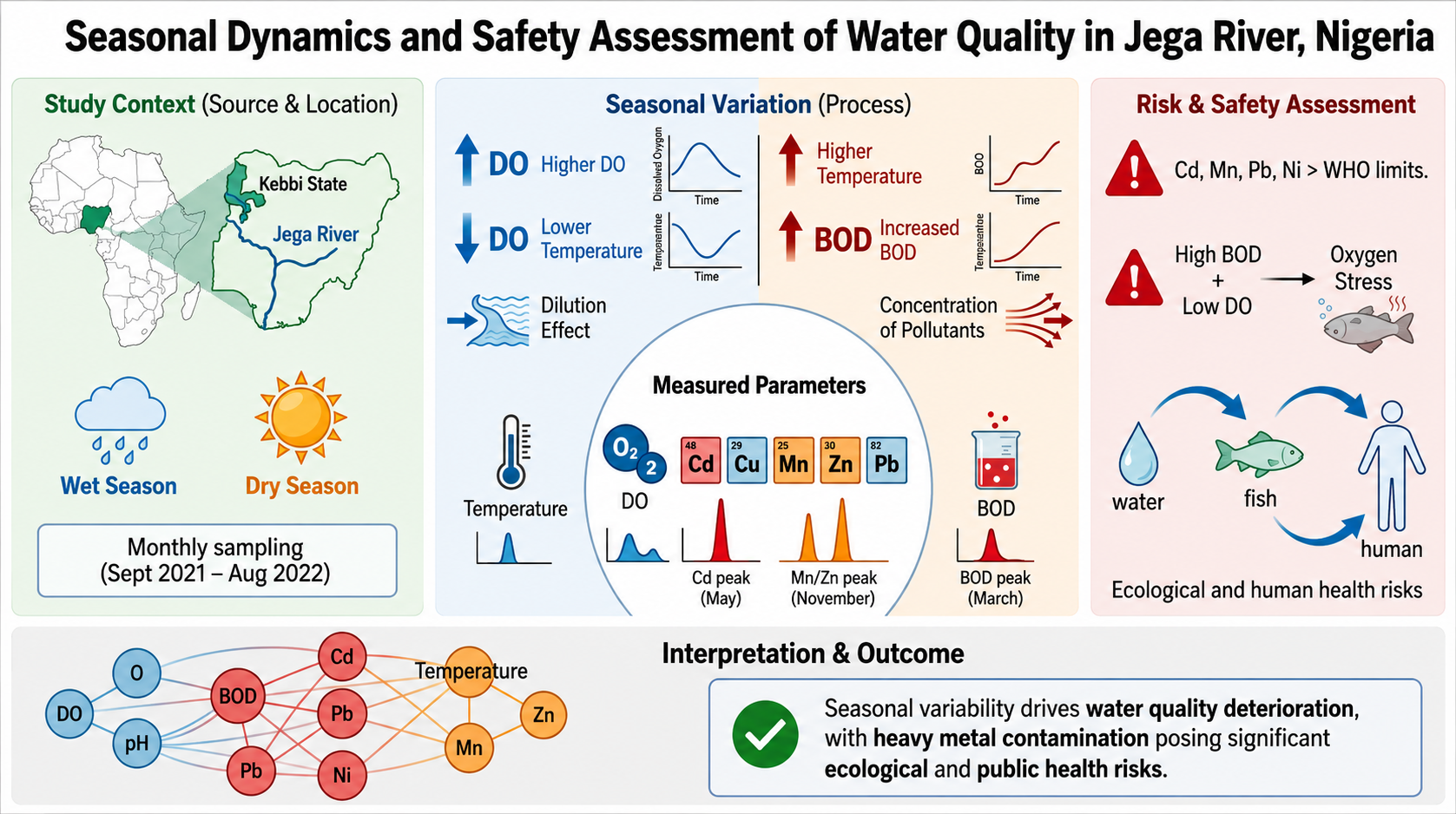
- Water temperature ranged from 27.71 °C (August) to 32.00 °C (May), DO peaked in July (7.47 mg/L) and dropped to its lowest in March (2.73 mg/L). BOD reached a critical maximum in March (43.60 mg/L).
- Heavy metals showed notable peaks: Cd (0.627 mg/L, May), Cu (0.051 mg/L, April), Mn (0.73 mg/L, November), and Zn (0.14 mg/L, November).
- Concentrations of Cd, Mn, Ni, Pb, along with DO and BOD levels, exceeded WHO permissible limits.
- Open Access
- Article
Seasonal Dynamics and Safety Assessment of Physicochemical and Heavy Metal Parameters in Jega River, Kebbi State, Nigeria
Author Information
Received: 14 Feb 2026 | Revised: 18 Apr 2026 | Accepted: 22 Apr 2026 | Published: 19 May 2026
Highlights
Abstract
Jega River in Kebbi State, Nigeria, is an important freshwater resource that supports diverse ecosystem functions. Despite its significance, recent comprehensive assessments of its water quality are lacking. This study evaluated the safety and seasonal variation of physicochemical parameters and heavy metal concentrations over a one-year period. Water samples were collected monthly between September 2021 and August 2022 and analyzed following standard protocols. The results revealed statistically significant (p < 0.05) seasonal variations in most parameters. For instance, water temperature peaked in May (32.00 ± 0.58 °C) and was lowest in August (27.71 ± 0.33 °C), reflecting seasonal thermal fluctuations. DO levels were highest in July (7.47 ± 0.20 mg/L) and lowest in March (2.73 ± 0.00 mg/L), while BOD reached its maximum levels in March (43.60 ± 4.45 mg/L). Among the heavy metals, Cd exhibited the highest concentration in May (0.627 ± 0.05 mg/L), Cu peaked in April (0.051 ± 0.00 mg/L), Mn was highest in November (0.73 ± 0.20 mg/L), and Zn reached its maximum concentrations in November (0.14 ± 0.00 mg/L). Notably, concentrations of Cd, Mn, Ni, and Pb, as well as DO and BOD, exceeded the World Health Organization (WHO) permissible limits for surface water. This indicates potential risks to both aquatic organisms and human health. Correlation analysis showed strong positive and negative relationships among several parameters, suggesting common pollution sources and complex interactions. Overall, these findings provide valuable data for water quality monitoring, pollution control strategies, and sustainable water resource management in line with national policies.
Graphical Abstract
Keywords
dissolved oxygen (DO) | Jega River | heavy metals | lead (Pb) | physicochemical parameters
References
- 1.
Yahaya, T.O.; Mohammed, U.F.; Umar, J.; et al. Level and Risk Assessment of Heavy Metal in Selected Leafy Vegetables Consumed in Birnin Kebbi, Northwestern Nigeria. Savanna J. Basic Appl. Sci. 2022, 4, 58–64. Available online: https://www.sjbas.com.ng/single.php?journalId=151 (accessed on 25 October 2025).
- 2.
Lukito, W. Current Evidence in Water and Hydration Science. Ann. Nutr. Metab. 2021, 77, 1–6.
- 3.
Xiang, R.; Xu, Y.; Liu, Y.Q. Isolation Distance between Municipal Solid Waste Landfills and Drinking Water Wells for Bacteria Attenuation and Safe Drinking. Sci. Rep. 2019, 9, 17881.
- 4.
Yahaya, T.; Oladele, E.; Chibs, B.; et al. Level and Health Risk Evaluation of Heavy Metals and Microorganisms in Urban Soils of Lagos, Southwest Nigeria. Alger. J. Biosci. 2020, 1, 51–60.
- 5.
Gupta, G.K.; Liu, H.; Shukla, P. Pulp and Paper Industry–Based Pollutants, Their Health Hazards, and Environmental Risks. Curr. Environ. Sci. Health 2019, 12, 48–56.
- 6.
Kuton, M.P.; Ayanda, I.O.; Uzoalu, I.U.; et al. Studies on Heavy Metals and Fish Health Indicators in Malapterurus electricus from Lekki Lagoon, Lagos, Nigeria. Vet. Anim. Sci. 2021, 12, 100169.
- 7.
Lin, Q. Influence of Dams on River Ecosystem and Its Countermeasures. J. Water Resour. Prot. 2021, 3, 60–66.
- 8.
Zarazua, G.; Ávila‑Pérez, P.; Tejeda, S.; et al. Analysis of Total and Dissolved Heavy Metals in Surface Water of a Mexican Polluted River by Total Reflection X‑ray Fluorescence Spectrometry. Spectrochim. Acta B At. Spectrosc. 2022, 61, 1180–1184.
- 9.
Yahaya, T.; Muhammed, A.; Onyeziri, J.A.; et al. Health Risks of Ecosystem Services in Ologe Lagoon, Lagos, Southwest Nigeria. Pollution 2022, 8, 681–692.
- 10.
Winiarska, M.A.; Kowalczuk‑Vasilev, E.; Kwiatkowska, K.; et al. Dietary Intake and Content of Cu, Mn, Fe, and Zn in Selected Cereal Products Marketed in Poland. Biol. Trace Elem. Res. 2019, 187, 568–578.
- 11.
Yahaya, T.O.; Abdulganiyu, Y.; Ologe, O.; et al. Quality and Safety Assessment of Borehole Water around Simpson Transfer Loading Station in Lagos, Southwest Nigeria. Dutse J. Pure Appl. Sci. 2022, 8, 20–35.
- 12.
Farmer, F.Y.; Sun, S.; Duan, X. Refined Assessment of Exposure and Health Risks of Heavy Metals in Water for the Children in Xigu District, Lanzhou. Environ. Sci. 2020, 41, 262–272.
- 13.
Sim, S.F.; Ling, T.Y.; Nyanti, L.; et al. Assessment of Heavy Metals in Water, Sediment, and Fishes of a Large Tropical Hydroelectric Dam in Sarawak, Malaysia. J. Chem. 2016, 2016, 8923183.
- 14.
Preonty, N.; Hassan, N.; Reza, S.; et al. Pollution and Health Risk Assessment of Heavy Metals in Surface Water of the Industrial Region in Gazipur, Bangladesh. Environ. Chem. Ecotoxicol. 2025, 7, 527–538.
- 15.
Wei, G.L.; Yang, Z.F.; Cui, B.S. Impact of Dam Construction on Water Quality and Water Self‑Purification Capacity of the Lancang River, China. Water Resour. Manag. 2009, 23, 1763–1780.
- 16.
APHA. Standard Methods for the Examination of Water and Wastewater 24. Available online: https://secure.apha.org/imis/ItemDetail?iProductCode=978-087553-2998&CATEGORY=BK (accessed on 25 October 2025).
- 17.
WHO. Guidelines for Drinking‑Water Quality Fourth Edition Incorporating the First and Second Addenda. Available online: https://www.who.int/publications/i/item/9789240045064 (accessed on 24 October 2025).
- 18.
Echebima, S.I.; Obafemi, A.A. The Influence of Local Rainy and Dry Seasons on the Diurnal Temperature Range in Nigeria. Atmos. Clim. Sci. 2023, 13, 314–332.
- 19.
Chen, C.; Wang, S.; Wang, Z.; et al. Differential Impacts of Sub‑Daily Precipitation on Temperature Extremes Across Chinaʼs Climatic Zones. Geophys. Res. Lett. 2025, 52, e2024GL114088.
- 20.
Bolan, S.; Padhye, L.P.; Jasemizad, T.; et al. Impacts of Climate Change on the Fate of Contaminants through Extreme Weather Events. Sci. Total Environ. 2024, 909, 168388.
- 21.
Johnson, M.F.; Albertson, L.K.; Algar, A.C.; et al. Rising Water Temperature in Rivers: Ecological Impacts and Future Resilience. WIREs Water 2024, 11, e1724.
- 22.
Nnaemeka‑Okeke, R.C.; Okeke, F.O. Assessing the Influence of Seasonal Precipitation Patterns on Groundwater Quality in the Coal Rich Environment of Enugu, Nigeria. Discov. Appl. Sci. 2024, 6, 208.
- 23.
Muhib, M.I.; Kabir, M.H. Should Optimum pH Range for Different Surface Water Become Fluctuate with Usage and Condition in Perspective of Aquatic Environment and Human Health Effects? Am. Int. J. Nurs. Educ. Pract. 2021, 2, 19–22.
- 24.
Mansour, H.; Ahmed, S.A.; Zaghloul, A.; et al. Seasonal Variation Effect on Water Quality and Sediments Criteria and Its Influence on Soil Pollution: Fayoum Governorate, Egypt. Environ. Sci. Eur. 2024, 36, 132.
- 25.
Rebello, L.R.B.; Siepman, T.; Drexle, S. Correlations between TDS and Electrical Conductivity for High‑Salinity Formation Brines Characteristic of South Atlantic Pre‑Salt Basins. Water SA 2020, 46, 602–609.
- 26.
Gupta, D.; Ranjan, R.J.; Parthasarathy, P.; et al. Spatial and Seasonal Variability in the Water Chemistry of Kabar Tal Wetland (Ramsar Site), Bihar, India: Multivariate Statistical Techniques and GIS Approach. Water Sci. Technol. 2021, 83, 2100–2117.
- 27.
Allia, Z.; Lalaoui, M.; Chebbah, M. Spatial and Seasonal Assessment of Surface Water Quality for Domestic Use in a Semi‑Arid Area of the Upper Kebir Sub‑Basin, NE Algeria. Water Supply 2024, 24, 2946–2962.
- 28.
Bonacina, L.; Fasano, F.; Mezzanotte, V.; et al. Effects of Water Temperature on Freshwater Macroinvertebrates: A Systematic Review. Biol. Rev. Camb. Philos. Soc. 2023, 98, 191–221.
- 29.
Siddique, M.A.; Mahalder, B.; Haque, M.M.; et al. Impact of Climatic Factors on Water Quality Parameters in Tilapia Broodfish Ponds and Predictive Modeling of Pond Water Temperature with ARIMAX. Heliyon 2024, 10, e37717.
- 30.
Vigiak, O.; Grizzetti, B.; Udias‑Moinelo, A.; et al. Predicting Biochemical Oxygen Demand in European Freshwater Bodies. Sci. Total Environ. 2019, 666, 1089–1105.
- 31.
Breitburg, D. Effects of Hypoxia, and the Balance between Hypoxia and Enrichment, on Coastal Fishes and Fisheries. Estuaries 2002, 25, 767–781.
- 32.
Larance, S.; Wang, J.; Delavar, M.A.; et al. Assessing Water Temperature and Dissolved Oxygen and Their Potential Effects on Aquatic Ecosystem Using a SARIMA Model. Environments 2025, 12, 25.
- 33.
Maddah, H.A. Predicting Optimum Dilution Factors for BOD Sampling and Desired Dissolved Oxygen for Controlling Organic Contamination in Various Wastewaters. Int. J. Chem. Eng. 2022, 2022, 8637064.
- 34.
Lemessa, F.; Simane, B.; Seyoum, A.; et al. Assessment of the Impact of Industrial Wastewater on the Water Quality of Rivers around the Bole Lemi Industrial Park (BLIP), Ethiopia. Sustainability 2023, 15, 4290.
- 35.
Edegbene, A.O.; Yandev, D.; Omotehinwa, T.O.; et al. Water Quality Assessment in Benue South, Nigeria: An Investigation of Physico-Chemical and Microbial Characteristics. Water Sci. 2025, 39, 279–290.
- 36.
Edward, A.; Adamu, N. Dry and Wet Seasonal Levels of Heavy Metals in Water, Fish (Brycinus leuciscus) and Sediments from Kiri Reservoir in Shelleng Local Government, Adamawa State, Nigeria. J. Agric. Aquac. 2023, 5, 1–7.
- 37.
Singh, J.; Pant, M.; Ghoshal, T.; et al. Spatio-Seasonal Observations of Water Quality Index, Heavy-Metal Pollution Index and Microbial Contagion in Springs of Lower Indian Himalayan Zone. Environ. Claims J. 2025, 37, 1–36.
- 38.
Liu, Y.; Chen, Q.; Li, Y.; et al. Toxic Effects of Cadmium on Fish. Toxics 2022, 10, 622.
- 39.
Genchi, G.; Sinicropi, M.S.; Lauria, G.; et al. The Effects of Cadmium Toxicity. Int. J. Environ. Res. Public Health 2020, 17, 3782.
- 40.
Gödeke, S.H.; Jamil, H.; Schirmer, M.; et al. Iron and Manganese Mobilisation Due to Dam Height Increase for a Tropical Reservoir in South East Asia. Environ. Monit. Assess. 2022, 194, 358.
- 41.
Wang, Q.G.; Du, Y.H.; Su, Y.; et al. Environmental Impact Post‑Assessment of Dam and Reservoir Projects: A Review. Procedia Environ. Sci. 2022, 13, 1439–1443.
- 42.
Cuevas, J.G.; Faz, A.; Martínez‑Martínez, S.; et al. Influence of Rainfall on Physicochemical Characteristics of Runoff Water and Sediments in Riverbeds Affected by Mining and Agricultural Activities. Sci. Total Environ. 2025, 958, 177889.
- 43.
Yahaya, T.O.; Bashar, D.M.; Liman, U.U.; et al. Effects of Pit Latrines on Borehole and Well Water in Maryland, Lagos, Nigeria. J. Adv. Environ. Health Res. 2023, 11, 20–27.
- 44.
Costa, M.; Salnikow, K.; Sutherland, J.E.; et al. The Role of Oxidative Stress in Nickel and Chromate Genotoxicity. Mol. Cell. Biochem. 2002, 234–235, 265–275.
- 45.
Redha, A.; Al-Hasan, R.; Afzal, M. Synergistic and Concentration Dependent Toxicity of Multiple Heavy Metals Compared with Single Heavy Metals in Conocarpus lancifolius. Environ. Sci. Pollut. Res. Int. 2021, 28, 23258–23272.

How to Cite
Isah, A.; Obaroh, I.; Abdulrahman, S.; Yahaya, T. Seasonal Dynamics and Safety Assessment of Physicochemical and Heavy Metal Parameters in Jega River, Kebbi State, Nigeria. Global Environmental Science 2026, 2 (2), 208–223. https://doi.org/10.53941/ges.2026.100014.
RIS
BibTex
Copyright & License

Copyright (c) 2026 by the authors.
This work is licensed under a Creative Commons Attribution 4.0 International License.
Article Metrics
192
Article Views
0
Citations
Contents
References

 Suite 4002 Level 4, 447 Collins Street, Melbourne, Victoria 3000, Australia
 General Inquiries: info@sciltp.com