
- Assessing airborne eDNA capabilities from taxonomy to public health.
- Identifying methodological biases and ecological mechanistic gaps.
- Proposing standardized frameworks for global ecological forecasting.
- Open Access
- Perspective
Atmospheric Environmental DNA: Integrating Biodiversity Monitoring with Global Ecological Forecasting
- Xiaoping Wang *,
- Guanhua Wang,
- Zihao Sun
Author Information
Received: 20 Jan 2026 | Revised: 28 Apr 2026 | Accepted: 11 May 2026 | Published: 21 May 2026
Highlights
Abstract
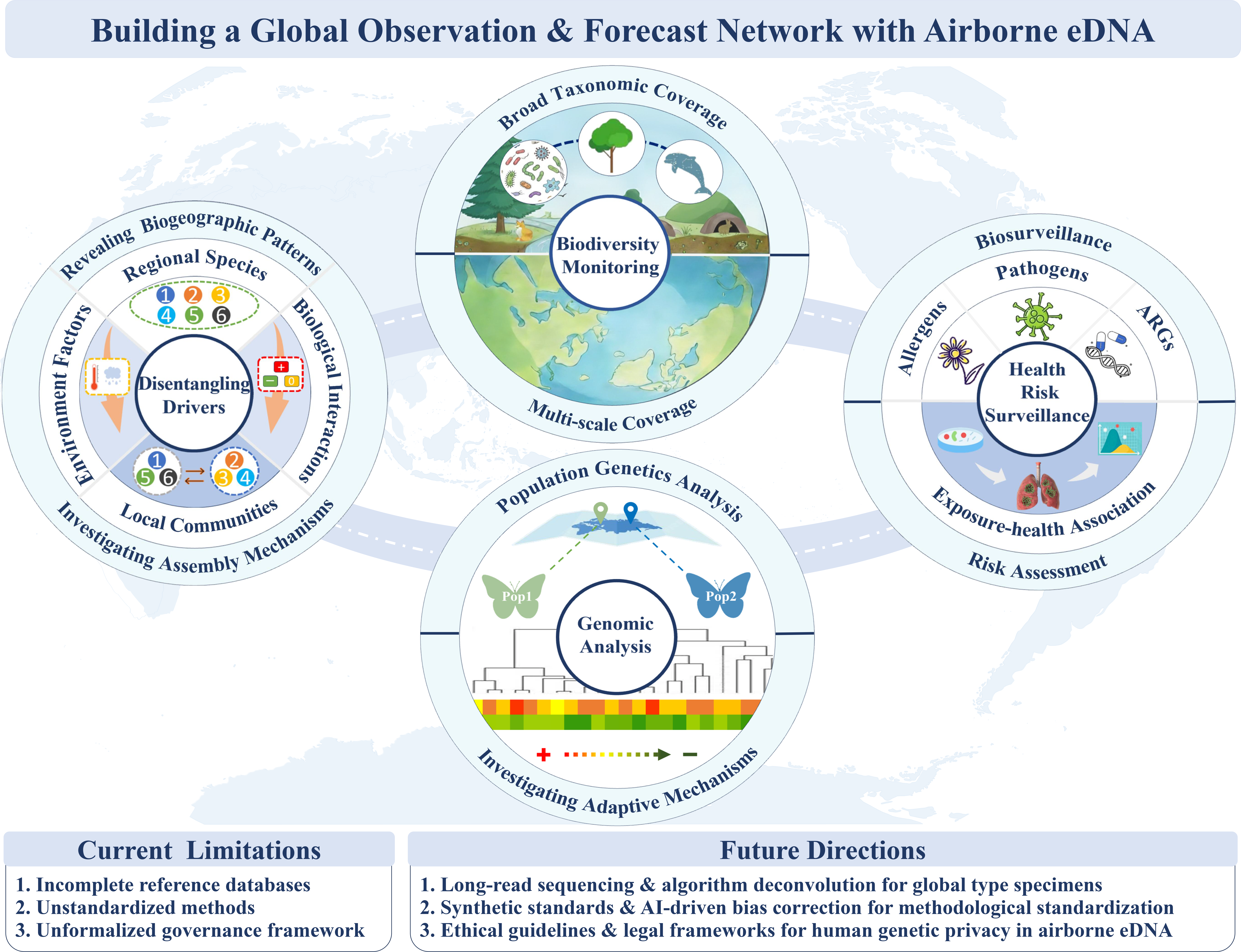
Airborne environmental DNA (eDNA) analysis is emerging as a transformative tool for planetary-scale biodiversity monitoring. This approach enables the capture of genetic material from entire biological communities, spanning viruses to vertebrates within a single air sample. While this technology offers unprecedented potential for conducting non-invasive biodiversity surveys, pathogen surveillance, and population genetic studies, the field remains dominated by descriptive observational studies. Furthermore, it faces significant hurdles, including a lack of mechanistic understanding, methodological biases, and unresolved ethical concerns related to human genetic bycatch. In this perspective, we present the current research landscape of airborne eDNA, highlighting key advancements and persistent limitations. We propose a roadmap for future development aimed at building a predictive framework for global ecological forecasting.
Graphical Abstract
Keywords
airborne | eDNA | biodiversity monitoring | mechanistic gaps | ecological forecasting
References
- 1.
Lappan, R.; Thakar, J.; Molares Moncayo, L.; et al. The Atmosphere: A Transport Medium or an Active Microbial Ecosystem? ISME J. 2024, 18, wrae092.
- 2.
Lin, R.; Yan, Z.; Yao, M. Robust Passive Sampling of Airborne Environmental DNA to Monitor Plants and Animals. Methods Ecol. Evol. 2025, 16, 2118–2130.
- 3.
Karlsson, E.; Johansson, A.-M.; Ahlinder, J.; et al. Airborne Microbial Biodiversity and Seasonality in Northern and Southern Sweden. PeerJ 2020, 8, e8424.
- 4.
Šašić Zorić, L.; Pal, D.; Stefanović, M.; et al. Insight into Outdoor Bioaerosol Diversity by Using High Volume Sampling and Environmental DNA (eDNA) Analysis. Atmos. Environ. 2025, 360, 121396.
- 5.
Abrego, N.; Furneaux, B.; Hardwick, B.; et al. Airborne DNA Reveals Predictable Spatial and Seasonal Dynamics of Fungi. Nature 2024, 631, 835–842.
- 6.
Nousias, O.; McCauley, M.; Stammnitz, M.R.; et al. Shotgun Sequencing of Airborne eDNA Achieves Rapid Assessment of Whole Biomes, Population Genetics and Genomic Variation. Nat. Ecol. Evol. 2025, 9, 1043–1060.
- 7.
Lynggaard, C.; Frøslev, T.G.; Johnson, M.S.; et al. Airborne Environmental DNA Captures Terrestrial Vertebrate Diversity in Nature. Mol. Ecol. Resour. 2024, 24, e13840.
- 8.
Tegart, L.J.; Schiro, G.; Dickinson, J.L.; et al. Decrypting Seasonal Patterns of Key Pollen Taxa in Cool Temperate Australia: A Multi-Barcode Metabarcoding Analysis. Environ. Res. 2024, 243, 117808.
- 9.
Frisk, C.A.; Apangu, G.P.; Petch, G.M.; et al. Microscale Pollen Release and Dispersal Patterns in Flowering Grass Populations. Sci. Total Environ. 2023, 880, 163345.
- 10.
Zhao, J.; Jin, L.; Wu, D.; et al. Global Airborne Bacterial Community—Interactions with Earthʼs Microbiomes and Anthropogenic Activities. Proc. Natl. Acad. Sci. USA 2022, 119, e2204465119.
- 11.
Wu, D.; Xie, J.; Liu, Y.; et al. Metagenomic and Machine Learning Meta‑Analyses Characterize Airborne Resistome Features and Their Hosts in China Megacities. Environ. Sci. Technol. 2023, 57, 16414–16423.
- 12.
Sullivan, A.R.; Karlsson, E.; Svensson, D.; et al. Airborne eDNA Captures Three Decades of Ecosystem Biodiversity. Nat. Commun. 2025, 16, 11281.
- 13.
Keck, F.; Couton, M.; Altermatt, F. Navigating the Seven Challenges of Taxonomic Reference Databases in Metabarcoding Analyses. Mol. Ecol. Resour. 2023, 23, 742–755.
- 14.
Tournayre, O.; Littlefair, J.E.; Garrett, N.R.; et al. First National Survey of Terrestrial Biodiversity Using Airborne eDNA. Sci. Rep. 2025, 15, 19247.
- 15.
Schlegel, M.; Treindl, A.D.; Panziera, J.; et al. A Case Study on the Application of Spore Sampling for the Monitoring of Macrofungi. Mol. Ecol. Resour. 2024, 24, e13941.
- 16.
Fonseca, V.G. Pitfalls in Relative Abundance Estimation Using eDNA Metabarcoding. Mol. Ecol. Resour. 2018, 18, 923–926.
- 17.
Shirazi, S.; Meyer, R.S.; Shapiro, B. Revisiting the Effect of PCR Replication and Sequencing Depth on Biodiversity Metrics in Environmental DNA Metabarcoding. Ecol. Evol. 2021, 11, 15766–15779.
- 18.
Corse, E.; Tougard, C.; Archambaud-Suard, G.; et al. One-Locus-Several-Primers: A Strategy to Improve the Taxonomic and Haplotypic Coverage in Diet Metabarcoding Studies. Ecol. Evol. 2019, 9, 4603–4620.
- 19.
Van der Loos, L.M.; Nijland, R. Biases in Bulk: DNA Metabarcoding of Marine Communities and the Methodology Involved. Mol. Ecol. 2021, 30, 3270–3288.
- 20.
Gimpel, A.L.; Fan, B.; Chen, D.; et al. Predicting Sequence‑Specific Amplification Efficiency in Multi‑Template PCR with Deep Learning. Nat. Commun. 2025, 16, 9187.
- 21.
Metaxatos, A.; Georgiadou, D.; Hatzinikolaou, D.; et al. The Diversity, Richness, and Potential Health and Ecological Role of the Fungal Aerosols in Attica, Greece. Aerosol Air Qual. Res. 2024, 24, 240170.
- 22.
Ramuta, M.D.; Newman, C.M.; Brakefield, S.F.; et al. SARS-CoV-2 and Other Respiratory Pathogens Are Detected in Continuous Air Samples from Congregate Settings. Nat. Commun. 2022, 13, 4717.
- 23.
Knight, A.; Li, D.; Uyttendaele, M.; et al. A Critical Review of Methods for Detecting Human Noroviruses and Predicting Their Infectivity. Crit. Rev. Microbiol. 2013, 39, 295–309.
- 24.
Yang, S.; Dong, Q.; Li, S.; et al. Persistence of SARS-CoV-2 RNA in Wastewater after the End of the COVID-19 Epidemics. J. Hazard. Mater. 2022, 429, 128358.
- 25.
Hongsibsam, T.; Prasertsopon, J.; Siripurkpong, P.; et al. Comparative Evaluation of Viability PCR Reagents Highlights the Superior Efficacy of PMAxx Azo Dye for Bacterial and Viral Viability Discrimination Using Real‑Time and Digital PCR. Microbiol. Spectrum 2026, 14, e0400225.
- 26.
Clare, E.L.; Economou, C.K.; Bennett, F.J.; et al. Measuring Biodiversity from DNA in the Air. Curr. Biol. 2022, 32, 693–700.e5.
- 27.
Sigsgaard, E.E.; Jensen, M.R.; Winkelmann, I.E.; et al. Population-Level Inferences from Environmental DNA—Current Status and Future Perspectives. Evol. Appl. 2020, 13, 245–262.
- 28.
Andres, K.J.; Lodge, D.M.; Andrés, J. Environmental DNA Reveals the Genetic Diversity and Population Structure of an Invasive Species in the Laurentian Great Lakes. Proc. Natl. Acad. Sci. USA 2023, 120, e2307345120.
- 29.
Ballard, J.W.O.; Whitlock, M.C. The Incomplete Natural History of Mitochondria. Mol. Ecol. 2004, 13, 729–744.
- 30.
Couton, M.; Viard, F.; Altermatt, F. Opportunities and Inherent Limits of Using Environmental DNA for Population Genetics. Environ. DNA 2023, 5, 1048–1064.
- 31.
Andres, K.J.; Sethi, S.A.; Lodge, D.M.; et al. Nuclear eDNA Estimates Population Allele Frequencies and Abundance in Experimental Mesocosms and Field Samples. Mol. Ecol. 2021, 30, 685–697.
- 32.
Adams, C.I.M.; Knapp, M.; Gemmell, N.J.; et al. Beyond Biodiversity: Can Environmental DNA (eDNA) Cut It as a Population Genetics Tool? Genes 2019, 10, 192.
- 33.
Jensen, M.R.; Sigsgaard, E.E.; Liu, S.; et al. Genome‑Scale Target Capture of Mitochondrial and Nuclear Environmental DNA from Water Samples. Mol. Ecol. Resour. 2021, 21, 690–702.
- 34.
Whitmore, L.; McCauley, M.; Farrell, J.A.; et al. Inadvertent Human Genomic Bycatch and Intentional Capture Raise Beneficial Applications and Ethical Concerns with Environmental DNA. Nat. Ecol. Evol. 2023, 7, 873–888.
- 35.
Elbrecht, V.; Vamos, E.E.; Steinke, D.; et al. Estimating Intraspecific Genetic Diversity from Community DNA Metabarcoding Data. PeerJ 2018, 6, e4644.
- 36.
Gounot, J.-S.; Chia, M.; Bertrand, D.; et al. Genome-Centric Analysis of Short and Long Read Metagenomes Reveals Uncharacterized Microbiome Diversity in Southeast Asians. Nat. Commun. 2022, 13, 6044.
- 37.
Wagner, R.; Montoya, L.; Gao, C.; et al. The Air Mycobiome Is Decoupled from the Soil Mycobiome in the California San Joaquin Valley. Mol. Ecol. 2022, 31, 4962–4978.
- 38.
Gusareva, E.S.; Gaultier, N.E.; Uchida, A.; et al. Short-Range Contributions of Local Sources to Ambient Air. PNAS Nexus 2022, 1, pgac043.
- 39.
Cai, W.; Li, Y.; Yang, C.; et al. Airborne eDNA Reveals Resource-Based Assembly of Frugivorous Vertebrates. Mol. Ecol. Resour. 2025, 25, e70056.
- 40.
Hanson, M.C.; Petch, G.M.; Ottosen, T.-B.; et al. Climate Change Impact on Fungi in the Atmospheric Microbiome. Sci. Total Environ. 2022, 830, 154491.

How to Cite
Wang, X.; Wang, G.; Sun, Z. Atmospheric Environmental DNA: Integrating Biodiversity Monitoring with Global Ecological Forecasting. Global Environmental Science 2026, 2 (2), 224–229. https://doi.org/10.53941/ges.2026.100015.
RIS
BibTex
Copyright & License

Copyright (c) 2026 by the authors.
This work is licensed under a Creative Commons Attribution 4.0 International License.
Article Metrics
319
Article Views
0
Citations
Contents
References

 Suite 4002 Level 4, 447 Collins Street, Melbourne, Victoria 3000, Australia
 General Inquiries: info@sciltp.com