
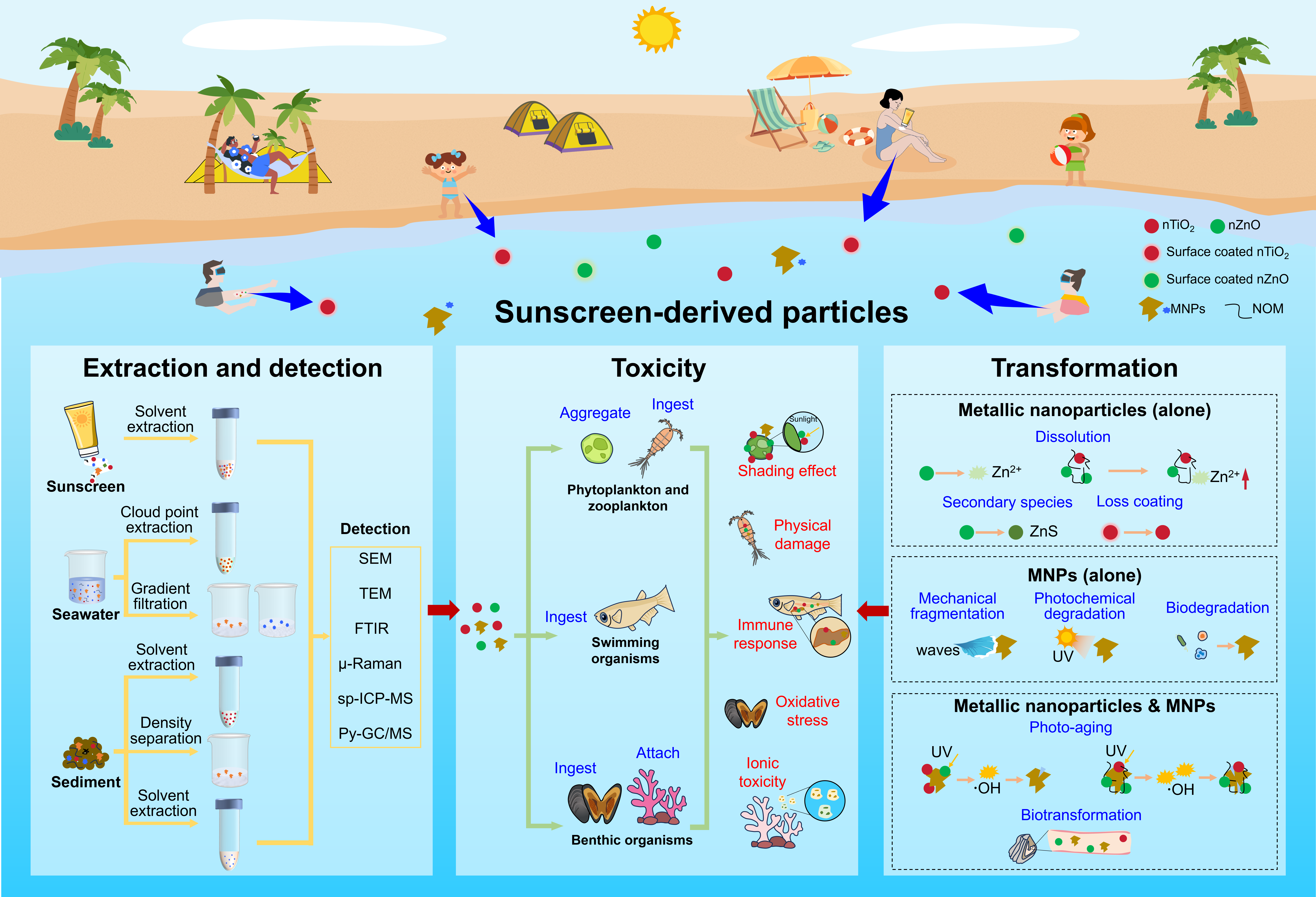
- Occurrences of sunscreen-derived nZnO and nTiO2 in coastal waters were positively correlated with tourist activities.
- Sunscreen-derived metallic and plastic particles induced physical damage and oxidative stress toward marine organisms after attachment or ingestion.
- Both nZnO and nTiO2 exhibit medium to high ecological risks in some coastal beaches.
- Dissolution and photo-aging of sunscreen-derived particles occur in marine environments, thus leading to changes in their toxicity.
- Open Access
- Review
Occurrence and Ecological Risk of Sunscreen-Derived Metallic and Plastic Particles in Marine Environments
- Jiale Wang 1,†,
- Ruyi Lan 1,†,
- Ping Wang 2,
- Zhuomiao Liu 1,*,
- Ziyi Wang 1,
- Mengyao Tao 1,
- Meng Wang 1,
- Jian Zhao 1,3,*
Author Information
Received: 22 Mar 2026 | Revised: 30 Apr 2026 | Accepted: 21 May 2026 | Published: 03 Jun 2026
Highlights
Abstract
Sunscreens are extensively applied to protect human skin from ultraviolet radiation, leading to a substantial rise in the release of sunscreen-derived particles into marine environments. These particles, including metallic nanoparticles (e.g., nanosized zinc oxide, nZnO; nanosized titanium dioxide, nTiO2) and plastic particles (e.g., micro- and nano-plastics, MNPs), are considered emerging contaminants after releasing into marine environment, raising growing concerns regarding their risk to both marine environment and human health. Therefore, this work focuses on these sunscreen-derived particles, and comprehensively reviews their extraction and detection approaches, occurrence, toxicity and ecological risk in marine environments. First, the extraction and detection approaches toward these particles from both original sunscreens and natural samples (e.g., seawater and sediment) are summarized. Based on these approaches, the occurrence of sunscreen-derived particles, primarily nZnO (max. 14.8 μg/L) and nTiO2 (6.0–903.1 μg/L), in coastal waters were summarized, which exhibit a significant correlation with tourist activities. Under environmentally relevant concentrations, these particles exhibit significant toxicity (e.g., physical damage and oxidative stress) after being attached or ingested by marine organisms. Based on the calculated risk characterization ratios, both nZnO and nTiO2 exhibit medium/high risk in some coastal beaches. Additionally, the transformation of sunscreen-derived particles occurs in marine environment, and its role in the toxicity of these particles were further analyzed. Finally, research challenges toward these sunscreen-derived particles are pointed out. This review provides a better understanding of ecological risk of sunscreen-derived metallic and plastic particles in marine environments.
Graphical Abstract
Keywords
sunscreen | metallic nanoparticles | micro- and nano-plastics | occurrence | ecological risk | transformation
References
- 1.
Research and Markets. Available online: https://www.researchandmarkets.com/report/sunscreen#tag-pos-1 (accessed on 15 March 2026).
- 2.
Tovar-Sánchez, A.; Sánchez-Quiles, D.; Rodríguez-Romero, A. Massive coastal tourism influx to the Mediterranean Sea: The environmental risk of sunscreens. Sci. Total Environ. 2019, 656, 316–321.
- 3.
Ma, X.; Li, K.; Chen, X.; et al. Photochemical degradation of sunscreen chemicals in sea spray aerosols. Environ. Sci. Technol. 2026, 60, 6378–6389.
- 4.
Hannan, K.D.; Zuckerman, Z.C.; Haak, C.R.; et al. Impacts of sun protection on feeding behavior and mucus removal of bonefish, Albula vulpes. Environ. Biol. Fishes 2015, 98, 2297–2304.
- 5.
Zhao, M.L.; Ji, X.; He, Z.; et al. Spatial distribution, partitioning, and ecological risk assessment of benzotriazoles, benzothiazoles, and benzotriazole UV absorbers in the eastern shelf seas of China. Water Res. 2024, 248, 120885.
- 6.
Chang, F.; Yin, X.; Ju, H.; et al. Organic ultraviolet filters in Hainan coral reefs: Distribution, accumulation, and ecological risks. Environ. Pollut. 2025, 367, 125541.
- 7.
Ma, Y.; Yoo, J. History of sunscreen: An updated view. J. Cosmet. Dermatol. 2021, 20, 1044–1049.
- 8.
Yuan, S.; Huang, J.; Qian, W.; et al. Are physical sunscreens safe for marine life? A study on a coral–zooxanthellae symbiotic system. Environ. Sci. Technol. 2023, 57, 15846–15857.
- 9.
Weir, A.; Westerhoff, P.; Fabricius, L.; et al. Titanium dioxide nanoparticles in food and personal care products. Environ. Sci. Technol. 2012, 46, 2242–2250.
- 10.
Chavda, V.P.; Acharya, D.; Hala, V.; et al. Sunscreens: A comprehensive review with the application of nanotechnology. J. Drug Deliv. Sci. Technol. 2023, 86, 104720.
- 11.
Arshad, H.; Mehmood, M.Z.; Shah, M.H.; et al. Evaluation of heavy metals in cosmetic products and their health risk assessment. Saudi Pharm. J. 2020, 28, 779–790.
- 12.
Philippe, A.; Košík, J.; Welle, A.; et al. Extraction and characterization methods for titanium dioxide nanoparticles from commercialized sunscreens. Environ. Sci. Nano 2018, 5, 191–202.
- 13.
Nthwane, Y.B.; Tancu, Y.; Maity, A.; et al. Characterisation of titanium oxide nanomaterials in sunscreens obtained by extraction and release exposure scenarios. SN Appl. Sci. 2019, 1, 312.
- 14.
Bairi, V.G.; Lim, J.; Fong, A.; et al. Size characterization of metal oxide nanoparticles in commercial sunscreen products. J. Nanopart. Res. 2017, 19, 256.
- 15.
Chaiyabutr, C.; Sukakul, T.; Kumpangsin, T.; et al. Ultraviolet filters in sunscreens and cosmetic products − A market survey. Contact Dermat. 2021, 85, 58–68.
- 16.
Hanigan, D.; Truong, L.; Schoepf, J.; et al. Trade-offs in ecosystem impacts from nanomaterial versus organic chemical ultraviolet filters in sunscreens. Water Res. 2018, 139, 281–290.
- 17.
Jesus, A.; Augusto, I.; Duarte, J.; et al. Recent trends on UV filters. Appl. Sci. 2022, 12, 12003.
- 18.
Sun, A.; Wang, W. Photodegradation of microplastics by ZnO nanoparticles with resulting cellular and subcellular responses. Environ. Sci. Technol. 2023, 57, 8118–8129.
- 19.
Labille, J.; Slomberg, D.; Catalano, R.; et al. Assessing UV filter inputs into beach waters during recreational activity: A field study of three French Mediterranean beaches from consumer survey to water analysis. Sci. Total Environ. 2020, 706, 136010.
- 20.
Tovar-Sánchez, A.; Sánchez-Quiles, D.; Basterretxea, G.; et al. Sunscreen products as emerging pollutants to coastal waters. PLoS ONE 2013, 8, e65451.
- 21.
Thallinger, D.; Labille, J.; Milinkovitch, T.; et al. UV filter occurrence in beach water of the Mediterranean coast − A field survey over 2 years in Palavas-les-Flots, France. Int. J. Cosmet. Sci. 2023, 45, 67–83.
- 22.
Sun, A.; Wang, W. Differentiation of cellular responses to particulate and soluble constituents in sunscreen products. J. Hazard. Mater. 2024, 474, 134791.
- 23.
Vejerano, E.P.; Khushboo, K.; Vejerano, J.; et al. Exposure of selected sunscreens to artificial sunlight generates persistent free radicals. Environ. Sci. Technol. Lett. 2025, 12, 1554–1560.
- 24.
Abouda, S.; Missaoui, Y.; Gaida, S.; et al. Unveil new insights into microplastic and benzo[a]pyrene toxicity in the seaworm Hediste diversicolor coelomic fluid: A transdisciplinary approach. J. Hazard. Mater. 2025, 496, 139275.
- 25.
Peng, Q.; Feng, Z.; Li, M.; et al. Overlooked role of aged cationic natural organic matter in aquatic microplastics aggregation-sedimentation. Water Res. 2025, 284, 123949.
- 26.
Labille, J.; Catalano, R.; Slomberg, D.; et al. Assessing sunscreen lifecycle to minimize environmental risk posed by nanoparticulate UV-filters—A review for safer-by-design products. Front. Environ. Sci. 2020, 8, 101.
- 27.
Quiñones, R.; Moreno, S.; Shoup, D.; et al. Examining particle size of inorganic active ingredients within sunscreens using dynamic light scattering. J. Chem. Educ. 2021, 98, 1371–1380.
- 28.
Khomami, N.T.S.; Welle, A.; Kunz, S.; et al. Sorption of fulvic acids onto titanium dioxide nanoparticles extracted from commercial sunscreens: ToF-SIMS and high-dimensional data analysis. Coatings 2022, 12, 335.
- 29.
Wimmer, A.; Urstoeger, A.; Funck, N.C.; et al. What happens to silver-based nanoparticles if they meet seawater? Water Res. 2020, 171, 115399.
- 30.
Yang, Y.; Liu, X.; Luo, L.; et al. Quantitative detection of zinc oxide nanoparticle in environmental water by cloud point extraction combined ICP-MS. Adsorpt. Sci. Technol. 2021, 2021, 9958422.
- 31.
Cecchi, T.; Poletto, D.; Berbecaru, A.C.; et al. Assessing microplastics and nanoparticles in the surface seawater of Venice Lagoon—Part I: Methodology of research. Materials 2024, 17, 1759.
- 32.
Hiltunen, A.; Huopalainen, J.; Mäkilä, E.; et al. Expanding sample volume for microscopical detection of nanoplastics. Mar. Environ. Res. 2024, 202, 106806.
- 33.
Seo, J.; Shin, G.; Shin, D. Metal-free AAO membranes function as both filters and Raman enhancers for the analysis of nanoplastics. Water Res. 2025, 273, 123043.
- 34.
Yang, J.; Monnot, M.; Sun, Y.; et al. Microplastics in different water samples (seawater, freshwater, and wastewater): Removal efficiency of membrane treatment processes. Water Res. 2023, 232, 119673.
- 35.
Tuuri, E.M.; Gascooke, J.R.; Leterme, S.C. Efficacy of chemical digestion methods to reveal undamaged microplastics from planktonic samples. Sci. Total Environ. 2024, 947, 174279.
- 36.
Li, G.; Liu, X.; Wang, H.; et al. Detection, distribution and environmental risk of metal-based nanoparticles in a coastal bay. Water Res. 2023, 242, 120242.
- 37.
Gran, A.; Vidal-Barrachina, D.; Casado-Coy, N.; et al. Comparing methods for optimising microplastic extraction in sediment through density separation. Environ. Pollut. 2025, 383, 126894.
- 38.
Duong, T.T.; Le, P.T.; Nguyen, T.N.H.; et al. Selection of a density separation solution to study microplastics in tropical riverine sediment. Environ. Monit. Assess. 2022, 194, 65.
- 39.
Cutroneo, L.; Reboa, A.; Geneselli, I.; et al. Considerations on salts used for density separation in the extraction of microplastics from sediments. Mar. Pollut. Bull. 2021, 166, 112216.
- 40.
Li, Z.; Gao, Y.; Wu, Q.; et al. Quantifying the occurrence of polystyrene nanoplastics in environmental solid matrices via pyrolysis-gas chromatography/mass spectrometry. J. Hazard. Mater. 2022, 440, 129855.
- 41.
Li, P.; Lai, Y.; Zheng, R.; et al. Extraction of common small microplastics and nanoplastics embedded in environmental solid matrices by tetramethylammonium hydroxide digestion and dichloromethane dissolution for Py-GC-MS determination. Environ. Sci. Technol. 2023, 57, 12010–12018.
- 42.
Al-Saeedi, F.M.A.A.; Dahmash, E.Z. In vitro assessment of sunscreen efficacy using fourier transform infrared (FTIR) spectroscopy on synthetic skin. AAPS PharmSciTech 2022, 23, 73.
- 43.
Ngoc, T.A.N.; Ly, T.Q.T.; Vo, V.Q.G.; et al. Sol–gel synthesis of Al-doped TiO2 nanoparticles as UV filters with diminished photocatalytic activity for the application in sunscreen products. J. Sol-Gel Sci. Technol. 2023, 108, 900–911.
- 44.
Le, N.Q.H.; Ngoc, T.A.N.; Nguyen, N.Q.H.; et al. Synthesis of Al-doped and Fe-doped ZnO nanoparticles as UV filters in sunscreens. Vietnam J. Chem. 2023, 61, 52–59.
- 45.
Azari, A.; Ronsmans, S.; Vanoirbeek, J.A.J.; et al. Challenges in Raman spectroscopy of (micro) plastics: The interfering role of colourants. Environ. Pollut. 2024, 363, 125250.
- 46.
Lu, P.J.; Fang, S.W.; Cheng, W.L.; et al. Characterization of titanium dioxide and zinc oxide nanoparticles in sunscreen powder by comparing different measurement methods. J. Food Drug Anal. 2018, 26, 1192–1200.
- 47.
Quiñones, R.; Logan Bayline, J.; Polvani, D.A.; et al. Integrating elemental analysis and chromatography techniques by analyzing metal oxide and organic UV absorbers in commercial sunscreens. J. Chem. Educ. 2016, 93, 1434–1440.
- 48.
Jang, E.; Sridharan, K.; Park, Y.M.; et al. Eliminated phototoxicity of TiO2 particles by an atomic-layer-deposited Al2O3 coating layer for UV-protection applications. Chem. Eur. J. 2016, 22, 12022–12026.
- 49.
Barbosa, J.S.; Neto, D.M.A.; Freire, R.M.; et al. Ultrafast sonochemistry-based approach to coat TiO2 commercial particles for sunscreen formulation. Ultrason. Sonochem. 2018, 48, 340–348.
- 50.
Bocca, B.; Caimi, S.; Senofonte, O.; et al. ICP-MS based methods to characterize nanoparticles of TiO2 and ZnO in sunscreens with focus on regulatory and safety issues. Sci. Total Environ. 2018, 630, 922–930.
- 51.
Barabash, M.; Ahabchane, H.-E.; Hadioui, M.; et al. Release of TiO2 and ZnO nanoparticles from sunscreens into natural waters: Detection and discrimination from natural particles using SP ICP-ToF-MS. Environ. Sci. Nano 2025, 12, 4994–5007.
- 52.
Sun, A.; Wang, W. Photodegradation of plastic leachate: Revealing the key role of halogen in reduced cytotoxicity in marine systems. Environ. Sci. Technol. 2025, 59, 17822–17833.
- 53.
Pallero-Flores, C.; Oviedo, J.L.; Tovar-Sánchez, A.; et al. A survey of beachgoers to estimate sunscreen coastal water input and potential eco-label consumption: Contributions to sustainable tourism. Sustainability 2024, 16, 8575.
- 54.
Danovaro, R.; Bongiorni, L.; Corinaldesi, C.; et al. Sunscreens cause coral bleaching by promoting viral infections. Environ. Health Perspect. 2008, 116, 441–447.
- 55.
Botta, C.; Labille, J.; Auffan, M.; et al. TiO2-based nanoparticles released in water from commercialized sunscreens in a life-cycle perspective: Structures and quantities. Environ. Pollut. 2011, 159, 1543–1550.
- 56.
Zuo, Y.; Ge, Y.; Wang, R.; et al. Occurrence and migration patterns of microplastics in different tidal zones of tourist beaches: A case study in the Bohai Bay, North China. J. Environ. Manag. 2024, 370, 122479.
- 57.
Soursou, V.; Campo, J.; Picó, Y. Spatio-temporal variation and ecological risk assessment of microplastics along the touristic beaches of a mediterranean coast transect (Valencia province, East Spain). J. Environ. Manag. 2024, 354, 120315.
- 58.
Novillo-Sanjuan, O.; Raga, J.A.; Tomás, J. Microdebris in three Spanish Mediterranean beaches located at a sporadic loggerhead turtles’ (Caretta caretta) nesting area. Reg. Stud. Mar. Sci. 2022, 49, 102116.
- 59.
Yeo, B.G.; Mizukawa, K.; Takada, H. Microplastics in global marine waters and biota: Effectiveness of potential bioindicators in mirroring local pollution levels. Environ. Monit. Contam. Res. 2023, 3, 43–68.
- 60.
Harris, P.T. The fate of microplastic in marine sedimentary environments: A review and synthesis. Mar. Pollut. Bull. 2020, 158, 111398.
- 61.
Simantiris, N.; Vardaki, M.Z. A systematic review and scientometrics analysis on microplastic pollution on coastal beaches around the globe. Cont. Shelf Res. 2025, 286, 105424.
- 62.
Hietbrink, T.S.; Materić, D.; Holzinger, R.; et al. Nanoplastic concentrations across the North Atlantic. Nature 2025, 643, 412–416.
- 63.
Schiavo, S.; Oliviero, M.; Philippe, A.; et al. Nanoparticles based sunscreens provoke adverse effects on marine microalgae Dunaliella tertiolecta. Environ. Sci. Nano 2018, 5, 3011–3022.
- 64.
Prato, E.; Parlapiano, I.; Biandolino, F.; et al. Chronic sublethal effects of ZnO nanoparticles on Tigriopus fulvus (Copepoda, Harpacticoida). Environ. Sci. Pollut. Res. 2020, 27, 30957–30968.
- 65.
Wang, Y.; Zhu, X.; Lao, Y.; et al. TiO2 nanoparticles in the marine environment: Physical effects responsible for the toxicity on algae Phaeodactylum tricornutum. Sci. Total Environ. 2016, 565, 818–826.
- 66.
Li, F.; Liang, Z.; Zheng, X.; et al. Toxicity of nano-TiO2 on algae and the site of reactive oxygen species production. Aquat. Toxicol. 2015, 158, 1–13.
- 67.
Shoman, N.; Solomonova, E.; Akimov, A. ZnO, CuO and TiO2 nanoparticles impacts on natural phytoplankton community (in vitro). Environ. Sci. Pollut. Res. 2025, 32, 21450–21462.
- 68.
Wong, S.W.Y.; Zhou, G.-J.; Leung, P.T.Y.; et al. Sunscreens containing zinc oxide nanoparticles can trigger oxidative stress and toxicity to the marine copepod Tigriopus japonicus. Mar. Pollut. Bull. 2020, 154, 111078.
- 69.
Kim, K.; Yoon, H.; Choi, J.S.; et al. Chronic effects of nano and microplastics on reproduction and development of marine copepod Tigriopus japonicus. Ecotoxicol. Environ. Saf. 2022, 243, 113962.
- 70.
Martin, N.; Wassmur, B.; Slomberg, D.; et al. Influence of TiO2 nanocomposite UV filter surface chemistry and their interactions with organic UV filters on uptake and toxicity toward cultured fish gill cells. Ecotoxicol. Environ. Saf. 2022, 243, 113984.
- 71.
Hao, L.; Wang, Z.; Xing, B. Effect of sub-acute exposure to TiO2 nanoparticles on oxidative stress and histopathological changes in Juvenile Carp (Cyprinus carpio). J. Environ. Sci. 2009, 21, 1459–1466.
- 72.
Chen, J.; Dong, X.; Xin, Y.; et al. Effects of titanium dioxide nano-particles on growth and some histological parameters of zebrafish (Danio rerio) after a long-term exposure. Aquat. Toxicol. 2011, 101, 493–499.
- 73.
Sukhsangchan, R.; Phaksopa, J.; Uchuwittayakul, A.; et al. Effects of zinc oxide nanoparticles (ZnO NPs) on growth, immune responses and histopathological alterations in Asian Seabass (Lates calcarifer, Bloch 1790) under low-salinity conditions. Animals 2024, 14, 2737.
- 74.
Fouqueray, M.; Noury, P.; Dherret, L.; et al. Exposure of juvenile Danio rerio to aged TiO2 nanomaterial from sunscreen. Environ. Sci. Pollut. Res. 2013, 20, 3340–3350.
- 75.
Zhang, X.; Wen, K.; Ding, D.; et al. Size-dependent adverse effects of microplastics on intestinal microbiota and metabolic homeostasis in the marine medaka (Oryzias melastigma). Environ. Int. 2021, 151, 106452.
- 76.
Zhu, L.; Zou, L.; Nie, M.; et al. Ocean acidification enhances TiO2 nanoparticle toxicity in Oryzias melastigma: Dominant role of size effects in driving bioaccumulation and hepatotoxicity. Water Res. 2025, 289, 124822.
- 77.
Kang, H.-M.; Byeon, E.; Jeong, H.; et al. Different effects of nano- and microplastics on oxidative status and gut microbiota in the marine medaka Oryzias melastigma. J. Hazard. Mater. 2021, 405, 124207.
- 78.
Kukavica, B.; Davidović-Plavšić, B.; Savić, A.; et al. Oxidative stress and neurotoxicity of cadmium and zinc on Artemia franciscana. Biol. Trace Elem. Res. 2023, 201, 2636–2649.
- 79.
Marisa, I.; Matozzo, V.; Martucci, A.; et al. Bioaccumulation and effects of titanium dioxide nanoparticles and bulk in the clam Ruditapes philippinarum. Mar. Environ. Res. 2018, 136, 179–189.
- 80.
Falfushynska, H.I.; Wu, F.; Ye, F.; et al. The effects of ZnO nanostructures of different morphology on bioenergetics and stress response biomarkers of the blue mussels Mytilus edulis. Sci. Total Environ. 2019, 694, 133717.
- 81.
Doyle, J.J.; Ward, J.E.; Mason, R. An examination of the ingestion, bioaccumulation, and depuration of titanium dioxide nanoparticles by the blue mussel (Mytilus edulis) and the eastern oyster (Crassostrea virginica). Mar. Environ. Res. 2015, 110, 45–52.
- 82.
Barmo, C.; Ciacci, C.; Canonico, B.; et al. In vivo effects of n-TiO2 on digestive gland and immune function of the marine bivalve Mytilus galloprovincialis. Aquat. Toxicol. 2013, 132–133, 9–18.
- 83.
Sureda, A.; Capó, X.; Busquets-Cortés, C.; et al. Acute exposure to sunscreen containing titanium induces an adaptive response and oxidative stress in Mytillus galloprovincialis. Ecotoxicol. Environ. Saf. 2018, 149, 58–63.
- 84.
Yuan, S.; Huang, J.; Jiang, X.; et al. Environmental fate and toxicity of sunscreen-derived inorganic ultraviolet filters in aquatic environments: A review. Nanomaterials 2022, 12, 699.
- 85.
Tang, C.-H.; Lin, C.-Y.; Lee, S.-H.; et al. Membrane lipid profiles of coral responded to zinc oxide nanoparticle-induced perturbations on the cellular membrane. Aquat. Toxicol. 2017, 187, 72–81.
- 86.
Gelabert, A.; Sivry, Y.; Ferrari, R.; et al. Uncoated and coated ZnO nanoparticle life cycle in synthetic seawater. Environ. Toxicol. Chem. 2014, 33, 341–349.
- 87.
Cong, Y.; Jin, F.; Wang, J.; et al. The embryotoxicity of ZnO nanoparticles to marine medaka, Oryzias melastigma. Aquat. Toxicol. 2017, 185, 11–18.
- 88.
Schiavo, S.; Oliviero, M.; Miglietta, M.; et al. Genotoxic and cytotoxic effects of ZnO nanoparticles for Dunaliella tertiolecta and comparison with SiO2 and TiO2 effects at population growth inhibition levels. Sci. Total Environ. 2016, 550, 619–627.
- 89.
George, S.; Yin, H.; Liu, Z.; et al. Hazard profiling of a combinatorial library of zinc oxide nanoparticles: Ameliorating light and dark toxicity through surface passivation. J. Hazard. Mater. 2022, 434, 128825.
- 90.
Choi, S.; Rahman, R.T.; Kim, B.; et al. Photochemically inert broad-spectrum sunscreen by metal-phenolic network coatings of titanium oxide nanoparticles. ACS Appl. Mater. Interfaces 2024, 16, 16767–16777.
- 91.
Slomberg, D.L.; Catalano, R.; Bartolomei, V.; et al. Release and fate of nanoparticulate TiO2 UV filters from sunscreen: Effects of particle coating and formulation type. Environ. Pollut. 2021, 271, 116263.
- 92.
Lai, R.W.S.; Kang, H.-M.; Zhou, G.-J.; et al. Hydrophobic surface coating can reduce toxicity of zinc oxide nanoparticles to the marine copepod Tigriopus japonicus. Environ. Sci. Technol. 2021, 55, 6917–6925.
- 93.
Catalano, R.; Labille, J.; Gaglio, D.; et al. Safety evaluation of TiO2 nanoparticle-based sunscreen UV filters on the development and the immunological state of the sea Urchin Paracentrotus lividus. Nanomaterials 2020, 10, 2102.
- 94.
Dobretsov, S.; Sathe, P.; Bora, T.; et al. Toxicity of different zinc oxide nanomaterials at 3 trophic levels: Implications for development of low‐toxicity antifouling agents. Environ. Toxicol. Chem. 2020, 39, 1343–1354.
- 95.
Cardoso, D.; Narcy, A.; Durosoy, S.; et al. Dissolution kinetics of zinc oxide and its relationship with physicochemical characteristics. Powder Technol. 2021, 378, 746–759.
- 96.
Liu, J.; Chen, Y.; Song, Y.; et al. Evidence of size-dependent toxicity of polystyrene nano-and microplastics in sea cucumber Apostichopus japonicus (Selenka, 1867) during the intestinal regeneration. Environ. Pollut. 2024, 357, 124394.
- 97.
Natarajan, L.; Jenifer, M.A.; Mukherjee, A. Influence of algal-extracellular polymeric substances (EPS) on the pristine and combined toxicity of TiO2 NPs and PSNPs in Artemia salina: Eco-corona enhances the toxic effects. Ecotoxicol. Environ. Saf. 2024, 282, 116760.
- 98.
Yagi, M.; Ono, Y.; Kawaguchi, T. Microplastic pollution in aquatic environments may facilitate misfeeding by fish. Environ. Pollut. 2022, 315, 120457.
- 99.
Fang, T.; Yu, L.P.; Zhang, W.C.; et al. Effects of humic acid and ionic strength on TiO2 nanoparticles sublethal toxicity to zebrafish. Ecotoxicology 2015, 24, 2054–2066.
- 100.
Sikder, M.; Croteau, M.N.; Poulin, B.A.; et al. Effect of nanoparticle size and natural organic matter composition on the bioavailability of polyvinylpyrrolidone-coated platinum nanoparticles to a model freshwater invertebrate. Environ. Sci. Technol. 2021, 55, 2452–2461.
- 101.
Wu, F.; Sokolova, I.M. Immune responses to ZnO nanoparticles are modulated by season and environmental temperature in the blue mussels Mytilus edulis. Sci. Total Environ. 2021, 801, 149786.
- 102.
Shang, Y.; Wang, X.; Kong, H.; et al. Nano-ZnO impairs anti-predation capacity of marine mussels under seawater acidification. J. Hazard. Mater. 2019, 371, 521–528.
- 103.
Duckworth, C.G.; Picariello, C.R.; Thomason, R.K.; et al. Responses of the sea anemone, Exaiptasia pallida, to ocean acidification conditions and zinc or nickel exposure. Aquat. Toxicol. 2017, 182, 120–128.
- 104.
Lee, G.; Lee, B.; Kim, K.-T. Mechanisms and effects of zinc oxide nanoparticle transformations on toxicity to zebrafish embryos. Environ. Sci. Nano 2021, 8, 1690–1700.
- 105.
Gomez‐Gonzalez, M.A.; Silva‐Ferreira, D.T.; Clark, N.; et al. Toward understanding the environmental risks of combined microplastics/nanomaterials exposures: Unveiling ZnO transformations after adsorption onto polystyrene microplastics in environmental solutions. Glob. Chall. 2023, 7, 2300036.
- 106.
Violatto, M.B.; Sitia, G.; Talamini, L.; et al. Variations in biodistribution and acute response of differently shaped titania nanoparticles in healthy rodents. Nanomaterials 2023, 13, 1174.
- 107.
Li, J.; Liu, Y.; Wang, Y.; et al. Hydrous alumina/silica double-layer surface coating of TiO2 pigment. Colloids Surf. A Physicochem. Eng. Asp. 2012, 407, 77–84.
- 108.
Jiang, C.; Aiken, G.R.; Hsu-Kim, H. Effects of natural organic matter properties on the dissolution kinetics of zinc oxide nanoparticles. Environ. Sci. Technol. 2015, 49, 11476–11484.
- 109.
Wang, J.; Hu, A.; Cui, Y.; et al. Toward the chemogeography of dissolved organic matter in the global ocean. Environ. Sci. Technol. 2025, 59, 23266–23274.
- 110.
Garzón-Cardona, J.E.; Martínez, A.M.; Alonso, C.; et al. Insight into origin and transformation of dissolved organic matter under contrasting nutrient conditions on the Northern Patagonian Continental Shelf, Southwestern Atlantic Ocean. Mar. Environ. Res. 2026, 213, 107660.
- 111.
Zhang, G.; Tang, D.; Wang, Y.; et al. Overlooked role of carbonyls of natural organic matter on the dissolution of zinc oxide nanoparticles. ACS Earth Space Chem. 2019, 3, 2786–2794.
- 112.
Monira, S.; Roychand, R.; Hai, F.I.; et al. Microplastic fragmentation into nanoplastics by water shear forces during wastewater treatment: Mechanical insights and theoretical analysis. Environ. Pollut. 2025, 364, 125310.
- 113.
Kaddouri, A.; Serier, B.; Kaddouri, K.; et al. Experimental analysis of the physical degradation of polymers—The case of polymethyl methacrylate. Fract. Struct. Integr. 2020, 14, 66–80.
- 114.
Sun, A.; Wang, W. Photodegradation controls of potential toxicity of secondary sunscreen-derived microplastics and associated leachates. Environ. Sci. Technol. 2025, 59, 5223–5236.
- 115.
Dovzhenko, N.V.; Chelomin, V.P.; Kukla, S.P.; et al. Enhanced toxicity of polymethylmethacrylate microparticles on cells and tissue of the marine mussel Mytilus trossulus after UV irradiation. Toxics 2025, 13, 818.
- 116.
Omura, T.; Isobe, N.; Miura, T.; et al. Microbial decomposition of biodegradable plastics on the deep-sea floor. Nat. Commun. 2024, 15, 568.
- 117.
Sudhakar, Y.N.; Selvakumar, M.; Bhat, D.K. Enhancement and investigation of biodegradability of poly (methyl methacrylate) and poly (vinyl chloride) by blending with biodegradable polymer. Polym. Bull. 2023, 80, 5623–5639.
- 118.
Yuan, Z.; Lv, R.; Gudda, F.; et al. Impacts of high temperatures on microbial degradation of microplastics and strategies for optimization. New Contam. 2025, 1, e018.
- 119.
Zeng, Q.; Qu, R.; Wen, Q.; et al. Effects of photoaged polystyrene microplastics and nanoplastics on the extracellular aggregation and intracellular accumulation of ZnO nanoparticles to algae. J. Environ. Sci. 2026, 162, 821–830.
- 120.
Armendáriz-Alonso, E.F.; Rivera-García, N.; Moreno-Razo, J.A.; et al. Structural water content in pigment-grade TiO2 particles coated with Al2O3 and SiO2, and their effect on polypropylene photodegradation. Coatings 2025, 15, 685.
- 121.
Li, S.; Ma, H.; Wallis, L.K.; et al. Impact of natural organic matter on particle behavior and phototoxicity of titanium dioxide nanoparticles. Sci. Total Environ. 2016, 542, 324–333.
- 122.
Li, F.; Bai, X.; Ji, Y.; et al. Understanding microplastic aging driven by photosensitization of algal extracellular polymeric substances. J. Hazard. Mater. 2024, 469, 133949.
- 123.
Liu, X.; Zhao, Y.; Yue, T.; et al. Heteroaggregation of functionalized nanoplastics with Al2O3 particles in aquatic environments. Chem. Eng. J. 2025, 518, 164555.
- 124.
Wang, Z.; Zhang, L.; Zhao, J.; et al. Environmental processes and toxicity of metallic nanoparticles in aquatic systems as affected by natural organic matter. Environ. Sci. Nano 2016, 3, 240–255.
- 125.
Chia, S.L.; Leong, D.T. Reducing ZnO nanoparticles toxicity through silica coating. Heliyon 2016, 2, e00177.
- 126.
Yu, Y.; Craig, N.; Su, L. A hidden pathway for human exposure to micro-and nanoplastics—The mechanical fragmentation of plastic products during daily use. Toxics 2023, 11, 774.
- 127.
Byeon, E.; Sanpradit, P.; Lee, J.S.; et al. Size-dependent toxicity of nano-and microplastics with zinc oxide nanoparticles in the marine rotifer Brachionus koreanus. Mar. Pollut. Bull. 2024, 209, 117206.
- 128.
Li, J.; Mao, S.; Ye, Y.; et al. Micro-polyethylene particles reduce the toxicity of nano zinc oxide in marine microalgae by adsorption. Environ. Pollut. 2021, 290, 118042.
- 129.
Rex, M.C.; Mukherjee, A. The comparative effects of visible light and UV-A radiation on the combined toxicity of P25 TiO2 nanoparticles and polystyrene microplastics on Chlorella sp. Environ. Sci. Pollut. Res. 2023, 30, 122700–122716.
- 130.
Lai, R.W.S.; Zhou, G.J.; Kang, H.M.; et al. Contrasting toxicity of polystyrene nanoplastics to the rotifer Brachionus koreanus in the presence of zinc oxide nanoparticles and zinc ions. Aquat. Toxicol. 2022, 253, 106332.
- 131.
Xin, X.; Huang, G.; Zhang, B.; et al. Trophic transfer potential of nTiO2, nZnO, and triclosan in an algae-algae eating fish food chain. Aquat. Toxicol. 2021, 235, 105824.
- 132.
Lewicka, Z.A.; Benedetto, A.F.; Benoit, D.N.; et al. The structure, composition, and dimensions of TiO2 and ZnO nanomaterials in commercial sunscreens. J. Nanopart. Res. 2011, 13, 3607–3617.
- 133.
Lu, P.J.; Cheng, W.L.; Huang, S.C.; et al. Characterizing titanium dioxide and zinc oxide nanoparticles in sunscreen spray. Int. J. Cosmet. Sci. 2015, 37, 620–626.
- 134.
Tou, F.; Niu, Z.; Fu, J.; et al. Simple method for the extraction and determination of Ti-, Zn-, Ag-, and Au-containing nanoparticles in sediments using single-particle inductively coupled plasma mass spectrometry. Environ. Sci. Technol. 2021, 55, 10354–10364.
- 135.
Choleva, T.G.; Tsogas, G.Z.; Vlessidis, A.G.; et al. Development of a sequential extraction and speciation procedure for assessing the mobility and fractionation of metal nanoparticles in soils. Environ. Pollut. 2020, 263, 114407.
- 136.
Li, Q.; Lai, Y.; Yu, S.; et al. Sequential isolation of microplastics and nanoplastics in environmental waters by membrane filtration, followed by cloud-point extraction. Anal. Chem. 2021, 93, 4559–4566.
- 137.
Wu, Z.; Qin, M.; Wei, H. Improved reliability of Raman spectroscopic imaging of low-micrometer microplastic mixtures in lake water by fractionated membrane filtration. ACS EST Water 2023, 3, 2616–2626.
- 138.
Arnould, M.; Quingongo, R.; Albignac, M.; et al. A membrane cascade for size-based separation and concentration of nanoplastics in environmental waters. Sep. Purif. Technol. 2025, 373, 133352.
- 139.
Nabi, I.; Zhang, L. A review on microplastics separation techniques from environmental media. J. Clean. Prod. 2022, 337, 130458.
- 140.
Wang, Z.; Wang, Y.; Lu, X.; et al. Generation of simulated “Natural” nanoplastics from polypropylene food packaging as the experimental standard. Molecules 2023, 28, 7254.
- 141.
Sökmen, T.Ö.; Sulukan, E.; Türkoğlu, M.; et al. Polystyrene nanoplastics (20 nm) are able to bioaccumulate and cause oxidative DNA damages in the brain tissue of zebrafish embryo (Danio rerio). Neurotoxicology 2020, 77, 51–59.
- 142.
Gumbiowski, N.; Barthel, J.; Loza, K.; et al. Simulated HRTEM images of nanoparticles to train a neural network to classify nanoparticles for crystallinity. Nanoscale Adv. 2024, 6, 4196–4206.
- 143.
Giulio, D.T.; Malitesta, C.; Mazzotta, E. Surface chemical analysis of plastic materials by X‐ray photoelectron spectroscopy: Understanding weathering, fragmentation and contaminant uptake in marine environments. Macromol. Mater. Eng. 2026, 311, e00280.
- 144.
Nor, N.H.M.; Obbard, J.P. Microplastics in Singapore’s coastal mangrove ecosystems. Mar. Pollut. Bull. 2014, 79, 278–283.
- 145.
Imhof, H.K.; Schmid, J.; Niessner, R.; et al. A novel, highly efficient method for the separation and quantification of plastic particles in sediments of aquatic environments. Limnol. Oceanogr. Methods 2012, 10, 524–537.
- 146.
Yang, J.; Monnot, M.; Sun, Y.; et al. Microplastics in different water samples (seawater, freshwater, and wastewater): Methodology approach for characterization using micro-FTIR spectroscopy. Water Res. 2023, 232, 119711.
- 147.
Hermabessiere, L.; Himber, C.; Boricaud, B.; et al. Optimization, performance, and application of a pyrolysis-GC/MS method for the identification of microplastics. Anal. Bioanal. Chem. 2018, 410, 6663–6676.
- 148.
Wang, Y.; Chen, B.; Wang, B.; et al. Phosphoric acid functionalized magnetic sorbents for selective enrichment of TiO2 nanoparticles in surface water followed by inductively coupled plasma mass spectrometry detection. Sci. Total Environ. 2020, 703, 135464.
- 149.
Azimzada, A.; Farner, J.M.; Hadioui, M.; et al. Release of TiO2 nanoparticles from painted surfaces in cold climates: Characterization using a high sensitivity single-particle ICP-MS. Environ. Sci. Nano 2020, 7, 139–148.
- 150.
Naasz, S.; Weigel, S.; Borovinskaya, O.; et al. Multi-element analysis of single nanoparticles by ICP-MS using quadrupole and time-of-flight technologies. J. Anal. At. Spectrom. 2018, 33, 835–845.
- 151.
Corinaldesi, C.; Marcellini, F.; Nepote, E.; et al. Impact of inorganic UV filters contained in sunscreen products on tropical stony corals (Acropora spp.). Sci. Total Environ. 2018, 637, 1279–1285.
- 152.
Li, M.; Jiang, Y.; Chuang, C.-Y.; et al. Recovery of Alexandrium tamarense under chronic exposure of TiO2 nanoparticles and possible mechanisms. Aquat. Toxicol. 2019, 208, 98–108.
- 153.
Minetto, D.; Libralato, G.; Marcomini, A.; et al. Potential effects of TiO2 nanoparticles and TiCl4 in saltwater to Phaeodactylum tricornutum and Artemia franciscana. Sci. Total Environ. 2017, 579, 1379–1386.
- 154.
Ates, M.; Daniels, J.; Arslan, Z.; et al. Effects of aqueous suspensions of titanium dioxide nanoparticles on Artemia salina: Assessment of nanoparticle aggregation, accumulation, and toxicity. Environ. Monit. Assess. 2013, 185, 3339–3348.
- 155.
Bhuvaneshwari, M.; Sagar, B.; Doshi, S.; et al. Comparative study on toxicity of ZnO and TiO2 nanoparticles on Artemia salina: Effect of pre-UV-A and visible light irradiation. Environ. Sci. Pollut. Res. 2017, 24, 5633–5646.
- 156.
Rekulapally, R.; Chavali, L.N.M.; Idris, M.M.; et al. Toxicity of TiO2, SiO2, ZnO, CuO, Au and Ag engineered nanoparticles on hatching and early nauplii of Artemia sp. PeerJ 2019, 6, e6138.
- 157.
Clément, L.; Hurel, C.; Marmier, N. Toxicity of TiO2 nanoparticles to cladocerans, algae, rotifers and plants—Effects of size and crystalline structure. Chemosphere 2013, 90, 1083–1090.
- 158.
Sendra, M.; Sánchez-Quiles, D.; Blasco, J.; et al. Effects of TiO2 nanoparticles and sunscreens on coastal marine microalgae: Ultraviolet radiation is key variable for toxicity assessment. Environ. Int. 2017, 98, 62–68.
- 159.
Baharlooeian, M.; Kerdgari, M.; Shimada, Y. Ecotoxicological effects of TiO2 nanoparticulates and bulk Ti on microalgae Chaetoceros muelleri. Environ. Technol. Innov. 2021, 23, 101720.
- 160.
Bameri, L.; Sourinejad, I.; Ghasemi, Z.; et al. Toxicity of TiO2 nanoparticles to the marine microalga Chaetoceros muelleri Lemmermann, 1898 under long-term exposure. Environ. Sci. Pollut. Res. 2022, 29, 30427–30440.
- 161.
Zhu, L.; Booth, A.M.; Feng, S.; et al. UV-B radiation enhances the toxicity of TiO2 nanoparticles to the marine microalga Chlorella pyrenoidosa by disrupting the protection function of extracellular polymeric substances. Environ. Sci.: Nano 2022, 9, 1591–1604.
- 162.
Bhuvaneshwari, M.; Thiagarajan, V.; Nemade, P.; et al. Toxicity and trophic transfer of P25 TiO2 NPs from Dunaliella salina to Artemia salina: Effect of dietary and waterborne exposure. Environ. Res. 2018, 160, 39–46.
- 163.
Manzo, S.; Buono, S.; Rametta, G.; et al. The diverse toxic effect of SiO2 and TiO2 nanoparticles toward the marine microalgae Dunaliella tertiolecta. Environ. Sci. Pollut. Res. 2015, 22, 15941–15951.
- 164.
Miller, R.J.; Bennett, S.; Keller, A.A.; et al. TiO2 nanoparticles are phototoxic to marine phytoplankton. PLoS ONE 2012, 7, e30321.
- 165.
Sivakumar, M.; Dhinakarasamy, I.; Chakraborty, S.; et al. Effects of titanium oxide nanoparticles on growth, biochemical composition, and photosystem mechanism of marine microalgae Isochrysis galbana COR-A3. Nanotoxicology 2025, 19, 156–179.
- 166.
Fernández-García, F.; Martins, M.; Raymond, E.; et al. Unravelling the role of environmentally realistic concentrations of titanium dioxide nanoparticles in altering gametogenesis and gonadal health of female Pacific oysters (Magallana gigas): A histopathological approach. Aquat. Toxicol. 2025, 287, 107539.
- 167.
Huang, W.; Zhou, Y.; Zhao, T.; et al. The effects of copper ions and copper nanomaterials on the output of amino acids from marine microalgae. Environ. Sci. Pollut. Res. 2022, 29, 9780–9791.
- 168.
Shang, Y.; Wu, F.; Wei, S.; et al. Specific dynamic action of mussels exposed to TiO2 nanoparticles and seawater acidification. Chemosphere 2020, 241, 125104.
- 169.
Huang, X.; Liu, Z.; Xie, Z.; et al. Oxidative stress induced by titanium dioxide nanoparticles increases under seawater acidification in the thick shell mussel Mytilus coruscus. Mar. Environ. Res. 2018, 137, 49–59.
- 170.
Canesi, L.; Fabbri, R.; Gallo, G.; et al. Biomarkers in Mytilus galloprovincialis exposed to suspensions of selected nanoparticles (Nano carbon black, C60 fullerene, Nano-TiO2, Nano-SiO2). Aquat. Toxicol. 2010, 100, 168–177.
- 171.
D'Agata, A.; Fasulo, S.; Dallas, L.J.; et al. Enhanced toxicity of ‘bulk’ titanium dioxide compared to ‘fresh’ and ‘aged’ nano-TiO2 in marine mussels (Mytilus galloprovincialis). Nanotoxicology 2014, 8, 549–558.
- 172.
Xia, B.; Chen, B.; Sun, X.; et al. Interaction of TiO2 nanoparticles with the marine microalga Nitzschia closterium: Growth inhibition, oxidative stress and internalization. Sci. Total Environ. 2015, 508, 525–533.
- 173.
Li, S.; Pan, X.; Wallis, L.K.; et al. Comparison of TiO2 nanoparticle and graphene—TiO2 nanoparticle composite phototoxicity to Daphnia magna and Oryzias latipes. Chemosphere 2014, 112, 62–69.
- 174.
Sanches, M.V.; Oliva, M.; De Marchi, L.; et al. Ecotoxicological screening of UV-filters using a battery of marine bioassays. Environ. Pollut. 2021, 290, 118011.
- 175.
Roger, L.M.; Adarkwa Darko, Y.; Bernas, T.; et al. Evaluation of fluorescence-based viability stains in cells dissociated from scleractinian coral Pocillopora damicornis. Sci. Rep. 2022, 12, 15297.
- 176.
Wong, S.W.Y.; Zhou, G.-J.; Kwok, K.W.H.; et al. In vivo toxicities of nine engineered nano metal oxides to the marine diatom Skeletonema costatum and rotifer Brachionus koreanus. Mar. Pollut. Bull. 2020, 153, 110973.
- 177.
Galletti, A.; Seo, S.; Joo, S.H.; et al. Effects of titanium dioxide nanoparticles derived from consumer products on the marine diatom Thalassiosira pseudonana. Environ. Sci. Pollut. Res. 2016, 23, 21113–21122.
- 178.
Sarkheil, M.; Johari, S.A.; An, H.J.; et al. Acute toxicity, uptake, and elimination of zinc oxide nanoparticles (ZnO NPs) using saltwater microcrustacean, Artemia franciscana. Environ. Toxicol. Pharmacol. 2018, 57, 181–188.
- 179.
Schiavo, S.; Oliviero, M.; Li, J.; et al. Testing ZnO nanoparticle ecotoxicity: Linking time variable exposure to effects on different marine model organisms. Environ. Sci. Pollut. Res. 2018, 25, 4871–4880.
- 180.
Ates, M.; Daniels, J.; Arslan, Z.; et al. Comparative evaluation of impact of Zn and ZnO nanoparticles on brine shrimp (Artemia salina) larvae: Effects of particle size and solubility on toxicity. Environ. Sci. Process. Impacts 2013, 15, 225–233.
- 181.
Xu, J.; Xin-Ming, P.U.; Lu, D.; et al. Seawater quality criteria and ecotoxicity risk assessment of zinc oxide nanoparticles based on data of resident marine organisms in China. Sci. Total Environ. 2023, 905, 166690.
- 182.
Suman, T.Y.; Radhika Rajasree, S.R.; Kirubagaran, R. Evaluation of zinc oxide nanoparticles toxicity on marine algae chlorella vulgaris through flow cytometric, cytotoxicity and oxidative stress analysis. Ecotoxicol. Environ. Saf. 2015, 113, 23–30.
- 183.
Vimercati, L.; Cavone, D.; Caputi, A.; et al. Nanoparticles: An experimental study of zinc nanoparticles toxicity on marine crustaceans. General overview on the health implications in humans. Front. Public Health 2020, 8, 192.
- 184.
Fabrega, J.; Tantra, R.; Amer, A.; et al. Sequestration of zinc from zinc oxide nanoparticles and life cycle effects in the sediment dweller amphipod Corophium volutator. Environ. Sci. Technol. 2012, 46, 1128–1135.
- 185.
Noventa, S.; Hacker, C.; Rowe, D.; et al. Dissolution and bandgap paradigms for predicting the toxicity of metal oxide nanoparticles in the marine environment: An in vivo study with oyster embryos. Nanotoxicology 2018, 12, 63–78.
- 186.
Trevisan, R.; Delapedra, G.; Mello, D.F.; et al. Gills are an initial target of zinc oxide nanoparticles in oysters Crassostrea gigas, leading to mitochondrial disruption and oxidative stress. Aquat. Toxicol. 2014, 153, 27–38.
- 187.
Miller, R.J.; Lenihan, H.S.; Muller, E.B.; et al. Impacts of metal oxide nanoparticles on marine phytoplankton. Environ. Sci. Technol. 2010, 44, 7329–7334.
- 188.
Aravantinou, A.F.; Tsarpali, V.; Dailianis, S.; et al. Effect of cultivation media on the toxicity of ZnO nanoparticles to freshwater and marine microalgae. Ecotoxicol. Environ. Saf. 2015, 114, 109–116.
- 189.
Cuccaro, A.; Oliva, M.; De Marchi, L.; et al. Biochemical response of Ficopomatus enigmaticus adults after exposure to organic and inorganic UV filters. Mar. Pollut. Bull. 2022, 178, 113601.
- 190.
Prato, E.; Fabbrocini, A.; Libralato, G.; et al. Comparative toxicity of ionic and nanoparticulate zinc in the species Cymodoce truncata, Gammarus aequicauda and Paracentrotus lividus. Environ. Sci. Pollut. Res. 2021, 28, 42891–42900.
- 191.
Zhu, X.; Tan, L.; Zhao, T.; et al. Alone and combined toxicity of ZnO nanoparticles and graphene quantum dots on microalgae Gymnodinium. Environ. Sci. Pollut. Res. 2022, 29, 47310–47322.
- 192.
Zhang, C.; Wang, J.; Tan, L.; et al. Toxic effects of nano-ZnO on marine microalgae Skeletonema costatum : Attention to the accumulation of intracellular Zn. Aquat. Toxicol. 2016, 178, 158–164.
- 193.
Li, J.; Schiavo, S.; Xiangli, D.; et al. Early ecotoxic effects of ZnO nanoparticle chronic exposure in Mytilus galloprovincialis revealed by transcription of apoptosis and antioxidant-related genes. Ecotoxicology 2018, 27, 369–384.
- 194.
Muller, E.B.; Hanna, S.K.; Lenihan, H.S.; et al. Impact of engineered zinc oxide nanoparticles on the energy budgets of Mytilus galloprovincialis. J. Sea Res. 2014, 94, 29–36.
- 195.
Ishwarya, R.; Vaseeharan, B.; Subbaiah, S.; et al. Sargassum wightii-synthesized ZnO nanoparticles—From antibacterial and insecticidal activity to immunostimulatory effects on the green tiger shrimp Penaeus semisulcatus. J. Photochem. Photobiol. B: Biol. 2018, 183, 318–330.
- 196.
Wong, S.W.Y.; Leung, P.T.Y.; Djurišić, A.B.; et al. Toxicities of nano zinc oxide to five marine organisms: Influences of aggregate size and ion solubility. Anal. Bioanal. Chem. 2010, 396, 609–618.
- 197.
Spisni, E.; Seo, S.; Joo, S.H.; et al. Release and toxicity comparison between industrial- and sunscreen-derived nano-ZnO particles. Int. J. Environ. Sci. Technol. 2016, 13, 2485–2494.
- 198.
Yung, M.M.N.; Kwok, K.W.H.; Djurišić, A.B.; et al. Influences of temperature and salinity on physicochemical properties and toxicity of zinc oxide nanoparticles to the marine diatom Thalassiosira pseudonana. Sci. Rep. 2017, 7, 3662.
- 199.
Bielmyer-Fraser, G.K.; Jarvis, T.A.; Lenihan, H.S.; et al. Cellular partitioning of nanoparticulate versus dissolved metals in marine phytoplankton. Environ. Sci. Technol. 2014, 48, 13443–13450.
- 200.
Yi, X.; Zhang, K.; Han, G.; et al. Toxic effect of triphenyltin in the presence of nano zinc oxide to marine copepod Tigriopus japonicus. Environ. Pollut. 2018, 243, 687–692.
- 201.
Park, J.; Kim, S.; Yoo, J.; et al. Effect of salinity on acute copper and zinc toxicity to Tigriopus japonicus: The difference between metal ions and nanoparticles. Mar. Pollut. Bull. 2014, 85, 526–531.
- 202.
Sarkhel, R.; Sengupta, S.; Das, P.; et al. Biodegradation of plastic waste using marine micro-organisms. In Urban Mining and Sustainable Waste Management; Ghosh, S.K., Ed.; Springer: Singapore, 2020; pp. 195–201.
How to Cite
Wang, J.; Lan, R.; Wang, P.; Liu, Z.; Wang, Z.; Tao, M.; Wang, M.; Zhao, J. Occurrence and Ecological Risk of Sunscreen-Derived Metallic and Plastic Particles in Marine Environments. Global Environmental Science 2026, 2 (2), 230–250. https://doi.org/10.53941/ges.2026.100016.
RIS
BibTex
Copyright & License

Copyright (c) 2026 by the authors.
This work is licensed under a Creative Commons Attribution 4.0 International License.
Article Metrics
329
Article Views
1
Citations
Contents
References

 Suite 4002 Level 4, 447 Collins Street, Melbourne, Victoria 3000, Australia
 General Inquiries: info@sciltp.com