
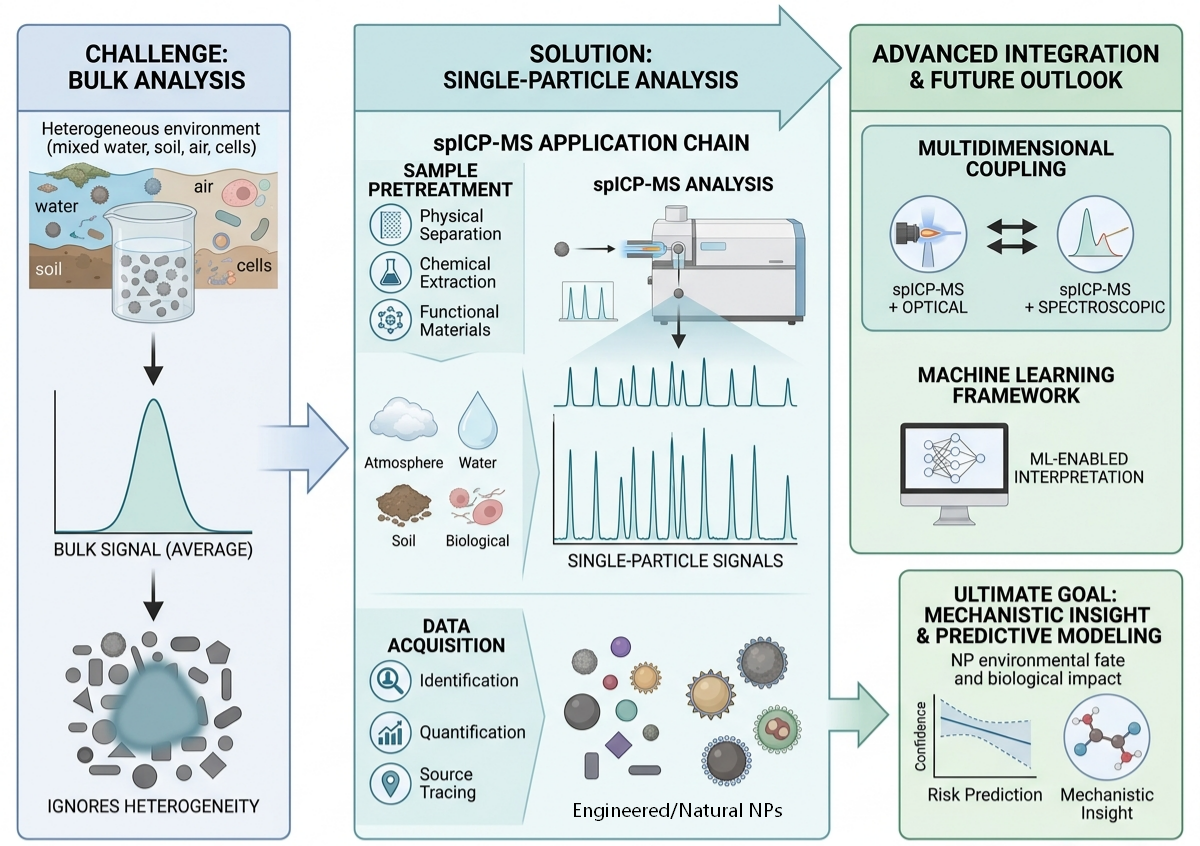
- Systematic summary of separation and extraction of nanoparticles from environmental samples
- Identification and quantification of engineered and natural nanoparticles across atmospheric, aquatic, and terrestrial systems
- Future application of single-particle mass spectrometry coupled with optical and spectroscopic techniques
- Enhanced data interpretation for nanoparticle classification, toxicity mechanism elucidation and risk prediction with machine learning
- Open Access
- Review
Advances in Methodological Evolution and Integration of Single-Particle Analysis for Nanoparticles in Environmental Matrices
- Chen Yao 1,2,
- Chen Miao 1,2,
- Jiang Xu 1,2,3,*
Author Information
Received: 12 Feb 2026 | Revised: 23 May 2026 | Accepted: 04 Jul 2026 | Published: 09 Jul 2026
Highlights
Abstract
Environmental heterogeneity significantly influences the transport, transformation, and ecological risks of nanoparticles (NPs). Traditional bulk-scale analytical approaches often overlook inter-particle heterogeneity, thereby limiting a nuanced understanding of nanoparticle behavior and associated risks. Since single-particle analysis can enable high-throughput and highly sensitive detection of NPs in complex environmental matrices, this review emphasizes that characterizing NPs at the single-particle level is therefore crucial for accurately assessing their environmental fate and biological impacts. This review traces the evolution of single-particle Inductively Coupled Plasma Mass Spectrometry (spICP-MS) from its quadrupole foundations to time-of-flight configurations, and summarizes their applications across environmental matrix. The optimization and integration of strategies such as physical separation, chemical extraction, and functionalized material pretreatment laid the methodological foundation for single-particle analysis. The applications of spICP-MS are demonstrated in the identification, quantification, and source tracing of metallic NPs in atmospheric, aquatic, soil, and biological samples. Special attention is given to its multidimensional coupling with optical and spectroscopic techniques, as well as emerging machine learning-enabled frameworks for intelligent data interpretation and risk prediction. Ultimately, this work highlights the pivotal role of multidisciplinary technological integration and data-driven strategies in advancing environmental nanoscience toward an era focused on mechanistic insight and predictive modeling.
Graphical Abstract
Keywords
single-particle analysis | hyphenated techniques | environmental nanoparticles | environmental monitoring | machine learning
References
- 1.
Vijver, M.G.; Zhai, Y.J.; Wang, Z.; et al. Emerging investigator series: The dynamics of particle size distributions need to be accounted for in bioavailability modelling of nanoparticles. Environ. Sci. Nano. 2018, 5, 2473–2481.
- 2.
Rasmussen, M.K.; Pedersen, J.N.; Marie, R. Size and surface charge characterization of nanoparticles with a salt gradient. Nat. Commun. 2020, 11, 2337.
- 3.
Gavilán-Arriazu, E.M.; Giménez, R.E.; Pinto, O.A. Structural surface and thermodynamics analysis of nanoparticles with defects. Phys. Chem. Chem. Phys. 2020, 22, 23148–23157.
- 4.
Visentin, C.; Braun, A.B.; Reginatto, C.; et al. Are contaminated soil and groundwater remediation with nanoscale zero-valent iron sustainable? An analysis of case studies. Environ. Pollut. 2024, 352, 124167.
- 5.
Macurková, A.; Maryska, L.; Jindrichová, B.; et al. Effect of round-shaped silver nanoparticles on the genetic and functional diversity of soil microbial community in soil and “soil-plant” systems. Appl. Soil Ecol. 2021, 168, 104165.
- 6.
Lerner, R.N.; Lu, Q.Y.; Zeng, H.B.; et al. The effects of biofilm on the transport of stabilized zerovalent iron nanoparticles in saturated porous media. Water Res. 2012, 46, 975–985.
- 7.
He, L.; Wu, D.; Rong, H.F.; et al. Influence of Nano- and Microplastic Particles on the Transport and Deposition Behaviors of Bacteria in Quartz Sand. Environ. Sci. Technol. 2018, 52, 11555–11563.
- 8.
Bidi, H.; Fallah, H.; Niknejad, Y.; et al. Iron oxide nanoparticles alleviate arsenic phytotoxicity in rice by improving iron uptake, oxidative stress tolerance and diminishing arsenic accumulation. Plant Physiol. Biochem. 2021, 163, 348–357.
- 9.
Degueldre, C.; Favarger, P.Y. Colloid analysis by single particle inductively coupled plasma-mass spectroscopy: A feasibility study. Colloids Surf. A Physicochem. Eng. Asp. 2003, 217, 137–142.
- 10.
Laborda, F.; Bolea, E.; Jiménez-Lamana, J. Single Particle Inductively Coupled Plasma Mass Spectrometry: A Powerful Tool for Nanoanalysis. Anal. Chem. 2014, 86, 2270–2278.
- 11.
Montaño, M.D.; Olesik, J.W.; Barber, A.G.; et al. Single Particle ICP-MS: Advances toward routine analysis of nanomaterials. Anal. Bioanal. Chem. 2016, 408, 5053–5074.
- 12.
Hendriks, L.; Gundlach-Graham, A.; Hattendorf, B.; et al. Characterization of a new ICP-TOFMS instrument with continuous and discrete introduction of solutions. J. Anal. At. Spectrom. 2017, 32, 548–561.
- 13.
Naasz, S.; Weigel, S.; Borovinskaya, O.; et al. Multi-element analysis of single nanoparticles by ICP-MS using quadrupole and time-of-flight technologies. J. Anal. At. Spectrom. 2018, 33, 835–845.
- 14.
Mozhayeva, D.; Engelhard, C. A critical review of single particle inductively coupled plasma mass spectrometry—A step towards an ideal method for nanomaterial characterization. J. Anal. At. Spectrom. 2020, 35, 1740–1783.
- 15.
Gundlach-Graham, A.; Harycki, S.; Szakas, S.E.; et al. Introducing “time-of-flight single particle investigator” (TOF-SPI): A tool for quantitative spICP-TOFMS data analysis. J. Anal. At. Spectrom. 2024, 39, 704–711.
- 16.
Metarapi, D.; Sala, M.; Vogel-Mikus, K.; et al. Nanoparticle Analysis in Biomaterials Using Laser Ablation-Single Particle-Inductively Coupled Plasma Mass Spectrometry. Anal. Chem. 2019, 91, 6200–6205.
- 17.
Tharaud, M.; Schlatt, L.; Shaw, P.; et al. Nanoparticle identification using single particle ICP-ToF-MS acquisition coupled to cluster analysis. From engineered to natural nanoparticles. J. Anal. At. Spectrom. 2022, 37, 2042–2052.
- 18.
Sikora, A.; Ojeda, D.; Bartczak, D.; et al. Multimethod Platform Based on Dynamic Image Analysis and spICP-MS for Number-Based Quantification of Microplastics. Anal. Chem. 2025, 97, 26054–26061.
- 19.
Holbrook, T.R.; Gallot-Duval, D.; Reemtsma, T.; et al. Machine learning: Our future spotlight into single-particle ICP-ToF-MS analysis. J. Anal. At. Spectrom. 2021, 36, 2684–2694.
- 20.
Xu, L.; Ma, X.M.; Yang, J.H.; et al. Advancing Simultaneous Extraction and Sequential Single-Particle ICP-MS Analysis for Metallic Nanoparticle Mixtures in Plant Tissues. J. Agric. Food Chem. 2024, 72, 11251–11258.
- 21.
Liu, W.Y.; Shi, H.L.; Liu, K.; et al. A Sensitive Single Particle-ICP-MS Method for CeO2 Nanoparticles Analysis in Soil during Aging Process. J. Agric. Food Chem. 2021, 69, 1115–1122.
- 22.
Dan, Y.B.; Ma, X.M.; Zhang, W.L.; et al. Single particle ICP-MS method development for the determination of plant uptake and accumulation of CeO2 nanoparticles. Anal. Bioanal. Chem. 2016, 408, 5157–5167.
- 23.
Paton, L.; Kiesel, S.; Steinhoefel, G.; et al. Assessing the impact of common sample preparation strategies for single particle ICP-MS regarding recovery and size distribution of natural single particles. J. Anal. At. Spectrom. 2025, 40, 2897–2908.
- 24.
Stolpe, B.; Guo, L.; Shiller, A.M.; et al. Size and composition of colloidal organic matter and trace elements in the Mississippi River, Pearl River and the northern Gulf of Mexico, as characterized by flow field-flow fractionation. Mar. Chem. 2010, 118, 119–128.
- 25.
Jiang, H.; Wang, Y.; Tan, Z.; et al. Dissolved metal ion removal by online hollow fiber ultrafiltration for enhanced size characterization of metal-containing nanoparticles with single-particle ICP-MS. J. Environ. Sci. 2023, 126, 494–505.
- 26.
Shah, N.K.; Ivone, R.; Shen, J.; et al. A comparison of centrifugation and tangential flow filtration for nanoparticle purification: A case study on acetalated dextran nanoparticles. Particuology. 2020, 50, 189–196.
- 27.
Bland, G.D.; Lowry, G.V. Multistep Method to Extract Moderately Soluble Copper Oxide Nanoparticles from Soil for Quantification and Characterization. Anal. Chem. 2020, 92, 9620–9628.
- 28.
Wei, W.J.; Yang, Y.; Li, X.Y.; et al. Cloud point extraction (CPE) combined with single particle-inductively coupled plasma-mass spectrometry (SP-ICP-MS) to analyze and characterize nano-silver sulfide in water environment. Talanta 2022, 239, 123117.
- 29.
Torrent, L.; Laborda, F.; Marguí, E.; et al. Combination of cloud point extraction with single particle inductively coupled plasma mass spectrometry to characterize silver nanoparticles in soil leachates. Anal. Bioanal. Chem. 2019, 411, 5317–5329.
- 30.
Lai, Y.J.; Dong, L.J.; Li, Q.C.; et al. Counting Nanoplastics in Environmental Waters by Single Particle Inductively Coupled Plasma Mass Spectroscopy after Cloud-Point Extraction and In Situ Labeling of Gold Nanoparticles. Environ. Sci. Technol. 2021, 55, 4783–4791.
- 31.
Li, Y.J.; Gao, Y.; Jia, J.B.; et al. Protein corona-induced extraction coupled to Fenton oxidation for selective and non-destructive preconcentration of Ag2S nanoparticles from waters. Water Res. 2022, 224, 119042.
- 32.
Taboada-López, M.V.; Herbello-Hermelo, P.; Domínguez-González, R.; et al. Enzymatic hydrolysis as a sample pre-treatment for titanium dioxide nanoparticles assessment in surimi (crab sticks) by single particle ICP-MS. Talanta 2019, 195, 23–32.
- 33.
Gao, Y.; Zhang, R.Y.; Sun, H.Z.; et al. High-efficiency mechanically assisted alkaline extraction of nanoparticles from biological tissues for spICP-MS analysis. Anal. Bioanal. Chem. 2022, 414, 4401–4408.
- 34.
Laughton, S.; Laycock, A.; Bland, G.; et al. Methanol-based extraction protocol for insoluble and moderately water-soluble nanoparticles in plants to enable characterization by single particle ICP-MS. Anal. Bioanal. Chem. 2021, 413, 299–314.
- 35.
Espada-Bernabé, E.; Gómez-Gómez, B.; Moreno-Martín, G.; et al. Development of a fast and low-cost aqueous based-extraction protocol for the simultaneous extraction and characterization of SiO2 and TiO2 (nano) particles in confectionary products. Anal. Chim. Acta. 2024, 1323, 343058.
- 36.
Zhang, M.; Wang, H.; Wu, Y.W.; et al. Silver ion-imprinted magnetic adsorbent hyphenated to single particle-ICP-MS for separation and analysis of dissolved silver and silver nanoparticles in antibacterial gel extracts. Anal. Chim. Acta. 2023, 1279, 341846.
- 37.
Ch’ng, A.C.W.; Konthur, Z.; Lim, T.S. Magnetic bead-based semi-automated phage display panning strategy for the directed evolution of antibodies. In Methods in Enzymology; Kumar C.V., ed.; Academic Press: San Diego, CA, USA, 2020; vol. 630, pp. 159–178.
- 38.
Tou, F.Y.; Niu, Z.S.; Fu, J.Q.; et al. Simple Method for the Extraction and Determination of Ti-, Zn-, Ag-, and Au-Containing Nanoparticles in Sediments Using Single-Particle Inductively Coupled Plasma Mass Spectrometry. Environ. Sci. Technol. 2021, 55, 10354–10364.
- 39.
Mozhayeva, D.; Strenge, I.; Engelhard, C. Implementation of Online Preconcentration and Microsecond Time Resolution to Capillary Electrophoresis Single Particle Inductively Coupled Plasma Mass Spectrometry (CE-SP-ICP-MS) and Its Application in Silver Nanoparticle Analysis. Anal. Chem. 2017, 89, 7152–7159.
- 40.
Li, B.; Chua, S.L.; Yu, D.Y.; et al. Separation and size characterization of highly polydisperse titanium dioxide nanoparticles (E171) in powdered beverages by using Asymmetric Flow Field-Flow Fractionation hyphenated with Multi-Angle Light Scattering and Inductively Coupled Plasma Mass Spectrometry. J. Chromatogr. A. 2021, 1643, 462059.
- 41.
Yang, Y.; Doudrick, K.; Bi, X.Y.; et al. Characterization of Food-Grade Titanium Dioxide: The Presence of Nanosized Particles. Environ. Sci. Technol. 2014, 48, 6391–6400.
- 42.
López-Heras, I.; Madrid, Y.; Cámara, C. Prospects and difficulties in TiO2 nanoparticles analysis in cosmetic and food products using asymmetrical flow field-flow fractionation hyphenated to inductively coupled plasma mass spectrometry. Talanta 2014, 124, 71–78.
- 43.
Yang, J.J.; Tan, P.; Huang, T.Y.; et al. Exploring the upper particle size limit for field flow fractionation online with ICP-MS to address the challenges of water samples from the Taihu Lake. Anal. Chim. Acta. 2020, 1093, 16–27.
- 44.
López-Sanz, S.; Fariñas, N.R.; Martín-Doimeadios, R.; et al. Analytical strategy based on asymmetric flow field flow fractionation hyphenated to ICP-MS and complementary techniques to study gold nanoparticles transformations in cell culture medium. Anal. Chim. Acta. 2019, 1053, 178–185.
- 45.
Rakcheev, D.; Philippe, A.; Schaumann, G.E. Hydrodynamic Chromatography Coupled with Single Particle-Inductively Coupled Plasma Mass Spectrometry for Investigating Nanoparticles Agglomerates. Anal. Chem. 2013, 85, 10643–10647.
- 46.
Donahue, N.D.; Francek, E.R.; Kiyotake, E.; et al. Assessing nanoparticle colloidal stability with single-particle inductively coupled plasma mass spectrometry (SP-ICP-MS). Anal. Bioanal. Chem. 2020, 412, 5205–5216.
- 47.
Moens, C.; Waegeneers, N.; Fritzsche, A.; et al. A systematic evaluation of Flow Field Flow Fractionation and single-particle ICP-MS to obtain the size distribution of organo-mineral iron oxyhydroxide colloids. J. Chromatogr. A. 2019, 1599, 203–214.
- 48.
Wang, P.; Lombi, E.; Sun, S.K.; et al. Characterizing the uptake, accumulation and toxicity of silver sulfide nanoparticles in plants. Environ. Sci. Nano. 2017, 4, 448–460.
- 49.
Grasso, A.; Ferrante, M.; Zuccarello, P.; et al. Chemical Characterization and Quantification of Titanium Dioxide Nanoparticles (TiO2-NPs) in Seafood by Single-Particle ICP-MS: Assessment of Dietary Exposure. Int. J. Environ. Res. Public Health. 2020, 17, 9547.
- 50.
Rivard, C.; Djebrani-Oussedik, N.; Cloix, R.; et al. Detection of titanium dioxide particles in human, animal and infant formula milk. Sci. Total Environ. 2025, 994, 180040.
- 51.
Dang, F.; Wang, Q.; Cai, W.P.; et al. Uptake kinetics of silver nanoparticles by plant: Relative importance of particles and dissolved ions. Nanotoxicology. 2020, 14, 654–666.
- 52.
Ge, C.; Huang, D.; Wang, D.; et al. Biotic Process Dominated the Uptake and Transformation of Ag+ by Shewanella oneidensis MR-1. Environ. Sci. Technol. 2022, 56, 2366–2377.
- 53.
Gray, E.P.; Coleman, J.G.; Bednar, A.J.; et al. Extraction and Analysis of Silver and Gold Nanoparticles from Biological Tissues Using Single Particle Inductively Coupled Plasma Mass Spectrometry. Environ. Sci. Technol. 2013, 47, 14315–14323.
- 54.
Zanoni, I.; Crosera, M.; Pavoni, E.; et al. Use of single particle ICP-MS to estimate silver nanoparticle penetration through baby porcine mucosa. Nanotoxicology. 2021, 15, 1005–1015.
- 55.
Dan, Y.B.; Zhang, W.L.; Xue, R.M.; et al. Characterization of Gold Nanoparticle Uptake by Tomato Plants Using Enzymatic Extraction Followed by Single-Particle Inductively Coupled Plasma-Mass Spectrometry Analysis. Environ. Sci. Technol. 2015, 49, 3007–3014.
- 56.
Baur, S.; Reemtsma, T.; Stärk, H.J.; et al. Surfactant assisted extraction of incidental nanoparticles from road runoff sediment and their characterization by single particle-ICP-MS. Chemosphere 2020, 246, 125765.
- 57.
Lucic, M.; Scancar, R.M.; Scancar, J.; et al. Optimized extraction, quantification and characterization of seven environmentally relevant metallic nanoparticles in sewage sludge: Occurrence, composition and environmental risk assessment. J. Hazard. Mater. 2025, 497, 139734.
- 58.
Tou, F.Y.; Yang, Y.; Feng, J.N.; et al. Environmental Risk Implications of Metals in Sludges from Waste Water Treatment Plants: The Discovery of Vast Stores of Metal Containing Nanoparticles. Environ. Sci. Technol. 2017, 51, 4831–4840.
- 59.
Wang, X.; Hussain, B.; Xin, X.P.; et al. Fate and Physiological Effects of Foliar Selenium Nanoparticles in Wheat. Acs Nano. 2025, 19, 21792–21806.
- 60.
Liu, X.; Zhou, Y.Y.; Yang, J.; et al. Bioavailability and translocation of platinum nanoparticles and platinum ions in rice (Oryza sativa L.): Nanoparticles biosynthesis and size-dependent transformation. Sci. Total Environ. 2023, 897, 165137.
- 61.
Xu, J.; Bland, G.D.; Gu, Y.; et al. Impacts of Sediment Particle Grain Size and Mercury Speciation on Mercury Bioavailability Potential. Environ. Sci. Technol. 2021, 55, 12393–12402.
- 62.
Lee, S.; Bi, X.Y.; Reed, R.B.; et al. Nanoparticle Size Detection Limits by Single Particle ICP-MS for 40 Elements. Environ. Sci. Technol. 2014, 48, 10291–10300.
- 63.
Suárez-Oubiña, C.; Herbello-Hermelo, P.; Bermejo-Barrera, P.; et al. Single-particle inductively coupled plasma mass spectrometry using ammonia reaction gas as a reliable and free-interference determination of metallic nanoparticles. Talanta 2022, 242, 123286.
- 64.
Pace, H.E.; Rogers, N.J.; Jarolimek, C.; et al. Determining Transport Efficiency for the Purpose of Counting and Sizing Nanoparticles via Single Particle Inductively Coupled Plasma Mass Spectrometry. Anal. Chem. 2011, 83, 9361–9369.
- 65.
Torregrosa, D.; Grindlay, G.; de la Guardia, M.; et al. Determination of metallic nanoparticles in air filters by means single particle inductively coupled plasma mass spectrometry. Talanta 2023, 252, 123818.
- 66.
Shin, N.; Velmurugan, K.; Su, C.; et al. Assessment of fine particles released during paper printing and shredding processes. Environ. Sci. Process Impacts. 2019, 21, 1342–1352.
- 67.
Bocca, B.; Leso, V.; Battistini, B.; et al. Human biomonitoring and personal air monitoring. An integrated approach to assess exposure of stainless-steel welders to metal-oxide nanoparticles. Environ. Res. 2023, 216, 114736.
- 68.
Ermolin, M.S.; Ivaneev, A.I.; Fedyunina, N.N.; et al. Nanospeciation of metals and metalloids in volcanic ash using single particle inductively coupled plasma mass spectrometry. Chemosphere 2021, 281, 130950.
- 69.
Villarruel, C.M.; Goodman, A.; Karkee, H.; et al. Wildfire induced release of Cr nanoparticles from Tire Crumb Rubber. J. Hazard. Mater. 2025, 495, 138880.
- 70.
Venkatesan, A.K.; Reed, R.B.; Lee, S.; et al. Detection and Sizing of Ti-Containing Particles in Recreational Waters Using Single Particle ICP-MS. Bull. Environ. Contam. Toxicol. 2018, 100, 120–126.
- 71.
Weng, C.H.; Chen, Y.T.; Liu, C.H.; et al. Temporal and Spatial Distributions of Ti-Containing Nanoparticles and On-Site Visitor Numbers in Three Recreation Waters in Eastern Taiwan. Water Environ. Res. 2025, 97, e70103.
- 72.
Bai, Q.S.; Li, Q.C.; Zheng, R.G.; et al. Speciation, distribution and environmental risk of dominant silver-containing nanoparticles in the Taihu Lake, China. Environ. Pollut. 2025, 368, 125726.
- 73.
Rearick, D.C.; Telgmann, L.; Hintelmann, H.; et al. Spatial and temporal trends in the fate of silver nanoparticles in a whole-lake addition study. PLoS ONE. 2018, 13, e0201412.
- 74.
Jiménez-Lamana, J.; Slaveykova, V.I. Silver nanoparticle behaviour in lake water depends on their surface coating. Sci. Total Environ. 2016, 573, 946–953.
- 75.
Toncelli, C.; Mylona, K.; Kalantzi, I.; et al. Silver nanoparticles in seawater: A dynamic mass balance at part per trillion silver concentrations. Sci. Total Environ. 2017, 601, 15–21.
- 76.
Iglesias, M.; Torrent, L. Silver Nanoparticles and Ionic Silver Separation Using a Cation-Exchange Resin. Variables Affecting Their Separation and Improvements of AgNP Characterization by SP-ICPMS. Nanomaterials 2021, 11, 2626.
- 77.
Gómez-Pertusa, C.; Grindlay, G.; Garcia, M.; et al. Determination of nanoparticles in wastewaters by means spICP-MS after a separation/preconcentration treatment with nylon filters. Talanta 2026, 298, 128805.
- 78.
Cai, W.P.; Sun, Y.; Wang, Y.X.; et al. Mapping National-to-Global Heterogeneities of Metal-Containing Nanoparticles in Municipal Solid Waste Leachates. Environ. Sci. Technol. 2025, 59, 23991–23999.
- 79.
Furtado, L.M.; Bundschuh, M.; Metcalfe, C.D. Monitoring the Fate and Transformation of Silver Nanoparticles in Natural Waters. Bull. Environ. Contam. Toxicol. 2016, 97, 449–455.
- 80.
Pettibone, J.M.; Liu, J.Y. In Situ Methods for Monitoring Silver Nanoparticle Sulfidation in Simulated Waters. Environ. Sci. Technol. 2016, 50, 11145–11153.
- 81.
Chi, Y.T.; Xu, D.F.; Liu, Z.M.; et al. Mechanistic Roles of Microplastics in the Phototransformation of Silver Ions in Aquatic Environments. Environ. Sci. Technol. 2025, 59, 14672–14684.
- 82.
Zhao, C.M.; Wu, L.L.; Wang, Y.M.; et al. Characterization of Neodymium Speciation in the Presence of Fulvic Acid by Ion Exchange Technique and Single Particle ICP-MS. Bull. Environ. Contam. Toxicol. 2022, 108, 779–785.
- 83.
Cervantes-Avilés, P.; Keller, A.A. Incidence of metal-based nanoparticles in the conventional wastewater treatment process. Water Res. 2021, 189, 116603.
- 84.
Loosli, F.; Wang, J.J.; Rothenberg, S.; et al. Sewage spills are a major source of titanium dioxide engineered (nano)-particle release into the environment. Environ. Sci. Nano. 2019, 6, 763–777.
- 85.
Vidmar, J.; Oprckal, P.; Milacic, R.; et al. Investigation of the behaviour of zero-valent iron nanoparticles and their interactions with Cd2+ in wastewater by single particle ICP-MS. Sci. Total Environ. 2018, 634, 1259–1268.
- 86.
Rand, L.N.; Ranville, J.F. Characteristics and Stability of Incidental Iron Oxide Nanoparticles during Remediation of a Mining-Impacted Stream. Environ. Sci. Technol. 2019, 53, 11214–11222.
- 87.
Kühnel, D.; Nickel, C. The OECD expert meeting on ecotoxicology and environmental fate—Towards the development of improved OECD guidelines for the testing of nanomaterials. Sci. Total Environ. 2014, 472, 347–353.
- 88.
Gao, X.; Kundu, A.; Bueno, V.; et al. Uptake and Translocation of Mesoporous SiO2-Coated ZnO Nanoparticles to Solanum lycopersicum Following Foliar Application. Environ. Sci. Technol. 2021, 55, 13551–13560.
- 89.
Bueno, V.; Gao, X.Y.; Rahim, A.A.; et al. Uptake and Translocation of a Silica Nanocarrier and an Encapsulated Organic Pesticide Following Foliar Application in Tomato Plants. Environ. Sci. Technol. 2022, 56, 6722–6732.
- 90.
Gomez-Gomez, B.; Corte-Rodríguez, M.; Perez-Corona, M.T.; et al. Combined single cell and single particle ICP-TQ-MS analysis to quantitatively evaluate the uptake and biotransformation of tellurium nanoparticles in bacteria. Anal. Chim. Acta. 2020, 1128, 116–128.
- 91.
Ma, X.M.; Wang, X.X.; Xu, L.; et al. Fate and distribution of orally-ingested CeO2-nanoparticles based on a mouse model: Implication for human health. Soil Environ. Health 2023, 1, 100017.
- 92.
Bruvold, A.S.; Valdersnes, S.; Bienfait, A.M.; et al. Determination of Nanoparticles and Elements in Blue Mussels (Mytilus edulis) along the Norwegian Coastline. J. Agric. Food Chem. 2024, 72, 25481–25489.
- 93.
Zhou, Q.; Liu, L.; Liu, N.; et al. Determination and characterization of metal nanoparticles in clams and oysters. Ecotox. Environ. Safe. 2020, 198, 110670.
- 94.
Xu, L.; Wang, Z.Y.; Zhao, J.; et al. Accumulation of metal-based nanoparticles in marine bivalve mollusks from offshore aquaculture as detected by single particle ICP-MS. Environ. Pollut. 2020, 260, 114043.
- 95.
Lammel, T.; Mackevica, A.; Johansson, B.R.; et al. Endocytosis, intracellular fate, accumulation, and agglomeration of titanium dioxide (TiO2) nanoparticles in the rainbow trout liver cell line RTL-W1. Environ. Sci. Pollut. Res. 2019, 26, 15354–15372.
- 96.
Scanlan, L.D.; Reed, R.B.; Loguinov, A.V.; et al. Silver Nanowire Exposure Results in Internalization and Toxicity to Daphnia magna. ACS Nano. 2013, 7, 10681–10694.
- 97.
Laycock, A.; Clark, N.J.; Clough, R.; et al. Determination of metallic nanoparticles in biological samples by single particle ICP-MS: A systematic review from sample collection to analysis. Environ. Sci. Nano. 2022, 9, 420–453.
- 98.
Hu, X.H.; Chen, C.H.; Chen, D.; et al. Lattice engineered nanoscale Fe0 for selective reductions. Nat. Water 2024, 2, 84–92.
- 99.
Hsiao, I.L.; Bierkandt, F.S.; Reichardt, P.; et al. Quantification and visualization of cellular uptake of TiO2 and Ag nanoparticles: Comparison of different ICP-MS techniques. J. Nanobiotechnol. 2016, 14, 50.
- 100.
Heetpat, N.; Sumranjit, J.; Siripinyanond, A. Use of single particle inductively coupled plasma mass spectrometry for understanding the formation of bimetallic nanoparticles. Talanta 2022, 236, 122871.
- 101.
Karkee, H.; Gundlach-Graham, A. Characterization and Quantification of Natural and Anthropogenic Titanium-Containing Particles Using Single-Particle ICP-TOFMS. Environ. Sci. Technol. 2023, 57, 14058–14070.
- 102.
Neuper, C.; Šimić, M.; Lockwood, T.E.; et al. Optofluidic Force Induction Meets Raman Spectroscopy and Inductively Coupled Plasma-Mass Spectrometry: A New Hyphenated Technique for Comprehensive and Complementary Characterizations of Single Particles. Anal. Chem. 2024, 96, 8291–8299.
- 103.
Sun, X.D.; Ma, J.Y.; Feng, L.J.; et al. Precise tracking of nanoparticles in plant roots. Nat. Protoc. 2025, 20, 248–271.
- 104.
Vander Pyl, C.; Martinez-Lopez, C.; Hoggatt, K.M.; et al. Analysis of primer gunshot residue particles by laser induced breakdown spectroscopy and laser ablation inductively coupled plasma mass spectrometry. Analyst. 2021, 146, 5389–5402.
- 105.
Li, Q.; Wang, Z.; Mo, J.M.; et al. Imaging gold nanoparticles in mouse liver by laser ablation inductively coupled plasma mass spectrometry. Sci Rep. 2017, 7, 2965.
- 106.
Gomez-Gonzalez, M.A.; Bolea, E.; O’Day, P.A.; et al. Combining single-particle inductively coupled plasma mass spectrometry and X-ray absorption spectroscopy to evaluate the release of colloidal arsenic from environmental samples. Anal. Bioanal. Chem. 2016, 408, 5125–5135.
- 107.
Gomez-Gomez, B.; Perez-Corona, M.T.; Madrid, Y. Using single-particle ICP-MS for unravelling the effect of type of food on the physicochemical properties and gastrointestinal stability of ZnO NPs released from packaging materials. Anal. Chim. Acta. 2020, 1100, 12–21.
- 108.
Šimić, M.; Neuper, C.; Hauer, R.; et al. Optofluidic Force Induction: A Workbench for Nanoparticle Characterization and Material Analytics. Nano Lett. 2025, 25, 8805–8813.
- 109.
Rogers, K.L.; Cruz-Hernandez, A.; Brown, J.M. A Quantitative Method for Determining Uptake of Silica Nanoparticles in Macrophages by Single Particle Inductively Coupled Plasma-Mass Spectrometry. Curr. Protoc. 2022, 2, e396.
- 110.
Lum, J.; Leung, K. Quantifying silver nanoparticle association and elemental content in single cells using dual mass mode in quadrupole-based inductively coupled plasma-mass spectrometry. Anal. Chim. Acta. 2019, 1061, 50–59.
- 111.
Szakas, S.E.; Menking-Hoggatt, K.; Trejos, T.; et al. Elemental Characterization of Leaded and Lead-Free Inorganic Primer Gunshot Residue Standards Using Single Particle Inductively Coupled Plasma Time-of-Flight Mass Spectrometry. Appl. Spectrosc. 2023, 77, 873–884.
- 112.
Bland, G.D.; Battifarano, M.; Del Real, A.; et al. Distinguishing Engineered TiO2 Nanomaterials from Natural Ti Nanomaterials in Soil Using spICP-TOFMS and Machine Learning. Environ. Sci. Technol. 2022, 56, 2990–3001.
- 113.
Harycki, S.; Gundlach-Graham, A. Single-Particle ICP-TOFMS with Online Microdroplet Calibration: A Versatile Approach for Accurate Quantification of Nanoparticles, Submicron Particles, and Microplastics in Seawater. Anal. Chem. 2023, 95, 15318–15324.
- 114.
Baalousha, M.; Wang, J.J.; Erfani, M.; et al. Elemental fingerprints in natural nanomaterials determined using SP-ICP-TOF-MS and clustering analysis. Sci. Total Environ. 2021, 792, 148426.
- 115.
Zhang, W.; Huo, S.; Deng, S.; et al. In Vivo Exposure Pathways of Ambient Magnetite Nanoparticles Revealed by Machine Learning-Aided Single-Particle Mass Spectrometry. Nano Lett. 2024, 24, 9535–9543.
- 116.
Laycock, A.; Kirjakulov, A.; Wright, M.D.; et al. Knock-out mouse models and single particle ICP-MS reveal that SP-D and SP-A deficiency reduces agglomeration of inhaled gold nanoparticles in vivo without significant changes to overall lung clearance. Nanotoxicology. 2025, 19, 119–140.
- 117.
Lu, H.Y.; Wang, Y.J.; Hou, W.C. Bioaccumulation and depuration of TiO2 nanoparticles by zebrafish through dietary exposure: Size- and number concentration-resolved analysis using single-particle ICP-MS. J. Hazard. Mater. 2022, 426, 127801.
- 118.
Fischer, J.; Evlanova, A.; Philippe, A.; et al. Soil properties can evoke toxicity of copper oxide nanoparticles towards springtails at low concentrations. Environ. Pollut. 2021, 270, 116084.
- 119.
Li, X.H.; Fourches, D. Inductive transfer learning for molecular activity prediction: Next-Gen QSAR Models with MolPMoFiT. J. Cheminf. 2020, 12, 27.
- 120.
Azodi, M.; Sultan, Y.; Ghoshal, S. Dissolution Behavior of Silver Nanoparticles and Formation of Secondary Silver Nanoparticles in Municipal Wastewater by Single Particle ICP-MS. Environ. Sci. Technol. 2016, 50, 13318–13327.
- 121.
Telgmann, L.; Nguyen, M.; Shen, L.; et al. Single particle ICP-MS as a tool for determining the stability of silver nanoparticles in aquatic matrixes under various environmental conditions, including treatment by ozonation. Anal. Bioanal. Chem. 2016, 408, 5169–5177.
- 122.
Revenco, D.; Hakenová, M.F.; Mestek, O.; et al. Using Single-Particle Inductively Coupled Plasma Mass Spectrometry to Determine the Changes of Silver Nanoparticles in Bread Induced via Simulated Digestion. Foods 2024, 13, 1311.
- 123.
Velicogna, J.R.; Schwertfeger, D.; Jesmer, A.; et al. Soil invertebrate toxicity and bioaccumulation of nano copper oxide and copper sulphate in soils, with and without biosolids amendment. Ecotox. Environ. Safe. 2021, 217, 112222.
- 124.
Chakraborty, S.; Valsami-Jones, E.; Misra, S.K. Characterising Dissolution Dynamics of Engineered Nanomaterials: Advances in Analytical Techniques and Safety-by-Design. Small 2025, 21, 2500622.
- 125.
Rodrigues, S.; Avellan, A.; Bland, G.D.; et al. Effect of a Zinc Phosphate Shell on the Uptake and Translocation of Foliarly Applied ZnO Nanoparticles in Pepper Plants (Capsicum annuum). Environ. Sci. Technol. 2024, 58, 3213–3223.
- 126.
Xu, J.; Chen, C.; Hu, X.; et al. Particle-Scale Understanding of Arsenic Interactions with Sulfidized Nanoscale Zerovalent Iron and Their Impacts on Dehalogenation Reactivity. Environ. Sci. Technol. 2023, 57, 21917–21926.
How to Cite
Yao, C.; Miao, C.; Xu, J. Advances in Methodological Evolution and Integration of Single-Particle Analysis for Nanoparticles in Environmental Matrices. Global Environmental Science 2026, 2 (3), 251–272. https://doi.org/10.53941/ges.2026.100017.
RIS
BibTex
Copyright & License

Copyright (c) 2026 by the authors.
This work is licensed under a Creative Commons Attribution 4.0 International License.
Article Metrics
173
Article Views
0
Citations
Contents
References
