
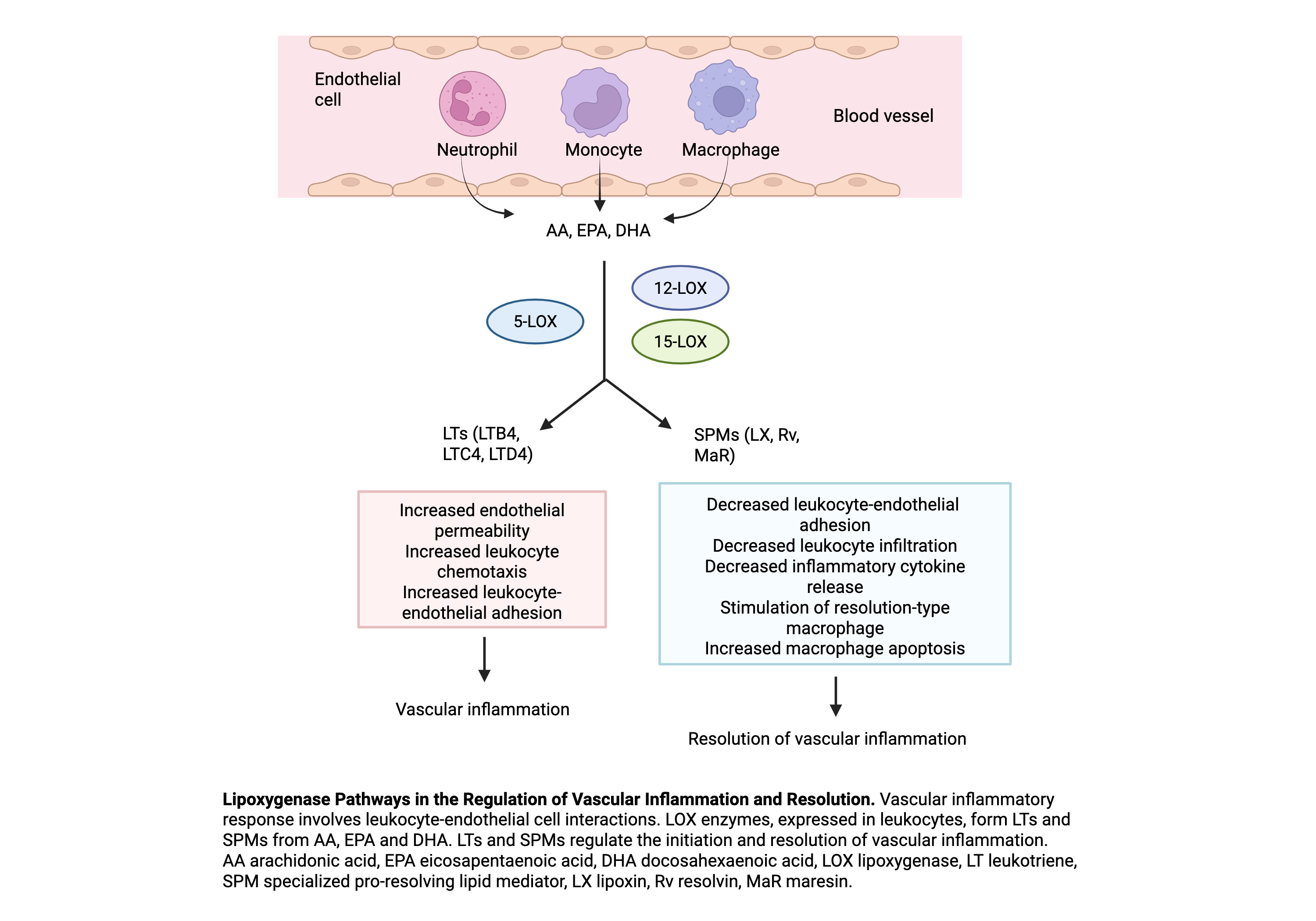
Inflammation is associated with vascular diseases, including atherosclerosis. The inflammatory response in the blood vessel involves cellular interactions between endothelial cells and monocytes/macrophages, and inflammatory mediators. Lipoxygenase (LOX) enzymes play an important role in inflammatory responses through the formation of lipid mediators. The 5-LOX pathway, primarily active in leukocytes such as monocytes/macrophages, converts arachidonic acid (AA) to leukotrienes (LTs), which are pro-inflammatory mediators that contribute to various vascular pathologies. In contrast, LOX pathways also generate specialized pro-resolving lipid mediators (SPMs), highlighting a dual role in both the initiation and resolution of inflammation. SPMs, formed by 5-LOX, 12-LOX and 15-LOX enzymes, are polyunsaturated fatty acid (PUFA)-derived anti-inflammatory and inflammation-resolving mediators that have important functions in the resolution of inflammatory processes. Dysregulation of the balance between pro-inflammatory leukotrienes and SPMs contributes to chronic vascular inflammation and disease progression. These mediators have been implicated in the treatment of vascular diseases with therapeutic strategies including LT receptor antagonists, 5-LOX-activating protein (FLAP) inhibitors, and approaches aimed at enhancing SPM pathways showing potential. This review provides an overview of the regulation of vascular inflammation and resolution by LOX pathways, and presents recent evidence on the role of LOX-derived lipid mediators in vascular inflammation and its resolution.
- Open Access
- Review Article
Lipoxygenase Pathways in the Regulation of Vascular Inflammation and Its Resolution
- Seynur Sunar 1,2,
- Melike Sena Aslan 1,2,
- Gulsev Ozen Yorgancigil 1,
- Michael R. Dashwood 3,
- Gokce Topal 1,*
Author Information
Received: 23 Jan 2026 | Revised: 21 Mar 2026 | Accepted: 30 Mar 2026 | Published: 08 Apr 2026
Abstract
Graphical Abstract
Keywords
Lipoxygenase | vascular inflammation | leukotrienes | specialized pro-resolving lipid mediators | resolution of inflammation
References
- 1.
Linares, I.; Chen, K.; Saffren, A.; et al. Fluid flow impacts endothelial-monocyte interactions in a model of vascular inflammatory fibrosis. Sci. Rep. 2025, 15, 3227.
- 2.
Uebbing, S.; Kreiß, M.; Scholl, F.; et al. Modulation of microRNA processing by 5-lipoxygenase. FASEB J. 2021, 35, e21193.
- 3.
Kreiß, M.; Oberlis, J.H.; Seuter, S.; et al. Human 5-lipoxygenase regulates transcription by association to euchromatin. Biochem. Pharmacol. 2022, 203, 115187.
- 4.
Ketelhuth, D.F.; Hermansson, A.; Hlawaty, H.; et al. The leukotriene B4 receptor (BLT) antagonist BIIL284 decreases atherosclerosis in ApoE−/− mice. Prostaglandins Other Lipid Mediat. 2015, 121, 105–109.
- 5.
Nshimiyimana, R.; Simard, M.; Teder, T.; et al. Biosynthesis of resolvin D1, resolvin D2, and RCTR1 from 7,8(S,S)-epoxytetraene in human neutrophils and macrophages. Proc. Natl. Acad. Sci. USA 2024, 121, e2405821121.
- 6.
Mainka, M.; George, S.; Angioni, C.; et al. On the biosynthesis of specialized pro-resolving mediators in human neutrophils and the influence of cell integrity. Biochim. Biophys. Acta Mol. Cell Biol. Lipids 2022, 1867, 159093.
- 7.
Libreros, S.; Shay, A.E.; Nshimiyimana, R.; et al. A New E-Series Resolvin: RvE4 Stereochemistry and Function in Efferocytosis of Inflammation-Resolution. Front. Immunol. 2021, 11, 631319.
- 8.
Fredman, G.; Hellmann, J.; Proto, J.D.; et al. An imbalance between specialized pro-resolving lipid mediators and pro-inflammatory leukotrienes promotes instability of atherosclerotic plaques. Nat. Commun. 2016, 7, 12859.
- 9.
Bay, B.; Tanner, R.; Gao, M.; et al. Residual cholesterol and inflammatory risk in statin-treated patients undergoing percutaneous coronary intervention. Eur. Heart J. 2025, 46, 3167–3177.
- 10.
Gao, S.; Huang, S.; Liu, X.; et al. Significance of Residual Inflammatory Risk and Persistent Inflammation in Patients with Myocardial Infarction with Nonobstructive Coronary Arteries. J. Inflamm. Res. 2025, 18, 13855–13868.
- 11.
Di Gennaro, A.; Araújo, A.C.; Busch, A.; et al. Cysteinyl leukotriene receptor 1 antagonism prevents experimental abdominal aortic aneurysm. Proc. Natl. Acad. Sci. USA 2018, 115, 1907–1912.
- 12.
Chen, J.W.; Li, Y.R.; Tao, L.Y.; et al. 12/15-lipoxygenase deficiency attenuates disturbed flow-induced LDL oxidation in endothelial cells. Biochem. Biophys. Res. Commun. 2026, 794, 153010.
- 13.
Manega, C.M.; Fiorelli, S.; Porro, B.; et al. 12(S)-Hydroxyeicosatetraenoic acid downregulates monocyte-derived macrophage efferocytosis: New insights in atherosclerosis. Pharmacol. Res. 2019, 144, 336–342.
- 14.
Vijil, C.; Hermansson, C.; Jeppsson, A.; et al. Arachidonate 15-lipoxygenase enzyme products increase platelet aggregation and thrombin generation. PLoS ONE 2014, 9, e88546.
- 15.
Brungs, M.; Rådmark, O.; Samuelsson, B.; et al. Sequential induction of 5-lipoxygenase gene expression and activity in Mono Mac 6 cells by transforming growth factor beta and 1,25-dihydroxyvitamin D3. Proc. Natl. Acad. Sci. USA 1995, 92, 107–111.
- 16.
Loesche, C.; Picard, D.; Van Hoorick, B.; et al. LTA4H inhibitor LYS006: Clinical PK/PD and safety in a randomized phase I clinical trial. Clin. Transl. Sci. 2024, 17, e13724.
- 17.
Elborn, J.S.; Konstan, M.W.; Taylor-Cousar, J.L.; et al. Empire-CF study: A phase 2 clinical trial of leukotriene A4 hydrolase inhibitor acebilustat in adult subjects with cystic fibrosis. J. Cyst. Fibros. 2021, 20, 1026–1034.
- 18.
Basavarajappa, D.; Wan, M.; Lukic, A.; et al. Roles of coactosin-like protein (CLP) and 5-lipoxygenase-activating protein (FLAP) in cellular leukotriene biosynthesis. Proc. Natl. Acad. Sci. USA 2014, 111, 11371–11376.
- 19.
Dahlke, P.; Peltner, L.K.; Jordan, P.M.; et al. Differential impact of 5-lipoxygenase-activating protein antagonists on the biosynthesis of leukotrienes and of specialized pro-resolving mediators. Front. Pharmacol. 2023, 14, 1219160.
- 20.
Teder, T.; König, S.; Singh, R.; et al. Modulation of the 5-Lipoxygenase Pathway by Chalcogen-Containing Inhibitors of Leukotriene A4 Hydrolase. Int. J. Mol. Sci. 2023, 24, 7539.
- 21.
Allen, S.; Dashwood, M.; Morrison, K.; et al. Differential leukotriene constrictor responses in human atherosclerotic coronary arteries. Circulation 1998, 97, 2406–2413.
- 22.
Yurdagul, A., Jr.; Subramanian, M.; Wang, X.; et al. Macrophage Metabolism of Apoptotic Cell-Derived Arginine Promotes Continual Efferocytosis and Resolution of Injury. Cell Metab. 2020, 31, 518–533.e10.
- 23.
Arnardottir, H.; Thul, S.; Pawelzik, S.C.; et al. The resolvin D1 receptor GPR32 transduces inflammation resolution and atheroprotection. J. Clin. Investig. 2021, 131, e142883.
- 24.
Ebert, R.; Cumbana, R.; Lehmann, C.; et al. Long-term stimulation of toll-like receptor-2 and -4 upregulates 5-LO and 15-LO-2 expression thereby inducing a lipid mediator shift in human monocyte-derived macrophages. Biochim. Biophys. Acta Mol. Cell Biol. Lipids 2020, 1865, 158702.
- 25.
Snodgrass, R.G.; Benatzy, Y.; Schmid, T.; et al. Efferocytosis potentiates the expression of arachidonate 15-lipoxygenase (ALOX15) in alternatively activated human macrophages through LXR activation. Cell Death Differ. 2021, 28, 1301–1316.
- 26.
Rood, K.M.; Patel, N.; DeVengencie, I.M.; et al. Aspirin modulates production of pro-inflammatory and pro-resolving mediators in endothelial cells. PLoS ONE 2023, 18, e0283163.
- 27.
Lukic, A.; Larssen, P.; Fauland, A.; et al. GM-CSF- and M-CSF-primed macrophages present similar resolving but distinct inflammatory lipid mediator signatures. FASEB J. 2017, 31, 4370–4381.
- 28.
Lehmann, C.; Homann, J.; Ball, A.K.; et al. Lipoxin and resolvin biosynthesis is dependent on 5-lipoxygenase activating protein. FASEB J. 2015, 29, 5029–5043.
- 29.
Herová, M.; Schmid, M.; Gemperle, C.; et al. ChemR23, the receptor for chemerin and resolvin E1, is expressed and functional on M1 but not on M2 macrophages. J. Immunol. 2015, 194, 2330–2337.
- 30.
Werz, O.; Gerstmeier, J.; Libreros, S.; et al. Human macrophages differentially produce specific resolvin or leukotriene signals that depend on bacterial pathogenicity. Nat. Commun. 2018, 9, 59.
- 31.
Abma, W.; Dahlén, S.E.; Wheelock, C.E.; et al. Protectin D1 and maresin 1 attenuate airway hyperreactivity induced by IL-13 in human isolated small bronchi. Br. J. Pharmacol. 2025. https://doi.org/10.1111/bph.70298.
- 32.
Lannan, K.L.; Spinelli, S.L.; Blumberg, N.; et al. Maresin 1 induces a novel pro-resolving phenotype in human platelets. J. Thromb. Haemost. 2017, 15, 802–813.
- 33.
Kriska, T.; Herrnreiter, A.; Pfister, S.L.; et al. Macrophage 12(S)-HETE Enhances Angiotensin II-Induced Contraction by a BLT2 (Leukotriene B4 Type-2 Receptor) and TP (Thromboxane Receptor)-Mediated Mechanism in Murine Arteries. Hypertension 2022, 79, 104–114.
- 34.
Yamaguchi, A.; Stanger, L.; Freedman, C.J.; et al. DHA 12-LOX-derived oxylipins regulate platelet activation and thrombus formation through a PKA-dependent signaling pathway. J. Thromb. Haemost. 2021, 19, 839–851.
- 35.
Adili, R.; Tourdot, B.E.; Mast, K.; et al. First Selective 12-LOX Inhibitor, ML355, Impairs Thrombus Formation and Vessel Occlusion In Vivo With Minimal Effects on Hemostasis. Arterioscler. Thromb. Vasc. Biol. 2017, 37, 1828–1839.
- 36.
Lundqvist, A.; Sandstedt, M.; Sandstedt, J.; et al. The Arachidonate 15-Lipoxygenase Enzyme Product 15-HETE Is Present in Heart Tissue from Patients with Ischemic Heart Disease and Enhances Clot Formation. PLoS ONE 2016, 11, e0161629.
- 37.
Hoyer, F.F.; Albrecht, L.; Nickenig, G.; et al. Selective inhibition of leukotriene receptor BLT-2 reduces vascular oxidative stress and improves endothelial function in ApoE−/− mice. Mol. Cell Biochem. 2012, 359, 25–31.
- 38.
Chatterjee, A.; Sharma, A.; Chen, M.; et al. The pro-resolving lipid mediator maresin 1 (MaR1) attenuates inflammatory signaling pathways in vascular smooth muscle and endothelial cells. PLoS ONE 2014, 9, e113480.
- 39.
Edwards-Glenn, J.M.; Fontes, M.T.; Waigi, E.W.; et al. Specialized Pro-resolving Mediator Improves Vascular Relaxation via Formyl Peptide Receptor-2. Am. J. Hypertens. 2023, 36, 542–550.
- 40.
Olivares-Silva, F.; De Gregorio, N.; Espitia-Corredor, J.; et al. Resolvin-D1 attenuation of angiotensin II-induced cardiac inflammation in mice is associated with prevention of cardiac remodeling and hypertension. Biochim. Biophys. Acta Mol. Basis Dis. 2021, 1867, 166241.
- 41.
Díaz Del Campo, L.S.; García-Redondo, A.B.; Rodríguez, C.; et al. Resolvin D2 Attenuates Cardiovascular Damage in Angiotensin II-Induced Hypertension. Hypertension 2023, 80, 84–96.
- 42.
Hiram, R.; Xiong, F.; Naud, P.; et al. An inflammation resolution-promoting intervention prevents atrial fibrillation caused by left ventricular dysfunction. Cardiovasc. Res. 2024, 120, 345–359.
- 43.
Bouhadoun, A.; Manikpurage, H.D.; Merheb, G.; et al. Upregulation of the maresin pathway and PGE2 metabolism in the failing human left ventricle. Biochim. Biophys. Acta Mol. Cell Biol. Lipids 2025, 1870, 159645.
- 44.
Chen, J.W.; Chen, S.L.; Wu, X.R.; et al. 12/15-lipoxygenase mediates disturbed flow-induced endothelial dysfunction and atherosclerosis. Mol. Med. 2025, 31, 257.
- 45.
Walker, M.E.; De Matteis, R.; Perretti, M.; et al. Resolvin T4 enhances macrophage cholesterol efflux to reduce vascular disease. Nat. Commun. 2024, 15, 975.
- 46.
Sather, S.; Kenyon, K.D.; Lefkowitz, J.B.; et al. A soluble form of the Mer receptor tyrosine kinase inhibits macrophage clearance of apoptotic cells and platelet aggregation. Blood 2007, 109, 1026–1033.
- 47.
Olkowicz, M.; Karas, A.; Berkowicz, P.; et al. Upregulation of ALOX12-12-HETE pathway impairs AMPK-dependent modulation of vascular metabolism in ApoE/LDLR−/− mice. Pharmacol. Res. 2024, 210, 107478.
- 48.
Lipscomb, M.; Salfate Del Rio, I.; Eid, M.; et al. Resolvin D2 limits senescent cell accumulation in atherosclerotic plaques. Vascul Pharmacol. 2025, 160, 107527.
- 49.
Laguna-Fernandez, A.; Checa, A.; Carracedo, M.; et al. ERV1/ChemR23 signaling protects against atherosclerosis by modifying oxidized low-density lipoprotein uptake and phagocytosis in macrophages. Circulation 2018, 138, 1693–1705.
- 50.
Bardin, M.; Pawelzik, S.C.; Lagrange, J.; et al. The resolvin D2—GPR18 axis is expressed in human coronary atherosclerosis and transduces atheroprotection in apolipoprotein E deficient mice. Biochem. Pharmacol. 2022, 201, 115075.
- 51.
Xu, F.; Zhang, J.; Zhou, X.; et al. Lipoxin A4 and its analog attenuate high fat diet-induced atherosclerosis via Keap1/Nrf2 pathway. Exp. Cell Res. 2022, 412, 113025.
- 52.
Kraft, J.D.; Blomgran, R.; Bergström, I.; et al. Lipoxins modulate neutrophil oxidative burst, integrin expression and lymphatic transmigration differentially in human health and atherosclerosis. FASEB J. 2022, 36, e22173.
- 53.
Cherpokova, D.; Jouvene, C.C.; Libreros, S.; et al. Resolvin D4 attenuates the severity of pathological thrombosis in mice. Blood 2019, 134, 1458–1468.
- 54.
Dienel, A.; Hong, S.H.; Zeineddine, H.A.; et al. 12/15-Lipooxygenase Inhibition Reduces Microvessel Constriction and Microthrombi After Subarachnoid Hemorrhage in Mice. Transl. Stroke Res. 2025, 16, 1156–1172.
- 55.
Wang, L.; Wang, B. ALOX5 regulates vascular smooth muscle cells pyroptosis to affect abdominal aortic aneurysm formation. Sci. Rep. 2025, 15, 29123.
- 56.
Elder, C.T.; Filiberto, A.C.; Su, G.; et al. Maresin 1 activates LGR6 signaling to inhibit smooth muscle cell activation and attenuate murine abdominal aortic aneurysm formation. FASEB J. 2021, 35, e21780.
- 57.
Bouhadoun, A.; Manikpurage, H.D.; Deschildre, C.; et al. DHA, RvD1, RvD5, and MaR1 reduce human coronary arteries contractions induced by PGE2. Prostaglandins Other Lipid Mediat. 2023, 165, 106700.
- 58.
Rodrigues-Diez, R.; Ballesteros-Martinez, C.; Moreno-Carriles, R.M.; et al. Resolvin D2 prevents vascular remodeling, hypercontractility and endothelial dysfunction in obese hypertensive mice through modulation of vascular and proinflammatory factors. Biomed. Pharmacother. 2024, 174, 116564.
- 59.
Miyahara, T.; Runge, S.; Chatterjee, A.; et al. D-series resolvin attenuates vascular smooth muscle cell activation and neointimal hyperplasia following vascular injury. FASEB J. 2013, 27, 2220–2232.
- 60.
Akagi, D.; Chen, M.; Toy, R.; et al. Systemic delivery of proresolving lipid mediators resolvin D2 and maresin 1 attenuates intimal hyperplasia in mice. FASEB J. 2015, 29, 2504–2513.
- 61.
Makino, Y.; Miyahara, T.; Nitta, J.; et al. Proresolving Lipid Mediators Resolvin D1 and Protectin D1 Isomer Attenuate Neointimal Hyperplasia in the Rat Carotid Artery Balloon Injury Model. J. Surg. Res. 2019, 233, 104–110.
- 62.
Kim, A.S.; Werlin, E.C.; Kagaya, H.; et al. 17R/S-Benzo-RvD1, a synthetic resolvin D1 analogue, attenuates neointimal hyperplasia in a rat model of acute vascular injury. PLoS ONE 2022, 17, e0264217.
- 63.
Mottola, G.; Werlin, E.C.; Wu, B.; et al. Oral Resolvin D1 attenuates early inflammation but not intimal hyperplasia in a rat carotid angioplasty model. Prostaglandins Other Lipid Mediat. 2020, 146, 106401.
- 64.
Kagaya, H.; Kim, A.S.; Chen, M.; et al. Dynamic changes in proresolving lipid mediators and their receptors following acute vascular injury in male rats. Physiol. Rep. 2024, 12, e16178.
- 65.
Celik, Z.; Ozen, G.; Sunar, S.; et al. Effect of specialized pro-resolving lipid mediators in the regulation of vascular tone and inflammation in human saphenous vein. Prostaglandins Other Lipid Mediat. 2023, 169, 106786.
- 66.
Cai, W.; Liu, L.; Shi, X.; et al. Alox15/15-HpETE Aggravates Myocardial Ischemia-Reperfusion Injury by Promoting Cardiomyocyte Ferroptosis. Circulation 2023, 147, 1444–1460.
- 67.
Kain, V.; Ingle, K.A.; Kabarowski, J.; et al. Genetic deletion of 12/15 lipoxygenase promotes effective resolution of inflammation following myocardial infarction. J. Mol. Cell. Cardiol. 2018, 118, 70–80.
- 68.
Fabre, P.; Molina, T.; Larose, J.; et al. Bioactive lipid mediator class switching regulates myogenic cell progression and muscle regeneration. Nat. Commun. 2025, 16, 5578.
- 69.
Freedman, C.; Tran, A.; Tourdot, B.E.; et al. Biosynthesis of the Maresin Intermediate, 13S,14S-Epoxy-DHA, by Human 15-Lipoxygenase and 12-Lipoxygenase and Its Regulation through Negative Allosteric Modulators. Biochemistry 2020, 59, 1832–1844.
- 70.
Kutzner, L.; Goloshchapova, K.; Rund, K.M.; et al. Human lipoxygenase isoforms form complex patterns of double and triple oxygenated compounds from eicosapentaenoic acid. Biochim. Biophys. Acta Mol. Cell Biol. Lipids 2020, 1865, 158806.
- 71.
Rao, Z.; Brunner, E.; Giszas, B.; et al. Glucocorticoids regulate lipid mediator networks by reciprocal modulation of 15-lipoxygenase isoforms affecting inflammation resolution. Proc. Natl. Acad. Sci. USA 2023, 120, e2302070120.
- 72.
Reinertsen, A.F.; Primdahl, K.G.; De Matteis, R.; et al. Stereoselective Synthesis, Configurational Assignment and Biological Evaluations of the Lipid Mediator RvD2n-3 DPA. Chemistry 2022, 28, e202103857.
- 73.
Ervik, K.; Reinertsen, A.F.; Koenis, D.S.; et al. Stereoselective Synthesis, Pro-resolution, and Anti-inflammatory Actions of RvD5n-3 DPA. J. Nat. Prod. 2023, 86, 2546–2553.
- 74.
Sønderskov, J.; Tungen, J.E.; Palmas, F.; et al. Stereoselective synthesis of MaR2n-3 DPA. Tetrahedron Lett. 2020, 61, 151510.
- 75.
Tungen, J.E.; Primdahl, K.G.; Hansen, T.V. The First Total Synthesis of the Lipid Mediator PD2n-3 DPA. J. Nat. Prod. 2020, 83, 2255–2260.
- 76.
Merlin, J.; Park, J.; Vandekolk, T.H.; et al. Multipathway In Vitro Pharmacological Characterization of Specialized Proresolving G Protein-Coupled Receptors. Mol. Pharmacol. 2022, 101, 246–256.
- 77.
Flak, M.B.; Koenis, D.S.; Sobrino, A.; et al. GPR101 mediates the pro-resolving actions of RvD5n-3 DPA in arthritis and infections. J. Clin. Investig. 2020, 130, 359–373.
- 78.
Kozłowska, H.; Malinowska, B.; Baranowska-Kuczko, M.; et al. GPR18-Mediated Relaxation of Human Isolated Pulmonary Arteries. Int. J. Mol. Sci. 2022, 23, 1427.
- 79.
Bellotti, P.; Ladd, Z.; Leroy, V.; et al. Resolvin D2/GPR18 signaling enhances monocytic myeloid-derived suppressor cell function to mitigate abdominal aortic aneurysm formation. FASEB J. 2024, 38, e70067.
- 80.
Pistorius, K.; Souza, P.R.; De Matteis, R.; et al. PDn-3 DPA Pathway Regulates Human Monocyte Differentiation and Macrophage Function. Cell Chem. Biol. 2018, 25, 749–760.e9.
- 81.
Galvão, I.; Melo, E.M.; de Oliveira, V.L.S.; et al. Therapeutic potential of the FPR2/ALX agonist AT-01-KG in the resolution of articular inflammation. Pharmacol. Res. 2021, 165, 105445.
- 82.
Serhan, C.N.; Hamberg, M.; Samuelsson, B. Lipoxins: Novel series of biologically active compounds formed from arachidonic acid in human leukocytes. Proc. Natl. Acad. Sci. USA 1984, 81, 5335–5339.
- 83.
Serhan, C.N.; Sheppard, K.A. Lipoxin formation during human neutrophil-platelet interactions. Evidence for the transformation of leukotriene A4 by platelet 12-lipoxygenase in vitro. J. Clin. Investig. 1990, 85, 772–780.
- 84.
Naruhn, S.; Meissner, W.; Adhikary, T.; et al. 15-hydroxyeicosatetraenoic acid is a preferential peroxisome proliferator-activated receptor beta/delta agonist. Mol. Pharmacol. 2010, 77, 171–184.
- 85.
Thankam, F.G.; Wilson, V.E.D.; Radwan, M.M.; et al. Involvement of ischemia-driven 5-lipoxygenase-resolvin-E1-chemokine like receptor-1 axis in the resolution of post-coronary artery bypass graft inflammation in coronary arteries. Mol. Biol. Rep. 2022, 49, 3123–3134.
- 86.
Liu, G.; Wan, N.; Liu, Q.; et al. Resolvin E1 Attenuates Pulmonary Hypertension by Suppressing Wnt7a/β-Catenin Signaling. Hypertension 2021, 78, 1914–1926.
- 87.
Arita, M.; Bianchini, F.; Aliberti, J.; et al. Stereochemical assignment, antiinflammatory properties, and receptor for the omega-3 lipid mediator resolvin E1. J. Exp. Med. 2005, 201, 713–722.
- 88.
Tjonahen, E.; Oh, S.F.; Siegelman, J.; et al. Resolvin E2: Identification and anti-inflammatory actions: Pivotal role of human 5-lipoxygenase in resolvin E series biosynthesis. Chem. Biol. 2006, 13, 1193–1202.
- 89.
Isobe, Y.; Arita, M.; Matsueda, S.; et al. Identification and structure determination of novel anti-inflammatory mediator resolvin E3, 17,18-dihydroxyeicosapentaenoic acid. J. Biol. Chem. 2012, 287, 10525–10534.
- 90.
Reinertsen, A.F.; Primdahl, K.G.; Shay, A.E.; et al. Stereoselective Synthesis and Structural Confirmation of the Specialized Pro-Resolving Mediator Resolvin E4. J. Org. Chem. 2021, 86, 3535–3545.
- 91.
Perry, S.C.; van Hoorebeke, C.; Sorrentino, J.; et al. Structural basis for altered positional specificity of 15-lipoxygenase-1 with 5S-HETE and 7S-HDHA and the implications for the biosynthesis of resolvin E4. Arch. Biochem. Biophys. 2022, 727, 109317.
- 92.
Ogawa, N.; Sugiyama, T.; Morita, M.; et al. Total Synthesis of Resolvin D5. J. Org. Chem. 2017, 82, 2032–2039.
- 93.
Shay, A.E.; Nshimiyimana, R.; Samuelsson, B.; et al. Human leukocytes selectively convert 4S,5S-epoxy-resolvin to resolvin D3, resolvin D4, and a cys-resolvin isomer. Proc. Natl. Acad. Sci. USA 2021, 118, e2116559118.
- 94.
Vara-Messler, M.; Trevisi, L.; Zulato, E.; et al. Aspirin-triggered DHA metabolites inhibit angiogenesis. Front. Pharmacol. 2025, 16, 1524980.
- 95.
Rodriguez, A.R.; Spur, B.W. First total syntheses of the pro-resolving lipid mediators 7(S),13(R),20(S)-Resolvin T1 and 7(S),13(R)-Resolvin T4. Tetrahedron Lett. 2020, 61, 151473.
- 96.
Aursnes, M.; Tungen, J.E.; Vik, A.; et al. Stereoselective synthesis of protectin D1: A potent anti-inflammatory and proresolving lipid mediator. Org. Biomol. Chem. 2014, 12, 432–437.
- 97.
Tsai, W.C.; Kalyanaraman, C.; Yamaguchi, A.; et al. In Vitro Biosynthetic Pathway Investigations of Neuroprotectin D1 (NPD1) and Protectin DX (PDX) by Human 12-Lipoxygenase, 15-Lipoxygenase-1, and 15-Lipoxygenase-2. Biochemistry 2021, 60, 1741–1754.
- 98.
Bang, S.; Xie, Y.K.; Zhang, Z.J.; et al. GPR37 regulates macrophage phagocytosis and resolution of inflammatory pain. J. Clin. Investig. 2018, 128, 3568–3582.
- 99.
Shin, K.-C.; Lee, T.-E.; Kim, S.-E.; et al. Enzymatic Formation of Protectin Dx and Its Production by Whole-Cell Reaction Using Recombinant Lipoxygenases. Catalysts 2022, 12, 1145.
- 100.
Lee, T.E.; Ko, Y.J.; Shin, K.C.; et al. Biotransformation of docosahexaenoic acid into 10R,17S-dihydroxydocosahexaenoic acid as protectin DX 10-epimer by serial reactions of arachidonate 8R- and 15S-lipoxygenases. World J. Microbiol. Biotechnol. 2024, 40, 219.
- 101.
Sugimoto, S.; Mena, H.A.; Sansbury, B.E.; et al. Brown adipose tissue-derived MaR2 contributes to cold-induced resolution of inflammation. Nat. Metab. 2022, 4, 775–790.
- 102.
Chiang, N.; Libreros, S.; Norris, P.C.; et al. Maresin 1 activates LGR6 receptor promoting phagocyte immunoresolvent functions. J. Clin. Invest. 2019, 129, 5294–5311.
- 103.
Sorokin, A.V.; Arnardottir, H.; Svirydava, M.; et al. Comparison of the dietary omega-3 fatty acids impact on murine psoriasis-like skin inflammation and associated lipid dysfunction. J. Nutr. Biochem. 2023, 117, 109348.
- 104.
Szczuko, M.; Kacprzak, J.; Przybylska, A.; et al. The Influence of an Anti-Inflammatory Gluten-Free Diet with EPA and DHA on the Involvement of Maresin and Resolvins in Hashimoto’s Disease. Int. J. Mol. Sci. 2024, 25, 11692.
- 105.
Dalli, J.; Vlasakov, I.; Riley, I.R.; et al. Maresin conjugates in tissue regeneration biosynthesis enzymes in human macrophages. Proc. Natl. Acad. Sci. USA 2016, 113, 12232–12237.
- 106.
Hong, S.; Lu, Y.; Tian, H.; et al. Maresin-like lipid mediators are produced by leukocytes and platelets and rescue reparative function of diabetes-impaired macrophages. Chem. Biol. 2014, 21, 1318–1329.
- 107.
Spanbroek, R.; Grabner, R.; Lotzer, K.; et al. Expanding expression of the 5-lipoxygenase pathway within the arterial wall during human atherogenesis. Proc. Natl. Acad. Sci. USA 2003, 100, 1238–1243.
- 108.
Di Gennaro, A.; Wågsäter, D.; Mäyränpää, M.I.; et al. Increased expression of leukotriene C4 synthase and predominant formation of cysteinyl-leukotrienes in human abdominal aortic aneurysm. Proc. Natl. Acad. Sci. USA 2010, 107, 21093–21097.
- 109.
Maga, P.; Wachsmann-Maga, A.; Włodarczyk, A.; et al. Leukotrienes E4 and B4 and vascular endothelium—New insight into the link between vascular inflammation and peripheral arterial. Int. J. Cardiol. Cardiovasc. Risk Prev. 2024, 23, 200343.
- 110.
Vidal, C.; Gómez-Hernández, A.; Sánchez-Galán, E.; et al. Licofelone, a balanced inhibitor of cyclooxygenase and 5-lipoxygenase, reduces inflammation in a rabbit model of atherosclerosis. J. Pharmacol. Exp. Ther. 2007, 320, 108–116.
- 111.
Matsumoto, S.; Ibrahim, R.; Grégoire, J.C.; et al. Effect of treatment with 5-lipoxygenase inhibitor VIA-2291 (atreleuton) on coronary plaque progression: A serial CT angiography study. Clin. Cardiol. 2017, 40, 210–215.
- 112.
Hakonarson, H.; Thorvaldsson, S.; Helgadottir, A.; et al. Effects of a 5-lipoxygenase-activating protein inhibitor on biomarkers associated with risk of myocardial infarction: A randomized trial. JAMA 2005, 293, 2245–2256.
- 113.
Knöchel, J.; Nelander, K.; Heijer, M.; et al. Pharmacokinetics, Pharmacodynamics, and Tolerability of AZD5718, an Oral 5-Lipoxygenase-Activating Protein (FLAP) Inhibitor, in Healthy Japanese Male Subjects. Clin. Drug Investig. 2021, 41, 895–905.
- 114.
Ericsson, H.; Nelander, K.; Heijer, M.; et al. Phase 1 Pharmacokinetic Study of AZD5718 in Healthy Volunteers: Effects of Coadministration With Rosuvastatin, Formulation and Food on Oral Bioavailability. Clin. Pharmacol. Drug Dev. 2020, 9, 411–421.
- 115.
Prescott, E.; Angerås, O.; Erlinge, D.; et al. Safety and efficacy of the 5-lipoxygenase-activating protein inhibitor AZD5718 in patients with recent myocardial infarction: The phase 2a FLAVOUR study. Int. J. Cardiol. 2022, 365, 34–40.
- 116.
Perry, S.C.; Kalyanaraman, C.; Tourdot, B.E.; et al. 15-Lipoxygenase-1 biosynthesis of 7S,14S-diHDHA implicates 15-lipoxygenase-2 in biosynthesis of resolvin D5. J. Lipid Res. 2020, 61, 1087–1103.
- 117.
Werner, M.; Jordan, P.M.; Romp, E.; et al. Targeting biosynthetic networks of the proinflammatory and proresolving lipid metabolome. FASEB J. 2019, 33, 6140–6153.
- 118.
Jannaway, M.; Torrens, C.; Warner, J.A.; et al. Resolvin E1, resolvin D1 and resolvin D2 inhibit constriction of rat thoracic aorta and human pulmonary artery induced by the thromboxane mimetic U46619. Br. J. Pharmacol. 2018, 175, 1100–1108.
- 119.
Viola, J.R.; Lemnitzer, P.; Jansen, Y.; et al. Resolving Lipid Mediators Maresin 1 and Resolvin D2 Prevent Atheroprogression in Mice. Circ. Res. 2016, 119, 1030–1038.
- 120.
Petri, M.H.; Laguna-Fernandez, A.; Arnardottir, H.; et al. Aspirin-triggered lipoxin A4 inhibits atherosclerosis progression in apolipoprotein E−/− mice. Br. J. Pharmacol. 2017, 174, 4043–4054.
- 121.
Filiberto, A.C.; Ladd, Z.; Leroy, V.; et al. Resolution of inflammation via RvD1/FPR2 signaling mitigates Nox2 activation and ferroptosis of macrophages in experimental abdominal aortic aneurysms. FASEB J. 2022, 36, e22579.
- 122.
Hasturk, H.; Abdallah, R.; Kantarci, A.; et al. Resolvin E1 (RvE1) Attenuates Atherosclerotic Plaque Formation in Diet and Inflammation-Induced Atherogenesis. Arterioscler. Thromb. Vasc. Biol. 2015, 35, 1123–1133.
- 123.
Salic, K.; Morrison, M.C.; Verschuren, L.; et al. Resolvin E1 attenuates atherosclerosis in absence of cholesterol-lowering effects and on top of atorvastatin. Atherosclerosis 2016, 250, 158–165.
- 124.
Elajami, T.K.; Colas, R.A.; Dalli, J.; et al. Specialized proresolving lipid mediators in patients with coronary artery disease and their potential for clot remodeling. FASEB J. 2016, 30, 2792–2801.
- 125.
Bazan, H.A.; Lu, Y.; Jun, B.; et al. Circulating inflammation-resolving lipid mediators RvD1 and DHA are decreased in patients with acutely symptomatic carotid disease. Prostaglandins Leukot. Essent. Fatty Acids 2017, 125, 43–47.
- 126.
Yuan, M.; Zhang, Y.; Hua, T.; et al. Omega-3 polyunsaturated fatty acid supplementation improves lipid metabolism and endothelial function by providing a beneficial eicosanoid-pattern in patients with acute myocardial infarction: A randomized, controlled trial. Clin. Nutr. 2021, 40, 445–459.
- 127.
Bhatt, D.L.; Steg, P.G.; Miller, M.; et al. Cardiovascular Risk Reduction with Icosapent Ethyl for Hypertriglyceridemia. N. Engl. J. Med. 2019, 380, 11–22.
- 128.
Budoff, M.J.; Bhatt, D.L.; Kinninger, A.; et al. Effect of icosapent ethyl on progression of coronary atherosclerosis in patients with elevated triglycerides on statin therapy: Final results of the EVAPORATE trial. Eur. Heart J. 2020, 41, 3925–3932.
- 129.
Souza, P.R.; Marques, R.M.; Gomez, E.A.; et al. Enriched Marine Oil Supplements Increase Peripheral Blood Specialized Pro-Resolving Mediators Concentrations and Reprogram Host Immune Responses: A Randomized Double-Blind Placebo-Controlled Study. Circ. Res. 2020, 126, 75–90.
- 130.
Ostermann, A.I.; West, A.L.; Schoenfeld, K.; et al. Plasma oxylipins respond in a linear dose-response manner with increased intake of EPA and DHA: Results from a randomized controlled trial in healthy humans. Am. J. Clin. Nutr. 2019, 109, 1251–1263.
- 131.
Schaller, M.S.; Chen, M.; Colas, R.A.; et al. Treatment With a Marine Oil Supplement Alters Lipid Mediators and Leukocyte Phenotype in Healthy Patients and Those With Peripheral Artery Disease. J. Am. Heart Assoc. 2020, 9, e016113.
- 132.
Ramirez, J.L.; Gasper, W.J.; Khetani, S.A.; et al. Fish oil increases specialized pro-resolving lipid mediators in PAD (the OMEGA-PAD II Trial). J. Surg. Res. 2019, 238, 164–174.
- 133.
Nicholls, S.J.; Lincoff, A.M.; Garcia, M.; et al. Effect of High-Dose Omega-3 Fatty Acids vs. Corn Oil on Major Adverse Cardiovascular Events in Patients at High Cardiovascular Risk: The STRENGTH Randomized Clinical Trial. JAMA 2020, 324, 2268–2280.
- 134.
Garscha, U.; Voelker, S.; Pace, S.; et al. BRP-187: A potent inhibitor of leukotriene biosynthesis that acts through impeding the dynamic 5-lipoxygenase/5-lipoxygenase-activating protein (FLAP) complex assembly. Biochem. Pharmacol. 2016, 119, 17–26.
- 135.
Kretzer, C.; Jordan, P.M.; Bilancia, R.; et al. Shifting the Biosynthesis of Leukotrienes Toward Specialized Pro-Resolving Mediators by the 5-Lipoxygenase-Activating Protein (FLAP) Antagonist BRP-201. J. Inflamm. Res. 2022, 15, 911–925.
- 136.
Schoenthaler, M.; Waltl, L.; Hasenoehrl, T.; et al. Novel thiazolopyridine derivatives of diflapolin as dual sEH/FLAP inhibitors with improved solubility. Bioorg. Chem. 2023, 139, 106685.

This work is licensed under a Creative Commons Attribution 4.0 International License.

 Suite 4002 Level 4, 447 Collins Street, Melbourne, Victoria 3000, Australia
 General Inquiries: info@sciltp.com