
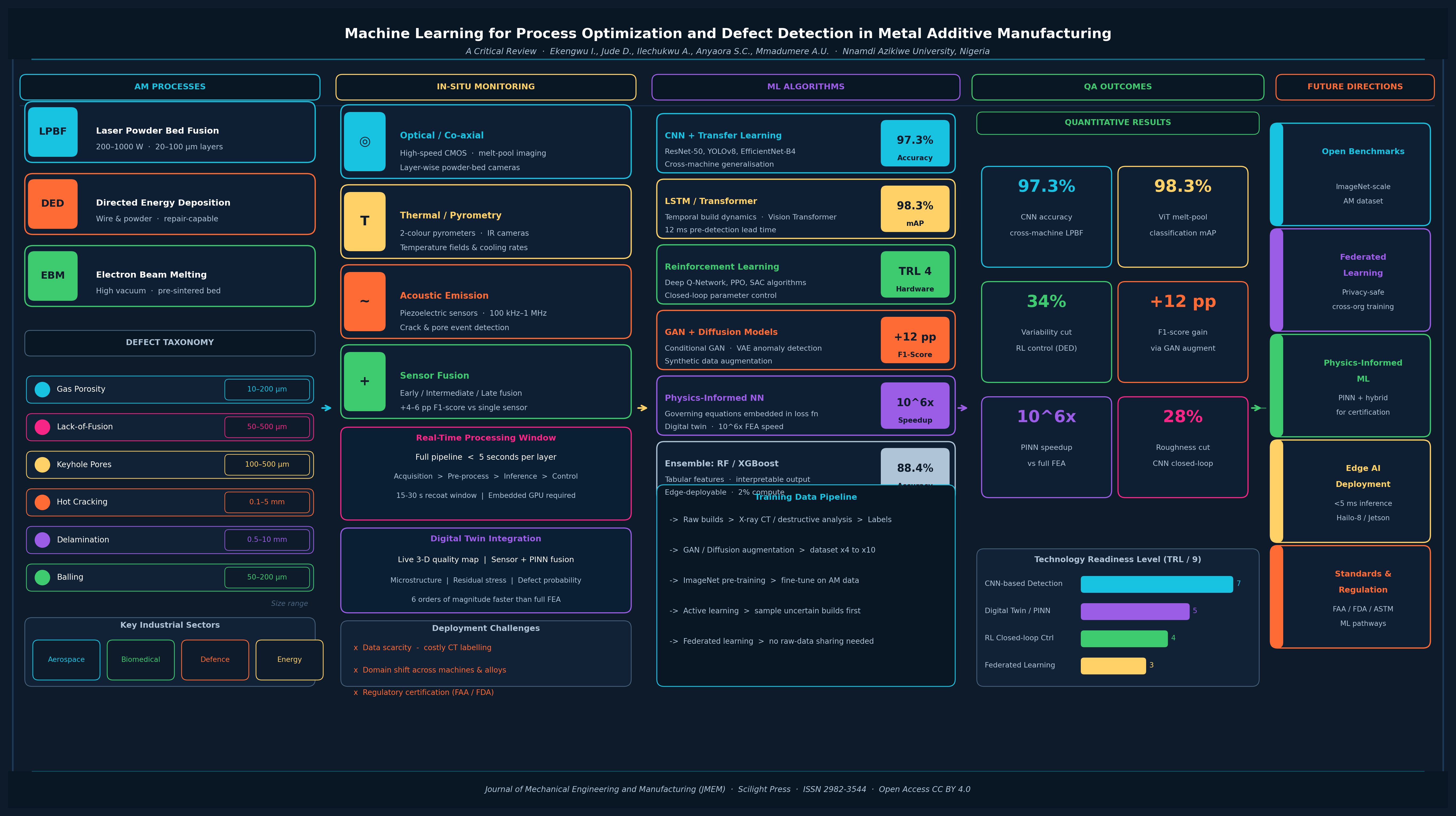
Among the many manufacturing technologies to emerge in the last three decades, metal additive manufacturing (AM)—spanning laser powder bed fusion (LPBF), directed energy deposition (DED), and electron beam melting (EBM)—stands out for the speed and breadth of its industrial adoption. Once confined to producing plastic concept models, it now fabricates flight-critical aerospace structures, load-bearing skeletal implants, and thermally demanding heat management components. Yet persistent process-induced defects—among them gas porosity, lack-of-fusion voids, hot cracking, and inter-layer delamination—continue to jeopardize part integrity and create formidable barriers to certification in regulated sectors. Machine learning (ML) and deep learning (DL) have attracted growing attention as remedies, offering the capacity to extract decision-relevant patterns from the rich multi-modal data streams that flow continuously during metal AM builds. This review undertakes a critical examination of the current state of ML-driven process optimization and defect detection for metal AM. Convolutional neural networks (CNNs) are evaluated for image-based anomaly identification; long short-term memory (LSTM) networks and transformer architectures are assessed for temporal process monitoring; reinforcement learning is examined for closed-loop parameter governance; and generative adversarial networks are considered as instruments for training data augmentation. In-situ monitoring hardware—encompassing melt-pool cameras, pyrometers, acoustic emission sensors, and photodiode arrays—is surveyed alongside the sensor fusion strategies that sharpen defect localization performance. Closed-loop quality assurance architectures, digital twin integration, and ML-guided parameter optimization receive detailed critical evaluation. Drawing on a systematic synthesis of more than 130 peer-reviewed studies spanning 2016 to 2025, we identify structural gaps: a shortage of large annotated benchmark datasets, insufficient cross-domain generalization, and the computational demands of real-time industrial deployment. A forward-looking research roadmap—centred on physics-informed neural networks, federated learning architectures, and edge-optimized inference—is advanced as the route toward certifiable, industrially viable ML quality assurance systems for metal AM.
- Open Access
- Review
Machine Learning for Process Optimization and Defect Detection in Metal Additive Manufacturing: A Critical Review of Algorithms, In-Situ Monitoring Strategies, and Quality Assurance Frameworks
- Ignatius Ekengwu *,
- Dara Jude,
- Anthonia Ilechukwu,
- Sunday Chimezie Anyaora,
- Augustine Uzochukwu Mmadumere
Author Information
Received: 08 Mar 2026 | Revised: 27 Mar 2026 | Accepted: 30 Mar 2026 | Published: 02 Jun 2026
Abstract
Graphical Abstract
Keywords
additive manufacturing | machine learning | defect detection | in-situ monitoring | process optimization | quality assurance
References
- 1.
Attaran, M. The rise of 3D printing: The advantages of additive manufacturing over traditional manufacturing. Bus. Horiz. 2017, 60, 677–688.
- 2.
SAE International. AS9100 Rev. D: Quality Management Systems—Requirements for Aviation, Space, and Defense Organizations; SAE International: Warrendale, PA, USA, 2016.
- 3.
International Organization for Standardization. ISO 13485:2016—Medical Devices: Quality Management Systems; ISO: Geneva, Switzerland, 2016.
- 4.
Tapia, G.; Elwany, A. A review on process monitoring and control in metal-based additive manufacturing. J. Manuf. Sci. Eng. 2014, 136, 060801.
- 5.
Taherkhani, K.; Ero, O.; Liravi, F.; et al. On the application of in-situ monitoring systems and machine learning algorithms for developing quality assurance platforms in laser powder bed fusion: A review. J. Manuf. Process. 2023, 99, 848–897.
- 6.
Page, M.J.; McKenzie, J.E.; Bossuyt, P.M.; et al. The PRISMA 2020 statement: An updated guideline for reporting systematic reviews. BMJ 2021, 372, n71.
- 7.
Liberati, A.; Altman, D.G.; Tetzlaff, J.; et al. The PRISMA statement for reporting systematic reviews and meta-analyses of studies that evaluate healthcare interventions. PLoS Med. 2009, 6, e1000100.
- 8.
Moher, D.; Liberati, A.; Tetzlaff, J.; et al. Preferred reporting items for systematic reviews and meta-analyses: The PRISMA statement. Ann. Intern. Med. 2009, 151, 264–269.
- 9.
Kitchenham, B.; Charters, S. Guidelines for Performing Systematic Literature Reviews in Software Engineering; Technical Report EBSE-2007-01; Keele University and Durham University: Staffordshire, UK, 2007.
- 10.
DebRoy, T.; Wei, H.L.; Zuback, J.S.; et al. Additive manufacturing of metallic components—Process, structure and properties. Prog. Mater. Sci. 2018, 92, 44–224.
- 11.
King, W.E.; Anderson, A.T.; Ferencz, R.M.; et al. Laser powder bed fusion additive manufacturing of metals: Physics, computational, and materials challenges. Appl. Phys. Rev. 2015, 2, 041304.
- 12.
Khairallah, S.A.; Anderson, A.T.; Rubenchik, A.; et al. Laser powder-bed fusion additive manufacturing: Physics of complex melt flow and formation mechanisms of pores, spatter, and denudation zones. Acta Mater. 2016, 108, 36–45.
- 13.
Gao, W.; Zhang, Y.; Ramanujan, D.; et al. Additive manufacturing: Technology, applications and research needs. Front. Mech. Eng. 2013, 10, 215–243.
- 14.
Thompson, S.M.; Bian, L.; Shamsaei, N.; et al. An overview of Direct Laser Deposition for additive manufacturing; Part I: Transport phenomena, modeling and diagnostics. Addit. Manuf. 2015, 8, 36–62.
- 15.
Juechter, V.; Scharowsky, T.; Singer, R.F.; et al. Processing window and evaporation phenomena for Ti–6Al–4V produced by selective electron beam melting. Acta Mater. 2014, 76, 252–258.
- 16.
Sames, W.J.; List, F.A.; Pannala, S.; et al. The metallurgy and processing science of metal additive manufacturing. Int. Mater. Rev. 2016, 61, 315–360.
- 17.
Leung, C.L.A.; Marussi, S.; Atwood, R.C.; et al. In situ X-ray imaging of defect and molten pool dynamics in laser additive manufacturing. Nat. Commun. 2018, 9, 1355.
- 18.
Cunningham, R.; Zhao, C.; Parab, N.; et al. Keyhole threshold and morphology in laser melting revealed by ultrahigh-speed x-ray imaging. Science 2019, 363, 849–852.
- 19.
Huang, Y.; Fleming, T.G.; Clark, S.J.; et al. Keyhole fluctuation and pore formation mechanisms during laser powder bed fusion additive manufacturing. Nat. Commun. 2022, 13, 1170.
- 20.
Carter, L.N.; Martin, C.; Withers, P.J.; et al. The influence of the laser scan strategy on grain structure and cracking behaviour in SLM powder-bed fabricated nickel superalloy. J. Alloys Compd. 2014, 615, 338–347.
- 21.
Zhao, C.; Fezzaa, K.; Cunningham, R.W.; et al. Real-time monitoring of laser powder bed fusion process using high-speed X-ray imaging and diffraction. Sci. Rep. 2017, 7, 3602.
- 22.
Mercelis, P.; Kruth, J.P. Residual stresses in selective laser sintering and selective laser melting. Rapid Prototyp. J. 2006, 12, 254–265.
- 23.
Mukherjee, T.; Zuback, J.S.; De, A.; et al. Printability of alloys for additive manufacturing. Sci. Rep. 2016, 6, 19717.
- 24.
LeCun, Y.; Bengio, Y.; Hinton, G. Deep learning. Nature 2015, 521, 436–444.
- 25.
Krizhevsky, A.; Sutskever, I.; Hinton, G.E. ImageNet classification with deep convolutional neural networks. Commun. ACM 2017, 60, 84–90.
- 26.
Scime, L.; Beuth, J. Anomaly detection and classification in a laser powder bed additive manufacturing process using a trained computer vision algorithm. Addit. Manuf. 2018, 19, 114–126.
- 27.
Caggiano, A.; Zhang, J.; Alfieri, V.; et al. Machine learning-based image processing for on-line defect recognition in additive manufacturing. CIRP Ann. 2019, 68, 451–454.
- 28.
Gobert, C.; Reutzel, E.W.; Petrich, J.; et al. Application of supervised machine learning for defect detection during metallic powder bed fusion additive manufacturing using high resolution imaging. Addit. Manuf. 2018, 21, 517–528.
- 29.
Kwon, O.; Kim, H.G.; Ham, M.J.; et al. A deep neural network for classification of melt-pool images in metal additive manufacturing. J. Intell. Manuf. 2020, 31, 375–386.
- 30.
Tan, M.; Le, Q. EfficientNet: Rethinking model scaling for convolutional neural networks. In Proceedings of the 36th International Conference on Machine Learning, Long Beach, CA, USA, 9–15 June 2019.
- 31.
Weiss, K.; Khoshgoftaar, T.M.; Wang, D. A survey of transfer learning. J. Big Data 2016, 3, 9.
- 32.
Pandiyan, V.; Drissi-Daoudi, R.; Shevchik, S.; et al. Deep transfer learning of additive manufacturing mechanisms across materials in metal-based laser powder bed fusion process. J. Mater. Process. Technol. 2022, 303, 117531.
- 33.
Jafari-Marandi, R.; Khanzadeh, M.; Tian, W.; et al. From in-situ monitoring toward high-throughput process control: Cost-driven decision-making framework for laser-based additive manufacturing. J. Manuf. Syst. 2019, 51, 29–41.
- 34.
Westphal, E.; Seitz, H. A machine learning method for defect detection and visualization in selective laser sintering based on convolutional neural networks. Addit. Manuf. 2021, 41, 101965.
- 35.
Zhang, Y.; Soon, H.G.; Ye, D.; et al. Extraction and evaluation of melt pool, plume and spatter information for powder-bed fusion AM process monitoring. Mater. Des. 2018, 156, 458–469.
- 36.
Scime, L.; Siddel, D.; Baird, S.; et al. Layer-wise anomaly detection and classification for powder bed additive manufacturing processes: A machine-agnostic algorithm for real-time pixel-wise semantic segmentation. Addit. Manuf. 2020, 36, 101453.
- 37.
Hochreiter, S.; Schmidhuber, J. Long short-term memory. Neural Comput. 1997, 9, 1735–1780.
- 38.
Ye, D.; Hong, G.S.; Zhang, Y.; et al. Defect detection in selective laser melting technology by acoustic signals with deep belief networks. Int. J. Adv. Manuf. Technol. 2018, 96, 2791–2801.
- 39.
Khanzadeh, M.; Chowdhury, S.; Marufuzzaman, M.; et al. Porosity prediction: Supervised-learning of thermal history for direct laser deposition. J. Manuf. Syst. 2018, 47, 69–82.
- 40.
Williams, R.J.; Davies, C.M.; Hooper, P.A. A pragmatic part scale model for residual stress and distortion prediction in powder bed fusion. Addit. Manuf. 2018, 22, 416–425.
- 41.
Dosovitskiy, A.; Beyer, L.; Kolesnikov, A.; et al. An image is worth 16×16 words: Transformers for image recognition at scale. In Proceedings of the ICLR 2021, Vienna, Austria, 4 May 2021.
- 42.
Sutton, R.S.; Barto, A.G. Reinforcement Learning: An Introduction, 2nd ed.; MIT Press: Cambridge, MA, USA, 2018.
- 43.
Mnih, V.; Kavukcuoglu, K.; Silver, D.; et al. Human-level control through deep reinforcement learning. Nature 2015, 518, 529–533.
- 44.
Donadello, I.; Motta, M.; Demir, A.G.; et al. Monitoring of laser metal deposition height by means of coaxial laser triangulation. Opt. Lasers Eng. 2019, 112, 136–144.
- 45.
Schulman, J.; Wolski, F.; Dhariwal, P.; et al. Proximal policy optimization algorithms. arXiv 2017, arXiv:1707.06347.
- 46.
Haarnoja, T.; Zhou, A.; Abbeel, P.; et al. Soft actor-critic: Off-policy maximum entropy deep reinforcement learning with a stochastic actor. In Proceedings of the 35th International Conference on Machine Learning, Stockholm, Sweden, 10–15 July 2018.
- 47.
Goodfellow, I.; Pouget-Abadie, J.; Mirza, M.; et al. Generative adversarial nets. In Proceedings of the Annual Conference on Neural Information Processing Systems 2014, Montreal, QC, Canada, 8–13 December 2014.
- 48.
Ho, J.; Jain, A.; Abbeel, P. Denoising diffusion probabilistic models. In Proceedings of the Annual Conference on Neural Information Processing Systems 2020, NeurIPS 2020, Virtual, 6–12 December 2020.
- 49.
Kingma, D.P.; Welling, M. Auto-encoding variational Bayes. In Proceedings of the ICLR 2014, Banff, AB, Canada, 14–16 April 2014.
- 50.
Paul, R.; Anand, S.; Gerner, F. Effect of thermal deformation on part errors in metal powder based additive manufacturing processes. J. Manuf. Sci. Eng. 2014, 136, 031009.
- 51.
Ero, O.; Taherkhani, K.; Toyserkani, E. Optical tomography and machine learning for in-situ defect detection in laser powder bed fusion: A self-organizing map and U-Net based approach. Addit. Manuf. 2023, 78, 103894.
- 52.
Everton, S.K.; Hirsch, M.; Stravroulakis, P.; et al. Review of in-situ process monitoring and in-situ metrology for metal additive manufacturing. Mater. Des. 2016, 95, 431–445.
- 53.
Grasso, M.; Colosimo, B.M. Process defects and in situ monitoring methods in metal powder bed fusion: A review. Meas. Sci. Technol. 2017, 28, 044005.
- 54.
Snow, Z.; Nassar, A.R.; Reutzel, E.W. Invited review article: Review of the formation and impact of flaws in powder bed fusion additive manufacturing. Addit. Manuf. 2020, 36, 101457.
- 55.
Grasso, M.; Laguzza, V.; Semeraro, Q.; et al. In-process monitoring of selective laser melting: Spatial detection of defects via image processing. J. Manuf. Sci. Eng. 2017, 139, 051001.
- 56.
Clijsters, S.; Craeghs, T.; Buls, S.; et al. In situ quality control of the selective laser melting process using a high-speed, real-time melt pool monitoring system. Int. J. Adv. Manuf. Technol. 2014, 75, 1089–1101.
- 57.
Imani, F.; Gaikwad, A.; Montazeri, M.; et al. Process mapping and in-process monitoring of porosity in laser powder bed fusion using layerwise optical imaging. J. Manuf. Sci. Eng. 2018, 140, 101009.
- 58.
Spears, T.G.; Gold, S.A. In-process sensing in selective laser melting (SLM) additive manufacturing. Integr. Mater. Manuf. Innov. 2016, 5, 16–40.
- 59.
Hooper, P.A. Melt pool temperature and cooling rates in laser powder bed fusion. Addit. Manuf. 2018, 22, 548–559.
- 60.
Wolff, S.J.; Webster, S.; Parab, N.D.; et al. In-situ high-speed X-ray imaging of piezo-driven directed energy deposition additive manufacturing. Sci. Rep. 2019, 9, 962.
- 61.
Oster, S.; Breese, P.P.; Ulbricht, A.; et al. A deep learning framework for defect prediction based on thermographic in-situ monitoring in laser powder bed fusion. J. Intell. Manuf. 2024, 35, 1687–1706.
- 62.
Krauss, H.; Zeugner, T.; Zaeh, M.F. Layerwise monitoring of the selective laser melting process by thermography. Phys. Procedia 2014, 56, 64–71.
- 63.
Shevchik, S.A.; Kenel, C.; Leinenbach, C.; et al. Acoustic emission for in situ quality monitoring in additive manufacturing using spectral convolutional neural networks. Addit. Manuf. 2018, 21, 598–604.
- 64.
Wasmer, K.; Kenel, C.; Leinenbach, C.; et al. In situ quality monitoring in AM using acoustic emission: A reinforcement learning approach. J. Mater. Eng. Perform. 2019, 28, 666–672.
- 65.
Repossini, G.; Laguzza, V.; Grasso, M.; et al. On the use of spatter signature for in-situ monitoring of laser powder bed fusion. Addit. Manuf. 2017, 16, 35–48.
- 66.
Mahmoudi, M.; Elwany, A.; Yadollahi, A.; et al. Mechanical properties and microstructural characterization of selective laser melted 17-4 PH stainless steel. Rapid Prototyp. J. 2017, 23, 280–294.
- 67.
Stavridis, J.; Papacharalampopoulos, A.; Stavropoulos, P. Recent advances in sensor fusion monitoring and control strategies in laser powder bed fusion: A review. Machines 2025, 13, 820.
- 68.
Petrich, J.; Snow, Z.; Corbin, D.; et al. Multi-modal sensor fusion with machine learning for data-driven process monitoring for additive manufacturing. Addit. Manuf. 2021, 48, 102364.
- 69.
Shen, N.; Chou, K. Simulations of thermo-mechanical characteristics in electron beam additive manufacturing. In Proceedings of the ASME 2012 International Mechanical Engineering Congress and Exposition, Houston, TX, USA, 9–15 November 2012.
- 70.
Baumgartl, H.; Tomas, J.; Buettner, R.; et al. A deep learning-based model for defect detection in laser-powder bed fusion using in-situ thermographic monitoring. Prog. Addit. Manuf. 2020, 5, 277–285.
- 71.
Wang, P.; Yang, Y.; Moghaddam, N.S. Process modeling in laser powder bed fusion towards defect detection and quality control via machine learning: The state-of-the-art and research challenges. J. Manuf. Process. 2022, 73, 961–984.
- 72.
Yeung, H.; Lane, B.; Fox, J. Part geometry and conduction-based laser power control for powder bed fusion additive manufacturing. Addit. Manuf. 2019, 30, 100844.
- 73.
Chen, L.; Bi, G.; Yao, X.; et al. In-situ process monitoring and adaptive quality enhancement in laser additive manufacturing: A critical review. J. Manuf. Syst. 2024, 74, 527–574.
- 74.
Mondal, S.; Gwynn, D.; Ray, A.; et al. Investigation of melt pool geometry control in additive manufacturing using hybrid modeling. Metals 2020, 10, 683.
- 75.
Mazzucato, F.; Tusacciu, S.; Lai, M.; et al. Monitoring approach to evaluate the performances of a new deposition nozzle solution for DED additive manufacturing. Technologies 2017, 5, 29.
- 76.
Mozaffar, M.; Paul, A.; Al-Bahrani, R.; et al. Data-driven prediction of the high-dimensional thermal history in directed energy deposition processes. Manuf. Lett. 2018, 18, 35–39.
- 77.
Renken, V.; von Freyberg, A.; Schumann, K.; et al. In-process closed-loop control for stabilising the melt pool temperature in selective laser melting. Prog. Addit. Manuf. 2019, 4, 411–421.
- 78.
Grieves, M.; Vickers, J. Digital twin: Mitigating unpredictable, undesirable emergent behavior in complex systems. In Transdisciplinary Perspectives on Complex Systems; Springer: Cham, Switzerland, 2017; pp. 85–113.
- 79.
Lu, Y.; Liu, C.; Kevin, I.; et al. Digital twin-driven smart manufacturing: Connotation, reference model, applications and research issues. Robot. CIM 2020, 61, 101837.
- 80.
Tudorache, L.; Babur, Ö.; Lucas, S.S.; et al. Current approaches to digital twins in additive manufacturing: A systematic literature review. Prog. Addit. Manuf. 2025, 10, 10819–10853.
- 81.
Nath, P.; Mahadevan, S. Probabilistic digital twin for additive manufacturing process design and control. J. Mech. Des. 2022, 144, 091703.
- 82.
Raissi, M.; Perdikaris, P.; Karniadakis, G.E. Physics-informed neural networks: A deep learning framework for solving forward and inverse problems involving nonlinear partial differential equations. J. Comput. Phys. 2019, 378, 686–707.
- 83.
Karniadakis, G.E.; Kevrekidis, I.G.; Lu, L.; et al. Physics-informed machine learning. Nat. Rev. Phys. 2021, 3, 422–440.
- 84.
Liu, R.; Liu, S.; Zhang, X. A physics-informed machine learning model for porosity analysis in laser powder bed fusion additive manufacturing. Int. J. Adv. Manuf. Technol. 2021, 113, 1943–1958.
- 85.
Jiang, F.; Xia, M.; Hu, Y. Physics-informed machine learning for accurate prediction of temperature and melt pool dimension in metal additive manufacturing. 3D Print. Addit. Manuf. 2024, 11, e1679–e1689.
- 86.
Zhu, Q.; Liu, Z.; Yan, J. Machine learning for metal additive manufacturing: Predicting temperature and melt pool fluid dynamics using physics-informed neural networks. Comput. Mech. 2021, 67, 619–635.
- 87.
ISO/ASTM International. ISO/ASTM 52941:2025—Additive Manufacturing—System Performance and Reliability—Acceptance Tests for Laser Metal Powder Bed Fusion Machines for Metallic Materials for Aerospace Applications; ISO: Geneva, Switzerland, 2025.
- 88.
ASTM International. F3187-16: Standard Guide for Directed Energy Deposition of Metals; ASTM International: West Conshohocken, PA, USA, 2016.
- 89.
ISO/ASTM International. ISO/ASTM 52920:2023—Additive Manufacturing—Qualification Principles; ISO: Geneva, Switzerland, 2023.
- 90.
Adadi, A.; Berrada, M. Peeking inside the black-box: A survey on explainable AI. IEEE Access 2018, 6, 52138–52160.
- 91.
Oliveira, J.P.; LaLonde, A.D.; Ma, J. Processing parameters in laser powder bed fusion metal additive manufacturing. Mater. Des. 2020, 193, 108762.
- 92.
Gu, D.; Shi, X.; Poprawe, R.; et al. Material-structure-performance integrated laser-metal additive manufacturing. Science 2021, 372, eabg1487.
- 93.
Wang, C.; Tan, X.P.; Tor, S.B.; et al. Machine learning in additive manufacturing: State-of-the-art and perspectives. Addit. Manuf. 2020, 36, 101538.
- 94.
Qi, X.; Chen, G.; Li, Y.; et al. Applying neural-network-based machine learning to additive manufacturing: Current applications, challenges, and future perspectives. Engineering 2019, 5, 721–729.
- 95.
Gan, Z.; Jones, K.K.; Lu, Y.; et al. Benchmark study of melted track geometries in laser powder bed fusion of Inconel 625. Integr. Mater. Manuf. Innov. 2021, 10, 177–195.
- 96.
Tapia, G.; Khairallah, S.; Matthews, M.; et al. Gaussian process-based surrogate modeling framework for process planning in laser powder-bed fusion additive manufacturing of 316L stainless steel. Int. J. Adv. Manuf. Technol. 2018, 94, 3591–3603.
- 97.
Brochu, E.; Cora, V.M.; de Freitas, N. A tutorial on Bayesian optimization of expensive cost functions. arXiv 2010, arXiv:1012.2599.
- 98.
Snoek, J.; Larochelle, H.; Adams, R.P. Practical Bayesian optimization of machine learning algorithms. In Proceedings of the 26th Annual Conference on Neural Information Processing Systems 2012, Lake Tahoe, NV, USA, 3–6 December 2012.
- 99.
Shahriari, B.; Swersky, K.; Wang, Z.; et al. Taking the human out of the loop: A review of Bayesian optimization. Proc. IEEE 2016, 104, 148–175.
- 100.
Hertlein, N.; Deshpande, S.; Venugopal, V.; et al. Prediction of selective laser melting part quality using hybrid Bayesian network. Addit. Manuf. 2020, 32, 101089.
- 101.
Okaro, I.A.; Jayasinghe, S.; Sutcliffe, C.; et al. Automatic fault detection for laser powder-bed fusion using semi-supervised machine learning. Addit. Manuf. 2019, 27, 42–53.
- 102.
Meng, L.; McWilliams, B.; Jarosinski, W.; et al. Machine learning in additive manufacturing: A review. JOM 2020, 72, 2363–2377.
- 103.
Johnson, N.S.; Vulimiri, P.S.; To, A.C.; et al. Invited review: Machine learning for materials developments in metals additive manufacturing. Addit. Manuf. 2020, 36, 101641.
- 104.
Gibson, I.; Rosen, D.; Stucker, B.; et al. Additive Manufacturing Technologies, 3rd ed.; Springer: New York, NY, USA, 2021.
- 105.
Wilson, A.G.; Hu, Z.; Salakhutdinov, R.; et al. Deep kernel learning. In Proceedings of the 19th International Conference on Artificial Intelligence and Statistics, Cadiz, Spain, 9–11 May 2016.
- 106.
Han, S.; Pool, J.; Tran, J.; et al. Learning both weights and connections for efficient neural network. In Proceedings of the Annual Conference on Neural Information Processing Systems 2015, Montreal, QC, Canada, 7–12 December 2015.
- 107.
Hinton, G.; Vinyals, O.; Dean, J. Distilling the knowledge in a neural network. arXiv 2015, arXiv:1503.02531.
- 108.
Guo, S.; Agarwal, M.; Cooper, C.; et al. Machine learning for metal additive manufacturing: Towards a physics-informed data-driven paradigm. J. Manuf. Syst. 2022, 62, 145–163.
- 109.
Deng, J.; Dong, W.; Socher, R.; et al. ImageNet: A large-scale hierarchical image database. In Proceedings of the IEEE CVPR 2009, Miami, FL, USA, 20–25 June 2009.
- 110.
Psichogios, D.C.; Ungar, L.H. A hybrid neural network-first principles approach to process modeling. AIChE J. 1992, 38, 1499–1511.
- 111.
Willard, J.; Jia, X.; Xu, S.; et al. Integrating scientific knowledge with machine learning for engineering and environmental systems. ACM Comput. Surv. 2022, 55, 1–37.
- 112.
Bayat, M.; Dong, W.; Thorborg, J.; et al. A review of multi-scale and multi-physics simulations of metal additive manufacturing processes with focus on modeling strategies. Addit. Manuf. 2021, 47, 102278.
- 113.
Loh, G.H.; Pei, E.; Harrison, D.; et al. An overview of functionally graded additive manufacturing. Addit. Manuf. 2018, 23, 34–44.
- 114.
Sajadi, P.; Rahmani Dehaghani, M.; Tang, Y.; et al. Physics-informed online learning for temperature prediction in metal additive manufacturing. Materials 2024, 17, 3306.
- 115.
McMahan, H.B.; Moore, E.; Ramage, D.; et al. Communication-efficient learning of deep networks from decentralized data. In Proceedings of the 20th International Conference on Artificial Intelligence and Statistics (AISTATS) 2017, Fort Lauderdale, FL, USA, 20–22 April 2017.
- 116.
NVIDIA Corporation. NVIDIA Jetson AGX Orin Technical Brief; NVIDIA: Santa Clara, CA, USA, 2022.
- 117.
U.S. Food and Drug Administration. Technical Considerations for Additive Manufactured Medical Devices; FDA: Silver Spring, MD, USA, 2017.
- 118.
Akmal, J.; Minet-Lallemand, K.; Kuva, J.; et al. AI-based defect detection and self-healing in metal additive manufacturing. Virtual Phys. Prototyp. 2025, 20, e2500671.
- 119.
Seifi, M.; Salem, A.; Beuth, J.; et al. Progress towards metal additive manufacturing standardization to support qualification and certification. JOM 2017, 69, 439–455.
- 120.
Mani, M.; Lane, B.M.; Donmez, M.A.; et al. A review on measurement science needs for real-time control of additive manufacturing metal powder bed fusion processes. Int. J. Prod. Res. 2017, 55, 1400–1418.


This work is licensed under a Creative Commons Attribution 4.0 International License.

 Suite 4002 Level 4, 447 Collins Street, Melbourne, Victoria 3000, Australia
 General Inquiries: info@sciltp.com