
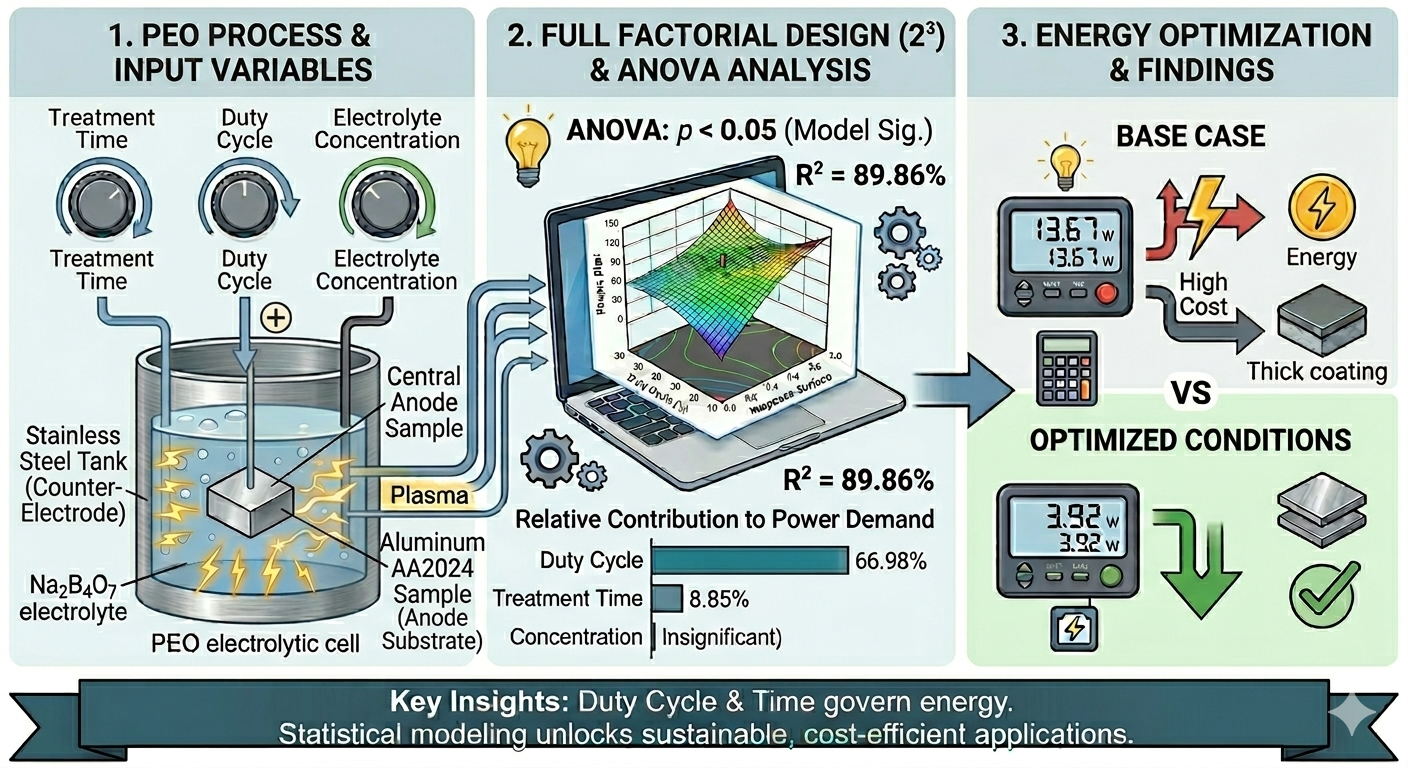
Plasma Electrolytic Oxidation (PEO) is an advanced electrochemical treatment for lightweight alloys such as Al, Ti, and Mg. It is an environmentally friendly process that utilizes silicate, aluminate, and phosphate-based electrolytes to produce oxide/ceramic coatings with superior physical and chemical properties compared to conventional techniques. Despite extensive studies on coating morphology and performance, systematic investigations into PEO parameter optimization for reducing energy consumption, a major limitation of the process, remain scarce. To address this gap, a full factorial design (23) was employed to evaluate the influence and determine optimized values of three parameters (treatment time, duty cycle, and electrolyte concentration) that minimize average power consumption. The novelty of this work lies in the quantitative demonstration that statistical modeling can disentangle the relative contributions of process variables to energy demand, offering new insights into PEO mechanisms and paving the way for more cost-efficient and sustainable applications. Average power consumption ranged from 3.68 W to 13.67 W, with lower values linked to shorter treatment times and reduced duty cycles. Analysis of variance (ANOVA) confirmed the model’s statistical robustness, explaining 89.86% of the response variability with a low noise level (0.93%). Treatment time and duty cycle were the only statistically significant factors (p < 0.05), contributing 8.85% and 66.98%, respectively. Beyond technological relevance, these findings provide a scientific framework for understanding parameter interactions in PEO and open promising avenues for future industrial and research applications.
- Open Access
- Communication
Parametric Analysis of Energy Consumption in the Plasma Electrolytic Oxidation (PEO) Process
- Rafael Resende Lucas 1,2,*,
- Rogério Pinto Mota 1,
- Edson Cocchieri Botelho 1,
- Rita de Cássia Mendonça Sales-Contini 2,3
Author Information
Received: 28 Nov 2025 | Revised: 14 Mar 2026 | Accepted: 09 Apr 2026 | Published: 03 Jun 2026
Abstract
Graphical Abstract
Keywords
micro-arc oxidation | statistical design | surface treatment | energy efficiency | ANOVA
References
- 1.
Rawart, S.; Wang, C.; Lay, S.; et al. Sustainable Biochar for Advanced Electrochemical/Energy Storage Applications. J. Energy Storage 2023, 63, 107115. https://doi.org/10.1016/j.est.2023.107115.
- 2.
Baruch‑Mordo, S.; Kiesecker, J.; Kennedy, C.; et al. From Paris to Practice: Sustainable Implementation of Renewable Energy Goals. Environ. Res. Lett. 2019, 14, 024013. https://doi.org/10.1088/1748-9326/aaf6e0.
- 3.
Rivera‑Cerezo, H.; Gaona‑Tiburcio, C.; Cabral‑Miramontes, J.; et al. Effect of Heat Treatment on the Electrochemical Behavior of AA2055 and AA2024 Alloys for Aeronautical Applications. Metals 2023, 13, 429. https://doi.org/10.3390/met13020429.
- 4.
Aamir, M.; Giasin, K.; Tolouei‑Rad, M.; et al. A Review: Drilling Performance and Hole Quality of Aluminium Alloys for Aerospace Applications. J. Mater. Res. Technol. 2020, 9, 12484–12500. https://doi.org/10.1016/j.jmrt.2020.09.003.
- 5.
Anijdan, S.; Sadeghi‑Nezhad, D.; Lee, H.; et al. TEM Study of Sʼ Hardening Precipitates in the Cold Rolled and Aged AA2024 Aluminum Alloy: Influence on the Microstructural Evolution, Tensile Properties & Electrical Conductivity. J. Mater. Res. Technol. 2021, 13, 798–807. https://doi.org/10.1016/j.jmrt.2021.05.003.
- 6.
Zhu, L.; Li, N.; Childs, P. Light‑Weighting in Aerospace Component and System Design. Propuls. Power Res. 2018, 7, 103–119. https://doi.org/10.1016/j.jppr.2018.04.001.
- 7.
Tomczyk, K.; Stepniowski, W. Incorporation of Anions into Anodic Alumina—A New Track in Cr(VI) Anodizing Substitution? Materials 2024, 17, 2938. https://doi.org/10.3390/ma17122938.
- 8.
Godja, N.; Munteanu, F. Environmentally Friendly Solutions as Potential Alternatives to Chromium‑Based Anodization and Chromate Sealing for Aeronautic Applications. Coatings 2025, 15, 439. https://doi.org/10.3390/coatings15040439.
- 9.
Hou, F.; Gorthy, R.; Mardon, I.; et al. Low Voltage Environmentally Friendly Plasma Electrolytic Oxidation Process for Titanium Alloys. Sci. Rep. 2022, 12, 6037. https://doi.org/10.1038/s41598-022-09693-w.
- 10.
Lucas, R.; Sales‑Contini, R.; Silva, F.; et al. Plasma Electrolytic Oxidation (PEO): An Alternative to Conventional Anodization Process. AIMS Mater. Sci. 2024, 11, 684–711. https://doi.org/10.3934/matersci.2024035.
- 11.
Lucas, R.; Hein, L.; Botelho, E.; et al. Influence of Electrolyte Concentration Variation on Thin Oxide Coating Production in Aluminum Alloy by PEO. Trans. Indian Natl. Acad. Eng. 2024, 9, 979–986. https://doi.org/10.1007/s41403-024-00500-8.
- 12.
Marcuz, N.; Ribeiro, R.; Rangel, E.; et al. Exploiting the Effect of PEO Parameters on the Surface of AISI 1020 Low‑Carbon Steel Treated in a TaOH‑Rich Electrolyte. Surf. Coat. Technol. 2024, 477, 130374. https://doi.org/10.1016/j.surfcoat.2024.130374.
- 13.
Cheng, Y.; Wei, B.; Liu, Y.; et al. Plasma Electrolytic Oxidation of Copper in an Aluminate Based Electrolyte with the Respective Additives of Na3PO4, NaH2PO4 and NaH2PO2. Appl. Surf. Sci. 2021, 565, 150477. https://doi.org/10.1016/j.apsusc.2021.150477.
- 14.
Guo, F.; Cao, Y.; Wang, K.; et al. Effect of the Anodizing Temperature on Microstructure and Tribological Properties of 6061 Aluminum Alloy Anodic Oxide Films. Coatings 2022, 12, 314. https://doi.org/10.3390/coatings12030314.
- 15.
Matykina, E.; Arrabal, R.; Pardo, R.; et al. Energy‑Efficient PEO Process of Aluminium Alloys. Mater. Lett. 2014, 127, 13–16. https://doi.org/10.1016/j.matlet.2014.04.077.
- 16.
Troughton, S.; Nominé, A.; Henrion, G.; et al. Synchronised Electrical Monitoring and High Speed Video of Bubble Growth Associated with Individual Discharges during Plasma Electrolytic Oxidation. Appl. Surf. Sci. 2015, 359, 405–411. https://doi.org/10.1016/j.apsusc.2015.10.124.
- 17.
Lucas, R.; Silva, E.; Marques, L.; et al. Analysis of Plasma Electrolytic Oxidation Process Parameters for Optimizing Adhesion in Aluminum–Composite Hybrid Structures. Appl. Sci. 2024, 14, 7972. https://doi.org/10.3390/app14177972.
- 18.
Dehnavi, V.; Luan, B.; Shoesmith, D.; et al. Effect of Duty Cycle and Applied Current Frequency on Plasma Electrolytic Oxidation (PEO) Coating Growth Behavior. Surf. Coat. Technol. 2013, 226, 100–107. https://doi.org/10.1016/j.surfcoat.2013.03.041.
- 19.
Zhu, M.; Song, K.; Dong, D.; et al. Correlation between the Transient Variation in Positive/Negative Pulse Voltages and the Growth of PEO Coating on 7075 Aluminum Alloy. Electrochim. Acta 2022, 411, 140056. https://doi.org/10.1016/j.electacta.2022.140056.
- 20.
Sevidova, E.; Pupan, L.; Gutsalenko, Y.; et al. Effect of Morphological Features on Dielectric Properties of Plasma Electrolytic Oxidation Coatings on D16T Aluminum Alloy. In Advances in Design, Simulation and Manufacturing III, Proceedings of the 3rd International Conference on Design, Simulation, Manufacturing: The Innovation Exchange, DSMIE-2020, Kharkiv, Ukraine, 9–12 June 2020; Springer: Berlin/Heidelberg, Germany, 2020; pp. 542–551. https://doi.org/10.1007/978-3-030-50794-7_53.
- 21.
de O. Frutuoso, F.G.S.; Vitoriano, J.O.; Alves-Junior, C. Controlling Plasma Electrolytic Oxidation of Titanium Using Current Pulses Compatible with the Duration of Microdischarges. Results Mater. 2022, 15, 100310. https://doi.org/10.1016/j.rinma.2022.100310.
- 22.
Tavares, M.; Vitoriano, J.; Silva, R.; et al. Effect of Duty Cycle and Treatment Time on Electrolytic Plasma Oxidation of Commercially Pure Al Samples. J. Mater. Res. Technol. 2019, 8, 2141–2147. https://doi.org/10.1016/j.jmrt.2019.01.020.
- 23.
Yan, H.; Liu, W.; Ma, Y.; et al. Effects of Micro‑Arc Oxidation Process Parameters on Microstructure and Properties of Al2O3 Coatings Prepared on Sintered 2024 Aluminum Alloy. J. Mater. Eng. Perform. 2024, 33, 1862–1873. https://doi.org/10.1007/s11665-023-08093-z.
- 24.
Zhang, X.; Tian, X.; Yang, S.; et al. Low Energy‑Consumption Plasma Electrolytic Oxidation Based on Grid Cathode. Rev. Sci. Instrum. 2010, 81, 103504. https://doi.org/10.1063/1.3500319.
- 25.
Bahador, R.; Hosseinabadi, N.; Yaghtin, A. Effect of Power Duty Cycle on Plasma Electrolytic Oxidation of A356–Nb2O₅ Metal Matrix Composites. J. Mater. Eng. Perform. 2021, 30, 2586–2604. https://doi.org/10.1007/s11665-021-05597-4.
- 26.
Kroes, A.; Finley, J. Demystifying Omega Squared: Practical Guidance for Effect Size in Common Analysis of Variance Designs. Psychol. Methods 2023, 30, 866–887. https://doi.org/10.1037/met0000581.
- 27.
Chaharmahali, R.; Fattah‑alhosseini, A.; Karbasi, M.; et al. A Systematic Study on Modulation of Plasma Electrolytic Oxidation Parameters for Optimizing Photocatalytic Coatings on Titanium Substrates. J. Alloys Compd. 2023, 963, 171234. https://doi.org/10.1016/j.jallcom.2023.171234.
- 28.
Torres‑Cerón, D.; Restrepo‑Parra, E.; Acosta‑Medina, C.; et al. Study of Duty Cycle Influence on the Band Gap Energy of TiO2/P Coatings Obtained by PEO Process. Surf. Coat. Technol. 2019, 375, 221–228. https://doi.org/10.1016/j.surfcoat.2019.06.021.
- 29.
Costa, N.; Lourenço, J. Desirability‑Based Post‑Hoc Selection of Pareto Solutions. Int. J. Manag. Sci. Eng. Manag. 2024, 19, 251–260. https://doi.org/10.1080/17509653.2023.2296876.

This work is licensed under a Creative Commons Attribution 4.0 International License.

 Suite 4002 Level 4, 447 Collins Street, Melbourne, Victoria 3000, Australia
 General Inquiries: info@sciltp.com