
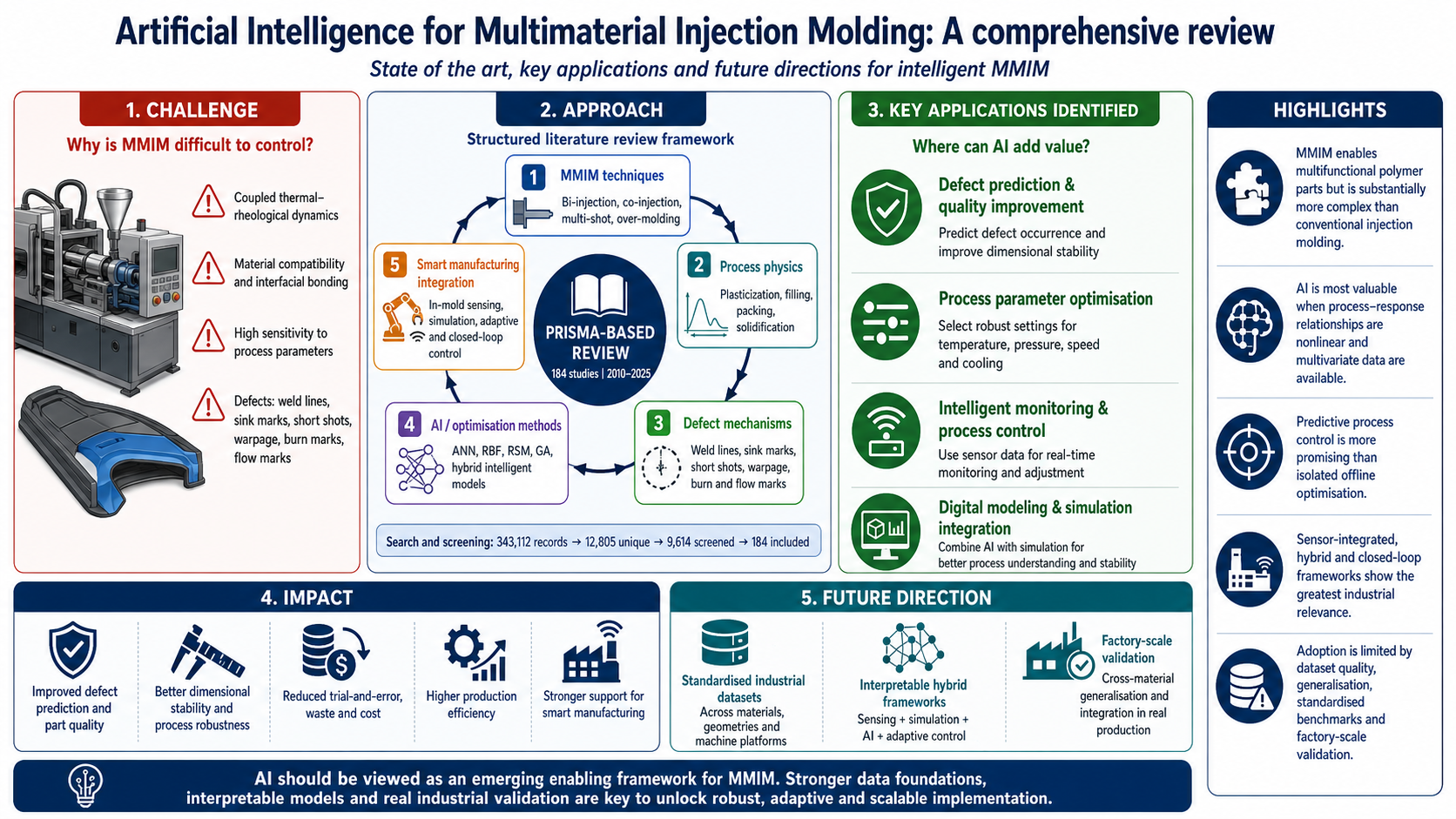
Multimaterial injection molding (MMIM) enables the integration of distinct polymer properties within a single component, but its tightly coupled thermal–rheological dynamics and interfacial phenomena complicate process control and quality assurance. Concurrently, advances in artificial intelligence (AI) and machine learning (ML) are reshaping manufacturing through predictive modeling, adaptive optimization and data-driven control. This review critically synthesises AI/ML methods and adjacent optimisation and control frameworks relevant to MMIM, distinguishing learning-based predictive models from conventional statistical, surrogate-based, and simulation-assisted approaches. Within this framework, methods such as artificial neural networks, radial basis function models, genetic algorithms, hybrid intelligent optimisation, and sensor-integrated control strategies are mapped against key manufacturing challenges including weld lines, sink marks, short shots, warpage, burn marks, and flow marks. Evidence from 2010–2025 shows that AI can improve dimensional stability, defect prediction and parameter selection, reduce experimental trial-and-error, and support intelligent monitoring. The most promising direction is the integration of AI with in-mold sensing, simulation and closed-loop control for real-time compensation. However, broader adoption requires high-quality datasets, standardized benchmarks, robust cross-material generalization and interpretable models validated in factory conditions. We outline a research agenda to bridge laboratory demonstrations and scalable industrial implementation, positioning AI as an enabler of more robust, adaptive and sustainable MMIM.
- Open Access
- Review
Minds and Molds: What Can Artificial Intelligence Do for Multi-Material Injection Molding
- André F. V. Pedroso 1,2,*,
- Pedro Santos 1,
- Filipe Silva 1,
- Ricardo J. D. Alexandre 3,
- Paulo J. Silva 1
Author Information
Received: 23 Mar 2026 | Revised: 16 Apr 2026 | Accepted: 23 Apr 2026 | Published: 10 Jun 2026
Abstract
Graphical Abstract
Keywords
machine learning | multi-component molding | defect prediction | in-mold sensing | predictive process control | intelligent manufacturing
References
- 1.
Pedroso, A.F.V.; Silva, F.J.G.; Campilho, R.D.S.G.; et al. Recent progress in milling operations for injection mold hardened tool steels: A concise review. Int. J. Adv. Manuf. Technol. 2025. https://doi.org/10.1007/s00170-025-16951-4.
- 2.
Masato, D.; Sorgato, M.; Lucchetta, G. Analysis of the influence of part thickness on the replication of micro-structured surfaces by injection molding. Mater. Des. 2016, 95, 219–224. https://doi.org/10.1016/j.matdes.2016.01.115.
- 3.
Wang, Y.; Lee, C. Design and Optimization of Conformal Cooling Channels for Increasing Cooling Efficiency in Injection Molding. Appl. Sci. 2023, 13, 7437.
- 4.
Pedroso, A.F.V.; Silva, F.J.G.; Campilho, R.D.S.G.; et al. Advanced Techniques for Extending the Service Life of Injection Molding Tools: A Brief Review. In Advances in Design, Simulation and Manufacturing VIII; Springer Nature: Cham, Switzerland, 2025; pp. 77–84.
- 5.
Shelesh-Nezhad, K.; Siores, E. An intelligent system for plastic injection molding process design. J. Mater. Process. Technol. 1997, 63, 458–462. https://doi.org/10.1016/S0924-0136(96)02664-7.
- 6.
Pedroso, A.F.V.; Durão, L.M.; Martinho, R.P.; et al. Recent Advances and Future Trends in Extending the Service Life of Injection Molding Tools: A Comprehensive Review. J. Mech. Eng. Manuf. 2026, 2, 12. https://doi.org/10.53941/jmem.2026.100012.
- 7.
Ogorodnyk, O.; Martinsen, K. Monitoring and Control for Thermoplastics Injection Molding a Review. Procedia CIRP 2018, 67, 380–385. https://doi.org/10.1016/j.procir.2017.12.229.
- 8.
Lee, H.; Ryu, K.; Cho, Y. A Framework of a Smart Injection Molding System Based on Real-time Data. Procedia Manuf. 2017, 11, 1004–1011. https://doi.org/10.1016/j.promfg.2017.07.206.
- 9.
Araújo, C.; Pereira, D.; Dias, D.; et al. In-cavity pressure measurements for failure diagnosis in the injection molding process and correlation with numerical simulation. Int. J. Adv. Manuf. Technol. 2023, 126, 291–300. https://doi.org/10.1007/s00170-023-11100-1.
- 10.
Fu, J.; Zhang, X.; Quan, L.; et al. Concurrent structural topology and injection gate location optimization for injection molding multimaterial parts. Adv. Eng. Softw. 2022, 165, 103088. https://doi.org/10.1016/j.advengsoft.2022.103088.
- 11.
Muaz, M.; Yu, H.; Sung, W.L.; et al. A multitask encoder–decoder model for quality prediction in injection molding. J. Manuf. Process. 2023, 103, 238–247. https://doi.org/10.1016/j.jmapro.2023.08.030.
- 12.
Moayyedian, M.; Mamedov, A. Multi-Objective Optimization of Injection Molding Process for Determination of Feasible Moldability Index. Procedia CIRP 2019, 84, 769–773. https://doi.org/10.1016/j.procir.2019.04.213.
- 13.
Farahani, S.; Khade, V.; Basu, S.; et al. A data-driven predictive maintenance framework for injection molding process. J. Manuf. Process. 2022, 80, 887–897. https://doi.org/10.1016/j.jmapro.2022.06.013.
- 14.
Kumar, S.; Park, H.S.; Lee, C.M. Data-driven smart control of injection molding process. CIRP J. Manuf. Sci. Technol. 2020, 31, 439–449. https://doi.org/10.1016/j.cirpj.2020.07.006.
- 15.
Ogorodnyk, O.; Lyngstad, O.V.; Larsen, M.; et al. Application of Machine Learning Methods for Prediction of Parts Quality in Thermoplastics Injection Molding. In Advanced Manufacturing and Automation VIII; Springer: Singapore, 2019; pp. 237–244.
- 16.
Yin, S.; Ding, S.X.; Xie, X.; et al. A Review on Basic Data-Driven Approaches for Industrial Process Monitoring. IEEE Trans. Ind. Electron. 2014, 61, 6418–6428. https://doi.org/10.1109/TIE.2014.2301773.
- 17.
Dang, X.P. General frameworks for optimization of plastic injection molding process parameters. Simul. Model. Pract. Theory 2014, 41, 15–27. https://doi.org/10.1016/j.simpat.2013.11.003.
- 18.
Pinto, H.A.; Silva, F.J.G.; Martinho, R.P.; et al. Improvement and validation of Zamak die casting molds. Procedia Manuf. 2019, 38, 1547–1557. https://doi.org/10.1016/j.promfg.2020.01.131.
- 19.
Wright, W.W. Polymers in aerospace applications. Mater. Des. 1991, 12, 222–227. https://doi.org/10.1016/0261-3069(91)90169-5.
- 20.
Gouker, R.M.; Gupta, S.K.; Bruck, H.A.; et al. Manufacturing of multimaterial compliant mechanisms using multimaterial molding. Int. J. Adv. Manuf. Technol. 2006, 30, 1049–1075. https://doi.org/10.1007/s00170-005-0152-4.
- 21.
Almeida, F.D.; Sousa, V.F.; Silva, F.J.; et al. Development of a Novel Design Strategy for Moving Mechanisms Used in Multi-Material Plastic Injection Molds. Appl. Sci. 2021, 11, 11805.
- 22.
Coates, P.D.; Speight, R.G. Towards Intelligent Process Control of Injection Molding of Polymers. J. Eng. Manuf. 1995, 209, 357–367. https://doi.org/10.1243/pime_proc_1995_209_095_02.
- 23.
Azarian, M.; Yu, H.; Shiferaw, A.T.; et al. Do We Perform Systematic Literature Review Right? A Scientific Mapping and Methodological Assessment. Logistics 2023, 7, 89. https://doi.org/10.3390/logistics7040089.
- 24.
Tóth, Á; Suta, A.; Pimentel, J.; et al. A comprehensive, semi-automated systematic literature review (SLR) design: Application to P-graph research with a focus on sustainability. J. Clean. Prod. 2023, 415, 137741. https://doi.org/10.1016/j.jclepro.2023.137741.
- 25.
Moher, D.; Liberati, A.; Tetzlaff, J.; et al. Preferred reporting items for systematic reviews and meta-analyses: The PRISMA statement. Int. J. Surg. 2010, 8, 336–341. https://doi.org/10.1016/j.ijsu.2010.02.007.
- 26.
Haddaway, N.R.; Page, M.J.; Pritchard, C.C.; et al. PRISMA2020: An R package and Shiny app for producing PRISMA 2020-compliant flow diagrams, with interactivity for optimised digital transparency and Open Synthesis. Campbell Syst. Rev. 2022, 18, 1230. https://doi.org/10.1002/cl2.1230.
- 27.
Tranfield, D.; Denyer, D.; Smart, P. Towards a Methodology for Developing Evidence-Informed Management Knowledge by Means of Systematic Review. Br. J. Manag. 2003, 14, 207–222. https://doi.org/10.1111/1467-8551.00375.
- 28.
Seuring, S.; Müller, M. From a literature review to a conceptual framework for sustainable supply chain management. J. Clean. Prod. 2008, 16, 1699–1710. https://doi.org/10.1016/j.jclepro.2008.04.020.
- 29.
Wawak, S.; Rogala, P.; Dahlgaard-Park, S.M. Research trends in quality management in years 2000–2019. Int. J. Qual. Serv. Sci. 2020, 12, 417–433. https://doi.org/10.1108/ijqss-12-2019-0133.
- 30.
Mieth, F.; Tromm, M. 1—Multicomponent Technologies. In Specialized Injection Molding Techniques; William Andrew Publishing: Norwich, NY, USA, 2016; pp. 1–51.
- 31.
Geminger, T.; Jarka, S. 4—Injection Molding of Multimaterial Systems. In Specialized Injection Molding Techniques; William Andrew Publishing: Norwich, NY, USA, 2016; pp. 165–210.
- 32.
Six, W.; Desplentere, F.; Bex, G.-J.; et al. Simulation and Optimization of Vulcanization in the Adhesion Area in a 2K Thermoset-Thermoplastic Product. Available online: https://www.researchgate.net/publication/314389808_Simulation_and_optimization_of_vulcanization_in_the_adhesion_area_in_a_2K_Thermoset-Thermoplastic_product (accessed on 22 March 2026).
- 33.
Six, W.; Bex, G.J.; Bael, A.; et al. Prediction of interfacial strength of HDPE overmolded with EPDM. Polym. Eng. Sci. 2019, 59, 1489–1498. https://doi.org/10.1002/pen.25148.
- 34.
Cao, Z.; Yang, Y.; Lu, J.; et al. Two-Time-Dimensional Model Predictive Control of Weld Line Positioning in Bi-Injection Molding. Ind. Eng. Chem. Res. 2015, 54, 4795–4804. https://doi.org/10.1021/ie5041397.
- 35.
Ou, H.; Sahli, M.; Barrière, T.; et al. Multiphysics modeling and experimental investigations of the filling and curing phases of bi-injection molding of thermoplastic polymer/liquid silicone rubbers. Int. J. Adv. Manuf. Technol. 2017, 92, 3871–3882. https://doi.org/10.1007/s00170-017-0425-8.
- 36.
Sahli, M.; Barrière, T.; Roizard, X. Experimental and numerical investigations of bi-injection molding of PA66/LSR peel test specimens. Polym. Test. 2020, 90, 106748. https://doi.org/10.1016/j.polymertesting.2020.106748.
- 37.
Barrière, T.; Sahli, M.; Roizard, X. Experimental and numerical investigation of peel test specimen using bi-injection molding process. Procedia Manuf. 2020, 50, 389–394. https://doi.org/10.1016/j.promfg.2020.08.071.
- 38.
Özel, A.; Soylemez, E. Experimental Investigation of Processing Temperature Effect on Adhesive Bond Strength Between Engineering Thermoplastics in the Plastic Injection Molding Process. J. Manuf. Sci. Eng. 2024, 146, 101001. https://doi.org/10.1115/1.4065847.
- 39.
Lu, Y.; Jiang, K.; Liu, Y.; et al. Study on mechanical properties of co-injection self-reinforced single polymer composites based on micro-morphology under different molding parameters. Polym. Test. 2020, 83, 106306. https://doi.org/10.1016/j.polymertesting.2019.106306.
- 40.
Lu, Y.; Jiang, K.; Wang, M. Study on rheological properties of in-mold co-injection self-reinforced polymer melt. Polym. Test. 2021, 93, 106910. https://doi.org/10.1016/j.polymertesting.2020.106910.
- 41.
Gall, M.; Steinbichler, G.; Lang, R.W. Learnings about design from recycling by using post-consumer polypropylene as a core layer in a co-injection molded sandwich structure product. Mater. Des. 2021, 202, 109576. https://doi.org/10.1016/j.matdes.2021.109576.
- 42.
Huang, C.-T.; Rao, Y.-T.; Ko, K.-Y.; et al. Investigation of Parameter Sensitivity and the Physical Mechanism for the Formation of a Core-Skin-Core (CSC) Structure in Two-Stage Co-Injection Molding. Polymers 2022, 14, 4747.
- 43.
He, W.; Yang, J.; Chen, Y.; et al. Study on co-injection molding of poly(styrene-ethylene-butylene-styrene) and polypropylene: Simulation and experiment. Polym. Test. 2022, 108, 107510. https://doi.org/10.1016/j.polymertesting.2022.107510.
- 44.
Liu, Q.; Liu, Y.; Jiang, C. Modeling and simulation of material distribution in the sequential co-injection molding process. Chin. J. Chem. Eng. 2022, 44, 507–520. https://doi.org/10.1016/j.cjche.2021.01.005.
- 45.
Wang, G.; Dong, M.; Yuan, M.; et al. Effects of process conditions and nano-fillers on the cell structure and mechanical properties of co-injection molded polypropylene-polyethylene composites. Polymer 2024, 299, 126935. https://doi.org/10.1016/j.polymer.2024.126935.
- 46.
Wieczorek, P.; Sykutera, D.; Czyżewski, P. Effect of PP+EVOH regranulate core thickness on mechanical properties of co-injection molded multilayer thin-wall packaging. Polimery 2025, 70, 504–509. https://doi.org/10.14314/polimery.2025.7.8.
- 47.
Kuang, T.; Kong, C.; Liu, H.; et al. Research on the Quality of Composite Pipe Components in Fluid-Powered Projectile-Assisted Injection Molding. Polymers 2025, 17, 489.
- 48.
Shen, J.; Ren, Y. Application and simulation of Co-injection molding combined with overmolding process of multi plastic materials. Eng. Res. Express 2025, 7, 035401. https://doi.org/10.1088/2631-8695/ade6c8.
- 49.
Huang, S.; Zhao, Z.; Zhang, T.; et al. Experimental analysis of gas-assisted co-injection molding for complex polymer multilayer circular tubular components. Iran. Polym. J. 2025, 34, 1589–1599. https://doi.org/10.1007/s13726-025-01461-7.
- 50.
Li, X.; Gupta, S.K. Geometric algorithms for automated design of rotary-platen multi-shot molds. Comput. -Aided Des. 2004, 36, 1171–1187. https://doi.org/10.1016/j.cad.2003.11.003.
- 51.
Wang, M.W.; Chen, C.H.; Arifin, F.; et al. Modeling and analysis of multi-shot injection molding of Blu-ray objective lens. J. Mech. Sci. Technol. 2018, 32, 4839–4849. https://doi.org/10.1007/s12206-018-0932-z.
- 52.
Schneider, D.; Hübner, C.; Bourbigot, S. New approach for the efficient attainment of flame retardancy using multi component injection molding. AIP Conf. Proc. 2019, 2055, 070007. https://doi.org/10.1063/1.5084851.
- 53.
Tengsuthiwat, J.; Sanjay, M.R.; Siengchin, S.; et al. 3D-MID Technology for Surface Modification of Polymer-Based Composites: A Comprehensive Review. Polymers 2020, 12, 1408.
- 54.
Gim, J.; Turng, L.S. A review of current advancements in high surface quality injection molding: Measurement, influencing factors, prediction, and control. Polym. Test. 2022, 115, 107718. https://doi.org/10.1016/j.polymertesting.2022.107718.
- 55.
Dias, D.; Peixoto, C.; Marques, R.; et al. Production of microcellular lightweight components with improved surface finish by technology combination: A review. Int. J. Lightweight Mater. Manuf. 2022, 5, 137–152. https://doi.org/10.1016/j.ijlmm.2021.11.005.
- 56.
Gao, R.; Zhao, P.; Xie, J.; et al. Research on the multilayer injection molding of thick-walled polymer optical products. J. Manuf. Process. 2023, 103, 309–319. https://doi.org/10.1016/j.jmapro.2023.08.033.
- 57.
Czepiel, M.; Bańkosz, M.; Sobczak-Kupiec, A. Advanced Injection Molding Methods: Review. Materials 2023, 16, 5802.
- 58.
Boros, R.; Rajamani, P.K.; Kovács, J.G. Thermoplastic Overmolding onto Injection-Molded and In Situ Polymerization-Based Polyamides. Materials 2018, 11, 2140.
- 59.
Andrzejewski, J.; Gosławska, W.; Salamaga, M.; et al. The Use of the Overmolding Technique for the Preparation of Basalt Fiber (BF)-Based Composite, the Comparative Study of Poly(ethylene terephthalate)/Polycarbonate—PET/PC and Poly(butylene terephthalate)—PBT/PC Blends. Polymers 2026, 18, 54.
- 60.
Lafranche, E.; Macedo, S.; Ferreira, P.; et al. Thin wall injection-overmolding of polyamide 6/polypropylene multilayer parts: PA6/PP-g-ma interfacial adhesion investigations. J. Appl. Polym. Sci. 2021, 138, 50294. https://doi.org/10.1002/app.50294.
- 61.
Liese, T.; Richter, J.; Niendorf, T.; et al. Overmolding of Additively Manufactured Titanium Inserts Using Polyoxymethylene (POM)—Evaluation of Bond Quality as a Function of Process Parameters. J. Compos. Sci. 2021, 5, 159. https://doi.org/10.3390/jcs5060159.
- 62.
Wurzbacher, S.; Gach, S.; Reisgen, U.; et al. Joining of plastic-metal hybrid components by overmolding of specially designed form-closure elements. Mater. Und Werkst. 2021, 52, 367–378. https://doi.org/10.1002/mawe.202000158.
- 63.
Aliyeva, N.; Sas, H.S.; Okan, B.S. Recent developments on the overmolding process for the fabrication of thermoset and thermoplastic composites by the integration of nano/micron-scale reinforcements. Compos. Part A Appl. Sci. Manuf. 2021, 149, 106525. https://doi.org/10.1016/j.compositesa.2021.106525.
- 64.
Mouellic, P.L.; Boyard, N.; Bailleul, J.L.; et al. Development of an original overmolding device to analyze heat transfer at polymer/polymer interface during overmolding. Appl. Therm. Eng. 2022, 216, 119042. https://doi.org/10.1016/j.applthermaleng.2022.119042.
- 65.
Hannesschläger, G.; Schwarze, M.; Leiss-Holzinger, E.; et al. In-Mold OCT Sensors Combined with Piezo-Actuated Positioning Devices for Compensating for Displacement in Injection Overmolding of Optoelectronic Parts. Sensors 2023, 23, 3242.
- 66.
Aliyeva, N.; Sas, H.S.; Okan, B.S. Revolutionizing transportation composite structures: Lightweight, sustainable, and multi-scale hybrid design through waste tire-driven graphene, hemp fiber, and bio-based overmolding. J. Thermoplast. Compos. Mater. 2024, 37, 2987–3011. https://doi.org/10.1177/08927057231222821.
- 67.
Wang, H.; Petersen, J.; Fischer, K.; et al. Influence of inlay consolidation quality on morphology of hybrid injection-molded parts and their bending behavior. J. Reinf. Plast. Compos. 2025, 44, 2846–2861. https://doi.org/10.1177/07316844241264598.
- 68.
Parsons, A.J.; Chen, S.; Ryder, A.; et al. Thermoplastic composite injection-overmolding with indirectly-loaded reinforcement: Design for manufacture. Compos. Struct. 2024, 337, 118056. https://doi.org/10.1016/j.compstruct.2024.118056.
- 69.
Wu, W.; Peng, H.; Jia, Y.; et al. Characteristics and mechanisms of polymer interfacial friction heating in ultrasonic plasticization for micro injection molding. Microsyst. Technol. 2017, 23, 1385–1392. https://doi.org/10.1007/s00542-016-2877-4.
- 70.
Iwko, J.; Steller, R.; Wróblewski, R. Experimentally Verified Mathematical Model of Polymer Plasticization Process in Injection Molding. Polymers 2018, 10, 968.
- 71.
Peng, T.; Jiang, B.; Zou, Y. Study on the Mechanism of Interfacial Friction Heating in Polymer Ultrasonic Plasticization Injection Molding Process. Polymers 2019, 11, 1407.
- 72.
Chen, S.-C.; Su, H.; Mathew, J.J.; et al. An Investigation to Reduce the Effect of Moisture on Injection-Molded Parts through Optimization of Plasticization Parameters. Appl. Sci. 2022, 12, 1410.
- 73.
Wu, W.; Pan, L.; Li, B.; et al. Plastic rod as a promising feed material for enhanced performance of ultrasonic plasticization microinjection molding: Plasticization rate, mechanical and thermal properties. Polym. Test. 2023, 118, 107909. https://doi.org/10.1016/j.polymertesting.2022.107909.
- 74.
Pan, L.; Wu, W.; Jia, C.; et al. Ultrasonic plasticization micro-injection molding technology: Characterization of replication fidelity and wettability of high-depth microstructure. J. Polym. Res. 2023, 30, 349. https://doi.org/10.1007/s10965-023-03735-1.
- 75.
Gülçür, M.; Gough, T.; Brown, E.; et al. Ultrasonic micro-injection molding: Characterisation of interfacial friction by varying feedstock shape and high-speed thermal imaging for microneedle feature replication. Int. J. Adv. Manuf. Technol. 2024, 133, 5515–5527. https://doi.org/10.1007/s00170-024-14078-6.
- 76.
Hopmann, C.; Wolters, J. Influence of plasticisation during foam injection molding on the melt viscosity and fibre length of long glass fibre-reinforced polypropylene. J. Polym. Eng. 2024, 44, 695–702. https://doi.org/10.1515/polyeng-2024-0104.
- 77.
Wu, S.; Du, J.; Liang, J.; et al. Characterization and Comparison of Polymer Melt Fluidity Across Three Ultrasonic Plasticization Molding Technologies. Polymers 2025, 17, 2576.
- 78.
Shoemaker, J. Filling Pattern. In Moldflow Design Guide; Carl Hanser Verlag GmbH & Co. KG: Munich, Germany, 2006; pp. 33–46. https://doi.org/10.3139/9783446418547.003.
- 79.
Tromm, M.; Shaayegan, V.; Wang, C.; et al. Investigation of the mold-filling phenomenon in high-pressure foam injection molding and its effects on the cellular structure in expanded foams. Polymer 2019, 160, 43–52. https://doi.org/10.1016/j.polymer.2018.11.006.
- 80.
Yu, W.; Ruan, S.; Li, Z.; et al. Effect of injection velocity on the filling behaviors of microinjection-molded polylactic acid micropillar array product. Int. J. Adv. Manuf. Technol. 2019, 103, 2929–2940. https://doi.org/10.1007/s00170-019-03766-3.
- 81.
Ma, H.; Fu, H. Study on Simulation of Mold Filling and Solidification Characteristics of Hypereutectic High-Chromium Cast Iron by Lost Foam Suspension Casting. Metals 2023, 13, 1761.
- 82.
Yavari, R.; Alizadeh, M. Investigation of Mold Filling Simulation, Segregation, and Rheological Properties in Low Pressure Injection Molding of Alumina Parts. J. Mater. Eng. Perform. 2024, 33, 8311–8321. https://doi.org/10.1007/s11665-023-08500-5.
- 83.
Karl, T.; Zartmann, J.; Dalpke, S.; et al. Influence of flow–fiber coupling during mold-filling on the stress field in short-fiber reinforced composites. Comput. Mech. 2023, 71, 991–1013. https://doi.org/10.1007/s00466-023-02277-z.
- 84.
Chien, M.; Lin, Y.; Huang, C.; et al. Impact of Runner Size, Gate Size, Polymer Viscosity, and Molding Process on Filling Imbalance in Geometrically Balanced Multi-Cavity Injection Molding. Polymers 2024, 16, 2874.
- 85.
Rabhi, F.; Cheng, G.; Barriere, T. Numerical Simulation of Mold Filling of Polymeric Materials with Friction Effect during Hot Embossing Process at Micro Scale. Polymers 2024, 16, 1417.
- 86.
Uyen, T.M.T.; Minh, P.S.; Thanh, B.C. Application of Cooling Layer and Thin Thickness Between Coolant and Cavity for Mold Temperature Control and Improving Filling Ability of Thin-Wall Injection Molding Product. Polymers 2025, 17, 2658.
- 87.
Li, K.; Wang, C.; Gong, F. The Filling Ratio and Surface Roughness Evolution of Glass Array Lens in Precision Glass Molding. Nanomanufacturing Metrol. 2025, 8, 2. https://doi.org/10.1007/s41871-025-00250-3.
- 88.
Li, S.; Zhao, S.; Li, F.; et al. Mold-filling behavior and microstructure evolution of semi-solid 6061 aluminum alloy slurry in die-casting of bracket parts. Int. J. Adv. Manuf. Technol. 2025, 141, 5417–5428. https://doi.org/10.1007/s00170-025-17020-6.
- 89.
Aasetre, S.; Andreassen, E. Packing of material along flow path in injection molded container. Plast. Rubber Compos. 2002, 31, 20–27. https://doi.org/10.1179/146580101125000475.
- 90.
Crawford, R.J.; Throne, J.L. 6—Processing; In Rotational Molding Technology; William Andrew Publishing: Norwich, NY, USA, 2002; pp. 201–306.
- 91.
Wee, J.W.; Park, S.Y.; Choi, B.H. Observation and understanding of scratch behaviors of glass fiber reinforced polycarbonate plates with various packing pressures during the injection molding process. Tribol. Int. 2015, 90, 491–501. https://doi.org/10.1016/j.triboint.2015.05.009.
- 92.
Kitayama, S.; Yokoyama, M.; Takano, M.; et al. Multi-objective optimization of variable packing pressure profile and process parameters in plastic injection molding for minimizing warpage and cycle time. Int. J. Adv. Manuf. Technol. 2017, 92, 3991–3999. https://doi.org/10.1007/s00170-017-0456-1.
- 93.
Zhao, P.; Yang, W.; Wang, X.; et al. A novel method for predicting degrees of crystallinity in injection molding during packing stage. J. Eng. Manuf. 2019, 233, 204–214. https://doi.org/10.1177/0954405417718593.
- 94.
Tseng, H.C.; Chang, R.Y.; Hsu, C.H. Effect of the packing stage on fiber orientation for injection molding simulation of fiber-reinforced composites. J. Thermoplast. Compos. Mater. 2018, 31, 1204–1218. https://doi.org/10.1177/0892705717734605.
- 95.
Chen, J.-Y.; Liu, C.-Y.; Huang, M.-S. Tie-Bar Elongation Based Filling-To-Packing Switchover Control and Prediction of Injection Molding Quality. Polymers 2019, 11, 1168.
- 96.
Kitayama, S.; Tsurita, S.; Takano, M.; et al. Multi-objective process parameters optimization in rapid heat cycle molding incorporating variable packing pressure profile for improving weldline, clamping force, and cycle time. Int. J. Adv. Manuf. Technol. 2022, 120, 3669–3681. https://doi.org/10.1007/s00170-022-08994-8.
- 97.
Xu, Y.; Xie, P.; Fu, N.; et al. Self-optimization of the V/P switchover and packing pressure for online viscosity compensation during injection molding. Polym. Eng. Sci. 2022, 62, 1114–1123. https://doi.org/10.1002/pen.25910.
- 98.
Estrella-Guayasamin, M.; Figueroa-López, U.; Guevara-Morales, A.; et al. Effect of crystallization and packing pressure on the development of residual stresses on injection molded polypropylene samples. Polym. Bull. 2023, 80, 4355–4369. https://doi.org/10.1007/s00289-022-04276-1.
- 99.
Sun, Y.; Niu, B.; Cai, H.; et al. High-Orientation and Shape-Controllable Thermal Conductive Composites Based on Dense Packing and Injection Molding Method. ACS Appl. Polym. Mater. 2025, 7, 4708–4715. https://doi.org/10.1021/acsapm.4c03515.
- 100.
Potuk, N.O.; Oksuz, M.; Ekinci, A.; et al. Optimization of Injection Molding Processing Parameters for Thin-Walled Plastic Parts Manufactured for the Automotive Industry. Polymers 2026, 18, 91.
- 101.
Ahn, C.; Söderhjelm, C.; Apelian, D. Enabling Technologies for Thermal Management During Permanent Mold Casting: A Critical Review. Int. J. Met. 2025. https://doi.org/10.1007/s40962-025-01784-4.
- 102.
Wei, Z.; Wu, J.; Shi, N.; et al. Review of conformal cooling system design and additive manufacturing for injection molds. Math. Biosci. Eng. 2020, 17, 5414–5431. https://doi.org/10.3934/mbe.2020292.
- 103.
Fu, G.; Loh, N.H.; Tor, S.B.; et al. A variotherm mold for micro metal injection molding. Microsyst. Technol. 2005, 11, 1267–1271. https://doi.org/10.1007/s00542-005-0605-6.
- 104.
Azaman, M.D.; Sapuan, S.M.; Sulaiman, S.; et al. Numerical Simulation Analysis of Unfilled and Filled Reinforced Polypropylene on Thin-Walled Parts Formed Using the Injection-Molding Process. Int. J. Polym. Sci. 2015, 2015, 659321. https://doi.org/10.1155/2015/659321.
- 105.
Hopmann, C.; Schmitz, M. Targeted Solidification through Self-optimising, Highly Segmented Mold Temperature Control in Injection Molding. Int. Polym. Sci. Technol. 2017, 44, 1–8. https://doi.org/10.1177/0307174x1704400801.
- 106.
Luca, A.; Riemer, O. Analysis of the Downscaling Effect and Definition of the Process Fingerprints in Micro Injection of Spiral Geometries. Micromachines 2019, 10, 335.
- 107.
Roth, B.; Wildner, W.; Drummer, D. Dynamic Compression Induced Solidification. Polymers 2020, 12, 488. https://doi.org/10.3390/polym12020488.
- 108.
Liparoti, S.; Speranza, V.; De Meo, A.; et al. Prediction of the maximum flow length of a thin injection molded part. 2020, 40, 783–795. https://doi.org/10.1515/polyeng-2019-0292.
- 109.
Li, X.; Yu, H.; Kang, X.; et al. Effect of injection molding on structure and properties of poly(styrene-ethylene-butylene-styrene) and its nanocomposite with functionalized montmorillonite. J. Appl. Polym. Sci. 2021, 138, 49633. https://doi.org/10.1002/app.49633.
- 110.
Liparoti, S.; Speranza, V.; Pantani, R.; et al. Multi-Scale Simulation of Injection Molding Process with Micro–Features Replication: Relevance of Rheological Behavior and Crystallization. Polymers 2021, 13, 3236.
- 111.
Chen, S.C.; Tsai, B.L.; Hsieh, C.C.; et al. Prediction of Part Shrinkage for Injection Molded Crystalline Polymer via Cavity Pressure and Melt Temperature Monitoring. Appl. Sci. 2023, 13, 9884. https://doi.org/10.3390/app13179884.
- 112.
Chang, Y.J.; Chang, R.Y.; Osswald, T.A. Modeling and simulation of bulk viscoelasticity for amorphous polymers in injection molding. Phys. Fluids 2023, 35, 053109. https://doi.org/10.1063/5.0150692.
- 113.
Nathan, D.K.; Prabhu, K.N. Polymer/mold interfacial heat transfer during injection molding. Polym. Eng. Sci. 2024, 64, 888–900. https://doi.org/10.1002/pen.26592.
- 114.
Mehat, N.M.; Kamaruddin, S. Multi-Response Optimization of Injection Molding Processing Parameters Using the Taguchi Method. Polym. -Plast. Technol. Eng. 2011, 50, 1519–1526. https://doi.org/10.1080/03602559.2011.603776.
- 115.
Nguyen, T.-P.; Khanh, P.T.M.; Minh, P.S.; et al. A Study on Thin Cooling Layers Between the Cooling Channel and Cavity in the Injection Molding Process for Mold Temperature Control to Enhance Weld Line Flexural Strength in Plastic Products. Polymers 2025, 17, 2831.
- 116.
Liparoti, S.; De Piano, G.; Salomone, R.; et al. Analysis of Weld Lines in Micro-Injection Molding. Materials 2023, 16, 6053.
- 117.
Viljoen, D.; Fischer, M.; Kühnert, I.; et al. The Tensile Behavior of Highly Filled High-Density Polyethylene Quaternary Composites: Weld-Line Effects, DIC Curiosities and Shifted Deformation Mechanisms. Polymers 2021, 13, 527.
- 118.
Fukushima, Y.; Kosaka, M.; Sakamoto, A. A study on the optimal mold design method for the prevention of weld-line by injection molding CAE. Adv. Mater. Process. Technol. 2022, 8, 1534–1549. https://doi.org/10.1080/2374068X.2020.1860587.
- 119.
Fereshteh-Saniee, N.; Reynolds, N.; Norman, D.; et al. Quality Analysis of Weld-Line Defects in Carbon Fibre Reinforced Sheet Molding Compounds by Automated Eddy Current Scanning. J. Manuf. Mater. Process. 2022, 6, 151.
- 120.
Jadhav, G.; Gaval, V. Weld-line strength prediction for glass fiber reinforced polyamide-6 material through integrative simulation and its experimental validation. J. Thermoplast. Compos. Mater. 2024, 37, 2447–2463. https://doi.org/10.1177/08927057231216747.
- 121.
Gruber, D.P.; Macher, J.; Haba, D.; et al. Measurement of the visual perceptibility of sink marks on injection molding parts by a new fast processing model. Polym. Test. 2014, 33, 7–12. https://doi.org/10.1016/j.polymertesting.2013.10.014.
- 122.
Inui, M.; Onishi, S.; Umezu, N. Visualization of potential sink marks using thickness analysis of finely tessellated solid model. J. Comput. Des. Eng. 2018, 5, 409–418. https://doi.org/10.1016/j.jcde.2018.02.003.
- 123.
Wang, G.; Zhao, G.; Li, H.; et al. Research on a New Variotherm Injection Molding Technology and its Application on the Molding of a Large LCD Panel. Polym. -Plast. Technol. Eng. 2009, 48, 671–681. https://doi.org/10.1080/03602550902824549.
- 124.
Guo, W.; Hua, L.; Mao, H. Minimization of sink mark depth in injection-molded thermoplastic through design of experiments and genetic algorithm. Int. J. Adv. Manuf. Technol. 2014, 72, 365–375. https://doi.org/10.1007/s00170-013-5603-8.
- 125.
Sun, X.; Tibbenham, P.; Zeng, D.; et al. Procedure development for predicting the sink mark of injection molded thermoplastics by finite element method. Int. J. Adv. Manuf. Technol. 2019, 103, 4095–4107. https://doi.org/10.1007/s00170-019-03687-1.
- 126.
Vanek, J.; Ovsik, M.; Stanek, M.; et al. Study of Injection Molding Process to Improve Geometrical Quality of Thick-Walled Polycarbonate Optical Lenses by Reducing Sink Marks. Polymers 2024, 16, 2318.
- 127.
Wang, F.; Luo, W.; Bu, J.; et al. Mitigation of Sink Voids in Thick-Walled Thermoplastic Components via Integrated Taguchi DOE and CAE Simulations. Polymers 2025, 17, 1126.
- 128.
Zhou, Y.; Jia, S.; Lu, Y.; et al. Study on ultrasonic elliptical vibration-assisted grinding mechanism and surface quality of C/SiC composite material. Diam. Relat. Mater. 2024, 149, 111565. https://doi.org/10.1016/j.diamond.2024.111565.
- 129.
Bhalerao, S.; Badgujar, T.Y.B.; Mahajan, D.; et al. Experimentation and Optimization of injection molding process parameter through Taguchi method and Mold flow analysis. Int. J. Eng. Trends Technol. 2017, 51, 97–105. https://doi.org/10.14445/22315381/IJETT-V51P218.
- 130.
Im, D.; Lee, S.; Lee, H.; et al. A Data-Centric Approach to Design and Analysis of a Surface-Inspection System Based on Deep Learning in the Plastic Injection Molding Industry. Processes 2021, 9, 1895.
- 131.
Mourya, A.; Nanda, A.; Parashar, K.; et al. An explanatory study on defects in plastic molding parts caused by machine parameters in injection molding process. Mater. Today Proc. 2023, 78, 656–661. https://doi.org/10.1016/j.matpr.2022.12.070.
- 132.
Moayyedian, M.; Abhary, K.; Marian, R. The analysis of short shot possibility in injection molding process. Int. J. Adv. Manuf. Technol. 2017, 91, 3977–3989. https://doi.org/10.1007/s00170-017-0055-1.
- 133.
Mahajan, L.D.; Ulhe, P.N. Analysis of injection molding process to reduced defects (short-shot). Int. J. Eng. Technol. Manag. Res. 2018, 5, 113–119. https://doi.org/10.29121/ijetmr.v5.i6.2018.251.
- 134.
Ramesh, M.; Panneerselvam, K. Optimization for Injection Molding process parameters towards Warpage and Shrinkage of HDPE-PBI composites. Mater. Sci. Eng. 2021, 1183, 012001. https://doi.org/10.1088/1757-899X/1183/1/012001.
- 135.
Carrupt, M.C.; Piedade, A.P. Modification of the Cavity of Plastic Injection Molds: A Brief Review of Materials and Influence on the Cooling Rates. Materials 2021, 14, 7249.
- 136.
Chang, Y.-H.; Chen, S.-C.; Ting, Y.-H.; et al. The Investigation of Novel Dynamic Packing Technology for Injection Molded Part Quality Control and Its Production Stability by Using Real-Time PVT Control Method. Polymers 2022, 14, 2720.
- 137.
Ren, J.; Chien, M.; Zhang, L.; et al. Influence of Process Parameters on Shrinkage/Warpage and Tensile Strength in ABS/PC Injection Overmolded Products. Polym. Eng. Sci. 2025, 65, 5561–5571. https://doi.org/10.1002/pen.70091.
- 138.
Laschet, G.; Alms, J.; Heym, M.K.; et al. Effective Local, Crystallization Degree and Microstructure Dependent Thermo-Elastic Properties of an Injection Molded i-PP Component via a Multiscale Approach and Their Impact on Warpage Simulations. J. Appl. Polym. Sci. 2026, 143, 70187. https://doi.org/10.1002/app.70187.
- 139.
Ashwaghosh, R.S.; Hemanth, R. Conceptual Design of Injection Mold Tool for Inlet Chamber of an Air Inflator. Int. J. Res. Eng. Technol. 2014, 03, 694–698. https://doi.org/10.15623/ijret.2014.0315130.
- 140.
Fukushima, Y.; Suzuki, T.; Onda, K.; et al. Study on the Online Monitoring of Burn Marks by Gas Sensor. Int. J. Autom. Technol. 2017, 11, 112–119. https://doi.org/10.20965/ijat.2017.p0112.
- 141.
Mesgaran, S.B.; Nik, F.E.; Mousavi, S.E.S. Experimental and Numerical Analysis of Burn Marks and Shrinkage Effect on Injection Molding. In Proceedings of the ASME 2017 12th International Manufacturing Science and Engineering Conference collocated with the JSME/ASME 2017 6th International Conference on Materials and Processing, Los Angeles, CA, USA, 4–8 June 2017.
- 142.
Tucker, M.; Griffiths, C.A.; Rees, A.; et al. High Temperature Adiabatic Heating in µ-IM Mold Cavities—A Case for Venting Design Solutions. Micromachines 2020, 11, 358.
- 143.
Li, J.; Liu, W.; Xia, X.; et al. Reducing the Burn Marks on Injection-Molded Parts by External Gas-Assisted Injection Molding. Polymers 2021, 13, 4087.
- 144.
Shakkarwal, P.; Kumar, R.; Sindhwani, R. Progressive Die Design and Development Using AutoCAD. In Advances in Engineering Design; Springer: Singapore, 2021; pp. 531–539.
- 145.
Gülçür, M.; Brown, E.; Gough, T.; et al. Characterisation of microneedle replication and flow behavior in ultrasonic micro-injection molding through design of experiments. J. Manuf. Process. 2023, 102, 513–527. https://doi.org/10.1016/j.jmapro.2023.07.068.
- 146.
Mascher, M.; Hess, R.; Hopmann, C.; et al. Effect of mold surface roughness adjustments to increase the flow path length in the injection molding process. J. Manuf. Process. 2023, 101, 974–981. https://doi.org/10.1016/j.jmapro.2023.06.056.
- 147.
Zhang, Y.; Hu, J.; Min, J.; et al. The influence of flowability based on molecular chain entanglement degree on flow marks in injection molding of polypropylene/polyolefin elastomer/talc composites. Polymer 2025, 337, 129029. https://doi.org/10.1016/j.polymer.2025.129029.
- 148.
Zhang, Y.; Hu, J.; Song, W.; et al. The influence of viscoelasticity of elastomer on flow marks in injection molding of polypropylene/polyolefin elastomer/talc composites. Appl. Sci. Manuf. 2025, 188, 108567. https://doi.org/10.1016/j.compositesa.2024.108567.
- 149.
Zhao, P.; Dong, Z.; Zhang, J.; et al. Optimization of Injection-Molding Process Parameters for Weight Control: Converting Optimization Problem to Classification Problem. Adv. Polym. Technol. 2020, 2020, 7654249. https://doi.org/10.1155/2020/7654249.
- 150.
Zhang, S.; Dubay, R.; Charest, M. A principal component analysis model-based predictive controller for controlling part warpage in plastic injection molding. Expert Syst. Appl. 2015, 42, 2919–2927. https://doi.org/10.1016/j.eswa.2014.11.030.
- 151.
Tzeng, C.J.; Yang, Y.K.; Lin, Y.H.; et al. A study of optimization of injection molding process parameters for SGF and PTFE reinforced PC composites using neural network and response surface methodology. Int. J. Adv. Manuf. Technol. 2012, 63, 691–704. https://doi.org/10.1007/s00170-012-3933-6.
- 152.
Zhao, N.Y.; Lian, J.Y.; Wang, P.F.; et al. Recent progress in minimizing the warpage and shrinkage deformations by the optimization of process parameters in plastic injection molding: A review. Int. J. Adv. Manuf. Technol. 2022, 120, 85–101. https://doi.org/10.1007/s00170-022-08859-0.
- 153.
Osarenmwinda, J.O.; Olodu, D.D. Optimization of injection molding process parameters in the molding of High Density Polyethylene (HDPE. J. Appl. Sci. Environ. Manag. 2018, 22, 203–206. https://doi.org/10.4314/jasem.v22i2.8.
- 154.
Ahmad, A.; Wahab, M.S.; Shah, A.S.M.; et al. Optimization of processing parameters for plastic injection molding process towards molded part shrinkage. AIP Conf. Proc. 2019, 2129, 020168. https://doi.org/10.1063/1.5118176.
- 155.
Park, H.S.; Dang, X.P. Structural optimization based on CAD–CAE integration and metamodeling techniques. Comput. -Aided Des. 2010, 42, 889–902. https://doi.org/10.1016/j.cad.2010.06.003.
- 156.
Simpson, T.W.; Poplinski, J.D.; Koch, P.N.; et al. Metamodels for Computer-based Engineering Design: Survey and recommendations. Eng. Comput. 2001, 17, 129–150. https://doi.org/10.1007/PL00007198.
- 157.
Wang, G.G.; Shan, S. Review of Metamodeling Techniques in Support of Engineering Design Optimization. J. Mech. Des. 2006, 129, 370–380. https://doi.org/10.1115/1.2429697.
- 158.
Kurtaran, H.; Erzurumlu, T. Efficient warpage optimization of thin shell plastic parts using response surface methodology and genetic algorithm. Int. J. Adv. Manuf. Technol. 2006, 27, 468–472. https://doi.org/10.1007/s00170-004-2321-2.
- 159.
Ozcelik, B.; Erzurumlu, T. Determination of effecting dimensional parameters on warpage of thin shell plastic parts using integrated response surface method and genetic algorithm. Int. Commun. Heat Mass Transf. 2005, 32, 1085–1094. https://doi.org/10.1016/j.icheatmasstransfer.2004.10.032.
- 160.
Chen, C.C.; Su, P.L.; Lin, Y.C. Analysis and modeling of effective parameters for dimension shrinkage variation of injection molded part with thin shell feature using response surface methodology. Int. J. Adv. Manuf. Technol. 2009, 45, 1087. https://doi.org/10.1007/s00170-009-2045-4.
- 161.
Mathivanan, D.; Parthasarathy, N.S. Prediction of sink depths using nonlinear modeling of injection molding variables. Int. J. Adv. Manuf. Technol. 2009, 43, 654–663. https://doi.org/10.1007/s00170-008-1749-1.
- 162.
Chiang, K.T.; Chang, F.P. Analysis of shrinkage and warpage in an injection-molded part with a thin shell feature using the response surface methodology. Int. J. Adv. Manuf. Technol. 2007, 35, 468–479. https://doi.org/10.1007/s00170-006-0739-4.
- 163.
Chen, W.C.; Nguyen, M.H.; Chiu, W.H.; et al. Optimization of the plastic injection molding process using the Taguchi method, RSM, and hybrid GA-PSO. Int. J. Adv. Manuf. Technol. 2016, 83, 1873–1886. https://doi.org/10.1007/s00170-015-7683-0.
- 164.
Li, K.; Yan, S.; Zhong, Y.; et al. Multi-objective optimization of the fiber-reinforced composite injection molding process using Taguchi method, RSM, and NSGA-II. Simul. Model. Pract. Theory 2019, 91, 69–82. https://doi.org/10.1016/j.simpat.2018.09.003.
- 165.
Ong, H.R.; Shah, I.M.; Iskandar, W.M.E.; et al. Rejection Rate Reduction of the Automotive Thermoplastic Parts in Injection Molding Using Response Surface Methodology. Key Eng. Mater. 2020, 841, 225–231.
- 166.
Kariminejad, M.; Tormey, D.; Ryan, C.; et al. Single and multi-objective real-time optimization of an industrial injection molding process via a Bayesian adaptive design of experiment approach. Sci. Rep. 2024, 14, 29799. https://doi.org/10.1038/s41598-024-80405-2.
- 167.
Zhao, N.Y.; Liu, J.F.; Su, M.Y.; et al. Measurement techniques in injection molding: A comprehensive review of machine status detection, molten resin flow state characterization, and component quality adjustment. Measurement 2024, 226, 114163. https://doi.org/10.1016/j.measurement.2024.114163.
- 168.
Shie, J.R. Optimization of injection molding process for contour distortions of polypropylene composite components by a radial basis neural network. Int. J. Adv. Manuf. Technol. 2008, 36, 1091–1103. https://doi.org/10.1007/s00170-007-0940-0.
- 169.
Chen, S.; Cowan, C.F.N.; Grant, P.M. Orthogonal least squares learning algorithm for radial basis function networks. IEEE Trans. Neural Netw. 1991, 2, 302–309. https://doi.org/10.1109/72.80341.
- 170.
Heidari, B.S.; Moghaddam, A.H.; Davachi, S.M.; et al. Optimization of process parameters in plastic injection molding for minimizing the volumetric shrinkage and warpage using radial basis function (RBF) coupled with the k-fold cross validation technique. J. Polym. Eng. 2019, 39, 481–492. https://doi.org/10.1515/polyeng-2018-0359.
- 171.
Chang, H.; Lu, S.; Sun, Y.; et al. Quality optimization of liquid silicon lenses based on sequential approximation optimization and radial basis function networks. Sci. Rep. 2025, 15, 4092. https://doi.org/10.1038/s41598-025-87753-7.
- 172.
Lin, C.Y.; Yao, W.S.; Li, H.Y. Bayesian Optimized Adaptive Control of Injection Molding Machines for Plastic Recycling Material. Results Control Optim. 2026, 23, 100686. https://doi.org/10.1016/j.rico.2026.100686.
- 173.
Sadeghi, B.H.M. A BP-neural network predictor model for plastic injection molding process. J. Mater. Process. Technol. 2000, 103, 411–416. https://doi.org/10.1016/S0924-0136(00)00498-2.
- 174.
Yarlagadda, P.K.D.V. Development of an integrated neural network system for prediction of process parameters in metal injection molding. J. Mater. Process. Technol. 2002, 130–131, 315–320. https://doi.org/10.1016/S0924-0136(02)00738-0.
- 175.
Kwak, T.S.; Suzuki, T.; Bae, W.B.; et al. Application of neural network and computer simulation to improve surface profile of injection molding optic lens. J. Mater. Process. Technol. 2005, 170, 24–31. https://doi.org/10.1016/j.jmatprotec.2005.04.099.
- 176.
Yarlagadda, P.K.D.V.; Khong, C.A.T. Development of a hybrid neural network system for prediction of process parameters in injection molding. J. Mater. Process. Technol. 2001, 118, 109–115. https://doi.org/10.1016/S0924-0136(01)00901-3.
- 177.
Mok, S.L.; Kwong, C.K. Application of artificial neural network and fuzzy logic in a case-based system for initial process parameter setting of injection molding. J. Intell. Manuf. 2002, 13, 165–176. https://doi.org/10.1023/A:1015730705078.
- 178.
Altan, M. Reducing shrinkage in injection moldings via the Taguchi, ANOVA and neural network methods. Mater. Des. 2010, 31, 599–604. https://doi.org/10.1016/j.matdes.2009.06.049.
- 179.
Kenig, S.; Ben-David, A.; Omer, M.; et al. Control of properties in injection molding by neural networks. Eng. Appl. Artif. Intell. 2001, 14, 819–823. https://doi.org/10.1016/S0952-1976(02)00006-4.
- 180.
Meyes, R.; Tercan, H.; Thiele, T.; et al. Interdisciplinary Data Driven Production Process Analysis for the Internet of Production. Procedia Manuf. 2018, 26, 1065–1076. https://doi.org/10.1016/j.promfg.2018.07.143.
- 181.
Moayyedian, M.; Dinc, A.; Mamedov, A. Optimization of Injection-Molding Process for Thin-Walled Polypropylene Part Using Artificial Neural Network and Taguchi Techniques. Polymers 2021, 13, 4158.
- 182.
Moayyedian, M.; Qazani, M.R.C.; Amirkhizi, P.J.; et al. Multiple objectives optimization of injection-molding process for dashboard using soft computing and particle swarm optimization. Sci. Rep. 2024, 14, 23767. https://doi.org/10.1038/s41598-024-62618-7.
- 183.
Raimi, O.A.; Lee, B.K. Artificial Neural Network (ANN)–Based Prediction Model of Demolding Force in Injection Molding Process. Adv. Polym. Technol. 2025, 2025, 1528204. https://doi.org/10.1155/adv/1528204.
- 184.
Luangpaiboon, P.; Atthirawong, W.; Hirunwat, A.; et al. Statistical learning-driven parameter tuning in injection molding using modified simplex method. Results Eng. 2025, 27, 106690. https://doi.org/10.1016/j.rineng.2025.106690.


This work is licensed under a Creative Commons Attribution 4.0 International License.

 Suite 4002 Level 4, 447 Collins Street, Melbourne, Victoria 3000, Australia
 General Inquiries: info@sciltp.com