
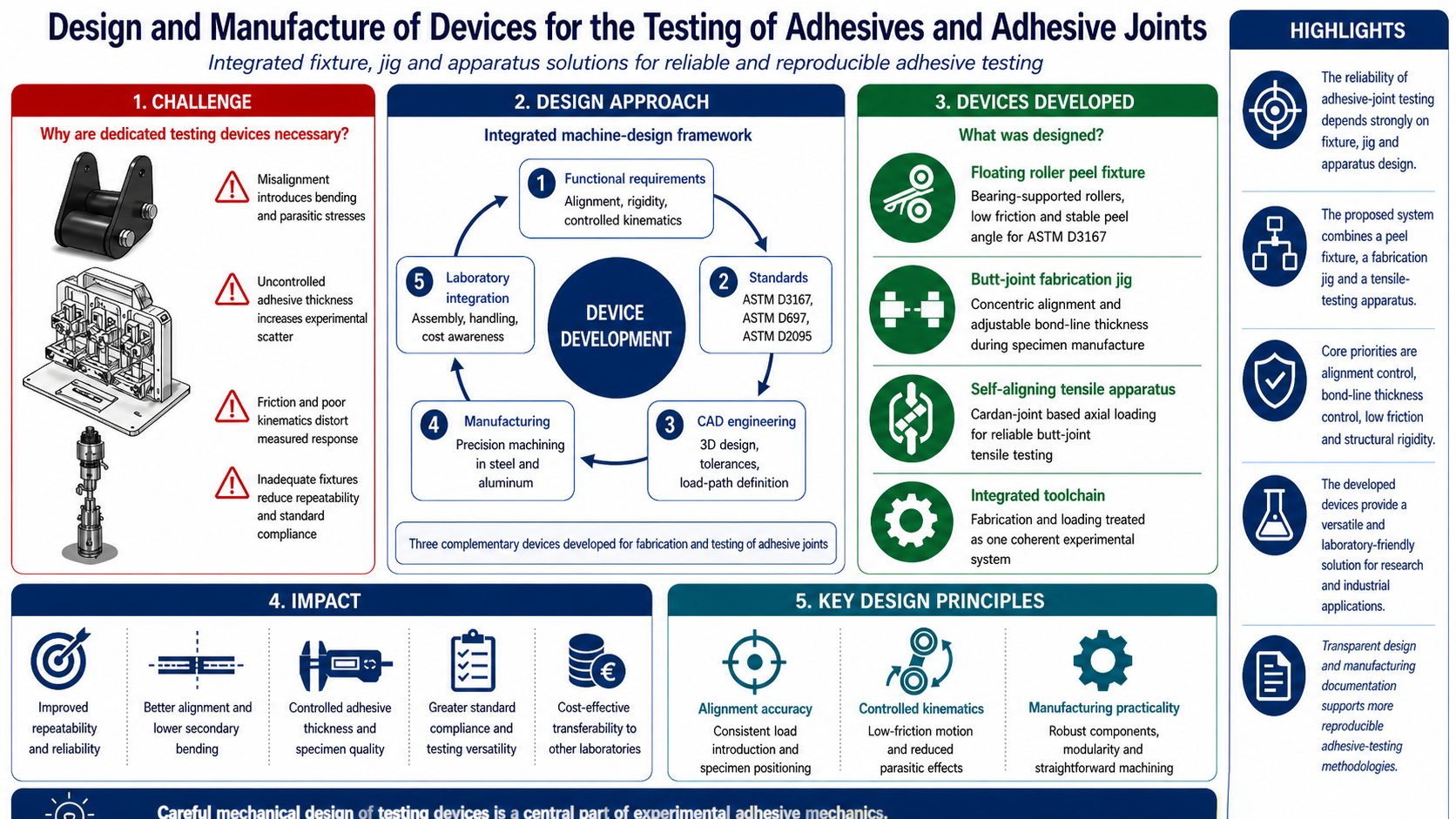
The reliability of mechanical testing of adhesive joints is strongly dependent on the design and performance of the testing fixtures, jigs or apparatus used to manufacture and load the specimens. Inadequate devices design may introduce misalignment, parasitic stresses, and uncontrolled adhesive thickness, compromising the accuracy and repeatability of experimental results. This paper presents the design, development, and manufacture of a set of dedicated mechanical devices for the characterisation of adhesive joints, specifically targeting floating roller peel and butt-joint tensile testing. These devices will ensure that the testing laboratory is duly equipped and qualified to carry out the specified tests for both research activities and industrial applications. The proposed system comprises three main components: a floating roller peel fixture compliant with ASTM D3167, a modular jig for the fabrication of butt-joint specimens with controlled adhesive thickness, and a self-aligning apparatus for tensile testing of butt joints. The design process was guided by key mechanical requirements, including precise load alignment, minimisation of frictional effects, controlled kinematics, and robustness under repeated testing conditions. All components were developed using CAD modelling and manufactured through precision machining using structural steels and aluminium alloys. Particular attention was given to the control of geometric tolerances, alignment mechanisms, and load transfer paths, ensuring consistent specimen positioning and minimisation of secondary stresses during testing. The proposed devices provide a versatile and cost-effective solution for laboratory-scale mechanical testing, enabling improved repeatability and reliability of experimental procedures. Experimental validation was performed using epoxy and polyurethane adhesives with distinct mechanical properties, which experimental values are addressed in another paper. Overall, the presented design contributes to the standardisation and optimisation of experimental methodologies for adhesive joint characterisation, supporting more accurate and reproducible mechanical testing in engineering applications.
- Open Access
- Article
Design and Manufacture of Devices for the Testing of Adhesives and Adhesive Joints
- André F. V. Pedroso 1,2,*,
- Arnaldo G. Pinto 1,
- Paulo J. R. O. Nóvoa 1,3,
- Rui M. Fazenda 1,
- José G. F. Barbosa 1,
- Diogo A. M. Solha 1,
- Isabel M. Pinto 1,4
Author Information
Received: 23 Mar 2026 | Revised: 17 Apr 2026 | Accepted: 12 May 2026 | Published: 05 Jun 2026
Abstract
Graphical Abstract
Keywords
adhesive joints | tool design | mechanical testing devices | alignment control | experimental setup | floating roller peel test | butt-joint testing
References
- 1.
Russo, M.; Zhang, D.; Liu, X.-J.; et al. A review of parallel kinematic machine tools: Design, modeling, and applications. Int. J. Mach. Tools Manuf. 2024, 196, 104118. https://doi.org/10.1016/j.ijmachtools.2024.104118.
- 2.
Wei, Y.; Jin, X.; Luo, Q.; et al. Adhesively bonded joints—A review on design, manufacturing, experiments, modeling and challenges. Compos. Part B Eng. 2024, 276, 111225. https://doi.org/10.1016/j.compositesb.2024.111225.
- 3.
Correia, D.S.; Costa, I.D.; Simões, B.D.; et al. Development of a Unified Specimen for Adhesive Characterisation—Part 1: Numerical Study on the Mode I (mDCB) and II (ELS) Fracture Components. Materials 2023, 16, 2951.
- 4.
Pragathi, P.; Jenison, S.J.; Singh, G.R.; et al. Performance of adhesively bonded similar and dissimilar joints under cyclic hygrothermal aging for aerospace applications. Int. J. Adhes. Adhes. 2025, 142, 104130. https://doi.org/10.1016/j.ijadhadh.2025.104130.
- 5.
Kupski, J.; Teixeira de Freitas, S. Design of adhesively bonded lap joints with laminated CFRP adherends: Review, challenges and new opportunities for aerospace structures. Compos. Struct. 2021, 268, 113923. https://doi.org/10.1016/j.compstruct.2021.113923.
- 6.
Ciardiello, R.; Boursier Niutta, C.; Goglio, L. Adhesive Thickness and Ageing Effects on the Mechanical Behaviour of Similar and Dissimilar Single Lap Joints Used in the Automotive Industry. Processes 2023, 11, 433.
- 7.
Rahmani, R.; Saeidi Googarchin, H. Adhesive bonding in impact crushing of automotive Al-CFRP hybrid tubes: A theoretical, experimental and numerical investigation. Int. J. Adhes. Adhes. 2025, 142, 104112. https://doi.org/10.1016/j.ijadhadh.2025.104112.
- 8.
Lamberti, M.; Maurel-Pantel, A.; Lebon, F. Accelerated aging procedure of epoxy structural adhesive for marine offshore applications. J. Adv. Join. Process. 2024, 9, 100216. https://doi.org/10.1016/j.jajp.2024.100216.
- 9.
Gude, M.; Meschut, G.; Flügge, W.; et al. Corrosion of adhesively bonded alloys in maritime environments: A review. Int. J. Adhes. Adhes. 2026, 147, 104264. https://doi.org/10.1016/j.ijadhadh.2026.104264.
- 10.
Shu, Y.; Qiang, X.; Jiang, X.; et al. Durability of epoxy adhesives employed in civil engineering under hot/wet environments. J. Build. Eng. 2025, 104, 112366. https://doi.org/10.1016/j.jobe.2025.112366.
- 11.
Machalická, K.V.; Vokáč, M.; Milerová, A.; et al. Improving water resistance of acrylate adhesive joints through atmospheric plasma treatment for civil engineering applications. Prog. Org. Coat. 2026, 215, 110101. https://doi.org/10.1016/j.porgcoat.2026.110101.
- 12.
Romano, M.G.; Guida, M.; Marulo, F.; et al. Characterization of Adhesives Bonding in Aircraft Structures. Materials 2020, 13, 4816.
- 13.
Dachev, D.; Kazilas, M.; Alfano, G.; et al. Towards Reliable Adhesive Bonding: A Comprehensive Review of Mechanisms, Defects, and Design Considerations. Materials 2025, 18, 2724.
- 14.
Monajati, L.; Vadean, A.; Boukhili, R. Mechanical Behavior of Adhesively Bonded Joints Under Tensile Loading: A Synthetic Review of Configurations, Modeling, and Design Considerations. Materials 2025, 18, 3557.
- 15.
Gu, Z.; Liu, Y.; Hughes, D.J.; et al. A parametric study of adhesive bonded joints with composite material using black-box and grey-box machine learning methods: Deep neuron networks and genetic programming. Compos. Part B Eng. 2021, 217, 108894. https://doi.org/10.1016/j.compositesb.2021.108894.
- 16.
Tserpes, K.; Barroso-Caro, A.; Carraro, P.A.; et al. A review on failure theories and simulation models for adhesive joints. J. Adhes. 2022, 98, 1855–1915. https://doi.org/10.1080/00218464.2021.1941903.
- 17.
Venkatappagari, S.; Mutra, R.R.; Mallikarjuna Reddy, D. State-of-the-art in adhesive joint technology: A comprehensive review of recent progress. J. Mater. Res. Technol. 2025, 37, 2593–2615. https://doi.org/10.1016/j.jmrt.2025.06.166.
- 18.
Neves, L.F.R.; Campilho, R.D.S.G.; Sánchez-Arce, I.J.; et al. Numerical Modelling and Validation of Mixed-Mode Fracture Tests to Adhesive Joints Using J-Integral Concepts. Processes 2022, 10, 2730.
- 19.
Fiedler, F.; Ehrenstein, J.; Höltgen, C.; et al. Jigs and Fixtures in Production: A Systematic Literature Review. J. Manuf. Syst. 2024, 72, 373–405. https://doi.org/10.1016/j.jmsy.2023.10.006.
- 20.
Ibrahim, A.D.; Hussein, H.M.A.; Ahmed, I.; et al. Computer-Aided Design of Traditional Jigs and Fixtures. Appl. Sci. 2022, 12, 3.
- 21.
ASTM International. Standard Test Method for Tensile Properties of Adhesive Bonds; ASTM D 897-08; ASTM International: West Conshohocken, PA, USA, 2015.
- 22.
Van Massenhove, K.; Vandepitte, D.; Debruyne, S. Strength and stiffness variability study of viscoelastic adhesive butt joints. J. Adhes. 2019, 95, 350–368. https://doi.org/10.1080/00218464.2018.1563545.
- 23.
Zhang, J.; Jia, H.; Li, H.; et al. Investigation on the uniaxial ratchetting and fatigue failure behaviors of silicone seal adhesive bonded butt-joints under tensile and torsional cyclic loading. Int. J. Adhes. Adhes. 2020, 99, 102588. https://doi.org/10.1016/j.ijadhadh.2020.102588.
- 24.
Mu, W.-L.; Xu, Q.-H.; Na, J.-X.; Wang, H.; Tan, W.; Li, D.-F. Influence of temperature and humidity on the fatigue behaviour of adhesively bonded CFRP/aluminium alloy joints. J. Adhes. 2022, 98, 1358–1376. https://doi.org/10.1080/00218464.2021.1896362.
- 25.
Wahab, M.M.A.; Hilmy, I.; Ashcroft, I.A.; Crocombe, A.D. Damage Parameters of Adhesive Joints with General Triaxiality Part I: Finite Element Analysis. J. Adhes. Sci. Technol. 2011, 25, 903–923. https://doi.org/10.1163/016942410X534939.
- 26.
Möhring, H.-C.; Biermann, D.; Bleicher, F.; et al. Fixtures and workpiece clamping systems in machining. CIRP Ann. 2025, 74, 945–969. https://doi.org/10.1016/j.cirp.2025.04.096.
- 27.
dos Reis, M.Q.; Marques, E.A.S.; Carbas, R.J.C.; et al. Functionally graded adherends in adhesive joints: An overview. J. Adv. Join. Process. 2020, 2, 100033. https://doi.org/10.1016/j.jajp.2020.100033.
- 28.
Polini, W.; Corrado, A. Effects of adherends’ misalignment on the 3-point flexural strength of single lap bonded joints. Procedia CIRP 2022, 114, 165–170. https://doi.org/10.1016/j.procir.2022.10.037.
- 29.
Bartlett, M.D.; Case, S.W.; Kinloch, A.J.; et al. Peel tests for quantifying adhesion and toughness: A review. Prog. Mater. Sci. 2023, 137, 101086. https://doi.org/10.1016/j.pmatsci.2023.101086.
- 30.
Akhavan-Safar, A.; Marques, E.A.S.; Carbas, R.J.C.; et al. 6—Stress analysis of adhesive joints. In Adhesive Bonding, 2nd ed.; Adams, R.D., Ed.; Woodhead Publishing: Cambridge, UK, 2021; pp. 159–192.
- 31.
ASTM International. Standard Test Method for Floating Roller Peel Resistance of Adhesives; ASTM D 3167-10; ASTM International: West Conshohocken, PA, USA, 2010.
- 32.
ASTM International. Standard Test Method for Tensile Strength of Adhesives by Means of Bar and Rod Specimens; ASTM D 2095-96; ASTM International: West Conshohocken, PA, USA, 2015.
- 33.
Pedroso, A.F.V.; Campilho, R.D.S.G.; Pinto, A.G.; et al. A Comprehensive Evaluation of Peel and Tensile Strength in Adhesive Bonding. J. Mech. Eng. Manuf. 2026, in press.


This work is licensed under a Creative Commons Attribution 4.0 International License.

 Suite 4002 Level 4, 447 Collins Street, Melbourne, Victoria 3000, Australia
 General Inquiries: info@sciltp.com