
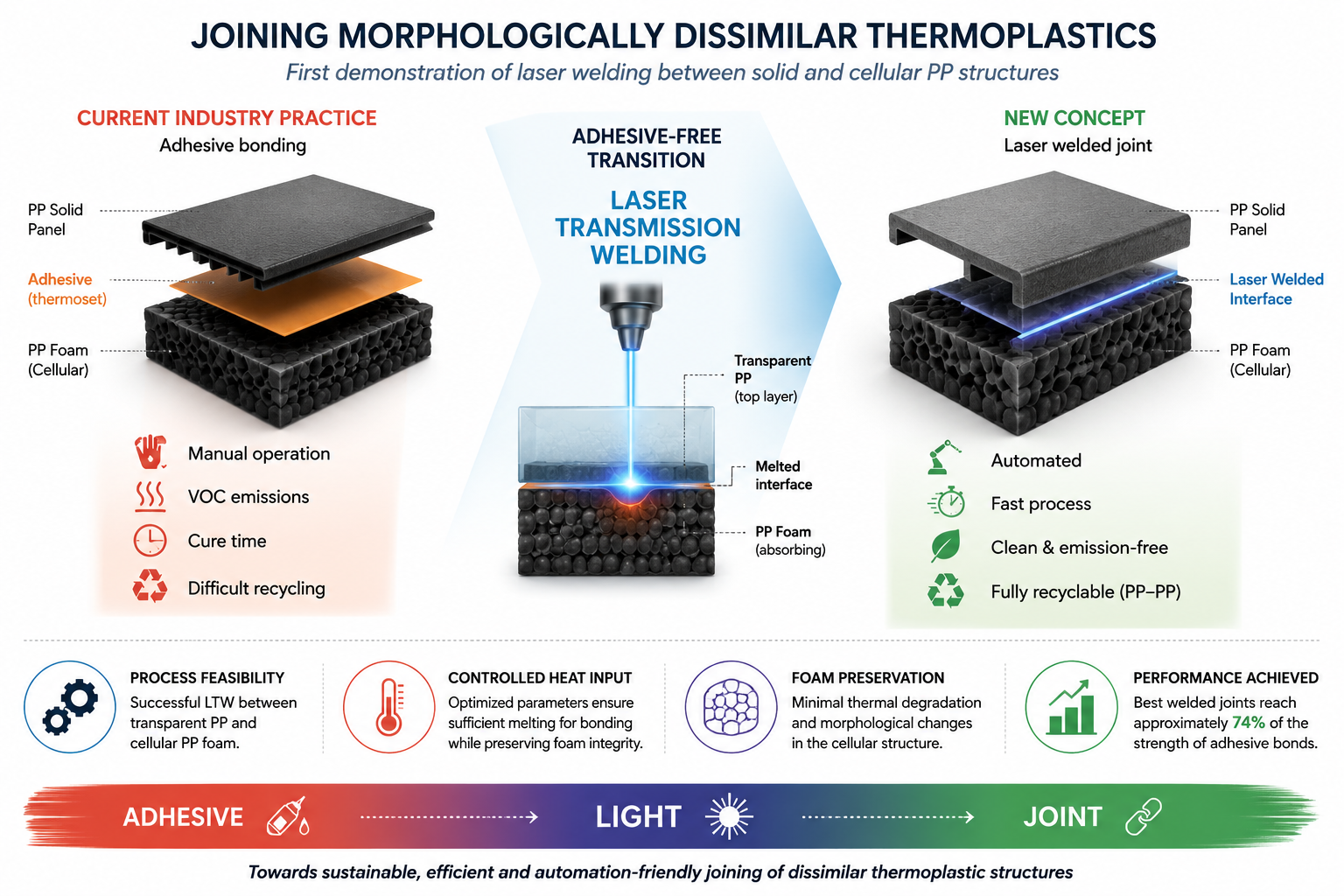
This work explores a disruptive solution for joining morphologically dissimilar thermoplastic structures (MDTS). The industry uses thermoset adhesives to bond these materials. This approach presents some intrinsic drawbacks (e.g., low automation, lengthy, with low flexibility, prone to human error, may require heat to cure, releases harmful residues/fumes, and may preclude recyclability). This work investigates the potential of an adhesive-free concept based on laser transmission welding for joining morphologically dissimilar thermoplastic structures composed of non-cellular and cellular thermoplastics by controlling the heat input to the foamed thermoplastic and the heat transfer to the non-cellular counterpart. The joint quality was evaluated by performing lap shear testing and scanning electron microscopy to assess joint morphology, and then comparing the results with those of the adhesive-bonded version. Considering the exploratory nature of this work, promising results were achieved, with the best welded joints reaching approximately 74% of the strength of the traditional adhesive solution, establishing a basis for future research to optimize the process.
- Open Access
- Communication
Laser Welding of Morphologically Dissimilar Thermoplastic Structures
Author Information
Received: 28 Feb 2026 | Revised: 11 May 2026 | Accepted: 18 May 2026 | Published: 09 Jun 2026
Abstract
Graphical Abstract
Keywords
laser welding | thermoplastics | dissimilar structures | joining techniques
References
- 1.
Worldwide Production of Passenger Cars | Statista. Available online: https://www.statista.com/statistics/268739/production-of-passenger-cars-worldwide/ (accessed on 29 February 2024).
- 2.
Sukanto, H.; Raharjo, W.W.; Ariawan, D.; et al. Epoxy Resins Thermosetting for Mechanical Engineering. Open Eng. 2021, 11, 797–814. https://doi.org/10.1515/ENG-2021-0078.
- 3.
Bayarsaikhan, E.; Lim, J.H.; Shin, S.H.; et al. Effects of Postcuring Temperature on the Mechanical Properties and Biocompatibility of Three-Dimensional Printed Dental Resin Material. Polymers 2021, 13, 1180. https://doi.org/10.3390/POLYM13081180.
- 4.
Haque, M.S.; Moeed, K.; Zaka, M.Z. Laser Welding of Thermoplastics—A Review. Mater. Today Proc. 2022, 64, 1479–1485. https://doi.org/10.1016/J.MATPR.2022.04.900.
- 5.
Gonçalves, L.F.F.F.; Duarte, F.M.; Martins, C.I.; et al. Laser Welding of Thermoplastics: An Overview on Lasers, Materials, Processes and Quality. Infrared Phys. Technol. 2021, 119, 103931. https://doi.org/10.1016/J.INFRARED.2021.103931.
- 6.
Wu, J.; Lu, S.; Wang, H.J.; et al. A Review on Laser Transmission Welding of Thermoplastics. Int. J. Adv. Manuf. Technol. 2021, 116, 2093–2109. https://doi.org/10.1007/S00170-021-07519-Z.
- 7.
Fernandes, F.A.O.; Pereira, A.B.; Guimarães, B.; et al. Laser Welding of Transmitting High-Performance Engineering Thermoplastics. Polymers 2020, 12, 402. https://doi.org/10.3390/POLYM12020402.
- 8.
Pereira, A.B.; Fernandes, F.A.O.; de Morais, A.B.; et al. Mechanical Strength of Thermoplastic Polyamide Welded by Nd:YAG Laser. Polymers 2019, 11, 1381. https://doi.org/10.3390/POLYM11091381.
- 9.
Acherjee, B. Laser Transmission Welding of Polymers—A Review on Process Fundamentals, Material Attributes, Weldability, and Welding Techniques. J. Manuf. Process. 2020, 60, 227–246. https://doi.org/10.1016/J.JMAPRO.2020.10.017.
- 10.
Wippo, V.; Rettschlag, K.; Surjoseputro, W.; et al. Laser Transmission Welding of Semi-Interpenetrating Polymer Networks-Composites. J. Laser Appl. 2017, 29, 022407. https://doi.org/10.2351/1.4983244.
- 11.
Kagan, V.; Bray, R.G. Advantages and Limitations of Laser Welding Technology for Semi-Crystalline Reinforced Plastics. In Proceedings of the Laser Materials Processing Conference and Laser Microfabrication Conference, Jacksonville, FL, USA, 15–18 October 2001; pp. 1218–1227. https://doi.org/10.2351/1.5059784.
- 12.
Kagan, V.; Bray, R.; Chambers, A. Forward to Better Understanding of Optical Characterization and Development of Colored Polyamides for the Infra-Red/Laser Welding: Part I—Efficiency of Polyamides for Infra-Red Welding. J. Reinf. Plast. Compos. 2003, 22, 533–547. https://doi.org/10.1106/073168403023283.
- 13.
Acherjee, B.; Kuar, A.S.; Mitra, S.; et al. Application of Grey-Based Taguchi Method for Simultaneous Optimization of Multiple Quality Characteristics in Laser Transmission Welding Process of Thermoplastics. Int. J. Adv. Manuf. Technol. 2011, 56, 995–1006. https://doi.org/10.1007/S00170-011-3224-7.
- 14.
Kagan, V.A.; Bray, R.G.; Kuhn, W.P. Laser Transmission Welding of Semi-Crystalline Thermoplastics—Part I: Optical Characterization of Nylon Based Plastics. J. Reinf. Plast. Compos. 2002, 21, 1101–1122. https://doi.org/10.1177/073168402128987699.
- 15.
Bonten, C.; Tüchert, C. Welding of Plastics—Introduction into Heating by Radiation. J. Reinf. Plast. Compos. 2002, 21, 699–709. https://doi.org/10.1177/073168402128988436.
- 16.
Bachmann, F.G.; Russek, U.A. Laser Welding of Polymers Using High-Power Diode Lasers. Photon Process. Microelectron. Photonics 2002, 4637, 505–518. https://doi.org/10.1117/12.470660.
- 17.
Geiger, M.; Frick, T.; Schmidt, M. Optical Properties of Plastics and Their Role for the Modelling of the Laser Transmission Welding Process. Prod. Eng. 2009, 3, 49–55. https://doi.org/10.1007/S11740-008-0141-1.
- 18.
Amanat, N.; James, N.L.; McKenzie, D.R. Welding Methods for Joining Thermoplastic Polymers for the Hermetic Enclosure of Medical Devices. Med. Eng. Phys. 2010, 32, 690–699. https://doi.org/10.1016/J.MEDENGPHY.2010.04.011.
- 19.
Chen, Z.; Wu, Z.; Lu, S.; et al. A New Laser Welding Method of Two Transparent Plastic Parts Based on Reflector Assisted Method. J. Mater. Res. Technol. 2023, 24, 5309–5320. https://doi.org/10.1016/J.JMRT.2023.04.108.
- 20.
Ofoegbu, S.U.; Rosa, P.J.A.; Fernandes, F.A.O.; et al. Laser Marking on Polyoxymethylene (POM) Polymer Substrate for a Lean Manufacturing Application. Int. J. Adv. Manuf. Technol. 2025, 136, 3863–3882. https://doi.org/10.1007/s00170-024-13178-7.
- 21.
Hopmann, C.; Kreimeier, S. Thermal Joining of Foamed Thermoplastic Injection-Moulded Parts Using Laser Radiation. Weld. World 2017, 61, 1237–1245. https://doi.org/10.1007/S40194-017-0499-9.


This work is licensed under a Creative Commons Attribution 4.0 International License.

 Suite 4002 Level 4, 447 Collins Street, Melbourne, Victoria 3000, Australia
 General Inquiries: info@sciltp.com