
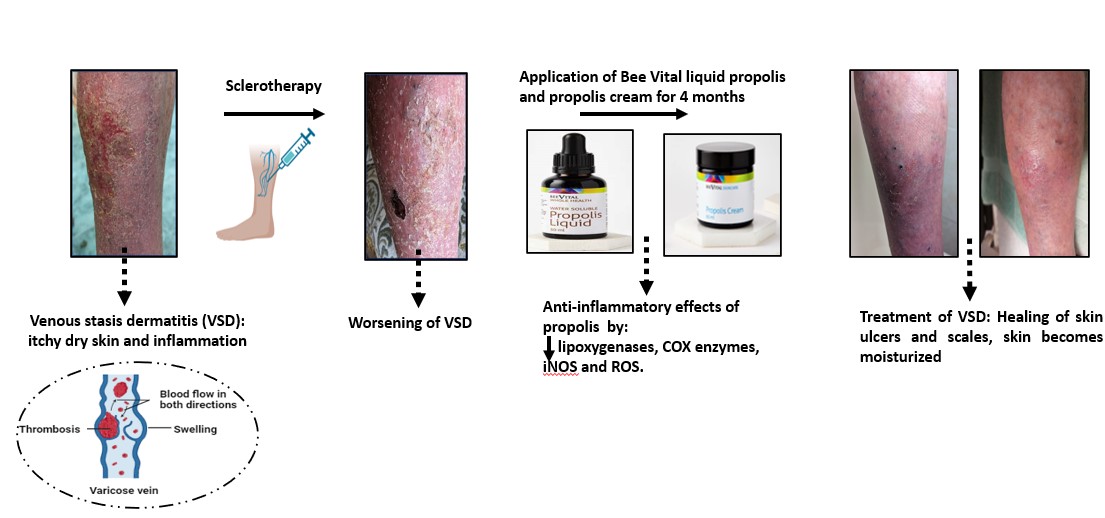
Venous stasis dermatitis (VSD) or varicose eczema is a chronic inflammatory skin condition caused by chronic venous insufficiency in the lower extremities due to retrograde venous blood flow and hypertension. The current report describes the outcome experience by 78-year-old subject who achieved complete recovery after suffering from VSD for more than 19 years. The subject was on 4-months oral administration of propolis tincture and topical application of propolis cream developed by Nature’s Laboratory Ltd. company, Whitby, UK under the brand BeeVital®. Propolis is a resinous material collected by bees from various plant exudates to shield their colony health and integrity. Propolis possesses anti-inflammatory, and wound healing properties which contributed to its therapeutic outcomes.
- Open Access
- Case Report
Propolis Tincture and Propolis Cream as Therapeutic Agents for Venous Stasis Dermatitis
- Bhagyashree Kamble 1,*,
- Ghaida Mustafa 2,
- Shankar Katekhaye 1,
- Samra Ihsan 3,
- Felix Zulhendri 4,
- James Fearnley 1,
- Anant Paradkar 2
Author Information
Received: 14 Oct 2025 | Revised: 21 Dec 2025 | Accepted: 24 Dec 2025 | Published: 25 Dec 2025
Abstract
Graphical Abstract
Keywords
venous stasis dermatitis | varicose veins | propolis | BeeVital® Propolis
References
- 1.
Yosipovitch, G.; Nedorost, S.T.; Silverberg, J.I.; et al. Stasis dermatitis: An overview of its clinical presentation, pathogenesis, and management. Am. J. Clin. Dermatol. 2023, 24, 275–286.
- 2.
Wagh, V.D. Propolis: A wonder bees product and its pharmacological potentials. Adv. Pharmacol. Pharm. Sci. 2013, 2013, 308249.
- 3.
Pahlavani, N.; Malekahmadi, M.; Firouzi, S.; et al. Molecular and cellular mechanisms of the effects of Propolis in inflammation, oxidative stress and glycemic control in chronic diseases. Nutr. Metab. 2020, 17, 65.
- 4.
Zullkiflee, N.; Taha, H.; Usman, A. Propolis: Its role and efficacy in human health and diseases. Molecules 2022, 27, 6120.
- 5.
da Rosa, C.; Bueno, I.L.; Quaresma, A.C.M.; et al. Healing potential of propolis in skin wounds evidenced by clinical studies. Pharmaceuticals 2022, 15, 1143.
- 6.
Sundaresan, S.; Migden, M.R.; Silapunt, S. Stasis dermatitis: Pathophysiology, evaluation, and management. Am. J. Clin. Dermatol. 2017, 18, 383–390.
- 7.
Rabe, E.; Breu, F.; Flessenkämper, I.; et al. Sclerotherapy in the treatment of varicose veins: S2k guideline of the Deutsche Gesellschaft für Phlebologie (DGP) in cooperation with the following societies: DDG, DGA, DGG, BVP. Der Hautarzt 2020, 72, 23.
- 8.
Katekhaye, S.; Kamble, B.; Mustafa, G.; et al. Chemical Analysis of Polyphenolic Content and Antioxidant Screening of 17 African Propolis Samples Using RP-HPLC and Spectroscopy. Future Integr. Med. 2025, 4, 77–87.
- 9.
Touzani, S.; Imtara, H.; Katekhaye, S.; et al. Determination of phenolic compounds in various propolis samples collected from an African and an Asian region and their impact on antioxidant and antibacterial activities. Molecules 2021, 26, 4589.
- 10.
Guzmán-Gutiérrez, S.L.; Nieto-Camacho, A.; Castillo-Arellano, J.I.; et al. Mexican propolis: A source of antioxidants and anti-inflammatory compounds, and isolation of a novel chalcone and ε-caprolactone derivative. Molecules 2018, 23, 334.
- 11.
Naito, Y.; Yasumuro, M.; Kondou, K.; et al. Antiinflammatory effect of topically applied propolis extract in carrageenan-induced rat hind paw edema. Phytother. Res. 2007, 21, 452–456.
- 12.
Gábor, M. Models of acute inflammation in the ear. In Inflammation Protocols; Humana Press: Totowa, NJ, USA, 2003; pp. 129–137.
- 13.
Saito, S.; Trovato, M.J.; You, R.; et al. Role of matrix metalloproteinases 1, 2, and 9 and tissue inhibitor of matrix metalloproteinase-1 in chronic venous insufficiency. J. Vasc. Surg. 2001, 34, 930–938.
- 14.
Shukla, S.K.; Sharma, A.K.; Gupta, V.; et al. Pharmacological control of inflammation in wound healing. J. Tissue Viability 2019, 28, 218–222.
- 15.
Valenzuela-Barra, G.; Castro, C.; Figueroa, C.; et al. Anti-inflammatory activity and phenolic profile of propolis from two locations in Región Metropolitana de Santiago, Chile. J. Ethnopharmacol. 2015, 168, 37–44.
- 16.
Cho, M.S.; Park, W.S.; Jung, W.-K.; et al. Caffeic acid phenethyl ester promotes anti-inflammatory effects by inhibiting MAPK and NF-κB signaling in activated HMC-1 human mast cells. Pharm. Biol. 2014, 52, 926–932.
- 17.
Wang, K.; Ping, S.; Huang, S.; et al. Molecular mechanisms underlying the in vitro anti-inflammatory effects of a flavonoid-rich ethanol extract from Chinese propolis (poplar type). Evid.-Based Complement. Altern. Med. 2013, 2013, 127672.

This work is licensed under a Creative Commons Attribution 4.0 International License.

 Suite 4002 Level 4, 447 Collins Street, Melbourne, Victoria 3000, Australia
 General Inquiries: info@sciltp.com