
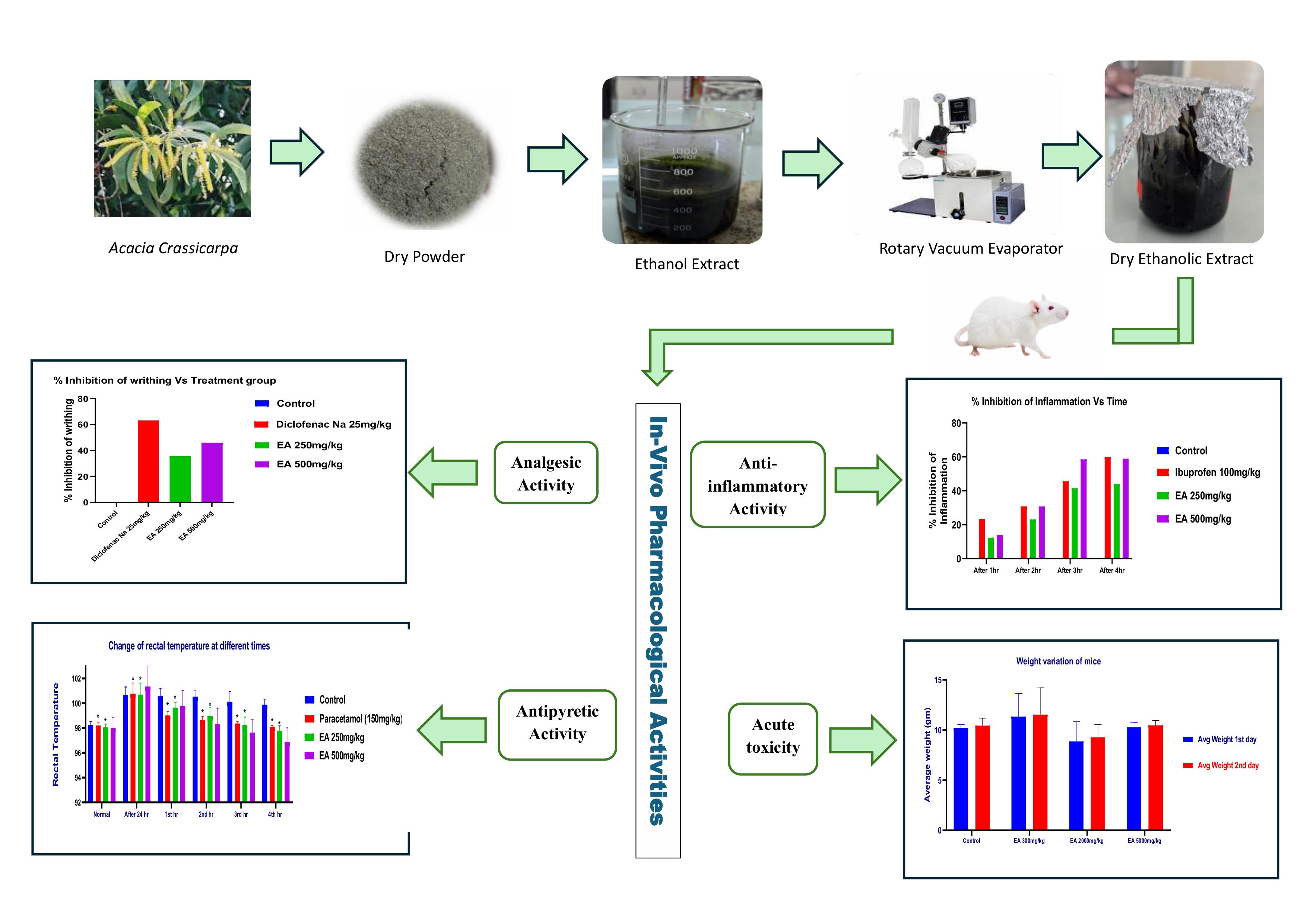
Objective: This study explores the biological properties of Acacia crassicarpa A. Cunn. ex Benth, a member of the Fabaceae family. Known for its antimicrobial, anti-inflammatory, and antidiarrheal effects, this plant may be beneficial in treating skin infections, diarrhea, wounds, and ulcers. In this study, fractions of ethanolic leaf extracts were analyzed for their analgesic, anti-inflammatory, antipyretic, and acute toxicity effects. Methods: Analgesic, anti-inflammatory, antipyretic, and acute toxicity evaluations were conducted in vivo. The analgesic activity was assessed using the acetic acid-induced writhing method, while the anti-inflammatory effect was measured through the formaldehyde-induced paw edema method. Antipyretic activity was determined by monitoring changes in rectal temperature in mice. Acute oral toxicity was evaluated following the OECD (Organization for Economic Co-operation and Development) guidelines-423 (Fixed Dose Procedure). Results: In the analgesic test, the ethyl acetate fraction exhibited inhibition rates of 35.63% and 45.97% at doses of 250 mg/kg and 500 mg/kg, respectively. In the anti-inflammatory test, inhibition rates were recorded at 43.83% for 250 mg/kg and 58.9% for 500 mg/kg, with the higher dose showing a more significant anti-inflammatory effect. The antipyretic test confirmed that both 250 mg/kg and 500 mg/kg doses demonstrated antipyretic properties. Acute toxicity assessments revealed no toxic effects at doses up to 5000 mg/kg. Conclusion: The Acacia crassicarpa leaf extract demonstrated analgesic, anti-inflammatory, and antipyretic effects.
- Open Access
- Article
Pharmacological Investigation of the Active Fractions of Acacia crassicarpa Leaf Extract
- As-Sazzad Mahmud *,
- Ariful Islam,
- Israt Jahan Meem,
- Md. Rabbi Hasan,
- Md. Mohiuddin Maruf,
- Tanvir Ahmed Anik,
- Mirja Mohammad Niaz Morshed
Author Information
Received: 15 Jan 2026 | Revised: 05 May 2026 | Accepted: 12 May 2026 | Published: 22 May 2026
Abstract
Graphical Abstract
Keywords
Acacia crassicarpa | analgesic | anti-inflammatory | antipyretic | acute toxicity
References
- 1.
Atanasov, A.G.; Zotchev, S.B.; Dirsch, V.M.; et al. Natural products in drug discovery: Advances and opportunities. Nat. Rev. Drug Discov. 2021, 20, 200–216.
- 2.
Truter, I. African traditional healers: Cultural and religious beliefs intertwined in a holistic way. S. Afr. Pharm. J. 2007, 74, 56–60.
- 3.
Gurib-Fakim, A. Medicinal plants: Traditions of yesterday and drugs of tomorrow. Mol. Asp. Med. 2006, 27, 1–93.
- 4.
Garcia-Alvarez, A.; Egan, B.; De Klein, S.; et al. Usage of plant food supplements across six European countries: Findings from the PlantLIBRA consumer survey. PLoS ONE 2014, 9, e92265.
- 5.
Ekor, M. The growing use of herbal medicines: Issues relating to adverse reactions and challenges in monitoring safety. Front. Pharmacol. 2014, 4, 177.
- 6.
Kumar, A.; P, N.; Kumar, M.; et al. Major phytochemicals: Recent advances in health benefits and extraction method. Molecules 2023, 28, 887.
- 7.
Ghlichloo, I.; Gerriets, V. Nonsteroidal anti-inflammatory drugs (NSAIDs); StatPearls Publishing: Treasure Island, FL, USA, 2019.
- 8.
Timbadiya, M.J.; Nishteswar, K.; Acharya, R.; et al. Experimental evaluation of antipyretic and analgesic activities of Amalakyadi Gana: An Ayurvedic formulation. AYU 2015, 36, 220–224.
- 9.
Vane, J.R. Inhibition of prostaglandin synthesis as a mechanism of action for aspirin-like drugs. Nat. New Biol. 1971, 231, 232–235.
- 10.
Wingfield, M.J.; Roux, J.; Wingfield, B.D. Insect pests and pathogens of Australian acacias grown as non‐natives–an experiment in biogeography with far‐reaching consequences. Divers. Distrib. 2011, 17, 968–977.
- 11.
Batiha, G.E.-S.; Akhtar, N.; Alsayegh, A.A.; et al. Bioactive compounds, pharmacological actions, and pharmacokinetics of genus Acacia. Molecules 2022, 27, 7340.
- 12.
Prayogo, Y.H.; Syafii, W.; Sari, R.K.; et al. Pharmacological activity and phytochemical profile of acacia heartwood extracts. Sci. Pharm. 2021, 89, 37.
- 13.
Prayogo, Y.H.; Batubara, I.; Wahyudi, S.T.; et al. Metabolite profile, antiproliferative, and antioxidant activity of Acacia auriculiformis and Acacia crassicarpa extracts. J. Saudi Chem. Soc. 2023, 27, 101742.
- 14.
Ali, M.A.; Lou, Y.; Hafeez, R.; et al. Functional analysis and genome mining reveal high potential of biocontrol and plant growth promotion in nodule-inhabiting bacteria within Paenibacillus polymyxa complex. Front. Microbiol. 2021, 11, 618601.
- 15.
Atiya, A.; Majrashi, T.; Akhtar, S.; et al. The value of Genus Acacia in arid and semi-arid environments for the treatment of chronic inflammatory diseases. Phytomed. Plus 2022, 2, 100315.
- 16.
Doan, T.Q.; Dinh, T.T.; Matsumoto, T.K.; et al. Chemical composition of essential oil of Acacia crassicarpa Benth. (Fabaceae) from Vietnam. Bull. Chem. Soc. Ethiop. 2025, 39, 1653–1660.
- 17.
Debnath, S.L.; Kundu, P.; Golder, M.; et al. Phytochemical Characterization and Evaluation of Pharmacological Activities of Leaves of a Mangrove Plant Species-Aegiceras corniculatum (L.): Doi. org/10.26538/tjnpr/v4i9. 4. Trop. J. Nat. Prod. Res. 2020, 4, 516–522.
- 18.
Subedi, N.K.; Rahman, S.A.; Akbar, M.A. Analgesic and antipyretic activities of methanol extract and its fraction from the root of Schoenoplectus grossus. Evid. ‐Based Complement. Altern. Med. 2016, 2016, 3820704.
- 19.
Malik, M.K.; Bhatt, P.; Singh, J.; et al. Preclinical safety assessment of chemically cross-linked modified mandua starch: Acute and sub-acute oral toxicity studies in Swiss albino mice. ACS Omega 2022, 7, 35506–35514.
- 20.
Jame, R.J.S. Phytochemical and pharmacological uses of Acacia nilotica—A review. Seeds 2018, 1, 15–21.
- 21.
Chaudhary, P.; Sharma, R.; Rawat, S.; et al. Antipyretic medicinal plants, phytocompounds, and green nanoparticles: An updated review. Curr. Pharm. Biotechnol. 2023, 24, 23–49.
- 22.
World Health Organization. WHO Expert Committee on Biological Standardization: Seventy-Eighth Report; World Health Organization: Geneva, Switzerland, 2024.
- 23.
Abdulkhaleq, L.; Assi, M.; Abdullah, R.; et al. The crucial roles of inflammatory mediators in inflammation: A review. Vet. World 2018, 11, 627.
- 24.
Vane, J.; Botting, R.M. Mechanism of action of anti-inflammatory drugs. Scand. J. Rheumatol. 1996, 25, 9–21.
- 25.
Liu, T.; Zhang, L.; Joo, D.; et al. NF-κB signaling in inflammation. Signal Transduct. Target. Ther. 2017, 2, 1–9.
- 26.
Flower, R.; Vane, J. Inhibition of prostaglandin synthetase in brain explains the anti-pyretic activity of paracetamol (4-acetamidophenol). Nature 1972, 240, 410–411.
- 27.
Gemeda, H.B.; Debella, A.; Endale, M.; et al. Acute and sub-acute toxicity of ethanol extracts of Hagenia abyssinica and Rumex abyssinicus flowers in Swiss albino mice. PLoS ONE 2025, 20, e0319464.

This work is licensed under a Creative Commons Attribution 4.0 International License.

 Suite 4002 Level 4, 447 Collins Street, Melbourne, Victoria 3000, Australia
 General Inquiries: info@sciltp.com