
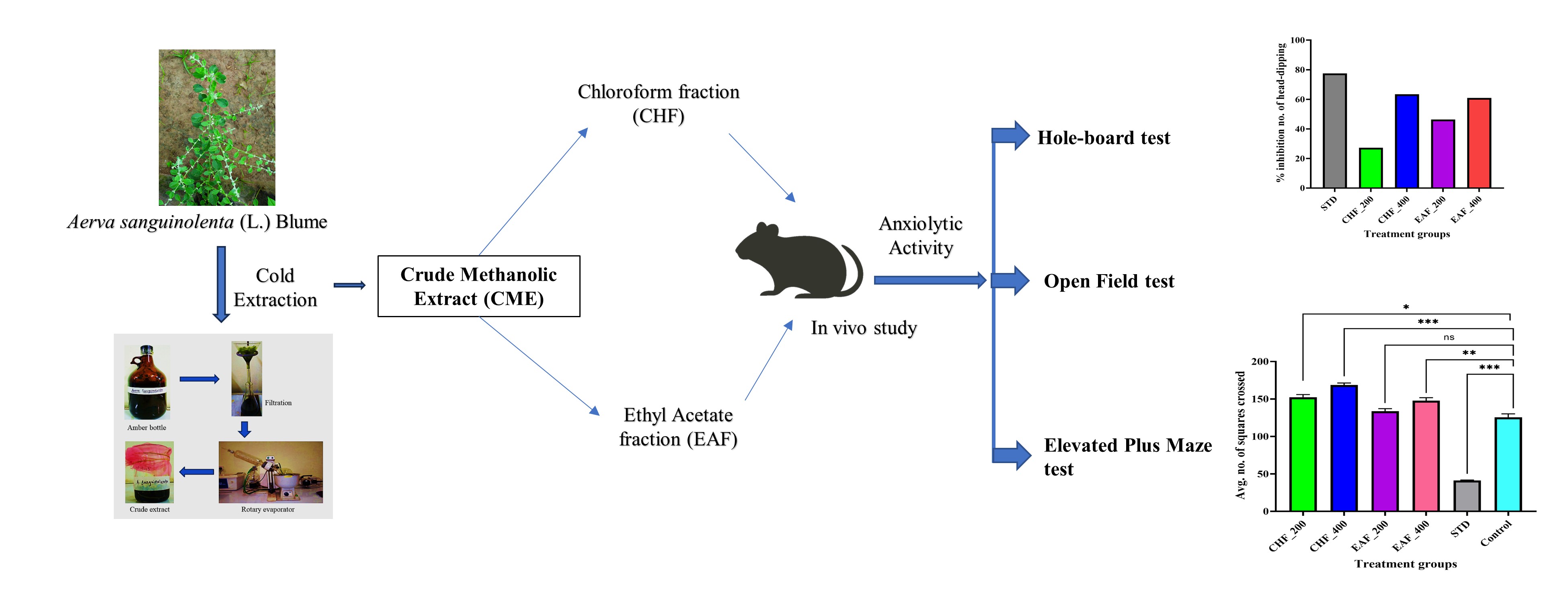
Anxiety disorders are among the most prevalent neuropsychiatric conditions, and current pharmacotherapies are often limited by adverse effects. The present study evaluated the anxiolytic-like activity of the chloroform (CHF) and ethyl acetate (EAF) fractions of Aerva sanguinolenta in Swiss albino mice. Acute oral toxicity studies demonstrated that both fractions were safe up to 4000 mg/kg. Anxiolytic activity was assessed using the hole-board test, open field test, and elevated plus maze test, with diazepam as the standard drug. Both CHF and EAF produced significant, dose-dependent anxiolytic-like effects across behavioral models, although their efficacy was lower than diazepam. These findings provide the first experimental evidence supporting the anxiolytic potential of A. sanguinolenta and justify further mechanistic investigations to identify the active constituents involved.
- Open Access
- Article
Behavioral Evidence of Anxiolytic Activity of Chloroform and Ethyl Acetate Fractions of Aerva sanguinolenta (L.) Blume
Author Information
Received: 31 Jan 2026 | Revised: 08 May 2026 | Accepted: 14 May 2026 | Published: 07 Jul 2026
Abstract
Graphical Abstract
Keywords
Aerva sanguinolenta | anxiety | hole-board test | elevated plus maze | medicinal plants | anxiolytic activity
References
- 1.
Stevens, J.C.; Pollack, M.H. Benzodiazepines in clinical practice: Consideration of their long-term use and alternative agents. J. Clin. Psychiatry 2005, 66, 21–27.
- 2.
Sanabria, E.; Cuenca, R.E.; Esteso, M.Á.; et al. Benzodiazepines: Their use either as essential medicines or as toxic substances. Toxics 2021, 9, 25. https://doi.org/10.3390/toxics9020025.
- 3.
Chaachouay, N.; Zidane, L. Plant-derived natural products: A source for drug discovery and development. Drugs Drug Candidates 2024, 3, 184–207. https://doi.org/10.3390/ddc3010011.
- 4.
Ratheesh, G.; Tian, L.; Venugopal, J.R.; et al. Role of medicinal plants in neurodegenerative diseases. Biomanufacturing Rev. 2017, 2, 2. https://doi.org/10.1007/s40898-017-0004-7.
- 5.
Singla, R.; Kamboj, S.; Duvey, B.K.; et al. Flavonoids and anxiety: Decoding their role in brain function and pathophysiology. Med. Drug Discov. 2025, 27, 100214. https://doi.org/10.1016/j.medidd.2025.100214.
- 6.
Fedotova, J.; Kubatka, P.; Büsselberg, D.; et al. Therapeutical strategies for anxiety and anxiety-like disorders using plant-derived natural compounds and plant extracts. Biomed. Pharmacother. 2017, 95, 437–446. https://doi.org/10.1016/j.biopha.2017.08.107.
- 7.
García Ríos, R.; Mora-Perez, A.; Ramos-Molina, A.; et al. Neuropharmacology of secondary metabolites from plants with anxiolytic and antidepressant properties. In Behavioral Pharmacology—From Basic to Clinical Research; IntechOpen: Rijeka, Croatia, 2020; ISBN 978-1-78985-679-8.
- 8.
Alramadhan, E.; Hanna, M.S.; Goldstein, T.A.; et al. Dietary and botanical anxiolytics. Med. Sci. Monit. 2012, 18, RA40–RA48. https://doi.org/10.12659/MSM.882608.
- 9.
Fedoce, A.G.; Ferreira, F.; Bota, R.G.; et al. The role of oxidative stress in anxiety disorder: Cause or consequence? Free Radic. Res. 2018, 52, 737–750. https://doi.org/10.1080/10715762.2018.1475733.
- 10.
Trofin, D.-M.; Sardaru, D.-P.; Trofin, D.; et al. Oxidative stress in brain function. Antioxidants 2025, 14, 297. https://doi.org/10.3390/antiox14030297.
- 11.
Tkaczenko, H.; Buyun, L.; Kołodziejska, R.; et al. Neuroactive phytochemicals as multi-target modulators of mental health and cognitive function: An integrative review. Int. J. Mol. Sci. 2025, 26, 8907. https://doi.org/10.3390/ijms26188907.
- 12.
Sarker, J.; Ali, M.R.; Khan, M.A.; et al. The plant Aerva sanguinolenta: A review on traditional uses, phytoconstituents and pharmacological activities. Pharmacogn. Rev. 2019, 13, 89–92. https://doi.org/10.5530/phrev.2019.2.9.
- 13.
Maqbool, M.; Muhammad, A.; Muhammad, I.; et al. Investigation of antimicrobial and antioxidant activity of Aerva sanguinolenta (L.) Blume from district Bhimber (AJK), Pakistan. Biosci. Res. 2021, 18, 640–652.
- 14.
Sarker, J.; Reza, A.S.M.A.; Ashraful, A.B.M.; et al. In vitro antioxidant and p53-targeted anticancer activity of Aerva sanguinolenta (L.) Blume across different human cancer cell lines and Ehrlich ascites carcinoma model. J. Chem. Health Risks 2026, 16, 1292–1316.
- 15.
Sarker, J.; Nawaz, S.M.B.; Yeasmin, M.N.; et al. Phytochemical profile, acute toxicity, and antinociceptive potential of methanolic extract of Aerva sanguinolenta (L.) Blume in Swiss albino mice. J. Chem. Health Risks 2026, 16, 3431–3442.
- 16.
Sarker, J.; Ashraful, A.B.M.; Hossain, M.S.; et al. Identification and in silico evaluation of polyphenolic compounds from Aerva sanguinolenta (L.) Blume for anticancer potential. Nat. Prod. Res. 2025, 1–5. https://doi.org/10.1080/14786419.2025.2598825.
- 17.
Vogel, H.G.; Vogel, W.H.; Schölkens, B.A.; et al. (Eds.) Drug Discovery and Evaluation; Springer: Berlin/Heidelberg, Germany, 2002.
- 18.
Islam, A.; Hussain, M.S.; Sen, N.; et al. Investigation of in vitro thrombolytic and anti-helminthic activity and in vivo anxiolytic and antidepressant potentiality with phytochemical nature of methanolic extract of Leucas lavandulifolia. Sustain. Chem. Pharm. 2017, 6, 61–66. https://doi.org/10.1016/j.scp.2017.09.001.
- 19.
Walsh, R.N.; Cummins, R.A. The open-field test: A critical review. Psychol. Bull. 1976, 83, 482–504.
- 20.
Pellow, S.; File, S.E. Anxiolytic and anxiogenic drug effects on exploratory activity in an elevated plus-maze: a novel test of anxiety in the rat. Pharmacol. Biochem. Behav. 1986, 24, 525–529. https://doi.org/10.1016/0091-3057(86)90552-6.
- 21.
Kenwood, M.M.; Kalin, N.H.; Barbas, H. The prefrontal cortex, pathological anxiety, and anxiety disorders. Neuropsychopharmacology 2022, 47, 260–275. https://doi.org/10.1038/s41386-021-01109-z.
- 22.
d’Isa, R.; Comi, G.; Leocani, L. The 4-hole-board test for assessment of long-term spatial memory in mice. Curr. Protoc. 2021, 1, e228. https://doi.org/10.1002/cpz1.228.
- 23.
Dhawan, K.; Kumar, S.; Sharma, A. Anxiolytic activity of aerial and underground parts of Passiflora incarnata. Fitoterapia 2001, 72, 922–926. https://doi.org/10.1016/s0367-326x(01)00322-7.
- 24.
Hattesohl, M.; Feistel, B.; Sievers, H.; et al. Extracts of Valeriana officinalis L. s.l. show anxiolytic and antidepressant effects but neither sedative nor myorelaxant properties. Phytomedicine 2008, 15, 2–15. https://doi.org/10.1016/j.phymed.2007.11.027.
- 25.
Bhattacharya, S.K.; Ghosal, S. Anxiolytic activity of a standardized extract of Bacopa monniera: An experimental study. Phytomedicine 1998, 5, 77–82. https://doi.org/10.1016/S0944-7113(98)80001-9.
- 26.
Walf, A.A.; Frye, C.A. The use of the elevated plus maze as an assay of anxiety-related behavior in rodents. Nat. Protoc. 2007, 2, 322–328. https://doi.org/10.1038/nprot.2007.44.
- 27.
Amsterdam, J.D.; Li, Y.; Soeller, I.; et al. A randomized, double-blind, placebo-controlled trial of oral Matricaria recutita (chamomile) extract therapy for generalized anxiety disorder. J. Clin. Psychopharmacol. 2009, 29, 378–382. https://doi.org/10.1097/JCP.0b013e3181ac935c.
- 28.
Rex, A.; Morgenstern, E.; Fink, H. Anxiolytic-like effects of kava-kava in the elevated plus maze test—A comparison with diazepam. Prog. Neuropsychopharmacol. Biol. Psychiatry 2002, 26, 855–860. https://doi.org/10.1016/S0278-5846(01)00330-X.
- 29.
Woelk, H.; Arnoldt, K.H.; Kieser, M.; et al. Ginkgo biloba special extract EGb 761 in generalized anxiety disorder and adjustment disorder with anxious mood: A randomized, double-blind, placebo-controlled trial. J. Psychiatr. Res. 2007, 41, 472–480. https://doi.org/10.1016/j.jpsychires.2006.05.004.
- 30.
Kraeuter, A.-K.; Guest, P.C.; Sarnyai, Z. The open field test for measuring locomotor activity and anxiety-like behavior. Methods Mol. Biol. 2019, 1916, 99–103. https://doi.org/10.1007/978-1-4939-8994-2_9.
- 31.
Wijeweera, P.; Arnason, J.T.; Koszycki, D.; et al. Evaluation of anxiolytic properties of gotukola—(Centella asiatica) extracts and asiaticoside in rat behavioral models. Phytomedicine 2006, 13, 668–676. https://doi.org/10.1016/j.phymed.2006.01.011.
- 32.
Bhattacharya, S.K.; Satyan, K.S.; Shibnath Ghosal, S. Antioxidant activity of glycowithanolides from Withania somnifera. Indian J. Exp. Biol. 1997, 35, 236–239.
- 33.
Taiwo, A.E.; Leite, F.B.; Lucena, G.M.; et al. Anxiolytic and antidepressant-like effects of Melissa officinalis (lemon balm) extract in rats: Influence of administration and gender. Indian J. Pharmacol. 2012, 44, 189–192. https://doi.org/10.4103/0253-7613.93846.

This work is licensed under a Creative Commons Attribution 4.0 International License.

 Suite 4002 Level 4, 447 Collins Street, Melbourne, Victoria 3000, Australia
 General Inquiries: info@sciltp.com