
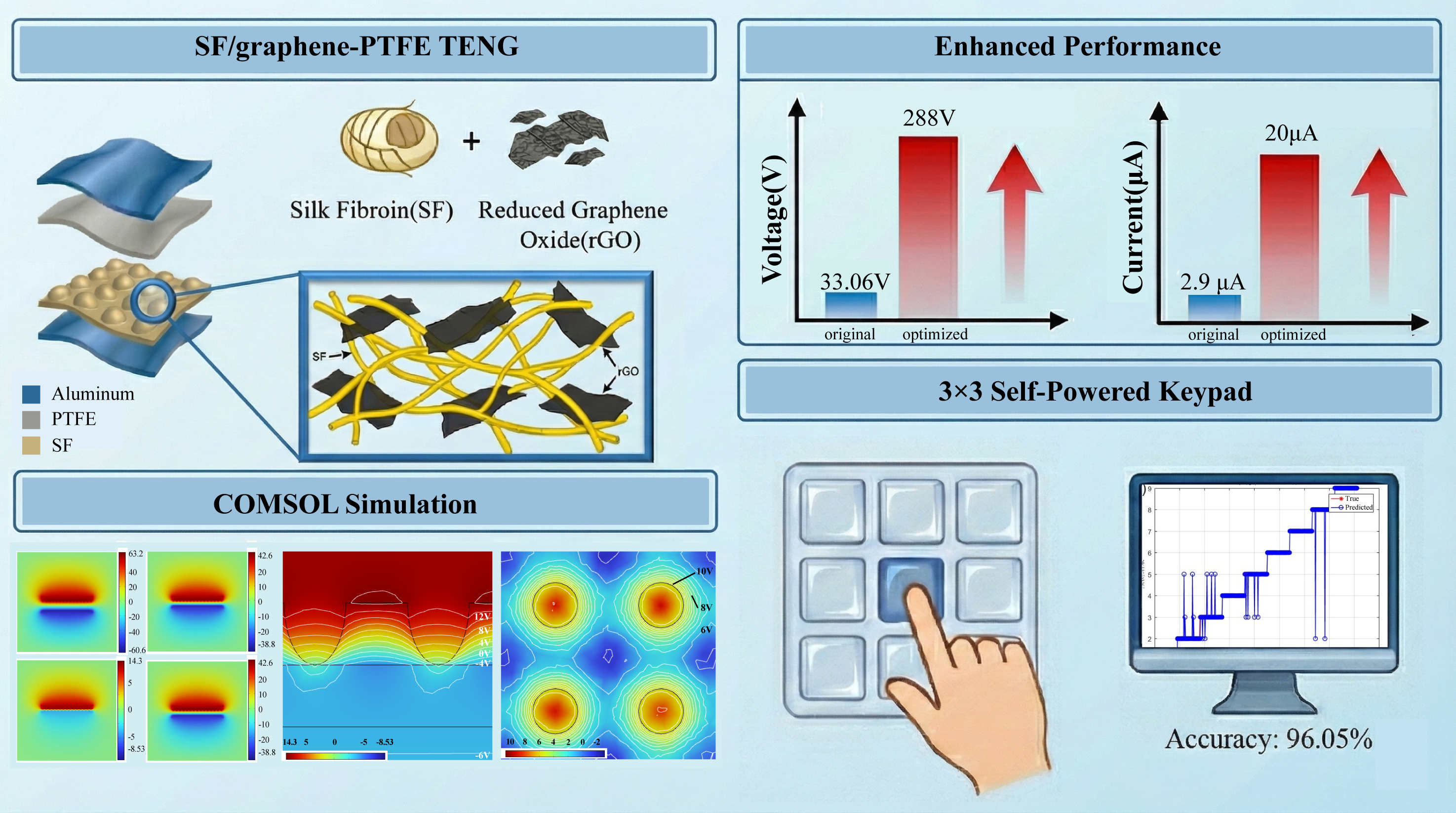
The pursuit of sustainable and high-performance energy harvesters has driven growing interest in triboelectric nanogenerators (TENGs), yet challenges remain in balancing output enhancement, material biocompatibility, and fabrication simplicity. Herein, we report a high-efficiency silk fibroin–PTFE TENG engineered through finite-element simulations, structure optimization and graphene-assisted conductivity modulation. Biocompatible silk fibroin films were microstructured with well-defined pyramid and arch arrays in different microstructure densities, significantly increasing surface charge density and contact area. The optimized TENG with micro-arch silk fibroin achieved a peak-to-peak open-circuit voltage of 224 V and a short-circuit current of 12.74 μA, corresponding to over sixfold and threefold improvements, respectively, over TENGs without microstructure. Moreover, reduced graphene oxide (rGO) incorporation further enhanced the output performance of the TENG, with the peak-to-peak open-circuit voltage and short-circuit current reaching 288 V and 20 μA, respectively, resulting in additional improvements of 28.57% and 56.99%. Leveraging these advances, a 3 × 3 self-powered digital recognition array based on the silk fibroin/graphene-PTFE TENG demonstrated a recognition accuracy of 96.05%, validating its applicability in intelligent human-machine interfaces. This work presents a scalable and environmentally benign route to fabricating flexible TENGs with superior electrical performance and robust operational stability, bridging sustainable materials and advanced self-powered electronics.
- Open Access
- Article
A Synergistic Strategy through Microstructuring and Graphene Doping for High-Output Silk Fibroin-Based Triboelectric Nanogenerators toward Self-Powered Systems
- Baizheng Zhu 1,†,
- Shiqi Zhang 1,†,
- Aoxiong He 1,
- Meng Sun 1,
- Qiaolin Fan 1,
- Zhonghua Ni 1,2,
- Xiao Li 1,2,*,
- Tao Hu 1,2,*
Author Information
Received: 07 Nov 2025 | Revised: 18 Dec 2025 | Accepted: 22 Dec 2025 | Published: 26 Dec 2025
Abstract
Graphical Abstract
Keywords
TENG | silk fibroin | microstructure | graphene | PTFE | self-powered system
References
- 1.
Chen, H.; Wang, J.; Ning, A. Optimization of a Rolling Triboelectric Nanogenerator Based on the Nano-Micro Structure for Ocean Environmental Monitoring. ACS Omega 2021, 6, 21059–21065.
- 2.
Wang, Z.L.; Wu, W. Nanotechnology-Enabled Energy Harvesting for Self-Powered Micro-/Nanosystems. Angew. Chem. Int. Ed. 2012, 51, 11700–11721.
- 3.
Wang, Z.L. Triboelectric Nanogenerators as New Energy Technology for Self-Powered Systems and as Active Mechanical and Chemical Sensors. ACS Nano 2013, 7, 9533–9557.
- 4.
Wang, Z.L. Triboelectric Nanogenerators as New Energy Technology and Self-Powered Sensors-Principles, Problems and Perspectives. Faraday Discuss. 2014, 176, 447–458.
- 5.
Khandelwal, G.; Maria Joseph Raj, N.P.; Kim, S.J. Materials Beyond Conventional Triboelectric Series for Fabrication and Applications of Triboelectric Nanogenerators. Adv. Energy Mater. 2021, 11, 2101170.
- 6.
Tao, X.; Chen, X.; Wang, Z.L. Design and Synthesis of Triboelectric Polymers for High Performance Triboelectric Nanogenerators. Energy Environ. Sci. 2023, 16, 3654–3678.
- 7.
Li, X.; Hu, N.; Fan, Q.; et al. High-Performance Triboelectric Nanogenerator Based on Natural Silk Fibroin and Microstructured Polytetrafluoroethylene for Self-Powered Electronics and Wearable Sensing. Mater. Today Commun. 2024, 38, 108418.
- 8.
Zhang, H.; Zhang, D.Z; Wang, D.Y.; et al. Flexible Single-Electrode Triboelectric Nanogenerator with MWCNT/PDMS Composite Film for Environmental Energy Harvesting and Human Motion Monitoring. Rare Met. 2022, 41, 3117–3128.
- 9.
Cheng, G.G.; Jiang, S.Y.; Li, K.; et al. Effect of Argon Plasma Treatment on the Output Performance of Triboelectric Nanogenerator. Appl. Surf. Sci. 2017, 412, 350–356.
- 10.
Sutka, A.; Ruza, J.; Jarvekulg, M.; et al. Triboelectric Nanogenerator Based on Immersion Precipitation Derived Highly Porous Ethyl Cellulose. J. Electrostat. 2018, 92, 1–5.
- 11.
Wen, D.L.; Sun, D.H.; Huang, P.; et al. Recent Progress in Silk Fibroin-Based Flexible Electronics. Microsyst. Nanoeng. 2021, 7, 35.
- 12.
Gulahmadov, O.; Muradov, M.B.; Mamedov, H.; et al. Enhancement of Triboelectric Nanogenerators with Nylon/TiO2 Nanocomposite Films. MRS Commun. 2024, 14, 114–120.
- 13.
Fan, F.R.; Lin, L.; Zhu, G.; et al. Transparent Triboelectric Nanogenerators and Self-Powered Pressure Sensors Based on Micropatterned Plastic Films. Nano Lett. 2012, 12, 3109–3114.
- 14.
Kim, J.; Gulahmadov, O.; et al. Enhancement of Performance of Triboelectric Generators by Introduction of Micro- and Nano-Structures on Triboelectric Films. J. Mater. Sci. Mater. Electron. 2021, 32, 24661–24680.
- 15.
Xi, Y.; Zhang, F.; Shi, Y. Effects of Surface Micro-Structures on Capacitances of the Dielectric Layer in Triboelectric Nanogenerator: A Numerical Simulation Study. Nano Energy 2021, 79, 105432.
- 16.
Zou, Y.; Xu, J.; Chen, K.; et al. Advances in Nanostructures for High-Performance Triboelectric Nanogenerators. Adv. Mater. Technol. 2021, 6, 2000919.
- 17.
Kim, D.; Tcho, I.W.; Jin, I.K.; et al. Direct-Laser-Patterned Friction Layer for the Output Enhancement of a Triboelectric Nanogenerator. Nano Energy 2017, 35, 379–386.
- 18.
Huang, J.; Fu, X.; Liu, G.; et al. Micro/Nano-Structures-Enhanced Triboelectric Nanogenerators by Femtosecond Laser Direct Writing. Nano Energy 2019, 62, 638–644.
- 19.
Fatemeh, M.; Fathallah, K.; Mahshid, K. Rational Micro/Nano-Structuring for High-Performance Triboelectric Nanogenerator. J. Alloys Compd. 2023, 960, 170693.
- 20.
Patnam, H.; Dudem, B.; Graham, S.A.; et al. High-Performance and Robust Triboelectric Nanogenerators Based on Optimal Microstructured Poly(Vinyl Alcohol) and Poly(Vinylidene Fluoride) Polymers for Self-Powered Electronic Applications. Energy 2021, 223, 120031.
- 21.
Mule, A.R.; Dudem, B.; Yu, J.S. High-Performance and Cost-Effective Triboelectric Nanogenerators by Sandpaper-Assisted Micropatterned Polytetrafluoroethylene. Energy 2018, 165, 677–684.
- 22.
Dudem, B.; Dharmasena, R.D.I.G.; Graham, S.A.; et al. Exploring the Theoretical and Experimental Optimization of High-Performance Triboelectric Nanogenerators Using Microarchitectured Silk Cocoon Films. Nano Energy 2020, 74, 104882.
- 23.
Dudem, B.; Heo, J.H.; Leem, J.W.; et al. CH3NH3PbI3 Planar Perovskite Solar Cells with Antireflection and Self-Cleaning Function Layers. J. Mater. Chem. A 2016, 4, 7573–7579.
- 24.
Dudem, B.; Kim, D.H.; Mule, A.R.; et al. Enhanced Performance of Microarchitectured PTFE-Based Triboelectric Nanogenerator via Simple Thermal Imprinting Lithography for Self-Powered Electronics. ACS Appl. Mater. Interfaces 2018, 10, 24181–24192.
- 25.
Liu, Y.; Ping, J.; Ying, Y.; et al. Recent Progress in 2D-Nanomaterial-Based Triboelectric Nanogenerators. Adv. Funct. Mater. 2021, 31, 2009994.
- 26.
Lan, L.; Yin, T.; Jiang, C.; et al. Highly Conductive 1D-2D Composite Film for Skin-Mountable Strain Sensor and Stretchable Triboelectric Nanogenerator. Nano Energy 2019, 62, 319–328.
- 27.
Nuthalapati, S.; et al. Wearable High-Performance MWCNTs/PDMS Nanocomposite-Based Triboelectric Nanogenerators for Haptic Applications. IEEE J. Flex. Electron. 2024, 3, 393–400.
- 28.
Biswas, M.; Bhattacharya, D.; Mondal, R.; et al. Surface Engineered MoS2-Based Novel Vertical Triboelectric Nanogenerator (V-TENG) for Wireless Information Processing. Small 2025, 21, 2410608.
- 29.
Zhai, L.; Cui, S.; Tong, B.; et al. Bromine-Functionalized Covalent Organic Frameworks for Efficient Triboelectric Nanogenerator. Chem. Eur. J. 2020, 26, 5784–5788.
- 30.
Khandelwal, G.; Chandrasekhar, A.; Raj, N.P.M.J.; et al. Metal-Organic Framework: A Novel Material for Triboelectric Nanogenerator-Based Self-Powered Sensors and Systems. Adv. Energy Mater. 2019, 9, 1803581.
- 31.
Bhatta, T.; Maharjan, P.; Cho, H.; et al. High-Performance Triboelectric Nanogenerator Based on MXene Functionalized Polyvinylidene Fluoride Composite Nanofibers. Nano Energy 2021, 81, 105670.
- 32.
Yan, J.; Wang, H.; Wang, X.; et al. High-Performance Triboelectric Nanogenerators with Laser-Induced Graphene Pattern for Efficient Charge Transfer. Appl. Surf. Sci. 2024, 661, 160034.
- 33.
Wu, Y.; Luo, Y.; Qu, J.; et al. Liquid Single-Electrode Triboelectric Nanogenerator Based on Graphene Oxide Dispersion for Wearable Electronics. Nano Energy 2019, 64, 103948.
- 34.
Gulahmadov, O.; Gahramanli, L.; Muradov, M.; et al. Optimization of MWCNT Concentration in Nylon-Based Nanocomposites for Enhanced Nanogenerator Performance. J. Mater. Sci. Mater. Electron. 2025, 20, 101.
- 35.
Parmar, S.; Biswas, A.; Singh, S.K.; et al. Coexisting 1T/2H Polymorphs, Reentrant Resistivity Behavior, and Charge Distribution in MoS2-hBN 2D/2D Composite Thin Films. Phys. Rev. Mater. 2019, 3, 074007.
- 36.
Jeong, Y.R.; Oh, S.Y.; Kim, J.W.; et al. A Highly Conductive and Electromechanically Self-Healable Gold Nanosheet Electrode for Stretchable Electronics. Chem. Eng. J. 2020, 384, 123336.
- 37.
Li, W.; Zhang, Y.; Liu, L.; et al. A High Energy Output Nanogenerator Based on Reduced Graphene Oxide. Nanoscale 2015, 7, 18147–18151.
- 38.
Morala-Martinez, C.L.; Rodriguez-Ortega, A.; Rodriguez, N.; et al. Biofabrication of Silk Fibers with Enhanced Conductivity through Silkworm Feeding with Reduced Graphene Oxide: Implications for Smart Textile Innovations. ACS Appl. Nano Mater. 2024, 7, 6229–6241.
- 39.
Inagaki, M.; Kim, Y.A.; Endo, M. Graphene: Preparation and Structural Perfection. J. Mater. Chem. 2011, 21, 3280–3294.
- 40.
Novoselov, K.S.; Falko, V.I.; Colombo, L.; et al. A Roadmap for Graphene. Nature 2012, 490, 192–200.
- 41.
Low, J.T.; Yusoff, N.; Othman, N.; et al. Silk Fibroin-Based Films in Food Packaging Applications: A Review. Compr. Rev. Food Sci. Food Saf. 2022, 21, 2253–2273.
- 42.
Lu, Q.; Hu, X.; Wang, X.; et al. Water-Insoluble Silk Films with Silk I Structure. Acta Biomater. 2010, 6, 1380–1387.
- 43.
Nguyen, V.T.; Le, H.D.; Nguyen, V.C.; et al. Synthesis of Multi-Layer Graphene Films on Copper Tape by Atmospheric Pressure Chemical Vapor Deposition Method. Adv. Nat. Sci. Nanosci. Nanotechnol. 2013, 4, 035012.
- 44.
Liu, C.; Li, J.; Che, L.; et al. Toward Large-Scale Fabrication of Triboelectric Nanogenerator (TENG) with Silk-Fibroin Patches Film via Spray-Coating Process. Nano Energy 2017, 41, 359–366.
- 45.
Li, Z.; Xu, S.; Xu, Z.; et al. Enhancing Cellular Behavior in Repaired Tissue via Silk Fibroin-Integrated Triboelectric Nanogenerators. Microsyst. Nanoeng. 2024, 10, 68.
- 46.
Suo, X.; Li, B.; Ji, H.; et al. Dielectric Layer Doping for Enhanced Triboelectric Nanogenerators. Nano Energy 2023, 114, 108651.
- 47.
Huang, Y.J.; Ke, K.H.; Chung, C.K. Effect of Commercial P25 TiO2 Doping in Polydimethylsiloxane Tribo-Film on the Output Performance of Triboelectric Nanogenerator and Its Application. Surf. Coat. Technol. 2024, 482, 130721.
- 48.
Li, Z.; Wang, X.; Hu, Y.; et al. Triboelectric Properties of BaTiO3/Polyimide Nanocomposite Film. Appl. Surf. Sci. 2022, 572, 151391.
- 49.
Jung, H.; Ouro-Koura, H.; Salalila, A.; et al. Frequency-Multiplied Cylindrical Triboelectric Nanogenerator for Harvesting Low Frequency Wave Energy to Power Ocean Observation System. Nano Energy 2022, 99, 107365.
- 50.
Du, T.; Dong, F.; Xi, Z.; et al. Recent Advances in Mechanical Vibration Energy Harvesters Based on Triboelectric Nanogenerators. Small 2023, 19, 2300401.
- 51.
Yu, H.; Kong, J.; Mao, M.; et al. Self-Powered Biodegradable and Antibacterial MoS2-Based Triboelectric Nanogenerators for the Acceleration of Wound Healing in Diabetes. Nano Energy 2024, 121, 109225.
- 52.
Farokhi, M.; Aleemardani, M.; Solouk, A.; et al. Crosslinking Strategies for Silk Fibroin Hydrogels: Promising Biomedical Materials. Biomed. Mater. 2021, 16, 022004.
- 53.
Wang, Z.L. On Maxwell’s Displacement Current for Energy and Sensors: The Origin of Nanogenerators. Mater. Today 2017, 20, 74–82.
- 54.
Niu, S.; Wang, S.; Lin, L.; et al. Theoretical Study of Contact-Mode Triboelectric Nanogenerators as an Effective Power Source. Energy Environ. Sci. 2013, 6, 3576–3583.
- 55.
Niu, S.; Liu, Y.; Chen, X.; et al. Theory of Freestanding Triboelectric-Layer-Based Nanogenerators. Nano Energy 2015, 12, 760–774.
- 56.
Niu, S.; Liu, Y.; Zhou, Y.S.; et al. Optimization of Triboelectric Nanogenerator Charging Systems for Efficient Energy Harvesting and Storage. IEEE Trans. Electron Devices 2015, 62, 641–647.


This work is licensed under a Creative Commons Attribution 4.0 International License.

 Suite 4002 Level 4, 447 Collins Street, Melbourne, Victoria 3000, Australia
 General Inquiries: info@sciltp.com