
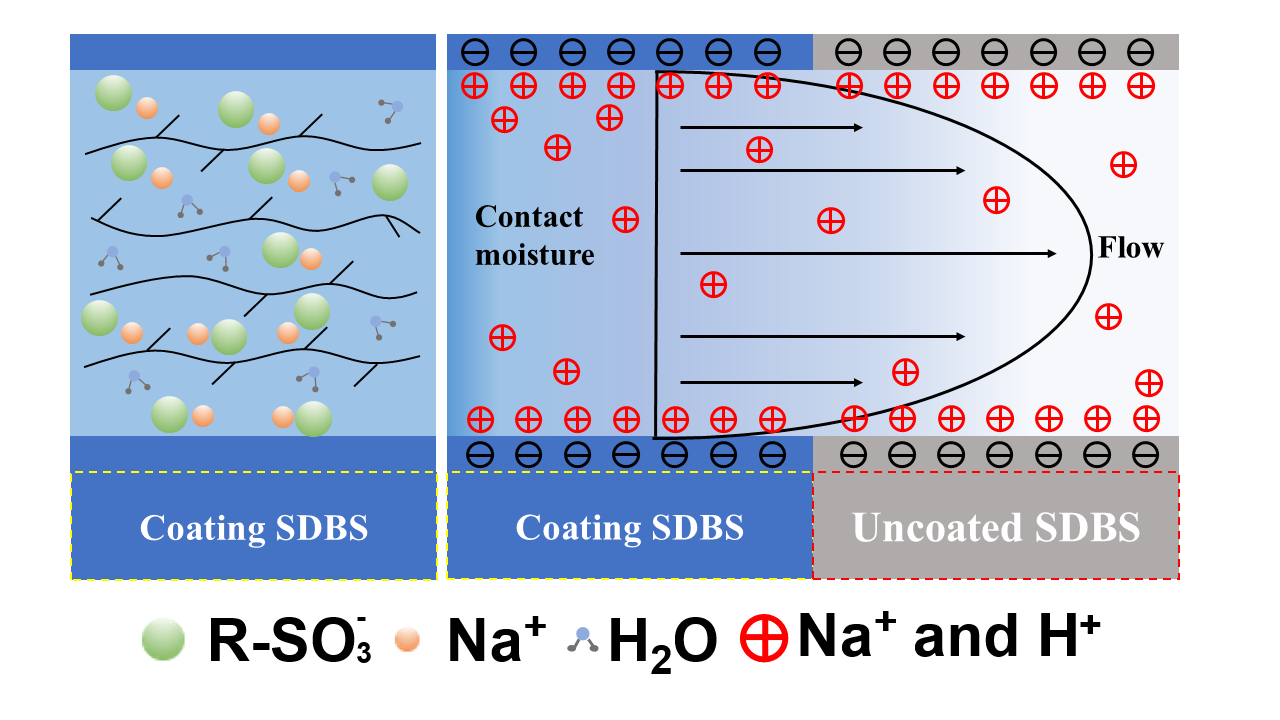
Harvesting electricity from atmospheric humidity represents a highly promising pathway for clean energy conversion. However, conventional nanofiber-based moisture-enabled electric generators mostly rely on vertical humidity gradients to generate power, leaving horizontally structured moisture-enabled electric generators relatively unexplored. Herein, we report a flexible moisture-induced electricity generator based on an electrospun polyacrylonitrile (PAN) nanofiber membrane, which achieves self-driven potential output through horizontally asymmetric distribution of sodium dodecyl benzene sulfonate (SDBS). Specifically, the nanofiber membrane was dip-coated with carbon nanotubes (CNT/PAN), not only introducing multi-level porous nanochannels but also endowing it with sensitive perception of ion migration. Subsequently, one half of the CNT/PAN was immersed in an SDBS solution to construct an asymmetric moisture-capturing structure, enabling the device to induce an ion concentration gradient upon humidity exposure. The gradient drives ion migration, thereby generating an ionic current. Under 93% relative humidity (RH), the device achieves an open-circuit voltage of 60 mV and a short-circuit current of 3 μA. The designed device can not only generate electricity but also function as a self-powered humidity sensor for applications such as touch sensing. It delivers stable direct-current output from ambient humidity without any external energy input, exhibiting good moisture response and promising wearability. These findings may provide new insights into the design and application of horizontally structured nanofiber-based moisture-enable electric generators.
- Open Access
- Article
Flexible Nanofiber Moisture-Enabled Electric Generator Based on Horizontal Asymmetric Structure
Author Information
Received: 29 Oct 2025 | Revised: 04 Jan 2026 | Accepted: 05 Jan 2026 | Published: 12 Jan 2026
Abstract
Graphical Abstract
References
- 1.
Peng, X.; Liu, Z.; Jiang, D. A Review of Multiphase Energy Conversion in Wind Power Generation. Renew. Sustain. Energy Rev. 2021, 147, 111172.
- 2.
Hao, D.; Qi, L.; Tairab, A.M.; et al. Solar energy harvesting technologies for PV self-powered applications: A Comprehensive Review. Renew. Energy 2022, 188, 678–697.
- 3.
Khan, N.D.; Kalair, A.; Abas, N.; et al. Review of Ocean Tidal, Wave and Thermal Energy Technologies. Renew. Sustain. Energy Rev. 2017, 72, 590–604.
- 4.
Tan, E.; Liu, Y.; Hu, C.; et al. Low-Humidity-Dependent and Stretchable Moisture-Electricity Generator Based on Ti3C2Tx MXene-Loaded Cotton and Hydrogel Bilayer for Green Power Harvesting and Wearable Electronics. ACS Appl. Mater. Interfaces 2025, 17, 48375–48386.
- 5.
Liang, Y.; Zhao, F.; Cheng, Z.; et al. Electric Power Generation via Asymmetric Moisturizing of Graphene Oxide for Flexible, Printable and Portable Electronics. Energy Environ. Sci. 2018, 11, 1730–1735.
- 6.
Qu, Y.; Zhang, X.; Fu, Q.; et al. Fabrication of High-Performance Moisture-Electric Generators via Synergistic Effect between CNTs and TiO2 on Porous PU Structure. Compos. Sci. Technol. 2023, 241, 110105.
- 7.
Zhao, F.; Cheng, H.; Zhang, Z.; et al. Direct Power Generation from a Graphene Oxide Film under Moisture. Adv. Mater. 2015, 27, 4351–4357.
- 8.
Huang, Y.; Cheng, H.; Shi, G.; et al. Highly Efficient Moisture-Triggered Nanogenerator Based on Graphene Quantum Dots. ACS Appl. Mater. Interfaces 2017, 9, 38170–38175.
- 9.
Shen, D.; Xiao, M.; Zou, G.; et al. Self-Powered Wearable Electronics Based on Moisture Enabled Electricity Generation. Adv. Mater. 2018, 10, 1705925.
- 10.
Huang, Y.; Cheng, H.; Yang, C.; et al. All-Region-Applicable, Continuous Power Supply of Graphene Oxide Composite. Energy Environ. Sci. 2019, 12, 1848–1856.
- 11.
Lyu, Q.; Peng, B.; Xie, Z.; et al. Moist-Induced Electricity Generation by Electrospun Cellulose Acetate Membranes with Optimized Porous Structures. ACS Appl. Mater. Interfaces 2020, 12, 57373–57381.
- 12.
Zhang, J.; Zhuang, J.; Lei, L.; et al. Rapid Preparation of a Self-Adhesive PAA Ionic Hydrogel Using Lignin Sulfonate–Al3+ Composite Systems for Flexible Moisture-Electric Generators. J. Mater. Chem. A 2023, 11, 3546–3555.
- 13.
Yang, S.; Tao, X.; Chen, W.; et al. Ionic Hydrogel for Efficient and Scalable Moisture-Electric Generation. Adv. Mater. 2022, 34, 2200693.
- 14.
Cai, T.; Lan, L.; Peng, B.; et al. Bilayer Wood Membrane with Aligned Ion Nanochannels for Spontaneous Moist-Electric Generation. Nano Lett. 2022, 22, 6476–6483.
- 15.
Ren, G.; Wang, Z.; Zhang, B.; et al. A Facile and Sustainable Hygroelectric Generator Using Whole-Cell Geobacter Sulfurreducens. Nano Energy. 2021, 89, 106361.
- 16.
Xu, T.; Ding, X.; Huang, Y.; et al. An Efficient Polymer Moist-Electric Generator. Energy Environ. Sci. 2019, 12, 972–978.
- 17.
Wang, H.; Sun, Y.; He, T.; et al. Bilayer of Polyelectrolyte Films for Spontaneous Power Generation in Air up to an Integrated 1,000 V Output. Nat. Nanotechnol. 2021, 16, 811–819.
- 18.
Huang, G.; Liu, J.; Zhang, H.; et al. A Double-Gradient Structured Hydrogel for an Efficient Moisture-Electric Generator. Chem. Eng. J. 2025, 504, 158878.
- 19.
Yang, S.; Zhang, L.; Mao, L.; et al. Green Moisture-Electric Generator Based on Supramolecular Hydrogel with Tens of Milliamp Electricity toward Practical Applications. Nat. Commun. 2024, 15, 3329.
- 20.
Sun, Z.; Feng, L.; Wen, X.; et al. Nanofiber Fabric Based Ion-Gradient-Enhanced Moist-Electric Generator with a Sustained Voltage Output of 1.1 Volts. Mater. Horiz. 2021, 8, 2303–2309.
- 21.
Wang, Z.; Li, J.; Shao, C.; et al. Moisture Power in Natural Polymeric Silk Fibroin Flexible Membrane Triggers Efficient Antibacterial Activity of Silver Nanoparticles. Nano Energy 2021, 90, 106529.
- 22.
Li, T.; Li, L.; Sun, H.; et al. Porous Ionic Membrane Based Flexible Humidity Sensor and Its Multifunctional Applications. Adv. Sci. 2017, 4, 1600404.
- 23.
Yang, B.; Aksak, B.; Lin, Q.; et al. Compliant and Low-Cost Humidity Nanosensors Using Nanoporous Polymer Membranes. Sens. Actuators B: Chem. 2006, 114, 254–262.
- 24.
Zhang, Y.; Zhang, T.; Huang, Z.; et al. A new class of electronic devices based on flexible porous substrates. Adv. Sci. 2022, 9, 2105084.
- 25.
Hu, Y.; Yang, W.; Wei, W.; et al. Phyto-Inspired Sustainable and High-Performance Fabric Generators via Moisture Absorption-Evaporation Cycles. Sci. Adv. 2024, 10, eadk4620.
- 26.
Chen, T.; Jiang, X.; Qiang, S.; et al. Construction of Cellulose-Based Dual-Gradient Heterogeneous Bilayer Membranes with Optimized Directional Moisture Transport Property for Enhancing Moisture-Electricity Generation. Int. J. Biol. Macromol. 2025, 307, 142060.
- 27.
Zheng, H.; Zhou, A.; Li, Y.; et al. A Sandwich-like Flexible Nanofiber Device Boosts Moisture Induced Electricity Generation for Power Supply and Multiple Sensing Applications. Nano Energy 2023, 113, 108529.
- 28.
Sun, Z.; Wen, X.; Wang, L.; et al. Capacitor-Inspired High-Performance and Durable Moist-Electric Generator. Energy Environ. Sci. 2022, 15, 4584–4591.
- 29.
Fauziah, A.R.; Schöfbeck, F.; Reithofer, M.R.; et al. Self-Powered Flexible Janus-like Metal-Organic Framework Membrane for Sustainable Moisture-Enabled Electrokinetic Energy Harvesting. J. Mater. Chem. A. 2026. https://doi.org/10.1039/D5TA06289F.
- 30.
Patel, D.K.; Patil, T.V.; Ganguly, K.; et al. Nanocellulose-Assisted 3D-Printable, Transparent, Bio-Adhesive, Conductive, and Biocompatible Hydrogels as Sensors and Moist Electric Generators. Carbohydr. Polym. 2023, 315, 120963.
- 31.
Huang, Y.; Zhou, K.; Cheng, H.; et al. Three-Dimensional Printing of High-Performance Moisture Power Generators. Adv. Funct. Mater. 2024, 34, 2308620.
- 32.
He, T.; Wang, H.; Lu, B.; et al. Fully Printed Planar Moisture-Enabled Electric Generator Arrays for Scalable Function Integration. Joule 2023, 7, 935–951.
- 33.
Anagnostou, K.; Urban, M.; Sotiropoulos, E.; et al. Water-Based Graphene Oxide Inks for Inkjet-Printed Flexible Moisture Energy Generators. Sci. Rep. 2025, 15, 24685.
- 34.
Yang, Y.; Xu, Y.; Liu, Z.; et al. Preparation and Characterization of High-Performance Electrospun forward Osmosis Membrane by Introducing a Carbon Nanotube Interlayer. J. Membr. Sci. 2020, 616, 118563.
- 35.
Pérez-Álvarez, L.; Ruiz-Rubio, L.; Moreno, I.; et al. Characterization and Optimization of the Alkaline Hydrolysis of Polyacrylonitrile Membranes. Polymers 2019, 11, 1843.
- 36.
Zhang, X.; Liu, X.; Jiang, L. Wettability and Applications of Nanochannels. Adv. Mater. 2019, 31, 1804508.
- 37.
Zhang, Y.; Guo, S.; Yu, Z.G.; et al. An Asymmetric Hygroscopic Structure for Moisture‐Driven Hygro‐Ionic Electricity Generation and Storage. Adv. Mater. 2022, 34, 2201228.
- 38.
He, H.; Zhang, J.; Pan, J.; et al. Moisture-Enabled Electric Generators Based on Electrospinning Silk Fibroin/Poly (Ethylene Oxide) Film Impregnated with Gradient-Structured Sericin. ACS Appl. Energy Mater. 2024, 7, 2980–2988.
- 39.
Zhao, K.; Li, S.; Zan, G.; et al. Moisture-Driven Energy Generation by Vertically Structured Polymer Aerogel on Water-Collecting Gel. Nano Energy 2024, 126, 109645.
- 40.
Sun, Z.; Feng, L.; Xiong, C.; et al. Electrospun Nanofiber Fabric: An Efficient, Breathable and Wearable Moist-Electric Generator. J. Mater. Chem. A 2021, 9, 7085–7093.
- 41.
Wang, L.; Feng, L.; Sun, Z.; et al. Flexible, Self-cleaning, and High-Performance Ceramic Nanofiber-Based Moist-Electric Generator Enabled by Interfacial Engineering. Sci. China Technol. Sci. 2022, 65, 450–457.
- 42.
Akhtar, M.S.; Li, Z.Y.; Park, D.M.; et al. A New Carbon Nanotubes (CNTs)–Poly Acrylonitrile (PAN) Composite Electrolyte for Solid State Dye Sensitized Solar Cells. Electrochim. Acta 2011, 56, 9973–9979.


This work is licensed under a Creative Commons Attribution 4.0 International License.

 Suite 4002 Level 4, 447 Collins Street, Melbourne, Victoria 3000, Australia
 General Inquiries: info@sciltp.com