
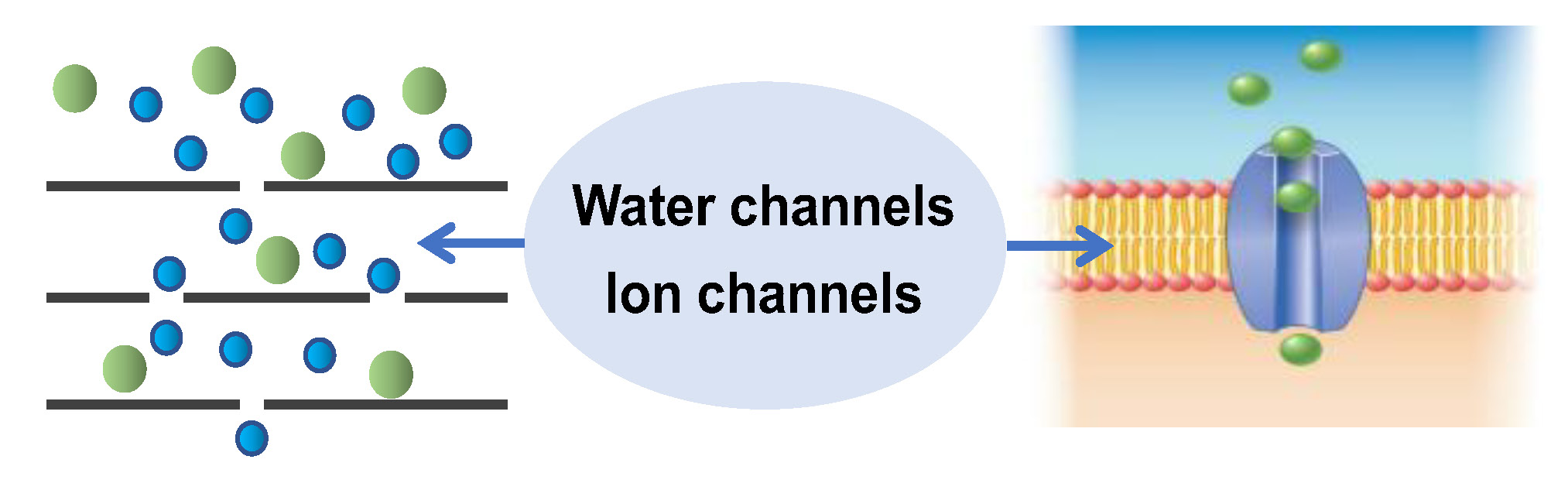
Graphene oxide (GO), with its unique two-dimensional structure, adjustable functional groups, and tunable nanofluidic channels, has emerged as a promising platform for bio-inspired neuromorphic computing. This perspective explores the structural and functional analogies between GO membranes and biological ion channels, emphasizing GO’s ability to support selective ion transport, stimuli-responsive behavior, and synaptic plasticity. Recent advances in material engineering and device integration have enabled GO-based artificial synapses, including memristors and ion-gated transistors, to emulate key neuronal features such as excitatory postsynaptic currents, paired-pulse facilitation, and spike-timing-dependent plasticity with sub-millisecond response times and picojoule-level energy consumption. Moreover, the incorporation of GO with polymers, quantum dots, and semiconductors has facilitated multimodal control via electric, optical, and chemical inputs. Together, these developments position GO as a powerful material system for future neuromorphic devices that operate in aqueous and dynamic biological environments, paving the way toward brain-inspired hardware, neuroprosthetics, and intelligent biointerfaces.
- Open Access
- Perspective
Spatio-Temporal Confinement in Two-Dimensional Channels for Neuromorphic Computing
Author Information
Received: 30 Oct 2025 | Revised: 05 Jan 2026 | Accepted: 06 Jan 2026 | Published: 13 Jan 2026
Abstract
Graphical Abstract
Keywords
2D materials | graphene oxide | artificial synapse | nanofluidics | neuromorphic computing
References
- 1.
Shen, J.; Liu, G.P.; Han, Y.; et al. Artificial channels for confined mass transport at the sub-nanometre scale. Nat. Rev. Mater. 2021, 6, 294–312.
- 2.
Hou, Y.Q.; Hou, X. Bioinspired nanofluidic iontronics. Science 2021, 373, 628–629.
- 3.
Sun, P.Z.; Wang, K.L.; Zhu, H.W. Recent developments in graphene-based membranes: Structure, mass transport mechanism and potential applications. Adv. Mater. 2016, 28, 2287.
- 4.
He, Z.J.; Zhou, J.; Lu, X.H.; et al. Bioinspired graphene nanopores with voltage-tunable ion selectivity for Na+ and K+. ACS Nano 2013, 7, 10148–10157.
- 5.
Zhao, G.K.; Zhu, H.W. Cation-π interactions in graphene containing systems for water treatment and beyond. Adv. Mater. 2020, 32, 1905756.
- 6.
Kim, S.S.; Choi, S.J.; Lee, H.G.; et al. Neuromorphic van der Waals crystals for substantial energy generation. Nature Commun. 2021, 12, 47.
- 7.
Barua, M.; Sreedhara, M.B.; Pramoda, K.; et al. Quantification of surface functionalities on graphene, boron nitride and borocarbonitrides by fluorescence labeling. Chem. Phys. Lett. 2017, 683, 459.
- 8.
Costinas, C.; Salagean, C.A.; Cotet, L.C.; et al. Insights into the stability of graphene oxide aqueous dispersions. Nanomaterials 2022, 12, 4489.
- 9.
Wang, X.W.; Sun, Y.H.; Liu, K. Chemical and structural stability of 2D layered materials. 2D Mater. 2019, 6, 042001.
- 10.
Chen, S.Y.; Tan, G.S.X.; Ivanov, A.; et al. Tunable anion transport and the chemical transistor effect in functionalized graphene oxide membranes. NPJ 2D Mater. Appl. 2025, 9, 62.
- 11.
Huang, Q.B.; Liu, S.; Guo, Y.A.; et al. Separation of mono-/di-valent ions charged interlayer channels of graphene oxide membranes. J. Membrane Sci. 2022, 645, 120212.
- 12.
Wang, K.; Ruan, J.; Song, H.; et al. Biocompatibility of graphene oxide. Nanoscale Res. Lett. 2010, 6, 8.
- 13.
Ryoo, S.R.; Kim, Y.K.; Kin, M.H.; et al. Behaviors of NIH-3T3 fibroblasts on graphene/carbon nanotubes: Proliferation, focal adhesion, and gene transfection studies. ACS. Nano 2010, 4, 6587–6598.
- 14.
Xue, Y.H.; Xia, Y.; Yang, S.; et al. Atomic-scale ion transistor with ultrahigh diffusivity. Science 2021, 372, 501–503.
- 15.
Huang, M.R.; Li, Z.C.; Zhu, H.W. Recent advances of graphene and related materials in artificial intelligence. Adv. Intell. Syst. 2022, 4, 2200077.
- 16.
Teng, Y.F.; Liu, P.L.; Fu, L.; et al. Bioinspired nervous signal transmission system based on two-dimensional laminar nanofluidics: From electronics to ionics. Proc. Natl. Acad. Sci. USA 2020, 117, 16743–16748.
- 17.
Gradov, O.V. Can graphene bilayers be the membrane mimetic materials? arXiv 2018, arXiv:1808.00109.
- 18.
Gradov, O.V.; Gradova, M.A. Can graphene bilayers be the membrane mimetic materials? Ion channels in graphene-based nanostructures. arXiv 2018, arXiv:1807.10139.
- 19.
Zhang, Y.C.; Liu, L.; Qiao, Y.; et al. Confinement of ions within graphene oxide membranes enables neuromorphic artificial gustation. Proc. Natl. Acad. Sci. USA 2025, 122, e2413060122.
- 20.
Sahu, D.P.; Jetty, P.; Jammalamadaka, S.N. Graphene oxide based synaptic memristor device for neuromorphic computing. Nanotechnology 2021, 32, 155701.
- 21.
Rauti, R.; Lozano, N.; Leon, V.; et al. Graphene oxide nanosheets reshape synaptic function in cultured brain networks. ACS Nano 2016, 10, 4459–4471.
- 22.
Biagioni, A.F.; Cellot, G.; Pati, E.; et al. Graphene oxide prevents lateral amygdala dysfunctional synaptic plasticity and reverts long lasting anxiety behavior in rats. Biomaterials 2021, 271, 120749.
- 23.
Li, Y.T.; Jin, X.; Tang, L.N.; et al. Receptor-mediated field effect transistor biosensor for real-time monitoring of glutamate release from primary hippocampal neurons. Anal. Chem. 2019, 91, 8229–8236.
- 24.
Robin, P.; Kavokine, N.; Bocquet, L. Modeling of emergent memory and voltage spiking in ionic transport through angstrom-scale slits. Science 2021, 373, 687–691.
- 25.
Hui, F.; Zhang, C.; Yu, H.; et al. Self-assembly of Janus graphene oxide via chemical breakdown for scalable high-performance memristors. Adv. Funct. Mater. 2024, 34, 2302073.
- 26.
Mei, T.T.; Zhang, H.J.; Xiao, K. Bioinspired artificial ion pumps. ACS Nano 2022, 16, 13323–13338.
- 27.
Noy, A.; Darling, S.B. Nanofluidic computing makes a splash. Science 2023, 379, 143–144.
- 28.
Xiong, T.Y.; Li, C.W.; He, X.L.; et al. Neuromorphic functions with a polyelectrolyte-confined fluidic memristor. Science 2023, 379, 156–161.
- 29.
Robin, P.; Emmerich, T.; Ismail, A.; et al. Long-term memory and synapse-like dynamics in two-dimensional nanofluidic channels. Science 2023, 379, 161–167.
- 30.
Chen, M.; Wan, Z.F.; Dong, H.; et al. Direct laser writing of graphene oxide for ultra-low power consumption memristors in reservoir computing for digital recognition. Natl. Sci. Open 2022, 1, 20220020.
- 31.
Li, Y.; Ling, S.T.; He, R.Y.; et al. A robust graphene oxide memristor enabled by organic pyridinium intercalation for artificial biosynapse application. Nano Res. 2023, 16, 11278–11287.
- 32.
Moazzeni, A.; Madvar, H.R.; Hamedi, S.; et al. Fabrication of graphene oxide-based resistive switching memory by the spray pyrolysis technique for neuromorphic computing. ACS Appl. Nano Mater. 2023, 6, 2236.
- 33.
Meng, X.R.; Qin, G.X.; Sun, Y.M. Graphene oxide-based bioinspired neuromorphic transistors with artificial synaptic plasticity. Mater. Sci. Semicond. Process. 2025, 186, 109053.
- 34.
Yu, X.W.; Cheng, H.H.; Zhang, M.; et al. Graphene-based smart materials. Nat. Rev. Mater. 2017, 2, 17046.
This work is licensed under a Creative Commons Attribution 4.0 International License.

 Suite 4002 Level 4, 447 Collins Street, Melbourne, Victoria 3000, Australia
 General Inquiries: info@sciltp.com