
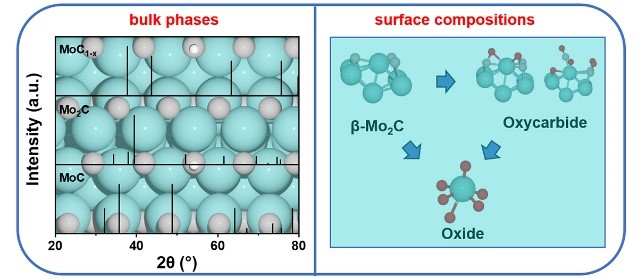
Molybdenum carbide has attracted much research attention for its precious metal-like catalytic properties, especially in hydrogen-involved reactions. It possesses rich crystal and surface structures leading to different activity and product selectivity. With advances in nanoengineering and new understanding of their surfaces and interfaces, one can control the transition between different phases and surface structures for molybdenum carbide nanoparticles. In this context, it is essential to understand their surface compositions and structures under operating conditions in addition to their intrinsic ones under ambient conditions without external cues. The necessity of surface study also comes from the mild oxidation brought by passivation in carbide nanoparticles. made using the bottom-up synthesis or solid-gas phase temperature-programmed reduction. In this perspective, we first introduce the relevant crystal structures of molybdenum carbides and highlight the features of the three types of chemical bonding within. We then briefly review the studies of thermodynamically favored surface components and nanostructures for partially oxidized molybdenum carbide nanoparticles based on both experimental and theoretical data. An electrochemical oxidation method is used to illustrate the feasibility in controlling and understanding the surface oxidation. Finally, structure-property relationship is discussed with several recent examples, focusing on the effect of phase dependency on the adsorption energy of reaction intermediates.
- Open Access
- Perspective
On the Surface Compositions of Molybdenum Carbide Nanoparticles for Electrocatalytic Applications
Author Information
Received: 28 Nov 2024 | Accepted: 02 Dec 2024 | Published: 06 Dec 2024
Abstract
Graphical Abstract
Keywords
molybdenum carbide | surface composition | oxycarbide | electrocatalysis | hydrogen evolution reaction | density functional theory
References
- 1.Huang, L.; Zheng, X.; Gao, G.; Zhang, H.; Rong, K.; Chen, J.; Liu, Y.; Zhu, X.; Wu, W.; Wang, Y.; et al. Interfacial electron engineering of palladium and molybdenum carbide for highly efficient oxygen reduction. J. Am. Chem. Soc. 2021, 143, 6933–6941.
- 2.Ge, R.; Huo, J.; Sun, M.; Zhu, M.; Li, Y.; Chou, S.; Li, W. Surface and interface engineering: Molybdenum carbide–based nanomaterials for electrochemical energy conversion. Small 2021, 17, 1903380.
- 3.Wu, J.; Yang, H. Platinum-based oxygen reduction electrocatalysts. Acc. Chem. Res. 2013, 46, 1848–1857.
- 4.Yu, S.; Yang, H. Design principles for the synthesis of platinum–cobalt intermetallic nanoparticles for electrocatalytic applications. Chem. Comm. 2023, 59, 4852–4871.
- 5.Tong, Y.; Zhang, Z.; Hou, Y.; Yan, L.; Chen, X.; Zhang, H.; Wang, X.; Li, Y. Recent progress of molybdenum carbide based electrocatalysts for electrocatalytic hydrogen evolution reaction. Nanoscale 2023, 15, 14717–14736.
- 6.Zhang, X.; Shi, C.; Chen, B.; Kuhn, A.N.; Ma, D.; Yang, H. Progress in hydrogen production over transition metal carbide catalysts: challenges and opportunities. Curr. Opin. Chem. Eng. 2018, 20, 68–77.
- 7.Liu, S.; Lin, Z.; Wan, R.; Liu, Y.; Liu, Z.; Zhang, S.; Zhang, X.; Tang, Z.; Lu, X.; Tian, Y. Cobalt phosphide supported by two-dimensional molybdenum carbide (MXene) for the hydrogen evolution reaction, oxygen evolution reaction, and overall water splitting. J. Mater. Chem. A 2021, 9, 21259–21269.
- 8.Zhang, B.; Zhou, J.; Elliott, S.R.; Sun, Z. Two-dimensional molybdenum carbides: Active electrocatalysts for the nitrogen reduction reaction. J. Mater. Chem. A 2020, 8, 23947–23954.
- 9.Li, Z.; Attanayake, N.H.; Blackburn, J.L.; Miller, E.M. Carbon dioxide and nitrogen reduction reactions using 2D transition metal dichalcogenide (TMDC) and carbide/nitride (MXene) catalysts. Energy Environ. Sci. 2021, 14, 6242–6286.
- 10.Wan, J.; Liu, Q.; Wang, T.; Yuan, H.; Zhang, P.; Gu, X. Theoretical investigation of platinum-like catalysts of molybdenum carbides for hydrogen evolution reaction. Solid State Commun. 2018, 284–286, 25–30.
- 11.Yu, G.-Q.; Huang, B.-Y.; Chen, X.; Wang, D.; Zheng, F.; Li, X.-B. Uncovering the surface and phase effect of molybdenum carbides on hydrogen evolution: A first-principles study. J. Phys. Chem. C 2019, 123, 21878–21887.
- 12.Wang, W.; Geng, W.; Zhang, L.; Zhao, Z.; Zhang, Z.; Ma, T.; Cheng, C.; Liu, X.; Zhang, Y.; Li, S. Molybdenum oxycarbide supported Rh-clusters with modulated interstitial C–O microenvironments for promoting hydrogen evolution. Small 2023, 19, 2206808.
- 13.Deng, B.; Wang, Z.; Chen, W.; Li, J.T.; Luong, D.X.; Carter, R.A.; Gao, G.; Yakobson, B.I.; Zhao, Y.; Tour, J.M. Phase controlled synthesis of transition metal carbide nanocrystals by ultrafast flash Joule heating. Nat. Comm. 2022, 13, 262.
- 14.Shrestha, A.; Gao, X.; Hicks, J.C.; Paolucci, C. Nanoparticle size effects on phase stability for molybdenum and tungsten carbides. Chem. Mater. 2021, 33, 4606–4620.
- 15.Hu, Z.; Zhang, L.; Huang, J.; Feng, Z.; Xiong, Q.; Ye, Z.; Chen, Z.; Li, X.; Yu, Z. Self-supported nickel-doped molybdenum carbide nanoflower clusters on carbon fiber paper for an efficient hydrogen evolution reaction. Nanoscale 2021, 13, 8264–8274.
- 16.Kuhn, A.N.; Park, R.C.; Yu, S.; Gao, D.; Zhang, C.; Zhang, Y.; Yang, H. Valorization of carbon dioxide into C1 product via reverse water gas shift reaction using oxide-supported molybdenum carbides. Carbon Future 2024, 1, 9200011.
- 17.Li, J.-S.; Wang, Y.; Liu, C.-H.; Li, S.-L.; Wang, Y.-G.; Dong, L.-Z.; Dai, Z.-H.; Li, Y.-F.; Lan, Y.-Q. Coupled molybdenum carbide and reduced graphene oxide electrocatalysts for efficient hydrogen evolution. Nat. Commun. 2016, 7, 11204.
- 18.Zhao, T.; Lan, D.; Jia, Z.; Gao, Z.; Wu, G. Hierarchical porous molybdenum carbide synergic morphological engineering towards broad multi-band tunable microwave absorption. Nano Res. 2024, 17, 9845–9856.
- 19.Baek, D.S.; Lee, J.; Kim, J.; Joo, S.H. Metastable phase-controlled synthesis of mesoporous molybdenum carbides for efficient alkaline hydrogen evolution. ACS Catal. 2022, 12, 7415–7426.
- 20.Wang, H.; Diao, Y.; Gao, Z.; Smith, K.J.; Guo, X.; Ma, D.; Shi, C. H2 production from methane reforming over molybdenum carbide catalysts: From surface properties and reaction mechanism to catalyst development. ACS Catal. 2022, 12, 15501–15528.
- 21.Upadhyay, S.; Pandey, O.P. Synthesis and electrochemical applications of molybdenum carbide: Recent progress and perspectives. J. Electrochem. Soc. 2022, 169, 016511.
- 22.Guardia-Valenzuela, J.; Bertarelli, A.; Carra, F.; Mariani, N.; Bizzaro, S.; Arenal, R. Development and properties of high thermal conductivity molybdenum carbide–graphite composites. Carbon 2018, 135, 72–84.
- 23.Yu, S.; Gautam, A.K.; Gao, D.; Kuhn, A.N.; He, H.; Mironenko, A.V.; Yang, H. Implication of surface oxidation of nanoscale molybdenum carbide on electrocatalytic activity. J. Mater. Chem. A 2024, 12, 15163–15176.
- 24.Yang, Q.; Sun, K.; Xu, Y.; Ding, Z.; Hou, R. Tuning crystal phase of molybdenum carbide catalyst to induce the different selective hydrogenation performance. Appl. Catal. A 2022, 630, 118455.
- 25.Xiao, T.-c.; York, A.P.E.; Williams, V.C.; Al-Megren, H.; Hanif, A.; Zhou, X.-y.; Green, M.L.H. Preparation of molybdenum carbides using butane and their catalytic performance. Chem. Mater. 2000, 12, 3896–3905.
- 26.Tacey, S.A.; Jankousky, M.; Farberow, C.A. Assessing the role of surface carbon on the surface stability and reactivity of β-Mo2C catalysts. Appl. Surf. Sci. 2022, 593, 153415.
- 27.Wyvratt, B.M.; Gaudet, J.R.; Thompson, L.T. Effects of passivation on synthesis, structure and composition of molybdenum carbide supported platinum water–gas shift catalysts. J. Catal. 2015, 330, 280–287.
- 28.Likith, S.R.J.; Farberow, C.A.; Manna, S.; Abdulslam, A.; Stevanović, V.; Ruddy, D.A.; Schaidle, J.A.; Robichaud, D.J.; Ciobanu, C.V. Thermodynamic stability of molybdenum oxycarbides formed from orthorhombic Mo2C in oxygen-rich environments. J. Phys. Chem. C 2018, 122, 1223–1233.
- 29.Yu, W.; Salciccioli, M.; Xiong, K.; Barteau, M.A.; Vlachos, D.G.; Chen, J.G. Theoretical and experimental studies of C–C versus C–O bond scission of ethylene glycol reaction pathways via metal-modified molybdenum carbides. ACS Catal. 2014, 4, 1409–1418.
- 30.Murugappan, K.; Anderson, E.M.; Teschner, D.; Jones, T.E.; Skorupska, K.; Román-Leshkov, Y. Operando NAP-XPS unveils differences in MoO3 and Mo2C during hydrodeoxygenation. Nat. Catal. 2018, 1, 960–967.
- 31.Kumar, A.; Bhan, A. Oxygen content as a variable to control product selectivity in hydrodeoxygenation reactions on molybdenum carbide catalysts. Chem. Eng. Sci. 2019, 197, 371–378.
- 32.Ammal, S.C.; Heyden, A. Active site identification for glycerol hydrodeoxygenation over the oxygen modified molybdenum carbide surface. ACS Catal. 2023, 13, 7499–7513.
- 33.Politi, J.R. d. S.; Viñes, F.; Rodriguez, J.A.; Illas, F. Atomic and electronic structure of molybdenum carbide phases: bulk and low Miller-index surfaces. Phys. Chem. Chem. Phys. 2013, 15, 12617–12625.
- 34.Ma, Y.; Guan, G.; Hao, X.; Cao, J.; Abudula, A. Molybdenum carbide as alternative catalyst for hydrogen production–A review. Renewable Sustainable Energy Rev. 2017, 75, 1101–1129.
- 35.Liu, X.; Salahub, D.R. Application of topological analysis of the electron localization function to the complexes of molybdenum carbide nanoparticles with unsaturated hydrocarbons. Can. J. Chem. 2016, 94, 282–292.
- 36.Ren, J.; Huo, C.-F.; Wang, J.; Cao, Z.; Li, Y.-W.; Jiao, H. Density functional theory study into the adsorption of CO2, H and CHx (x = 0–3) as well as C2H4 on α-Mo2C(0001). Surf. Sci. 2006, 600, 2329–2337.
- 37.Zhao, L.; Yuan, H.; Sun, D.; Jia, J.; Yu, J.; Zhang, X.; Liu, X.; Liu, H.; Zhou, W. Active facet regulation of highly aligned molybdenum carbide porous octahedrons via crystal engineering for hydrogen evolution reaction. Nano Energy 2020, 77, 105056.
- 38.Wu, N.; Liu, J.; Zhao, W.; Du, J.; Zhong, W. Molybdenum carbide MXene embedded with nickel sulfide clusters as an efficient electrocatalyst for hydrogen evolution reaction. Int. J. Hydrogen Energy 2023, 48, 17526–17535.
- 39.Yang, C.; Zhao, R.; Xiang, H.; Wu, J.; Zhong, W.; Li, X.; Zhang, Q. Structural transformation of molybdenum carbide with extensive active centers for superior hydrogen evolution. Nano Energy 2022, 98, 107232.
- 40.Sullivan, M.M.; Bhan, A. Acid site densities and reactivity of oxygen-modified transition metal carbide catalysts. J. Catal. 2016, 344, 53–58.
- 41.Yao, S.; Yan, B.; Jiang, Z.; Liu, Z.; Wu, Q.; Lee, J.H.; Chen, J.G. Combining CO2 reduction with ethane oxidative dehydrogenation by oxygen-modification of molybdenum carbide. ACS Catal. 2018, 8, 5374–5381.
- 42.Sullivan, M.M.; Held, J.T.; Bhan, A. Structure and site evolution of molybdenum carbide catalysts upon exposure to oxygen. J. Catal. 2015, 326, 82–91.
- 43.Sullivan, M.M.; Bhan, A. Effects of oxygen coverage on rates and selectivity of propane-CO2 reactions on molybdenum carbide. J. Catal. 2018, 357, 195–205.
- 44.Gautam, A.K.; Yu, S.; He, H.; Yang, H.; Mironenko, A.V. Role of surface oxygen in α-MoC catalyst stability and activity under electrooxidation conditions. ChemRxiv 2024. https://doi.org/10.26434/chemrxiv-2024-xwh17.
- 45.Park, J.H.; Lee, C.H.; Yu, S.; Kharel, P.; Choi, R.; Zhang, C.; Huang, P.Y.; Kwon, J.S.-I.; Yang, H. Effects of amine-based covalent organic framework on platinum electrocatalyst performance towards hydrogen evolution reaction. Nano Energy 2024, 128, 109947.

How to Cite
Yu, S.; Yang, H. On the Surface Compositions of Molybdenum Carbide Nanoparticles for Electrocatalytic Applications. Materials and Interfaces 2024, 1 (1), 3–12. https://doi.org/10.53941/mi.2024.100006.
RIS
BibTex
Copyright & License

Copyright (c) 2024 by the authors.
This work is licensed under a Creative Commons Attribution 4.0 International License.
Article Metrics
522
Article Views
1
Citations
Contents
References

 Suite 4002 Level 4, 447 Collins Street, Melbourne, Victoria 3000, Australia
 General Inquiries: info@sciltp.com