
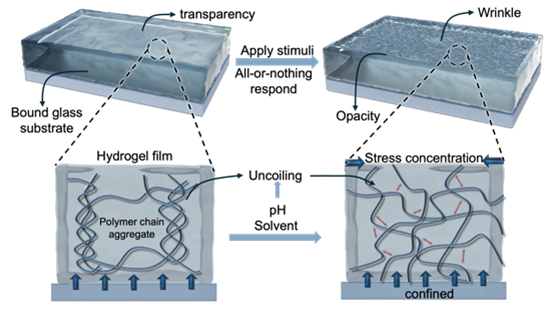
Surface instability-based hydrogel sensors offer equipment-free visual detection but suffer from severe angle-dependent visibility that limits practical applications. Here we demonstrate that film thickness serves as a critical fourth design parameter—beyond elastic modulus, swelling ratio, and stimulus concentration—to achieve omnidirectional optical readout. Through systematic optimization across poly(2-(dimethylamino) ethyl methacrylate) (PDMAEMA), poly(acrylamide-co-acrylic acid) (P(AAm-co-AAc)), and poly(N-isopropylacrylamide-co-acrylamide) (P(NIPAm-co-Am)) systems, we identify an operational thickness window of 160–1300 μm, with 300 μm producing wrinkle dimensions that match visible light wavelengths for angle-independent scattering. This morphological control reduces viewing angle effects by >80%, enabling reliable naked-eye detection across a wide viewing angle range (0–60°), representing an >80% improvement over previous angle-dependent sensors. We validate this design framework through enzyme-coupled glucose sensors operating across clinical ranges (200–1000 mg/dL) and direct polarity sensors with binary discrimination at Polarity Index (PI) ~3.5. Exploiting the threshold nature of instability-induced scattering (IIS), we further demonstrate soft material logic gates (AND, OR, XOR) that process environmental stimuli and autonomously control LCE actuators within 15 s—establishing the examples of hydrogel-based Boolean computation without electronic components. These advances transform IIS sensors from laboratory curiosities into practical platforms for soft robotics and autonomous systems.
- Open Access
- Article
Angle-Independent Surface-Instability Hydrogel Sensors Enabled by Thickness Control
- Ruoyi Ke †,
- Imri Frenkel †,
- Zixiao Liu,
- Chuan Wei Zhang,
- Ping He,
- Pengju Shi,
- Abdullatif Jazzar,
- Yousif Alsaid,
- Yingjie Du,
- Sidi Duan,
- Dong Wu,
- Mutian Hua,
- Shuwang Wu,
- Ximin He *
Author Information
Received: 09 Jul 2025 | Revised: 26 Aug 2025 | Accepted: 01 Sep 2025 | Published: 04 Sep 2025
Abstract
Graphical Abstract
Keywords
hydrogel sensors | surface instability | angle-independent detection | material-based computation | soft robotics
References
- 1.Ates, H.C.; Nguyen, P.Q.; Gonzalez-Macia, L.; Morales-Narvaez, E.; Guder, F.; Collins, J.J.; Dincer, C. End-to-end design of wearable sensors. Nat. Rev. Mater. 2022, 7, 887–907.
- 2.Zhao, D.; Zhu, Y.; Cheng, W.; Chen, W.; Wu, Y.; Yu, H. Cellulose-Based Flexible Functional Materials for Emerging Intelligent Electronics. Adv. Mater. 2021, 33, e2000619.
- 3.McEvoy, M.A.; Correll, N. Materials science. Materials that couple sensing, actuation, computation, and communication. Science 2015, 347, 1261689.
- 4.Qian, X.; Zhao, Y.; Alsaid, Y.; Wang, X.; Hua, M.; Galy, T.; Gopalakrishna, H.; Yang, Y.; Cui, J.; Liu, N.; et al. Artificial phototropism for omnidirectional tracking and harvesting of light. Nat. Nanotechnol. 2019, 14, 1048–1055.
- 5.Pedro, D.I.; Nguyen, D.T.; Trachsel, L.; Rosa, J.G.; Chu, B.; Eikenberry, S.; Sumerlin, B.S.; Sawyer, W.G. Superficial Modulus, Water-Content, and Mesh-Size at Hydrogel Surfaces. Tribol. Lett. 2021, 69. 160.
- 6.Zhao, Y.; Lo, C.Y.; Ruan, L.; Pi, C.H.; Kim, C.; Alsaid, Y.; He, X. Somatosensory actuator based on stretchable conductive photothermally responsive hydrogel. Sci. Robot. 2021, 6, eabd5483.
- 7.Zhao, Y.; Hua, M.; Yan, Y.; Wu, S.; Alsaid, Y.; He, X. Stimuli-Responsive Polymers for Soft Robotics. Annu. Rev. Control Robot. Auton. Syst. 2022, 5, 515–545.
- 8.Hoffman, A.S. Hydrogels for biomedical applications. Adv. Drug Deliv. Rev. 2012, 64, 18–23.
- 9.Cai, Z.; Luck, L.A.; Punihaole, D.; Madura, J.D.; Asher, S.A. Photonic crystal protein hydrogel sensor materials enabled by conformationally induced volume phase transition. Chem. Sci. 2016, 7, 4557–4562.
- 10.Dušková-Smrčková, M.; Dušek, K. How to Force Polymer Gels to Show Volume Phase Transitions. ACS Macro Lett. 2019, 8, 272–278.
- 11.Walker, J.P.; Asher, S.A. Acetylcholinesterase-Based Organophosphate Nerve Agent Sensing Photonic Crystal. Anal. Chem. 2005, 77, 1596–1600.
- 12.Ferreira, L.; Vidal, M.M.; Gil, M.H. Evaluation of poly(2-hydroxyethyl methacrylate) gels as drug delivery systems at different pH values. Int. J. Pharm. 2000, 194, 169–180.
- 13.Nakayama, M.; Yamada, N.; Kumashiro, Y.; Kanazawa, H.; Yamato, M.; Okano, T. Thermoresponsive poly(N-isopropylacrylamide)-based block copolymer coating for optimizing cell sheet fabrication. Macromol. Biosci. 2012, 12, 751–760.
- 14.Yetisen, A.K.; Jiang, N.; Fallahi, A.; Montelongo, Y.; Ruiz-Esparza, G.U.; Tamayol, A.; Zhang, Y.S.; Mahmood, I.; Yang, S.-A.; Kim, K.S.; et al. Glucose-sensitive hydrogel optical fibers functionalized with phenylboronic acid. Adv. Mater. 2017, 29, 1606380.
- 15.Choi, M.; Humar, M.; Kim, S.; Yun, S.-H. Step-Index Optical Fiber Made of Biocompatible Hydrogels. Adv. Mater. 2015, 27, 4081–4086.
- 16.Wang, Z.; Zhang, W.; Liu, X.; Li, M.; Lang, X.; Singh, R.; Marques, C.; Zhang, B.; Kumar, S. Novel Optical Fiber-Based Structures for Plasmonics Sensors. Biosensors 2022, 12, 1016.
- 17.Ling, Z.; Chen, J.; Li, S.; Lu, H.; Du, J.; Liu, Z.; Qiu, J. A multi-band stealth and anti-interference superspeed light-guided swimming robot based on multiscale bicontinuous three-dimensional network. Chem. Eng. J. 2024, 485, 150094.
- 18.Zhang, C.W.; Chen, C.; Duan, S.; Yan, Y.; He, P.; He, X. Hydrogel-based soft bioelectronics for personalized healthcare. Med-X 2024, 2, 20.
- 19.Yang, S.; Sarkar, S.; Xie, X.; Li, D.; Chen, J. Application of Optical Hydrogels in Environmental Sensing. Energy Environ. Mater. 2024, 7, e12646.
- 20.Cao, H.; Duan, L.; Zhang, Y.; Cao, J.; Zhang, K. Current hydrogel advances in physicochemical and biological response-driven biomedical application diversity. Signal Transduct. Target. Ther. 2021, 6, 426.
- 21.Yetisen, A.K.; Butt, H.; Volpatti, L.R.; Pavlichenko, I.; Humar, M.; Kwok, S.J.J.; Koo, H.; Kim, K.S.; Naydenova, I.; Khademhosseini, A.; et al. Photonic hydrogel sensors. Biotechnol. Adv. 2016, 34, 250–271.
- 22.Wang, M.; Yang, Y.; Min, J.; Song, Y.; Tu, J.; Mukasa, D.; Ye, C.; Xu, C.; Heflin, N.; McCune, J.S.; et al. A wearable electrochemical biosensor for the monitoring of metabolites and nutrients. Nat. Biomed. Eng. 2022, 6, 1225–1235.
- 23.Sun, S.; Chen, J. Recent Advances in Hydrogel-Based Biosensors for Cancer Detection. ACS Appl. Mater. Interfaces 2024, 16, 46988–47002.
- 24.Shen, P.; Li, M.; Li, R.; Han, B.; Ma, H.; Hou, X.; Zhang, Y.; Wang, J.-J. Aptamer-functionalized smart photonic hydrogels: application for the detection of thrombin in human serum. NPG Asia Mater. 2022, 14, 94.
- 25.Qin, M.; Sun, M.; Hua, M.; He, X. Bioinspired structural color sensors based on responsive soft materials. Curr. Opin. Solid State Mater. Sci. 2019, 23, 13–27.
- 26.Qin, M.; Sun, M.; Bai, R.; Mao, Y.; Qian, X.; Sikka, D.; Zhao, Y.; Qi, H.J.; Suo, Z.; He, X. Bioinspired Hydrogel Interferometer for Adaptive Coloration and Chemical Sensing. Adv. Mater. 2018, 30, 1800468.
- 27.Yang, S.; Tang, Z.; Tian, Y.; Ji, X.; Wang, F.; Xie, C.; He, Z. Dual-Color Fluorescent Hydrogel Microspheres Combined with Smartphones for Visual Detection of Lactate. Biosensors 2022, 12, 802.
- 28.Li, W.; Zhang, X.; Hu, X.; Shi, Y.; Li, Z.; Huang, X.; Zhang, W.; Zhang, D.; Zou, X.; Shi, J. A smartphone-integrated ratiometric fluorescence sensor for visual detection of cadmium ions. J. Hazard. Mater. 2021, 408, 124872.
- 29.Wang, Q.; Zhao, X. Beyond wrinkles: Multimodal surface instabilities for multifunctional patterning. MRS Bull. 2016, 41, 115–122.
- 30.Frenkel, I.; Hua, M.; Alsaid, Y.; He, X. Self-Reporting Hydrogel Sensors Based on Surface Instability-Induced Optical Scattering. Adv. Photonics Res. 2021, 2, 2100058.
- 31.Fan, W.; Zeng, J.; Gan, Q.; Ji, D.; Song, H.; Liu, W.; Shi, L.; Wu, L. Iridescence-controlled and flexibly tunable retroreflective structural color film for smart displays. Sci. Adv. 2019, 5, eaaw8755.
- 32.Lee, K.-L.; Chang, C.-C.; You, M.-L.; Pan, M.-Y.; Wei, P.-K. Enhancing Surface Sensing Sensitivity of Metallic Nanostructures using Blue-Shifted Surface Plasmon Mode and Fano Resonance. Sci. Rep. 2018, 8, 9762.
- 33.Zhang, R.; Yang, Z.; Wang, Q.; Li, W.; Xu, H.; Li, L. Angle dependent structural colors with full-visible-spectrum and narrow-angle change properties for anti-counterfeiting. Dyes Pigm. 2023, 208, 110794.
- 34.Chung, J.Y.; Nolte, A.J.; Stafford, C.M. Surface Wrinkling: A Versatile Platform for Measuring Thin-Film Properties. Adv. Mater. 2011, 23, 349–368.
- 35.Warren, T.J.; Bowles, N.E.; Donaldson Hanna, K.; Bandfield, J.L. Modeling the Angular Dependence of Emissivity of Randomly Rough Surfaces. J. Geophys. Res. Planets 2019, 124, 585–601.
- 36.Gross, P.; Störzer, M.; Fiebig, S.; Clausen, M.; Maret, G.; Aegerter, C.M. A precise method to determine the angular distribution of backscattered light to high angles. Rev. Sci. Instrum. 2007, 78, 033105.
- 37.Considine, P.S.; Cronin, D.J.; Reynolds, G.O. Angular Dependence of Radiance of Rough Surfaces in Imaging Systems. J. Opt. Soc. Am. 1966, 56, 877–883.
- 38.Chen, C.; Shi, P.; Liu, Z.; Duan, S.; Si, M.; Zhang, C.; Du, Y.; Yan, Y.; White, T.J.; Kramer-Bottiglio, R.; et al. Advancing physical intelligence for autonomous soft robots. Sci. Robot. 2025, 10, eads1292.
- 39.Zhao, Y.; Li, Q.; Liu, Z.; Alsaid, Y.; Shi, P.; Jawed, M.K.; He, X. Sunlight-powered self-excited oscillators for sustainable autonomous soft robotics. Sci. Robot. 2023, 8, eadf4753.
- 40.Liu, Y.; Tian, G.; Du, Y.; Shi, P.; Li, N.; Li, Y.; Qin, Z.; Jiao, T.; He, X. Highly Stretchable, Low-Hysteresis, and Adhesive TA@MXene-Composited Organohydrogels for Durable Wearable Sensors. Adv. Funct. Mater. 2024, 34, 2315813.
- 41.Zhao, K.; Cao, X.; Alsaid, Y.; Cheng, J.; Wang, Y.; Zhao, Y.; He, X.; Zhang, S.; Niu, W. Interactively mechanochromic electronic textile sensor with rapid and durable electrical/optical response for visualized stretchable electronics. Chem. Eng. J. 2021, 426, 130870.
- 42.Liu, Q.; Nian, G.; Yang, C.; Qu, S.; Suo, Z. Bonding dissimilar polymer networks in various manufacturing processes. Nat. Commun. 2018, 9, 846.
- 43.Yuk, H.; Zhang, T.; Lin, S.; Parada, G.A.; Zhao, X. Tough bonding of hydrogels to diverse non-porous surfaces. Nat. Mater. 2016, 15, 190–196.
- 44.Wirthl, D.; Pichler, R.; Drack, M.; Kettlguber, G.; Moser, R.; Gerstmayr, R.; Hartmann, F.; Bradt, E.; Kaltseis, R.; Kaltenbrunner, M. Instant tough bonding of hydrogels for soft machines and electronics. Sci. Adv. 2017, 3, e1700053.
- 45.Vandeparre, H.; Gabriele, S.; Brau, F.; Gay, C.; Parker, K.K.; Damman, P. Hierarchical wrinkling patterns. Soft Matter. 2010, 6, 5751–5756.
- 46.Li, B.; Cao, Y.-P.; Feng, X.-Q.; Gao, H. Mechanics of morphological instabilities and surface wrinkling in soft materials: a review. Soft Matter. 2012, 8, 5728–5745.
- 47.Kim, H.S.; Crosby, A.J. Solvent-Responsive Surface via Wrinkling Instability. Adv. Mater. 2011, 23, 4188–4192.
- 48.Liu, J.; Jiang, Z.; Li, Y.; Kang, G.; Qu, S. Stability of hydrogel adhesion enabled by siloxane bonds. Eng. Fract. Mech. 2022, 271, 108662.
- 49.Kang, M.K.; Huang, R. Effect of surface tension on swell-induced surface instability of substrate-confined hydrogel layers. Soft Matter. 2010, 6, 5736–5745.
- 50.Auguste, A.; Yang, J.; Jin, L.; Chen, D.; Suo, Z.; Hayward, R.C. Formation of high aspect ratio wrinkles and ridges on elastic bilayers with small thickness contrast. Soft Matter. 2018, 14, 8545–8551.
- 51.Zhou, Y.; Chen, Y.; Jin, L. Three-dimensional postbuckling analysis of thick hyperelastic tubes. J. Mech. Phys. Solids 2023, 173, 105202.
- 52.Kang, C.; Liu, Z.; Chen, S.; Jiang, X. Circular trajectory weaving welding control algorithm based on space transformation principle. J. Manuf. Process. 2019, 46, 328–336.
- 53.Jin, L.; Takei, A.; Hutchinson, J.W. Mechanics of wrinkle/ridge transitions in thin film/substrate systems. J. Mech. Phys. Solids 2015, 81, 22–40.
- 54.Lynch, D.K. Snell’s window in wavy water. Appl. Opt. 2015, 54, B8–B11.
- 55.Young, A.T. Rayleigh scattering. Appl. Opt. 1981, 20, 533–535.
- 56.Schwartz, C.; Dogariu, A. Conservation of angular momentum of light in single scattering. Opt. Express. 2006, 14, 8425–8433.
- 57.Mansuripur, M. Angular Momentum Exchange Between Light and Material Media Deduced from the Doppler Shift. Proc. SPIE 2012, 8458, 20–27.
- 58.Zia, M.A.; Khalil Ur, R.; Kamal, S.M.; Andaleeb, F.; Mahmood, I.R.; Ahmad, S.M.; Khan, I.A.; Ahmad, I.K. Thermal Characterization of Purified Glucose Oxidase from A Newly Isolated Aspergillus Niger UAF-1. J. Clin. Biochem. Nutr. 2007, 41, 132–138.
- 59.Bright, H.J.; Appleby, M. The pH Dependence of the Individual Steps in the Glucose Oxidase Reaction. J. Biol. Chem. 1969, 244, 3625–3634.
- 60.Snyder, L.R. Classification of the solvent properties of common liquids. J. Chromatogr. A 1974, 92, 223–230.
- 61.Acree, W.E.; Lang, A.S.I.D. Reichardt’s Dye-Based Solvent Polarity and Abraham Solvent Parameters: Examining Correlations and Predictive Modeling. Liquids 2023, 3, 303–313.

How to Cite
Ke, R.; Frenkel, I.; Liu, Z.; Zhang, C. W.; He, P.; Shi, P.; Jazzar, A.; Alsaid, Y.; Du, Y.; Duan, S.; Wu, D.; Hua, M.; Wu, S.; He, X. Angle-Independent Surface-Instability Hydrogel Sensors Enabled by Thickness Control. Materials and Interfaces 2025, 2 (3), 348–360. https://doi.org/10.53941/mi.2025.100026.
RIS
BibTex
Copyright & License

Copyright (c) 2025 by the authors.
This work is licensed under a Creative Commons Attribution 4.0 International License.
Article Metrics
333
Article Views
0
Citations
Contents
References

 Suite 4002 Level 4, 447 Collins Street, Melbourne, Victoria 3000, Australia
 General Inquiries: info@sciltp.com