
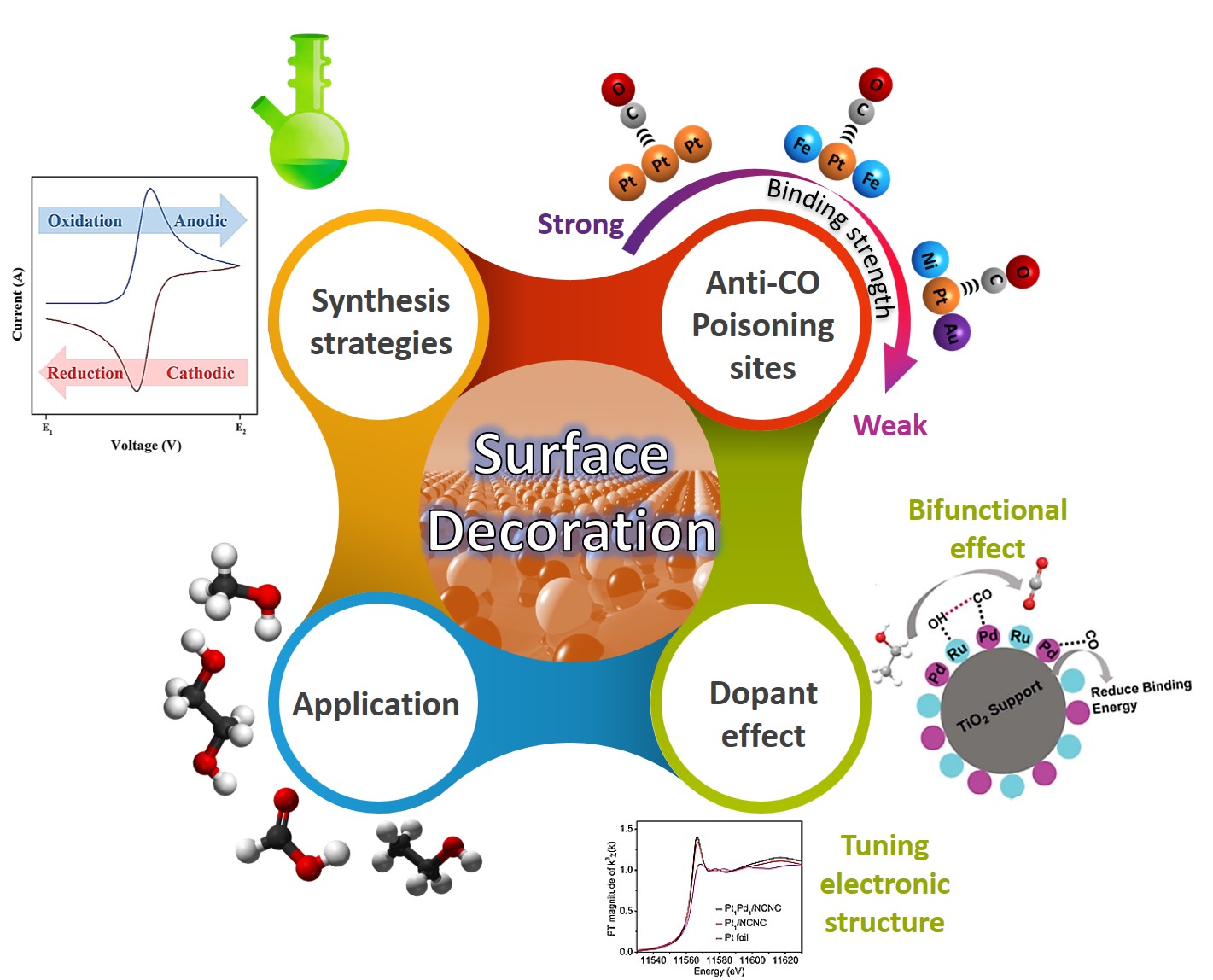
Surface dopant engineering has emerged as a powerful approach to enhance the catalytic properties of Pt and Pd nanomaterials by introducing site-specific modifications at the atomic scale. In liquid fuel oxidation reactions (LFORs), surface-decorated Pt/Pd catalysts demonstrate remarkable activity and durability by providing engineered sites that mitigate the long-standing challenge of carbon monoxide (CO) poisoning. Transition metal atoms and their oxides anchored on Pt/Pd surfaces act as anti-CO centers, facilitating more efficient fuel oxidation pathways while preserving catalytic stability. This review highlights recent advances in surface-decorated Pt/Pd catalysts, emphasizing the underlying mechanisms of CO resistance, synthetic strategies for dopant incorporation, and the structure-performance correlations that define their electrocatalytic behavior. We also summarize the performances achieved in methanol, ethanol, and other liquid fuel oxidation systems using dopant-engineered catalysts. Finally, we discuss the remaining challenges and future opportunities in rationally designing CO-tolerant catalytic surfaces for next-generation energy conversion devices.
- Open Access
- Review
CO-Resistant Surface Dopant Engineering of Pt/Pd Catalysts for High-Performance Liquid Fuel Oxidation Reactions
Author Information
Received: 10 Oct 2025 | Revised: 20 Nov 2025 | Accepted: 25 Nov 2025 | Published: 23 Dec 2025
Abstract
Graphical Abstract
Keywords
surface dopant engineering | platinum | CO poisoning | fuel cell | electrocatalysis
References
- 1.
Cheng, H.; Wang, J.; Wu, C.; Liu, Z. Electrocatalysts for Formic Acid-Powered PEM Fuel Cells: Challenges and Prospects. Energy Mater. Adv. 2025, 4, 67.
- 2.
Chang, J.; Wang, G.; Zhang, W.; Yang, Y. Atomically Dispersed Catalysts for Small Molecule Electrooxidation in Direct Liquid Fuel Cells. J. Energy Chem. 2022, 68, 439–453.
- 3.
Ramli, Z.A.C.; Pasupuleti, J.; Samidin, S.; Saharuddin, T.S.T.; Isahak, W.N.R.W.; Sofiah, A.G.N.; Koh, S.P.; Kiong, S.T. Recent Advances of Two-Dimensional-Based (2D) Materials as Electrocatalysts in DLFC: An Overview. Fuel 2025, 387, 134386.
- 4.
Li, Y.; Yao, M.-S.; He, Y.; Du, S. Recent Advances of Electrocatalysts and Electrodes for Direct Formic Acid Fuel Cells: From Nano to Meter Scale Challenges. Nano-Micro Lett. 2025, 17, 148.
- 5.
Shaari, N.; Kamarudin, S.K.; Bahru, R.; Osman, S.H.; Md Ishak, N.A.I. Progress and Challenges: Review for Direct Liquid Fuel Cell. Int. J. Energy Res. 2021, 45, 6644–6688.
- 6.
Altarawneh, R.M. Overview on the Vital Step toward Addressing Platinum Catalyst Poisoning Mechanisms in Acid Media of Direct Ethanol Fuel Cells (DEFCs). Energy Fuels 2021, 35, 11594–11612.
- 7.
Cai, B.; Chen, X.; Wang, L.; Fu, H. Advanced Progress for Promoting Anodic Hydrogen Oxidation Activity and Anti-CO Poisoning in Fuel Cells. ACS Catal. 2024, 14, 13602–13629.
- 8.
Chen, A.; Ostrom, C. Palladium-Based Nanomaterials: Synthesis and Electrochemical Applications. Chem. Rev. 2015, 115, 11999–12044.
- 9.
Kabiraz, M.K.; Kim, J.; Lee, W.-J.; Ruqia, B.; Kim, H.C.; Lee, S.-U.; Kim, J.-R.; Paek, S.-M.; Hong, J.W.; Choi, S.-I. Ligand Effect of Shape-Controlled β-Palladium Hydride Nanocrystals on Liquid-Fuel Oxidation Reactions. Chem. Mater. 2019, 31, 5663–5673.
- 10.
Antolini, E. Palladium in Fuel Cell Catalysis. Energy Environ. Sci. 2009, 2, 915–931.
- 11.
Zhang, H.; Jin, M.; Xia, Y. Enhancing the Catalytic and Electrocatalytic Properties of Pt-Based Catalysts by Forming Bimetallic Nanocrystals with Pd. Chem. Soc. Rev. 2012, 41, 8035–8049.
- 12.
Wu, C.; Zhang, Y.; Yang, H.Y. Rational Design and Facile Preparation of Palladium-Based Electrocatalysts for Small Molecules Oxidation. ChemSusChem 2025, 18, e202401127.
- 13.
Neto, A.O.; Dias, R.R.; Tusi, M.M.; Linardi, M.; Spinacé, E.V. Electro-Oxidation of Methanol and Ethanol Using PtRu/C, PtSn/C and PtSnRu/C Electrocatalysts Prepared by an Alcohol-Reduction Process. J. Power Sources 2007, 166, 87–91.
- 14.
Busó-Rogero, C.; Herrero, E.; Feliu, J.M. Ethanol Oxidation on Pt Single-Crystal Electrodes: Surface-Structure Effects in Alkaline Medium. ChemPhysChem 2014, 15, 2019–2028.
- 15.
Ozoemena, K.I. Nanostructured Platinum-Free Electrocatalysts in Alkaline Direct Alcohol Fuel Cells: Catalyst Design, Principles and Applications. RSC Adv. 2016, 6, 89523–89550.
- 16.
Liao, Y.; Chen, W.; Ding, Y.; Xie, L.; Yang, Q.; Wu, Q.; Liu, X.; Zhu, J.; Feng, R.; Fu, X.-Z. Boosting Alcohol Oxidation Electrocatalysis with Multifactorial Engineered Pd1/Pt Single-Atom Alloy-BiOx Adatoms Surface. Nano-Micro Lett. 2025, 17, 172.
- 17.
Mai, Q.; Mai, Y.; Zhong, Y.; Xue, R.; Jia, B.; Guan, X.; Du, W.; Pan, H.; Li, Y.; Zhang, Z. Intermetallic Electrocatalysts for Small-Molecule Fuel Oxidation. Adv. Energy Mater. 2025, 15, 2500415.
- 18.
Kwon, T.; Kim, T.; Son, Y.; Lee, K. Dopants in the Design of Noble Metal Nanoparticle Electrocatalysts and Their Effect on Surface Energy and Coordination Chemistry at the Nanocrystal Surface. Adv. Energy Mater. 2021, 11, 2100265.
- 19.
Chen, Q.-S.; Vidal-Iglesias, F.J.; Solla-Gullón, J.; Sun, S.-G.; Feliu, J.M. Role of Surface Defect Sites: From Pt Model Surfaces to Shape-Controlled Nanoparticles. Chem. Sci. 2012, 3, 136–147.
- 20.
Bommersbach, P.; Chaker, M.; Mohamedi, M.; Guay, D. Physico-Chemical and Electrochemical Properties of Platinum−Tin Nanoparticles Synthesized by Pulsed Laser Ablation for Ethanol Oxidation. J. Phys. Chem. C 2008, 112, 14672–14681.
- 21.
Hsieh, C.-T.; Lin, J.-Y. Fabrication of Bimetallic Pt–M (M=Fe, Co, and Ni) Nanoparticle/Carbon Nanotube Electrocatalysts for Direct Methanol Fuel Cells. J. Power Sources 2009, 188, 347–352.
- 22.
Kowal, A.; Li, M.; Shao, M.; Sasaki, K.; Vukmirovic, M.B.; Zhang, J.; Marinkovic, N.S.; Liu, P.; Frenkel, A.I.; Adzic, R.R. Ternary Pt/Rh/SnO2 Electrocatalysts for Oxidizing Ethanol to CO2. Nat. Mater. 2009, 8, 325–330.
- 23.
Koper, M.T.M. Structure Sensitivity and Nanoscale Effects in Electrocatalysis. Nanoscale 2011, 3, 2054–2073.
- 24.
Erini, N.; Rudi, S.; Beermann, V.; Krause, P.; Yang, R.; Huang, Y.; Strasser, P. Exceptional Activity of a Pt–Rh–Ni Ternary Nanostructured Catalyst for the Electrochemical Oxidation of Ethanol. ChemElectroChem 2015, 2, 903–908.
- 25.
Ong, B.C.; Kamarudin, S.K.; Basri, S. Direct Liquid Fuel Cells: A Review. Int. J. Hydrogen Energy 2017, 42, 10142–10157.
- 26.
Karim, N.A.; Kamarudin, S.K. Chapter 2—Introduction to Direct Alcohol Fuel Cells (DAFCs); Akay, R.G., Akay, R.G., Yurtcan, A.B., Eds.; Academic Press: London, UK, 2021; pp. 49–70.
- 27.
Ponmani, K.; Durga, S.; Arun, A.; Kiruthika, S.; Muthukumaran, B. Development of Membraneless Sodium Perborate Fuel Cell for Media Flexible Power Generation. Int. J. Electrochem. 2014, 2014, 962161.
- 28.
Arenz, M.; Mayrhofer, K.J.J.; Stamenkovic, V.; Blizanac, B.B.; Tomoyuki, T.; Ross, P.N.; Markovic, N.M. The Effect of the Particle Size on the Kinetics of CO Electrooxidation on High Surface Area Pt Catalysts. J. Am. Chem. Soc. 2005, 127, 6819–6829.
- 29.
Li, X.; Haunold, T.; Werkovits, S.; Marks, L.D.; Blaha, P.; Rupprechter, G. CO Adsorption and Disproportionation on Smooth and Defect-Rich Ir(111). J. Phys. Chem. C 2022, 126, 6578–6589.
- 30.
Fang, Q.; Zhang, Z.; Yang, X.; Cheng, T.; Ma, X.; Tang, J. Cu2O Nanoparticles with Controlled Surface Roughness for CO2 Electroreduction towards C2+ Products. Chem. Eng. J. 2025, 515, 163293.
- 31.
Cao, L.; Soto, F.A.; Li, D.; Deng, T.; Hu, E.; Lu, X.; Cullen, D.A.; Eidson, N.; Yang, X.-Q.; He, K.; et al. Pd-Ru Pair on Pt Surface for Promoting Hydrogen Oxidation and Evolution in Alkaline Media. Nat. Commun. 2024, 15, 7245.
- 32.
Long, D.; Liu, Y.; Ping, X.; Chen, F.; Tao, X.; Xie, Z.; Wang, M.; Wang, M.; Li, L.; Guo, L.; et al. Constructing CO-Immune Water Dissociation Sites around Pt to Achieve Stable Operation in High CO Concentration Environment. Nat. Commun. 2024, 15, 8105.
- 33.
Huang, H.; Hayes, E.T.C.; Gianolio, D.; Cibin, G.; Hage, F.S.; Ramasse, Q.M.; Russell, A.E. Role of SnO2 in the Bifunctional Mechanism of CO Oxidation at Pt-SnO2 Electrocatalysts. ChemElectroChem 2021, 8, 2572–2582.
- 34.
Berretti, E.; Osmieri, L.; Baglio, V.; Miller, H.A.; Filippi, J.; Vizza, F.; Santamaria, M.; Specchia, S.; Santoro, C.; Lavacchi, A. Direct Alcohol Fuel Cells: A Comparative Review of Acidic and Alkaline Systems. Electrochem. Energy Rev. 2023, 6, 30.
- 35.
Li, M.; Adzic, R.R. Low-Platinum-Content Electrocatalysts for Methanol and Ethanol Electrooxidation BT—Electrocatalysis in Fuel Cells: A Non- and Low-Platinum Approach; Shao, M., Ed.; Springer: London, UK, 2013; pp. 1–25.
- 36.
Wang, Y.; Zou, S.; Cai, W.-B. Recent Advances on Electro-Oxidation of Ethanol on Pt- and Pd-Based Catalysts: From Reaction Mechanisms to Catalytic Materials. Catalysts 2015, 5, 1507–1534.
- 37.
Flórez-Montaño, J.; García, G.; Guillén-Villafuerte, O.; Rodríguez, J.L.; Planes, G.A.; Pastor, E. Mechanism of Ethanol Electrooxidation on Mesoporous Pt Electrode in Acidic Medium Studied by a Novel Electrochemical Mass Spectrometry Set-Up. Electrochim. Acta 2016, 209, 121–131.
- 38.
Dai, L.-X.; Wang, X.-Y.; Yang, S.-S.; Zhang, T.; Ren, P.-J.; Ye, J.-Y.; Nan, B.; Wen, X.-D.; Zhou, Z.-Y.; Si, R.; et al. Intrinsic Composition and Electronic Effects of Multicomponent Platinum Nanocatalysts with High Activity and Selectivity for Ethanol Oxidation Reaction. J. Mater. Chem. A 2018, 6, 11270–11280.
- 39.
Asiri, H.A.; Anderson, A.B. Mechanisms for Ethanol Electrooxidation on Pt(111) and Adsorption Bond Strengths Defining an Ideal Catalyst. J. Electrochem. Soc. 2015, 162, F115.
- 40.
Yang, Y.-Y.; Ren, J.; Li, Q.-X.; Zhou, Z.-Y.; Sun, S.-G.; Cai, W.-B. Electrocatalysis of Ethanol on a Pd Electrode in Alkaline Media: An in Situ Attenuated Total Reflection Surface-Enhanced Infrared Absorption Spectroscopy Study. ACS Catal. 2014, 4, 798–803.
- 41.
Chang, Q.; Hong, Y.; Lee, H.J.; Lee, J.H.; Ologunagba, D.; Liang, Z.; Kim, J.; Kim, M.J.; Hong, J.W.; Song, L.; et al. Achieving Complete Electrooxidation of Ethanol by Single Atomic Rh Decoration of Pt Nanocubes. Proc. Natl. Acad. Sci. USA 2022, 119, e2112109119.
- 42.
Schnaidt, J.; Heinen, M.; Jusys, Z.; Behm, R.J. Mechanistic Aspects of the Electro-Oxidation of Ethylene Glycol on a Pt-Film Electrode: A Combined in Situ IR Spectroscopy and Online Mass Spectrometry Study of Kinetic Isotope Effects. Catal. Today 2013, 202, 154–162.
- 43.
Liu, Y.; Hu, P.; Wei, M.; Wang, C. Electrocatalytic Study of Ethylene Glycol Oxidation on Pt3Sn Alloy Nanoparticles. ChemElectroChem 2019, 6, 1004–1008.
- 44.
Kabiraz, M.K.; Wahidah, H.; Hong, J.W.; Choi, S.-I. Platinum Metallenes: Advanced Electrocatalysts for Sustainable Energy Solutions. Small 2025, 21, 2500858.
- 45.
Tong, Y.; Yan, X.; Liang, J.; Dou, S.X. Metal-Based Electrocatalysts for Methanol Electro-Oxidation: Progress, Opportunities, and Challenges. Small 2021, 17, 1904126.
- 46.
Ayán-Varela, M.; Ruiz-Rosas, R.; Villar-Rodil, S.; Paredes, J.I.; Cazorla-Amorós, D.; Morallón, E.; Martínez-Alonso, A.; Tascón, J.M.D. Efficient Pt Electrocatalysts Supported onto Flavin Mononucleotide-Exfoliated Pristine Graphene for the Methanol Oxidation Reaction. Electrochim. Acta 2017, 231, 386–395.
- 47.
Mu, Y.; Liang, H.; Hu, J.; Jiang, L.; Wan, L. Controllable Pt Nanoparticle Deposition on Carbon Nanotubes as an Anode Catalyst for Direct Methanol Fuel Cells. J. Phys. Chem. B 2005, 109, 22212–22216.
- 48.
Watanabe, M.; Motoo, S. Electrocatalysis by Ad-Atoms: Part III. Enhancement of the Oxidation of Carbon Monoxide on Platinum by Ruthenium Ad-Atoms. J. Electroanal. Chem. Interfacial Electrochem. 1975, 60, 275–283.
- 49.
Pei, A.; Ruan, L.; Liu, B.; Chen, W.; Lin, S.; Chen, B.; Liu, Y.; Zhu, L.H.; Chen, B.H. Ultra-Low Au Decorated PtNi Alloy Nanoparticles on Carbon for High-Efficiency Electro-Oxidation of Methanol and Formic Acid. Int. J. Hydrogen Energy 2020, 45, 22893–22905.
- 50.
Bhalothia, D.; Huang, T.-H.; Chou, P.-H.; Wang, K.-W.; Chen, T.-Y. Promoting Formic Acid Oxidation Performance of Pd Nanoparticles via Pt and Ru Atom Mediated Surface Engineering. RSC Adv. 2020, 10, 17302–17310.
- 51.
Bhalothia, D.; Huang, T.-H.; Chou, P.-H.; Chen, P.-C.; Wang, K.-W.; Chen, T.-Y. CO-Reductive and O2-Oxidative Annealing Assisted Surface Restructure and Corresponding Formic Acid Oxidation Performance of PdPt and PdRuPt Nanocatalysts. Sci. Rep. 2020, 10, 8457.
- 52.
Xia, S.; Wu, F.; Liu, Q.; Gao, W.; Guo, C.; Wei, H.; Hussain, A.; Zhang, Y.; Xu, G.; Niu, W. Steering the Selective Production of Glycolic Acid by Electrocatalytic Oxidation of Ethylene Glycol with Nanoengineered PdBi-Based Heterodimers. Small 2024, 20, 2400939.
- 53.
Schnaidt, J.; Heinen, M.; Jusys, Z.; Behm, R.J. Oxidation of the Partly Oxidized Ethylene Glycol Oxidation Products Glycolaldehyde, Glyoxal, Glycolic Acid, Glyoxylic Acid, and Oxalic Acid on Pt Electrodes: A Combined ATR-FTIRS and DEMS Spectroelectrochemical Study. J. Phys. Chem. C 2013, 117, 12689–12701.
- 54.
Yue, H.; Zhao, Y.; Ma, X.; Gong, J. Ethylene Glycol: Properties, Synthesis, and Applications. Chem. Soc. Rev. 2012, 41, 4218–4244.
- 55.
Zhong, J.; Bin, D.; Feng, Y.; Zhang, K.; Wang, J.; Wang, C.; Guo, J.; Yang, P.; Du, Y. Synthesis and High Electrocatalytic Activity of Au-Decorated Pd Heterogeneous Nanocube Catalysts for Ethanol Electro-Oxidation in Alkaline Media. Catal. Sci. Technol. 2016, 6, 5397–5404.
- 56.
Yuan, X.; Zhang, Y.; Cao, M.; Zhou, T.; Jiang, X.; Chen, J.; Lyu, F.; Xu, Y.; Luo, J.; Zhang, Q.; et al. Bi(OH)3/PdBi Composite Nanochains as Highly Active and Durable Electrocatalysts for Ethanol Oxidation. Nano Lett. 2019, 19, 4752–4759.
- 57.
Gao, L.; Yang, Z.; Sun, T.; Tan, X.; Lai, W.; Li, M.; Kim, J.; Lu, Y.-F.; Choi, S.-I.; Zhang, W.; et al. Autocatalytic Surface Reduction-Assisted Synthesis of PtW Ultrathin Alloy Nanowires for Highly Efficient Hydrogen Evolution Reaction. Adv. Energy Mater. 2022, 12, 2103943.
- 58.
Wasmus, S.; Küver, A. Methanol Oxidation and Direct Methanol Fuel Cells: A Selective Review. J. Electroanal. Chem. 1999, 461, 14–31.
- 59.
Tiwari, J.N.; Tiwari, R.N.; Singh, G.; Kim, K.S. Recent Progress in the Development of Anode and Cathode Catalysts for Direct Methanol Fuel Cells. Nano Energy 2013, 2, 553–578.
- 60.
Park, J.; Kwon, T.; Kim, J.; Jin, H.; Kim, H.Y.; Kim, B.; Joo, S.H.; Lee, K. Hollow Nanoparticles as Emerging Electrocatalysts for Renewable Energy Conversion Reactions. Chem. Soc. Rev. 2018, 47, 8173–8202.
- 61.
Aricò, A.S.; Srinivasan, S.; Antonucci, V. DMFCs: From Fundamental Aspects to Technology Development. Fuel Cells 2001, 1, 133–161.
- 62.
Yuda, A.; Ashok, A.; Kumar, A. A Comprehensive and Critical Review on Recent Progress in Anode Catalyst for Methanol Oxidation Reaction. Catal. Rev. 2022, 64, 126–228.
- 63.
Liu, M.; Zhang, Z.; Li, C.; Jin, S.; Zhu, K.; Fan, S.; Li, J.; Liu, K. High-Entropy Alloyed Single-Atom Pt for Methanol Oxidation Electrocatalysis. Nat. Commun. 2025, 16, 6359.
- 64.
Li, P.; Hu, Q.; Fan, W.; Li, M.; Zhou, C.; Zhang, H.; Chen, L.; Pan, Z.; Jiao, X.; Chen, Q. Synergistic Multi-Active Sites in High-Entropy Alloy Nanowires Enhances the Methanol Oxidation Reaction Performances. Small 2025, 21, 2506472.
- 65.
Xing, S.; Liu, Z.; Jiang, Y.; Tang, P.; Zhang, J.; Chen, J.; Li, H.; Li, C. Platinum-Copper Nanowire Networks with Enhanced CO Tolerance toward Methanol Oxidation Electrocatalysis. Chem. Sci. 2025, 16, 9311–9319
- 66.
Lin, Z.; Chen, W.; Jiang, Y.; Bian, T.; Zhang, H.; Wu, J.; Wang, Y.; Yang, D. Facile Synthesis of Ru-Decorated Pt Cubes and Icosahedra as Highly Active Electrocatalysts for Methanol Oxidation. Nanoscale 2016, 8, 12812–12818.
- 67.
Maiyalagan, T.; Alaje, T.O.; Scott, K. Highly Stable Pt–Ru Nanoparticles Supported on Three-Dimensional Cubic Ordered Mesoporous Carbon (Pt–Ru/CMK-8) as Promising Electrocatalysts for Methanol Oxidation. J. Phys. Chem. C 2012, 116, 2630–2638.
- 68.
Takeguchi, T.; Yamanaka, T.; Asakura, K.; Muhamad, E.N.; Uosaki, K.; Ueda, W. Evidence of Nonelectrochemical Shift Reaction on a CO-Tolerant High-Entropy State Pt–Ru Anode Catalyst for Reliable and Efficient Residential Fuel Cell Systems. J. Am. Chem. Soc. 2012, 134, 14508–14512.
- 69.
Nilekar, A.U.; Sasaki, K.; Farberow, C.A.; Adzic, R.R.; Mavrikakis, M. Mixed-Metal Pt Monolayer Electrocatalysts with Improved CO Tolerance. J. Am. Chem. Soc. 2011, 133, 18574–18576.
- 70.
Gasteiger, H.A.; Markovic, N.; Ross, P.N.; Cairns, E.J. Methanol Electrooxidation on Well-Characterized Platinum-Ruthenium Bulk Alloys. J. Phys. Chem. 1993, 97, 12020–12029.
- 71.
Zhao, X.; Yin, M.; Ma, L.; Liang, L.; Liu, C.; Liao, J.; Lu, T.; Xing, W. Recent Advances in Catalysts for Direct Methanol Fuel Cells. Energy Environ. Sci. 2011, 4, 2736–2753.
- 72.
Yajima, T.; Wakabayashi, N.; Uchida, H.; Watanabe, M. Adsorbed Water for the Electro-Oxidation of Methanol at Pt–Ru Alloy. Chem. Commun. 2003, 7, 828–829.
- 73.
Pelliccione, C.J.; Timofeeva, E.V.; Katsoudas, J.P.; Segre, C.U. In Situ Ru K-Edge X-Ray Absorption Spectroscopy Study of Methanol Oxidation Mechanisms on Model Submonolayer Ru on Pt Nanoparticle Electrocatalyst. J. Phys. Chem. C 2013, 117, 18904–18912.
- 74.
Cai, Z.; Lu, Z.; Bi, Y.; Li, Y.; Kuang, Y.; Sun, X. Superior Anti-CO Poisoning Capability: Au-Decorated PtFe Nanocatalysts for High-Performance Methanol Oxidation. Chem. Commun. 2016, 52, 3903–3906.
- 75.
Gu, J.; Liu, W.-C.; Zhao, Z.-Q.; Lan, G.-X.; Zhu, W.; Zhang, Y.-W. Pt/Ru/C Nanocomposites for Methanol Electrooxidation: How Ru Nanocrystals’ Surface Structure Affects Catalytic Performance of Deposited Pt Particles. Inorg. Chem. Front. 2014, 1, 109–117.
- 76.
Freitas, R.G.; Marchesi, L.F.Q.; Forim, M.R.; Bulhões, L.O.; Pereira, E.C.; Santos, M.C.; Oliveira, R.T. Ethanol Electrooxidation Using Ti/(RuO2)(x)Pt(1−x) Electrodes Prepared by the Polymeric Precursor Method. J. Braz. Chem. Soc. 2011, 22, 1709–1717.
- 77.
Freitas, R.G.; Marchesi, L.F.; Oliveira, R.T.S.; Mattos-Costa, F.I.; Pereira, E.C.; Bulhoes, L.O.S.; Santos, M.C. Methanol Oxidation Reaction on Ti/(RuO2)(x)Pt(1−x) Electrodes Prepared by the Polymeric Precursor Method. J. Power Sources 2007, 171, 373–380.
- 78.
Park, J.; Kim, H.J.; Oh, A.; Kwon, T.; Baik, H.; Choi, S.-I.; Lee, K. RuO X-Decorated Multimetallic Hetero-Nanocages as Highly Efficient Electrocatalysts toward the Methanol Oxidation Reaction. Nanoscale 2018, 10, 21178–21185.
- 79.
Qiao, B.; Wang, A.; Yang, X.; Allard, L.F.; Jiang, Z.; Cui, Y.; Liu, J.; Li, J.; Zhang, T. Single-Atom Catalysis of CO Oxidation Using Pt1/FeOX. Nat. Chem. 2011, 3, 634–641.
- 80.
Fu, Q.; Li, W.-X.; Yao, Y.; Liu, H.; Su, H.-Y.; Ma, D.; Gu, X.-K.; Chen, L.; Wang, Z.; Zhang, H. Interface-Confined Ferrous Centers for Catalytic Oxidation. Science 2010, 328, 1141–1144.
- 81.
Pedersen, M.Ø.; Helveg, S.; Ruban, A.; Stensgaard, I.; Lægsgaard, E.; Nørskov, J.K.; Besenbacher, F. How a Gold Substrate Can Increase the Reactivity of a Pt Overlayer. Surf. Sci. 1999, 426, 395–409.
- 82.
Koenigsmann, C.; Semple, D.B.; Sutter, E.; Tobierre, S.E.; Wong, S.S. Ambient Synthesis of High-Quality Ruthenium Nanowires and the Morphology-Dependent Electrocatalytic Performance of Platinum-Decorated Ruthenium Nanowires and Nanoparticles in the Methanol Oxidation Reaction. ACS Appl. Mater. Interfaces 2013, 5, 5518–5530.
- 83.
Marinkovic, N.S.; Li, M.; Adzic, R.R. Pt-based Catalysts for Electrochemical Oxidation of Ethanol. Electrocatalysis 2019, 377, 11.
- 84.
Li, G.; Pickup, P.G. Analysis of Performance Losses of Direct Ethanol Fuel Cells with the Aid of a Reference Electrode. J. Power Sources 2006, 161, 256–263.
- 85.
Xu, Y.; Zhang, B. Recent Advances in Porous Pt-Based Nanostructures: Synthesis and Electrochemical Applications. Chem. Soc. Rev. 2014, 43, 2439–2450.
- 86.
Zhu, W.; Ke, J.; Wang, S.-B.; Ren, J.; Wang, H.-H.; Zhou, Z.-Y.; Si, R.; Zhang, Y.-W.; Yan, C.-H. Shaping Single-Crystalline Trimetallic Pt–Pd–Rh Nanocrystals toward High-Efficiency C–C Splitting of Ethanol in Conversion to CO2. ACS Catal. 2015, 5, 1995–2008.
- 87.
Kim, H.J.; Ruqia, B.; Kang, M.S.; Lim, S.B.; Choi, R.; Nam, K.M.; Seo, W.S.; Lee, G.; Choi, S.-I. Shape-Controlled Pt Nanocubes Directly Grown on Carbon Supports and Their Electrocatalytic Activity toward Methanol Oxidation. Sci. Bull. 2017, 62, 943–949.
- 88.
Kim, K.S.; Hong, Y.; Kim, H.C.; Choi, S.; Hong, J.W. Ultrathin-Polyaniline-Coated Pt–Ni Alloy Nanooctahedra for the Electrochemical Methanol Oxidation Reaction. Chem. Eur. J. 2019, 25, 7185–7190.
- 89.
Zhang, Z.; Liu, J.; Zhu, S.; Wang, Y.; Wang, J.; Xu, M.; Zhao, J.; Wang, Z.; Zeng, D.; Zeng, J. Dizygotic Atomic Platinum and Palladium on Carbon for High-Performance Ethanol and Methanol Electro-Oxidation. Angew. Chem. Int. Ed. 2025, 64, e202502348.
- 90.
Kim, H.J.; Ahn, Y.-D.; Kim, J.; Kim, K.-S.; Jeong, Y.U.; Hong, J.W.; Choi, S.-I. Surface Elemental Distribution Effect of Pt-Pb Hexagonal Nanoplates for Electrocatalytic Methanol Oxidation Reaction. Chin. J. Catal. 2020, 41, 813–819.
- 91.
Zhang, K.; Bin, D.; Yang, B.; Wang, C.; Ren, F.; Du, Y. Ru-Assisted Synthesis of Pd/Ru Nanodendrites with High Activity for Ethanol Electrooxidation. Nanoscale 2015, 7, 12445–12451.
- 92.
Wu, Z.; Duan, R.; Cui, J.; Ye, C.; Zhang, S.; Yan, S. An Overview of the Pd Based Electrocatalysts Utilized in Direct Alcohol Fuel Cells. Electrocatalysis 2025, 16, 197–223.
- 93.
Cui, Y.; Ma, K.; Chen, Z.; Yang, J.; Geng, Z.; Zeng, J. Atomic-Level Insights into Strain Effect on p-Nitrophenol Reduction via Au@Pd Core–Shell Nanocubes as an Ideal Platform. J. Catal. 2020, 381, 427–433.
- 94.
Yuge, K.; Koyama, Y.; Kuwabara, A.; Tanaka, I. Surface Design of Alloy Protection against CO-Poisoning from First Principles. J. Phys. Condens. Matter 2014, 26, 355006.
- 95.
Nguyen, M.T.X.; Nguyen, M.-K.; Pham, P.T.T.; Huynh, H.K.P.; Pham, H.H.; Vo, C.C.; Nguyen, S.T. High-Performance Pd-Coated Ni Nanowire Electrocatalysts for Alkaline Direct Ethanol Fuel Cells. J. Electroanal. Chem. 2021, 888, 115180.
- 96.
Li, M.; Zhao, Z.; Xia, Z.; Yang, Y.; Luo, M.; Huang, Y.; Sun, Y.; Chao, Y.; Yang, W.; Yang, W.; et al. Lavender-Like Ga-Doped Pt3Co Nanowires for Highly Stable and Active Electrocatalysis. ACS Catal. 2020, 10, 3018–3026.
- 97.
Mao, J.; Chen, W.; He, D.; Wan, J.; Pei, J.; Dong, J.; Wang, Y.; An, P.; Jin, Z.; Xing, W. Design of Ultrathin Pt-Mo-Ni Nanowire Catalysts for Ethanol Electrooxidation. Sci. Adv. 2017, 3, e1603068.
- 98.
Hong, Y.; Kim, H.J.; Lee, H.J.; Kim, J.; Choi, S.-I. Ni(OH)2 Decorated Pt–Cu Octahedra for Ethanol Electrooxidation Reaction. Front. Chem. 2019, 7, 608.
- 99.
Fan, X.; Tang, M.; Wu, X.; Luo, S.; Chen, W.; Song, X.; Quan, Z. SnO2 Patched Ultrathin PtRh Nanowires as Efficient Catalysts for Ethanol Electrooxidation. J. Mater. Chem. A 2019, 7, 27377–27382.
- 100.
Gruzeł, G.; Szmuc, K.; Drzymała, E.; Piekarz, P.; Pajor-Świerzy, A.; Budziak, A.; Pastor, E. Thin Layer vs. Nanoparticles: Effect of SnO2 Addition to PtRhNi Nanoframes for Ethanol Oxidation Reaction. Int. J. Hydrogen Energy 2022, 47, 14823–14835.
- 101.
Yu, X.; Pickup, P.G. Recent Advances in Direct Formic Acid Fuel Cells (DFAFC). J. Power Sources 2008, 182, 124–132.
- 102.
Rhee, Y.-W.; Ha, S.Y.; Masel, R.I. Crossover of Formic Acid through Nafion® Membranes. J. Power Sources 2003, 117, 35–38.
- 103.
Demirci, U.B. Direct Liquid-Feed Fuel Cells: Thermodynamic and Environmental Concerns. J. Power Sources 2007, 169, 239–246.
- 104.
Aslam, N.M.; Masdar, M.S.; Kamarudin, S.K.; Daud, W.R.W. Overview on Direct Formic Acid Fuel Cells (DFAFCs) as an Energy Sources. Apcbee Procedia 2012, 3, 33–39.
- 105.
Capon, A.; Parson, R. The Oxidation of Formic Acid at Noble Metal Electrodes: I. Review of Previous Work. J. Electroanal. Chem. Interfacial Electrochem. 1973, 44, 1–7.
- 106.
Capon, A.; Parsons, R. The Oxidation of Formic Acid on Noble Metal Electrodes: II. A Comparison of the Behaviour of Pure Electrodes. J. Electroanal. Chem. Interfacial Electrochem. 1973, 44, 239–254.
- 107.
Fayette, M.; Nutariya, J.; Vasiljevic, N.; Dimitrov, N. A Study of Pt Dissolution during Formic Acid Oxidation. Acs Catal. 2013, 3, 1709–1718.
- 108.
Rettenmaier, C.; Arán-Ais, R.M.; Timoshenko, J.; Rizo, R.; Jeon, H.S.; Kühl, S.; Chee, S.W.; Bergmann, A.; Roldan Cuenya, B. Enhanced Formic Acid Oxidation over SnO2-Decorated Pd Nanocubes. ACS Catal. 2020, 10, 14540–14551.
- 109.
Miyake, H.; Okada, T.; Samjeské, G.; Osawa, M. Formic Acid Electrooxidation on Pd in Acidic Solutions Studied by Surface-Enhanced Infrared Absorption Spectroscopy. Phys. Chem. Chem. Phys. 2008, 10, 3662–3669.
- 110.
Zhou, Y.; Du, C.; Han, G.; Gao, Y.; Yin, G. Ultra-Low Pt Decorated PdFe Alloy Nanoparticles for Formic Acid Electro-Oxidation. Electrochim. Acta 2016, 217, 203–209.
- 111.
Wang, J.-Y.; Kang, Y.-Y.; Yang, H.; Cai, W.-B. Boron-Doped Palladium Nanoparticles on Carbon Black as a Superior Catalyst for Formic Acid Electro-Oxidation. J. Phys. Chem. C 2009, 113, 8366–8372.
- 112.
Xu, H.; Yan, B.; Zhang, K.; Wang, C.; Zhong, J.; Li, S.; Yang, P.; Du, Y. Facile Synthesis of Pd–Ru–P Ternary Nanoparticle Networks with Enhanced Electrocatalytic Performance for Methanol Oxidation. Int. J. Hydrogen Energy 2017, 42, 11229–11238.
- 113.
Lv, H.; Xu, D.; Sun, L.; Henzie, J.; Suib, S.L.; Yamauchi, Y.; Liu, B. Ternary Palladium-Boron-Phosphorus Alloy Mesoporous Nanospheres for Highly Efficient Electrocatalysis. ACS Nano 2019, 13, 12052–12061.
- 114.
Scofield, M.E.; Koenigsmann, C.; Wang, L.; Liu, H.; Wong, S.S. Tailoring the Composition of Ultrathin, Ternary Alloy PtRuFe Nanowires for the Methanol Oxidation Reaction and Formic Acid Oxidation Reaction. Energy Environ. Sci. 2015, 8, 350–363.
- 115.
Vidal-Iglesias, F.J.; Solla-Gullón, J.; Herrero, E.; Aldaz, A.; Feliu, J.M. Pd Adatom Decorated (100) Preferentially Oriented Pt Nanoparticles for Formic Acid Electrooxidation. Angew. Chem. Int. Ed. 2010, 49, 6998–7001.
- 116.
Yang, F.-K.; Fang, Y.; Li, F.-F.; Qu, W.-L.; Deng, C. Sn-Doped PdCu Alloy Nanosheet Assemblies as an Efficient Electrocatalyst for Formic Acid Oxidation. Dalt. Trans. 2023, 52, 14428–14434.
- 117.
Lin, X.; Geng, S.; Du, X.; Wang, F.; Zhang, X.; Xiao, F.; Xiao, Z.; Wang, Y.; Cheng, J.; Zheng, Z.; et al. Efficient Direct Formic Acid Electrocatalysis Enabled by Rare Earth-Doped Platinum-Tellurium Heterostructures. Nat. Commun. 2025, 16, 147.
- 118.
Vidal-Iglesias, F.J.; López-Cudero, A.; Solla-Gullón, J.; Feliu, J.M. Towards More Active and Stable Electrocatalysts for Formic Acid Electrooxidation: Antimony-Decorated Octahedral Platinum Nanoparticles. Angew. Chem. Int. Ed. 2013, 52, 964–967.
- 119.
Serov, A.; Kwak, C. Recent Achievements in Direct Ethylene Glycol Fuel Cells (DEGFC). Appl. Catal. B Environ. 2010, 97, 1–12.
- 120.
Gao, J.; Mao, M.; Li, P.; Liu, R.; Song, H.; Sun, K.; Zhang, S. Segmentation and Re-Encapsulation of Porous PtCu Nanoparticles by Generated Carbon Shell for Enhanced Ethylene Glycol Oxidation and Oxygen-Reduction Reaction. ACS Appl. Mater. Interfaces 2020, 12, 6298–6308.
- 121.
An, L.; Chen, R. Recent Progress in Alkaline Direct Ethylene Glycol Fuel Cells for Sustainable Energy Production. J. Power Sources 2016, 329, 484–501.
- 122.
Chang, S.C.; Ho, Y.; Weaver, M.J. Applications of Real-Time FTIR Spectroscopy to the Elucidation of Complex Electroorganic Pathways: Electrooxidation of Ethylene Glycol on Gold, Platinum, and Nickel in Alkaline Solution. J. Am. Chem. Soc. 1991, 113, 9506–9513.
- 123.
Schnaidt, J.; Heinen, M.; Jusys, Z.; Behm, R.J. Electro-Oxidation of Ethylene Glycol on a Pt-Film Electrode Studied by Combined in Situ Infrared Spectroscopy and Online Mass Spectrometry. J. Phys. Chem. C 2012, 116, 2872–2883.
- 124.
Wang, Y.; Zhuo, H.; Sun, H.; Zhang, X.; Dai, X.; Luan, C.; Qin, C.; Zhao, H.; Li, J.; Wang, M. Implanting Mo Atoms into Surface Lattice of Pt3Mn Alloys Enclosed by High-Indexed Facets: Promoting Highly Active Sites for Ethylene Glycol Oxidation. ACS Catal. 2018, 9, 442–455.
- 125.
Bai, S.; Wang, C.; Deng, M.; Gong, M.; Bai, Y.; Jiang, J.; Xiong, Y. Surface Polarization Matters: Enhancing the Hydrogen-evolution Reaction by Shrinking Pt Shells in Pt–Pd–Graphene Stack Structures. Angew. Chem. Int. Ed. 2014, 53, 12120–12124.
- 126.
Li, C.; Yuan, Q.; Ni, B.; He, T.; Zhang, S.; Long, Y.; Gu, L.; Wang, X. Dendritic Defect-Rich Palladium–Copper–Cobalt Nanoalloys as Robust Multifunctional Non-Platinum Electrocatalysts for Fuel Cells. Nat. Commun. 2018, 9, 3702.
- 127.
Robinson, A.M.; Mark, L.; Rasmussen, M.J.; Hensley, J.E.; Medlin, J.W. Surface Chemistry of Aromatic Reactants on Pt-and Mo-Modified Pt Catalysts. J. Phys. Chem. C 2016, 120, 26824–26833.
- 128.
Demarconnay, L.; Brimaud, S.; Coutanceau, C.; Léger, J.-M. Ethylene Glycol Electrooxidation in Alkaline Medium at Multi-Metallic Pt Based Catalysts. J. Electroanal. Chem. 2007, 601, 169–180.
- 129.
Yang, Y.-Y.; Ren, J.; Zhang, H.-X.; Zhou, Z.-Y.; Sun, S.-G.; Cai, W.-B. Infrared Spectroelectrochemical Study of Dissociation and Oxidation of Methanol at a Palladium Electrode in Alkaline Solution. Langmuir 2013, 29, 1709–1716.
- 130.
Hahn, F.; Beden, B.; Kadirgan, F.; Lamy, C. Electrocatalytic Oxidation of Ethylene Glycol: Part III. In-Situ Infrared Reflectance Spectroscopic Study of the Strongly Bound Species Resulting from Its Chemisorption at a Platinum Electrode in Aqueous Medium. J. Electroanal. Chem. Interfacial Electrochem. 1987, 216, 169–180.
- 131.
Leung, L.W.H.; Weaver, M.J. Real-Time FTIR Spectroscopy as a Quantitative Kinetic Probe of Competing Electrooxidation Pathways of Small Organic Molecules. J. Phys. Chem. 1988, 92, 4019–4022.
- 132.
Christensen, P.A.; Hamnett, A. The Oxidation of Ethylene Glycol at a Platinum Electrode in Acid and Base: An in Situ FTIR Study. J. Electroanal. Chem. Interfacial Electrochem. 1989, 260, 347–359.
- 133.
Wang, H.; Jiang, B.; Zhao, T.-T.; Jiang, K.; Yang, Y.-Y.; Zhang, J.; Xie, Z.; Cai, W.-B. Electrocatalysis of Ethylene Glycol Oxidation on Bare and Bi-Modified Pd Concave Nanocubes in Alkaline Solution: An Interfacial Infrared Spectroscopic Investigation. ACS Catal. 2017, 7, 2033–2041.
- 134.
Wang, P.; Lin, X.; Yang, B.; Jin, J.-M.; Hardacre, C.; Yu, N.-F.; Sun, S.-G.; Lin, W.-F. Activity Enhancement of Tetrahexahedral Pd Nanocrystals by Bi Decoration towards Ethanol Electrooxidation in Alkaline Media. Electrochim. Acta 2015, 162, 290–299.
- 135.
Bambagioni, V.; Bevilacqua, M.; Bianchini, C.; Filippi, J.; Marchionni, A.; Vizza, F.; Wang, L.Q.; Shen, P.K. Ethylene Glycol Electrooxidation on Smooth and Nanostructured Pd Electrodes in Alkaline Media. Fuel Cells 2010, 10, 582–590.
- 136.
Cheng, J.; Tu, Y.; Xiang, Y.; Ni, J.; Guo, T.; Huang, X.; Liu, B.; Wei, Z. Anti-Poisoning of CO and Carbonyl Species over Pd Catalysts during the Electrooxidation of Ethylene Glycol to Glycolic Acid at Elevated Current Density. Chem. Sci. 2025, 16, 4303–4310.
- 137.
Wang, C.; Xu, H.; Shang, H.; Jin, L.; Chen, C.; Wang, Y.; Yuan, M.; Du, Y. Ir-Doped Pd Nanosheet Assemblies as Bifunctional Electrocatalysts for Advanced Hydrogen Evolution Reaction and Liquid Fuel Electrocatalysis. Inorg. Chem. 2020, 59, 3321–3329.
- 138.
Wang, Y.; Zheng, M.; Sun, H.; Zhang, X.; Luan, C.; Li, Y.; Zhao, L.; Zhao, H.; Dai, X.; Ye, J.-Y.; et al. Catalytic Ru Containing Pt3Mn Nanocrystals Enclosed with High-Indexed Facets: Surface Alloyed Ru Makes Pt More Active than Ru Particles for Ethylene Glycol Oxidation. Appl. Catal. B Environ. 2019, 253, 11–20.
- 139.
Qin, Y.; Zhang, W.; Wang, F.; Li, J.; Ye, J.; Sheng, X.; Li, C.; Liang, X.; Liu, P.; Wang, X. Extraordinary p–d Hybridization Interaction in Heterostructural Pd-PdSe Nanosheets Boosts C–C Bond Cleavage of Ethylene Glycol Electrooxidation. Angew. Chem. Int. Ed. 2022, 61, e202200899.
- 140.
Yang, X.; Yao, K.X.; Ye, J.Y.; Yuan, Q.; Zhao, F.; Li, Y.; Zhou, Z. Interface-Rich Three-Dimensional Au-Doped PtBi Intermetallics as Highly Effective Anode Catalysts for Application in Alkaline Ethylene Glycol Fuel Cells. Adv. Funct. Mater. 2021, 31, 2103671.


This work is licensed under a Creative Commons Attribution 4.0 International License.

 Suite 4002 Level 4, 447 Collins Street, Melbourne, Victoria 3000, Australia
 General Inquiries: info@sciltp.com