
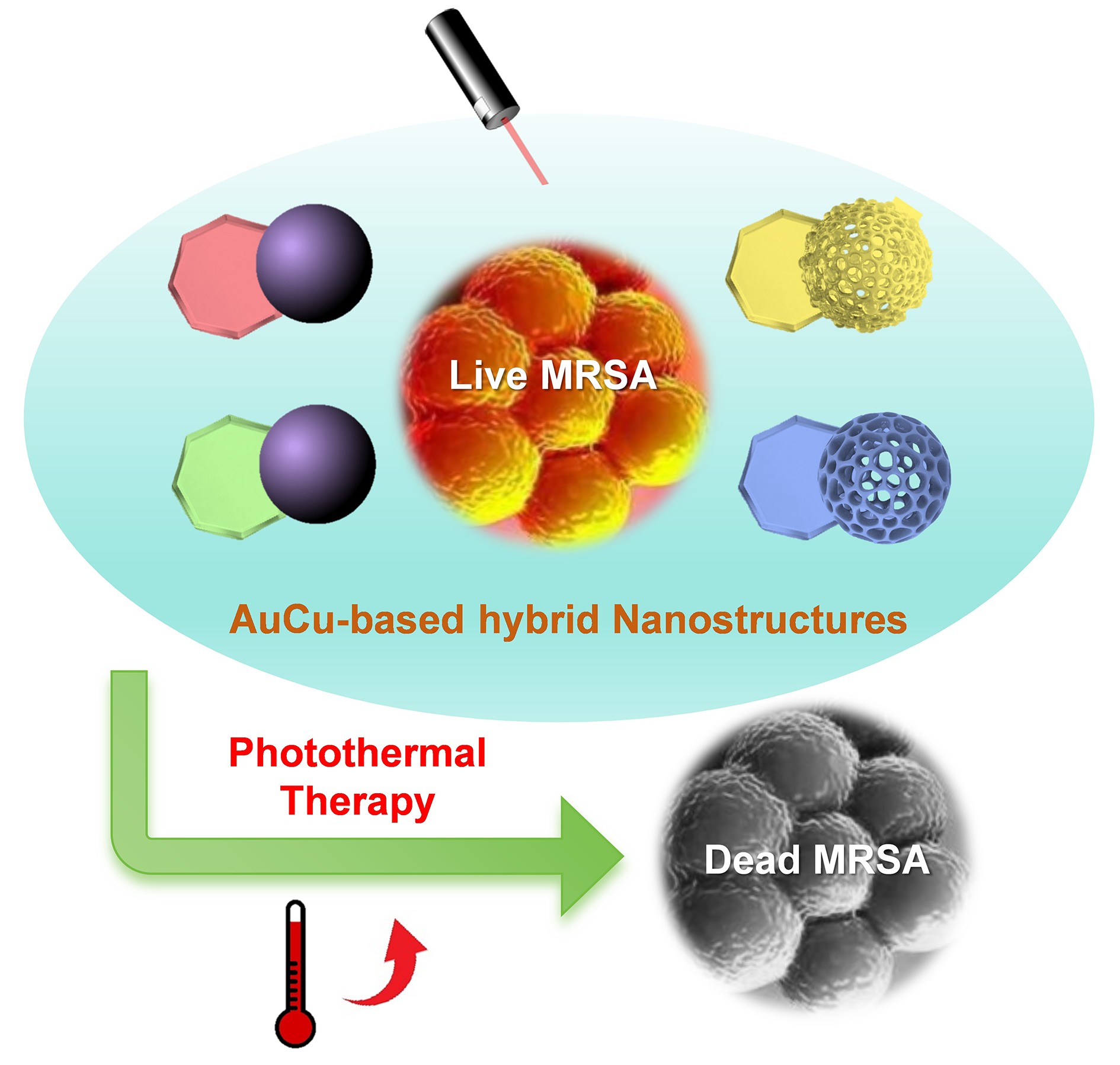
Hybrid nanostructures incorporating anisotropic structural components present promising opportunities for developing advanced photothermal agents. Here, we report the controlled synthesis of solid–hollow hybrid nanostructures based on gold–copper (Au–Cu) and demonstrate their photothermal antibacterial properties. Starting from Au nanoplate seeds, we achieve anisotropic deposition to synthesize AuCu and AuAgCu Janus nanostructures. The newly-deposited regions are subsequently transformed into porous architectures via a galvanic replacement reaction mediated by KCl and acetic acid. The introduced nanopores enhance near-infrared (NIR) absorption, thereby improving photothermal conversion efficiency under both 808 nm and 1064 nm laser irradiation and enabling the efficient eradication of multidrug-resistant bacteria. Finite-difference time-domain (FDTD) simulations confirm their optimized plasmonic properties. The current study underscores the potential of morphologically complex hybrid nanostructures for advanced photothermal applications.
- Open Access
- Article
AuCu-Based Solid-Hollow Hybrid Nanostructures for Efficient Photothermal Therapy against Multidrug-Resistant Bacteria
- Qiuping Yang 1,†,
- Qian Wu 2,†,
- Xiaowen Chen 3,†,
- Xiaoying Shen 4,†,
- Yi Wang 2,*,
- Xiaohu Wu 5,*,
- Yanyun Ma 6,
- Pu Zhang 4,*,
- Yiqun Zheng 1,*
Author Information
Received: 10 Aug 2025 | Revised: 03 Sep 2025 | Accepted: 25 Dec 2025 | Published: 30 Dec 2025
Abstract
Graphical Abstract
Keywords
hybrid | noble metal | two dimensional | porous | photothermal conversion | FDTD simulation
References
- 1.
Su, H.; Price, C.A.H.; Jing, L.; Tian, Q.; Liu, J.; Qian, K. Janus Particles: Design, Preparation, and Biomedical Applications. Mater. Today Bio 2019, 4, 100033. https://doi.org/10.1016/j.mtbio.2019.100033.
- 2.
Wu, Z.; Li, L.; Liao, T.; Chen, X.; Jiang, W.; Luo, W.; Yang, J.; Sun, Z. Janus Nanoarchitectures: From Structural Design to Catalytic Applications. Nano Today 2018, 22, 62–82. https://doi.org/10.1016/j.nantod.2018.08.009.
- 3.
Li, X.; Chen, L.; Cui, D.; Jiang, W.; Han, L.; Niu, N. Preparation and Application of Janus Nanoparticles: Recent Development and Prospects. Coord. Chem. Rev. 2022, 454, 214318. https://doi.org/10.1016/j.ccr.2021.214318.
- 4.
Zhang, X.; Fu, Q.; Duan, H.; Song, J.; Yang, H. Janus Nanoparticles: From Fabrication to (Bio)Applications. ACS Nano 2021, 15, 6147–6191. https://doi.org/10.1021/acsnano.1c01146.
- 5.
Li, Y.; Xia, M.; Zhou, J.; Hu, L.; Du, Y. Recent Advances in Gold Janus Nanomaterials: Preparation and Application. Adv. Colloid Interface Sci. 2024, 334, 103315. https://doi.org/10.1016/j.cis.2024.103315.
- 6.
Li, C.-Y.; Duan, S.; Wen, B.-Y.; Li, S.-B.; Kathiresan, M.; Xie, L.-Q.; Chen, S.; Anema, J.R.; Mao, B.-W.; Luo, Y.; et al. Observation of Inhomogeneous Plasmonic Field Distribution in a Nanocavity. Nat. Nanotech. 2020, 15, 922–926. https://doi.org/10.1038/s41565-020-0753-y.
- 7.
Wei, Y.; Qi, J.; Li, J.; Yu, C.; Zhao, J.; Pei, H. Precise Regulation of Surface Plasmonic Hotspots in an Au Split Nanoring Coupled System. Results Phys. 2024, 61, 107718. https://doi.org/10.1016/j.rinp.2024.107718.
- 8.
Lu, Z.; Ji, J.; Ye, H.; Zhang, H.; Zhang, S.; Xu, H. Quantifying the Ultimate Limit of Plasmonic Near-Field Enhancement. Nat. Commun. 2024, 15, 8803. https://doi.org/10.1038/s41467-024-53210-8.
- 9.
Zhang, D.; Chen, Y.; Hao, M.; Xia, Y. Putting Hybrid Nanomaterials to Work for Biomedical Applications. Angew. Chem. Int. Ed. 2024, 63, e202319567. https://doi.org/10.1002/anie.202319567.
- 10.
Qiu, J.; Nguyen, Q.N.; Lyu, Z.; Wang, Q.; Xia, Y. Bimetallic Janus Nanocrystals: Syntheses and Applications. Adv. Mater. 2021, 34, 2102591. https://doi.org/10.1002/adma.202102591.
- 11.
Li, Z.; Gong, J.; Lu, S.; Li, X.; Gu, X.; Xu, J.; Khan, J.U.; Jin, D.; Chen, X. Photothermal Lanthanide Nanomaterials: From Fundamentals to Theranostic Applications. BMEMat 2024, 2, e12088. https://doi.org/10.1002/bmm2.12088.
- 12.
Zhang, M.; Ran, S.; Yin, X.; Zhang, J.; Sun, X.; Sun, W.; Zhu, Z. Mesoporous Polydopamine Nanoplatforms Loaded with Calcium Ascorbate for Amplified Oxidation and Photothermal Combination Cancer Therapy. BMEMat 2023, 1, e12041. https://doi.org/10.1002/bmm2.12041.
- 13.
Chen, C.; Chu, G.; He, W.; Liu, Y.; Dai, K.; Valdez, J.; Moores, A.; Huang, P.; Wang, Z.; Jin, J.; et al. A Janus Au–Polymersome Heterostructure with Near-Field Enhancement Effect for Implant-Associated Infection Phototherapy. Adv. Mater. 2023, 35, 2207950. https://doi.org/10.1002/adma.202207950.
- 14.
Xu, W.; Dong, C.; Hu, H.; Qian, X.; Chang, L.; Jiang, Q.; Yu, L.; Chen, Y.; Zhou, J. Engineering Janus Chemoreactive Nanosonosensitizers for Bilaterally Augmented Sonodynamic and Chemodynamic Cancer Nanotherapy. Adv. Funct. Mater. 2021, 31, 2103134. https://doi.org/10.1002/adfm.202103134.
- 15.
Lv, Y.; Duan, S.; Wang, R. Structure Design, Controllable Synthesis, and Application of Metal-Semiconductor Heterostructure Nanoparticles. Prog. Nat. Sci. Mater. Int. 2020, 30, 1–12. https://doi.org/10.1016/j.pnsc.2019.12.005.
- 16.
Zhao, T.; Chen, L.; Liu, M.; Lin, R.; Cai, W.; Hung, C.-T.; Wang, S.; Duan, L.; Zhang, F.; Elzatahry, A.; et al. Emulsion-Oriented Assembly for Janus Double-Spherical Mesoporous Nanoparticles as Biological Logic Gates. Nat. Chem. 2023, 15, 832–840. https://doi.org/10.1038/s41557-023-01183-4.
- 17.
Yu, Y.; Lin, R.; Yu, H.; Liu, M.; Xing, E.; Wang, W.; Zhang, F.; Zhao, D.; Li, X. Versatile Synthesis of Metal-Compound Based Mesoporous Janus Nanoparticles. Nat. Commun. 2023, 14, 4249. https://doi.org/10.1038/s41467-023-40017-2.
- 18.
Lv, K.; Hou, M.; Kou, Y.; Yu, H.; Liu, M.; Zhao, T.; Shen, J.; Huang, X.; Zhang, J.; Mady, M.F.; et al. Black Titania Janus Mesoporous Nanomotor for Enhanced Tumor Penetration and Near-Infrared Light-Triggered Photodynamic Therapy. ACS Nano 2024, 18, 13910–13923. https://doi.org/10.1021/acsnano.4c03652.
- 19.
Peng, Z.; Huang, J.; Guo, Z. Anisotropic Janus Materials: From Micro-/Nanostructures to Applications. Nanoscale 2021, 13, 18839–18864. https://doi.org/10.1039/D1NR05499F.
- 20.
Lu, Y.; Xu, R.; Liu, W.; Song, X.; Cai, W.; Fang, Y.; Xue, W.; Yu, S. Copper Peroxide Nanodot-Decorated Gold Nanostar/Silica Nanorod Janus Nanostructure with NIR-II Photothermal and Acid-Triggered Hydroxyl Radical Generation Properties for the Effective Treatment of Wound Infections. J. Mater. Chem. B 2024, 12, 5111–5127. https://doi.org/10.1039/D4TB00536H.
- 21.
Li, S.; Zhu, J.; Shi, D.; Guo, P.; Wang, J.; Zhao, D.; Ma, Y. Interfacial Templating Strategy for Asymmetric Mesoporous Materials: Synthesis and Typical Applications. Next Mater. 2024, 2, 100144. https://doi.org/10.1016/j.nxmate.2024.100144.
- 22.
Xia, X.; Xia, Y. Symmetry Breaking during Seeded Growth of Nanocrystals. Nano Lett. 2012, 12, 6038–6042. https://doi.org/10.1021/nl3040114.
- 23.
Yang, T.-H.; Shi, Y.; Janssen, A.; Xia, Y. Surface Capping Agents and Their Roles in Shape-Controlled Synthesis of Colloidal Metal Nanocrystals. Angew. Chem. Int. Ed. 2020, 59, 15378–15401. https://doi.org/10.1002/anie.201911135.
- 24.
Zeng, J.; Zheng, Y.; Rycenga, M.; Tao, J.; Li, Z.-Y.; Zhang, Q.; Zhu, Y.; Xia, Y. Controlling the Shapes of Silver Nanocrystals with Different Capping Agents. J. Am. Chem. Soc. 2010, 132, 8552–8553. https://doi.org/10.1021/ja103655f.
- 25.
Xia, Y.; Gilroy, K.D.; Peng, H.-C.; Xia, X. Seed-Mediated Growth of Colloidal Metal Nanocrystals. Angew. Chem. Int. Ed. 2017, 56, 60–95. https://doi.org/10.1002/anie.201604731.
- 26.
González-Rubio, G.; Mosquera, J.; Kumar, V.; Pedrazo-Tardajos, A.; Llombart, P.; Solís, D.M.; Lobato, I.; Noya, E.G.; Guerrero-Martínez, A.; Taboada, J.M.; et al. Micelle-Directed Chiral Seeded Growth on Anisotropic Gold Nanocrystals. Science 2020, 368, 1472–1477. https://doi.org/10.1126/science.aba0980.
- 27.
Gao, C.; Goebl, J.; Yin, Y. Seeded Growth Route to Noble Metal Nanostructures. J. Mater. Chem. C 2013, 1, 3898–3909. https://doi.org/10.1039/C3TC30365A.
- 28.
Xia, Y.; Xia, X.; Peng, H.-C. Shape-Controlled Synthesis of Colloidal Metal Nanocrystals: Thermodynamic versus Kinetic Products. J. Am. Chem. Soc. 2015, 137, 7947–7966. https://doi.org/10.1021/jacs.5b04641.
- 29.
Zheng, Y.; Zeng, J.; Ruditskiy, A.; Liu, M.; Xia, Y. Oxidative Etching and Its Role in Manipulating the Nucleation and Growth of Noble-Metal Nanocrystals. Chem. Mater. 2014, 26, 22–33. https://doi.org/10.1021/cm402023g.
- 30.
Liu, Y.-C.; Li, S.-Y.; Chen, X.-Y.; Chuang, Y.-C.; Wu, H.-L. Control of Oxidative Etching Rate of Cu Nanocubes in Synthesis of CuRu Nanocages and Nanoframes. Chem. Mater. 2023, 35, 136–143. https://doi.org/10.1021/acs.chemmater.2c02828.
- 31.
Long, R.; Zhou, S.; Wiley, B.J.; Xiong, Y. Oxidative Etching for Controlled Synthesis of Metal Nanocrystals: Atomic Addition and Subtraction. Chem. Soc. Rev. 2014, 43, 6288–6310. https://doi.org/10.1039/C4CS00136B.
- 32.
Makvandi, P.; Wang, C.-y.; Zare, E.N.; Borzacchiello, A.; Niu, L.-n.; Tay, F.R. Metal-Based Nanomaterials in Biomedical Applications: Antimicrobial Activity and Cytotoxicity Aspects. Adv. Funct. Mater. 2020, 30, 1910021. https://doi.org/10.1002/adfm.201910021.
- 33.
Roper, D.K.; Ahn, W.; Hoepfner, M. Microscale Heat Transfer Transduced by Surface Plasmon Resonant Gold Nanoparticles. J. Phys. Chem. C 2007, 111, 3636–3641. https://doi.org/10.1021/jp064341w.
- 34.
Rakić, A.D.; Djurišić, A.B.; Elazar, J.M.; Majewski, M.L. Optical Properties of Metallic Films for Vertical-Cavity Optoelectronic Devices. Appl. Opt. 1998, 37, 5271–5283. https://doi.org/10.1364/AO.37.005271.
- 35.
Chen, X.; Qin, C.; Yang, L.; Li, X.; Wu, X.; Zhang, B. Triangular Pyramid Nanostructure Enhanced Photothermal Utilization of Noble Metal Nanoparticles. Int. J. Therm. Sci. 2024, 200, 108980. https://doi.org/10.1016/j.ijthermalsci.2024.108980.
- 36.
Fu, X.; Tan, J.; Ma, Y.; Zhao, N.; Kong, Y.; Liu, F.; Zheng, Y.; Wang, Y.; Liu, M. In Situ Crumpling of Gold Nanosheets into Spherical Three-Dimensional Architecture: Probing the Aggregation-Induced Enhancement in Photothermal Properties. Langmuir 2022, 38, 1929–1936. https://doi.org/10.1021/acs.langmuir.1c03248.
- 37.
Yang, Q.; Kong, H.; Tang, L.; Ma, Y.; Liu, F.; Liu, M.; Wang, Y.; Zhang, P.; Zheng, Y. Au–Cu Janus Nanostructures as NIR-II Photothermal Antibacterial Agents. ACS Appl. Nano Mater. 2024, 7, 20783–20792. https://doi.org/10.1021/acsanm.4c03673.
- 38.
Zou, Y.; Qin, C.; Zhai, H.; Sun, C.; Zhang, B.; Wu, X. The Optical Characteristics of C@Cu Core-Shell Nanorods for Solar Thermal Applications. Int. J. Therm. Sci. 2022, 182, 107824. https://doi.org/10.1016/j.ijthermalsci.2022.107824.
- 39.
Zou, Y.; Qin, C.; Yang, L.; Li, X.; Zhang, B.; Wu, X. Effect of Hollow Structure on Solar Thermal Applications of Au Nanodiscs. J. Mol. Liquids 2024, 393, 123528. https://doi.org/10.1016/j.molliq.2023.123528.
- 40.
Jiang, T.; Song, J.; Zhang, W.; Wang, H.; Li, X.; Xia, R.; Zhu, L.; Xu, X. Au–Ag@Au Hollow Nanostructure with Enhanced Chemical Stability and Improved Photothermal Transduction Efficiency for Cancer Treatment. ACS Appl. Mater. Interfaces 2015, 7, 21985–21994. https://doi.org/10.1021/acsami.5b08305.
- 41.
Bu, Y.; Huang, R.; Li, Z.; Zhang, P.; Zhang, L.; Yang, Y.; Liu, Z.; Guo, K.; Gao, F. Anisotropic Truncated Octahedral Au with Pt Deposition on Arris for Localized Surface Plasmon Resonance-Enhanced Photothermal and Photodynamic Therapy of Osteosarcoma. ACS Appl. Mater. Interfaces 2021, 13, 35328–35341. https://doi.org/10.1021/acsami.1c07181.
- 42.
Song, Q.; Liu, Y.; Zhang, P.; Feng, W.; Shi, S.; Zhou, N.; Chu, X.; Shen, J. Au–Cu Bimetallic Nanostructures for Photothermal Antibacterial and Wound Healing Promotion. ACS Appl. Nano Mater. 2022, 5, 8621–8630. https://doi.org/10.1021/acsanm.2c02152.
- 43.
Zhu, R.; Li, Y.; Zhang, X.; Bian, K.; Yang, M.; Cong, C.; Cheng, X.; Zhao, S.; Li, X.; Gao, D. Vapreotide-Mediated Hierarchical Mineralized Ag/Au Nanoshells for Photothermal Anti-Tumor Therapy. Nanotechnology 2019, 30, 055602. https://doi.org/10.1088/1361-6528/aaf0db.
- 44.
Xu, M.; Lu, Q.; Song, Y.; Yang, L.; Ren, C.; Li, W.; Liu, P.; Wang, Y.; Zhu, Y.; Li, N. NIR-II Driven Plasmon-Enhanced Cascade Reaction for Tumor Microenvironment-Regulated Catalytic Therapy Based on Bio-Breakable Au–Ag nanozyme. Nano Res. 2020, 13, 2118–2129. https://doi.org/10.1007/s12274-020-2818-5.
- 45.
Wang, Z.; Yu, N.; Li, X.; Yu, W.; Han, S.; Ren, X.; Yin, S.; Li, M.; Chen, Z. Galvanic Exchange-Induced Growth of Au Nanocrystals on CuS Nanoplates for Imaging Guided Photothermal Ablation of Tumors. Chem. Eng. J. 2020, 381, 122613. https://doi.org/10.1016/j.cej.2019.122613.
- 46.
Sun, L.; Chen, Y.; Gong, F.; Dang, Q.; Xiang, G.; Cheng, L.; Liao, F.; Shao, M. Silicon Nanowires Decorated with Gold Nanoparticles via in situ Reduction for Photoacoustic Imaging-Guided Photothermal Cancer Therapy. J. Mater. Chem. B 2019, 7, 4393–4401. https://doi.org/10.1039/C9TB00147F.
- 47.
Chen, M.M.; Hao, H.L.; Zhao, W.; Zhao, X.; Chen, H.Y.; Xu, J.J. A Plasmon-Enhanced Theranostic Nanoplatform for Synergistic Chemo-Phototherapy of Hypoxic Tumors in the NIR-II Window. Chem. Sci. 2021, 12, 10848–10854. https://doi.org/10.1039/d1sc01760h.

This work is licensed under a Creative Commons Attribution 4.0 International License.

 Suite 4002 Level 4, 447 Collins Street, Melbourne, Victoria 3000, Australia
 General Inquiries: info@sciltp.com