
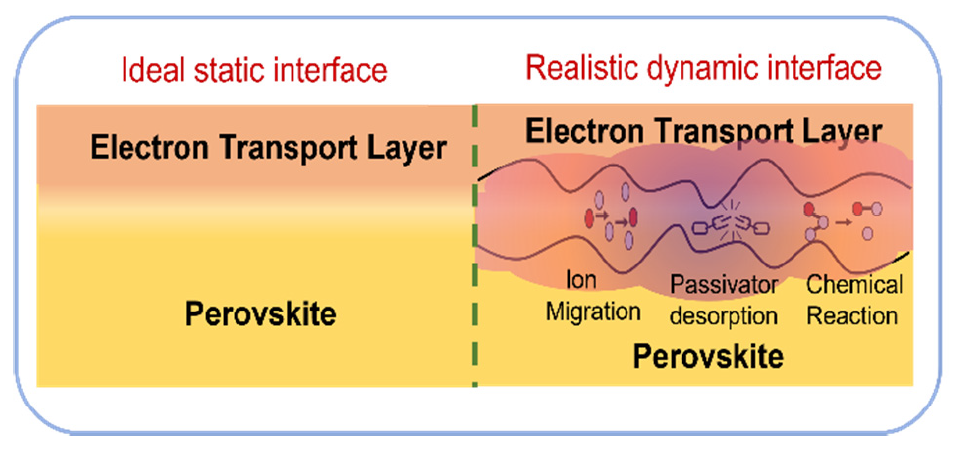
Interface passivation is central to efficiency improvement in inverted perovskite solar cells, yet its effectiveness is fundamentally limited by the assumption of a static picture. Herein, we argue that the perovskite/electron transport layer interface is intrinsically dynamic under operation, continuously evolving under illumination, thermal stress, and electrical bias owing to ion migration, interfacial redistribution, passivator destabilization, and chemical reactions. These coupled processes progressively reconstruct interfacial energetics and defect landscapes, leading to voltage loss, fill-factor decay, hysteresis re-emergence, and irreversible performance degradation even in devices with high initial efficiencies. By reframing the interface as a time-dependent system rather than a fixed structure, this perspective highlights dynamic interfacial evolution as the origin of long-term instability and calls for interface regulation strategies that prioritize sustained functional stability under realistic operating conditions.
- Open Access
- Perspective
Author Information
Received: 30 Jan 2026 | Revised: 03 Mar 2026 | Accepted: 23 Mar 2026 | Published: 25 Mar 2026
Abstract
Graphical Abstract
Keywords
dynamic interface | interface passivation | ion migration | operational stability | interfacial evolution
References
- 1.
Rajagopal, A.; Yao, K.; Jen, A.K.Y. Toward Perovskite Solar Cell Commercialization: A Perspective and Research Roadmap Based on Interfacial Engineering. Adv. Mater. 2018, 30, 1800455. https://doi.org/10.1002/adma.201800455.
- 2.
Kim, D.H.; Park, N.-G. Advanced Interface Engineering for Perovskite Solar Cells: The Way to Ensure Efficiency and Stability. Acc. Mater. Res. 2025, 6, 1147–1157. https://doi.org/10.1021/accountsmr.5c00170.
- 3.
Tao, J.; Zhao, C.; Wang, Z.; Chen, Y.; Zang, L.; Yang, G.; Bai, Y.; Chu, J. Suppressing non-radiative recombination for efficient and stable perovskite solar cells. Energy Environ. Sci. 2025, 18, 509–544. https://doi.org/10.1039/D4EE02917H.
- 4.
Shin, S.S.; Park, B.; Noh, J.H.; Seok, S.I. Interlayer engineering in metal halide perovskite photovoltaics. Nat. Photonics 2026, 20, 11–23. https://doi.org/10.1038/s41566-025-01809-8.
- 5.
Shen, Y.; Zhang, T.; Xu, G.; Steele, J.A.; Chen, X.; Chen, W.; Zheng, G.; Li, J.; Guo, B.; Yang, H.; et al. Strain regulation retards natural operation decay of perovskite solar cells. Nature 2024, 635, 882–889. https://doi.org/10.1038/s41586-024-08161-x.
- 6.
Jin, B.; Cao, J.; Yuan, R.; Cai, B.; Wu, C.; Zheng, X. Strain Relaxation for Perovskite Lattice Reconfiguration. Adv. Energy Sustain. Res. 2023, 4, 2200143. https://doi.org/10.1002/aesr.202200143.
- 7.
Lin, Z.; Zhang, W.; Cai, Q.; Xu, X.; Dong, H.; Mu, C.; Zhang, J.-P. Precursor Engineering of the Electron Transport Layer for Application in High-Performance Perovskite Solar Cells. Adv. Sci. 2021, 8, 2102845. https://doi.org/10.1002/advs.202102845.
- 8.
Luo, D.; Su, R.; Zhang, W.; Gong, Q.; Zhu, R. Minimizing non-radiative recombination losses in perovskite solar cells. Nat. Rev. Mater. 2020, 5, 44–60. https://doi.org/10.1038/s41578-019-0151-y.
- 9.
Kang, J.; Li, J.; Wei, S.-H. Atomic-scale understanding on the physics and control of intrinsic point defects in lead halide perovskites. Appl. Phys. Rev. 2021, 8, 031302. https://doi.org/10.1063/5.0052402.
- 10.
Chen, H.; Zhang, W.; Li, M.; He, G.; Guo, X. Interface Engineering in Organic Field-Effect Transistors: Principles, Applications, and Perspectives. Chem. Rev. 2020, 120, 2879–2949. https://doi.org/10.1021/acs.chemrev.9b00532.
- 11.
Li, J.; Jin, C.; Jiang, R.; Su, J.; Tian, T.; Yin, C.; Meng, J.; Kou, Z.; Bai, S.; Müller-Buschbaum, P.; et al. Homogeneous coverage of the low-dimensional perovskite passivation layer for formamidinium–caesium perovskite solar modules. Nat. Energy 2024, 9, 1540–1550. https://doi.org/10.1038/s41560-024-01667-8.
- 12.
Guan, H.; Zhang, W.; Liang, J.; Wang, C.; Hu, X.; Pu, D.; Huang, L.; Ge, Y.; Cui, H.; Zou, Y.; et al. Low-Dimensional 2-thiopheneethylammonium Lead Halide Capping Layer Enables Efficient Single-Junction Methylamine-Free Wide-Bandgap and Tandem Perovskite Solar Cells. Adv. Funct. Mater. 2023, 33, 2300860. https://doi.org/10.1002/adfm.202300860.
- 13.
Su, R.; Xu, Z.; Wu, J.; Luo, D.; Hu, Q.; Yang, W.; Yang, X.; Zhang, R.; Yu, H.; Russell, T.P.; et al. Dielectric screening in perovskite photovoltaics. Nat. Commun. 2021, 12, 2479. https://doi.org/10.1038/s41467-021-22783-z.
- 14.
Chen, B.; Rudd, P.N.; Yang, S.; Yuan, Y.; Huang, J. Imperfections and their passivation in halide perovskite solar cells. Chem. Soc. Rev. 2019, 48, 3842–3867. https://doi.org/10.1039/C8CS00853A.
- 15.
Liu, C.; Yang, Y.; Chen, H.; Xu, J.; Liu, A.; Bati, A.S.R.; Zhu, H.; Grater, L.; Hadke, S.S.; Huang, C.; et al. Bimolecularly passivated interface enables efficient and stable inverted perovskite solar cells. Science 2023, 382, 810–815. https://doi.org/10.1126/science.adk1633.
- 16.
Wu, G.; Liang, R.; Ge, M.; Sun, G.; Zhang, Y.; Xing, G. Surface Passivation Using 2D Perovskites toward Efficient and Stable Perovskite Solar Cells. Adv. Mater. 2022, 34, 2105635. https://doi.org/10.1002/adma.202105635.
- 17.
Tress, W.; Domanski, K.; Carlsen, B.; Agarwalla, A.; Alharbi, E.A.; Graetzel, M.; Hagfeldt, A. Performance of perovskite solar cells under simulated temperature-illumination real-world operating conditions. Nat. Energy 2019, 4, 568–574. https://doi.org/10.1038/s41560-019-0400-8.
- 18.
Wu, L.; Hu, S.; Yang, F.; Li, G.; Wang, J.; Zuo, W.; Jerónimo-Rendon, J.J.; Turren-Cruz, S.-H.; Saba, M.; Saliba, M.; et al. Resilience pathways for halide perovskite photovoltaics under temperature cycling. Nat. Rev. Mater. 2025, 10, 536–549. https://doi.org/10.1038/s41578-025-00781-7.
- 19.
Zhu, H.; Teale, S.; Lintangpradipto, M.N.; Mahesh, S.; Chen, B.; McGehee, M.D.; Sargent, E.H.; Bakr, O.M. Long-term operating stability in perovskite photovoltaics. Nat. Rev. Mater. 2023, 8, 569–586. https://doi.org/10.1038/s41578-023-00582-w.
- 20.
Hu, J.; Chen, P.; Luo, D.; Wang, D.; Chen, N.; Yang, S.; Fu, Z.; Yu, M.; Li, L.; Zhu, R.; et al. Tracking the evolution of materials and interfaces in perovskite solar cells under an electric field. Commun. Mater. 2022, 3, 39. https://doi.org/10.1038/s43246-022-00262-2.
- 21.
Meggiolaro, D.; Motti, S.G.; Mosconi, E.; Barker, A.J.; Ball, J.; Andrea Riccardo Perini, C.; Deschler, F.; Petrozza, A.; De Angelis, F. Iodine chemistry determines the defect tolerance of lead-halide perovskites. Energy Environ. Sci. 2018, 11, 702–713. https://doi.org/10.1039/C8EE00124C.
- 22.
Li, Z.; Jia, C.; Wu, H.; Tang, Y.; Zhao, J.; Su, Z.; Gao, X.; Qiu, S.; Yuan, H.; Li, M. In-Situ Cross-Linked Polymers for Enhanced Thermal Cycling Stability in Flexible Perovskite Solar Cells. Angew. Chem. Int. Ed. 2025, 64, e202421063. https://doi.org/10.1002/anie.202421063.
- 23.
Ma, M.; Zhang, X.; Chen, X.; Xiong, H.; Xu, L.; Cheng, T.; Yuan, J.; Wei, F.; Shen, B. In situ imaging of the atomic phase transition dynamics in metal halide perovskites. Nat. Commun. 2023, 14, 7142. https://doi.org/10.1038/s41467-023-42999-5.
- 24.
Yang, B.; Bogachuk, D.; Suo, J.; Wagner, L.; Kim, H.; Lim, J.; Hinsch, A.; Boschloo, G.; Nazeeruddin, M.K.; Hagfeldt, A. Strain effects on halide perovskite solar cells. Chem. Soc. Rev. 2022, 51, 7509–7530. https://doi.org/10.1039/D2CS00278G.
- 25.
Wei, J.; Wang, Q.; Huo, J.; Gao, F.; Gan, Z.; Zhao, Q.; Li, H. Mechanisms and Suppression of Photoinduced Degradation in Perovskite Solar Cells. Adv. Energy Mater. 2021, 11, 2002326. https://doi.org/10.1002/aenm.202002326.
- 26.
Xing, Z.; Fan, B.; Meng, X.; Li, D.; Huang, Z.; Li, L.; Zhang, Y.; Wang, F.; Hu, X.; Hu, T.; et al. Repairing humidity-induced interfacial degradation in quasi-2D perovskite solar cells printed in ambient air. Energy Environ. Sci. 2024, 17, 3660–3669. https://doi.org/10.1039/D4EE00912F.
- 27.
Lan, Z.; Yang, Y.; Huang, H.; Du, S.; Zhang, Q.; Wang, Z.; Jiang, T.; Sun, C.; Qu, S.; Li, L.; et al. Interfacial electrostatic repulsion inhibits iodide ion migration for enhancing reverse-bias stability of perovskite solar cells. Nat. Commun. 2025, 16, 11407. https://doi.org/10.1038/s41467-025-66224-7.
- 28.
Xu, J.; Boyd, C.C.; Yu, Z.J.; Palmstrom, A.F.; Witter, D.J.; Larson, B.W.; France, R.M.; Werner, J.; Harvey, S.P.; Wolf, E.J.; et al. Triple-halide wide–band gap perovskites with suppressed phase segregation for efficient tandems. Science 2020, 367, 1097–1104. https://doi.org/10.1126/science.aaz5074.
- 29.
Draguta, S.; Sharia, O.; Yoon, S.J.; Brennan, M.C.; Morozov, Y.V.; Manser, J.S.; Kamat, P.V.; Schneider, W.F.; Kuno, M. Rationalizing the light-induced phase separation of mixed halide organic–inorganic perovskites. Nat. Commun. 2017, 8, 200. https://doi.org/10.1038/s41467-017-00284-2.
- 30.
Thiesbrummel, J.; Shah, S.; Gutierrez-Partida, E.; Zu, F.; Peña-Camargo, F.; Zeiske, S.; Diekmann, J.; Ye, F.; Peters, K.P.; Brinkmann, K.O.; et al. Ion-induced field screening as a dominant factor in perovskite solar cell operational stability. Nat. Energy 2024, 9, 664–676. https://doi.org/10.1038/s41560-024-01487-w.
- 31.
Hoke, E.T.; Slotcavage, D.J.; Dohner, E.R.; Bowring, A.R.; Karunadasa, H.I.; McGehee, M.D. Reversible photo-induced trap formation in mixed-halide hybrid perovskites for photovoltaics. Chem. Sci. 2015, 6, 613–617. https://doi.org/10.1039/C4SC03141E.
- 32.
Hu, M.; Bi, C.; Yuan, Y.; Bai, Y.; Huang, J. Stabilized Wide Bandgap MAPbBrxI3–x Perovskite by Enhanced Grain Size and Improved Crystallinity. Adv. Sci. 2016, 3, 1500301. https://doi.org/10.1002/advs.201500301.
- 33.
Duong, T.; Mulmudi, H.K.; Wu, Y.; Fu, X.; Shen, H.; Peng, J.; Wu, N.; Nguyen, H.T.; Macdonald, D.; Lockrey, M.; et al. Light and Electrically Induced Phase Segregation and Its Impact on the Stability of Quadruple Cation High Bandgap Perovskite Solar Cells. ACS Appl. Mater. Interfaces 2017, 9, 26859–26866. https://doi.org/10.1021/acsami.7b06816.
- 34.
Yang, Z.; Rajagopal, A.; Jo, S.B.; Chueh, C.C.; Williams, S.; Huang, C.C.; Katahara, J.K.; Hillhouse, H.W.; Jen, A.K.Y. Stabilized Wide Bandgap Perovskite Solar Cells by Tin Substitution. Nano Lett. 2016, 16, 7739–7747. https://doi.org/10.1021/acs.nanolett.6b03857.
- 35.
Barker, A.J.; Sadhanala, A.; Deschler, F.; Gandini, M.; Senanayak, S.P.; Pearce, P.M.; Mosconi, E.; Pearson, A.J.; Wu, Y.; Srimath Kandada, A.R.; et al. Defect-Assisted Photoinduced Halide Segregation in Mixed-Halide Perovskite Thin Films. ACS Energy Lett. 2017, 2,1416–1424. https://doi.org/10.1021/acsenergylett.7b00282.
- 36.
Yu, D.; Cao, F.; Qiu, X.; Chen, Y.; Zhang, Z.; Wang, G.; Mao, Y.; Zhong, J.; Su, C.; Huang, W.; et al. Violet/ultraviolet light-induced depassivation in halide perovskite solar cells. Nat. Commun. 2025, 16, 11409. https://doi.org/10.1038/s41467-025-66227-4.
- 37.
Pei, F.; Lin, S.; Zhang, Z.; Lin, S.; Huang, X.; Zhao, M.; Xu, J.; Zhuang, X.; Zhang, Y.; Tang, J.; et al. Inhibiting defect passivation failure in perovskite for perovskite/Cu(In,Ga)Se2 monolithic tandem solar cells with certified efficiency 27.35%. Nat. Energy 2025, 10, 824–835. https://doi.org/10.1038/s41560-025-01761-5.
- 38.
Li, H.; Xie, G.; Fang, J.; Peng, H.; Huang, N.; Wang, X.; Lin, D.; Qiu, L. Revealing the Relationship between Interfacial Morphology Degradation and Unsatisfied Stability in Phenethylamine-Treated Perovskite Solar Cell. Small 2025, 21, e03623. https://doi.org/10.1002/smll.202503623.
- 39.
Li, X.; Fu, S.; Zhang, W.; Ke, S.; Song, W.; Fang, J. Chemical anti-corrosion strategy for stable inverted perovskite solar cells. Sci. Adv. 2020, 6, eabd1580. https://doi.org/10.1126/sciadv.abd1580.
- 40.
Wang, H.; Li, Q.; Zhu, Y.; Sui, X.; Fan, X.; Lin, M.; Shi, Y.; Zheng, Y.; Yuan, H.; Zhou, Y.; et al. Photomechanically accelerated degradation of perovskite solar cells. Energy Environ. Sci. 2025, 18, 2254–2263. https://doi.org/10.1039/D4EE04878D.
- 41.
Zhou, J.; Liu, Z.; Yu, P.; Tong, G.; Chen, R.; Ono, L.K.; Chen, R.; Wang, H.; Ren, F.; Liu, S.; et al. Modulation of perovskite degradation with multiple-barrier for light-heat stable perovskite solar cells. Nat. Commun. 2023, 14, 6120. https://doi.org/10.1038/s41467-023-41856-9.
- 42.
Divitini, G.; Cacovich, S.; Matteocci, F.; Cinà, L.; Di Carlo, A.; Ducati, C. In situ observation of heat-induced degradation of perovskite solar cells. Nat. Energy 2016, 1, 15012. https://doi.org/10.1038/nenergy.2015.12.
- 43.
Correa-Baena, J.-P.; Hippalgaonkar, K.; van Duren, J.; Jaffer, S.; Chandrasekhar, V.R.; Stevanovic, V.; Wadia, C.; Guha, S.; Buonassisi, T. Accelerating Materials Development via Automation, Machine Learning, and High-Performance Computing. Joule 2018, 2, 1410–1420. https://doi.org/10.1016/j.joule.2018.05.009.
- 44.
Zhang, C.; Jia, Y.; Zhang, B.; Zhao, Q.; Xu, R.; Pang, S.; Wang, H.; De Wolf, S.; Wang, K. Machine learning-driven interface material design for high-performance perovskite solar cells with scalability and band-gap universality. Joule 2025, 10, 102264. https://doi.org/10.1016/j.joule.2025.102264.
- 45.
Wang, W.-T.; Holzhey, P.; Zhou, N.; Zhang, Q.; Zhou, S.; Duijnstee, E.A.; Rietwyk, K.J.; Lin, J.-Y.; Mu, Y.; Zhang, Y.; et al. Water- and heat-activated dynamic passivation for perovskite photovoltaics. Nature 2024, 632, 294–300. https://doi.org/10.1038/s41586-024-07705-5.
- 46.
Mao, L.; Xiang, C. A comprehensive review of machine learning applications in perovskite solar cells: Materials discovery, device performance, process optimization and systems integration. Mater. Today Energy 2025, 47, 101742. https://doi.org/10.1016/j.mtener.2024.101742.


This work is licensed under a Creative Commons Attribution 4.0 International License.

 Suite 4002 Level 4, 447 Collins Street, Melbourne, Victoria 3000, Australia
 General Inquiries: info@sciltp.com