
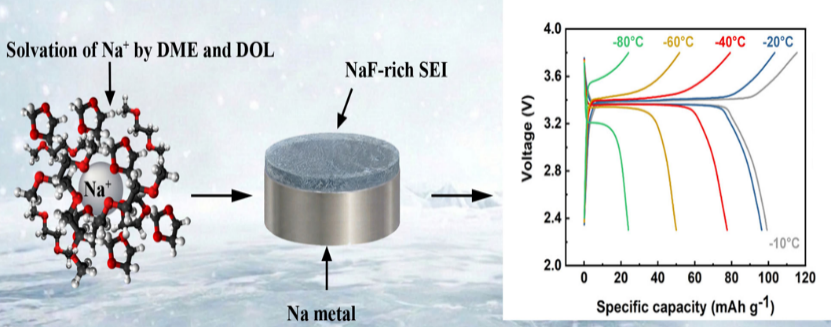
Sodium metal batteries have shown considerable potential when operated at ambient temperatures. However, their performance in cold environments is constrained by increased electrolyte resistance with decreasing temperature and dendritic sodium plating associated with unstable solid electrolyte interphase (SEI), which are primarily influenced by the electrolyte composition. In this study, we present an electrolyte formulation that remains thermally stable down to −150 °C, which not only facilitates low internal resistance but also contributes to the formation of a protective SEI under cryogenic conditions. When cycled at −40 °C at 1 mA cm−2, the sodium metal electrode exhibits a low overpotential of only 16 mV over 750 h; even at an ultra-low temperature of −80 °C, the electrode demonstrates remarkable long-term stability with a low overpotential of 54 mV sustained over 1500 h at 0.5 mA cm−2. Furthermore, full cell evaluations when paring with Na3V2(PO4)3 cathode reveal a high average Coulombic efficiency exceeding 99.1% and a capacity retention over 83% after 100 cycles at both −40 °C and −80 °C.
- Open Access
- Article
Rational Electrolyte Formulation for Sodium Metal Batteries Operating in Extremely Cold Environments
Author Information
Received: 03 Mar 2026 | Revised: 27 Mar 2026 | Accepted: 30 Mar 2026 | Published: 31 Mar 2026
Abstract
Graphical Abstract
Keywords
sodium metal battery | low temperature | ether electrolyte | sodium hexafluorophosphate | solid electrolyte interphase
References
- 1.
Dunn, B.; Kamath, H.; Tarascon, J.-M. Electrical energy storage for the grid: A battery of choices. Science 2011, 334, 928–935.
- 2.
Goodenough, J.; Park, K.-S. The Li-ion rechargeable battery: A perspective. J. Am. Chem. Soc. 2013, 135, 1167–1176.
- 3.
Tarascon, J.-M.; Armand, M. Issues and challenges facing rechargeable lithium batteries. Nature 2001, 414, 359–367.
- 4.
Zhang, S.; Xu, K.; Jow, T. The low temperature performance of Li-ion batteries. J. Power Sources 2003, 115, 137–140.
- 5.
Xu, J.; Wang, X.; Yuan, N.; Ding, J.; Qin, S.; Razal, J.; Wang, X.; Ge, S.; Gogotsi, Y. Extending the low temperature operational limit of Li-ion battery to −80 °C. Energy Storage Mater. 2019, 23, 383–389.
- 6.
Zhu, G. Materials insights into low-temperature performances of lithium-ion batteries. J. Power Sources 2015, 300, 29–40.
- 7.
Yoon, S.; Cavallaro, K.; Park, B.; Yook, H.; Han, J.; McDowell, M. Controlling solvation and solid-electrolyte interphase formation to enhance lithium interfacial kinetics at low temperatures. Adv. Funct. Mater. 2023, 38, 2302778.
- 8.
Gupta, A.; Manthiram, A. Designing advanced lithium-based batteries for low-temperature conditions. Adv. Energy Mater. 2020, 10, 2001972.
- 9.
Dong, X.; Lin, Y.; Li, P.; Ma, Y.; Huang, J.; Bin, D.; Wang, Y.; Qi, Y.; Xia, Y. High-energy rechargeable metallic lithium battery at −70 °C enabled by a cosolvent electrolyte. Angew. Chem. Int. Ed. 2019, 58, 5623–5627.
- 10.
Thenuwara, A.; Shetty, P.; Kondekar, N.; Sandoval, S.; Cavallaro, K.; May, R.; Yang, C.; Marbella, L.; Qi, Y.; McDowell, M. Efficient low-temperature cycling of lithium metal anodes by tailoring the solid-electrolyte interphase. ACS Energy Lett. 2020, 5, 2411−2420.
- 11.
Holoubek, J.; Kim, K.; Yin, Y.; Wu, Z.; Liu, H.; Li, M.; Chen, A.; Gao, H.; Cai, G.; Pascal, T. et al. Electrolyte design implications of ion-pairing in low- temperature Li metal batteries. Energy Environ. Sci. 2022, 15, 1647–1658.
- 12.
Tan, S.; Shadike, Z.; Cai, X.; Lin, R.; Kludze, A.; Borodin, O.; Lucht, B.; Wang, C.; Hu, E.; Xu, K.; et al. Review on low-temperature electrolytes for lithium-ion and lithium metal batteries. Electrochem. Energy Rev. 2023, 6, 35.
- 13.
Weng, S.; Zhang, X.; Yang, G.; Zhang, S.; Ma, B.; Liu, Q.; Liu, Y.; Peng, C.; Chen, H.; Yu, H. et al. Temperature-dependent interphase formation and Li+ transport in lithium metal batteries. Nat Commun 2023, 14, 4474.
- 14.
Zhang, W.; Lu, Y.; Feng, Q.; Wang, H.; Cheng, G.; Liu, H.; Cao, Q.; Luo, Z.; Zhou, P.; Xia, Y. et al. Multifunctional electrolyte additive for high power lithium metal batteries at ultra-low temperatures. Nat Commun 2025, 16, 3344.
- 15.
Peng, Z.; Ding, K.; Lai, M.; Qiu, R.; Xiao, Y.; Shi, J.; Guan, X.; Cai, Y.; Xu, C.; Wang, F.; et al. Rational electrolyte solvent screening for high-energy lithium metal batteries at low temperatures. Nat Commun 2026, 17, 590.
- 16.
Holoubk, J.; Liu, H.; Wu, Z.; Yin, Y.; Xing, X.; Cai, G.; Yu, S.; Zhou, H.; Pascal, T.; Chen, Z.; et al. Tailoring electrolyte solvation for Li metal batteries cycled at ultra-low temperature. Nat Energy 2021, 6, 303–313.
- 17.
Wang, H.; Wang, C.; Matios, E.; Li, W. Critical role of ultrathin graphene films with tunable thickness in enabling highly stable sodium metal anodes. Nano Lett. 2017, 17, 6808–6815.
- 18.
Wang, C.; Wang, H.; Matios, E.; Hu, X.; Li, W. A chemically engineered porous copper matrix with cylindrical core-shell skeleton as a stable host for metallic sodium anodes. Adv. Funct. Mater. 2018, 28, 1802282.
- 19.
Wang, H.; Wang, C.; Matios, E.; Li, W. Facile stabilization of the sodium metal anode with additives: Unexpected key role of sodium polysulfide and adverse effect of sodium nitrate. Angew. Chem. Int. Ed. 2018, 57, 7734–7737.
- 20.
Wang, H.; Matios, E.; Luo, J.; Li, W. Combining theories and experiments to understand the sodium nucleation behavior towards safe sodium metal batteries. Chem. Soc. Rev. 2020, 49, 3783–3805.
- 21.
Zhao, Y.; Adair, K.; Sun, X. Recent developments and insights into the understanding of Na metal anodes for Na-metal batteries. Energy Environ. Sci. 2018, 11, 2673–2695.
- 22.
Lee, B.; Paek, E.; Mitlin, D.; Lee, S. Sodium Metal Anodes: Emerging Solutions to Dendrite Growth. Chem. Rev. 2019, 119, 8, 5416–5460.
- 23.
Wang, C.; Thenuwara, A.C.; Luo, J.; Shetty, P.; McDowell, M.; Zhu, H.; Posada-Pérez, S.; Xiong, H.; Hautier, G.; Li, W. Extending the low-temperature operation of sodium metal batteries combining linear and cyclic ether-based electrolyte solutions. Nat Commun. 2022, 13, 4934.
- 24.
Thenuwara, A.C.; Shetty, P.; Kondekar, N.; Wang, C.; Li, W.; McDowell, M. Enabling highly reversible sodium metal cycling across a wide temperature range with dual-salt electrolytes. J. Mater. Chem. A 2021, 9, 10992–11000.
- 25.
Cheng, F.; Hu, J.; Zhang, W.; Guo, B.; Yu, P.; Sun, X.; Peng, J. Reviving ether-based electrolytes for sodium-ion batteries. Energy Environ. Sci. 2025, 18, 6874–6898.
- 26.
Ge, B.; Deng, J.; Wang, Z.; Liang, Q.; Hu, L.; Ren, X.; Li, R.; Lin, Y.; Li, Y.; Wang, Q. et al. Aggregate-Dominated Dilute Electrolytes with Low-Temperature-Resistant Ion-Conducting Channels for Highly Reversible Na Plating/Stripping. Adv. Mater. 2024, 36, 2408161.
- 27.
Hu, X.; Matios, E.; Zhang, Y.; Wang, C.; Luo, J.; Li, W. Deeply cycled sodium metal anodes at low temperature and in lean electrolyte conditions. Angew. Chem. Int. Ed. 2021, 60, 5978–5983.
- 28.
Zhou, J.; Wang, Y.; Wang, J.; Liu, Y.; Li, Y.; Chen, L.; Ding, D.; Dong, S.; Zhu, Q.; Tang, M. et al. Low-temperature and high-rate sodium metal batteries enabled by electrolyte chemistry. Energy Storage Mater. 2022, 50, 47–54.
- 29.
Hu, L.; Deng, J.; Lin, Y.; Liang, Q.; Ge, B.; Weng, Q.; Bai, Y.; Li, Y.; Deng, Y.; Chen, G.; et al. Restructuring electrolyte solvation by a versatile diluent toward beyond 99.9% coulombic efficiency of sodium plating/stripping at ultralow temperatures. Adv. Mater. 2024, 36, 2312161.
- 30.
Zhu, Q.; Yu, D.; Chen, J.; Cheng, L.; Tang, M.; Wang, Y.; Li, Y.; Yang, J.; Wang, H. A 110 Wh kg−1 Ah-level anode-free sodium battery at −40 °C. Joule 2024, 8, 482–495.
- 31.
Seh, Z.; Sun, J.; Sun, Y.; Cui, Y. A highly reversible room-temperature sodium metal anode. ACS Cent. Sci. 2015, 1, 449–455.
- 32.
Cui, Y.; Ni, Y.; Wang, Y.; Wang, L.; Yang, W.; Wu, S.; Xie, W.; Zhang, K.; Yan, Z.; Chen, J. A temperature-adapted ultraweakly solvating electrolyte for cold-resistant sodium-ion batteries. Adv. Energy Mater. 2025, 15, 2405363.
- 33.
Lutz, L.; Cortz, D.; Tang, M.; Salager, E.; Deschamps, M.; Grimaud, A.; Johson, L.; Bruce, P.; Tarascon, J. Role of electrolyte anions in the Na–O2 battery: Implications for NaO2 solvation and the stability of the sodium solid electrolyte interphase in glyme ethers. Chem. Mater. 2017, 29, 6066–6075.
- 34.
Cresce, A.; Russell, S.; Borodin, O.; Allen, J.; Schroeder, M.; Dai, M.; Peng, J.; Gobet, M.; Greenbaum, S.; Rogers, R.; et al. Solvation behavior of carbonate-based electrolytes in sodium ion batteries. Phys. Chem. Chem. Phys. 2017, 19, 574–586.
- 35.
Moulder, J.F. Handbook of X-ray Photoelectron Spectroscopy: A Reference Book of Standard Spectra for Identification and Interpretation of XPS Data; Physical Electronics Division, Perkin-Elmer Corporation Press: Eden Prairie, MI, USA, 1992.
- 36.
Fiedler, C.; Luerssen, B.; Rohnke, M.; Sann, J.; Janek, J. XPS and SIMS analysis of solid electrolyte interphases on lithium formed by ether-based electrolytes. J. Electrochem. Soc. 2017, 164, A3742–A3749.
- 37.
Aminabhavi, T.; Gopalakrishna, B. Density, viscosity, refractive index, and speed of sound in aqueous mixtures of N,N-dimethylformamide, dimethyl sulfoxide, N,N-dimethylacetamide, acetonitrile, ethylene glycol, diethylene glycol, 1,4-dioxane, tetrahydrofuran, 2-methoxyethanol, and 2-ethoxyethanol at 298.15 K. J. Chem. Eng. Data 1995, 40, 856–861.


This work is licensed under a Creative Commons Attribution 4.0 International License.

 Suite 4002 Level 4, 447 Collins Street, Melbourne, Victoria 3000, Australia
 General Inquiries: info@sciltp.com