
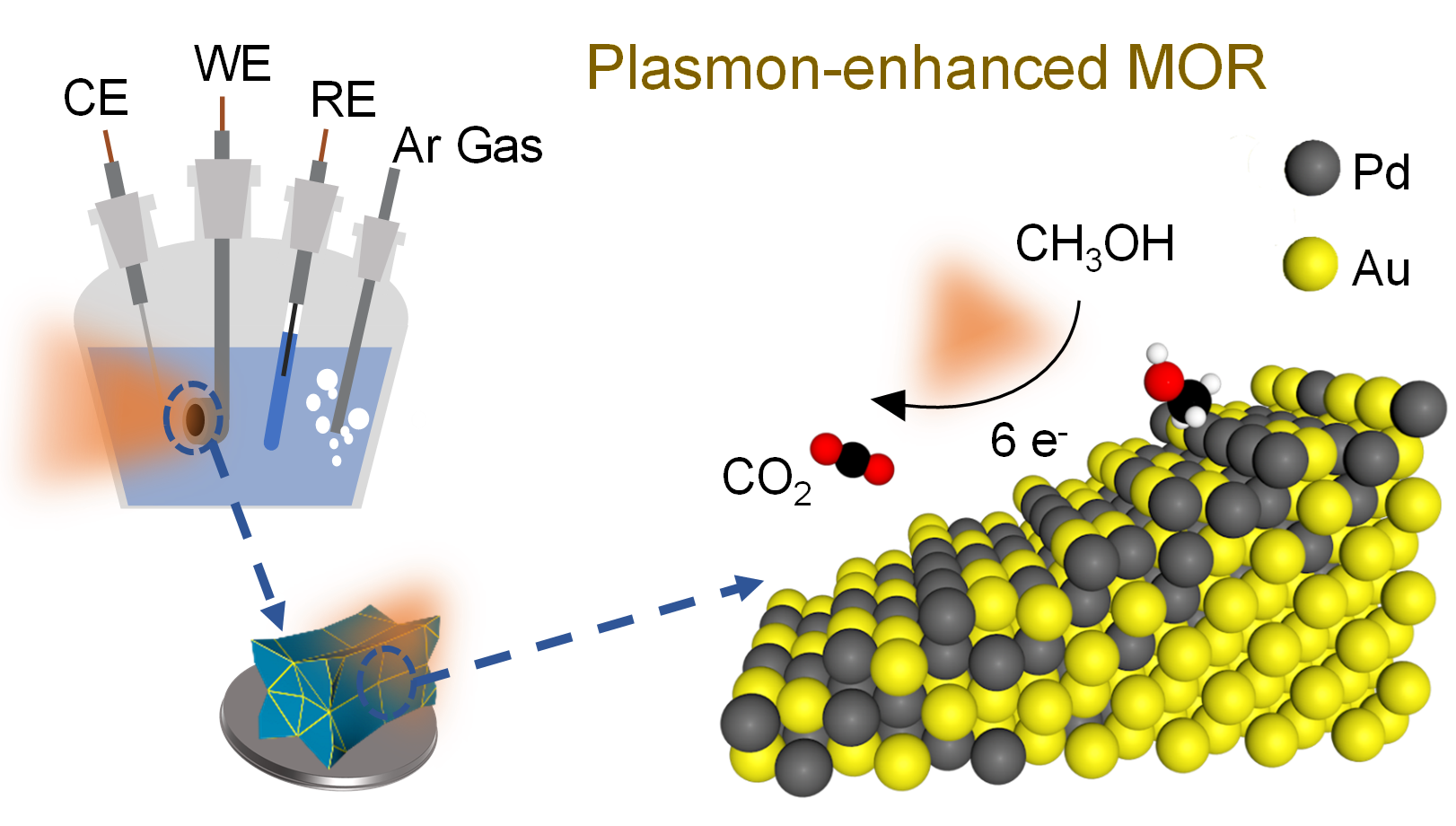
The spatial arrangement of plasmonic metals relative to catalytically active components directly governs the coupling efficiency between hot carriers and the local electromagnetic field at the catalytic interface, thereby profoundly affecting the activity and selectivity of plasmon-enhanced electrocatalytic reactions. However, relying solely on a catalytic metal as the dominant surface species often results in significant plasmon damping. At the same time, synergistically optimizing plasmonic enhancement and intrinsic catalytic activity through precise control of the composition, facets, and thickness of bimetallic alloys remains a major challenge in synthesis and structural design. In this study, Au@AuxPdy alloy core-shell nanorods with tunable shell composition and thickness were constructed, achieving a balance between plasmonic enhancement and intrinsic catalytic activity toward the methanol oxidation reaction (MOR). Through a combination of experimental observations, single-particle dark-field scattering spectroscopy, and numerical simulations, the alloy-shell-dependent extinction characteristics and their correlation with the plasmonic enhancement effect were elucidated. Under light irradiation, the optimal Au@Au5Pd5 nanorods show a 1.88-fold enhancement in current density for MOR. The as-designed bimetallic nanocatalysts can also be used as active substrates for in situ Raman spectroscopic studies of MOR. This work provides important insights for designing bimetallic nanostructures that integrate efficient plasmonic enhancement with high catalytic activity for plasmon-promoted catalysis.
- Open Access
- Article
Structurally Modulated AuPd Alloy Nanorods for Plasmon-Promoted Methanol Electrooxidation
- Zixu Wang 1,†,
- Guoxin Cao 1,†,
- Guizeng Yang 1,
- Lichao Sun 1,2,3,*,
- Vladimir Bochenkov 4,*,
- Qingfeng Zhang 1,*
Author Information
Received: 14 Jul 2026 | Revised: 17 Aug 2026 | Accepted: 03 Sep 2026 | Published: 10 Sep 2026
Abstract
Graphical Abstract
Keywords
plasmonics | bimetallic nanoparticles | Au-Pd alloy | plasmon-enhanced electrocatalysis | methanol oxidation reaction
References
- 1.
Chen, Y.X.; Kanan, M.W. Thermal Ca2+/Mg2+ exchange reactions to synthesize CO2 removal materials. Nature 2025, 638, 972–979.
- 2.
Zhou, L.A.; Martirez, J.M.P.; Finzel, J.; Zhang, C.; Swearer, D.F.; Tian, S.; Robatjazi, H.; Lou, M.H.; Dong, L.L.; Henderson, L.; et al. Light-driven methane dry reforming with single atomic site antenna-reactor plasmonic photocatalysts. Nat. Energy 2020, 5, 61–70.
- 3.
Bhattacharjee, S.; Linley, S.; Reisner, E. Solar reforming as an emerging technology for circular chemical industries. Nat. Rev. Chem. 2024, 8, 87–105.
- 4.
Xia, Y.N.; Xiong, Y.J.; Lim, B.; Skrabalak, S.E. Shape-Controlled Synthesis of Metal Nanocrystals: Simple Chemistry Meets Complex Physics? Angew. Chem. Int. Ed. 2009, 48, 60–103.
- 5.
Li, W.; Elzatahry, A.; Aldhayan, D.; Zhao, D. Core–shell structured titanium dioxide nanomaterials for solar energy utilization. Chem. Soc. Rev. 2018, 47, 8203–8237.
- 6.
Liu, J.X.; Ma, H.; Yuan, S.F.; Zhang, J.N.; Liang, J.G.; Zhou, R.; Li, D.S.; Chen, W.; Li, M.D.; Wu, T. Semiconductor clusters enable high-efficiency extraction of hot electrons from gold nanorods for photocatalytic organic conversions. Sci. China Chem. 2025, 68, 3574–3585.
- 7.
Aslam, U.; Rao, V.G.; Chavez, S.; Linic, S. Catalytic conversion of solar to chemical energy on plasmonic metal nanostructures. Nat. Catal. 2018, 1, 656–665.
- 8.
Gong, J.L.; Li, C.; Wasielewski, M.R. Advances in solar energy conversion. Chem. Soc. Rev. 2019, 48, 1862–1864.
- 9.
Zou, L.; Sa, R.J.; Zhong, H.; Lv, H.W.; Wang, X.C.; Wang, R.H. Photoelectron Transfer Mediated by the Interfacial Electron Effects for Boosting Visible-Light-Driven CO2 Reduction. ACS Catal. 2022, 12, 3550–3557.
- 10.
Lan, Z.A.; Wu, M.; Fang, Z.P.; Zhang, Y.F.; Chen, X.; Zhang, G.G.; Wang, X.C. Ionothermal Synthesis of Covalent Triazine Frameworks in a NaCl-KCl-ZnCl2 Eutectic Salt for the Hydrogen Evolution Reaction. Angew. Chem. Int. Ed. 2022, 61, e202201482.
- 11.
Sun, L.C.; Zhang, Q.F.; Li, G.G.; Villarreal, E.; Fu, X.Q.; Wang, H. Multifaceted Gold–Palladium Bimetallic Nanorods and Their Geometric, Compositional, and Catalytic Tunabilities. ACS Nano 2017, 11, 3213–3228.
- 12.
Xu, C.P.; Ravi Anusuyadevi, P.; Aymonier, C.; Luque, R.; Marre, S. Nanostructured materials for photocatalysis. Chem. Soc. Rev. 2019, 48, 3868–3902.
- 13.
Lin, Y.H.; Deng, C.Y.; Wu, L.; Zhang, Y.C.; Chen, C.C.; Ma, W.H.; Zhao, J.C. Quantitative isotope measurements in heterogeneous photocatalysis and electrocatalysis. Energy Environ. Sci. 2020, 13, 2602–2617.
- 14.
Li, A.; Zhu, W.J.; Li, C.C.; Wang, T.; Gong, J.L. Rational design of yolk–shell nanostructures for photocatalysis. Chem. Soc. Rev. 2019, 48, 1874–1907.
- 15.
Rebello Sousa Dias, M.; Leite, M.S. Alloying: A Platform for Metallic Materials with On-Demand Optical Response. Acc. Chem. Res. 2019, 52, 2881–2891.
- 16.
Zhao, Y.H.; Wu, F.X.; Wei, J.P.; Sun, H.D.; Yuan, Y.L.; Bao, H.B.; Li, F.H.; Zhang, Z.C.; Han, S.; Niu, W.X. Designer Gold-Framed Palladium Nanocubes for Plasmon-Enhanced Electrocatalytic Oxidation of Ethanol. Chem.-Eur. J. 2022, 28, e202200494.
- 17.
Lee, S.; Lee, J.; Lee, S.; Haddadnezhad, M.; Oh, M.J.; Zhao, Q.; Yoo, S.; Liu, L.; Jung, I.; Park, S. Multi-Layered PtAu Nanoframes and Their Light-Enhanced Electrocatalytic Activity via Plasmonic Hot Spots. Small 2023, 19, 2206377.
- 18.
Zhang, L.; Zhang, J.W.; Kuang, Q.; Xie, S.F.; Jiang, Z.Y.; Xie, Z.X.; Zheng, L.S. Cu2+-Assisted Synthesis of Hexoctahedral Au-Pd Alloy Nanocrystals with High-Index Facets. J. Am. Chem. Soc. 2011, 133, 17114–17117.
- 19.
Helveston, J.P.; He, G.; Davidson, M.R. Quantifying the cost savings of global solar photovoltaic supply chains. Nature 2022, 612, 83–87.
- 20.
Dai, C.H.; Liu, B. Conjugated polymers for visible-light-driven photocatalysis. Energy Environ. Sci. 2020, 13, 24–52.
- 21.
Ding, B.; Ding, Y.; Peng, J.; Romano-deGea, J.; Frederiksen, L.E.K.; Kanda, H.; Syzgantseva, O.A.; Syzgantseva, M.A.; Audinot, J.-N.; Bour, J.; et al. Dopant-additive synergism enhances perovskite solar modules. Nature 2024, 628, 299–305.
- 22.
Liu, J.; He, Y.C.; Ding, L.; Zhang, H.; Li, Q.Y.; Jia, L.B.; Yu, J.; Lau, T.W.; Li, M.H.; Qin, Y.; et al. Perovskite/silicon tandem solar cells with bilayer interface passivation. Nature 2024, 635, 596–603.
- 23.
Yang, Y.H.; Zhang, B.B.; Sun, X.H.; Tao, Y.L.; Yang, G.Z.; Liu, C.; Wang, Z.X.; Sun, L.C.; Zhang, Q.F. Tuning the modal coupling in three-dimensional Au@Cu2O@Au core–shell–satellite nanostructures for enhanced plasmonic photocatalysis. Chem. Sci. 2025, 16, 8069–8081.
- 24.
Yu, Z.J.; Wang, J.M.; Chen, Z.L.; Liu, S.Q.; Zhang, Y.C.; Zhao, J.C. Plasmon-assisted photothermal catalysis for efficient styrene epoxidation on Au/NiCo2O4 photoanodes. Sci. China Chem. 2026, 69, 961–969.
- 25.
Zhang, Z.L.; Zhang, C.Y.; Zheng, H.R.; Xu, H.X. Plasmon-Driven Catalysis on Molecules and Nanomaterials. Acc. Chem. Res. 2019, 52, 2506–2515.
- 26.
Gellé, A.; Jin, T.; de la Garza, L.; Price, G.D.; Besteiro, L.V.; Moores, A. Applications of Plasmon-Enhanced Nanocatalysis to Organic Transformations. Chem. Rev. 2020, 120, 986–1041.
- 27.
Brongersma, M.L.; Halas, N.J.; Nordlander, P. Plasmon-induced hot carrier science and technology. Nat. Nanotechnol. 2015, 10, 25–34.
- 28.
Clavero, C. Plasmon-induced hot-electron generation at nanoparticle/metal-oxide interfaces for photovoltaic and photocatalytic devices. Nat. Photon. 2014, 8, 95–103.
- 29.
Zeng, Y.J.; Yang, G.Z.; Yang, Y.H.; Tao, Y.L.; Zhang, B.B.; Cheng, Q.Q.; Sun, X.H.; Wang, Z.X.; Sun, L.C.; Zhang, Q.F. Au@TiN hybrid nanostructures with geometric, compositional, and optical tunability. Sci. China Mater. 2026, 69, 2860–2870.
- 30.
Hu, Q.; Li, P.P.; Li, M.Q.; Wu, J.C.; Ding, J.Y.; Fan, W.Y.; Hu, Q.Y.; Chen, Q.X.; Jiao, X.C. High-index faceted jagged PtPdTe nanotubes for methanol oxidation reaction. Sci. China Chem. 2025, 68, 4216–4223.
- 31.
Cao, S.Y.; Li, M.F.; Guo, Z.H.; Gong, L.; Lu, Y.F.; Zhang, W.H.; Ni, Y.; Gao, L.; Ma, C.; Huang, H.W. Crystal-phase-controlled PtSn intermetallic nanowires for efficient methanol oxidation. Sci. China Chem. 2024, 67, 4142–4148.
- 32.
Zhao, J.; Xue, S.; Ji, R.R.; Li, B.; Li, J.H. Localized surface plasmon resonance for enhanced electrocatalysis. Chem. Soc. Rev. 2021, 50, 12070–12097.
- 33.
Li, S.W.; Miao, P.; Zhang, Y.Y.; Wu, J.; Zhang, B.; Du, Y.C.; Han, X.J.; Sun, J.M.; Xu, P. Recent Advances in Plasmonic Nanostructures for Enhanced Photocatalysis and Electrocatalysis. Adv. Mater. 2021, 33, 2000086.
- 34.
Choi, C.H.; Chung, K.; Nguyen, T.T.H.; Kim, D.H. Plasmon-Mediated Electrocatalysis for Sustainable Energy: From Electrochemical Conversion of Different Feedstocks to Fuel Cell Reactions. ACS Energy Lett. 2018, 3, 1415–1433.
- 35.
Zhang, Q.F.; Chen, K.X.; Wang, H. Hot-Hole-Induced Molecular Scissoring: A Case Study of Plasmon-Driven Decarboxylation of Aromatic Carboxylates. J. Phys. Chem. C 2021, 125, 20958–20971.
- 36.
Besteiro, L.V.; Yu, P.; Wang, Z.M.; Holleitner, A.W.; Hartland, G.V.; Wiederrecht, G.P.; Govorov, A.O. The fast and the furious: Ultrafast hot electrons in plasmonic metastructures. Size and structure matter. Nano Today 2019, 27, 120–145.
- 37.
Kale, M.J.; Avanesian, T.; Christopher, P. Direct Photocatalysis by Plasmonic Nanostructures. ACS Catal. 2014, 4, 116–128.
- 38.
Bohren, C.F. How can a particle absorb more than the light incident on it? Am. J. Phys. 1983, 51, 323–327.
- 39.
Dombi, P.; Hörl, A.; Rácz, P.; Márton, I.; Trügler, A.; Krenn, J.R.; Hohenester, U. Ultrafast Strong-Field Photoemission from Plasmonic Nanoparticles. Nano Lett. 2013, 13, 674–678.
- 40.
Wang, T.; Wang, H.J.; Lin, J.S.; Yang, J.L.; Zhang, F.L.; Lin, X.M.; Zhang, Y.J.; Jin, S.Z.; Li, J.F. Plasmonic photocatalysis: Mechanism, applications and perspectives. Chin. J. Struct. Chem. 2023, 42, 100066.
- 41.
Jung, H.; Kwon, Y.; Kim, Y.; Ahn, H.; Ahn, H.; Wy, Y.; Han, S.W. Directing Energy Flow in Core–Shell Nanostructures for Efficient Plasmon-Enhanced Electrocatalysis. Nano Lett. 2023, 23, 1774–1780.
- 42.
Ding, J.W.; Wang, F.M.; Pan, F.; Yu, P.; Gao, N.; Goldsmith, R.H.; Cai, S.F.; Yang, R.; He, J. Two-Dimensional Palladium Nanosheet Intercalated with Gold Nanoparticles for Plasmon-Enhanced Electrocatalysis. ACS Catal. 2021, 11, 13721–13732.
- 43.
Stete, F.; Kesarwani, S.; Ruhmlieb, C.; Askes, S.H.C.; Schulz, F.; Bargheer, M.; Lange, H. Inverted temperature gradients in gold–palladium antenna-reactor nanoparticles. Nat. Commun. 2025, 16, 8168.
- 44.
da Silva, K.N.; Shetty, S.; Sullivan-Allsop, S.; Cai, R.S.; Wang, S.Q.; Quiroz, J.; Chundak, M.; dos Santos, H.L.S.; Abdelsalam, I.; Oropeza, F.E.; et al. Au@AuPd Core-Alloyed Shell Nanoparticles for Enhanced Electrocatalytic Activity and Selectivity under Visible Light Excitation. ACS Nano 2024, 18, 24391–24403.
- 45.
Bezerra, L.S.; Brasseur, P.; Sullivan-Allsop, S.; Cai, R.S.; da Silva, K.N.; Wang, S.Q.; Singh, H.; Yadav, A.K.; Santos, H.L.S.; Chundak, M.; et al. Ultralow Catalytic Loading for Optimised Electrocatalytic Performance of AuPt Nanoparticles to Produce Hydrogen and Ammonia. Angew. Chem. Int. Ed. 2024, 63, e202405459.
- 46.
Xie, X.M.; Feng, J.G.; Cui, X.J.; Liu, J.; Jiang, L.H.; Dong, L.F. Plasmon-Enhanced Photocatalysis Coupling Electrocatalysis Steering Methanol Oxidation toward a CO-Free Dominant Pathway. ACS Catal. 2021, 11, 13160–13168.
- 47.
Zhang, H.W.; Itoi, T.; Konishi, T.; Izumi, Y. Dual Photocatalytic Roles of Light: Charge Separation at the Band Gap and Heat via Localized Surface Plasmon Resonance to Convert CO2 into CO over Silver-Zirconium Oxide. J. Am. Chem. Soc. 2019, 141, 6292–6301.
- 48.
Forcherio, G.T.; Ostovar, B.; Boltersdorf, J.; Cai, Y.Y.; Leff, A.C.; Grew, K.N.; Lundgren, C.A.; Link, S.; Baker, D.R. Single-Particle Insights into Plasmonic Hot Carrier Separation Augmenting Photoelectrochemical Ethanol Oxidation with Photocatalytically Synthesized Pd–Au Bimetallic Nanorods. ACS Nano 2022, 16, 12377–12389.
- 49.
Sytwu, K.; Vadai, M.; Hayee, F.; Angell, D.K.; Dai, A.; Dixon, J.; Dionne, J.A. Driving energetically unfavorable dehydrogenation dynamics with plasmonics. Science 2021, 371, 280–283.
- 50.
Mohan, P.; Takahashi, M.; Higashimine, K.; Mott, D.; Maenosono, S. AuFePt Ternary Homogeneous Alloy Nanoparticles with Magnetic and Plasmonic Properties. Langmuir 2017, 33, 1687–1694.
- 51.
Luo, M.; Guo, S. Strain-controlled electrocatalysis on multimetallic nanomaterials. Nat. Rev. Mater. 2017, 2, 17059.
- 52.
Liu, T.; Li, W.; Wang, D.Z.; Luo, T.; Fei, M.; Shin, D.; Waegele, M.M.; Wang, D. Low Catalyst Loading Enhances Charge Accumulation for Photoelectrochemical Water Splitting. Angew. Chem. Int. Ed. 2023, 62, e202307909.
- 53.
Aguilar-Ferrer, D.; Vasileiadis, T.; Iatsunskyi, I.; Ziółek, M.; Żebrowska, K.; Ivashchenko, O.; Błaszkiewicz, P.; Grześkowiak, B.; Pazos, R.; Moya, S.; et al. Understanding the Photothermal and Photocatalytic Mechanism of Polydopamine Coated Gold Nanorods. Adv. Funct. Mater. 2023, 33, 2304208.
- 54.
Patel, M.; Park, H.H.; Bhatnagar, P.; Kumar, N.; Lee, J.; Kim, J. Transparent integrated pyroelectric-photovoltaic structure for photo-thermo hybrid power generation. Nat. Commun. 2024, 15, 3466.
- 55.
Zhang, Q.; Hernandez, T.; Smith, K.W.; Hosseini Jebeli, S.A.; Dai, A.X.; Warning, L.; Baiyasi, R.; McCarthy, L.A.; Guo, H.; Chen, D.-H.; et al. Unraveling the origin of chirality from plasmonic nanoparticle-protein complexes. Science 2019, 365, 1475–1478.
- 56.
Johnson, P.B.; Christy, R.W. Optical constants of the noble metals. Phys. Rev. B 1972, 6, 4370–4379.
- 57.
Stofela, S.K.F.; Kizilkaya, O.; Diroll, B.T.; Leite, T.R.; Taheri, M.M.; Willis, D.E.; Baxter, J.B.; Shelton, W.A.; Sprunger, P.T.; McPeak, K.M. A Noble-Transition Alloy Excels at Hot-Carrier Generation in the Near Infrared. Adv. Mater. 2020, 32, 1906478.
- 58.
Wang, L.B.; Zhao, S.T.; Liu, C.X.; Li, C.; Li, X.; Li, H.L.; Wang, Y.C.; Ma, C.; Li, Z.Y.; Zeng, J. Aerobic Oxidation of Cyclohexane on Catalysts Based on Twinned and Single-Crystal AuPd Bimetallic Nanocrystals. Nano Lett. 2015, 15, 2875–2880.
- 59.
Hong, J.W.; Kim, D.; Lee, Y.W.; Kim, M.; Kang, S.W.; Han, S.W. Atomic-Distribution-Dependent Electrocatalytic Activity of Au-Pd Bimetallic Nanocrystals. Angew. Chem. Int. Ed. 2011, 50, 8876–8880.
- 60.
Lim, B.; Kobayashi, H.; Yu, T.; Wang, J.G.; Kim, M.J.; Li, Z.Y.; Rycenga, M.; Xia, Y.N. Synthesis of Pd-Au Bimetallic Nanocrystals via Controlled Overgrowth. J. Am. Chem. Soc. 2010, 132, 2506–2507.
- 61.
Sun, M.Q.; Wang, A.K.; Zhang, M.; Zou, S.L.; Wang, H. Interband and Intraband Hot Carrier-Driven Photocatalysis on Plasmonic Bimetallic Nanoparticles: A Case Study of Au-Cu Alloy Nanoparticles. ACS Nanosci. Au 2024, 4, 360–373.
- 62.
Foerster, B.; Joplin, A.; Kaefer, K.; Celiksoy, S.; Link, S.; Sönnichsen, C. Chemical Interface Damping Depends on Electrons Reaching the Surface. ACS Nano 2017, 11, 2886–2893.
- 63.
Willets, K.A.; Van Duyne, R.P. Localized Surface Plasmon Resonance Spectroscopy and Sensing. Annu. Rev. Phys. Chem. 2007, 58, 267–297.
- 64.
Ding, S.Y.; Yi, J.; Li, J.F.; Ren, B.; Wu, D.Y.; Panneerselvam, R.; Tian, Z.Q. Nanostructure-based plasmon-enhanced Raman spectroscopy for surface analysis of materials. Nat. Rev. Mater. 2016, 1, 16021.
- 65.
Li, J.F.; Huang, Y.F.; Ding, Y.; Yang, Z.L.; Li, S.B.; Zhou, X.S.; Fan, F.R.; Zhang, W.; Zhou, Z.Y.; Wu, D.Y.; et al. Shell-isolated nanoparticle-enhanced Raman spectroscopy. Nature 2010, 464, 392–395.
- 66.
Zhang, Q.F.; Wang, H. Mechanistic Insights on Plasmon-Driven Photocatalytic Oxidative Coupling of Thiophenol Derivatives: Evidence for Steady-State Photoactivated Oxygen. J. Phys. Chem. C 2018, 122, 5686–5697.
- 67.
Zhang, Q.F.; Zhou, Y.D.; Fu, X.Q.; Villarreal, E.; Sun, L.C.; Zou, S.L.; Wang, H. Photothermal Effect, Local Field Dependence, and Charge Carrier Relaying Species in Plasmon-Driven Photocatalysis: A Case Study of Aerobic Nitrothiophenol Coupling Reaction. J. Phys. Chem. C 2019, 123, 26695–26704.
- 68.
Cao, Y.T.; Li, Y.L.; Du, A.X.; Zhang, Y.Y.; Xie, W. Unlocking Plasmonic Hot Electron Utilization on Palladium Nanoparticles via Modulation of the Bimetallic Interface for Enhanced Photocatalysis. J. Am. Chem. Soc. 2026, 148, 893–901.
- 69.
Wang, T.; Zhang, M.D.; Huang, Z.Z.; Yue, X.X.; Zhu, A.N.; Tong, L.B.; Du, X.M.; Xie, W. Unveiling Exciton-Molecular Crosstalk Mediating Photocatalysis on Perovskite Quantum Dots via In-Situ SERS. J. Am. Chem. Soc. 2026, 148, 1662–1671.
- 70.
Li, D.Z.; Kuang, Y.B.; Wang, S.L.; Feng, L.G. Carbon-encapsulated RuO2 clusters supported Pt nanoparticles for effective methanol electrooxidation. Sci. China Chem. 2025, 68, 6083–6091.
- 71.
Dong, J.C.; Zhang, X.G.; Briega-Martos, V.; Jin, X.; Yang, J.; Chen, S.; Yang, Z.L.; Wu, D.Y.; Feliu, J.M.; Williams, C.T.; et al. In Situ Raman spectroscopic evidence for oxygen reduction reaction intermediates at platinum single-crystal surfaces. Nat. Energy 2019, 4, 60–67.
- 72.
Ze, H.J.; Chen, X.; Wang, X.T.; Wang, Y.H.; Chen, Q.Q.; Lin, J.S.; Zhang, Y.J.; Zhang, X.G.; Tian, Z.Q.; Li, J.F. Molecular Insight of the Critical Role of Ni in Pt-Based Nanocatalysts for Improving the Oxygen Reduction Reaction Probed Using an In Situ SERS Borrowing Strategy. J. Am. Chem. Soc. 2021, 143, 1318–1322.
- 73.
Jiao, W.L.; Chen, C.; You, W.B.; Zhao, X.R.; Zhang, J.; Feng, Y.Z.; Wang, P.; Che, R.C. Hollow Palladium-Gold Nanochains with Periodic Concave Structures as Superior ORR Electrocatalysts and Highly Efficient SERS Substrates. Adv. Energy Mater. 2020, 10, 1904072.
- 74.
Cheng, Y.; Sun, H.R.; Shen, Y.; Zhan, C.H.; Huang, Z.L.; Huang, W.H.; Pao, C.W.; Su, D.; Liu, W.; Huang, X.Q.; et al. Molybdenum-Pocket Driven Low-Platinum Oxygen Reduction Catalysts for 100-Watt-Scale Fuel Cell Stacks. Adv. Mater. 2026, 38, e73444.
- 75.
Shan, W.Y.; Liu, R.; Zhao, H.C.; He, Z.L.; Lai, Y.J.; Li, S.S.; He, G.Z.; Liu, J.F. In Situ Surface-Enhanced Raman Spectroscopic Evidence on the Origin of Selectivity in CO2 Electrocatalytic Reduction. ACS Nano 2020, 14, 11363–11372.
- 76.
Herzog, A.; Bergmann, A.; Jeon, H.S.; Timoshenko, J.; Kühl, S.; Rettenmaier, C.; Lopez Luna, M.; Haase, F.T.; Roldan Cuenya, B. Operando Investigation of Ag-Decorated Cu2O Nanocube Catalysts with Enhanced CO2 Electroreduction toward Liquid Products. Angew. Chem. Int. Ed. 2021, 60, 7426–7435.
- 77.
Jiang, S.; Klingan, K.; Pasquini, C.; Dau, H. New aspects of operando Raman spectroscopy applied to electrochemical CO2 reduction on Cu foams. J. Chem. Phys. 2019, 150, 041718.
- 78.
Mao, T.J.; Lin, D.; Han, X.; Huang, J.L.; Chen, Y.R.; Wang, J.; Jin, H.L.; Wang, S.; Huang, X.Q. Fluorine–Mediated Interfacial Microenvironment for Boosting pH–Universal CO2 Reduction. Adv. Mater. 2025, 37, 2509720.
- 79.
Ding, Y.M.; Liu, Y.L.; Rao, G.S.; Wang, G.F.; Zhong, Q.L.; Ren, B.; Tian, Z.Q. Electrooxidation Mechanism of Methanol at Pt-Ru Catalyst Modified GC Electrode in Electrolytes with Different pH Using Electrochemical and SERS Techniques. Chin. J. Chem. 2007, 25, 1617–1621.
- 80.
Chen, X.; Liang, M.M.; Xu, J.; Sun, H.L.; Wang, C.; Wei, J.; Zhang, H.; Yang, W.M.; Yang, Z.L.; Sun, J.J.; et al. Unveiling the size effect of Pt-on-Au nanostructures on CO and methanol electrooxidation by in situ electrochemical SERS. Nanoscale 2020, 12, 5341–5346.

This work is licensed under a Creative Commons Attribution 4.0 International License.
