
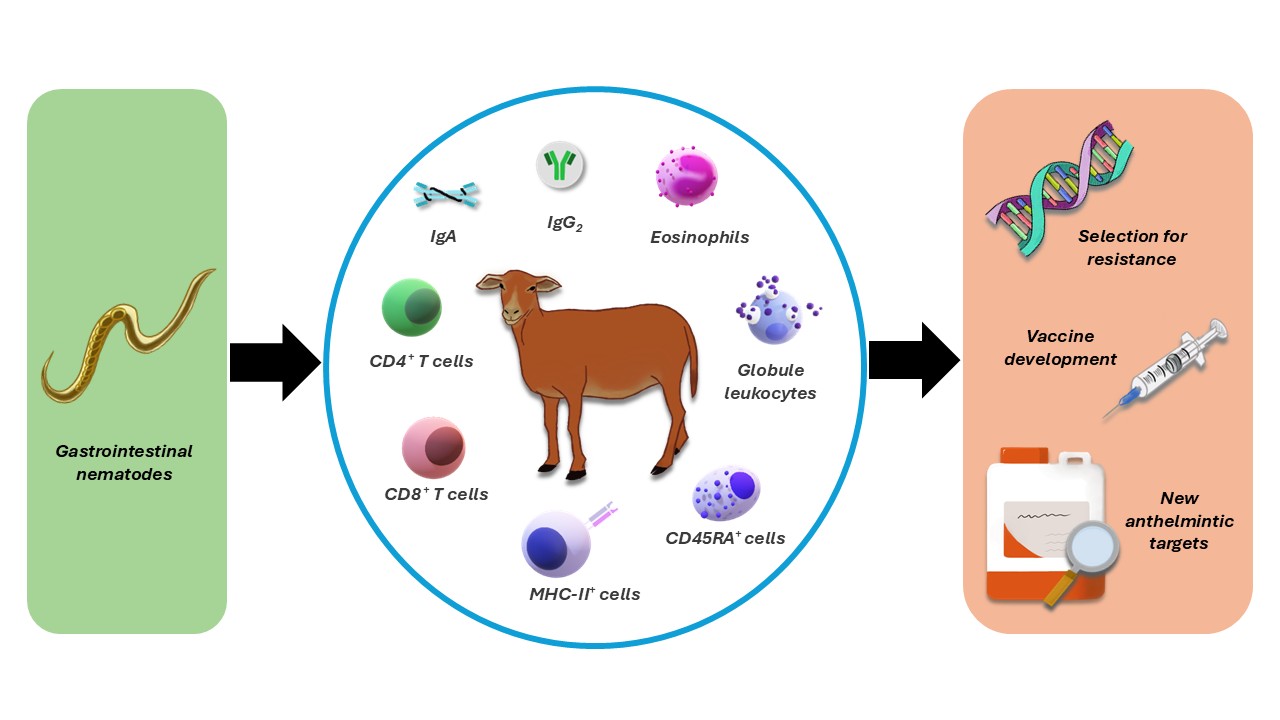
Gastrointestinal nematodes (GINs) are common parasites in grazing sheep. They have been traditionally controlled through the strategic administration of anthelmintics, but the increasing emergence of resistance, makes it necessary to identify new control alternatives. Vaccines and the selection of resistant animals are strategies based on the development of an effective immune response. For the development of these strategies, a detailed understanding of the effective immune response is essential. Some local breeds, such as the Canaria Hair Breed (CHB) sheep, are particularly resistant to GINs infection. This review presents some previous studies conducted in the CHB that have confirmed its ability to develop an immune response oriented toward the adult stage rather than the larval stage in single infection, and the contribution of Tgd+ cells, eosinophils, and local IgA in these mechanisms. The response capacity of very young lambs of this breed to vaccination against Teladorsagia circumcincta and the possible role of Treg lymphocytes compared to other more susceptible breeds are also discussed, as well as the possible biotechnological implications that these findings may have on vaccine design and the identification of genetic resistance markers.
- Open Access
- Review
Gastrointestinal Nematodes in Sheep: Looking Back for Building Up Future
Author Information
Received: 07 Aug 2025 | Revised: 04 Sep 2025 | Accepted: 16 Sep 2025 | Published: 30 Sep 2025
Abstract
Graphical Abstract
Keywords
gastrointestinal nematode | breed resistance | Canaria Hair Breed | immunity | local breed
References
- 1.Tompkins, D.M.; Dunn, A.M.; Smith, M.J.; et al. Wildlife diseases: From individuals to ecosystems. J. Anim. Ecol. 2011, 80, 19–38.
- 2.Suárez-González, Z.; González, J.F.; Arbelo, M.; et al. Parasitic Infections in Stranded Whales and Dolphins in Canary Islands (2018–2022): An Update. Animals 2024, 14, 3377.
- 3.Llinás-Caballero, K.; Caraballo, L. Helminths and bacterial microbiota: The interactions of two of humans’ “old friends”. Int. J. Mol. Sci. 2022, 23, 13358.
- 4.Zhang, B.; Gems, D. Gross ways to live long: Parasitic worms as an anti-inflammaging therapy? Elife 2021, 10, e65180.
- 5.Craig, J.M. Atopic dermatitis and the intestinal microbiota in humans and dogs. Vet. Med. Sci. 2016, 2, 95–105.
- 6.Giannelli, A.; Schnyder, M.; Wright, I.; et al. Control of companion animal parasites and impact on One Health. One Health 2024, 18, 100679.
- 7.Charlier, J.; Rinaldi, L.; Musella, V.; et al. Initial assessment of the economic burden of major parasitic helminth infections to the ruminant livestock industry in Europe. Prev. Vet. Med. 2020, 182, 105103.
- 8.Charlier, J.; Rinaldi, L.; Morgan, E.R.; et al. Sustainable worm control in ruminants in Europe: Current perspectives. Anim. Front. 2024, 14, 13–23.
- 9.Cunha, S.M.F.; Willoughby, O.; Schenkel, F.; et al. Genetic Parameter Estimation and Selection for Resistance to Gastrointestinal Nematode Parasites in Sheep—A Review. Animals 2024, 14, 613.
- 10.Höglund, J.; Gustafsson, K. Anthelmintic Treatment of Sheep and the Role of Parasites Refugia in a Local Context. Animals 2023, 13, 1960.
- 11.Piedrafita, D.; Raadsma, H.W.; Gonzalez, J.; et al. Increased production through parasite control: Can ancient breeds of sheep teach us new lessons? Trends Parasitol. 2010, 26, 568–573.
- 12.Karlsson, L.J.; Greeff, J.C. Selection response in fecal worm egg counts in the Rylington Merino parasite resistant flock. Aust. J. Exp. Agr. 2006, 46, 809–811.
- 13.Stear, M.J.; Strain, S.; Bishop, S.C. How lambs control infection with Ostertagia circumcincta. Vet. Immunol. Immunopathol. 1999, 72, 213–218.
- 14.Bordes, L.; Dumont, N.; Lespine, A.; et al. First report of multiple resistance to eprinomectin and benzimidazole in Haemonchus contortus on a dairy goat farm in France. Parasitol. Int. 2020, 76, 102063.
- 15.Mavrot, F.; Hertzberg, H.; Torgerson, P. Effect of gastro-intestinal nematode infection on sheep performance: A systematic review and meta-analysis. Parasites Vectors 2015, 8, 557–568.
- 16.Nisbet, A.J.; Meeusen, E.N.; González, J.F.; et al. Immunity to Haemonchus contortus and Vaccine Development. Adv. Parasitol. 2016, 93, 353–396.
- 17.Nisbet, A.J.; McNeilly, T.N.; Price, D.R.G.; et al. Field testing of recombinant subunit vaccines against Teladorsagia circumcincta in lambing ewes demonstrates a lack of efficacy in the face of a multi-species parasite challenge. Front. Parasitol. 2024, 3, 1360029.
- 18.Bisset, S.A.; Morris, C.A.; McEwan, J.C.; et al. Breeding sheep in New Zealand that are less reliant on anthelmintics to maintain health and productivity. N. Z. Vet. J. 2001, 49, 236–246.
- 19.Woolaston, R.R.; Baker, R.L. Prospects of Breeding Small Ruminants for Resistance to Internal Parasites. Int. J. Parasitol. 1996, 26, 845–855.
- 20.McManus, C.; do Prado Paim, T.; de Melo, C.B.; et al. Selection methods for resistance to and tolerance of helminths in livestock. Parasite 2014, 21, 56.
- 21.Hunt, P.W.; Kijas, J.; Ingham, A. Understanding parasitic infection in sheep to design more efficient animal selection strategies. Vet. J. 2013, 197, 143–152.
- 22.Shaw, R.J.; Morris, C.A.; Wheeler, M. Genetic and phenotypic relationships between carbohydrate larval antigen (CarLA) IgA, parasite resistance and productivity in serial samples taken from lambs after weaning. Int. J. Parasitol. 2013, 43, 661–667.
- 23.Castilla Gómez de Agüero, V.; Valderas-García, E.; González del Palacio, L.; et al. Secretory IgA as Biomarker for Gastrointestinal Nematodes Natural Infection in Different Breed Sheep. Animals 2023, 13, 2189. https://doi.org/10.3390/ani13132189.
- 24.Stear, M.J.; Bishop, S.C.; Doligalska, M.; et al. Regulation of egg production, worm burden, worm length and worm fecundity by host responses in sheep infected with Ostertagia circumcincta. Parasite Immunol. 1995, 17, 643–652.
- 25.McRae, K.M.; Stear, M.J.; Good, B.; et al. The host immune response to gastrointestinal nematode infection in sheep. Parasite Immunol. 2015, 3, 605–613.
- 26.Meeusen, E.N.T.; Balic, A. Do eosinophils have a role in the killing of helminth parasites? Parasitol. Today 2000, 16, 95–101.
- 27.Terefe, G.; Grisez, C.; Prevot, F.; et al. In vitro pre-exposure of Haemonchus contortus L3 to blood eosinophils reduces their establishment potential in sheep. Vet. Res. 2007, 38, 647–654.
- 28.Rainbird, M.A.; MacMillan, D.; Meeusen, E.N.T. Eosinophil-mediated killing of Haemonchus contortus larvae: Effect of eosinophil activation and role of antibody, complement and interleukin-5. Parasite Immunol. 1998, 20, 93–103.
- 29.Balic, A.; Bowles, V.M.; Meeusen, E.N.T. The immunobiology of gastrointestinal nematode infections in ruminants. Adv. Parasitol. 2000, 45, 181–241.
- 30.Strain, S.A.J.; Stear, M.J. The recognition of molecules from fourth-stage larvae of Ostertagia circumcincta by IgA from infected sheep. Parasite Immunol. 1999, 21, 163–168.
- 31.Santos, I.B.; Ferreira, A.U.C.; Rabelo, M.D.; et al. Portable near-infrared spectroscopy: A rapid and accurate blood test for diagnosis of Haemonchus contortus infection and for targeted selective treatment of sheep. Int. J. Parasitol. 2023, 53, 119–127.
- 32.Das, S.; Hembram, A.; Pandit, S.; et al. Comparative parasitological and haemato-biochemical responses between resistant and susceptible Garole sheep infected with Haemonchus contortus. Indian J. Anim. Health 2025. https://doi.org/10.36062/ijah.2025.15124.
- 33.Niciura, S.C.M.; Cardoso, T.F.; Ibelli, A.M.G.; et al. Multi-omics data elucidate parasite-host-microbiota interactions and resistance to Haemonchus contortus in sheep. Parasites Vectors 2024, 17, 102.
- 34.Álvarez, I.; Traoré, A.; Fernández, I.; et al. Usefulness of running animal models in absence of pedigrees: Estimation of genetic parameters for gastrointestinal parasite resistance traits in Djallonké sheep of Burkina Faso. Small Rumin. Res. 2018, 160, 81–88.
- 35.do Bem, R.D.; de Freitas, L.A.; Menegatto, L.S.; et al. Estimates of genetic parameters for indicator traits of resistance to gastrointestinal nematodes and growth traits in Santa Inês sheep. Small Rum. Res. 2023, 224, 106983.
- 36.González-Garduño, R.; Mendoza-de Gives, P.; López-Arellano, M.E.; et al. Influence of the physiological stage of Blackbelly sheep on immunological behaviour against gastrointestinal nematodes. Exp. Parasitol. 2018, 193, 20–26.
- 37.Estrada-Reyes, Z.M.; Rae, D.O.; Mateescu, R.G. Genome-wide scan reveals important additive and non-additive genetic effects associated with resistance to Haemonchus contortus in Florida Native sheep. Int. J. Parasitol. 2021, 51, 535–543.
- 38.Weaver, A.R.; Wright, D.L.; Greiner, S.P.; et al. Effect of sire fecal egg count estimated breeding value on Katahdin lamb parasite resistance in pasture-based system. Small Rum. Res. 2023, 224, 106984.
- 39.Kapritchkoff, R.T.I.; Okino, C.H.; Niciura, S.C.M.; et al. Association of β-globin polymorphisms and tolerance to haemonchosis in ewes and lambs of different sheep breeds. Vet. Parasitol. 2024, 328, 110163.
- 40.Delgado, J.V.; Perezgrovas, R.; Camacho, M.E.; et al. The Wool-Less canary sheep and their relationship with the present breeds in America. Anim. Genet. Resour. Inf. 2000, 28, 27–34.
- 41.González, J.F.; Hernández, Á.; Molina, J.M.; et al. Comparative experimental Haemonchus contortus infection of two sheep breeds native to the Canary Islands. Vet. Parasitol. 2008, 153, 374–378.
- 42.González, J.F.; Hernández, A.; Meeusen, E.N.T., et al. Fecundity in adult Haemonchus contortus parasites is correlated with abomasal tissue eosinophils and γδ T cells in resistant Canaria Hair Breed sheep. Vet. Parasitol. 2011, 178, 286–292.
- 43.Hernández, J.N.; Hernández, A.; Stear, M.J.; et al. Potential role for mucosal IgA in modulating Haemonchus contortus adult worm infection in sheep. Vet. Parasitol. 2016, 223, 153–158.
- 44.Hernández, J.N. Interacción Parásito-Hospedador Entre Nematodos Gastrointestinales y Razas Ovinas Canarias: Papel de Los Linfocitos T Gammadelta y Los Eosinófilos. Ph.D. Thesis, Universidad de Las Palmas de Gran Canaria, Las Palmas, Spain, 2015.
- 45.Bishop, S.C. Possibilities to breed for resistance to nematode parasite infections in small ruminants in tropical production systems. Animal 2012, 6, 741–747.
- 46.Hernández, J.N.; Meeusen, E.; Stear, M.; et al. Modulation of Haemonchus contortus infection by depletion of γδ + T cells in parasite resistant Canaria Hair Breed sheep. Vet. Parasitol. 2017, 237, 57–62.
- 47.Hernández, A. Estudio de la Respuesta Inmune Frente a Haemonchus contortus en Dos Razas Ovinas Canarias. Ph.D. Thesis, Universidad de Las Palmas de Gran Canaria, Las Palmas, Spain, 2011.
- 48.Hernández, J.N.; Meeusen, E.; Rodríguez, F.; et al. Increased susceptibility to Haemonchus contortus infection by interleukin-5 modulation of eosinophil responses in sheep. Parasite Immunol. 2020, 42, e12680.
- 49.Guo, Z.; González, J.F.; Hernández, J.N.; et al. Possible mechanisms of host resistance to Haemonchus contortus infection in sheep breeds native to the Canary Islands. Sci. Rep. 2016, 6, 26200.
- 50.Preston, S.J.M.; Beddoe, T.; Walkden-Brown, S.; et al. Galectin-11: A novel host mediator targeting specific stages of the gastrointestinal nematode parasite, Haemonchus contortus. Int. J. Parasitol. 2015, 45, 791–796.
- 51.Liu, F.; Shao, J.; Ingham, A.B.; et al. Disruptions in gene interaction networks abolish host susceptibility to Trichostrongylus colubriformis infections in sheep. PLOS Neglected Trop. Dis. 2025, 19, e0013399.
- 52.González, J.F.; Hernández, J.N.; Machín, C.; et al. Impacts of breed type and vaccination on Teladorsagia circumcincta infection in native sheep in Gran Canaria. Vet. Res. 2019, 50, 29.
- 53.Machin, C.; Corripio-Miyar, Y.; Hernandez, J.N.; et al. Cellular and humoral immune responses associated with protection in sheep vaccinated against Teladorsagia circumcincta. Vet. Res. 2021, 52, 89.
- 54.Manton, V.J.A.; Peacock, R.; Poynter, D.; et al. The Influence of Age on Naturally Acquired Resistance to Haemonchus contortus in Lambs. Res. Vet. Sci. 1962, 3, 308–314.
- 55.Vervelde, L.; Kooyman, F.N.J.; van Leeuwen, M.A.W.; et al. Age-related protective immunity after vaccination with Haemonchus contortus excretory/secretory proteins. Parasite Immunol. 2001, 23, 419–426.
- 56.McClure, S.J.; Emery, D.L.; Bendixsen, T.; et al. Attempts to generate immunity against Trichostrongylus colubriformis and Haemonchus contortus in young lambs by vaccination with viable parasites. Int. J. Parasitol. 1998, 28, 739–746.
- 57.Colditz, I.G.; Watson, D.L.; Gray, G.D.; et al. Some relationships between age, immune responsiveness and resistance to parasites in ruminants. Int. J. Parasitol. 1996, 26, 869–877.
- 58.Barger, I.A. Resistance of young lambs to Haemonchus contortus infection, and its loss following anthelmintic treatment. Int. J. Parasitol. 1998, 18, 1107–1109.
- 59.Smith, W.D.; Jackson, F.; Jackson, E.; et al. Age immunity to Ostertagia circumcincta: Comparison of the local immune responses of 412- and 10-month-old lambs. J. Comp. Pathol. 1985, 95, 235–245.
- 60.Pérez-Hernández, T.; Hernández, J.N.; Machín, C.; et al. Variability in the Response against Teladorsagia circumcincta in Lambs of Two Canarian Sheep Breeds. Int. J. Mol. Sci. 2023, 24, 29.
- 61.Rocha, R.A.; Amarante, A.F.T.; Bricarello, P.A. Resistance of Santa Inês and Ile de France suckling lambs to gastrointestinal nematode infections. Rev. Bras. De Parasitol. Veterinária 2005, 14, 17–20.
- 62.Gruner, L.; Aumont, G.; Getachew, T.; et al. Experimental infection of Black Belly and INRA 401 straight and crossbred sheep with trichostrongyle nematode parasites. Vet. Parasitol. 2003, 116, 239–249.
- 63.Bahirathan, M.; Miller, J.E.; Barras, S.R.; et al. Susceptibility of Suffolk and Gulf Coast Native suckling lambs to naturally acquired strongylate nematode infection. Vet. Parasitol. 1996, 65, 259–268.
- 64.Pérez-Hernández, T.; Corripio-Miyar, Y.; Hernández, J.N.; et al. Differences in the protection elicited by a recombinant Teladorsagia circumcincta vaccine in weaned lambs of two Canarian sheep breeds. Vet. Parasitol. 2022, 306, 109722.
- 65.Liu, W.; McNeilly, T.N.; Mitchell, M.; et al. The right time and place: Time- and age-dependent vaccine-enhanced mucosal immunity to parasite infection. BioRxiv 2021. https://doi.org/10.1101/2021.04.28.441781.
- 66.Andronicos, N.M.; Knox, M.R.; McNally, J.; et al. Direct comparison of host resistance status and Barbevax vaccination to control parasitism in sheep subjected to a mixed parasite field challenge. Vet. Parasitol. 2025, 339, 110552.
- 67.Pérez-Hernández, T.; Hernández, J.N.; Machín, C.; et al. Exploring the transcriptomic changes underlying recombinant vaccine efficacy against Teladorsagia circumcincta in 3-month-old lambs. Vet. Parasitol. 2023, 320, 109960.
- 68.Ndure, J.; Flanagan, K.L. Targeting regulatory T cells to improve vaccine immunogenicity in early life. Front. Microbiol. 2014, 11, 477.
- 69.Ohue, Y.; Nishikawa, H. Regulatory T (Treg) cells in cancer: Can Treg cells be a new therapeutic target? Cancer Sci. 2019, 110, 2080–2089.
- 70.Rech, A.J.; Vonderheide, R.H. Clinical use of anti-CD25 antibody daclizumab to enhance immune responses to tumor antigen vaccination by targeting regulatory T cells. Ann. N. Y. Acad. Sci. 2009, 1174, 99–106.
- 71.Batista-Duharte, A.; Téllez-Martínez, D.; Fuentes, D.L.P.; et al. Molecular adjuvants that modulate regulatory T cell function in vaccination: A critical appraisal. Pharmacol. Res. 2018, 129, 237–250.
- 72.Espinoza Mora, M.D.R.; Steeg, C.; Tartz, S.; et al. Depletion of regulatory T cells augments a vaccine-induced T effector cell response against the liver-stage of malaria but fails to increase memory. PLoS ONE 2014, 9, e104627.
- 73.Knuschke, T.; Rotan, O.; Bayer, W.; et al. Combination of nanoparticle-based therapeutic vaccination and transient ablation of regulatory T cells enhances anti-viral immunity during chronic retroviral infection. Retrovirology 2016, 13, 24.
How to Cite
González, J. F.; Machín, C.; Pérez-Hernández, T.; Hernández, J. N. Gastrointestinal Nematodes in Sheep: Looking Back for Building Up Future. Parasitological Science 2026, 1 (1), 3. https://doi.org/10.53941/parsci.2026.100003.
RIS
BibTex
Copyright & License

Copyright (c) 2025 by the authors.
This work is licensed under a Creative Commons Attribution 4.0 International License.
Article Metrics
313
Article Views
0
Citations
Contents
References

 Suite 4002 Level 4, 447 Collins Street, Melbourne, Victoria 3000, Australia
 General Inquiries: info@sciltp.com