
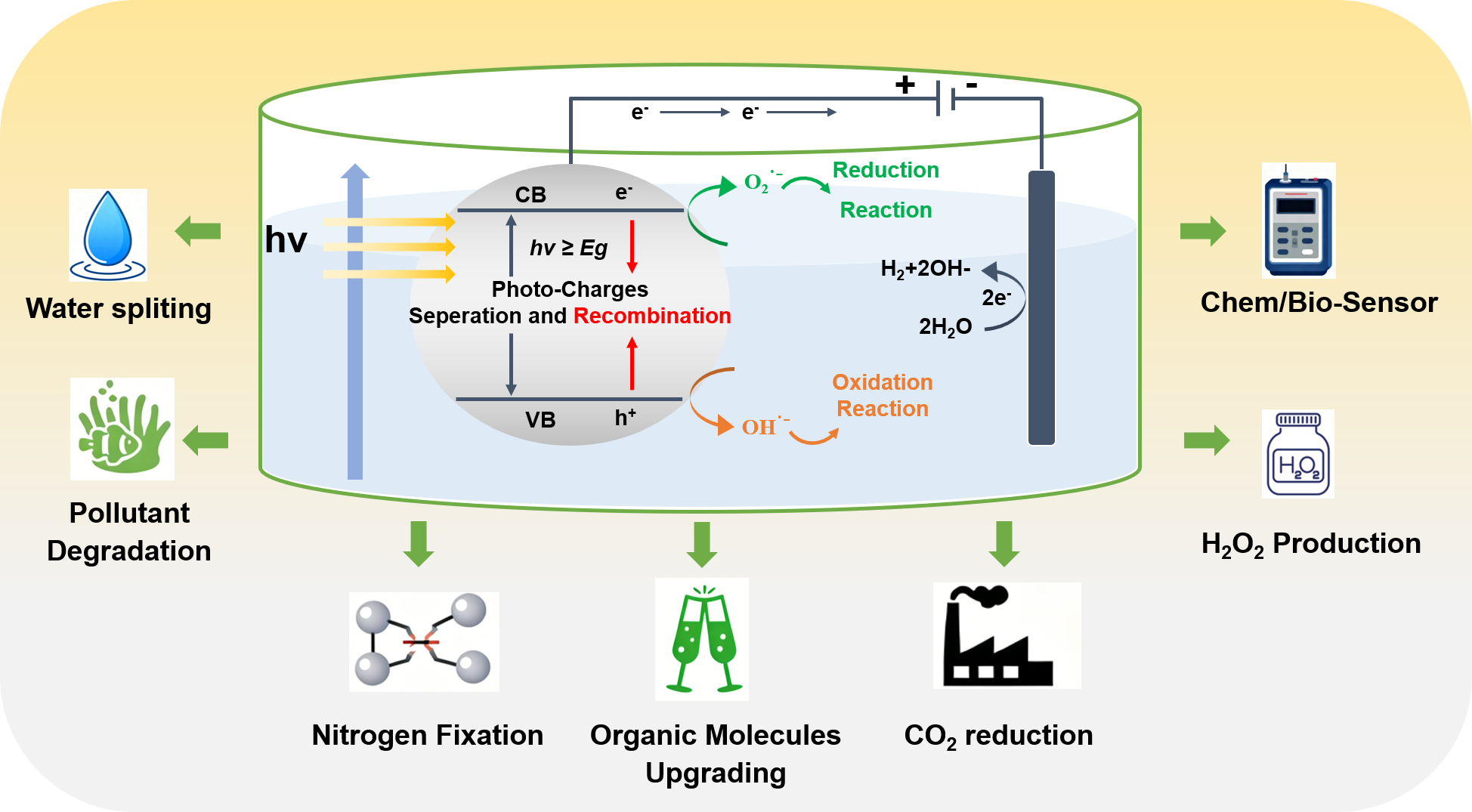
Photoelectrochemical (PEC) technology serves as a pivotal pathway for converting solar energy into chemical fuels, demonstrating significant potential in addressing global energy crises and environmental challenges. Two-dimensional (2D) layered materials have garnered extensive attention in PEC research due to their unique structural characteristics, such as high specific surface area, efficient charge transport capabilities, and tunable electronic properties. This review systematically summarizes recent advances in the application of 2D materials in PEC systems, including metal oxyhalides, MXenes, graphitic carbon nitride (g-C3N4), and layered double hydroxides (LDHs), with a focus on their design, performance optimization, and implementation in energy conversion and environmental remediation. The article highlights key modification strategies for enhancing the PEC performance of 2D materials, such as photosensitizer decoration, elemental doping, and heterojunction engineering, which collectively contribute to improved light absorption, facilitated charge separation and transport, and accelerated surface reaction kinetics. Furthermore, diverse applications of 2D materials in PEC water splitting, CO2 reduction, nitrogen reduction, organic pollutant degradation, and biosensing are summarized. Despite remarkable progress, the practical application of 2D materials in PEC systems still faces challenges related to conversion efficiency, operational stability, and cost-effectiveness. Future efforts should prioritize the development of novel robust materials, the integration of advanced in situ characterization and theoretical simulations to elucidate underlying mechanisms, and the fabrication of PEC devices resistant to electrochemical corrosion. Through interdisciplinary collaboration and technological innovation, 2D materials are poised to play a crucial role in advancing green energy conversion and sustainable chemical production.
- Open Access
- Review
Two-Dimensional Layered Materials in Photoelectrocatalysis: A Review on Energy Conversion and Environmental Remediation
- Penghui Xu 1,2,†,
- Hao Niu 2,†,
- Yuanping He 2,
- Yongfang Sun 1,2,
- Qiuhong Sun 2,
- Yang Li 1,
- Xiao-Jue Bai 1,2,
- Yung-Kang Peng 3,
- Tongjun Bao 4,
- Yanli Liang 5,
- Deqiang Feng 5,
- Ce Zhang 5,*,
- Yufei Zhao 1,2,*
Author Information
Received: 29 Jan 2026 | Revised: 27 Feb 2026 | Accepted: 09 Mar 2026 | Published: 31 Mar 2026
Abstract
Graphical Abstract
Keywords
two-dimensional layered materials | photoelectrocatalysis | modification strategies | PEC electrolyzers and applications
References
- 1.
Chen, J.S.; Guan, C.; Gui, Y.; et al. Rational Design of Self-Supported Ni3S2 Nanosheets Array for Advanced Asymmetric Supercapacitor with a Superior Energy Density. ACS Appl. Mater. Interfaces 2017, 9, 496–504. https://doi.org/10.1021/acsami.6b14746.
- 2.
Cho, K.G.; Kim, H.S.; Jang, S.S.; et al. Optimizing Electrochemically Active Surfaces of Carbonaceous Electrodes for Ionogel Based Supercapacitors. Adv. Funct. Mater. 2020, 30, 2002053. https://doi.org/10.1002/adfm.202002053.
- 3.
Ren, J.; Shen, M.; Li, Z.; et al. Towards high-performance all-solid-state asymmetric supercapacitors: A hierarchical doughnut-like Ni3S2@PPy core−shell heterostructure on nickel foam electrode and density functional theory calculations. J. Power Sources 2021, 501, 230003. https://doi.org/10.1016/j.jpowsour.2021.230003.
- 4.
Zhang, A.; Cai, Y.; Guo, L.; et al. Recent Progress in CO2 Conversion: An Overview of Catalytic Strategies for Sustainable Fuel and Chemical Synthesis. SmartMat 2026, 6, e70058. https://doi.org/10.1002/smm2.70058.
- 5.
Wang, S.N.; Zhang, R.; Ding, R.J.; et al. Intramolecular-locking modification enables efficient asymmetric donor-acceptor-donor′ type ultraviolet emitters for high-performance OLEDs with reduced efficiency roll-off and high color purity. Chem. Sci. 2025, 16, 5518–5527. https://doi.org/10.1039/d4sc08473j.
- 6.
Feng, C.; Liu, Z.; Ju, H.X.; et al. Understanding the in-situ transformation of CuxO interlayers to increase the water splitting efficiency in NiO/n-Si photoanodes. Nat. Commun. 2024, 15, 6436. https://doi.org/10.1038/s41467-024-50893-x.
- 7.
Chi, J.S.; Wei, Z.D.; Guo, W.Q.; et al. Enhanced Photoelectrochemical Water Splitting on BiVO4 Photoanode via Efficient Hole Transport Layers of NiFe-LDH. Acs Catal. 2025, 15, 11293–11306. https://doi.org/10.1021/acscatal.5c02714.
- 8.
Wan, W.R.; Meng, F.H.; Chen, S.; et al. Triazine-COF@Silicon nanowire mimicking plant leaf to enhance photoelectrocatalytic CO2 reduction to C2+ chemicals. Green Energy Environ. 2025, 10, 422–432. https://doi.org/10.1016/j.gee.2024.04.007.
- 9.
Zhao, Z.F.; Shen, X.Y.; Luo, X.Y.; et al. Electric Field Redistribution Triggered Surface Adsorption and Mass Transfer to Boost Electrocatalytic Glycerol Upgrading Coupled with Hydrogen Evolution. Adv. Energy Mater. 2024, 14, 2400851. https://doi.org/10.1002/aenm.202400851.
- 10.
Luo, L.; Chen, W.S.; Xu, S.M.; et al. Selective Photoelectrocatalytic Glycerol Oxidation to Dihydroxyacetone via Enhanced Middle Hydroxyl Adsorption over a Bi2O3-Incorporated Catalyst. J. Am. Chem. Soc. 2022, 144, 7720–7730. https://doi.org/10.1021/jacs.2c00465.
- 11.
An, Y.; Lei, T.; Jiang, W.Y.; et al. Research progress on photocatalytic, electrocatalytic and photoelectrocatalytic selective oxidation of 5-hydroxymethylfurfural. Green Chem. 2024, 26, 10739–10773. https://doi.org/10.1039/d4gc03597f.
- 12.
Tang, D.B.; Liu, J.G.; Zhang, X.H.; et al. Sacrifice and valorization of biomass to realize energy exploitation and transformation in a photoelectrochemical way. Green Chem. 2023, 25, 7843–7862. https://doi.org/10.1039/d3gc01934a.
- 13.
Singh, N.; Jabbour, G.; Schwingenschlögl, U. Optical and photocatalytic properties of two-dimensional MoS2. Eur. Phys. J. B 2012, 85, 392. https://doi.org/10.1140/epjb/e2012-30449-7.
- 14.
Li, Q.; Li, X.; Wageh, S.; et al. CdS/Graphene Nanocomposite Photocatalysts. Adv. Energy Mater. 2015, 5, 1500010. https://doi.org/10.1002/aenm.201500010.
- 15.
Li, Y.G.; Li, Y.L.; Sa, B.S.; et al. Review of two-dimensional materials for photocatalytic water splitting from a theoretical perspective. Catal. Sci. Technol. 2017, 7, 545–559. https://doi.org/10.1039/c6cy02178f.
- 16.
Kumar, P.; Boukherroub, R.; Shankar, K. Sunlight-driven water-splitting using two-dimensional carbon based semiconductors. J. Mater. Chem. A 2018, 6, 12876–12931. https://doi.org/10.1039/c8ta02061b.
- 17.
Nayak, S.; Parida, K. Advancement of LDH-carbonaceous coupled structure towards promising water splitting and supercapacitor applications. Adv. Colloid. Interfac. 2025, 346, 103677. https://doi.org/10.1016/j.cis.2025.103677.
- 18.
Liu, Z.H.; Chen, X.Y.; Zhao, Y.; et al. Constructing MO/TMDs heterostructures: Photoelectrochemical activity and charge transfer mechanism investigation. Chem. Eng. J. 2025, 511, 161981. https://doi.org/10.1016/j.cej.2025.161981.
- 19.
Fernández-Escamilla, H.N.; Paez-Ornelas, J.I.; Gutiérrez-Lazos, C.D.; et al. Bismuth and oxygen vacancies induce (2 × 1) reconstructions in bismuth oxyhalide (BiOX, X=Cl, Br, I) (001) surfaces. Appl. Surf. Sci. 2023, 618, 156583. https://doi.org/10.1016/j.apsusc.2023.156583.
- 20.
Lim, K.R.G.; Shekhirev, M.; Wyatt, B.C.; et al. Fundamentals of MXene synthesis. Nat. Synth. 2022, 1, 601–614. https://doi.org/10.1038/s44160-022-00104-6.
- 21.
Low, J.; Cheng, B.; Yu, J.; et al. Carbon-based two-dimensional layered materials for photocatalytic CO2 reduction to solar fuels. Energy Storage Mater. 2016, 3, 24–35. https://doi.org/10.1016/j.ensm.2015.12.003.
- 22.
Jain, C.; Kushwaha, R.; Rase, D.; et al. Tailoring COFs: Transforming Nonconducting 2D Layered COF into a Conducting Quasi-3D Architecture via Interlayer Knitting with Polypyrrole. J. Am. Chem. Soc. 2023, 146, 487–499. https://doi.org/10.1021/jacs.3c09937.
- 23.
Zhu, X.Q.; Ke, T.; Zhou, J.Y.; et al. Vertex Strategy in Layered 2D MOFs: Simultaneous Improvement of Thermodynamics and Kinetics for Record C2H2/CO2 Separation Performance. J. Am. Chem. Soc. 2023, 145, 9254–9263. https://doi.org/10.1021/jacs.3c01784.
- 24.
Jie, K.C.; Zhou, Y.J.; Li, E.R.; et al. Nonporous Adaptive Crystals of Pillararenes. Acc. Chem. Res. 2018, 51, 2064–2072. https://doi.org/10.1021/acs.accounts.8b00255.
- 25.
Marandi, M.; Torabi, N.; Farahani, F.A. Facile fabrication of well-performing CdS/CdSe quantum dot sensitized solar cells through a fast and effective formation of the CdSe nanocrystalline layer. Sol. Energy 2020, 207, 32–39. https://doi.org/10.1016/j.solener.2020.06.041.
- 26.
Wang, Z.Y.; Xu, P.H.; Wang, W.J.; et al. Free radical-mediated glycerol selective upgrading to dihydroxyacetone over Au/BiVO4 photoanodes at low bias. Chem. Eng. J. 2025, 522, 167841. https://doi.org/10.1016/j.cej.2025.167841.
- 27.
Park, J.-H.; Kim, K.; Lee, J.; et al. Bias-Free Highly Efficient and Stable Dye-Sensitized Photoelectrochemical Cells via Cascade Charge Transfer. Adv. Funct. Mater. 2025, e22757. https://doi.org/10.1002/adfm.202422757.
- 28.
Zhu, Y.; Li, X.; Wen, Z.; et al. Highly Efficient Photoelectrochemical Alkene Epoxidation on a Dye-Sensitized Photoanode. J. Am. Chem. Soc. 2024, 146, 21903–21912. https://doi.org/10.1021/jacs.4c06461.
- 29.
Luo, X.; Tan, X.; Guo, X.; et al. BiVO4/Bi:NiO/Co–Ci photoanode and BiVO4–Cu3BiS3 tandem cell for unbiased solar hydrogen evolution and simultaneous urea oxidation. J. Mater. Chem. A 2025, 13, 41780–41787. https://doi.org/10.1039/D5TA07828H.
- 30.
Bachmeier, A.; Hall, S.; Ragsdale, S.W.; et al. Selective Visible-Light-Driven CO2 Reduction on a p-Type Dye-Sensitized NiO Photocathode. J. Am. Chem. Soc. 2014, 136, 13518–13521. https://doi.org/10.1021/ja506998b.
- 31.
Click, K.A.; Beauchamp, D.R.; Huang, Z.; et al. Membrane-Inspired Acidically Stable Dye-Sensitized Photocathode for Solar Fuel Production. J. Am. Chem. Soc. 2016, 138, 1174–1179. https://doi.org/10.1021/jacs.5b07723.
- 32.
Sherman, B.D.; Sheridan, M.V.; Wee, K.-R.; et al. A Dye-Sensitized Photoelectrochemical Tandem Cell for Light Driven Hydrogen Production from Water. J. Am. Chem. Soc. 2016, 138, 16745–16753. https://doi.org/10.1021/jacs.6b10699.
- 33.
Chen, C.; Chen, A.; Shao, S.; et al. Photoanode/electrolyte interface modification in solar PEC cells sensitized with Cd0.8Zn0.2S quantum dots for efficient dye degradation. Appl. Surf. Sci. 2025, 698, 163123. https://doi.org/10.1016/j.apsusc.2025.163123.
- 34.
Tang, Y.Q.; Wang, R.R.; Yang, Y.; et al. Highly Enhanced Photoelectrochemical Water Oxidation Efficiency Based on Triadic Quantum Dot/Layered Double Hydroxide/BiVO4 Photoanodes. ACS Appl. Mater. Interfaces 2016, 8, 19446–19455. https://doi.org/10.1021/acsami.6b04937.
- 35.
Zhou, W.; Liu, M.; Cao, Y.; et al. Breaking the photoelectrochemical activity-battery voltage trade-off for efficient photocharging of TEMPO/quinone redox flow battery. Chem. Eng. J. 2025, 507, 160162. https://doi.org/10.1016/j.cej.2025.160162.
- 36.
Liang, M.J.; Zhang, J.C.; Ramalingam, K.; et al. Stable and efficient self-sustained photoelectrochemical desalination based on CdS QDs/BiVO4 heterostructure. Chem. Eng. J. 2022, 429, 132168. https://doi.org/10.1016/j.cej.2021.132168.
- 37.
Zhou, G.; Zhao, T.; Wang, O.; et al. Bi2Se3, Bi2Te3 quantum dots-sensitized rutile TiO2 nanorod arrays for enhanced solar photoelectrocatalysis in azo dye degradation. J. Phys. Energy 2021, 3, 014003. https://doi.org/10.1088/2515-7655/abc52c.
- 38.
Yang, H.; Peng, Y.; Jiang, L.; et al. Carbon quantum dots sensitized Bi2O3 photoanode with enhanced photoelectrocatalytic properties. Chem. Phys. Lett. 2020, 739, 137025. https://doi.org/10.1016/j.cplett.2019.137025.
- 39.
Wang, Z.; Gao, Y.; Lu, Y.; et al. BiV1–xOy/Noble Metal Nanoparticle Domains with Reverse Charge Transfer Improves Photoelectrochemical Glycerol to Dihydroxyacetone Conversion. J. Am. Chem. Soc. 2025, 147, 40136–40145. https://doi.org/10.1021/jacs.5c06621.
- 40.
Wang, Q.; Zheng, Q.; Jin, R.; et al. Photoelectrocatalytic removal of organic dyes and Cr(VI) ions using Ag3PO4 nanoparticles sensitized TiO2 nanotube arrays. Mater. Chem. Phys. 2017, 199, 209–215. https://doi.org/10.1016/j.matchemphys.2017.06.051.
- 41.
Chen, X.; Li, X.; Peng, Y.; et al. Tailoring Carrier Dynamics of BiVO4 Photoanode via Dual Incorporation of Au and Co(OH)x Cooperative Modification for Photoelectrochemical Water Splitting. Adv. Funct. Mater. 2025, 35, 2416091. https://doi.org/10.1002/adfm.202416091.
- 42.
Liu, Y.; Sui, P.-F.; Wang, Y.-C.; et al. Evoking plasmon electronic and thermal effects via Au nanoparticles for efficient photoelectrochemical water oxidation. Appl. Catal. B Environ. 2025, 374, 125391. https://doi.org/10.1016/j.apcatb.2025.125391.
- 43.
Xiao, T.T.; Diao, P. Quantifying Localized Surface Plasmon Resonance Induced Enhancement on Metal@Cu2O Composites for Photoelectrochemical Water Splitting. Adv. Mater. 2025, 37, 2501069. https://doi.org/10.1002/adma.202501069.
- 44.
Dagnaw, F.W.; Harrath, K.; Zheng, T.; et al. Cationic covalent framework microenvironment steering CuPt alloy toward record-breaking photoelectrochemical ethane synthesis from CO2. J. Energy Chem. 2026, 112, 339–349. https://doi.org/10.1016/j.jechem.2025.08.062.
- 45.
Wu, H.; Moncusí, L.M.; Li, J.; et al. Co-Sensitized Solar Cell Achieves 13.7% Efficiency with Bis-Hexylthiophene Dyes. Adv. Sci. 2025, 12, e09116. https://doi.org/10.1002/advs.202509116.
- 46.
Zhang, J.; Shen, K.D.; Xu, C.; et al. Dual-channeled organic-inorganic hybrid architecture: Leveraging a unique photosensitive semiconductor for enhanced photocatalytic hydrogen evolution. Appl. Catal. B Environ. 2025, 366, 125025. https://doi.org/10.1016/j.apcatb.2025.125025.
- 47.
Shang, J.; Zhao, F.W.; Zhu, T.; et al. Photocatalytic degradation of rhodamine B by dye-sensitized TiO2 under visible-light irradiation. Sci. China Chem. 2011, 54, 167–172. https://doi.org/10.1007/s11426-010-4168-8.
- 48.
Zhang, D.; Yang, S.; Fang, X.; et al. In situ localization of BiVO4 onto two-dimensional MXene promoting photoelectrochemical nitrogen reduction to ammonia. Chin. Chem. Lett. 2022, 33, 4669–4674. https://doi.org/10.1016/j.cclet.2022.02.001.
- 49.
Lee, E.K.; Baruah, R.K.; Leem, J.W.; et al. Fractal Web Design of a Hemispherical Photodetector Array with Organic-Dye-Sensitized Graphene Hybrid Composites. Adv. Mater. 2020, 32, 2004456. https://doi.org/10.1002/adma.202004456.
- 50.
Zhao, Y.Y.; Wang, D.; Sun, G.T.; et al. Rhodamine B sensitization promoting TiO2/CdIn2S4 S-scheme photocatalytic H2O2-production activity and its charge transfer mechanism. Chem. Eng. J. 2025, 518, 164759. https://doi.org/10.1016/j.cej.2025.164759.
- 51.
Wang, P.; Zong, L.L.; Guan, Z.J.; et al. PtNi Alloy Cocatalyst Modification of Eosin Y-Sensitized g-C3N4/GO Hybrid for Efficient Visible-Light Photocatalytic Hydrogen Evolution. Nanoscale Res. Lett. 2018, 13, 33. https://doi.org/10.1186/s11671-018-2448-y.
- 52.
Yu, F.T.; Wang, Z.Q.; Zhang, S.C.; et al. N-Annulated perylene-based organic dyes sensitized graphitic carbon nitride to form an amide bond for efficient photocatalytic hydrogen production under visible-light irradiation. Appl. Catal. B Environ. 2018, 237, 32–42. https://doi.org/10.1016/j.apcatb.2018.05.045.
- 53.
Sun, B.; Ouellette, O.; de Arquer, F.P.G.; et al. Multibandgap quantum dot ensembles for solar-matched infrared energy harvesting. Nat. Commun. 2018, 9, 4003. https://doi.org/10.1038/s41467-018-06342-7.
- 54.
Shi, L.; Daniele, B.; Li, F.; et al. MOF-Templated Metal Oxides Sensitized with Quantum Dots Heterojunction for Efficient Solar Fuels Generation. ECS Meet. Abstr. 2020, MA2020-01, 1350. https://doi.org/10.1149/ma2020-01231350mtgabs.
- 55.
Li, Y.Y.; Wu, S.; Zheng, J.W.; et al. 2D photocatalysts with tuneable supports for enhanced photocatalytic water splitting. Mater. Today 2020, 41, 34–43. https://doi.org/10.1016/j.mattod.2020.05.018.
- 56.
Sahu, A.; Garg, A.; Dixit, A. A review on quantum dot sensitized solar cells: Past, present and future towards carrier multiplication with a possibility for higher efficiency. Sol. Energy. 2020, 203, 210–239. https://doi.org/10.1016/j.solener.2020.04.044.
- 57.
Liu, J.; Cao, S.; Xu, H.; et al. Designing Hybrid Electrodes for Fiber Quantum Dot‐Sensitized Solar Cells with Record 11.05% Efficiency. Adv. Funct. Mater. 2025, 36, e23627. https://doi.org/10.1002/adfm.202523627.
- 58.
Xu, M.; Lin, L.; Jin, G.; et al. Two-in-one: Portable piezoelectric and plasmonic exciton effect-based co-enhanced photoelectrochemical biosensor for point-of-care testing of low-abundance cancer markers. Biosens. Bioelectron. 2022, 211, 114413. https://doi.org/10.1016/j.bios.2022.114413.
- 59.
Tian, Y.; Cui, Q.Q.; Xu, L.L.; et al. Alloyed AuPt nanoframes loaded on h-BN nanosheets as an ingenious ultrasensitive near-infrared photoelectrochemical biosensor for accurate monitoring glucose in human tears. Biosens. Bioelectron. 2021, 192, 113490. https://doi.org/10.1016/j.bios.2021.113490.
- 60.
Chen, Y.L.; Yao, Q.; Zhang, L.J.; et al. HPLC for simultaneous quantification of free mannose and glucose concentrations in serum: Use in detection of ovarian cancer. Front. Chem. 2023, 11, 1289211. https://doi.org/10.3389/fchem.2023.1289211.
- 61.
Li, M.X.; Wang, H.Y.; Wang, X.X.; et al. Ti3C2/Cu2O heterostructure based signal-off photoelectrochemical sensor for high sensitivity detection of glucose. Biosens. Bioelectron. 2019, 142, 111535. https://doi.org/10.1016/j.bios.2019.111535.
- 62.
Datta, D.; Mondal, R.; Maji, R.C.; et al. Anisotropic Au nanobypyramids with molybdenum disulfide for plasmon-enhanced electrocatalysis, biosensing and energy production. Nanoscale Horiz. 2025, 10, 3453–3468. https://doi.org/10.1039/d5nh00491h.
- 63.
Li, S.Q.; Li, Z.X.; Yue, J.N.; et al. Photocatalytic CO2 Reduction by Near-Infrared-Light (1200 nm) Irradiation and a Ruthenium-Intercalated NiAl-Layered Double Hydroxide. Angew. Chem. Int. Ed. 2024, 63, e20240763. https://doi.org/10.1002/anie.202407638.
- 64.
Long, D.; Qian, G.L.; Ma, S.H.; et al. Two-dimensional photocatalysts for photoreduction of CO2. Renew. Sustain. Energy Rev. 2026, 226, 116222. https://doi.org/10.1016/j.rser.2025.116222.
- 65.
Suryawanshi, M.P.; Ghorpade, U.V.; Shin, S.W.; et al. Facile, Room Temperature, Electroless Deposited (Fe1−x,Mnx)OOH Nanosheets as Advanced Catalysts: The Role of Mn Incorporation. Small 2018, 14, 1801226. https://doi.org/10.1002/smll.201801226.
- 66.
Tran, T.T.T.; Trinh, V.Y.; Seo, J. Two-dimensional perovskite SrNbO2N with Zr doping for accelerating photoelectrochemical water splitting. J. Mater. Sci. Technol. 2023, 142, 176–184. https://doi.org/10.1016/j.jmst.2022.09.034.
- 67.
Li, W.Z.; Liu, Y.; Wang, Z.Y.; et al. Fabrication of C and N co-doped CdS semiconductor photocatalysts derived from a novel Cd-MOF for enhancing photocatalytic performance. J. Environ. Chem. Eng. 2024, 12, 114204. https://doi.org/10.1016/j.jece.2024.114204.
- 68.
Zhang, M.X.; Luo, W.; Gu, S.H.; et al. Photoelectrochemical catalytic CO2 reduction enhanced by In-doped GaN and combined with vibration energy harvester driving CO2 reduction. Appl. Catal. A Gen. 2024, 683, 119859. https://doi.org/10.1016/j.apcata.2024.119859.
- 69.
Li, S.; Zhang, G.; Meng, D.; et al. Photoelectrocatalytic activation of sulfate for sulfamethoxazole degradation and simultaneous H2 production by bifunctional N,P co-doped black-blue TiO2 nanotube array electrode. Chem. Eng. J. 2024, 485, 149828. https://doi.org/10.1016/j.cej.2024.149828.
- 70.
Hu, C.L.; Wu, J.H.; Dong, C.Z.; et al. Enhancement of the photoelectrochemical water splitting performance of hematite photoanodes via uniform Ti and gradient Ge co-doping. Inorg. Chem. Front. 2025, 12, 5037–5045. https://doi.org/10.1039/d5qi00700c.
- 71.
Gu, W.; Chen, W.; Wang, W.; et al. Highly Coupled Dynamically Modulated Electrocatalysts on Wafer-Scale InGaN/GaN Nanowires on Silicon for Successive Acidic Photoelectrochemical Water Oxidation. Adv. Mater. 2025, 37, 2501218. https://doi.org/10.1002/adma.202501218.
- 72.
Li, C.; Song, J.W.; Ma, P.J.; et al. Ladder-Like Built-In Electric Field Enhances Self-Assembly, Carrier Separation and Ultra-Efficient Photocatalytic Oxygen Reduction. Adv. Mater. 2025, 37, 2502918. https://doi.org/10.1002/adma.202502918.
- 73.
Ai, M.H.; Peng, Z.H.; Li, X.D.; et al. Piezoelectric-enhanced n-TiO2/BaTiO3/p-TiO2 heterojunction for highly efficient photoelectrocatalysis. Green Energy Environ. 2024, 9, 1466–1476. https://doi.org/10.1016/j.gee.2023.12.001.
- 74.
Sun, P.P.; Zhang, J.Y.; Song, Y.H.; et al. Built-in Electric Fields Enhancing Photocarrier Separation and H2 Evolution. Acta Phys.-Chim. Sin. 2024, 40, 2311001. https://doi.org/10.3866/Pku.Whxb202311001.
- 75.
Guo, H.; Wang, S.; Chen, X.; et al. Engineering a covalent organic framework-based type-II heterojunction for enhanced photocatalytic H2O2 synthesis. Nat. Synth. 2025, 4, 1610–1620. https://doi.org/10.1038/s44160-025-00880-x.
- 76.
Han, Z.; Song, Y.; Jia, Y.; et al. Classification and Characterization Methods for Heterojunctions. Adv. Mater. Interfaces 2025, 12, 2500191. https://doi.org/10.1002/admi.202500191.
- 77.
Meng, Z.; Zhang, J.J.; Long, H.Y.; et al. Kelvin Probe Force Microscopy Reveals Spatially Resolved Charge-Transfer Mechanism in CdS/BiOBr S-scheme Heterojunction Photocatalyst. Angew. Chem. Int. Ed. 2025, 64, e202505456. https://doi.org/10.1002/anie.202505456.
- 78.
Zhu, H.D.; Ren, X.F.; Yang, X.X.; et al. Fe-based catalysts for nitrogen reduction toward ammonia electrosynthesis under ambient conditions. SusMat 2022, 2, 214–242. https://doi.org/10.1002/sus2.70.
- 79.
Li, X.; Fan, W.Q.; Xu, D.B.; et al. Boosted Photoelectrochemical N2 Reduction over Mo2C In Situ Coated with Graphitized Carbon. Langmuir 2020, 36, 14802–14810. https://doi.org/10.1021/acs.langmuir.0c02770.
- 80.
Bo, Y.R.; Li, L.R.; Miao, P.; et al. 2D Z-scheme ZnIn2S4/g-C3N4 heterojunction based on photoelectrochemical immunosensor with enhanced carrier separation for sensitive detection of CEA. Biosens. Bioelectron. 2024, 247, 115926. https://doi.org/10.1016/j.bios.2023.115926.
- 81.
Tan, J.X.; Cheng, Y.F.; Li, Q.J.; et al. Construction of 1D/2D Sb2(S,Se)3/In2S3 S‑Scheme Heterojunction Photoanodes toward Photoelectrochemical Water Splitting. Langmuir 2025, 41, 27444–27454. https://doi.org/10.1021/acs.langmuir.5c03796.
- 82.
Chung, C.C.; Yeh, H.; Wu, P.H.; et al. Atomic-Layer Controlled Interfacial Band Engineering at Two-Dimensional Layered PtSe2/Si Heterojunctions for Efficient Photoelectrochemical Hydrogen Production. Acs Nano 2021, 15, 4627–4635. https://doi.org/10.1021/acsnano.0c08970.
- 83.
Bhat, S.S.M.; Pawar, S.A.; Potphode, D.; et al. Substantially enhanced photoelectrochemical performance of TiO2 nanorods/CdS nanocrystals heterojunction photoanode decorated with MoS2 nanosheets. Appl. Catal. B Environ. 2019, 259, 118102. https://doi.org/10.1016/j.apcatb.2019.118102.
- 84.
Zhang, M.; Xuan, X.; Wang, W.; et al. Anode Photovoltage Compensation-Enabled Synergistic CO2 Photoelectrocatalytic Reduction on a Flower-Like Graphene-Decorated Cu Foam Cathode. Adv. Funct. Mater. 2020, 30, 2005983. https://doi.org/10.1002/adfm.202005983.
- 85.
Wang, J.; Liu, K.; Liao, W.R.; et al. Metal vacancies in semiconductor oxides enhance hole mobility for efficient photoelectrochemical water splitting. Nat. Catal. 2025, 8, 229–238. https://doi.org/10.1038/s41929-025-01300-1.
- 86.
Kang, X.S.; Dong, G.H.; Dong, T.T. Oxygen Vacancy Defect Engineering of Heterophase Junction TiO2: Interfacial/Surface Oxygen Vacancies Coadjust the Photocatalytic ROS Production. ACS Appl. Energy Mater. 2023, 6, 1025–1036. https://doi.org/10.1021/acsaem.2c03535.
- 87.
Man, P.; Jiang, S.; Leung, K.H.; et al. Salt-Induced High-Density Vacancy-Rich 2D MoS2 for Efficient Hydrogen Evolution. Adv. Mater. 2024, 36, 2304808. https://doi.org/10.1002/adma.202304808.
- 88.
Liang, J.W.; Li, S.B.; Li, F.B.; et al. Defect engineering induces Mo-regulated Co9Se8/FeNiSe heterostructures with selenium vacancy for enhanced electrocatalytic overall water splitting in alkaline. J. Colloid. Interf. Sci. 2024, 655, 296–306. https://doi.org/10.1016/j.jcis.2023.11.010.
- 89.
Zhou, Y.Q.; Zhang, L.F.; Suo, H.L.; et al. Atomic Cobalt Vacancy-Cluster Enabling Optimized Electronic Structure for Efficient Water Splitting. Adv. Funct. Mater. 2021, 31, 2101797. https://doi.org/10.1002/adfm.202101797.
- 90.
Wang, Y.H.; Hu, J.C.; Ge, T.; et al. Gradient Cationic Vacancies Enabling Inner-To-Outer Tandem Homojunctions: Strong Local Internal Electric Field and Reformed Basic Sites Boosting CO2 Photoreduction. Adv. Mater. 2023, 35, 2302538. https://doi.org/10.1002/adma.202302538.
- 91.
Jiang, X.L.; Ma, X.H.; Liu, Y.X.; et al. Cation vacancies creation propel pre-oxidation enhancing nickel hydroxide activity for highly efficient 5-hydroxymethylfurfural upgrading. Appl. Catal. B Environ. 2024, 347, 123785. https://doi.org/10.1016/j.apcatb.2024.123785.
- 92.
Chen, C.-J.; Yeh, C.-Y.; Chen, C.-H.; et al. Molybdenum Tungsten Disulfide with a Large Number of Sulfur Vacancies and Electronic Unoccupied States on Silicon Micropillars for Solar Hydrogen Evolution. ACS Appl. Mater. Interfaces 2020, 12, 54671–54682. https://doi.org/10.1021/acsami.0c15905.
- 93.
Zheng, H.; Jiang, S.; Liu, Y.; et al. Improved photocathodic protection performance of C-vacancy g-C3N4/GO/WO3 for 304 stainless steel. J. Phys. Chem. Solids 2022, 160, 110270. https://doi.org/10.1016/j.jpcs.2021.110270.
- 94.
Huang, W.T.; Zhou, Q.W.; Su, S.Q.; et al. Ion Beam Defect Engineering on ReS2/Si Photocathode with Significantly Enhanced Hydrogen Evolution Reaction. Adv. Mater. Interfaces 2019, 6, 1801663. https://doi.org/10.1002/admi.201801663.
- 95.
Lu, J.; Chen, Y.; Li, L.; et al. Facet engineering on the interface of BiOCl-PbS heterostructures for enhanced broad-spectrum photocatalytic H2 production. Chem. Eng. J. 2019, 362, 1–11. https://doi.org/10.1016/j.cej.2018.12.130.
- 96.
Liu, B.Y.; Wang, X.; Zhang, Y.J.; et al. Bismuth Vacancies Induced Lattice Strain in BiVO4 Photoanodes Boosting Charge Separation For Water Oxidation. Adv. Energy Mater. 2025, 15, 2403835. https://doi.org/10.1002/aenm.202403835.
- 97.
Hu, Y.; Jin, Y.Z.; Gao, Y.Q.; et al. Interface and Defect Engineering in 3D Co3O4−Ov/TiO2 to Boost Simultaneous Removal of BPA and Cr(VI) upon Photoelectrocatalytic/Peroxymonosulfate (PEC/PMS) System. Adv. Funct. Mater. 2025, 35, 2414350. https://doi.org/10.1002/adfm.202414350.
- 98.
Bai, H.; Yang, Y.X.; Huang, Y.; et al. Quantum confinement and defect engineering mediated “two birds with one stone” strategy for Co/Bi self-regeneration and effective photogenerated carrier separation. Appl. Catal. B: Environ. 2025, 365, 125001. https://doi.org/10.1016/j.apcatb.2024.125001.
- 99.
Chu, D.D.; Xing, C.; Sun, D.Y.; et al. Defective In2S3 with Proton-Enriched Interface Enable Sacrificial-Agent-Free Visible-Light Photocatalytic H2O2 Production. Adv. Funct. Mater. 2025, 36, e16500. https://doi.org/10.1002/adfm.202516500.
- 100.
Hou, J.H.; Zhang, T.T.; Jiang, T.; et al. Fast preparation of oxygen vacancy-rich 2D/2D bismuth oxyhalides-reduced graphene oxide composite with improved visible-light photocatalytic properties by solvent-free grinding. J. Clean. Prod. 2021, 328, 129651. https://doi.org/10.1016/j.jclepro.2021.129651.
- 101.
Rana, M.M.; Alam, K.M.; Chaulagain, N.; et al. Tunable Absorption and Emission in Mixed Halide Bismuth Oxyhalides for Photoelectrochemical Water Splitting. ACS Appl. Nano Mater. 2024, 7, 6005–6019. https://doi.org/10.1021/acsanm.3c05925.
- 102.
Wang, X.; Zhang, Y.; Zhou, C.; et al. Hydroxyl-regulated BiOI nanosheets with a highly positive valence band maximum for improved visible-light photocatalytic performance. Appl. Catal. B Environ. 2020, 268, 118390. https://doi.org/10.1016/j.apcatb.2019.118390.
- 103.
Fu, R.R.; Zeng, X.Q.; Ma, L.; et al. Enhanced photocatalytic and photoelectrochemical activities of reduced TiO2−x/BiOCl heterojunctions. J. Power Sources 2016, 312, 12–22. https://doi.org/10.1016/j.jpowsour.2016.02.038.
- 104.
Kshetri, T.; Tran, D.T.; Le, H.T.; et al. Recent advances in MXene-based nanocomposites for electrochemical energy storage applications. Prog. Mater. Sci. 2021, 117, 100733. https://doi.org/10.1016/j.pmatsci.2020.100733.
- 105.
Hussain, I.; Amna, R.; Kalidasan, B.; et al. MXenes for Various Applications: Recent Trends and Future Aspects. SmartMat 2025, 6, e70012. https://doi.org/10.1002/smm2.70012.
- 106.
Zhou, S.Q.; Jiang, C.X.; Han, J.L.; et al. High-Performance Self-Powered PEC Photodetectors Based on 2D BiVO4/MXene Schottky Junction. Adv. Funct. Mater. 2025, 35, 2416922. https://doi.org/10.1002/adfm.202416922.
- 107.
Zeng, W.; Zhang, Y.; Wu, Z.Y.; et al. Hierarchically Converged Defect Engineering with 2-Dimensional Black Phosphorus/MXene Sequence for Sensitive Photoelectrochemical-Electrostatic Sensors. Research 2025, 8, 0966. https://doi.org/10.34133/research.0966.
- 108.
Yang, G.L.; Li, S.J.; Wang, X.S.; et al. A universal strategy boosting photoelectrochemical water oxidation by utilizing MXene nanosheets as hole transfer mediators. Appl. Catal. B Environ. 2021, 297, 120268. https://doi.org/10.1016/j.apcatb.2021.120268.
- 109.
Xu, Y.J.; Wang, F.; Lei, S.L.; et al. In situ grown two-dimensional TiO2/Ti3CN MXene heterojunction rich in Ti3+ species for highly efficient photoelectrocatalytic CO2 reduction. Chem. Eng. J. 2023, 452, 139392. https://doi.org/10.1016/j.cej.2022.139392.
- 110.
Kang, M.J.; Kim, C.W.; Pawar, A.U.; et al. Selective Alcohol on Dark Cathodes by Photoelectrochemical CO2 Valorization and Their In Situ Characterization. Acs Energy Lett. 2019, 4, 1549–1555. https://doi.org/10.1021/acsenergylett.9b00927.
- 111.
Park, H.R.; Pawar, A.U.; Pal, U.; et al. Enhanced solar photoreduction of CO2 to liquid fuel over rGO grafted NiO-CeO2 heterostructure nanocomposite. Nano Energy 2021, 79, 105483. https://doi.org/10.1016/j.nanoen.2020.105483.
- 112.
Jung, M.; Kim, C.W.; Kim, S.Y.; et al. Boosting Photoelectrochemical Ethanol Evolution on Reduced Graphene Oxide Functionalized Photocathode. Adv. Energy Mater. 2022, 12, 2202160. https://doi.org/10.1002/aenm.202202160.
- 113.
Niu, P.; Zhang, L.L.; Liu, G.; et al. Graphene-Like Carbon Nitride Nanosheets for Improved Photocatalytic Activities. Adv. Funct. Mater. 2012, 22, 4763–4770. https://doi.org/10.1002/adfm.201200922.
- 114.
Wang, X.C.; Maeda, K.; Chen, X.F.; et al. Polymer Semiconductors for Artificial Photosynthesis: Hydrogen Evolution by Mesoporous Graphitic Carbon Nitride with Visible Light. J. Am. Chem. Soc. 2009, 131, 1680–1681. https://doi.org/10.1021/ja809307s.
- 115.
Yang, S.B.; Gong, Y.J.; Zhang, J.S.; et al. Exfoliated Graphitic Carbon Nitride Nanosheets as Efficient Catalysts for Hydrogen Evolution Under Visible Light. Adv. Mater. 2013, 25, 2452–2456. https://doi.org/10.1002/adma.201204453.
- 116.
Lu, Z.; Li, C.; Han, J.; et al. Construction 0D/2D heterojunction by highly dispersed Ni2P QDs loaded on the ultrathin g-C3N4 surface towards superhigh photocatalytic and photoelectric performance. Appl. Catal. B Environ. 2018, 237, 919–926. https://doi.org/10.1016/j.apcatb.2018.06.062.
- 117.
Wang, J.; Yang, Z.; Gao, X.X.; et al. Core-shell g-C3N4@ZnO composites as photoanodes with double synergistic effects for enhanced visible-light photoelectrocatalytic activities. Appl. Catal. B Environ. 2017, 217, 169–180. https://doi.org/10.1016/j.apcatb.2017.05.034.
- 118.
Jerome, M.P.; Alahmad, F.A.; Salem, M.T.; et al. Layered double hydroxide (LDH) nanomaterials with engineering aspects for photocatalytic CO2 conversion to energy efficient fuels: Fundamentals, recent advances, and challenges. J. Environ. Chem. Eng. 2022, 10, 108151. https://doi.org/10.1016/j.jece.2022.108151.
- 119.
Silva, C.G.; Bouizi, Y.; Fornés, V.; et al. Layered Double Hydroxides as Highly Efficient Photocatalysts for Visible Light Oxygen Generation from Water. J. Am. Chem. Soc. 2009, 131, 13833–13839. https://doi.org/10.1021/ja905467v.
- 120.
Mohapatra, L.; Parida, K. A review on the recent progress, challenges and perspective of layered double hydroxides as promising photocatalysts. J. Mater. Chem. A 2016, 4, 10744–10766. https://doi.org/10.1039/c6ta01668e.
- 121.
Cho, D.K.; Jeon, C.W.; Park, I.K. Growth and optical band gap of CdAl-layered double hydroxide thin structures on rigid substrate. J. Alloys Compd. 2018, 737, 725–730. https://doi.org/10.1016/j.jallcom.2017.12.163.
- 122.
Intachai, S.; Nakato, T.; Khaorapapong, N. ZnO decorated on low carbonate NiAl-layered double hydroxide as efficient photocatalyst for methyl orange degradation. Appl. Clay Sci. 2021, 201, 105927. https://doi.org/10.1016/j.clay.2020.105927.
- 123.
Chen, Y.; Xu, L.; Dong, J.T.; et al. An enhanced photoelectrochemical ofloxacin aptasensor using NiFe layered double hydroxide/graphitic carbon nitride heterojunction. Electrochim. Acta 2021, 368, 137595. https://doi.org/10.1016/j.electacta.2020.137595.
- 124.
Yang, S.M.; Deng, K.Q.; Zhang, J.; et al. Synergy effect of Ag plasmonic resonance and heterostructure construction enhanced visible-light photoelectrochemical sensing for quercetin. Electrochim. Acta 2021, 371, 137772. https://doi.org/10.1016/j.electacta.2021.137772.
- 125.
Yang, X.H.; Sun, J.J.; Fu, H.T.; et al. MoS2 modified NiFe LDH hierarchical structure as efficient photoanode towards photoelectrochemical water splitting. Powder Technol. 2024, 431, 119051. https://doi.org/10.1016/j.powtec.2023.119051.
- 126.
Choi, S.; Lee, S.A.; Yang, J.W.; et al. Boosted charge transport through Au-modified NiFe layered double hydroxide on silicon for efficient photoelectrochemical water oxidation. J. Mater. Chem. A 2023, 11, 17503–17513. https://doi.org/10.1039/d3ta03075j.
- 127.
Zheng, L.X.; Xu, P.H.; Zhao, Y.J.; et al. Solar-driven upgrading of 5-hydroxymethylfurfural on BiVO4 photoanodes: Effect of TEMPO mediator and cocatalyst on reaction kinetics. Appl. Catal. B Environ. 2023, 331, 122679. https://doi.org/10.1016/j.apcatb.2023.122679.
- 128.
Fang, G.Z.; Zhang, D.T.; Zhang, X.L.; et al. Balanced Spin-State Energy Level Splitting Boosts Photoelectrochemical Water Oxidation on Amorphous NiFeAl-LDH Engineered BiVO4. Adv. Funct. Mater. 2025, 36, e18870. https://doi.org/10.1002/adfm.202518870.
- 129.
Ren, J.; Li, Z.X.; Wang, R.Y.; et al. Lattice distortion promotes dehydrogenation of layered double hydroxide for enhanced electrocatalytic oxidation activity. AIChE J. 2025, 72, e70104. https://doi.org/10.1002/aic.70104.
- 130.
Zhou, S.J.; Liu, X.; Gunawan, M.; et al. Unassisted Photoelectrochemical Hydrogen Production Coupled with Selective Glucose Oxidation Using Metal Halide Perovskite Photoanodes. Adv. Funct. Mater. 2025, 36, 2505281. https://doi.org/10.1002/adfm.202505281.
- 131.
Ma, W.C.; He, X.Y.; Wang, W.; et al. Electrocatalytic reduction of CO2 and CO to multi-carbon compounds over Cu-based catalysts. Chem. Soc. Rev. 2021, 50, 12897–12914. https://doi.org/10.1039/d1cs00535a.
- 132.
Wang, Q.; Ma, X.; Wu, P.; et al. CoNiFe-LDHs decorated Ta3N5 nanotube array photoanode for remarkably enhanced photoelectrochemical glycerol conversion coupled with hydrogen generation. Nano Energy 2021, 89, 106326. https://doi.org/10.1016/j.nanoen.2021.106326.
- 133.
Yang, H.; Wang, H.; Wang, P.; et al. Energy-Transfer-Based Dual-Mode PEC-ECL Biosensor for Acetamiprid Analysis Sensitized by Two-Step DNA Circuit Amplification. ACS Appl. Mater. Interfaces 2025, 17, 3052–3061. https://doi.org/10.1021/acsami.4c18752.
- 134.
Lyu, R.; Lei, Y.; Zhang, C.; et al. An ultra-sensitive photoelectrochemical sensor for chlorpyrifos detection based on a novel BiOI/TiO2 n-n heterojunction. Anal. Chim. Acta 2023, 1275, 341579. https://doi.org/10.1016/j.aca.2023.341579.
- 135.
Hu, C.-C.; Zhang, Q.-E.; Shi, S.-P.; et al. Ti3C2-Cl-Bi12O17Cl2/Bi12O17Cl2 Mott-Schottky heterojunction with mixed noncovalent/covalent type to boost ultra-sensitive photoelectrochemical sensing of ciprofloxacin. Chem. Eng. J. 2025, 527, 171533. https://doi.org/10.1016/j.cej.2025.171533.
- 136.
Li, L.; Min, Z.; Lu, Z.; et al. Bi-doped BiOBr0.5I0.5 solid solution catalysts with synergistic effect of SPR and oxygen vacancies for enhanced photoelectrochemical sensing of oxytetracycline in food sample. J. Food Compos. Anal. 2025, 148, 108459. https://doi.org/10.1016/j.jfca.2025.108459.
- 137.
Zhao, H.; Li, X.; Yu, K.; et al. A MOF-on-MOF based photoelectrochemical sensor for hydrogen sulfide detection in food quality assessment. Sens. Actuator B-Chem. 2025, 433, 137525. https://doi.org/10.1016/j.snb.2025.137525.
- 138.
Zhang, B.; Jian, X.; An, Z.; et al. A colorimetric and photocurrent-polarity-switching photoelectrochemical dual-mode biosensor for the ultrasensitive detection of DNA damage biomarker and rapid screening of genotoxic chemicals. Biosens. Bioelectron. 2025, 279, 117396. https://doi.org/10.1016/j.bios.2025.117396.
- 139.
Wu, C.; Hao, Z.; Deng, H.; et al. AgI Precipitation Induced Polarity Reversal with Formation of Z-Type Heterojunction for Photoelectrochemical Sensing. Anal. Chem. 2024, 96, 14759–14765. https://doi.org/10.1021/acs.analchem.4c01577.
- 140.
Wang, J.; Guo, Q.; Li, Q.; et al. A “signal-off” type photoelectrochemical immunosensor for detecting carcinoembryonic antigen based on TiO2 NRs/BiOI heterojunction and SiO2/PDA-Au inhibitor. Microchem. J. 2022, 182, 107888. https://doi.org/10.1016/j.microc.2022.107888.
- 141.
Suo, Z.; Yu, T.; Xu, Y.; et al. Research progress of photoelectrochemical sensors in food detection. Food Res. Int. 2025, 206, 116071. https://doi.org/10.1016/j.foodres.2025.116071.
- 142.
Liu, Y.-L.; Da, H.-M.; Chai, Y.-Q.; et al. Photoelectrochemical aptamer-based sensing of the vascular endothelial growth factor by adjusting the light harvesting efficiency of g-C3N4 via porous carbon spheres. Microchim. Acta 2019, 186, 275. https://doi.org/10.1007/s00604-019-3393-x.
- 143.
Dong, W.; Li, Z.; Wen, W.; et al. PCN-222@g-C3N4 cathodic materials for “signal-off” photoelectrochemical sensing of kanamycin sulfate. RSC Adv. 2021, 11, 28320. https://doi.org/10.1039/d1ra04275k.
- 144.
Blanchaert, B.; Jorge, E.P.; Jankovics, P.; et al. Assay of Kanamycin A by HPLC with Direct UV Detection. Chromatographia 2013, 76, 1505–1512. https://doi.org/10.1007/s10337-013-2440-8.
- 145.
Perez, J.J.; Chen, C.Y. Rapid detection and quantification of aminoglycoside phosphorylation products using direct-infusion high-resolution and ultra-high-performance liquid chromatography/mass spectrometry. Rapid Commun. Mass. Sp. 2018, 32, 1822–1828. https://doi.org/10.1002/rcm.8241.
- 146.
Guo, J.; Song, L.; Chen, M.; et al. Schottky-functionalized Z-scheme heterojunction: Improved photoelectric conversion efficiency and immunosensing. Biosens. Bioelectron. 2022, 222, 115000. https://doi.org/10.1016/j.bios.2022.115000.
- 147.
Ding, K.; Zhong, R.; Zhang, Z.; et al. Photoelectrochemical Nanofiber Ferritin Sensor with Integrated “Migrating-Destructing-Detecting” Capability. Adv. Funct. Mater. 2025, 36, e18124. https://doi.org/10.1002/adfm.202518124.
- 148.
Tan, R.; Qin, Y.; Liu, M.; et al. Nickel Single-Atom Catalyst-Mediated Efficient Redox Cycle Enables Self-Checking Photoelectrochemical Biosensing with Dual Photocurrent Readouts. ACS Sens. 2023, 8, 263–269. https://doi.org/10.1021/acssensors.2c02125.
- 149.
Wu, S.; Deng, J.; Wang, X.; et al. Polarization photodetectors with configurable polarity transition enabled by programmable ferroelectric-doping patterns. Nat. Commun. 2024, 15, 8743. https://doi.org/10.1038/s41467-024-52877-3.
- 150.
Geng, W.; Liu, H.; Yuan, X.; et al. 1D/3D MOF-919-Sc Networked Octahedron-Derived 2D/3D Sc2O3@CuO Layered Octahedron for Polarity-Switchable Photoelectrochemical Sensing. Anal. Chem. 2025, 97, 13984–13992. https://doi.org/10.1021/acs.analchem.5c02283.
- 151.
Hu, R.; Ren, X.-X.; Song, P.; et al. Hollow cage-like PtCu nanozyme-regulated photo-activity of porous CdIn2S4/SnO2 heterojunctions for ultrasensitive PEC sensing of streptomycin. Biosens. Bioelectron. 2023, 236, 115425. https://doi.org/10.1016/j.bios.2023.115425.
- 152.
Wu, Z.G.; Zhao, J.L.; Yin, Z.K.; et al. Highly sensitive photoelectrochemical detection of glucose based on BiOBr/TiO2 nanotube array p-n heterojunction nanocomposites. Sens. Actuators B Chem. 2020, 312, 127978. https://doi.org/10.1016/j.snb.2020.127978.
- 153.
Shen, Y.; Quan, C.; Ma, K. Accurate Determination of Serum Glucose by Liquid Chromatography-Isotope Dilution Mass Spectrometry. J. Chin. Mass Spectrom. Soc. 2011, 32, 211–215.
- 154.
Yu, S.Y.; Chen, X.; Huang, C.B.; et al. A Cu2+-doped two-dimensional material-based heterojunction photoelectrode: Application for highly sensitive photoelectrochemical detection of hydrogen sulfide. Rsc Adv. 2019, 9, 28276–28283. https://doi.org/10.1039/c9ra05385a.
- 155.
Li, C.; Chen, J.; Su, Y.; et al. Establishment of a method for the determination of hydrogen sulfide in human serum by liquid chromatography-tandem mass spectrometry and evaluation of its clinical application. Acta Biochim. Biophys. Sin. 2024, 56, 494–498. https://doi.org/10.3724/abbs.2024007.
- 156.
Zhang, Z.; Wu, X.; Wei, C.; et al. Determination of hydrogen sulfide in blood by trichloroacetic acid acidification HS-GC-FPD. Chin. J. Forensic Med. 2022, 37, 471–474+484. https://doi.org/10.13618/j.issn.1001-5728.2022.05.012.
- 157.
Li, R.Y.; Zhang, Y.; Tu, W.W.; et al. Photoelectrochemical Bioanalysis Platform for Cells Monitoring Based on Dual Signal Amplification Using in Situ Generation of Electron Acceptor Coupled with Heterojunction. Acs Appl. Mater. Inter. 2017, 9, 22289–22297. https://doi.org/10.1021/acsami.7b06107.
- 158.
Park, J.; Noh, H.; Suh, H.J.; et al. High-performance liquid chromatography using diode array detector and fluorescence detector for hydrogen peroxide analysis in processed fishery foods. Food Sci. Biotechnol. 2023, 32, 27–37. https://doi.org/10.1007/s10068-022-01165-1.
- 159.
Shin, G.S.; Shin, H.S. Determination of hydrogen peroxide in milk and coffee by gas chromatography-mass spectrometry after 4-iodo-2,6-dimethylphenol derivatization. J. Food Compos. Anal. 2025, 137, 106872. https://doi.org/10.1016/j.jfca.2024.106872.
- 160.
Li, R.Z.; Liu, Y.; Cheng, L.; et al. Photoelectrochemical Aptasensing of Kanamycin Using Visible Light-Activated Carbon Nitride and Graphene Oxide Nanocomposites. Anal. Chem. 2014, 86, 9372–9375. https://doi.org/10.1021/ac502616n.
- 161.
Su, P.; Chen, X.N.; He, Z.J.; et al. Preparation of Polyclonal Antibody and Development of a Biotin-streptavidin-based ELISA Method for Detecting Kanamycin in Milk and Honey. Chem. Res. Chin. Univ. 2017, 33, 876–881. https://doi.org/10.1007/s40242-017-7168-9.
- 162.
He, J.X.; Wang, Y.; Zhang, X.Y. Preparation of Artificial Antigen and Development of IgY-Based Indirect Competitive ELISA for the Detection of Kanamycin Residues. Food Anal. Methods 2016, 9, 744–751. https://doi.org/10.1007/s12161-015-0248-x.
- 163.
Zhang, L.X.; Feng, L.P.; Zhuang, X.; et al. A visible-light-driven photoelectrochemical sensor for the sensitive and selective detection of chlorpyrifos via CoS2 quantum dots/CdS nanowires nanocomposites with 0D/1D heterostructure. Chem. Eng. J. 2023, 476, 146770. https://doi.org/10.1016/j.cej.2023.146770.
- 164.
Ma, J.K.; Huang, X.C.; Wei, S.L. Preparation and application of chlorpyrifos molecularly imprinted solid-phase microextraction probes for the residual determination of organophosphorous pesticides in fresh and dry foods. J. Sep. Sci. 2018, 41, 3152–3162. https://doi.org/10.1002/jssc.201800385.
- 165.
Koshki, M.-S.; Baghayeri, M.; Salemi, S.; et al. A simple-structured enzyme-free photoelectrochemical sensor: Facile deposition of mesoporous BiVO4 thin film for selective ascorbic acid detection with outstanding long-term stability. Food Chem. 2025, 489, 145115. https://doi.org/10.1016/j.foodchem.2025.145115.
- 166.
Wang, L.; Li, L.; Wang, N.; et al. GDH-TiO2NFs-rGO photoelectrode: A novel photoelectric chemobiosensor for lipase activity detection. Int. J. Biol. Macromol. 2025, 307, 141708. https://doi.org/10.1016/j.ijbiomac.2025.141708.
- 167.
Friebe, V.M.; Barszcz, A.J.; Jones, M.R.; et al. Sustaining Electron Transfer Pathways Extends Biohybrid Photoelectrode Stability to Years. Angew. Chem. Int. Ed. 2022, 61, e202201148. https://doi.org/10.1002/anie.202205845.
- 168.
Su, A.; Lei, Q.; Tian, G.; et al. An Enzyme-free Glucose Sensing Device Based on TiO2 Nanorod Array Photoelectric Catalysis. Chin. J. Struct. Chem. 2023, 42, 100133. https://doi.org/10.1016/j.cjsc.2023.100133.
- 169.
Chen, L.; Miao, L.; Chen, Y.; et al. An enzyme-free photoelectrochemical glucose sensor based on coupling BiVO4 with gold nanoparticles. Mater. Sci. Semicond. Process. 2020, 125, 105632. https://doi.org/10.1016/j.mssp.2020.105632.
- 170.
Liu, F.; Zhao, J.; Liu, X.; et al. PEC-SERS Dual-Mode Detection of Foodborne Pathogens Based on Binding-Induced DNA Walker and C3N4/MXene-Au NPs Accelerator. Anal. Chem. 2023, 95, 14297–14307. https://doi.org/10.1021/acs.analchem.3c02529.
- 171.
Zheng, T.; Jiang, X.; Li, N.; et al. A portable, battery-powered photoelectrochemical aptasesor for field environment monitoring of E. coli O157:H7. Sens. Actuators B Chem. 2021, 346, 130520. https://doi.org/10.1016/j.snb.2021.130520.
- 172.
Wang, G.; Li, L.; Zheng, H.; et al. Bifunctional Strategy toward Constructing Perovskite/Upconversion Lab-on-Paper Photoelectrochemical Device for Sensitive Detection of Malathion. ACS Nano 2023, 17, 13418–13429. https://doi.org/10.1021/acsnano.3c01692.
- 173.
Lin, Q.; Yu, Z.; Lu, L.; et al. Smartphone-based photoelectrochemical immunoassay of prostate-specific antigen based on Co-doped Bi2O2S nanosheets. Biosens. Bioelectron. 2023, 230, 115260. https://doi.org/10.1016/j.bios.2023.115260.
- 174.
Qiu, M.; Wang, D.; Liang, W.; et al. Novel concept of the smart NIR-light–controlled drug release of black phosphorus nanostructure for cancer therapy. Proc. Natl. Acad. Sci. USA 2018, 115, 501–506. https://doi.org/10.1073/pnas.1714421115.
- 175.
Xie, Z.; Peng, M.; Lu, R.; et al. Black phosphorus-based photothermal therapy with aCD47-mediated immune checkpoint blockade for enhanced cancer immunotherapy. Light Sci. Appl. 2020, 9, 161. https://doi.org/10.1038/s41377-020-00388-3.
- 176.
Chen, S.; Xing, C.; Huang, D.; et al. Eradication of tumor growth by delivering novel photothermal selenium-coated tellurium nanoheterojunctions. Sci. Adv. 2020, 6, eaay6825. https://doi.org/10.1126/sciadv.aay6825.
- 177.
Abdinejad, M.; Elmahgary, M.G.; Bolongaro, V.; et al. Solar-Driven Carbon Dioxide Capture Using a Photoelectrochemical Redox Flow System. Acs Energy Lett. 2025, 10, 2952–2959. https://doi.org/10.1021/acsenergylett.5c00452.
- 178.
Wang, S.; Zhu, J.-H.; Zheng, Y.; et al. Target-Induced Dye-Sensitized Solar Cell Design on Photoelectrochemical Anode for Improved Enantiomer Discrimination. Adv. Funct. Mater. 2025, e23978. https://doi.org/10.1002/adfm.202523978.
- 179.
Balog, A.; Kecsenovity, E.; Samu, G.F.; et al. Paired photoelectrochemical conversion of CO2/H2O and glycerol at high rate. Nat. Catal. 2024, 7, 522–535. https://doi.org/10.1038/s41929-024-01134-3.
- 180.
Meng, X.; Zhu, C.; Wang, X.; et al. Hierarchical triphase diffusion photoelectrodes for photoelectrochemical gas/liquid flow conversion. Nat. Commun. 2023, 14, 2643. https://doi.org/10.1038/s41467-023-38138-9.
- 181.
Stoll, T.; Zafeiropoulos, G.; Tsampas, M.N. Solar fuel production in a novel polymeric electrolyte membrane photoelectrochemical (PEM-PEC) cell with a web of titania nanotube arrays as photoanode and gaseous reactants. Int. J. Hydrog. Energy 2016, 41, 17807–17817. https://doi.org/10.1016/j.ijhydene.2016.07.230.
- 182.
Chen, M.; Chen, R.; Zhu, X.; et al. A membrane electrode assembled photoelectrochemical cell with a solar-responsive cadmium sulfide-zinc sulfide-titanium dioxide/mesoporous silica photoanode. J. Power Sources 2017, 371, 96–105. https://doi.org/10.1016/j.jpowsour.2017.10.049.
- 183.
Zhang, Y.; Hu, H.; Kang, W.; et al. Enhancing hydrogen evolution by photoelectrocatalysis of water splitting over a CdS flowers-loaded TiO2 nanotube array film on the Ti foil substrate. Ceram. Int. 2020, 46, 17606–17613. https://doi.org/10.1016/j.ceramint.2020.04.062.
- 184.
Satriyatama, A.; Zhou, S.; Toe, C.Y.; et al. Optimizing Bismuth Vanadate Photoanode for Photoelectrochemical Water Splitting Membrane Electrode Assembly Electrolyzers. Energy Fuels 2025, 39, 18649–18659. https://doi.org/10.1021/acs.energyfuels.5c03698.
- 185.
Hong, C.Y.; Zou, W.J.; Ran, P.X.; et al. Anomalous intense coherent secondary photoemission from a perovskite oxide. Nature 2023, 617, 493–498. https://doi.org/10.1038/s41586-023-05900-4.
- 186.
Yan, J.; Yuan, X.; Liang, Z.; et al. A Stable Ultrathin Porous Membrane based on Rigid Polymer by Phase Separation for Flow Batteries. Trans. Tianjin Univ. 2025, 31, 320–329. https://doi.org/10.1007/s12209-025-00435-3.
- 187.
Lu, R.; Du, K.; Liu, G.; et al. Preparation and Photoelectrochemical Properties of Multilayered WS2 Coated Titanium Dioxide Nanocomposites. ECS Meet. Abstr. 2020, MA2015-01, 902. https://doi.org/10.1149/ma2015-01/9/902.
- 188.
Liu, D.; Liu, J.C.; Cai, W.Z.; et al. Selective photoelectrochemical oxidation of glycerol to high value-added dihydroxyacetone. Nat. Commun. 2019, 10, 1779. https://doi.org/10.1038/s41467-019-09788-5.
- 189.
Du, D.F.; Han, Y.M.; Liu, P.X.; et al. Simultaneous Glycolate and Hydrogen Generation Enabled by Unassisted Photocathode-Anode Cells. Adv. Energy Mater. 2025, 15, e04721. https://doi.org/10.1002/aenm.202504721.
- 190.
Mushtaq, M.; Sathyakam, U.P. Simulation and optimization of hematite-based photoelectrochemical cells for enhanced solar-to-hydrogen conversion efficiency. J. Power Sources 2025, 642, 236806. https://doi.org/10.1016/j.jpowsour.2025.236806.
- 191.
Gao, B.; Mu, X.W.; Feng, J.Y.; et al. Proton-Coupled Electron Transfer in Photoelectrochemical Alcohol Oxidation Enhanced by Nickel-Based Cocatalysts. Angew. Chem. Int. Ed. 2025, 64, e202413298. https://doi.org/10.1002/anie.202413298.
- 192.
Chen, Z.; Zhu, Y.; Li, X.N.; et al. Photoelectrochemical Asymmetric Epoxidation of Alkenes with Water as an Oxygen Source in a Biphasic System. J. Am. Chem. Soc. 2025, 147, 30154–30162. https://doi.org/10.1021/jacs.5c08112.
- 193.
Liu, Y.; Sun, J.H.; Huang, H.H.; et al. Improving CO2 photoconversion with ionic liquid and Co single atoms. Nat. Commun. 2023, 14, 1457. https://doi.org/10.1038/s41467-023-36980-5.
- 194.
Zong, X.; Han, J.F.; Seger, B.; et al. An Integrated Photoelectrochemical-Chemical Loop for Solar-Driven Overall Splitting of Hydrogen Sulfide. Angew. Chem. Int. Ed. 2014, 53, 4399–4403. https://doi.org/10.1002/anie.201400571.
- 195.
Tian, Y.; Long, L.Z.; Wang, H.M.; et al. Efficient Photoelectrocatalytic Reduction of CO2 to Selectively Produce Ethanol Using FeS2/TiO2 p–n Heterojunction Photoelectrodes. ACS Appl. Mater. Interfaces 2024, 16, 52299–52308. https://doi.org/10.1021/acsami.4c10453.
- 196.
Mao, R.; Di, S.; Wang, Y.; et al. Photoelectrocatalytic degradation of Ag-cyanide complexes and synchronous recovery of metallic Ag driven by TiO2 nanorods array photoanode combined with titanium cathode. Chemosphere 2020, 242, 125156. https://doi.org/10.1016/j.chemosphere.2019.125156.
- 197.
Li, W.C.; Cheng, C.; Zhao, J.Q.; et al. Enhanced Azo Dye Removal through Sequential Ultrasound-Assisted-Treatment and Photocatalysis Using CdZnS. Angew. Chem. Int. Ed. 2025, 64, e202425508. https://doi.org/10.1002/anie.202425508.
- 198.
Guo, S.H.; Su, J.; Luo, H.; et al. Boosting Photocatalytic Hydrogen Evolution Reaction by the Improved Mass Flow and Energy Flow Process Based on Ultrasound Waves. Acs Catal. 2023, 13, 296–307. https://doi.org/10.1021/acscatal.2c05365.
- 199.
Li, J.C.; Kuang, Y.; Meng, Y.T.; et al. Electroreduction of CO2 to formate on copper based electrocatalyst at high pressures with high energy conversion efficiency. J. Am. Chem. Soc. 2020, 142, 7276–7282. https://doi.org/10.1021/jacs.0c00122.
- 200.
Wu, L.; Arenas, L.F.; Graves, J.E.; et al. Flow Cell Characterisation: Flow Visualisation, Pressure Drop and Mass Transport at 2D Electrodes in a Rectangular Channel. J. Electrochem. Soc. 2020, 167, 043505. https://doi.org/10.1149/1945-7111/ab7b49.
- 201.
Peng, O.W.; Hu, Q.K.; Jin, M.T.; et al. Hydroxyl and nitrate co-upgrading to oxime via anode-cathode cascade electrolyzer. Nat. Commun. 2025, 16, 6145. https://doi.org/10.1038/s41467-025-61186-2.
- 202.
Mu, Rui; Ma, X.; Weng, W.; et al. Simulation Study on the Effect of Spiral Flow Field Design on the Performance of PEM Electrolytic Cells. Adv. New Renew. Enengy 2023, 11, 295–302. https://doi.org/10.3969/j.issn.2095-560X.2023.04.001.
- 203.
Zhao, R.C.; Xu, Y.Q.; Lv, Z.P.; et al. Structure Design of Electrolytic Cell: An Approach of Enhancing Mass Transfer. J. Electrochem. Soc. 2025, 172, 034512. https://doi.org/10.1149/1945-7111/adbfc7.
- 204.
Haaring, R.; Lee, J.W.; Jeon, S.S.; et al. A Guide to the Design and Testing of a Lab-Scale Flow Cell CO2 Electrolyzer with Gas-Diffusion Electrodes. Chem. Mater. 2025, 37, 3022−3039. https://doi.org/10.1021/acs.chemmater.4c03459.
- 205.
Ham, C.T.; Shrestha, P.; Kober, L.; et al. The Role of Operating Temperature on Pore-Scale Gas Transport in Polymer Electrolyte Membrane Electrolyzers. Adv. Sci. 2025, 12, e07606. https://doi.org/10.1002/advs.202507606.
- 206.
Wang, B.; Ni, M.; Zhang, S.; et al. Two-phase analytical modeling and intelligence parameter estimation of proton exchange membrane electrolyzer for hydrogen production. Renew. Energy 2023, 211, 202–213. https://doi.org/10.1016/j.renene.2023.04.090.
- 207.
Yao, C.; Zhang, Q.J.; Lu, H.; et al. Deep Learning Guided Exploration of Transition Metal Oxide Catalysts in Acetylene Selective Hydrogenation. J. Am. Chem. Soc. 2026, 148, 790−800. https://doi.org/10.1021/jacs.5c16333.
- 208.
Lang, F.F.; Zhang, L.L.; Li, Y.; et al. Retrieving the Stability and Practical Performance of Activation-Unstable Mesoporous Zr(IV)-MOF for Highly Efficient Self-Calibrating Acidity Sensing. Angew. Chem. Int. Ed. 2025, 64, e202422517. https://doi.org/10.1002/anie.202422517.
- 209.
Hashemi, S.A.; Ghaffarkhah, A.; Isari, A.A.; et al. Advancing from MOFs and COFs to Functional Macroscopic Porous Constructs. Adv. Mater. 2025, 37, 2411617. https://doi.org/10.1002/adma.202411617.
- 210.
Liang, F.; Kong, H.; Babu, D.S.; et al. Photoelectrochemical water splitting cells at elevated pressure using BiVO4 and platinized III-V semiconductor photoelectrodes. Nat. Commun. 2025, 16, 11139. https://doi.org/10.1038/s41467-025-67294-3.
- 211.
Gao, Y.F.; Sun, F.Q.; Fang, Y.J.; et al. Molecular Photoelectrodes with Enhanced Photogenerated Charge Transport for Efficient Solar Hydrogen Evolution. J. Am. Chem. Soc. 2025, 147, 7671–7681. https://doi.org/10.1021/jacs.4c17133.
- 212.
Luo, L.; Zhu, Y.Q.; Chen, W.; et al. Photoelectrocatalytic Activation of C─H Bond in Toluene by Titanium Dioxide‐Supported Subnanometric PtOx Clusters. Angew. Chem. Int. Ed. 2025, 64, e202505544. https://doi.org/10.1002/anie.202505544.
- 213.
Wang, X.; Zhao, S.; Guo, T.; et al. Designing Membrane Electrode Assembly for Electrochemical CO2 Reduction: A Review. Trans. Tianjin Univ. 2024, 30, 117–129. https://doi.org/10.1007/s12209-024-00390-5.
- 214.
Qian, W.; Zhang, H.; Chen, M.; et al. Designing Janus Photoelectrode for Efficient Photoelectrochemical VOC Mineralization at the Gas–Solid Interface. ACS EST Eng. 2025, 5, 3533−3543. https://doi.org/10.1021/acsestengg.5c00632.
- 215.
Zhang, T.H.; Lin, S.A.; Liu, H.M.; et al. An Ionomer-Free Gapless Catalyst-Bridging Membrane Electrode Assembly for High-Performance Pure Water-Fed Anion Exchange Membrane Electrolyzer. Adv. Mater. 2025, 38, e09805. https://doi.org/10.1002/adma.202509805.
- 216.
Chen, Y.; Kong, X.; Yang, C.S.; et al. A catalytic cycle that enables crude hydrogen separation, storage and transportation. Nat. Energy 2025, 10, 971–980. https://doi.org/10.1038/s41560-025-01806-9.
- 217.
Ernst, M.F.; Meier, V.; Kornherr, M.; et al. Preparation and Performance Evaluation of Microporous Transport Layers for Proton Exchange Membrane (PEM) Water Electrolyzer Anodes. J. Electrochem. Soc. 2024, 171, 074511. https://doi.org/10.1149/1945-7111/ad63cf.
- 218.
Wan, L.; Pang, M.B.; Le, J.F.; et al. Oriented intergrowth of the catalyst layer in membrane electrode assembly for alkaline water electrolysis. Nat. Commun. 2022, 13, 7956. https://doi.org/10.1038/s41467-022-35603-9.
- 219.
Seger, B.; Kamat, P.V. Fuel Cell Geared in Reverse: Photocatalytic Hydrogen Production Using a TiO2/Nafion/Pt Membrane Assembly with No Applied Bias. J. Phys. Chem. C 2009, 113, 18946–18952. https://doi.org/10.1021/jp907367k.
- 220.
Kageshima, Y.; Minegishi, T.; Domen, K. Model Study for Photoelectrochemical Methylcyclohexane Production from Toluene and Water Using SrTiO3 Photoanodes. ECS Meet. Abstr. 2020, MA2017-01 1528. https://doi.org/10.1149/ma2017-01/32/1528.
- 221.
Jin, T.; Chen, P.; Wang, J.T.; et al. Entropy-guided discovery of denary trirutile antimonates for electrocatalytic chlorine evolution. Joule 2025, 9, 102200. https://doi.org/10.1016/j.joule.2025.102200.
- 222.
Bennett, J.A.; Orouji, N.; Khan, M.; et al. Autonomous reaction Pareto-front mapping with a self-driving catalysis laboratory. Nat. Chem. Eng. 2024, 1, 240–250. https://doi.org/10.1038/s44286-024-00033-5.
- 223.
Mao, J.; Wang, D.; Zhang, C.; et al. Upcycling CO2 into succinic acid (C4H6O4) by cascading CO2 electroreduction with electrocarboxylation. Chem Catal. 2025, 5, 101415. https://doi.org/10.1016/j.checat.2025.101415.
- 224.
Yang, L.; Zhang, C.; Yu, X.; et al. Extraterrestrial artificial photosynthetic materials for in-situ resource utilization. Natl. Sci. Rev. 2021, 8, nwab104. https://doi.org/10.1093/nsr/nwab104.
- 225.
Ross, B.; Haussener, S.; Brinkert, K. Assessment of the technological viability of photoelectrochemical devices for oxygen and fuel production on Moon and Mars. Nat. Commun. 2023, 14, 3141. https://doi.org/10.1038/s41467-023-38676-2.
- 226.
Brinkert, K.; Richter, M.H.; Akay, Ö.; et al. Efficient solar hydrogen generation in microgravity environment. Nat. Commun. 2018, 9, 2527. https://doi.org/10.1038/s41467-018-04844-y.
- 227.
Kölbach, M.; Rehfeld, K.; May, M.M. Efficiency gains for thermally coupled solar hydrogen production in extreme cold. Energy Environ. Sci. 2021, 14, 4410–4417. https://doi.org/10.1039/D1EE00650A.
- 228.
Miao, R.K.; Fan, M.Y.; Wang, N.; et al. CO electrolysers with 51% energy efficiency towards C2+ using porous separators. Nat. Energy 2025, 10, 1197–1204. https://doi.org/10.1038/s41560-025-01846-1.


This work is licensed under a Creative Commons Attribution 4.0 International License.

 Suite 4002 Level 4, 447 Collins Street, Melbourne, Victoria 3000, Australia
 General Inquiries: info@sciltp.com