
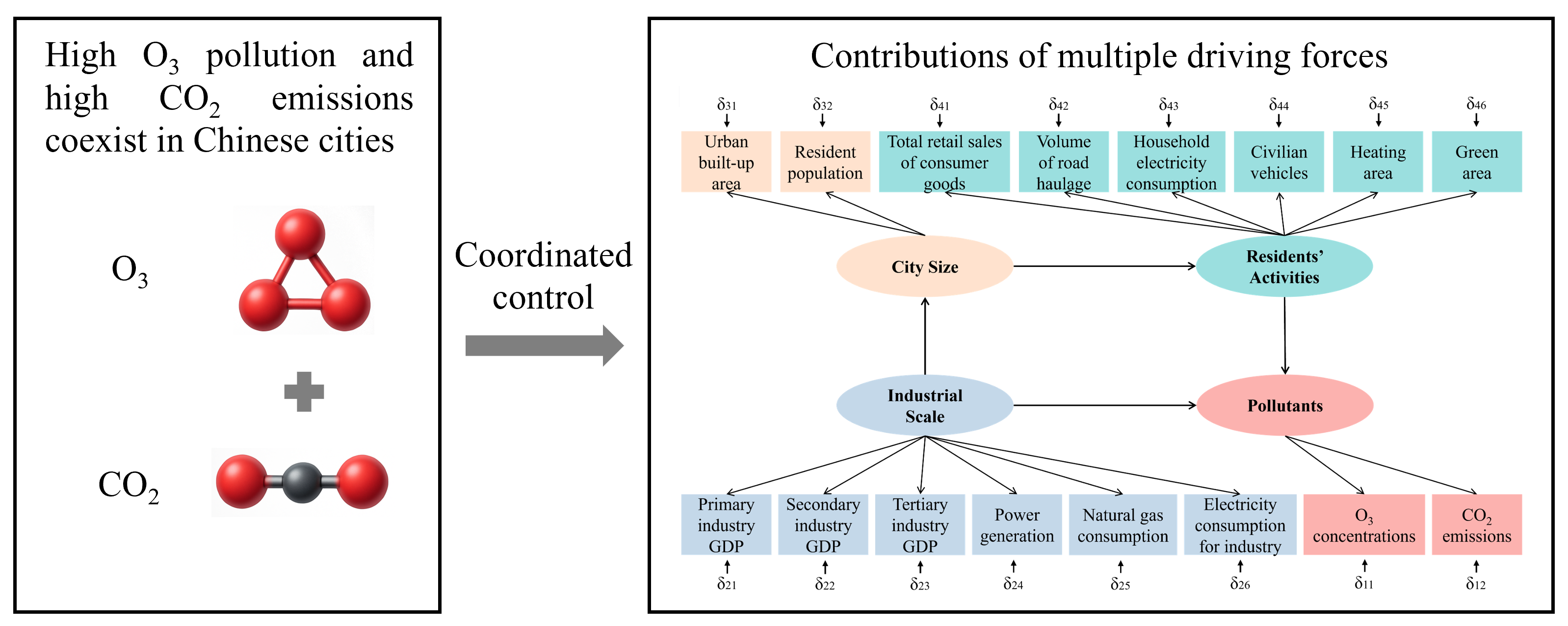
China’s atmosphere is experiencing severe ozone (O3) pollution and carbon dioxide (CO2) emissions, posing persistent threats to public health and sustainable development. Previous research has confirmed a synergistic coupling between O3 pollution and CO2 emissions, driven by mutual feedback mechanisms associated with climate warming. To gain a deeper understanding of the contribution of socioeconomic activities, we conducted a multi-parameter analysis of driving forces. In this study, we employed a Structural Equation Model (SEM) to quantify the synergistic control mechanisms for urban O3 pollution and CO2 emissions. The findings revealed that compared to 2014, urban atmospheric O3 concentrations in China significantly increased by 2022, and CO2 emissions mirrored this upward trend. Assessment of health effects showed that the number of all-cause deaths related to O3 pollution was approximately 198 × 103 in 2022. The SEM results indicated that the tertiary industry GDP and secondary industry GDP contribute most substantially to atmospheric O3 pollution and CO2 emissions. This underscored the importance of optimizing industrial structure to reduce environmental impacts. Building upon the exploration of current abatement technologies, we proposed seven recommendations for synergistic control. Our research provides a scientific foundation for the implementation of “Synergistic Pollution Reduction and Carbon Mitigation” in China.
- Open Access
- Article
Driving Forces for Synergistic Reduction of Carbon Dioxide Emissions and Ozone Pollution in Chinese Cities
- Xiaoyun Hou 1,2,
- Shiliang Liu 2,*,
- Shuang Zhao 2,3,
- Jingting Li 4,
- Siyang Zhou 2,
- Tianyi Yao 5
Author Information
Received: 04 Dec 2025 | Revised: 12 Jan 2026 | Accepted: 15 Jan 2026 | Published: 22 Jan 2026
Abstract
Graphical Abstract
Keywords
socioeconomic factor | carbon dioxide emission | ozone pollution | driving force | national scale
References
- 1.
Bashir, A.; Ali, M.; Patil, S.; et al. Comprehensive review of CO2 geological storage: Exploring principles, mechanisms, and prospects. Earth-Sci. Rev. 2024, 249, 104672. https://doi.org/10.1016/j.earscirev.2023.104672.
- 2.
Li, X.J.; Lin, C.X.; Lin, M.C.; Drivers and spatial patterns of carbon emissions from residential buildings: An empirical analysis of Fuzhou city (China). Build. Environ. 2024, 257, 111534. https://doi.org/10.1016/j.buildenv.2024.111534.
- 3.
Huang, X.P.; Zheng, W.; Li, Y.C.; et al. Ozone formation in a representative urban environment: Model discrepancies and critical roles of oxygenated volatile organic compounds. Environ. Sci. Technol. Lett. 2025, 12, 297–304. https://doi.org/10.1021/acs.estlett.4c01026.
- 4.
Zhang, J.F.; Wei, Y.J.; Fang, Z.F. Ozone pollution: A major health hazard worldwide. Front. Immunol. 2019, 10, 2518. https://doi.org/10.3389/fimmu.2019.02518.
- 5.
Wang, T.; Chen, X.; Yao, Y.; et al. Pro-thrombotic changes in response to ambient ozone exposure exacerbated by temperatures. Environ. Sci. Technol. 2025, 59, 8391–8401. https://doi.org/10.1021/acs.est.4c13457.
- 6.
Feng, Z.Z.; Uddling, J.; Tang, H.Y.; et al. Comparison of crop yield sensitivity to ozone between open-top chamber and free-air experiments. Global Chang. Biol. 2018, 24, 2231–2238. https://doi.org/10.1111/gcb.14077.
- 7.
Mills, G.; Sharps, K.; Simpson, D.; et al. Ozone pollution will compromise efforts to increase global wheat production. Global Chang. Biol. 2018, 24, 3560–3574. https://doi.org/10.1111/gcb.14157.
- 8.
Xie, B.; Zhao, Z.P.; Xu, L.; et al. Nitrogen deposition mitigates ozone-induced stress in Quercus aliena: Transcriptomic and metabolomic perspectives. Environ. Pollut. 2025, 373, 126158. https://doi.org/10.1016/j.envpol.2025.126158.
- 9.
Lu, X.F.; Li, J.; Zhou, X.Y.; et al. Negative effects of elevated ozone levels on soil microbial characteristics: A meta-analysis. Plant Soil 2025, 513, 2177–2192. https://doi.org/10.1007/s11104-025-07309-6.
- 10.
Jiao, G.; Chen, L.; Li, K.; et al. Worsened ozone pollution exacerbates the loss of agricultural production in China. J. Geophys. Res. Atmos. 2025, 130, e2024JD042781. https://doi.org/10.1029/2024JD042781.
- 11.
Yang, J.Z.; Zhao, Y.; Cao, J.; et al. Co-benefits of carbon and pollution control policies on air quality and health till 2030 in China. Environ. Int. 2021, 152, 106482. https://doi.org/10.1016/j.envint.2021.106482.
- 12.
Yang, X.Y.; Wu, K.; Wang, H.L.; et al. Summertime ozone pollution in Sichuan Basin, China: Meteorological conditions, sources and process analysis. Atmos. Environ. 2020, 226, 117392. https://doi.org/10.1016/j.atmosenv.2020.117392.
- 13.
Wang, L.L.; Yang, X.C.; Dong, J.W.; et al. Evolution of surface ozone pollution pattern in eastern China and its relationship with different intensity heatwaves. Environ. Pollut. 2023, 338, 122725. https://doi.org/10.1016/j.envpol.2023.122725.
- 14.
Lin, M.Y.; Xie, Y.Y.; De Smedt, I.; et al. Ozone pollution extremes in southeast China exacerbated by reduced uptake by vegetation during hot droughts. Geophys. Res. Lett. 2025, 52, e2025GL114934. https://doi.org/10.1029/2025GL114934.
- 15.
Ding, S.; Wei, Z.W.; Liu, S.L.; et al. Uncovering the evolution of ozone pollution in China: A spatiotemporal characteristics reconstruction from 1980 to 2021. Atmos. Res. 2024, 307, 107472. https://doi.org/10.1016/j.atmosres.2024.107472.
- 16.
Zhu, X.C.; Dong, H.X.; Huang, Y.W.; et al. Assessing ozone pollution and climate change impacts on winter wheat: Flux modeling vs. dose-response modeling. J. Environ. Manag. 2025, 387, 125767. https://doi.org/10.1016/j.jenvman.2025.125767.
- 17.
Nowroz, F.; Hasanuzzaman, M.; Siddika, A.; et al. Elevated tropospheric ozone and crop production: Potential negative effects and plant defense mechanisms. Front. Plant Sci. 2024, 14, 1244515. https://doi.org/10.3389/fpls.2023.1244515.
- 18.
Lei, Y.D.; Yue, X.; Liao, H.; et al. Global perspective of drought impacts on ozone pollution episodes. Environ. Sci. Technol. 2022, 56, 3932–3940. https://doi.org/10.1021/acs.est.1c07260.
- 19.
Liu, C.Q.; Shi, K. A review on methodology in O3-NOx-VOC sensitivity study. Environ. Pollut. 2021, 291, 118249. https://doi.org/10.1016/j.envpol.2021.118249.
- 20.
Zohdirad, H.; Namin, M.M.; Ashrafi, K.; et al. Temporal variations, regional contribution, and cluster analyses of ozone and NOx in a middle eastern megacity during summertime over 2017–2019. Environ. Sci. Pollut. Res. 2021, 29, 16233–16249. https://doi.org/10.1007/s11356-021-14923-1.
- 21.
Gao, C.; Zhang, X.L.; Lun, X.X.; et al. BVOCs’ role in dynamic shifts of summer ozone formation regimes across China and policy implications. J. Environ. Manag. 2025, 376, 124150. https://doi.org/10.1016/j.jenvman.2025.124150.
- 22.
Zhao, Y.F.; Gao, J.; Cai, J.Y.; et al. Real-time tracing VOCs, O3 and PM2.5 emission sources with vehicle-mounted proton transfer reaction mass spectrometry combined differential absorption lidar. Atmos. Pollut. Res. 2021, 12, 146–153. https://doi.org/10.1016/j.apr.2021.01.008.
- 23.
Zhang, Y.L.; Yang, X.X.; Lin, X.; et al. Characteristics of ozone pollution and VOCs source analysis in the northern cities of Zhejiang, China. Atmos. Pollut. Res. 2025, 16, 102429. https://doi.org/10.1016/j.apr.2025.102429.
- 24.
Guo, J.; Zhang, X.S.; Gao, Y.; et al. Evolution of ozone pollution in China: What track will it follow? Environ. Sci. Technol. 2023, 57, 109–117. https://doi.org/10.1021/acs.est.2c08205.
- 25.
Liu, Z.Q.; Xu, W.L.; Zhu, S.N.; et al. Elucidating ozone formation mechanisms in the central Yangtze River Delta region, China: Urban and rural differences. Environ. Pollut. 2025, 372, 125979. https://doi.org/10.1016/j.envpol.2025.125979.
- 26.
Qiu, Y.Q.; Li, X.; Chai, W.X.; et al. Insights into ozone pollution control in urban areas by decoupling meteorological factors based on machine learning. Atmos. Chem. Phys. 2025, 25, 1749–1763. https://doi.org/10.5194/acp-25-1749-2025.
- 27.
Yang, G.F.; Liu, Y.H.; Li, W.L.; et al. Association analysis between socioeconomic factors and urban ozone pollution in China. Environ. Sci. Pollut. R. 2023, 30, 17597–17611. https://doi.org/10.1007/s11356-022-23298-w.
- 28.
Zhu, Q.D.; Schwantes, R.H.; Stockwell, C.E.; et al. Incorporating cooking emissions to better simulate the impact of zero-emission vehicle adoption on ozone pollution in Los Angeles. Environ. Sci. Technol. 2025, 59 5672–5682. https://doi.org/10.1021/acs.est.5c00902.
- 29.
Li, Y.W.; Yang, X.X.; Du, E.S.; et al. A review on carbon emission accounting approaches for the electricity power industry. Appl. Energy 2024, 359, 122681. https://doi.org/10.1016/j.apenergy.2024.122681.
- 30.
Chen, L.; Huang, L.P.; Hua, J.M.; et al. Green construction for low-carbon cities: A review. Environ. Chem. Lett. 2023, 21, 1627–1657. https://doi.org/10.1007/s10311-022-01544-4.
- 31.
Mohammed, S.; Eljack, F.; Al-Sobhi, S.; et al. A systematic review: The role of emerging carbon capture and conversion technologies for energy transition to clean hydrogen. J. Clean. Prod. 2024, 447, 141506. https://doi.org/10.1016/j.jclepro.2024.141506.
- 32.
Zhang, Q.; Gu, B.H.; Zhang, H.Y.; et al. Emission reduction mode of China’s provincial transportation sector: Based on “Energy+” carbon efficiency evaluation. Energy Policy 2023, 177, 113556. https://doi.org/10.1016/j.enpol.2023.113556.
- 33.
Liu, X.; Yang, L.; Du, J.H.; et al. Carbon and air pollutant emissions forecast of China’s cement industry from 2021 to 2035. Resour. Conserv. Recycl. 2024, 204, 107498. https://doi.org/10.1016/j.resconrec.2024.107498.
- 34.
Song, X.C.; Du, S.; Deng, C.N.; et al. Carbon emissions in China’s steel industry from a life cycle perspective: Carbon footprint insights. J. Environ. Sci. 2025, 148, 650–664. https://doi.org/10.1016/j.jes.2023.04.027.
- 35.
He, D.C.; Li, F.H.; Wu, M.; et al. Emission of volatile organic compounds (VOCs) from application of commercial pesticides in China. J. Environ. Manag. 2022, 314, 115069. https://doi.org/10.1016/j.jenvman.2022.115069.
- 36.
Zhang, Y.P.; Guo, X.H.; Zhu, X.D. Strong diurnal variability of carbon dioxide flux over algae-shellfish aquaculture ponds revealed by eddy covariance measurements. Agric. Ecosyst. Environ. 2023, 348, 108426. https://doi.org/10.1016/j.agee.2023.108426.
- 37.
He, S.Q.; Yang, Y.; Wang, H.L.; et al. Source attribution of near-surface ozone pollution in Jiangsu Province of China over 2013–2019. Atmos. Environ. 2025, 352, 121205. https://doi.org/10.1016/j.atmosenv.2025.121205.
- 38.
Xia, X.S.; Ren, P.Y.; Wang, X.H.; et al. The carbon budget of China: 1980–2021. Sci. Bull. 2024, 69, 114–124. https://doi.org/10.1016/j.scib.2023.11.016.
- 39.
Zhao, S.; Liu, S.L.; Hou, X.Y.; et al. Temporal dynamics of SO2 and NOX pollution and contributions of driving forces in urban areas in China. Environ. Pollut. 2018, 242, 239–248. https://doi.org/10.1016/j.envpol.2018.06.085.
- 40.
Wang, J.F.; Qiu, Y.; He, S.T.; et al. Investigating the driving forces of NOX generation from energy consumption in China. J. Clean. Prod. 2018, 184, 836–846. https://doi.org/10.1016/j.jclepro.2018.02.305.
- 41.
He, C.; Hong, S.; Zhang, L.; Global, continental, and national variation in PM2.5, O3, and NO2 concentrations during the early 2020 COVID-19 lockdown. Atmos. Pollut. Res. 2021, 12, 136–145. https://doi.org/10.1016/j.apr.2021.02.002.
- 42.
Al-Hemoud, A.; Gasana, J.; Alajeel, A.; et al. Ambient exposure of O3 and NO2 and associated health risk in Kuwait. Environ. Sci. Pollut. Res. 2021, 28, 14917–14926. https://doi.org/10.1007/s11356-020-11481-w.
- 43.
Pope, C.A.; Turner, M.C.; Burnett, R.T.; et al. Relationships between fine particulate air pollution, cardiometabolic disorders, and cardiovascular mortality. Circ. Res. 2015, 116, 108–115. https://doi.org/10.1161/circresaha.116.305060.
- 44.
Lelieveld, J.; Evans, J.S.; Fnais, M.; et al. The contribution of outdoor air pollution sources to premature mortality on a global scale. Nature 2015, 525, 367–371. https://doi.org/10.1038/nature15371.
- 45.
Turner, M.C.; Jerrett, M.; Pope, C.A., III; et al. Long-term ozone exposure and mortality in a large prospective study. Am. J. Resp. Crit. Care. 2016, 193, 1134–1142. https://doi.org/10.1164/rccm.201508-1633OC.
- 46.
Hou, X.Y.; Guo, Q.H.; Hong, Y.; et al. Assessment of PM2.5-related health effects: A comparative study using multiple methods and multi-source data in China. Environ. Pollut. 2022, 306, 119381. https://doi.org/10.1016/j.envpol.2022.119381.
- 47.
R Development Core Team. R: A Language and Environment for Statistical Computing; R Foundation for Statistical Computing: Vienna, Austria, 2017; ISBN 3-900051-07-0. Available online: http://www.R-project.org/ (accessed on 1 June 2025).
- 48.
Zhang, X.; Lu, X.; Wang, F.; et al. Enhanced late spring ozone in Southern China by early onset of the South China Sea summer monsoon. J. Geophys. Res. Atmos. 2024, 129, e2023JD039029. https://doi.org/10.1029/2023JD039029.
- 49.
Lu, S.; Gong, S.; Chen, J.; et al. Composite effects of ENSO and EASM on summer ozone pollution in two regions of China. J. Geophys. Res. Atmos. 2022, 127, e2022JD036938. https://doi.org/10.1029/2022JD036938.
- 50.
Bao, J.M.; Zhang, X.; Wu, Z.H.; et al. Atmospheric carbonyl compounds are crucial in regional ozone heavy pollution: Insights from the Chengdu Plain Urban Agglomeration, China. Atmos. Chem. Phys. 2025, 25, 1899–1916. https://doi.org/10.5194/acp-25-1899-2025.
- 51.
Wang, H.C.; Ma, X.F.; Tan, Z.F.; et al. Anthropogenic monoterpenes aggravating ozone pollution. Natl. Sci. Rev. 2022, 9, nwac103. https://doi.org/10.1093/nsr/nwac103.
- 52.
Setälä, H.; Viippola, V.; Rantalainen, A.L.; et al. Does urban vegetation mitigate air pollution in northern conditions? Environ. Pollut. 2013, 183, 104–112. https://doi.org/10.1016/j.envpol.2012.11.010.
- 53.
Carriero, G.; Brunetti, C.; Fares, S.; et al. BVOC responses to realistic nitrogen fertilization and ozone exposure in silver birch. Environ. Pollut. 2016, 213, 988–995. https://doi.org/10.1016/j.envpol.2015.12.047.
- 54.
Fang, T.T.; Hu, J.; Gu, Y.F.; et al. Response of ozone to current and future emission scenarios and the resultant human health impact in Southeast Asia. Environ. Int. 2025, 197, 109333. https://doi.org/10.1016/j.envint.2025.109333.
- 55.
Li, X.B.; Yuan, B.; Parrish, D.D.; et al. Long-term trend of ozone in southern China reveals future mitigation strategy for air pollution. Atmos. Environ. 2022, 269, 118869. https://doi.org/10.1016/j.atmosenv.2021.118869.
- 56.
Xing, J.; Ding, D.; Wang, S.X.; et al. Quantification of the enhanced effectiveness of NOX control from simultaneous reductions of VOC and NH3 for reducing air pollution in the Beijing-Tianjin-Hebei region, China. Atmos. Chem. Phys. 2018, 18, 7799–7814. https://doi.org/10.5194/acp-18-7799-2018.
- 57.
Xie, Y.; Dai, H.C.; Zhang, Y.X.; et al. Comparison of health and economic impacts of PM2.5 and ozone pollution in China. Environ. Int. 2019, 130, 104881. https://doi.org/10.1016/j.envint.2019.05.075.
- 58.
Qi, C.; Shang, L.; Yang, W.; et al. Maternal exposure to O3 and NO2 may increase the risk of newborn congenital hypothyroidism: A national data-based analysis in China. Environ. Sci. Pollut. Res. 2021, 28, 34621–34629. https://doi.org/10.1007/s11356-021-13083-6.
- 59.
Wang, Y.; Yang, Y.J.; Yuan, Q.Q.; et al. Substantially underestimated global health risks of current ozone pollution. Nat. Commun. 2025, 16, 102. https://doi.org/10.1038/s41467-024-55450-0.
- 60.
Dantas, G.; Siciliano, B.; da Silva, C.M.; et al. A reactivity analysis of volatile organic compounds in a Rio de Janeiro urban area impacted by vehicular and industrial emissions. Atmos. Pollut. Res. 2020, 11, 1018–1027. https://doi.org/10.1016/j.apr.2020.02.017.
- 61.
Hu, Q.; Zhou, W.L.; Qi, S.; et al. Pulsed co-electrolysis of carbon dioxide and nitrate for sustainable urea synthesis. Nat. Sustain. 2024, 7, 442–451. https://doi.org/10.1038/s41893-024-01302-0.
- 62.
Huang, L.Q.; Long, Y.; Chen, J.D.; et al. Sustainable lifestyle: Urban household carbon footprint accounting and policy implications for lifestyle-based decarbonization. Energy Policy 2023, 181, 113696. https://doi.org/10.1016/j.enpol.2023.113696.
- 63.
Shin, H.M.; Mckone, T.E.; Bennett, D.H. Contribution of low vapor pressure-volatile organic compounds (LVP-VOCs) from consumer products to ozone formation in urban atmospheres. Atmos. Environ. 2015, 108, 98–106. https://doi.org/10.1016/j.atmosenv.2015.02.067.
- 64.
Li, H.G.; Zick, M.E.; Trisukhon, T.; et al. Capturing carbon dioxide from air with charged-sorbents. Nature 2024, 630, 654–659. https://doi.org/10.1038/s41586-024-07449-2.
- 65.
Krevor, S.; de Coninck, H.; Gasda, S.E.; et al. Subsurface carbon dioxide and hydrogen storage for a sustainable energy future. Nat. Rev. Earth Environ. 2023, 4, 102–118. https://doi.org/10.1038/s43017-022-00376-8.
- 66.
Abdellah, A.M.; Ismail, F. Impact of palladium/palladium hydride conversion on electrochemical CO2 reduction via in-situ transmission electron microscopy and diffraction. Nat. Commun. 2024, 15, 938. https://doi.org/10.1038/s41467-024-45096-3.
- 67.
Jiang, M.H.; Wang, H.Z.; Zhu, M.F.; et al. Review on strategies for improving the added value and expanding the scope of CO2 electroreduction products. Chem. Soc. Rev. 2024, 53, 5149–5189. https://doi.org/10.1039/d3cs00857f.
- 68.
Fang, W.S.; Guo, W.; Lu, R.H.; et al. Durable CO2 conversion in the proton-exchange membrane system. Nature 2024, 626, 86–91. https://doi.org/10.1038/s41586-023-06917-5.
- 69.
Khoshooei, M.A.; Wang, X.J.; Vitale, G.; et al. An active, stable cubic molybdenum carbide catalyst for the high-temperature reverse water-gas shift reaction. Science 2024, 384, 540–546. https://doi.org/10.1126/science.adl1260.
- 70.
Singh, A.; Barman, S.; Rahimi, F.A.; et al. Atomically dispersed Co2+ in a redox-active COF for electrochemical CO2 reduction to ethanol: Unravelling mechanistic insight through operando studies. Energy Environ. Sci. 2024, 17, 2315–2325. https://doi.org/10.1039/d3ee02946h.
- 71.
Baskaran, D.; Saravanan, P.; Nagarajan, L.; et al. An overview of technologies for capturing, storing, and utilizing carbon dioxide: Technology readiness, large-scale demonstration, and cost. Chem. Eng. J. 2024, 491, 151998. https://doi.org/10.1016/j.cej.2024.151998.
- 72.
Fuhrman, J.; Bergero, C.; Weber, M.; et al. Diverse carbon dioxide removal approaches could reduce impacts on the energy-water-land system. Nat. Clim. Chang. 2023, 13, 341–350. https://doi.org/10.1038/s41558-023-01604-9.
- 73.
Ampah, J.D.; Jin, C.; Liu, H.F.; et al. Prioritizing non-carbon dioxide removal mitigation strategies could reduce the negative impacts associated with large-scale reliance on negative emissions. Environ. Sci. Technol. 2024, 58, 3755–3765. https://doi.org/10.1021/acs.est.3c06866.
- 74.
Chen, K.L.; Liu, Q.; Chen, B.; et al. Effect of raw materials on the performance of 3D printing geopolymer: A review. J. Build. Eng. 2024, 84, 108501. https://doi.org/10.1016/j.jobe.2024.108501.
- 75.
Mcdonald, B.C.; De Gouw, J.A.; Gilman, J.B.; et al. Volatile chemical products emerging as largest petrochemical source of urban organic emissions. Science 2018, 359, 760–764. https://doi.org/10.1126/science.aaq0524.
- 76.
Vidal, F.; van der Marel, E.R.; Kerr, R.W.F.; et al. Designing a circular carbon and plastics economy for a sustainable future. Nature 2024, 626, 45–57. https://doi.org/10.1038/s41586-023-06939-z.
- 77.
Araminienė, V.; Sicard, P.; Anav, A.; et al. Trends and inter-relationships of ground-level ozone metrics and forest health in Lithuania. Sci. Total. Environ. 2019, 658, 1265–1277. https://doi.org/10.1016/j.scitotenv.2018.12.092.
- 78.
Wang, W.P.; Wang, Y.; Chen, X.Y.; et al. The future underlying differential response of surface ozone to biogenic emissions in China (2019–2060). Atmos. Environ. 2025, 352, 121206. https://doi.org/10.1016/j.atmosenv.2025.121206.
- 79.
Weber, J.; King, J.A.; Abraham, N.L.; et al. Chemistry-albedo feedbacks offset up to a third of forestation’s CO2 removal benefits. Science 2024, 383, 860–864. https://doi.org/10.1126/science.adg6196.
- 80.
Guo, R.Y.; Shi, G.M.; Zhang, D.; et al. An observed nocturnal ozone transport event in the Sichuan Basin, Southwestern China. J. Environ. Sci. 2024, 138, 10–18. https://doi.org/10.1016/j.jes.2023.02.054.


This work is licensed under a Creative Commons Attribution 4.0 International License.

 Suite 4002 Level 4, 447 Collins Street, Melbourne, Victoria 3000, Australia
 General Inquiries: info@sciltp.com