
Coastal zones act as dynamic socio-ecological interfaces facing compounded pressures from climate change, urban growth, and land-use transformation. Despite abundant literature, research often remains compartmentalized, addressing biophysical and socioeconomic drivers separately. This study systematically examines the evolution of coastal land-use and resilience research using CiteSpace, a bibliometric analysis tool. Results identify nine major clusters, with land-use dynamics, climate impacts, and management forming the field’s core structure. Three dominant evolutionary trajectories emerged: (1) the integration of land-use and ecosystem dynamics as foundational resilience drivers; (2) a shift toward climate risk, variability, and adaptation-oriented analysis; and (3) the rise of governance and community-focused perspectives prioritizing socio-ecological resilience. However, significant structural biases remain, especially regarding data availability in the Global South. This review underscores the need for coherent frameworks that reconceptualize coastal systems as coupled socio-ecological interfaces. To advance long-term sustainability, future research must bridge methodological gaps by integrating multi-scale monitoring, from regional trends to neighborhood-level human expansion, with inclusive, justice-oriented adaptation strategies.
- Open Access
- Review
Coastal Land Use Transitions and Their Cascading Impacts on Ecosystem Resilience: A Global Bibliometric Review
Author Information
Received: 28 Jan 2026 | Revised: 19 Mar 2026 | Accepted: 10 Apr 2026 | Published: 24 Apr 2026
Abstract
Graphical Abstract
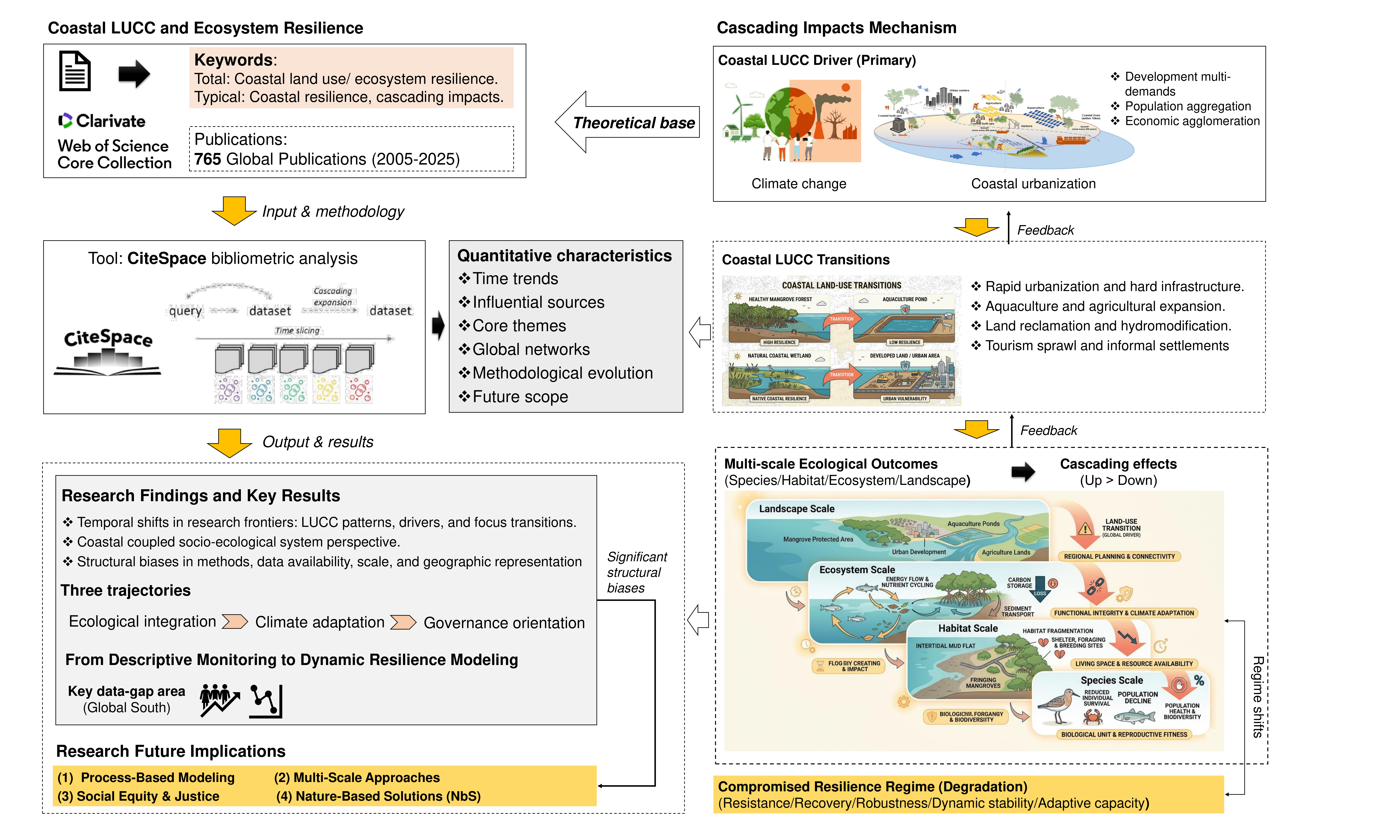
Keywords
coastal land use | ecosystem resilience | socio-ecological systems | bibliometric analysis | LUCC
References
- 1.
Ward, N.D.; Megonigal, J.P.; Bond-Lamberty, B.; et al. Representing the Function and Sensitivity of Coastal Interfaces in Earth System Models. Nat. Commun. 2020, 11, 2458.
- 2.
Cohen, J.E.; Small, C.; Mellinger, A.; et al. Estimates of Coastal Populations. Science 1997, 278, 1209–1213.
- 3.
Varis, O.; Taka, M.; Kummu, M. Mapping World’s Coastal Population Facing Water-Related Risks. Geogr. Sustain. 2026, 7, 100411.
- 4.
Cosby, A.G.; Lebakula, V.; Smith, C.N.; et al. Accelerating Growth of Human Coastal Populations at the Global and Continent Levels: 2000–2018. Sci. Rep. 2024, 14, 22489.
- 5.
Wang, Y.; Liao, J.; Ye, Y.; et al. Long-Term Human Expansion and the Environmental Impacts on the Coastal Zone of China. Front. Mar. Sci. 2022, 9, 1033466.
- 6.
Tanwari, K.; Terefenko, P.; Shi, X.; et al. Coastal Zones Vulnerability Evaluation in the Southern Baltic Sea: Shoreline Dynamics and Land Use/Land Cover Changes over Five Decades. Sci. Total Environ. 2025, 976, 179345.
- 7.
Liu, Y.; Zeng, H. Coastal Squeeze and Multi-Scenario Risk Assessment in China, 1985–2024. Environ. Impact Assess. Rev. 2026, 118, 108248.
- 8.
Durkin, C.J.; Seenath, A.; Knaapen, M.A.F. A Critical Review of Closure Depth Theories and Uncertainties: Implications for Shoreline Modelling and Coastal Management. Ocean Coast. Manag. 2025, 267, 107732.
- 9.
Vousdoukas, M.I.; Paprotny, D.; Mentaschi, L.; et al. Coastal Flood Impacts and Lost Ecosystem Services along Europe’s Outermost Regions and Overseas Countries and Territories. Nat. Commun. 2026, 17, 188.
- 10.
Borzì, L.; Marino, M.; Stagnitti, M.; et al. Impact of Coastal Land Use on Long-Term Shoreline Change. Ocean Coast. Manag. 2025, 262, 107583.
- 11.
Pricope, N.G.; Halls, J.N.; Dalton, E.G.; et al. Precision Mapping of Coastal Wetlands: An Integrated Remote Sensing Approach Using Unoccupied Aerial Systems Light Detection and Ranging and Multispectral Data. J. Remote Sens. 2024, 4, 0169.
- 12.
Dong, Y.Q.; Zhou, Y.; Zhang, L.; et al. Intensive Land Use Is Associated with Development Status in Port Cities of Southeast Asia. Environ. Res. Lett. 2023, 18, 044006.
- 13.
Taylor, C.M.; Klein, C.; Parker, D.J.; et al. “Late-Stage” Deforestation Enhances Storm Trends in Coastal West Africa. Proc. Natl. Acad. Sci. USA 2022, 119, e2109285119.
- 14.
Wolff, C.; Bonatz, H.; Vafeidis, A.T. Setback Zones Can Effectively Reduce Exposure to Sea-Level Rise in Europe. Sci. Rep. 2023, 13, 5515.
- 15.
Tay, C.; Lindsey, E.O.; Chin, S.T.; et al. Sea-Level Rise from Land Subsidence in Major Coastal Cities. Nat. Sustain. 2022, 5, 1049–1057.
- 16.
Yang, D.; Luan, W.; Li, Y.; et al. Multi-Scenario Simulation of Land Use and Land Cover Based on Shared Socioeconomic Pathways: The Case of Coastal Special Economic Zones in China. J. Environ. Manag. 2023, 335, 117536.
- 17.
Elyasi, A.H.; Ledari, D.G.; Nasseri, M.; et al. Assessing the Impacts of Anthropogenic-Induced Land Use/Land Cover Changes in Wetlands Using Remotely Sensed Information: A Systematic State-of-the-Art Review and Future Directions. Anthropocene 2025, 52, 100496.
- 18.
Jamilah, M.; Becker, A.; Lee, S.L.; et al. Socioeconomic Impacts Linked to Land Use and Land Use Changes Affecting Blue Carbon Ecosystems in Southeast Asia: A Systematic Map. Ocean Coast. Manag. 2025, 267, 107643.
- 19.
Wang, Y.; Ye, Y.; Nicholls, R.J.; et al. Managing Development Choices Is Essential to Reduce Coastal Flood Risk in China. Nat. Clim. Chang. 2025, 15, 1033–1034.
- 20.
Lansu, E.M.; Reijers, V.C.; Hofer, S.; et al. A Global Analysis of How Human Infrastructure Squeezes Sandy Coasts. Nat. Commun. 2024, 15, 432.
- 21.
Hagger, V.; Waltham, N.J.; Lovelock, C.E. Opportunities for Coastal Wetland Restoration for Blue Carbon with Co Benefits for Biodiversity, Coastal Fisheries, and Water Quality. Ecosyst. Serv. 2022, 55, 101423.
- 22.
Guimond, J.A. The Overlooked Role of Terrestrial Groundwater in Coastal Wetland Resilience. Nat. Water 2025, 3, 364–366.
- 23.
Richardson, C.M.; Peucker-Ehrenbrink, B.; Wyatt, S.; et al. Effects of Climate Change on River and Groundwater Nutrient Inputs to the Coastal Ocean. Commun. Earth Environ. 2025, 6, 761.
- 24.
Richardson, C.M.; Davis, K.L.; Ruiz-González, C.; et al. The Impacts of Climate Change on Coastal Groundwater. Nat. Rev. Earth Environ. 2024, 5, 100–119.
- 25.
Siddik, M.A.; Islam, A.R.M.T. Review of Coastal Land Transformation: Factors, Impacts, Adaptation Strategies, and Future Scopes. Geogr. Sustain. 2024, 5, 167–178.
- 26.
Aerts, J.C.J.H.; Botzen, W.J.W.; Emanuel, K.; et al. Evaluating Flood Resilience Strategies for Coastal Megacities. Science 2014, 344, 473–475.
- 27.
He, Q.; Li, Z.A.; Daleo, P.; et al. Coastal Wetland Resilience through Local, Regional, and Global Conservation. Nat. Rev. Biodivers. 2025, 1, 50–67.
- 28.
Campbell, A.D.; Fatoyinbo, L.; Goldberg, L.; et al. Global Hotspots of Salt Marsh Change and Carbon Emissions. Nature 2022, 612, 701–706.
- 29.
Ghosh, M.; Mondal, K.C.; Roy, A. Recognition of the Co-Existence Pattern of Salt Marshes and Mangroves for Littoral Forest Restoration. Ecol. Inform. 2022, 71, 101769.
- 30.
Thyrring, J.; Archambault, P.; Burrows, M.; et al. A Horizon Scan for Arctic Coastal Biodiversity Research: Understanding Changes Requires International Collaboration. Trends Ecol. Evol. 2025, 40, 460–467.
- 31.
Huang, A.; Zhou, W.; Han, W.; et al. Nutrient Thresholds Drive Nonlinear Shifts in Estuarine Macrobenthic Functional Traits: Implications for Eutrophication Monitoring and Ecological Resilience. J. Environ. Manag. 2025, 394, 127519.
- 32.
Zhou, T.; Li, Y.; Zheng, L.; et al. Capturing Land Use System Thresholds through Regime Shifts of Coastal Sustainability in China. Environ. Impact Assess. Rev. 2026, 116, 108127.
- 33.
Martínez, M.L.; Silva, R.; Pérez-Maqueo, O.; et al. The Dilemma of Coastal Management: Exploitation or Conservation? Camb. Prism. Coast. Futures 2024, 2, e10.
- 34.
Pichler, E.; Connell, S.D.; McAfee, D. Improving Human Well-Being through Community-Led Coastal Restoration. Biol. Conserv. 2025, 301, 110892.
- 35.
Reguero, B.G.; Gaido, C.; Storlazzi, C.D.; et al. Where to Restore and Conserve? A Regional Benefit Cost Analysis of Coral Reef Protection and Restoration for Coastal Flood Resilience. J. Environ. Manag. 2026, 397, 128166.
- 36.
Chen, M.H.; Chen, F.; Tang, C.J.; et al. Integration of DPSIR Framework and TOPSIS Model Reveals Insight into the Coastal Zone Ecosystem Health. Ocean Coast. Manag. 2022, 226, 106285.
- 37.
Fan, Y.; Wei, G. Assessment of Ecological Resilience and Its Response Mechanism to Land Spatial Structure Conflicts in China’s Southeast Coastal Areas. Ecol. Indic. 2025, 170, 112980.
- 38.
Mishra, M.; Bhattacharyya, D.; Mondal, B.; et al. Forecasting Shoreline Dynamics and Land Use/Land Cover Changes in Balukhand-Konark Wildlife Sanctuary (India) Using Geospatial Techniques and Machine Learning. Sci. Total Environ. 2025, 975, 179207.
- 39.
Yu, L.; Du, Z.; Li, X.; et al. FROM-GLC Plus 3.0: Multimodal Land Change Mapping with SAM and Dense Surface Observations. J. Remote Sens. 2025, 5, 0728.
- 40.
Bevacqua, A.; Yu, D.; Zhang, Y. Coastal Vulnerability: Evolving Concepts in Understanding Vulnerable People and Places. Environ. Sci. Policy 2018, 82, 19–29.
- 41.
Li, S.-H.; Lin, W. A Hybrid Landscape Metric-Enhanced Cellular Automata Model (LE-CA) for Land Use/Land Cover Change Simulation: An Application to Coastal Wetlands. Ecol. Modell. 2025, 508, 111209.
- 42.
Zhou, J.; Xu, H.; Jim, C.Y.; et al. Spatiotemporal Dynamics of Land Use and Landscape in Coastal Zhejiang Using Multiple Methods. iScience 2025, 28, 112898.
- 43.
Hood, W.W.; Wilson, C.S. The Literature of Bibliometrics, Scientometrics, and Informetrics. Scientometrics 2001, 52, 291–314.
- 44.
Chen, C. Searching for Intellectual Turning Points: Progressive Knowledge Domain Visualization. Proc. Natl. Acad. Sci. USA 2004, 101, 5303–5310.
- 45.
Chen, C. CiteSpace II: Detecting and Visualizing Emerging Trends and Transient Patterns in Scientific Literature. J. Am. Soc. Inf. Sci. Technol. 2006, 57, 359–377.
- 46.
Segaran, T.C.; Azra, M.N.; Mohd Noor, M.I.; et al. Knowledge Mapping Analysis of the Global Seaweed Research Using CiteSpace. Heliyon 2024, 10, e28418.
- 47.
Laino, E.; Iglesias, G. Scientometric Review of Climate-Change Extreme Impacts on Coastal Cities. Ocean Coast. Manag. 2023, 242, 106709.
- 48.
Synnestvedt, M.B.; Chen, C.; Holmes, J.H. CiteSpace II: Visualization and Knowledge Discovery in Bibliographic Databases. AMIA Annu. Symp. Proc. 2005, 2005, 724–728.
- 49.
Chuai, X.; Huang, X.; Wu, C.; et al. Land Use and Ecosystem Services Value Changes and Ecological Land Management in Coastal Jiangsu, China. Habitat Int. 2016, 57, 164–174.
- 50.
Sarfo, I.; Qiao, J.; Yeboah, E.; et al. Meta-Analysis of Land Use Systems Development in Africa: Trajectories, Implications, Adaptive Capacity, and Future Dynamics. Land Use Policy 2024, 144, 107261.
- 51.
Albarico, F.P.J.B.; Chen, C.W.; Dong, C.D. Multifactorial Environmental and Ecological Gradients from Hydrology and Land-Use Reflect Coordinated Plankton-Organic Pollutant Spatial Dynamics in Coastal Ecosystems. Water Res. 2026, 288, 124727.
- 52.
Meng, C.; Wu, C.; Wu, J.; et al. Spatiotemporal Changes of Coastal Land Use Land Cover and Its Drivers in Shanghai, China between 1989 and 2015. Ocean Coast. Manag. 2023, 244, 106802.
- 53.
IPCC. Climate Change 2014: Mitigation of Climate Change. Contribution of Working Group III to the Fifth Assessment Report of the Intergovernmental Panel on Climate Change; Edenhofer, O., Pichs-Madruga, R., Sokona, Y., et al., Eds.; Cambridge University Press: Cambridge, UK/New York, NY, USA, 2014.
- 54.
IPCC. Climate Change 2022: Impacts, Adaptation, and Vulnerability. Contribution of Working Group II to the Sixth Assessment Report of the Intergovernmental Panel on Climate Change; Pörtner, H.-O., Roberts, D.C., Tignor, M., et al., Eds.; Cambridge University Press: Cambridge, UK/New York, NY, USA, 2022. https://doi.org/10.1017/9781009325844.
- 55.
Cinner, J.E.; McClanahan, T.R.; Graham, N.A.J.; et al. Vulnerability of Coastal Communities to Key Impacts of Climate Change on Coral Reef Fisheries. Global Environ. Chang. 2012, 22, 12–20.
- 56.
Xu, W.; He, M.; Meng, W.; et al. Temporal-Spatial Change of China’s Coastal Ecosystems Health and Driving Factors Analysis. Sci. Total Environ. 2022, 845, 157319.
- 57.
Leijnse, T.; van Ormondt, M.; Nederhoff, K.; et al. Modeling Compound Flooding in Coastal Systems Using a Computationally Efficient Reduced-Physics Solver: Including Fluvial, Pluvial, Tidal, Wind- and Wave-Driven Processes. Coast. Eng. 2021, 163, 103796.
- 58.
Zhou, S.; Geng, X.; Jia, W.; et al. Towards Climate-Adaptive Equality in Coastal Megacities: Assessing Urban Flooding Risk Disparities and Nonlinear Effect of Multidimensional Indicators through an Interpretable LightGBM-SHAP Framework. Sustain. Cities Soc. 2025, 132, 106809.
- 59.
Capano, G.; Lepori, B. Designing Policies That Could Work: Understanding the Interaction between Policy Design Spaces and Organizational Responses in the Public Sector. Policy Sci. 2024, 57, 53–82.
- 60.
Amorim-Maia, A.T.; Olazabal, M. Beyond Adjustment: A New Paradigm for Climate Change Adaptation in a Complex World. Global Environ. Chang. 2025, 93, 103027.
- 61.
Babacan, H. From Crisis to Policy Action: Tackling Climate Change through SDG 13. Int. J. Community Soc. Dev. 2025, 7, 205–221.
- 62.
Goonesekera, S.M.; Olazabal, M. Climate Adaptation Indicators and Metrics: State of Local Policy Practice. Ecol. Indic. 2022, 145, 109657.
- 63.
Anik, M.; An, C.; Li, S.S. Evolution from the Physical Process-Based Approaches to Machine Learning Approaches to Predicting Urban Floods: A Literature Review. Environ. Syst. Res. 2025, 14, 15.
- 64.
Ghosh, S.; Saha, S.; Bera, B. Flood Susceptibility Zonation Using Advanced Ensemble Machine-Learning Models in the Himalayan Foreland Basin. Nat. Hazards Res. 2022, 2, 363–374.
- 65.
Shaw, R.; Luo, Y.; Cheong, T.S.; et al. Asia. In Climate Change 2022: Impacts, Adaptation and Vulnerability. Contribution of Working Group II to the Sixth Assessment Report of the Intergovernmental Panel on Climate Change; Pörtner, H.-O., Roberts, D.C., Tignor, M., et al., Eds.; Cambridge University Press: Cambridge, UK/New York, NY, USA, 2022; pp. 1457–1579.
- 66.
Patrick, C.J.; Kominoski, J.S.; McDowell, W.H.; et al. A General Pattern of Trade-Offs between Ecosystem Resistance and Resilience to Tropical Cyclones. Sci. Adv. 2022, 8, eabl9155.
- 67.
Wu, W.; Gao, Y.; Chen, C. CLSER: A New Indicator for the Social Ecological Resilience of Coastal Systems and Sustainable Management. J. Clean. Prod. 2024, 435, 140564.
- 68.
Elrick Barr, C.E.; Thomsen, D.C.; Smith, T.F. Governance Innovations in the Coastal Zone: Towards Social-Ecological Resilience. Environ. Sci. Policy 2024, 153, 103687.
- 69.
Mabon, L.; Kawabe, M. Social Media within Digitalisation for Coastal Resilience: The Case of Coastal Fisheries in Minamisoma, Fukushima Prefecture, Japan. Ocean Coast. Manag. 2023, 232, 106440.
- 70.
Muis, S. Early Action for Coastal Communities. Nat. Geosci. 2026, 19, 239–240.
- 71.
Pichler, M.; Hartig, F. Machine Learning and Deep Learning—A Review for Ecologists. Methods Ecol. Evol. 2023, 14, 994–1016.
- 72.
Teng, M.; Zhang, F.; Gong, Z.; et al. Evaluating Climate Adaptation Strategies for Coastal Resilience Using a Multi Criteria Decision-Making Framework. Mar. Pollut. Bull. 2025, 217, 118060.
- 73.
Lawless, S.; Cohen, P.J.; McDougall, C.; et al. Tinker, Tailor or Transform: Gender Equality amidst Social-Ecological Change. Global Environ. Chang. 2022, 72, 102434.
- 74.
Seenath, A.; Romeo Mahadeo, S.M.; Catterson, J. Public Perceptions of Nature-Based Coastal Solutions in the UK. J. Environ. Manag. 2025, 373, 123413.
- 75.
Wang, W.; Wu, C.; Fang, Q.; et al. Cultural Ecosystem Services Evaluation in a Coastal City of China Using Social Media Data. Ocean Coast. Manag. 2023, 242, 106693.
- 76.
Zhong, W.; Chu, T.; Tissot, P.; et al. Integrated Coastal Subsidence Analysis Using InSAR, LiDAR, and Land Cover Data. Remote Sens. Environ. 2022, 282, 113297.
- 77.
Agate, J.; Ballinger, R.; Ward, R.D. Satellite Remote Sensing Can Provide Semi-Automated Monitoring to Aid Coastal Decision-Making. Estuar. Coast. Shelf Sci. 2024, 298, 108639.
- 78.
Zhang, X.; Xiao, X.; Qiu, S.; et al. Quantifying Latitudinal Variation in Land Surface Phenology of Spartina alterniflora Saltmarshes across Coastal Wetlands in China by Landsat 7/8 and Sentinel-2 Images. Remote Sens. Environ. 2022, 269, 112810.
- 79.
Fringer, O.B.; Dawson, C.N.; He, R.; et al. The Future of Coastal and Estuarine Modeling: Findings from a Workshop. Ocean Modell. 2019, 143, 101458.
- 80.
Leist, A.K.; Klee, M.; Kim, J.H.; et al. Mapping of Machine Learning Approaches for Description, Prediction, and Causal Inference in the Social and Health Sciences. Sci. Adv. 2022, 8, eabk1942.
- 81.
Martínez, M.L.; Intralawan, A.; Vázquez, G.; et al. The Coasts of Our World: Ecological, Economic and Social Importance. Ecol. Econ. 2007, 63, 254–272.
- 82.
Hill, R.; Adem, Ç.; Alangui, W.V.; et al. Working with Indigenous, Local, and Scientific Knowledge in Assessments of Nature and Nature’s Linkages with People. Curr. Opin. Environ. Sustain. 2020, 43, 8–20.
- 83.
Lloyd, M.G.; Peel, D.; Duck, R.W. Towards a Social-Ecological Resilience Framework for Coastal Planning. Land Use Policy 2013, 30, 925–933.
- 84.
Martin, J.F.; Roy, E.D.; Diemont, S.A.W.; et al. Traditional Ecological Knowledge (TEK): Ideas, Inspiration, and Designs for Ecological Engineering. Ecol. Eng. 2010, 36, 839–849.
- 85.
Kankam, S.; Koo, H.; Inkoom, J.N.; et al. Modeling Coastal Land Use Scenario Impacts on Ecosystem Services Restoration in Southwest Ghana, West Africa. NPJ Ocean Sustain. 2025, 4, 13.
- 86.
Babapoorkamani, A.; Ricci, L. Decision-Making Strategies for Climate Change Adaptation in Coastal Regions of Africa. Environ. Dev. 2025, 55, 101196.
- 87.
Allen, C.; Malekpour, S.; Mintrom, M. Cross-Scale, Cross-Level and Multi-Actor Governance of Transformations toward the Sustainable Development Goals: A Review of Common Challenges and Solutions. Sustain. Dev. 2023, 31, 1250–1267.
- 88.
Lawless, S.; Ogier, E.M.; Streit, R.; et al. Promoting Socially Responsible Governance of New Marine Climate Intervention. Cell Rep. Sustain. 2025, 2, 100366.
- 89.
Marzio, S.; Tosi, J.; Poggi, F.; et al. Nature-Based Solutions for Urban Waterfront Regeneration: A Systematic Review of Frameworks, Strategies and Applications. City Environ. Interact. 2026, 29, 100281.
- 90.
Haddad, N.M.; Brudvig, L.A.; Clobert, J.; et al. Habitat Fragmentation and Its Lasting Impact on Earth’s Ecosystems. Sci. Adv. 2015, 1, e1500052.
- 91.
Storlazzi, C.D.; Reguero, B.G.; Alkins, K.C.; et al. Hybrid Coral Reef Restoration Can Be a Cost-Effective Nature-Based Solution to Provide Protection to Vulnerable Coastal Populations. Sci. Adv. 2025, 11, eadn4004.


This work is licensed under a Creative Commons Attribution 4.0 International License.

 Suite 4002 Level 4, 447 Collins Street, Melbourne, Victoria 3000, Australia
 General Inquiries: info@sciltp.com