
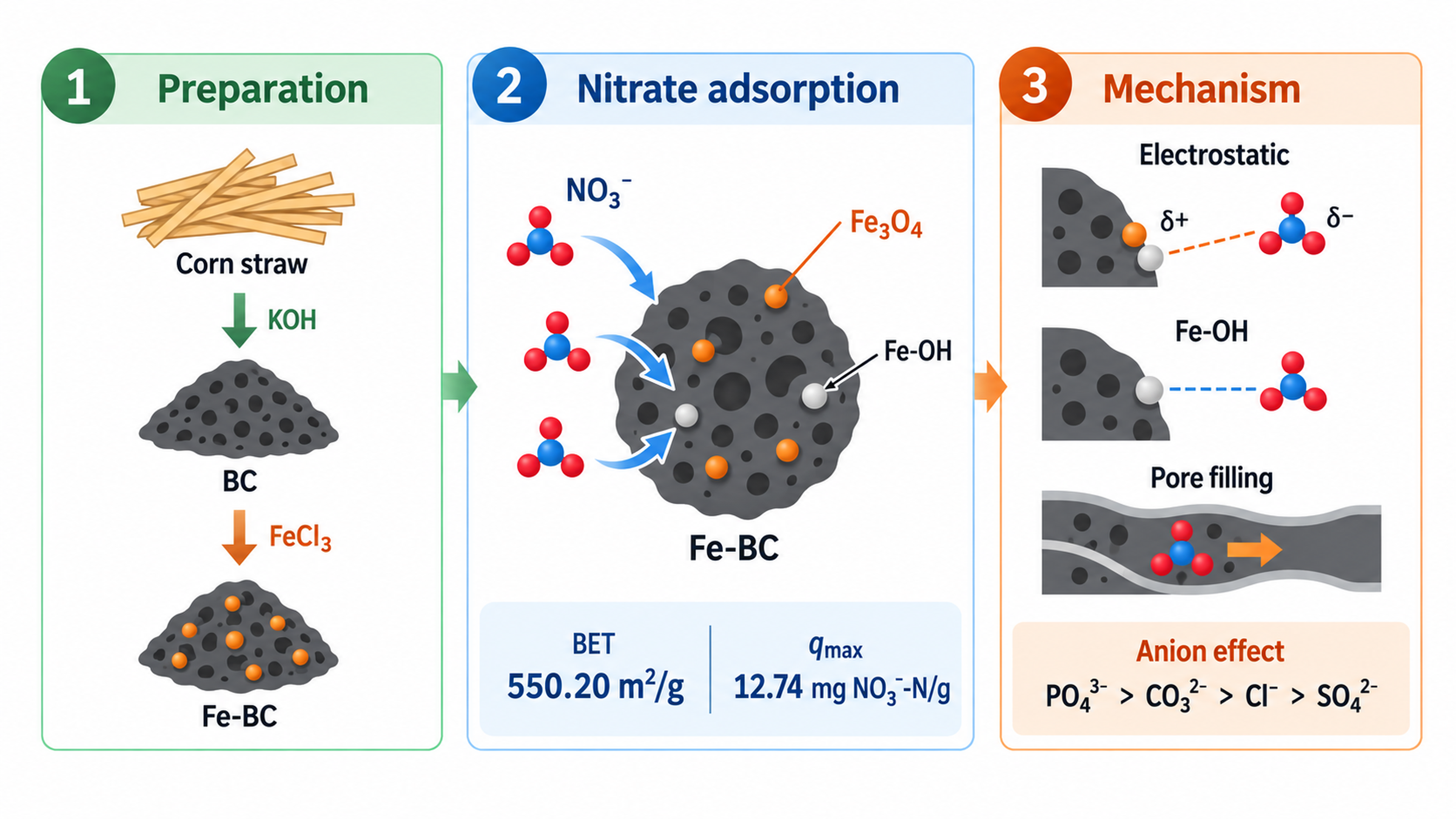
Nitrate contamination of groundwater requires low-cost adsorbents with strong affinity for anionic species. This study developed an iron-modified corn straw biochar (Fe-BC) by coupling KOH activation with FeCl3 impregnation and secondary pyrolysis, thereby integrating a porous carbon framework with iron-derived adsorption sites. The optimal Fe-BC was obtained at an iron-to-biochar mass ratio of 1:3 and a secondary pyrolysis temperature of 600 °C. It contained uniformly dispersed crystalline Fe3O4, had a Brunauer–Emmett–Teller (BET) surface area of 550.20 m2/g, and exhibited a point of zero charge of 7.3. Fe-BC maintained an adsorption capacity above 5 mg/g at pH 2–7 and reached a Langmuir maximum capacity of 12.74 mg/g at 313 K, nearly fivefold that of pristine biochar. The pseudo-second-order model showed higher R² values (0.978–0.980) than the pseudo-first-order model, while the Langmuir model yielded R² values of 0.970–0.986. Thermodynamic parameters (ΔG = −17.77 to −19.47 kJ/mol, ΔH = 7.11 kJ/mol, and ΔS = 84.89 J/(mol·K)) indicated spontaneous and mildly endothermic adsorption. Phosphate produced the strongest competitive inhibition, whereas chloride and sulfate had smaller effects. Characterization results support a combined mechanism involving pH-dependent electrostatic attraction, association with Fe–OH sites, and pore filling. The principal contribution is the deliberate coupling of KOH-generated porosity and Fe3O4 functionalization in an agricultural-waste matrix, which provides a balanced improvement in accessible surface area, near-neutral-pH performance, and resistance to common anions. Regeneration and flow-through performance require further verification.
- Open Access
- Article
KOH-Activated Iron-Modified Corn Straw Biochar for Nitrate Removal: Preparation, Adsorption Performance, and Mechanism
- Yuan Liu 1,
- Xiaoyu Li 2,
- Chaokun Wang 3,
- Kaixin Lu 4,
- An Yang 5,
- Sicheng Yan 6,
- Haoyuan Wu 7, *,
- Chengjun Li 8
Author Information
Received: 27 Jun 2026 | Revised: 28 Jul 2026 | Accepted: 03 Sep 2026 | Published: 18 Sep 2026
Abstract
Graphical Abstract
Keywords
corn straw biochar | KOH activation | iron modification | nitrate nitrogen | adsorption mechanism
References
- 1.
Picetti, R.; Deeney, M.; Pastorino, S.; et al. Nitrate and nitrite contamination in drinking water and cancer risk: A systematic review with meta-analysis. Environ. Res. 2022, 210, 112988. https://doi.org/10.1016/j.envres.2022.112988.
- 2.
Abascal, E.; Gómez-Coma, L.; Ortiz, I.; et al. Global diagnosis of nitrate pollution in groundwater and review of removal technologies. Sci. Total Environ. 2022, 810, 152233. https://doi.org/10.1016/j.scitotenv.2021.152233.
- 3.
Zhao, B.; Sun, Z.; Liu, Y. An overview of in-situ remediation for nitrate in groundwater. Sci. Total Environ. 2022, 804, 149981. https://doi.org/10.1016/j.scitotenv.2021.149981.
- 4.
Osman, A.I.; Fawzy, S.; Farghali, M.; et al. Biochar for agronomy, animal farming, anaerobic digestion, composting, water treatment, soil remediation, construction, energy storage, and carbon sequestration: A review. Environ. Chem. Lett. 2022, 20, 2385–2485. https://doi.org/10.1007/s10311-022-01424-x.
- 5.
Hassan, M.; Wang, B.; Wu, P.; et al. Engineered biochar for in-situ and ex-situ remediation of contaminants from soil and water. Sci. Total Environ. 2024, 957, 177384. https://doi.org/10.1016/j.scitotenv.2024.177384.
- 6.
Laishram, D.; Kim, S.B.; Lee, S.Y.; et al. Advancements in Biochar as a Sustainable Adsorbent for Water Pollution Mitigation. Adv. Sci. 2025, 12, 2410383. https://doi.org/10.1002/advs.202410383.
- 7.
Liu, Y.; Zhang, X.; Wang, J. A critical review of various adsorbents for selective removal of nitrate from water: Structure, performance and mechanism. Chemosphere 2022, 291, 132728. https://doi.org/10.1016/j.chemosphere.2021.132728.
- 8.
Mehmood, T.; Khan, A.U.; Raj Dandamudi, K.P.; et al. Oil tea shell synthesized biochar adsorptive utilization for the nitrate removal from aqueous media. Chemosphere 2022, 307, 136045. https://doi.org/10.1016/j.chemosphere.2022.136045.
- 9.
Chon, K.; Kim, Y.M.; Bae, S. Advances in Fe-modified lignocellulosic biochar: Impact of iron species and characteristics on wastewater treatment. Bioresour. Technol. 2024, 395, 130332. https://doi.org/10.1016/j.biortech.2024.130332.
- 10.
Zhang, Z.; Huang, G.; Zhang, P.; et al. Development of iron-based biochar for enhancing nitrate adsorption: Effects of specific surface area, electrostatic force, and functional groups. Sci. Total Environ. 2023, 856, 159037. https://doi.org/10.1016/j.scitotenv.2022.159037.
- 11.
Oprescu, E.E.; Enascuta, E.C.; Vasilievici, G.; et al. Preparation of magnetic biochar for nitrate removal from aqueous solutions. React. Kinet. Mech. Catal. 2022, 135, 2629–2642. https://doi.org/10.1007/s11144-022-02263-1.
- 12.
Gao, X.; Xu, M.; Shi, Y.N.; et al. Development of MgFe layered double hydroxide-modified biochar for efficient nitrate adsorption and potential slow-release fertilizer: Mechanism and artificial neural network modeling. J. Environ. Manag. 2025, 394, 127292. https://doi.org/10.1016/j.jenvman.2025.127292.
- 13.
Haghighi Mood, S.; Peláez-Samaniego, M.R.; Han, Y.; et al. Iron- and nitrogen-modified biochar for nitrate adsorption from aqueous solution. Sustainability 2024, 16, 5733. https://doi.org/10.3390/su16135733.
- 14.
Zhang, S.; Kong, Z.; Wang, H.; et al. Enhanced nitrate removal by biochar supported nano zero-valent iron (nZVI) at biocathode in bioelectrochemical system (BES). Chem. Eng. J. 2022, 433, 133535. https://doi.org/10.1016/j.cej.2021.133535.
- 15.
Yang, G.C.C.; Lee, H.L. Chemical reduction of nitrate by nanosized iron: Kinetics and pathways. Water Res. 2005, 39, 884–894. https://doi.org/10.1016/j.watres.2004.11.030.
- 16.
Curcio, G.M.; Limonti, C.; Siciliano, A.; et al. Nitrate Removal by Zero-Valent Metals: A Comprehensive Review. Sustainability 2022, 14, 4500. https://doi.org/10.3390/su14084500.
- 17.
Ansari, S.; Bello-Mendoza, R.; O’Sullivan, A. Iron-modified barley straw biochar for nitrate and phosphate removal from water. Environ. Sci. Pollut. Res. 2026, 33, 2319–2333. https://doi.org/10.1007/s11356-025-37358-4.
- 18.
Verma, A.; Dhiman, P.; Lai, C.W.; et al. Fabrication and characterization of corn-silk biochar@Fe3O4 composite for the adsorption of malachite green dye. Waste Dispos. Sustain. Energy 2026, 8, 159–178. https://doi.org/10.1007/s42768-025-00274-x.
- 19.
Lillo-Ródenas, M.A.; Cazorla-Amorós, D.; Linares-Solano, A. Understanding chemical reactions between carbons and NaOH and KOH: An insight into the chemical activation mechanism. Carbon 2003, 41, 267–275. https://doi.org/10.1016/s0008-6223(02)00279-8.
- 20.
Marsh, H.; Rodríguez-Reinoso, F. Activated Carbon; Elsevier: Amsterdam, The Netherlands, 2006. https://doi.org/10.1016/b978-0-08-044463-5.x5013-4.
- 21.
Foo, K.Y.; Hameed, B.H. Insights into the modeling of adsorption isotherm systems. Chem. Eng. J. 2010, 156, 2–10. https://doi.org/10.1016/j.cej.2009.09.013.
- 22.
Tran, H.N.; You, S.J.; Hosseini-Bandegharaei, A.; et al. Mistakes and inconsistencies regarding adsorption of contaminants from aqueous solutions: A critical review. Water Res. 2017, 120, 88–116. https://doi.org/10.1016/j.watres.2017.04.014.
- 23.
Rodrigues, A.E.; Silva, C.M. What’s wrong with Lagergreen pseudo first order model for adsorption kinetics? Chem. Eng. J. 2016, 306, 1138–1142. https://doi.org/10.1016/j.cej.2016.08.055.
- 24.
Ho, Y.S.; McKay, G. Pseudo-second order model for sorption processes. Process Biochem. 1999, 34, 451–465. https://doi.org/10.1016/s0032-9592(98)00112-5.
- 25.
Langmuir, I. The adsorption of gases on plane surfaces of glass, mica and platinum. J. Am. Chem. Soc. 1918, 40, 1361–1403. https://doi.org/10.1021/ja02242a004.
- 26.
Freundlich, H. Über die Adsorption in Lösungen. Z. Phys. Chem. 1907, 57, 385–470. https://doi.org/10.1515/zpch-1907-5723.
- 27.
Liu, Y. Is the free energy change of adsorption correctly calculated? J. Chem. Eng. Data 2009, 54, 1981–1985. https://doi.org/10.1021/je800661q.
- 28.
Milonjić, S.K. A consideration of the correct calculation of thermodynamic parameters of adsorption. J. Serb. Chem. Soc. 2007, 72, 1363–1367. https://doi.org/10.2298/jsc0712363m.
- 29.
Cornell, R.M.; Schwertmann, U. The Iron Oxides: Structure, Properties, Reactions, Occurrences and Uses, 2nd ed.; Wiley-VCH: Weinheim, Germany, 2003. https://doi.org/10.1002/3527602097.
- 30.
Schwertmann, U.; Cornell, R.M. Iron Oxides in the Laboratory: Preparation and Characterization, 2nd ed.; Wiley-VCH: Weinheim, Germany, 2000. https://doi.org/10.1002/9783527613229.
- 31.
Boehm, H.P. Some aspects of the surface chemistry of carbon blacks and other carbons. Carbon 1994, 32, 759–769. https://doi.org/10.1016/0008-6223(94)90031-0.
- 32.
Nakamoto, K. Infrared and Raman Spectra of Inorganic and Coordination Compounds: Part A: Theory and Applications in Inorganic Chemistry, 6th ed.; Wiley: Hoboken, NJ, USA, 2009. https://doi.org/10.1002/9780470405840.
- 33.
Szanyi, J.; Kwak, J.H.; Chimentao, R.J.; et al. Effect of H2O on the adsorption of NO2 on γ-Al2O3: an in situ FTIR/MS study. J. Phys. Chem. C 2007, 111, 2661–2669. https://doi.org/10.1021/jp066326x.


This work is licensed under a Creative Commons Attribution 4.0 International License.

 Suite 4002 Level 4, 447 Collins Street, Melbourne, Victoria 3000, Australia
 General Inquiries: info@sciltp.com