
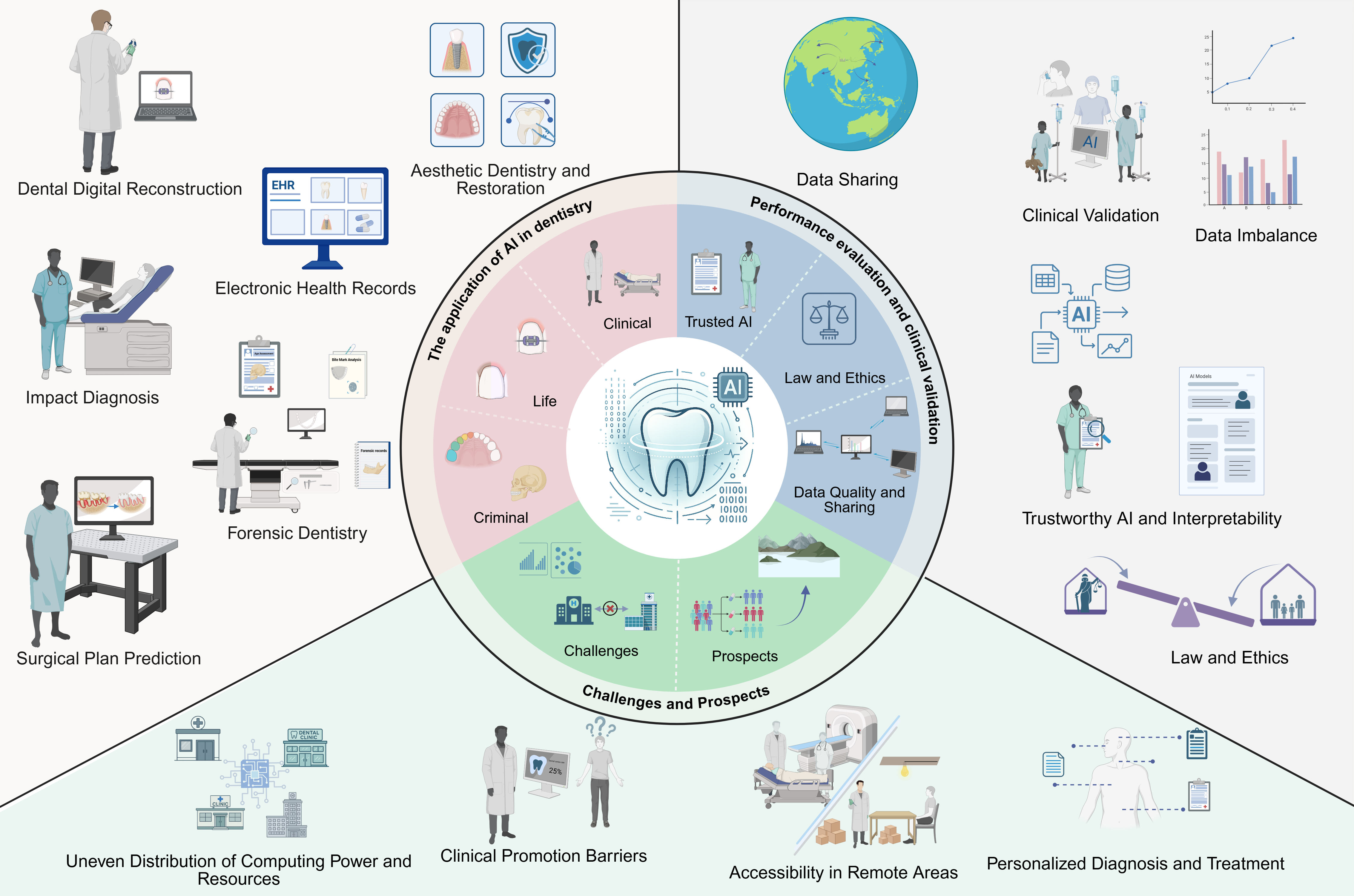
The emergence and development of artificial intelligence is rapidly promoting dental diagnosis and treatment from experience-driven to data-driven and accurate methods. With the help of AI models based on deep learning, AI has been widely used in dental fields such as oral radiology, orthodontics and maxillofacial surgery, periodontal disease and dental pulp, aesthetic restoration and so on. In addition, AI technology has also made great contributions in forensic dentistry and tele dentistry. The application of a technology can not only improve the limitations of traditional treatment methods, but also improve the accuracy of treatment of dental caries, periapical lesions, and other diseases. However, its clinical promotion is still limited by data imbalance and heterogeneity, privacy and security, lack of model interpretability and lack of standardized evaluation system. In the future, it is urgent to build high-quality multicenter data sets, introduce privacy computing technologies such as federal learning, and improve regulatory and human-computer collaboration specifications, so as to realize the safe and controllable application of AI in dentistry, and promote the overall transformation of oral medicine to prevention oriented, precision diagnosis and intelligent services.
- Open Access
- Review
AI-Enabled Dental Care
Author Information
Received: 10 Dec 2025 | Revised: 22 Jan 2026 | Accepted: 25 Feb 2026 | Published: 03 Mar 2026
Abstract
Graphical Abstract
Keywords
artificial intelligence | dentistry | stomatology | intelligent diagnosis and treatment | precision medicine
References
- 1.
Champa-Bujaico, E.; Díez-Pascual, A.M.; García-Díaz, P. Synthesis and Characterization of Polyhydroxyalkanoate/Graphene Oxide/Nanoclay Bionanocomposites: Experimental Results and Theoretical Predictions via Machine Learning Models. Biomolecules 2023, 13, 1192. https://doi.org/10.3390/biom13081192.
- 2.
Zhang, X.; Gu, Y.; Yin, J.; et al. Development, Reliability, and Structural Validity of the Scale for Knowledge, Attitude, and Practice in Ethics Implementation Among AI Researchers: Cross-Sectional Study. JMIR Form. Res. 2023, 7, e42202. https://doi.org/10.2196/42202.
- 3.
Kourounis, G.; Elmahmudi, A.A.; Thomson, B.; et al. Computer Image Analysis with Artificial Intelligence: A Practical Introduction to Convolutional Neural Networks for Medical Professionals. Postgrad. Med. J. 2023, 99, 1287–1294. https://doi.org/10.1093/postmj/qgad095.
- 4.
Singla, J.; Grover, D.; Bhandari, A. Medical expert systems for diagnosis of various diseases. Int. J. Comput. Appl. 2014, 93,
36–43. https://doi.org/10.5120/16230-5717. - 5.
Pauwels, R. A Brief Introduction to Concepts and Applications of Artificial Intelligence in Dental Imaging. Oral Radiol. 2021, 37, 153–160. https://doi.org/10.1007/s11282-020-00468-5.
- 6.
Goecks, J.; Jalili, V.; Heiser, L.M.; et al. How Machine Learning Will Transform Biomedicine. Cell 2020, 181, 92–101. https://doi.org/10.1016/j.cell.2020.03.022.
- 7.
Parvin, N.; Joo, S.W.; Jung, J.H.; et al. Multimodal AI in Biomedicine: Pioneering the Future of Biomaterials, Diagnostics, and Personalized Healthcare. Nanomaterials 2025, 15, 895. https://doi.org/10.3390/nano15120895.
- 8.
Li, Q.; Fan, Q.-L.; Han, Q.-X.; et al. Machine Learning in Nephrology: Scratching the Surface. Chin. Med. J. 2020, 133, 687–698. https://doi.org/doi:10.1097/CM9.0000000000000694.
- 9.
Dai, J.; Kim, M.-Y.; Sutton, R.T.; et al. Comparative Analysis of Natural Language Processing Methodologies for Classifying Computed Tomography Enterography Reports in Crohn’s Disease Patients. NPJ Digital Med. 2025, 8, 324. https://doi.org/10.1038/s41746-025-01729-5.
- 10.
Negi, S.; Mathur, A.; Tripathy, S.; et al. Artificial Intelligence in Dental Caries Diagnosis and Detection: An Umbrella Review. Clin. Exp. Dent. Res. 2024, 10, e70004. https://doi.org/10.1002/cre2.70004.
- 11.
Huang, Y.; Zhou, P.; Liu, S.; et al. Metabolome and Microbiome of Chronic Periapical Periodontitis in Permanent Anterior Teeth: A Pilot Study. BMC Oral Health 2021, 21, 599. https://doi.org/10.1186/s12903-021-01972-8.
- 12.
Prados-Privado, M.; García Villalón, J.; Martínez-Martínez, C.H.; et al. Dental Caries Diagnosis and Detection Using Neural Networks: A Systematic Review. J. Clin. Med. 2020, 9, 3579. https://doi.org/10.3390/jcm9113579.
- 13.
Lee, J.-H.; Kim, D.-H.; Jeong, S.-N.; et al. Detection and Diagnosis of Dental Caries Using a Deep Learning-Based Convolutional Neural Network Algorithm. J. Dent. 2018, 77, 106–111. https://doi.org/10.1016/j.jdent.2018.07.015.
- 14.
Zhang, K.; Wu, J.; Chen, H.; et al. An Effective Teeth Recognition Method Using Label Tree with Cascade Network Structure. Comput. Med. Imaging Graphics 2018, 68, 61–70. https://doi.org/10.1016/j.compmedimag.2018.07.001.
- 15.
Li, P.; Kong, D.; Tang, T.; et al. Orthodontic Treatment Planning Based on Artificial Neural Networks. Sci. Rep. 2019, 9, 2037. https://doi.org/10.1038/s41598-018-38439-w.
- 16.
Patcas, R.; Timofte, R.; Volokitin, A.; et al. Facial Attractiveness of Cleft Patients: A Direct Comparison Between Artificial-Intelligence-Based Scoring and Conventional Rater Groups. Eur. J. Orthod. 2019, 41, 428–433. https://doi.org/10.1093/ejo/cjz007.
- 17.
Schwendicke, F.; Elhennawy, K.; Paris, S.; et al. Deep Learning for Caries Lesion Detection in Near-Infrared Light Transillumination Images: A Pilot Study. J. Dent. 2020, 92, 103260. https://doi.org/10.1016/j.jdent.2019.103260.
- 18.
Kılıc, M.C.; Bayrakdar, I.S.; Çelik, Ö.; et al. Artificial Intelligence System for Automatic Deciduous Tooth Detection and Numbering in Panoramic Radiographs. Dentomaxillofacial Radiol. 2021, 50, 20200172. https://doi.org/10.1259/dmfr.20200172.
- 19.
Li, Y.; Cui, Z.; Mei, L.; et al. A Novel AI-Powered Radiographic Analysis Surpasses Specialists in Stage II–IV Periodontitis Detection: A Multicenter Diagnostic Study. npj Digital Med. 2025, 8, 691. https://doi.org/10.1038/s41746-025-02077-0.
- 20.
Maganur, P.C.; Vishwanathaiah, S.; Mashyakhy, M.; et al. Development of Artificial Intelligence Models for Tooth Numbering and Detection: A Systematic Review. Int. Dent. J. 2024, 74, 917–929. https://doi.org/10.1016/j.identj.2024.02.009.
- 21.
Ghorbani, Z.; Mirebeigi-Jamasbi, S.S.; Hassannia Dargah, M.; et al. A Novel Deep Learning-Based Model for Automated Tooth Detection and Numbering in Mixed and Permanent Dentition in Occlusal Photographs. BMC Oral Health 2025, 25, 455. https://doi.org/10.1186/s12903-025-06023-0.
- 22.
Ayyıldız, H.; Orhan, M.; Bilgir, E.; et al. Tooth Numbering with Polygonal Segmentation on Periapical Radiographs: An Artificial Intelligence Study. Clin. Oral Invest. 2024, 28, 610. https://doi.org/10.1007/s00784-024-05999-3.
- 23.
Khanagar, S.B.; Alfouzan, K.; Awawdeh, M.; et al. Performance of Artificial Intelligence Models Designed for Diagnosis, Treatment Planning and Predicting Prognosis of Orthognathic Surgery (OGS)—A Scoping Review. Appl. Sci. 2022, 12, 5581. https://doi.org/10.3390/app12115581.
- 24.
Sankar, H.; Alagarsamy, R.; Lal, B.; et al. Role of Artificial Intelligence in Treatment Planning and Outcome Prediction of Jaw Corrective Surgeries by Using 3-D Imaging: A Systematic Review. Oral Surg. Oral Med. Oral Pathol. Oral Radiol. 2025, 139, 299–310. https://doi.org/10.1016/j.oooo.2024.09.010.
- 25.
Khanagar, S.B.; Al-Ehaideb, A.; Vishwanathaiah, S.; et al. Scope and Performance of Artificial Intelligence Technology in Orthodontic Diagnosis, Treatment Planning, and Clinical Decision-Making—A Systematic Review. J. Dent. Sci. 2021, 16, 482–492. https://doi.org/10.1016/j.jds.2020.05.022.
- 26.
Albalawi, F.; Abalkhail, K.A. Trends and Application of Artificial Intelligence Technology in Orthodontic Diagnosis and Treatment Planning—A Review. Appl. Sci. 2022, 12, 11864. https://doi.org/10.3390/app122211864.
- 27.
Khanagar, S.B.; Alfouzan, K.; Awawdeh, M.; et al. Application and Performance of Artificial Intelligence Technology in Detection, Diagnosis and Prediction of Dental Caries (DC)—A Systematic Review. Diagnostics 2022, 12, 1083. https://doi.org/10.3390/diagnostics12051083.
- 28.
Tariq, A.; Nakhi, F.B.; Salah, F.; et al. Efficiency and Accuracy of Artificial Intelligence in the Radiographic Detection of Periodontal Bone Loss: A Systematic Review. Imaging Sci. Dent. 2023, 53, 193–198. https://doi.org/10.5624/isd.20230092.
- 29.
Alotaibi, G.; Awawdeh, M.; Farook, F.F.; et al. Artificial Intelligence (AI) Diagnostic Tools: Utilizing a Convolutional Neural Network (CNN) to Assess Periodontal Bone Level Radiographically—A Retrospective Study. BMC Oral Health 2022, 22, 399. https://doi.org/10.1186/s12903-022-02436-3.
- 30.
Uzun Saylan, B.C.; Baydar, O.; Yeşilova, E.; et al. Assessing the Effectiveness of Artificial Intelligence Models for Detecting Alveolar Bone Loss in Periodontal Disease: A Panoramic Radiograph Study. Diagnostics 2023, 13, 1800. https://doi.org/10.3390/diagnostics13101800.
- 31.
Anil, S.; Porwal, P.; Porwal, A. Transforming Dental Caries Diagnosis Through Artificial Intelligence-Based Techniques. Cureus 2023, 15, e41694. https://doi.org/10.7759/cureus.41694.
- 32.
Zheng, L.; Wang, H.; Mei, L.; et al. Artificial Intelligence in Digital Cariology: A New Tool for the Diagnosis of Deep Caries and Pulpitis Using Convolutional Neural Networks. Ann. Transl. Med. 2021, 9, 763. https://doi.org/10.21037/atm-21-119.
- 33.
Kurt-Bayrakdar, S.; Bayrakdar, İ.Ş.; Yavuz, M.B.; et al. Detection of Periodontal Bone Loss Patterns and Furcation Defects from Panoramic Radiographs Using Deep Learning Algorithm: A Retrospective Study. BMC Oral Health 2024, 24, 155. https://doi.org/10.1186/s12903-024-03896-5.
- 34.
Al-Khalifa, K.S.; Ahmed, W.M.; Azhari, A.A.; et al. The Use of Artificial Intelligence in Caries Detection: A Review. Bioengineering 2024, 11, 936. https://doi.org/10.3390/bioengineering11090936.
- 35.
Ahmed, W.M.; Azhari, A.A.; Fawaz, K.A.; et al. Artificial Intelligence in the Detection and Classification of Dental Caries. J. Prosthet. Dent. 2025, 133, 1326–1332. https://doi.org/10.1016/j.prosdent.2023.07.013.
- 36.
Justiawan; Wahjuningrum, D.A.; Hadi, R.P.; et al. Comparative Analysis of Color Matching System for Teeth Recognition Using Color Moment. Med. Devices Evid. Res. 2019, 12, 497–504. https://doi.org/10.2147/MDER.S224280.
- 37.
Awdaljan, M.W.; Roque, J.C.; Choi, J.; et al. Introducing a Novel Approach to Dental Color Reproduction Using AI Technology. J. Esthet. Restor. Dent. 2024, 36, 1623–1637. https://doi.org/10.1111/jerd.13300.
- 38.
Saleh, O.; Spies, B.C.; Brandenburg, L.S.; et al. Feasibility of Using Two Generative AI Models for Teeth Reconstruction. J. Dent. 2024, 151, 105410. https://doi.org/10.1016/j.jdent.2024.105410.
- 39.
Mohammad, N.; Ahmad, R.; Kurniawan, A.; et al. Applications of Contemporary Artificial Intelligence Technology in Forensic Odontology as Primary Forensic Identifier: A Scoping Review. Front. Artif. Intell. 2022, 5, 1049584. https://doi.org/10.3389/frai.2022.1049584.
- 40.
Khanagar, S.B.; Vishwanathaiah, S.; Naik, S.; et al. Application and Performance of Artificial Intelligence Technology in Forensic Odontology—A Systematic Review. Leg. Med. 2021, 48, 101826. https://doi.org/10.1016/j.legalmed.2020.101826.
- 41.
Mullankandy, S.; Mukherjee, S.; Ingole, B.S. Applications of AI in Electronic Health Records, Challenges, and Mitigation Strategies. In Proceedings of the 2024 International Conference on Computer and Applications (ICCA), Cairo, Egypt, 17–19 December 2024; pp. 1–7. https://doi.org/10.1109/ICCA62237.2024.10927863.
- 42.
Rahdar, M.; Esmaeili, H. Artificial Intelligence and Its Role in Electronic Patient Record. Hosp. Pract. Res. 2023, 8, 333–343. https://doi.org/10.30491/hpr.2024.454379.1424.
- 43.
Claman, D.; Sezgin, E. Artificial Intelligence in Dental Education: Opportunities and Challenges of Large Language Models and Multimodal Foundation Models. JMIR Med. Educ. 2024, 10, e52346. https://doi.org/10.2196/52346.
- 44.
Kavadella, A.; Dias da Silva, M.A.; Kaklamanos, E.G.; et al. Evaluation of ChatGPT’s Real-Life Implementation in Undergraduate Dental Education: Mixed Methods Study. JMIR Med. Educ. 2024, 10, e51344. https://doi.org/10.2196/51344.
- 45.
Semerci, Z.M.; Yardımcı, S. Empowering Modern Dentistry: The Impact of Artificial Intelligence on Patient Care and Clinical Decision Making. Diagnostics 2024, 14, 1260. https://doi.org/10.3390/diagnostics14121260.
- 46.
Thorat, V.; Rao, P.; Joshi, N.; et al. Role of Artificial Intelligence (AI) in Patient Education and Communication in Dentistry. Cureus 2024, 16, e59799. https://doi.org/10.7759/cureus.59799.
- 47.
Ghods, K.; Azizi, A.; Jafari, A.; et al. Application of Artificial Intelligence in Clinical Dentistry, a Comprehensive Review of Literature. J. Dent. 2023, 24, 356–371. https://doi.org/10.30476/dentjods.2023.96835.1969.
- 48.
Boldt, J.; Schuster, M.; Krastl, G.; et al. Developing the Benchmark: Establishing a Gold Standard for the Evaluation of AI Caries Diagnostics. J. Clin. Med. 2024, 13, 3846. https://doi.org/10.3390/jcm13133846.
- 49.
Yoon, K.; Jeong, H.-M.; Kim, J.-W.; et al. AI-Based Dental Caries and Tooth Number Detection in Intraoral Photos: Model Development and Performance Evaluation. J. Dent. 2024, 141, 104821. https://doi.org/10.1016/j.jdent.2023.104821.
- 50.
Szabó, V.; Szabó, B.T.; Orhan, K.; et al. Validation of Artificial Intelligence Application for Dental Caries Diagnosis on Intraoral Bitewing and Periapical Radiographs. J. Dent. 2024, 147, 105105. https://doi.org/10.1016/j.jdent.2024.105105.
- 51.
Sadegh-Zadeh, S.; Bagheri, M. Harnessing the Power of Clinical Data in Dentistry: Importance and Guidelines for Dentists in AI Modelling for Enhanced Patient Care. Open J. Clin. Med. Images 2024, 4, 1188.
- 52.
Schwendicke, F.; Krois, J. Data Dentistry: How Data Are Changing Clinical Care and Research. J. Dent. Res. 2022, 101, 21–29. https://doi.org/10.1177/00220345211020265.
- 53.
Tuygunov, N.; Samaranayake, L.; Khurshid, Z.; et al. The Transformative Role of Artificial Intelligence in Dentistry: A Comprehensive Overview Part 2: The Promise and Perils, and the International Dental Federation Communique. Int. Dent. J. 2025, 75, 397–404. https://doi.org/10.1016/j.identj.2025.02.006.
- 54.
Ali, M.A. The Role of Artificial Intelligence in Modern Dentistry: Applications, Challenges, and Future Directions. Future Dent. Res. 2024, 2, 39–49. https://doi.org/10.57238/fdr.2024.152576.1012.
- 55.
Schwendicke, F.; Samek, W.; Krois, J. Artificial Intelligence in Dentistry: Chances and Challenges. J. Dent. Res. 2020, 99, 769–774. https://doi.org/10.1177/0022034520915714.
- 56.
Khera, R.; Simon, M.A.; Ross, J.S. Automation Bias and Assistive AI: Risk of Harm From AI-Driven Clinical Decision Support. JAMA 2023, 330, 2255–2257. https://doi.org/10.1001/jama.2023.22557.
- 57.
Mehta, N.; Born, K.; Fine, B. How Artificial Intelligence Can Help Us ’Choose Wisely’. Bioelectron. Med. 2021, 7, 5. https://doi.org/10.1186/s42234-021-00066-8.
- 58.
Komorowski, M.; Celi, L.A. Will Artificial Intelligence Contribute to Overuse in Healthcare? Crit. Care Med. 2017, 45, 912–913. https://doi.org/10.1097/ccm.0000000000002351.
- 59.
Mahesh Batra, A.; Reche, A. A New Era of Dental Care: Harnessing Artificial Intelligence for Better Diagnosis and Treatment. Cureus 2023, 15, e49319. https://doi.org/10.7759/cureus.49319.

This work is licensed under a Creative Commons Attribution 4.0 International License.

 Suite 4002 Level 4, 447 Collins Street, Melbourne, Victoria 3000, Australia
 General Inquiries: info@sciltp.com