
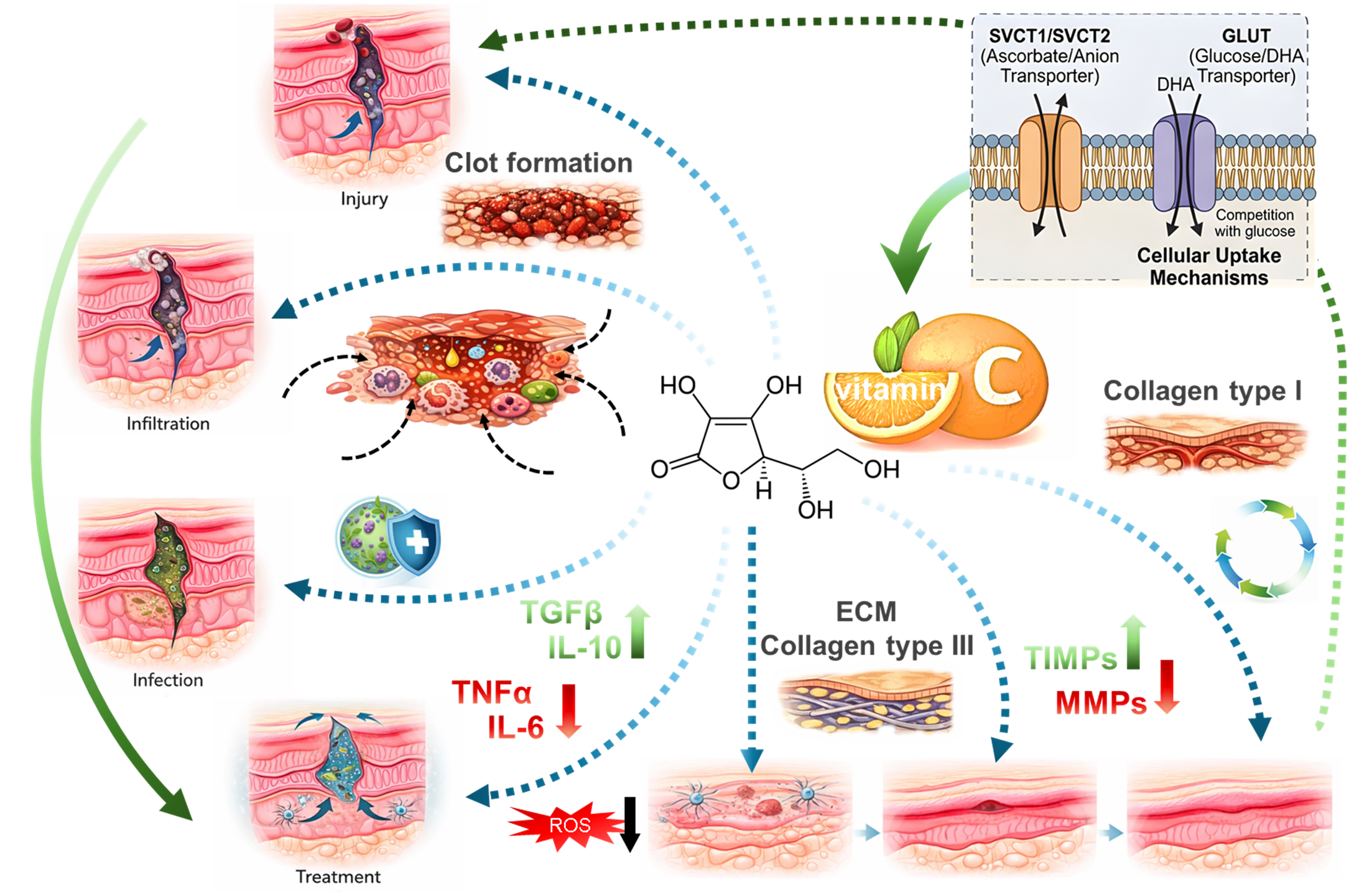
Skin ulcers remain a major cause of morbidity worldwide, affecting millions and burdening healthcare systems with prolonged hospitalisation. Conventional wound therapies rarely achieve full regeneration because the biochemical imbalances that sustain inflammation, oxidative stress and poor collagen deposition remain uncorrected. Among essential nutrients, vitamin C (L-ascorbic acid) has emerged as a decisive molecular regulator of cutaneous repair. Acting as a cofactor for collagen synthesis, vitamin C governs matrix synthesis, promotes angiogenic signalling and maintains immune–redox balance within the ulcer microenvironment. Accumulating evidence demonstrate direct control of cellular metabolism and gene expression by vitamin C through modulation of prolyl hydroxylases, hypoxia-inducible factor-1α, and NF-κB pathways, thus modulating fibroblast proliferation, keratinocyte differentiation, and vascular maturation. It also suppresses pathogen-driven oxidative injury, reinforcing host defence in infected ulcers. This review consolidates biochemical and clinical data to define vitamin C as a clinical modulator of chronic wound healing rather than a supportive micronutrient. The discussion connects mechanistic findings to outcomes from topical and systemic supplementation trials, highlighting how optimised vitamin C delivery can accelerate tissue regeneration and reduce infection risk. Collectively, the evidence establishes vitamin C as a practical, low-cost adjunct capable of bridging nutritional intervention and regenerative medicine for effective ulcer management.
- Open Access
- Review
Revisiting the Regenerative Role of Vitamin C in Skin Ulcer Repair—Mechanistic Insights and Therapeutic Roles
Author Information
Received: 06 Feb 2026 | Revised: 14 Apr 2026 | Accepted: 13 May 2026 | Published: 02 Jul 2026
Abstract
Graphical Abstract
Keywords
Vitamin C | L-ascorbic acid | chronic wound healing | ulcer | collagen | skin regeneration
References
- 1.
Gröne, A. Keratinocytes and cytokines. Vet. Immunol. Immunopathol. 2002, 88, 1–12. https://doi.org/10.1016/S0165-2427(02)00136-8.
- 2.
Patton, K.T.; Bell, F.B.; Thompson, T.; et al. Anatomy & Physiology with Brief Atlas of the Human Body and Quick Guide to the Language of Science and Medicine-E-Book; Elsevier Health Sciences: Amsterdam, The Netherlands, 2022.
- 3.
Marks, R. The stratum corneum barrier: The final frontier. J. Nutr. 2004, 134, 2017S–2021S.
- 4.
Smith, L.T.; Holbrook, K.A.; Madri, J.A. Collagen types I, III, and V in human embryonic and fetal skin. Am. J. Anat. 1986, 175, 507–521.
- 5.
Taherzadeh, O.; Otto, W.R.; Anand, U.; et al. Influence of human skin injury on regeneration of sensory neurons. Cell Tissue Res. 2003, 312, 275–280.
- 6.
Schulze, E.; Witt, M.; Fink, T.; et al. Immunohistochemical detection of human skin nerve fibers. Acta Histochem. 1997, 99, 301–309.
- 7.
Breitkreutz, D.; Koxholt, I.; Thiemann, K.; et al. Skin basement membrane: The foundation of epidermal integrity—BM functions and diverse roles of bridging molecules nidogen and perlecan. BioMed Res. Int. 2013, 2013, 179784.
- 8.
Wang, W.; Lu, K.-j.; Yu, C.-h.; et al. Nano-drug delivery systems in wound treatment and skin regeneration. J. Nanobiotechnology 2019, 17, 82.
- 9.
Rezaie, F.; Momeni-Moghaddam, M.; Naderi-Meshkin, H. Regeneration and repair of skin wounds: Various strategies for treatment. Int. J. Low. Extrem. Wounds 2019, 18, 247–261.
- 10.
Whitney, J.D. Overview: Acute and chronic wounds. Nurs. Clin. 2005, 40, 191–205.
- 11.
Nicks, B.A.; Ayello, E.A.; Woo, K.; et al. Acute wound management: Revisiting the approach to assessment, irrigation, and closure considerations. Int. J. Emerg. Med. 2010, 3, 399–407. https://doi.org/10.1007/s12245-010-0217-5.
- 12.
Järbrink, K.; Ni, G.; Sönnergren, H.; et al. Prevalence and incidence of chronic wounds and related complications: A protocol for a systematic review. Syst. Rev. 2016, 5, 1–6.
- 13.
Nussbaum, S.R.; Carter, M.J.; Fife, C.E.; et al. An economic evaluation of the impact, cost, and medicare policy implications of chronic nonhealing wounds. Value Health 2018, 21, 27–32.
- 14.
Armstrong, D.G.; Boulton, A.J.M.; Bus, S.A. Diabetic foot ulcers and their recurrence. N. Engl. J. Med. 2017, 376, 2367–2375.
- 15.
White-Chu, E.F.; Conner-Kerr, T.A. Overview of guidelines for the prevention and treatment of venous leg ulcers: A US perspective. J. Multidiscip. Healthc. 2014, 7, 111–117.
- 16.
Posnett, J.; Gottrup, F.; Lundgren, H.; et al. The resource impact of wounds on health-care providers in Europe. J. Wound Care 2009, 18, 154.
- 17.
Frech, T.M.; Frech, M.; Saknite, I.; et al. Novel therapies and innovation for systemic sclerosis skin ulceration. Best. Pract. Res. Clin. Rheumatol. 2022, 36, 101813.
- 18.
Colenci, R.; Abbade, L.P.F. Fundamental aspects of the local approach to cutaneous ulcers. An. Bras. De Dermatol. 2018, 93, 859–870.
- 19.
Ren, S.-Y.; Liu, Y.-S.; Zhu, G.-J.; et al. Strategies and challenges in the treatment of chronic venous leg ulcers. World J. Clin. Cases 2020, 8, 5070.
- 20.
Maduba, C.C.; Nnadozie, U.U.; Modekwe, V.I.; et al. Split Skin Graft Take in Leg Ulcers: Conventional Dressing Versus Locally Adapted Negative Pressure Dressing. J. Surg. Res. 2020, 251, 296–302. https://doi.org/10.1016/j.jss.2020.01.029.
- 21.
Shi, C.; Wang, C.; Liu, H.; et al. Selection of appropriate wound dressing for various wounds. Front. Bioeng. Biotechnol. 2020, 8, 182.
- 22.
Richy, F.; Scarpignato, C.; Lanas, A.; et al. Efficacy and safety of piroxicam revisited. A global meta-analysis of randomised clinical trials. Pharmacol. Res. 2009, 60, 254–263. https://doi.org/10.1016/j.phrs.2009.03.021.
- 23.
Bagheri, H.; Lhiaubet, V.; Montastruc, J.L.; et al. Photosensitivity to ketoprofen: Mechanisms and pharmacoepidemiological data. Drug Saf. 2000, 22, 339–349. https://doi.org/10.2165/00002018-200022050-00002.
- 24.
Bryant, A.E.; Bayer, C.R.; Aldape, M.J.; et al. The roles of injury and nonsteroidal anti-inflammatory drugs in the development and outcomes of severe group A streptococcal soft tissue infections. Curr. Opin. Infect. Dis. 2015, 28, 231–239. https://doi.org/10.1097/QCO.0000000000000160.
- 25.
Ward, K.E.; Archambault, R.; Mersfelder, T.L. Severe adverse skin reactions to nonsteroidal antiinflammatory drugs: A review of the literature. Am. J. Health Syst. Pharm. 2010, 67, 206–213. https://doi.org/10.2146/ajhp080603.
- 26.
Sánchez-Borges, M.; Capriles-Hulett, A.; Caballero-Fonseca, F. Risk of skin reactions when using ibuprofen-based medicines. Expert. Opin. Drug Saf. 2005, 4, 837–848. https://doi.org/10.1517/14740338.4.5.837.
- 27.
Zaver, V.; Kankanalu, P. Negative Pressure Wound Therapy. StatPearls: Treasure Island, FL, USA, 2024.
- 28.
Kaye, A.D.; Islam, R.K.; Tong, V.T.; et al. Cutaneous Dermatologic Manifestations of Cardiovascular Diseases: A Narrative Review. Cureus 2024, 16, e72336.
- 29.
Grey, J.E.; Harding, K.G.; Enoch, S. Venous and arterial leg ulcers. ABC Wound Heal. 2022, 163, 34.
- 30.
Bánvölgyi, A.; Görög, A.; Gadó, K.; et al. Chronic wounds in the elderly: Decubitus, leg ulcers, and ulcers of rare aetiology. Dev. Health Sci. 2022, 4, 81–85.
- 31.
Zhang, X.; Zhu, N.; Li, Z.; et al. The global burden of decubitus ulcers from 1990 to 2019. Sci. Rep. 2021, 11, 21750.
- 32.
Foyer, C.H. Ascorbic acid. In Antioxidants in Higher Plants; CRC Press: Boca Raton, FL, USA, 2017; pp. 31–58.
- 33.
Fuquay, J.W.; McSweeney, P.L.H.; Fox, P.F. Encyclopedia of Dairy Sciences; Academic Press: Cambridge, MA, USA, 2011.
- 34.
Carr, A.C.; Vissers, M.C.M. Synthetic or food-derived vitamin C—Are they equally bioavailable? Nutrients 2013, 5, 4284–4304.
- 35.
Robert Li, Y. Vitamin C in Health and Disease: From Redox Biology to Clinical Medicine. In Hydrophilic Vitamins in Health and Disease; Springer: Berlin/Heidelberg, Germany, 2024; pp. 341–355.
- 36.
Gopi, S.; Balakrishnan, P. Evaluation and clinical comparison studies on liposomal and non-liposomal ascorbic acid (vitamin C) and their enhanced bioavailability. J. Liposome Res. 2021, 31, 356–364.
- 37.
Łukawski, M.; Dałek, P.; Borowik, T.; et al. New oral liposomal vitamin C formulation: Properties and bioavailability. J. Liposome Res. 2020, 30, 227–234.
- 38.
Asaikkutti, A.; Vimala, K.; Jha, N.; et al. Effect of dietary supplementation of vitamin C-loaded chitosan nanoparticles on growth, immune-physiological parameters, and resistance of white shrimp Litopenaeus vannamei to Vibrio harveyi challenge. Anim. Feed. Sci. Technol. 2023, 305, 115764.
- 39.
Liu, C.; Li, J.; Wang, C.; et al. Fabrication of crosslinked starch microspheres via water-in-water Pickering emulsion and their application in controlled release of Vitamin C. J. Dispers. Sci. Technol. 2024, 1–13.
- 40.
Shabana, S.; Prasansha, R.; Kalinina, I.; et al. Ultrasound assisted acid hydrolyzed structure modification and loading of antioxidants on potato starch nanoparticles. Ultrason. Sonochemistry 2019, 51, 444–450.
- 41.
Zhou, X.-y.; Yu, J.-h.; Yu, H. Effect of gelatin content and oral processing ability on vitamin C release in gummy jelly. J. Food Sci. Technol. 2022, 59, 677–685.
- 42.
Layton, A.T. Mathematical modeling of kidney transport. Wiley Interdiscip. Rev. Syst. Biol. Med. 2013, 5, 557–573.
- 43.
Chisholm-Burns, M.A.; Schwinghammer, T.L.; Malone, P.M.; et al. Pharmacotherapy Principles & Practice, 5th ed.; Mcgraw-Hill Education: Columbus, OH, USA, 2019.
- 44.
Krautheim, A.; Gollnick, H.P.M. Acne: Topical treatment. Clin. Dermatol. 2004, 22, 398–407.
- 45.
Cullen, J.K.; Simmons, J.L.; Parsons, P.G.; et al. Topical treatments for skin cancer. Adv. Drug Deliv. Rev. 2020, 153, 54–64.
- 46.
González-Molina, V.; Martí-Pineda, A.; González, N. Topical treatments for melasma and their mechanism of action. J. Clin. Aesthetic Dermatol. 2022, 15, 19.
- 47.
Tomita, K.; Hosokawa, K.; Yano, K.; et al. Dermal vascularity of the auricle: Implications for novel composite grafts. J. Plast. Reconstr. Aesthetic Surg. 2009, 62, 1609–1615.
- 48.
Premjit, Y.; Pandey, S.; Mitra, J. Recent trends in folic acid (vitamin B9) encapsulation, controlled release, and mathematical modelling. Food Rev. Int. 2023, 39, 5528–5562.
- 49.
Chand, T.; Savitri, B. Vitamin B3, niacin. Ind. Biotechnol. Vitam. Biopigments Antioxid. 2016, 41–65.
- 50.
Coerdt, K.M.; Goggins, C.A.; Khachemoune, A. Vitamins A, B, C, and D: A short review for the dermatologist. Altern. Ther. Health Med. 2021, 27, 41–48.
- 51.
Moll, R.; Davis, B. Iron, vitamin B12 and folate. Medicine 2017, 45, 198–203.
- 52.
Calderón‐Ospina, C.A.; Nava‐Mesa, M.O. B Vitamins in the nervous system: Current knowledge of the biochemical modes of action and synergies of thiamine, pyridoxine, and cobalamin. CNS Neurosci. Ther. 2020, 26, 5–13.
- 53.
Di Salvo, M.L.; Contestabile, R.; Safo, M.K. Vitamin B6 salvage enzymes: Mechanism, structure and regulation. Biochim. Et. Biophys. Acta (BBA)-Proteins Proteom. 2011, 1814, 1597–1608.
- 54.
Khan, N.A.; Auranen, M.; Paetau, I.; et al. Effective treatment of mitochondrial myopathy by nicotinamide riboside, a vitamin B 3. EMBO Mol. Med. 2014, 6, 721–731.
- 55.
Bostancı, N.S.; Büyüksungur, S.; Hasirci, N.; et al. Bioprinted scaffolds assembled as synthetic skin grafts by natural hydrogels containing fibroblasts and bioactive agents. Int. J. Polym. Mater. Polym. Biomater. 2024, 73, 927–945.
- 56.
Fan, L.; Wang, H.; Zhang, K.; et al. Vitamin C-reinforcing silk fibroin nanofibrous matrices for skin care application. Rsc Adv. 2012, 2, 4110–4119.
- 57.
Khaloo Kermani, P.; Zargar Kharazi, A. A promising antibacterial wound dressing made of electrospun poly (glycerol sebacate)(PGS)/gelatin with local delivery of ascorbic acid and pantothenic acid. J. Polym. Environ. 2023, 31, 2504–2518.
- 58.
Esmaeilzadeh, J.; Shabani, F.; Zak, A.K. Electrospun poly (ɛ-caprolactone)/gelatin nanofibrous mats with local delivery of vitamin C for wound healing applications. Colloids Surf. A Physicochem. Eng. Asp. 2024, 687, 133546.
- 59.
Fiorentini, F.; Suarato, G.; Summa, M.; et al. Plant-Based, hydrogel-like microfibers as an antioxidant platform for skin burn Healing. ACS Appl. Bio Mater. 2023, 6, 3103–3116.
- 60.
Zhou, W.; Liu, W.; Zou, L.; et al. Storage stability and skin permeation of vitamin C liposomes improved by pectin coating. Colloids Surf. B Biointerfaces 2014, 117, 330–337.
- 61.
Jain, A.; Garg, N.K.; Jain, A.; et al. A synergistic approach of adapalene-loaded nanostructured lipid carriers, and vitamin C co-administration for treating acne. Drug Dev. Ind. Pharm. 2016, 42, 897–905.
- 62.
Duarah, S.; Durai, R.D.; Narayanan, V.B. Nanoparticle-in-gel system for delivery of vitamin C for topical application. Drug Deliv. Transl. Res. 2017, 7, 750–760.
- 63.
Rozman, B.; Zvonar, A.; Falson, F.; et al. Temperature-sensitive microemulsion gel: An effective topical delivery system for simultaneous delivery of vitamins C and E. AAPS PharmSciTech 2009, 10, 54–61.
- 64.
Kenawy, E.-R.; El-Meligy, M.A.; Ghaly, Z.S.; et al. Novel Physically-Crosslinked Caffeine and Vitamin C-Loaded PVA/Aloe Vera Hydrogel Membranes for Topical Wound Healing: Synthesis, Characterization and In-Vivo Wound Healing Tests. J. Polym. Environ. 2024, 32, 2140–2157.
- 65.
Starr, N.J.; Hamid, K.A.; Wibawa, J.; et al. Enhanced vitamin C skin permeation from supramolecular hydrogels, illustrated using in situ ToF-SIMS 3D chemical profiling. Int. J. Pharm. 2019, 563, 21–29.
- 66.
Steiling, H.; Longet, K.; Moodycliffe, A.; et al. Sodium-dependent vitamin C transporter isoforms in skin: Distribution, kinetics, and effect of UVB-induced oxidative stress. Free Radic. Biol. Med. 2007, 43, 752–762.
- 67.
Hong, C.-K.; Choe, S.-W.; Chun, B.-H.; et al. Expression of Sodium-dependent Vitamin C Transporter in Rat Dermal Fibroblasts. Korean J. Dermatol. 2004, 435–442.
- 68.
Lauer, A.-C.; Groth, N.; Haag, S.F.; et al. Dose-dependent vitamin C uptake and radical scavenging activity in human skin measured with in vivo electron paramagnetic resonance spectroscopy. Ski. Pharmacol. Physiol. 2013, 26, 147–154.
- 69.
Savini, I.; Rossi, A.; Pierro, C.; et al. SVCT1 and SVCT2: Key proteins for vitamin C uptake. Amino Acids 2008, 34, 347–355.
- 70.
Kobayashi, T.A.; Shimada, H.; Sano, F.K.; et al. Dimeric transport mechanism of human vitamin C transporter SVCT1. Nat. Commun. 2024, 15, 5569.
- 71.
Malik, A.; Bagchi, A.K.; Vinayak, K.; et al. Vitamin C: Historical perspectives and heart failure. Heart Fail. Rev. 2021, 26, 699–709.
- 72.
Luo, S.; Wang, Z.; Kansara, V.; et al. Activity of a sodium-dependent vitamin C transporter (SVCT) in MDCK-MDR1 cells and mechanism of ascorbate uptake. Int. J. Pharm. 2008, 358, 168–176.
- 73.
Gao, Y.; Xu, Y.; Bai, F.; et al. Factors that influence the Na/K-ATPase signaling and function. Front. Pharmacol. 2025, 16, 1639859.
- 74.
Foyer, C.H.; Noctor, G. Ascorbate and glutathione: The heart of the redox hub. Plant Physiol. 2011, 155, 2–18.
- 75.
Chadt, A.; Al-Hasani, H. Glucose transporters in adipose tissue, liver, and skeletal muscle in metabolic health and disease. Pflügers Arch. -Eur. J. Physiol. 2020, 472, 1273–1298.
- 76.
Custódio, T.F.; Paulsen, P.A.; Frain, K.M.; et al. Structural comparison of GLUT1 to GLUT3 reveal transport regulation mechanism in sugar porter family. Life Sci. Alliance 2021, 4.
- 77.
Stanirowski, P.J.; Szukiewicz, D.; Majewska, A.; et al. Differential expression of glucose transporter proteins GLUT-1, GLUT-3, GLUT-8 and GLUT-12 in the placenta of macrosomic, small-for-gestational-age and growth-restricted foetuses. J. Clin. Med. 2021, 10, 5833.
- 78.
Schmidt, S.; Joost, H.-G.; Schurmann, A. GLUT8, the enigmatic intracellular hexose transporter. Am. J. Physiol. -Endocrinol. Metab. 2009, 296, E614–E618.
- 79.
Mardones, L.; Ormazabal, V.; Romo, X.; et al. The glucose transporter-2 (GLUT2) is a low affinity dehydroascorbic acid transporter. Biochem. Biophys. Res. Commun. 2011, 410, 7–12.
- 80.
van Gerwen, J.; Shun-Shion, A.S.; Fazakerley, D.J. Insulin signalling and GLUT4 trafficking in insulin resistance. Biochem. Soc. Trans. 2023, 51, 1057–1069.
- 81.
Rumsey, S.C.; Kwon, O.; Xu, G.W.; et al. Glucose transporter isoforms GLUT1 and GLUT3 transport dehydroascorbic acid. J. Biol. Chem. 1997, 272, 18982–18989.
- 82.
Corpe, C.P.; Eck, P.; Wang, J.; et al. Intestinal dehydroascorbic acid (DHA) transport mediated by the facilitative sugar transporters, GLUT2 and GLUT8. J. Biol. Chem. 2013, 288, 9092–9101.
- 83.
Peng, W.; Tan, C.; Mo, L.; et al. Glucose transporter 3 in neuronal glucose metabolism: Health and diseases. Metabolism 2021, 123, 154869.
- 84.
Montel-Hagen, A.; Kinet, S.; Manel, N.; et al. Erythrocyte Glut1 triggers dehydroascorbic acid uptake in mammals unable to synthesize vitamin C. Cell 2008, 132, 1039–1048.
- 85.
Zhang, Z.; Zi, Z.; Lee, E.E.; et al. Differential glucose requirement in skin homeostasis and injury identifies a therapeutic target for psoriasis. Nat. Med. 2018, 24, 617–627.
- 86.
Yu, D.-M.; Zhao, J.; Lee, E.E.; et al. GLUT3 promotes macrophage signaling and function via RAS-mediated endocytosis in atopic dermatitis and wound healing. J. Clin. Investig. 2023, 133.
- 87.
Cibrian, D.; de la Fuente, H.; Sánchez-Madrid, F. Metabolic pathways that control skin homeostasis and inflammation. Trends Mol. Med. 2020, 26, 975–986.
- 88.
Shen, S.; Sampson, S.R.; Tennenbaum, T.; et al. Characterization of glucose transport system in keratinocytes: Insulin and IGF-1 differentially affect specific transporters. J. Investig. Dermatol. 2000, 115, 949–954.
- 89.
Masin, M.; Vazquez, J.; Rossi, S.; et al. GLUT3 is induced during epithelial-mesenchymal transition and promotes tumor cell proliferation in non-small cell lung cancer. Cancer Metab. 2014, 2, 1–14.
- 90.
Cornwell, A.; Ziółkowski, H.; Badiei, A. Glucose transporter glut1-dependent metabolic reprogramming regulates lipopolysaccharide-induced inflammation in RAW264. 7 macrophages. Biomolecules 2023, 13, 770.
- 91.
Wood, I.S.; Wang, B.; Lorente-Cebrián, S.; et al. Hypoxia increases expression of selective facilitative glucose transporters (GLUT) and 2-deoxy-D-glucose uptake in human adipocytes. Biochem. Biophys. Res. Commun. 2007, 361, 468–473.
- 92.
Mamun, A.A.; Hayashi, H.; Yamamura, A.; et al. Hypoxia induces the translocation of glucose transporter 1 to the plasma membrane in vascular endothelial cells. J. Physiol. Sci. 2020, 70, 44.
- 93.
Ballaz, S.J.; Rebec, G.V. Neurobiology of vitamin C: Expanding the focus from antioxidant to endogenous neuromodulator. Pharmacol. Res. 2019, 146, 104321.
- 94.
Travica, N.; Ried, K.; Sali, A.; et al. Vitamin C status and cognitive function: A systematic review. Nutrients 2017, 9, 960.
- 95.
Patak, P.; Willenberg, H.S.; Bornstein, S.R. Vitamin C is an important cofactor for both adrenal cortex and adrenal medulla. Endocr. Res. 2004, 30, 871–875.
- 96.
Awadalla, E.A. Efficacy of vitamin C against liver and kidney damage induced by paraquat toxicity. Exp. Toxicol. Pathol. 2012, 64, 431–434.
- 97.
Lykkesfeldt, J.; Tveden-Nyborg, P. The pharmacokinetics of vitamin C. Nutrients 2019, 11, 2412.
- 98.
Hasselholt, S.; Tveden-Nyborg, P.; Lykkesfeldt, J. Distribution of vitamin C is tissue specific with early saturation of the brain and adrenal glands following differential oral dose regimens in guinea pigs. Br. J. Nutr. 2015, 113, 1539–1549.
- 99.
Salazar, K.; Espinoza, F.; Cerda-Gallardo, G.; et al. SVCT2 overexpression and ascorbic acid uptake increase cortical neuron differentiation, which is dependent on vitamin c recycling between neurons and astrocytes. Antioxidants 2021, 10, 1413.
- 100.
Salazar, K.; Jara, N.; Ramírez, E.; et al. Role of vitamin C and SVCT2 in neurogenesis. Front. Neurosci. 2023, 17, 1155758.
- 101.
Mason, S.A.; Baptista, R.; Della Gatta, P.A.; et al. High-dose vitamin C supplementation increases skeletal muscle vitamin C concentration and SVCT2 transporter expression but does not alter redox status in healthy males. Free Radic. Biol. Med. 2014, 77, 130–138.
- 102.
Chen, P.; Reed, G.; Jiang, J.; et al. Pharmacokinetic Evaluation of Intravenous Vitamin C: A Classic Pharmacokinetic Study: P. Chen et al. Clin. Pharmacokinet. 2022, 61, 1237–1249.
- 103.
Tveden-Nyborg, P. Vitamin C deficiency in the young brain—Findings from experimental animal models. Nutrients 2021, 13, 1685.
- 104.
Wang, K.; Jiang, H.; Li, W.; et al. Role of vitamin C in skin diseases. Front. Physiol. 2018, 9, 378515.
- 105.
Weber, S.U.; Thiele, J.J.; Packer, L.; et al. Vitamin C, uric acid, and glutathione gradients in murine stratum corneum and their susceptibility to ozone exposure. J. Investig. Dermatol. 1999, 113, 1128–1132.
- 106.
Susa, F.; Pisano, R. Advances in ascorbic Acid (vitamin C) manufacturing: Green extraction techniques from natural sources. Processes 2023, 11, 3167.
- 107.
Pullar, J.M.; Carr, A.C.; Vissers, M. The roles of vitamin C in skin health. Nutrients 2017, 9, 866.
- 108.
Carr, A.C.; Rowe, S. Factors affecting vitamin C status and prevalence of deficiency: A global health perspective. Nutrients 2020, 12, 1963.
- 109.
Rhie, G.-e.; Shin, M.H.; Seo, J.Y.; et al. Aging-and photoaging-dependent changes of enzymic and nonenzymic antioxidants in the epidermis and dermis of human skin in vivo. J. Investig. Dermatol. 2001, 117, 1212–1217.
- 110.
Sauermann, K.; Jaspers, S.; Koop, U.; et al. Topically applied vitamin C increases the density of dermal papillae in aged human skin. BMC Dermatol. 2004, 4, 1–6.
- 111.
Schmitt, J.; Apfelbacher, C.J.; Flohr, C. Eczema. BMJ Clin. Evid. 2011, 2011.
- 112.
Kanda, N.; Hoashi, T.; Saeki, H. Nutrition and psoriasis. Int. J. Mol. Sci. 2020, 21, 5405.
- 113.
Will, J.C.; Byers, T. Does diabetes mellitus increase the requirement for vitamin C? Nutr. Rev. 1996, 54, 193–202.
- 114.
Short, B.; Bakri, A.; Baz, A.; et al. There is more to wounds than bacteria: Fungal biofilms in chronic wounds. Curr. Clin. Microbiol. Rep. 2023, 10, 9–16.
- 115.
Radzieta, M.; Sadeghpour-Heravi, F.; Peters, T.J.; et al. A multiomics approach to identify host-microbe alterations associated with infection severity in diabetic foot infections: A pilot study. NPJ Biofilms Microbiomes 2021, 7, 29.
- 116.
Durand, B.A.R.N.; Pouget, C.; Magnan, C.; et al. Bacterial interactions in the context of chronic wound biofilm: A review. Microorganisms 2022, 10, 1500.
- 117.
Percival, S.L.; McCarty, S.M.; Lipsky, B. Biofilms and wounds: An overview of the evidence. Adv. Wound Care 2015, 4, 373–381.
- 118.
Rahim, K.; Saleha, S.; Zhu, X.; et al. Bacterial contribution in chronicity of wounds. Microb. Ecol. 2017, 73, 710–721.
- 119.
Portugal, C.C. Ascorbate and its transporter SVCT2: The dynamic duo's integrated roles in CNS neurobiology and pathophysiology. Free Radic. Biol. Med. 2024, 212, 448–462.
- 120.
Subramanian, V.S.; Teafatiller, T.; Agrawal, A.; et al. Effect of lipopolysaccharide and TNFα on neuronal ascorbic acid uptake. Mediat. Inflamm. 2021, 2021, 4157132.
- 121.
Sun, L.; Yang, X.; Yuan, Z.; et al. Metabolic reprogramming in immune response and tissue inflammation. Arterioscler. Thromb. Vasc. Biol. 2020, 40, 1990–2001.
- 122.
Darweesh, M.; Mohammadi, S.; Rahmati, M.; et al. Metabolic reprogramming in viral infections: The interplay of glucose metabolism and immune responses. Front. Immunol. 2025, 16, 1578202.
- 123.
Marino, A.L.; Rex, T.S.; Harrison, F.E. Modulation of microglia activation by the ascorbic acid transporter SVCT2. Brain Behav. Immun. 2024, 120, 557–570.
- 124.
Wilson, J.X. Mechanism of action of vitamin C in sepsis: Ascorbate modulates redox signaling in endothelium. Biofactors 2009, 35, 5–13.
- 125.
Roy, S.; Santra, S.; Das, A.; et al. Staphylococcus aureus biofilm infection compromises wound healing by causing deficiencies in granulation tissue collagen. Ann. Surg. 2020, 271, 1174–1185.
- 126.
Aburawi, S.M.; Doro, B.M.; Awad, E.A. Effect of ciprofloxacin on S. aureus and E. coli growth in presence of vitamin C using cup cut diffusion method. J. Pharm. Pharmacol. 2019, 7, 473–484.
- 127.
Masadeh, M.M.; Mhaidat, N.M.; Alzoubi, K.H.; et al. Ciprofloxacin-induced antibacterial activity is reversed by vitamin E and vitamin C. Curr. Microbiol. 2012, 64, 457–462.
- 128.
Masadeh, M.M.; Alzoubi, K.H.; Al-Azzam, S.I.; et al. Ciprofloxacin-induced antibacterial activity is atteneuated by pretreatment with antioxidant agents. Pathogens 2016, 5, 28.
- 129.
Golonka, I.; Oleksy, M.; Junka, A.; et al. Selected physicochemical and biological properties of ethyl ascorbic acid compared to ascorbic acid. Biol. Pharm. Bull. 2017, 40, 1199–1206.
- 130.
Eydou, Z.; Jad, B.N.; Elsayed, Z.; et al. Investigation on the effect of vitamin C on growth & biofilm-forming potential of Streptococcus mutans isolated from patients with dental caries. BMC Microbiol. 2020, 20, 1–11.
- 131.
Forssten, S.D.; Björklund, M.; Ouwehand, A.C. Streptococcus mutans, caries and simulation models. Nutrients 2010, 2, 290–298.
- 132.
Vilchèze, C.; Kim, J.; Jacobs Jr, W.R. Vitamin C potentiates the killing of Mycobacterium tuberculosis by the first-line tuberculosis drugs isoniazid and rifampin in mice. Antimicrob. Agents Chemother. 2018, 62, 10–1128.
- 133.
Gaglani, P.; Dwivedi, M.; Upadhyay, T.K.; et al. A pro-oxidant property of vitamin C to overcome the burden of latent Mycobacterium tuberculosis infection: A cross-talk review with Fenton reaction. Front. Cell. Infect. Microbiol. 2023, 13, 1152269.
- 134.
El-Soudany, I.; Attia, N.; Emad, R.; et al. The Effect of Citric and Ascorbic Acids as Anti-Biofilm and Anti-Capsular Agents on Multidrug-Resistant Acinetobacter baumannii. Med. Princ. Pract. 2024, 33, 281–290.
- 135.
Abdelraheem, W.M.; Refaie, M.M.M.; Yousef, R.K.M.; et al. Assessment of antibacterial and anti-biofilm effects of vitamin C against Pseudomonas aeruginosa clinical isolates. Front. Microbiol. 2022, 13, 847449.
- 136.
El-Gebaly, E.; Essam, T.; Hashem, S.; et al. Effect of levofloxacin and vitamin C on bacterial adherence and preformed biofilm on urethral catheter surfaces. J. Microb. Biochem. Technol. 2012, 4, 131–136.
- 137.
Shivaprasad, D.P.; Taneja, N.K.; Lakra, A.; et al. In vitro and in situ abrogation of biofilm formation in E. coli by vitamin C through ROS generation, disruption of quorum sensing and exopolysaccharide production. Food Chem. 2021, 341, 128171.
- 138.
Mumtaz, S.; Mumtaz, S.; Ali, S.; et al. Evaluation of antibacterial activity of vitamin C against human bacterial pathogens. Braz. J. Biol. 2021, 83, e247165.
- 139.
ElBaradei, A.; Yakout, M.A. Stenotrophomonas maltophilia: Genotypic characterization of virulence genes and the effect of ascorbic acid on biofilm formation. Curr. Microbiol. 2022, 79, 180.
- 140.
Mirani, Z.A.; Khan, M.N.; Siddiqui, A.; et al. Ascorbic acid augments colony spreading by reducing biofilm formation of methicillin-resistant Staphylococcus aureus. Iran. J. Basic. Med. Sci. 2018, 21, 175.
- 141.
Mills, K.H.G. IL-17 and IL-17-producing cells in protection versus pathology. Nat. Rev. Immunol. 2023, 23, 38–54.
- 142.
Yamazaki, Y.; Ito, T.; Tamai, M.; et al. The role of Staphylococcus aureus quorum sensing in cutaneous and systemic infections. Inflamm. Regen. 2024, 44, 9.
- 143.
Matsumoto, M.; Nakagawa, S.; Zhang, L.; et al. Interaction between Staphylococcus Agr virulence and neutrophils regulates pathogen expansion in the skin. Cell Host Microbe 2021, 29, 930–940.
- 144.
Matias, C.; Serrano, I.; Van-Harten, S.; et al. Polymicrobial interactions influence the agr copy number in Staphylococcus aureus isolates from diabetic foot ulcers. Antonie Van Leeuwenhoek 2018, 111, 2225–2232.
- 145.
Ge, Y.; Wang, Q. Current research on fungi in chronic wounds. Front. Mol. Biosci. 2023, 9, 1057766.
- 146.
Galimberti, R.L.; Flores, V.; Gonzalez Ramos, M.C.; et al. Cutaneous ulcers due to Candida albicans in an immunocompromised patient—Response to therapy with itraconazole. Clin. Exp. Dermatol. 1989, 14, 295–297.
- 147.
Figueroa-Ramos, G.; Bermúdez-Rodríguez, S.P.; Gatica-Torres, M.; et al. Non-superficial Cutaneous Manifestations by Candida Species. Curr. Fungal Infect. Rep. 2024, 18, 51–59.
- 148.
Ginter, G.; Rieger, E.; Soyer, H.P.; et al. Granulomatous panniculitis caused by Candida albicans: A case presenting with multiple leg ulcers. J. Am. Acad. Dermatol. 1993, 28, 315–317.
- 149.
Morales, D.K.; Hogan, D.A. Candida albicans interactions with bacteria in the context of human health and disease. PLoS Pathog. 2010, 6, e1000886.
- 150.
Förster, T.M.; Mogavero, S.; Dräger, A.; et al. Enemies and brothers in arms: Candida albicans and Gram‐positive bacteria. Cell. Microbiol. 2016, 18, 1709–1715.
- 151.
Shirtliff, M.E.; Peters, B.M.; Jabra-Rizk, M.A. Cross-kingdom interactions: Candida albicans and bacteria. FEMS Microbiol. Lett. 2009, 299, 1–8.
- 152.
Todd, O.A.; Fidel Jr, P.L.; Harro, J.M.; et al. Candida albicans augments Staphylococcus aureus virulence by engaging the Staphylococcal agr quorum sensing system. MBio 2019, 10, 10–1128.
- 153.
Hu, Y.; Niu, Y.; Ye, X.; et al. Staphylococcus aureus synergized with Candida albicans to increase the pathogenesis and drug resistance in cutaneous abscess and peritonitis murine models. Pathogens 2021, 10, 1036.
- 154.
Grainha, T.; Jorge, P.; Alves, D.; et al. Unraveling Pseudomonas aeruginosa and Candida albicans communication in coinfection scenarios: Insights through network analysis. Front. Cell. Infect. Microbiol. 2020, 10, 550505.
- 155.
Fourie, R.; Ells, R.; Swart, C.W.; et al. Candida albicans and Pseudomonas aeruginosa interaction, with focus on the role of eicosanoids. Front. Physiol. 2016, 7, 64.
- 156.
Schlecht, L.M.; Peters, B.M.; Krom, B.P.; et al. Systemic Staphylococcus aureus infection mediated by Candida albicans hyphal invasion of mucosal tissue. Microbiology 2015, 161, 168–181.
- 157.
Kalan, L.; Grice, E.A. Fungi in the wound microbiome. Adv. Wound Care 2018, 7, 247–255.
- 158.
Morales, D.K.; Grahl, N.; Okegbe, C.; et al. Control of Candida albicans metabolism and biofilm formation by Pseudomonas aeruginosa phenazines. MBio 2013, 4, 10–1128.
- 159.
Gibson, J.; Sood, A.; Hogan, D.A. Pseudomonas aeruginosa-Candida albicans interactions: Localization and fungal toxicity of a phenazine derivative. Appl. Environ. Microbiol. 2009, 75, 504–513.
- 160.
Li, Y.; Huang, S.; Du, J.; et al. Current and prospective therapeutic strategies: Tackling Candida albicans and Streptococcus mutans cross-kingdom biofilm. Front. Cell. Infect. Microbiol. 2023, 13, 1106231.
- 161.
Kim, D.; Sengupta, A.; Niepa, T.H.R.; et al. Candida albicans stimulates Streptococcus mutans microcolony development via cross-kingdom biofilm-derived metabolites. Sci. Rep. 2017, 7, 41332.
- 162.
Tao, L.; Wang, M.; Guan, G.; et al. Streptococcus mutans suppresses filamentous growth of Candida albicans through secreting mutanocyclin, an unacylated tetramic acid. Virulence 2022, 13, 542–557.
- 163.
Lu, Y.; Lin, Y.; Li, M.; et al. Roles of Streptococcus mutans-Candida albicans interaction in early childhood caries: A literature review. Front. Cell. Infect. Microbiol. 2023, 13, 1151532.
- 164.
Uranga, C.; Nelson, K.E.; Edlund, A.; et al. Tetramic acids mutanocyclin and reutericyclin A, produced by Streptococcus mutans strain B04Sm5 modulate the ecology of an in vitro oral biofilm. Front. Oral Health 2022, 2, 796140.
- 165.
Jiang, M.; Chen, S.; Li, J.; et al. The biological and chemical diversity of tetramic acid compounds from marine-derived microorganisms. Mar. Drugs 2020, 18, 114.
- 166.
Mousavi, S.; Bereswill, S.; Heimesaat, M.M. Immunomodulatory and antimicrobial effects of vitamin C. Eur. J. Microbiol. Immunol. 2019, 9, 73–79.
- 167.
Ganeshkumar, A.; Suvaithenamudhan, S.; Rajaram, R. In vitro and in silico analysis of ascorbic acid towards lanosterol 14-α-demethylase enzyme of fluconazole-resistant Candida albicans. Curr. Microbiol. 2021, 78, 292–302.
- 168.
Zhang, W.; Li, B.; Lv, Y.; et al. Transcriptomic analysis shows the antifungal mechanism of honokiol against Aspergillus flavus. Int. J. Food Microbiol. 2023, 384, 109972.
- 169.
Fried, L.E.; Arbiser, J.L. Honokiol, a multifunctional antiangiogenic and antitumor agent. Antioxid. Redox Signal. 2009, 11, 1139–1148.
- 170.
Sun, L.; Ye, X.; Ding, D.; et al. Opposite effects of vitamin C and vitamin E on the antifungal activity of honokiol. J. Microbiol. Biotechnol. 2019, 29, 538–547.
- 171.
Biancatelli, R.; Berrill, M.; Marik, P.E. The antiviral properties of Vitamin C. Expert Rev. Anti-Infect. Ther. 2020, 18, 99–101.
- 172.
Rocha, M.P.; Amorim, J.M.; Lima, W.G.; et al. Effect of honey and propolis, compared to acyclovir, against Herpes Simplex Virus (HSV)-induced lesions: A systematic review and meta-analysis. J. Ethnopharmacol. 2022, 287, 114939.
- 173.
Naik, P.P.; Mossialos, D.; Wijk, B.V.; et al. Medical-grade honey outperforms conventional treatments for healing cold sores—A clinical study. Pharmaceuticals 2021, 14, 1264.
- 174.
Nabzdyk, C.S.; Bittner, E.A. Vitamin C in the critically ill-indications and controversies. World J. Crit. Care Med. 2018, 7, 52.
- 175.
Ito, K.; Okuno, T.; Sawada, A.; et al. Recurrent Aphthous Stomatitis Caused by Cytomegalovirus, Herpes Simplex Virus, and Candida Species in a Kidney Transplant Recipient: A Case Report. Transplant. Proc. 2019, 51, 993–997. https://doi.org/10.1016/j.transproceed.2019.01.058.
- 176.
Das, S.; Das, S. Human papillomavirus infection: Management and treatment. Hum. Papillomavirus 2020, 31.
- 177.
Chelidze, K.; Thomas, C.; Chang, A.Y.; et al. HIV-related skin disease in the era of antiretroviral therapy: Recognition and management. Am. J. Clin. Dermatol. 2019, 20, 423–442.
- 178.
Kim, G.-N.; Yoo, W.-S.; Park, M.-H.; et al. Clinical features of herpes simplex keratitis in a Korean tertiary referral center: Efficacy of oral antiviral and ascorbic acid on recurrence. Korean J. Ophthalmol. 2018, 32, 353–360.
- 179.
Barker, N.H. Ocular herpes simplex. BMJ Clin. Evid. 2008, 2008, 707.
- 180.
Furuya, A.; Uozaki, M.; Yamasaki, H.; et al. Antiviral effects of ascorbic and dehydroascorbic acids in vitro. Int. J. Mol. Med. 2008, 22, 541–545.
- 181.
Liu, Y.; Wang, M.; Xiong, M.-M.; et al. Intravenous Administration of Vitamin C in the Treatment of Herpes Zoster‐Associated Pain: Two Case Reports and Literature Review. Pain. Res. Manag. 2020, 2020, 8857287.
- 182.
Barrett, A.P. Herpes zoster virus infection: A clinicopathologic review and case reports. Aust. Dent. J. 1990, 35, 328–332.
- 183.
Niu, X.; Ni, H.; Dai, S. Efficacy of Vitamin C Combined with Famciclovir in the Treatment of Post-Herpetic Neuralgia. Curr. Top. Nutraceutical Res. 2022, 20.
- 184.
Wierzbowska, N.; Olszowski, T.; Chlubek, D.; et al. Vitamins in Gynecologic Malignancies. Nutrients 2024, 16, 1392.
- 185.
Ferrari, F.A.; Magni, F.; Bosco, M.; et al. The Role of Micronutrients in Human Papillomavirus Infection, Cervical Dysplasia, and Neoplasm. Healthcare 2023, 11, 1652. https://doi.org/10.3390/healthcare11111652.
- 186.
Lin, H.-Y.; Fu, Q.; Kao, Y.-H.; et al. Antioxidants associated with oncogenic human papillomavirus infection in women. J. Infect. Dis. 2021, 224, 1520–1528.
- 187.
Zheng, C.; Zheng, Z.; Chen, W. Association between serum vitamin C and HPV infection in American women: A cross-sectional study. BMC Women's Health 2022, 22, 404.
- 188.
Ono, A.; Koshiyama, M.; Nakagawa, M.; et al. The preventive effect of dietary antioxidants on cervical cancer development. Medicina 2020, 56, 604.
- 189.
Wojcik, M.; Kazimierczak, P.; Vivcharenko, V.; et al. Effect of vitamin C/hydrocortisone immobilization within curdlan-based wound dressings on in vitro cellular response in context of the management of chronic and burn wounds. Int. J. Mol. Sci. 2021, 22, 11474.
- 190.
Cinatl, J.; Cinatl, J.; Weber, B.; et al. In vitro inhibition of human cytomegalovirus replication in human foreskin fibroblasts and endothelial cells by ascorbic acid 2-phosphate. Antivir. Res. 1995, 27, 405–418.
- 191.
Visser, M.E.; Durao, S.; Sinclair, D.; et al. Micronutrient supplementation in adults with HIV infection. Cochrane Database Syst. Rev. 2017, 2017, CD003650.
- 192.
Allard, J.P.; Aghdassi, E.; Chau, J.; et al. Effects of vitamin E and C supplementation on oxidative stress and viral load in HIV-infected subjects. Aids 1998, 12, 1653–1659.
- 193.
Rivas, C.I.; Vera, J.C.; Guaiquil, V.H.; et al. Increased uptake and accumulation of vitamin C in human immunodeficiency virus 1-infected hematopoietic cell lines. J. Biol. Chem. 1997, 272, 5814–5820.
- 194.
Harakeh, S.; Jariwalla, R.J.; Pauling, L. Suppression of human immunodeficiency virus replication by ascorbate in chronically and acutely infected cells. Proc. Natl. Acad. Sci. USA 1990, 87, 7245–7249.
- 195.
Williams, N.H.; Yandell, J.K. Outer-sphere electron-transfer reactions of ascorbate anions. Aust. J. Chem. 1982, 35, 1133–1144.
- 196.
Moldoveanu, S.C. Comparison of several HPLC methods for the analysis of vitamin C. Biomed. Chromatogr. 2024, 38, e5753.
- 197.
Pinnell, S.R.; Yang, H.; Omar, M.; et al. Topical L-ascorbic acid: Percutaneous absorption studies. Dermatol. Surg. 2001, 27, 137–142.
- 198.
Pinnell, S.R. Cutaneous photodamage, oxidative stress, and topical antioxidant protection. J. Am. Acad. Dermatol. 2003, 48, 1–22.
- 199.
Lambers, H.; Piessens, S.; Bloem, A.; et al. Natural skin surface pH is on average below 5, which is beneficial for its resident flora. Int. J. Cosmet. Sci. 2006, 28, 359–370.
- 200.
Brooks, S.G.; Mahmoud, R.H.; Lin, R.R.; et al. The skin acid mantle: An update on skin pH. J. Investig. Dermatol. 2025, 145, 509–521.
- 201.
Choi, E.H. Skin barrier function in neonates and infants. Allergy Asthma Immunol. Res. 2025, 17, 32.
- 202.
Schreml, S.; Szeimies, R.M.; Karrer, S.; et al. The impact of the pH value on skin integrity and cutaneous wound healing. J. Eur. Acad. Dermatol. Venereol. 2010, 24, 373–378.
- 203.
Jones, E.M.; Cochrane, C.A.; Percival, S.L. The effect of pH on the extracellular matrix and biofilms. Adv. Wound Care 2015, 4, 431–439.
- 204.
Strohal, R.; Mittlböck, M.; Hämmerle, G. The management of critically colonized and locally infected leg ulcers with an acid-oxidizing solution: A pilot study. Adv. Ski. Wound Care 2018, 31, 163–171.
- 205.
Schreml, S.; Meier, R.J.; Wolfbeis, O.S.; et al. 2D luminescence imaging of pH in vivo. Proc. Natl. Acad. Sci. USA 2011, 108, 2432–2437.
- 206.
Leveen, H.H.; Falk, G.; Borek, B.; et al. Chemical acidification of wounds. An adjuvant to healing and the unfavorable action of alkalinity and ammonia. Ann. Surg. 1973, 178, 745.
- 207.
Wallace, L.A.; Gwynne, L.; Jenkins, T. Challenges and opportunities of pH in chronic wounds. Ther. Deliv. 2019, 10, 719–735.
- 208.
Saftić Martinović, L.; Birkic, N.; Miletić, V.; et al. Antioxidant Activity, Stability in Aqueous Medium and Molecular Docking/Dynamics Study of 6-Amino-and N-Methyl-6-amino-L-ascorbic Acid. Int. J. Mol. Sci. 2023, 24, 1410.
- 209.
Campos, P.M.B.G.M.; Gianeti, M.D.; Camargo Jr, F.B.; et al. Application of tetra-isopalmitoyl ascorbic acid in cosmetic formulations: Stability studies and in vivo efficacy. Eur. J. Pharm. Biopharm. 2012, 82, 580–586.
- 210.
Kobayashi, S.; Takehana, M.; Itoh, S.; et al. Protective effect of magnesium‐l‐ascorbyl‐2 phosphate against skin damage induced by UVB irradiation. Photochem. Photobiol. 1996, 64, 224–228.
- 211.
Xu, X.; Woźniczka, M.; Van Hecke, K.; et al. Structural study of L-ascorbic acid 2-phosphate magnesium, a raw material in cell and tissue therapy. JBIC J. Biol. Inorg. Chem. 2020, 25, 875–885.
- 212.
Pinnell, S.R.; Madey, D.L. Topical vitamin C in skin care. Aesthetic Surg. J. 1998, 18, 468–470.
- 213.
Meščić Macan, A.; Gazivoda Kraljević, T.; Raić-Malić, S. Therapeutic perspective of vitamin C and its derivatives. Antioxidants 2019, 8, 247.
- 214.
Gunton, J.E.; Girgis, C.M.; Lau, T.; et al. Vitamin C improves healing of foot ulcers: A randomised, double-blind, placebo-controlled trial. Br. J. Nutr. 2021, 126, 1451–1458.
- 215.
Yarahmadi, A.; Saeed Modaghegh, M.-H.; Mostafavi-Pour, Z.; et al. The effect of platelet-rich plasma-fibrin glue dressing in combination with oral vitamin E and C for treatment of non-healing diabetic foot ulcers: A randomized, double-blind, parallel-group, clinical trial. Expert. Opin. Biol. Ther. 2021, 21, 687–696.
- 216.
Tong, K.P.; Intine, R.; Wu, S. Vitamin C and the management of diabetic foot ulcers: A literature review. J. Wound Care 2022, 31, S33–S44.
- 217.
Bechara, N.; Flood, V.M.; Gunton, J.E. A systematic review on the role of vitamin C in tissue healing. Antioxidants 2022, 11, 1605.
- 218.
Laggner, H.; Besau, V.; Goldenberg, H. Preferential uptake and accumulation of oxidized vitamin C by THP‐1 monocytic cells. Eur. J. Biochem. 1999, 262, 659–665.
- 219.
Mohammed, B.M.; Sanford, K.W.; Fisher, B.J.; et al. Impact of high dose vitamin C on platelet function. World J. Crit. Care Med. 2017, 6, 37.
- 220.
Machlus, K.R.; Italiano Jr, J.E. Megakaryocyte development and platelet formation. In Platelets; Elsevier: Amsterdam, The Netherlands, 2019; pp. 25–46.
- 221.
Le, T.N.; Bright, R.; Truong, V.K.; et al. Key biomarkers in type 2 diabetes patients: A systematic review. Diabetes Obes. Metab. 2025, 27, 7–22.
- 222.
Padayatty, S.J.; Levine, M. Vitamin C: The known and the unknown and Goldilocks. Oral. Dis. 2016, 22, 463–493.
- 223.
Pignatelli, P.; Sanguigni, V.; Paola, S.G.; et al. Vitamin C inhibits platelet expression of CD40 ligand. Free Radic. Biol. Med. 2005, 38, 1662–1666.
- 224.
Sathler, P.C.; Lourenço, A.L.; Saito, M.S.; et al. The antihemostatic profile of vitamin C: Mechanisms that underlie the technical application of a physiological molecule. Arch. Biol. Sci. 2016, 68, 325–331.
- 225.
Njus, D.; Kelley, P.M.; Tu, Y.-J.; et al. Ascorbic acid: The chemistry underlying its antioxidant properties. Free Radic. Biol. Med. 2020, 159, 37–43.
- 226.
Lemmens, T.P.; Luo, Q.; Wielders, S.J.H.; et al. Platelet collagen receptors and their role in modulating platelet adhesion patterns and activation on alternatively processed collagen substrates. Thromb. Res. 2024, 244, 109201.
- 227.
Yamazaki, F. Oral vitamin C enhances the adrenergic vasoconstrictor response to local cooling in human skin. J. Appl. Physiol. 2012, 112, 1689–1697.
- 228.
Aschauer, S.; Gouya, G.; Klickovic, U.; et al. Effect of systemic high dose vitamin C therapy on forearm blood flow reactivity during endotoxemia in healthy human subjects. Vasc. Pharmacol. 2014, 61, 25–29.
- 229.
Taddei, S.; Virdis, A.; Ghiadoni, L.; et al. Vitamin C improves endothelium-dependent vasodilation by restoring nitric oxide activity in essential hypertension. Circulation 1998, 97, 2222–2229.
- 230.
Gao, Z.; Spilk, S.; Momen, A.; et al. Vitamin C prevents hyperoxia-mediated coronary vasoconstriction and impairment of myocardial function in healthy subjects. Eur. J. Appl. Physiol. 2012, 112, 483–492.
- 231.
Jablonski, K.L.; Seals, D.R.; Eskurza, I.; et al. High-dose ascorbic acid infusion abolishes chronic vasoconstriction and restores resting leg blood flow in healthy older men. J. Appl. Physiol. 2007, 103, 1715–1721.
- 232.
Zhang, X.; Zhang, F.; Li, Y.; et al. Blockade of PI3K/AKT signaling pathway by Astragaloside IV attenuates ulcerative colitis via improving the intestinal epithelial barrier. J. Transl. Med. 2024, 22, 406.
- 233.
Downward, J. Mechanisms and consequences of activation of protein kinase B/Akt. Curr. Opin. Cell Biol. 1998, 10, 262–267.
- 234.
Stephens, L.; Anderson, K.; Stokoe, D.; et al. Protein kinase B kinases that mediate phosphatidylinositol 3, 4, 5-trisphosphate-dependent activation of protein kinase B. Science 1998, 279, 710–714.
- 235.
Teng, Y.; Fan, Y.; Ma, J.; et al. The PI3K/Akt pathway: Emerging roles in skin homeostasis and a group of non-malignant skin disorders. Cells 2021, 10, 1219.
- 236.
Saravanan, R.; Adav, S.S.; Choong, Y.K.; et al. Proteolytic signatures define unique thrombin-derived peptides present in human wound fluid in vivo. Sci. Rep. 2017, 7, 13136.
- 237.
Ferreira, I.A.; Mocking, A.I.M.; Urbanus, R.T.; et al. Glucose uptake via glucose transporter 3 by human platelets is regulated by protein kinase B. J. Biol. Chem. 2005, 280, 32625–32633.
- 238.
Mussbacher, M.; Kral-Pointner, J.B.; Salzmann, M.; et al. Mechanisms of hemostasis: Contributions of platelets, coagulation factors, and the vessel wall. In Fundamentals of Vascular Biology; Springer: Berlin/Heidelberg, Germany, 2024; pp. 167–203.
- 239.
Sindrilaru, A.; Scharffetter-Kochanek, K. Disclosure of the culprits: Macrophages—Versatile regulators of wound healing. Adv. Wound Care 2013, 2, 357–368.
- 240.
Linnerz, T.; Hall, C.J. The diverse roles of phagocytes during bacterial and fungal infections and sterile inflammation: Lessons from zebrafish. Front. Immunol. 2020, 11, 1094.
- 241.
Ang, A.; Pullar, J.M.; Currie, M.J.; et al. Vitamin C and immune cell function in inflammation and cancer. Biochem. Soc. Trans. 2018, 46, 1147–1159.
- 242.
Agathocleous, M.; Meacham, C.E.; Burgess, R.J.; et al. Ascorbate regulates haematopoietic stem cell function and leukaemogenesis. Nature 2017, 549, 476–481.
- 243.
Semenza, G.L. Hypoxia-inducible factors in physiology and medicine. Cell 2012, 148, 399–408.
- 244.
Flashman, E.; Davies, S.L.; Yeoh, K.K.; et al. Investigating the dependence of the hypoxia-inducible factor hydroxylases (factor inhibiting HIF and prolyl hydroxylase domain 2) on ascorbate and other reducing agents. Biochem. J. 2010, 427, 135–142.
- 245.
Campbell, E.J.; Vissers, M.C.M.; Dachs, G.U. Ascorbate availability affects tumor implantation-take rate and increases tumor rejection in Gulo–/–mice. Hypoxia 2016, 4, 41–52.
- 246.
Whyte, M.K.B.; Walmsley, S.R. The regulation of pulmonary inflammation by the hypoxia-inducible factor–hydroxylase oxygen-sensing pathway. Ann. Am. Thorac. Soc. 2014, 11, S271–S276.
- 247.
Chen, Z.; Han, F.; Du, Y.; et al. Hypoxic microenvironment in cancer: Molecular mechanisms and therapeutic interventions. Signal Transduct. Target. Ther. 2023, 8, 70.
- 248.
Bigos, K.J.A.; Quiles, C.G.; Lunj, S.; et al. Tumour response to hypoxia: Understanding the hypoxic tumour microenvironment to improve treatment outcome in solid tumours. Front. Oncol. 2024, 14, 1331355.
- 249.
Mirchandani, A.S.; Walmsley, S.R. Systemic hypoxia drives inflammation persistence via suppression of monocytes. 2022, 23, 830–831.
- 250.
Albadari, N.; Deng, S.; Li, W. The transcriptional factors HIF-1 and HIF-2 and their novel inhibitors in cancer therapy. Expert. Opin. Drug Discov. 2019, 14, 667–682.
- 251.
Yang, S.-L.; Wu, C.; Xiong, Z.-F.; et al. Progress on hypoxia-inducible factor-3: Its structure, gene regulation and biological function. Mol. Med. Rep. 2015, 12, 2411–2416.
- 252.
Watts, E.R.; Walmsley, S.R. Inflammation and hypoxia: HIF and PHD isoform selectivity. Trends Mol. Med. 2019, 25, 33–46.
- 253.
Packer, M. Mutual antagonism of hypoxia-inducible factor isoforms in cardiac, vascular, and renal disorders. Basic. Transl. Sci. 2020, 5, 961–968.
- 254.
Walmsley, S.R.; Cowburn, A.S.; Clatworthy, M.R.; et al. Neutrophils from patients with heterozygous germline mutations in the von Hippel Lindau protein (pVHL) display delayed apoptosis and enhanced bacterial phagocytosis. Blood 2006, 108, 3176–3178.
- 255.
Mecklenburgh, K.I.; Walmsley, S.R.; Cowburn, A.S.; et al. Involvement of a ferroprotein sensor in hypoxia-mediated inhibition of neutrophil apoptosis. Blood J. Am. Soc. Hematol. 2002, 100, 3008–3016.
- 256.
Lodge, K.M.; Cowburn, A.S.; Li, W.; et al. The impact of hypoxia on neutrophil degranulation and consequences for the host. Int. J. Mol. Sci. 2020, 21, 1183.
- 257.
Jóźwiak, P.; Ciesielski, P.; Zaczek, A.; et al. Expression of hypoxia inducible factor 1α and 2α and its association with vitamin C level in thyroid lesions. J. Biomed. Sci. 2017, 24, 1–10.
- 258.
Liugan, M.; Carr, A.C. Vitamin C and neutrophil function: Findings from randomized controlled trials. Nutrients 2019, 11, 2102.
- 259.
Uchio, R.; Hirose, Y.; Murosaki, S.; et al. High dietary intake of vitamin C suppresses age-related thymic atrophy and contributes to the maintenance of immune cells in vitamin C-deficient senescence marker protein-30 knockout mice. Br. J. Nutr. 2015, 113, 603–609.
- 260.
Härtel, C.; Strunk, T.; Bucsky, P.; et al. Effects of vitamin C on intracytoplasmic cytokine production in human whole blood monocytes and lymphocytes. Cytokine 2004, 27, 101–106.
- 261.
Schmidt, T.; Kahn, R.; Kahn, F. Ascorbic acid attenuates activation and cytokine production in sepsis-like monocytes. J. Leukoc. Biol. 2022, 112, 491–498.
- 262.
Pawlowska, E.; Szczepanska, J.; Blasiak, J. Pro‐and antioxidant effects of vitamin C in cancer in correspondence to its dietary and pharmacological concentrations. Oxidative Med. Cell. Longev. 2019, 2019, 7286737.
- 263.
Sasidharan Nair, V.; Huehn, J. Impact of vitamin C on the development, differentiation and functional properties of T cells. Eur. J. Microbiol. Immunol. 2024, 14, 67–74.
- 264.
Kabelitz, D.; Cierna, L.; Juraske, C.; et al. Empowering γδ T‐cell functionality with vitamin C. Eur. J. Immunol. 2024, 54, 2451028.
- 265.
Tartaglia, G.; Cao, Q.; Padron, Z.M.; et al. Impaired Wound Healing, Fibrosis, and Cancer: The Paradigm of Recessive Dystrophic Epidermolysis Bullosa. Int. J. Mol. Sci. 2021, 22, 5104. https://doi.org/10.3390/ijms22105104.
- 266.
Toussaint, F.; Erdmann, M.; Berking, C.; et al. Malignant Tumours Presenting as Chronic Leg or Foot Ulcers. J. Clin. Med. 2021, 10, 2251. https://doi.org/10.3390/jcm10112251.
- 267.
Papayannopoulos, V. Neutrophil extracellular traps in immunity and disease. Nat. Rev. Immunol. 2018, 18, 134–147.
- 268.
Qiao, X.; Kashiouris, M.G.; L’Heureux, M.; et al. Biological effects of intravenous vitamin C on neutrophil extracellular traps and the endothelial glycocalyx in patients with sepsis-induced ARDS. Nutrients 2022, 14, 4415.
- 269.
Lefrançais, E.; Mallavia, B.; Zhuo, H.; et al. Maladaptive role of neutrophil extracellular traps in pathogen-induced lung injury. JCI Insight 2018, 3, e98178.
- 270.
Azzouz, L.; Cherry, A.; Riedl, M.; et al. Relative antibacterial functions of complement and NETs: NETs trap and complement effectively kills bacteria. Mol. Immunol. 2018, 97, 71–81.
- 271.
Wang, X.; He, J.; Sun, M.; et al. High-dose vitamin C as a metabolic treatment of cancer: A new dimension in the era of adjuvant and intensive therapy. Clin. Transl. Oncol. 2025, 27, 1366–1382.
- 272.
Meng, W.; Paunel-Görgülü, A.; Flohé, S.; et al. Depletion of neutrophil extracellular traps in vivo results in hypersusceptibility to polymicrobial sepsis in mice. Crit. Care 2012, 16, 1–13.
- 273.
McDonald, B.; Urrutia, R.; Yipp, B.G.; et al. Intravascular neutrophil extracellular traps capture bacteria from the bloodstream during sepsis. Cell Host Microbe 2012, 12, 324–333.
- 274.
Arumugam, P.; Kielian, T. Metabolism shapes immune responses to Staphylococcus aureus. J. Innate Immun. 2023, 16, 12–30.
- 275.
Yin, B.; Xu, Y.C.; Lu, Y. Oxidative stress-mediated apoptosis via the SLC23A2-ascorbic acid interaction contributes to cleft lip development. Front. Pediatr. 2025, 13, 1632778.
- 276.
Qian, L.W.; Fourcaudot, A.B.; Yamane, K.; et al. Exacerbated and prolonged inflammation impairs wound healing and increases scarring. Wound Repair. Regen. 2016, 24, 26–34.
- 277.
Holzer-Geissler, J.C.J.; Schwingenschuh, S.; Zacharias, M.; et al. The impact of prolonged inflammation on wound healing. Biomedicines 2022, 10, 856.
- 278.
Hofmann, E.; Fink, J.; Pignet, A.-L.; et al. Human in vitro skin models for wound healing and wound healing disorders. Biomedicines 2023, 11, 1056.
- 279.
Holl, J.; Kowalewski, C.; Zimek, Z.; et al. Chronic diabetic wounds and their treatment with skin substitutes. Cells 2021, 10, 655.
- 280.
Gao, J.; Guo, Z.; Zhang, Y.; et al. Age-related changes in the ratio of Type I/III collagen and fibril diameter in mouse skin. Regen. Biomater. 2023, 10, rbac110.
- 281.
Abreu-Velez, A.M.; Howard, M.S. Collagen IV in normal skin and in pathological processes. N. Am. J. Med. Sci. 2012, 4, 1.
- 282.
Wilkinson, H.N.; Hardman, M.J. Wound healing: Cellular mechanisms and pathological outcomes. Open Biol. 2020, 10, 200223.
- 283.
Chitturi, R.T.; Balasubramaniam, A.M.; Parameswar, R.A.; et al. The role of myofibroblasts in wound healing, contraction and its clinical implications in cleft palate repair. J. Int. Oral. Health: JIOH 2015, 7, 75–80.
- 284.
Pastar, I.; Stojadinovic, O.; Yin, N.C.; et al. Epithelialization in wound healing: A comprehensive review. Adv. Wound Care 2014, 3, 445–464.
- 285.
Myllylä, R.; Kuutti-Savolainen, E.-R.; Kivirikko, K.I. The role of ascorbate in the prolyl hydroxylase reaction. Biochem. Biophys. Res. Commun. 1978, 83, 441–448.
- 286.
Vasta, J.D.; Raines, R.T. Human collagen prolyl 4-hydroxylase is activated by ligands for its iron center. Biochemistry 2016, 55, 3224–3233.
- 287.
Lin, C.; McGough, R.; Aswad, B.; et al. Hypoxia induces HIF‐1α and VEGF expression in chondrosarcoma cells and chondrocytes. J. Orthop. Res. 2004, 22, 1175–1181.
- 288.
Ferrara, N.; Adamis, A.P. Ten years of anti-vascular endothelial growth factor therapy. Nat. Rev. Drug Discov. 2016, 15, 385–403.
- 289.
Wlaschek, M.; Singh, K.; Sindrilaru, A.; et al. Iron and iron-dependent reactive oxygen species in the regulation of macrophages and fibroblasts in non-healing chronic wounds. Free Radic. Biol. Med. 2019, 133, 262–275.
- 290.
Hussain, A.; Tabrez, E.; Peela, J.; et al. Vitamin C: A preventative, therapeutic agent against Helicobacter pylori. Cureus 2018, 10.
- 291.
Gross, S.J.; Webb, A.M.; Peterlin, A.D.; et al. Notch regulates vascular collagen IV basement membrane through modulation of lysyl hydroxylase 3 trafficking. Angiogenesis 2021, 24, 789–805.
- 292.
Pérez-Gutiérrez, L.; Ferrara, N. Biology and therapeutic targeting of vascular endothelial growth factor A. Nat. Rev. Mol. Cell Biol. 2023, 24, 816–834.
- 293.
Ashino, H.; Shimamura, M.; Nakajima, H.; et al. Novel function of ascorbic acid as an angiostatic factor. Angiogenesis 2003, 6, 259–269.
- 294.
DePhillipo, N.N.; Aman, Z.S.; Kennedy, M.I.; et al. Efficacy of vitamin C supplementation on collagen synthesis and oxidative stress after musculoskeletal injuries: A systematic review. Orthop. J. Sports Med. 2018, 6, 2325967118804544.
- 295.
Bai, J.; Li, L.; Kou, N.; et al. Low level laser therapy promotes bone regeneration by coupling angiogenesis and osteogenesis. Stem Cell Res. Ther. 2021, 12, 1–18.
- 296.
Telang, S.; Clem, A.L.; Eaton, J.W.; et al. Depletion of ascorbic acid restricts angiogenesis and retards tumor growth in a mouse model. Neoplasia 2007, 9, 47–56.
- 297.
Saghiri, M.A.; Asatourian, A.; Ershadifar, S.; et al. Vitamins and regulation of angiogenesis:[A, B1, B2, b3, B6, B9, B12, C, D, E, k]. J. Funct. Foods 2017, 38, 180–196.
- 298.
As, M.N.; Deshpande, R.; Kale, V.P.; et al. Establishment of an in ovo chick embryo yolk sac membrane (YSM) assay for pilot screening of potential angiogenic and anti‐angiogenic agents. Cell Biol. Int. 2018, 42, 1474–1483.
- 299.
Tronci, L.; Serreli, G.; Piras, C.; et al. Vitamin C cytotoxicity and its effects in redox homeostasis and energetic metabolism in papillary thyroid carcinoma cell lines. Antioxidants 2021, 10, 809.
- 300.
Timoshnikov, V.A.; Kobzeva, T.V.; Polyakov, N.E.; et al. Redox interactions of vitamin C and iron: Inhibition of the pro-oxidant activity by deferiprone. Int. J. Mol. Sci. 2020, 21, 3967.
- 301.
Hüsunet, M.T.; Yilmaz, M.B.; İla, H.B. Cell‐Type‐Dependent Differential Cytotoxic and Genotoxic Effects: Comprehensive Mechanistic Insights of l‐Ascorbic Acid on Healthy Lymphocytes and HL‐60 Cancer Cells. Arch. Der Pharm. 2025, 358, e70093.
- 302.
Singh, D.; Rai, V.; Agrawal, D.K. Regulation of collagen I and collagen III in tissue injury and regeneration. Cardiol. Cardiovasc. Med. 2023, 7, 5.
- 303.
Hatz, R.A.; von Jan, N.C.S.; Schildberg, F.W. Mechanisms of action of collagenase in wound repair. In Wound healing and skin physiology; Springer: Berlin/Heidelberg, Germany, 1995; pp. 227–237.
- 304.
Mathew-Steiner, S.S.; Roy, S.; Sen, C.K. Collagen in wound healing. Bioengineering 2021, 8, 63.
- 305.
Sudbeck, B.D.; Pilcher, B.K.; Welgus, H.G.; et al. Induction and repression of collagenase-1 by keratinocytes is controlled by distinct components of different extracellular matrix compartments. J. Biol. Chem. 1997, 272, 22103–22110.
- 306.
Sandor, M.; Leamy, P.; Assan, P.; et al. Relevant in vitro predictors of human acellular dermal matrix-associated inflammation and capsule formation in a nonhuman primate subcutaneous tissue expander model. Eplasty 2017, 17, e1.
- 307.
Ågren, M.S.; Taplin, C.J.; Woessner Jr, J.F.; et al. Collagenase in wound healing: Effect of wound age and type. J. Investig. Dermatol. 1992, 99, 709–714.
- 308.
Rodriguez-Pascual, F.; Slatter, D.A. Collagen cross-linking: Insights on the evolution of metazoan extracellular matrix. Sci. Rep. 2016, 6, 37374.
- 309.
Gaar, J.; Naffa, R.; Brimble, M. Enzymatic and non-enzymatic crosslinks found in collagen and elastin and their chemical synthesis. Org. Chem. Front. 2020, 7, 2789–2814.
- 310.
Rodríguez, C.; Martínez-González, J. The role of lysyl oxidase enzymes in cardiac function and remodeling. Cells 2019, 8, 1483.
- 311.
Trackman, P.C. Lysyl oxidase isoforms and potential therapeutic opportunities for fibrosis and cancer. Expert. Opin. Ther. Targets 2016, 20, 935–945.
- 312.
Añazco, C.; Riedelsberger, J.; Vega-Montoto, L.; et al. Exploring the Interplay between Polyphenols and Lysyl Oxidase Enzymes for Maintaining Extracellular Matrix Homeostasis. Int. J. Mol. Sci. 2023, 24. https://doi.org/10.3390/ijms241310985.
- 313.
Cai, L.; Xiong, X.; Kong, X.; et al. The role of the lysyl oxidases in tissue repair and remodeling: A concise review. Tissue Eng. Regen. Med. 2017, 14, 15–30.
- 314.
Boo, Y.C. Ascorbic acid (vitamin C) as a cosmeceutical to increase dermal collagen for skin antiaging purposes: Emerging combination therapies. Antioxidants 2022, 11, 1663.
- 315.
Gref, R.; Deloménie, C.; Maksimenko, A.; et al. Vitamin C–squalene bioconjugate promotes epidermal thickening and collagen production in human skin. Sci. Rep. 2020, 10, 16883.
- 316.
Kozel, B.A.; Wachi, H.; Davis, E.C.; et al. Domains in tropoelastin that mediate elastin depositionin vitro and in vivo. J. Biol. Chem. 2003, 278, 18491–18498.
- 317.
Zhong, Y.; Mahoney, R.C.; Khatun, Z.; et al. Lysyl oxidase regulation and protein aldehydes in the injured newborn lung. Am. J. Physiol. -Lung Cell. Mol. Physiol. 2022, 322, L204–L223.
- 318.
Yamauchi, M.; Shiiba, M. Lysine hydroxylation and cross-linking of collagen. Post-Transl. Modif. Proteins: Tools Funct. Proteom. 2008, 95–108.
- 319.
Takahashi, M.; Hoshino, H.; Kushida, K.; et al. Direct measurement of crosslinks, pyridinoline, deoxypyridinoline, and pentosidine, in the hydrolysate of tissues using high-performance liquid chromatography. Anal. Biochem. 1995, 232, 158–162.
- 320.
Bailey, A.J.; Paul, R.G.; Knott, L. Mechanisms of maturation and ageing of collagen. Mech. Ageing Dev. 1998, 106, 1–56.
- 321.
Onursal, C.; Dick, E.; Angelidis, I.; et al. Collagen biosynthesis, processing, and maturation in lung ageing. Front. Med. 2021, 8, 593874.
- 322.
Nowak, D.; Gośliński, M.; Wojtowicz, E.; et al. Antioxidant properties and phenolic compounds of vitamin C‐rich juices. J. Food Sci. 2018, 83, 2237–2246.
- 323.
Andayani, U.; Sari, M.I.; Sabarudin, A. Printed Low-Cost Microfluidic Paper-based Analytical Devices for Quantitative Detection of Vitamin C in Fruits. IOP Publ. 2019, 546, 032002.
- 324.
Cabral-Pacheco, G.A.; Garza-Veloz, I.; Castruita-De la Rosa, C.; et al. The roles of matrix metalloproteinases and their inhibitors in human diseases. Int. J. Mol. Sci. 2020, 21, 9739.
- 325.
Lubis, B.; Lelo, A.; Amelia, P.; et al. The effect of thiamine, ascorbic acid, and the combination of them on the levels of matrix metalloproteinase-9 (MMP-9) and tissue inhibitor of matrix metalloproteinase-1 (TIMP-1) in sepsis patients. Infect. Drug Resist. 2022, 5741–5751.
- 326.
Roseboom, I.C.; Rosing, H.; Beijnen, J.H.; et al. Skin tissue sample collection, sample homogenization, and analyte extraction strategies for liquid chromatographic mass spectrometry quantification of pharmaceutical compounds. J. Pharm. Biomed. Anal. 2020, 191, 113590.
- 327.
Galvão, A.C.; Robazza, W.S.; Bianchi, A.D.; et al. Solubility and thermodynamics of vitamin C in binary liquid mixtures involving water, methanol, ethanol and isopropanol at different temperatures. J. Chem. Thermodyn. 2018, 121, 8–16.
- 328.
Cendrowski, A.; Studnicki, M.; Kalisz, S. Impact of different solvents and temperatures on the extraction of bioactive compounds from rose fruits (Rosa rugosa) pomace. Appl. Sci. 2024, 14, 691.
- 329.
Elbehery, N.H.A.; Amr, A.E.-G.E.; Kamel, A.H.; et al. Novel potentiometric 2, 6-dichlorophenolindo-phenolate (dcpip) membrane-based sensors: Assessment of their input in the determination of total phenolics and ascorbic acid in beverages. Sensors 2019, 19, 2058.
- 330.
Fedotcheva, T.A.; Sheichenko, O.P.; Fedotcheva, N.I. New properties and mitochondrial targets of polyphenol agrimoniin as a natural anticancer and preventive agent. Pharmaceutics 2021, 13, 2089.
- 331.
Ravasz, D.; Kacso, G.; Fodor, V.; et al. Reduction of 2-methoxy-1, 4-naphtoquinone by mitochondrially-localized Nqo1 yielding NAD+ supports substrate-level phosphorylation during respiratory inhibition. Biochim. Et. Biophys. Acta (BBA)-Bioenerg. 2018, 1859, 909–924.
- 332.
Syed, K. Ferredoxins: Functions, Evolution, Potential Applications, and Challenges of Subtype Classification. Curr. Issues Mol. Biol. 2024, 46, 9659–9673.
- 333.
Mohibi, S.; Zhang, Y.; Perng, V.; et al. Ferredoxin 1 is essential for embryonic development and lipid homeostasis. Elife 2024, 13, e91656.
- 334.
Gervason, S.; Larkem, D.; Mansour, A.B.; et al. Physiologically relevant reconstitution of iron-sulfur cluster biosynthesis uncovers persulfide-processing functions of ferredoxin-2 and frataxin. Nat. Commun. 2019, 10, 3566.
- 335.
Yamamura, Y.; Mabuchi, A. Functional characterization of NADPH-cytochrome P450 reductase and cinnamic acid 4-hydroxylase encoding genes from Scoparia dulcis L. Bot. Stud. 2020, 61, 1–11.
- 336.
Kapucu, S. Characterization of the mitochondrial respiratory chain of Leishmania tarentolae promastigotes. 2023.
- 337.
Kelly, D.S.; van der Ley, C.P.; Booij, R.; et al. Development and validation of an LC-MS/MS method for the analysis of total ascorbic acid capacity in plasma. J. Chromatogr. B 2026, 125023.
- 338.
Cakmak, I.; Brown, P.; Colmenero-Flores, J.M.; et al. Micronutrients. In Marschner's Mineral Nutrition of Plants; Elsevier: Amsterdam, The Netherlands, 2023; pp. 283–385.
- 339.
Mondovì, B.; Avigliano, L. Ascorbate oxidase. In Copper Proteins and Copper Enzymes; CRC Press: Boca Raton, FL, USA, 2018; pp. 101–118.
- 340.
Dell’Aglio, E.; Mhamdi, A. What are the roles for dehydroascorbate reductases and glutathione in sustaining ascorbate accumulation? Plant Physiol. 2020, 183, 11–12.
- 341.
Foyer, C.H.; Kyndt, T.; Hancock, R.D. Vitamin C in plants: Novel concepts, new perspectives, and outstanding issues. Antioxid. Redox Signal. 2020, 32, 463–485.
- 342.
Balla, G.; Jacob, H.S.; Balla, J.; et al. Ferritin: A cytoprotective antioxidant strategem of endothelium. J. Biol. Chem. 1992, 267, 18148–18153.
- 343.
Roginsky, V.A.; Barsukova, T.K.; Stegmann, H.B. Kinetics of redox interaction between substituted quinones and ascorbate under aerobic conditions. Chem. -Biol. Interact. 1999, 121, 177–197.
- 344.
Badu-Boateng, C.; Naftalin, R.J. Ascorbate and ferritin interactions: Consequences for iron release in vitro and in vivo and implications for inflammation. Free Radic. Biol. Med. 2019, 133, 75–87.
- 345.
Al-Soufi, M.A. Quantitative and qualitative detection of vitamin C in some foods by immobilized ascorbate oxidase. Int. J. Sci. Basic. Appl. Res. 2016, 26, 235–245.
- 346.
Zhitkovich, A. Ascorbate: Antioxidant and biochemical activities and their importance for in vitro models. Arch. Toxicol. 2021, 95, 3623–3631.
- 347.
Kumar, P. Measurement of ascorbate peroxidase activity in sorghum. Bio-Protoc. 2022, 12, e4531.
- 348.
Saxena, A.; Lakshmi, J.; Bhattacharjya, R.; et al. The role of antioxidant enzymes in diatoms and their therapeutic role. In Marine Antioxidants; Elsevier: Amsterdam, The Netherlands, 2023; pp. 89–118.
- 349.
Dąbrowska, G.; Kata, A.; Goc, A.; et al. Characteristics of the plant ascorbate peroxidase family. Acta Biol. Cracoviensia Ser. Bot. 2007, 49, 7–17.
- 350.
Feijão, E.; Cruz de Carvalho, R.; Duarte, I.A.; et al. Fluoxetine arrests growth of the model diatom Phaeodactylum tricornutum by increasing oxidative stress and altering energetic and lipid metabolism. Front. Microbiol. 2020, 11, 1803.
- 351.
Yang, M.S.; Chan, H.W.; Yu, L.C. Glutathione peroxidase and glutathione reductase activities are partially responsible for determining the susceptibility of cells to oxidative stress. Toxicology 2006, 226, 126–130.
- 352.
Liu, F.; Huang, N.; Wang, L.; et al. A novel L-ascorbate peroxidase 6 gene, ScAPX6, plays an important role in the regulation of response to biotic and abiotic stresses in sugarcane. Front. Plant Sci. 2018, 8, 2262.
- 353.
Mohammadian, M.A.; Largani, Z.K.; Sajedi, R.H. Quantitative and qualitative comparison of antioxidant activity in the flavedo tissue of three cultivars of citrus fruit under cold stress. Aust. J. Crop Sci. 2012, 6, 402–406.
- 354.
Jones, D.K.; Dalton, D.A.; Rosell, F.I.; et al. Class I heme peroxidases: Characterization of soybean ascorbate peroxidase. Arch. Biochem. Biophys. 1998, 360, 173–178.
- 355.
Patterson, W.R.; Poulos, T.L.; Goodin, D.B. Identification of a porphyrin. pi. Cation radical in ascorbate peroxidase compound I. Biochemistry 1995, 34, 4342–4345.
- 356.
Ranjan, A.; Sinha, R.; Sharma, T.R.; et al. Alleviating aluminum toxicity in plants: Implications of reactive oxygen species signaling and crosstalk with other signaling pathways. Physiol. Plant. 2021, 173, 1765–1784.
- 357.
Singh, S.; Singh, A.; Srivastava, P.K.; et al. Cadmium toxicity and its amelioration by kinetin in tomato seedlings vis-à-vis ascorbate-glutathione cycle. J. Photochem. Photobiol. B Biol. 2018, 178, 76–84.
- 358.
Park, A.K.; Kim, I.-S.; Do, H.; et al. Structure and catalytic mechanism of monodehydroascorbate reductase, MDHAR, from Oryza sativa L. japonica. Sci. Rep. 2016, 6, 33903.
- 359.
Sano, S. Molecular and functional characterization of monodehydro-ascorbate and dehydroascorbate reductases. Ascorbic Acid. Plant Growth Dev. Stress. Toler. 2017, 129-156.
- 360.
Bánhegyi, G.; Szarka, A.; Mandl, J. Role of Ascorbate and Dehydroascorbic Acid in Metabolic Integration of the Cell. In Vitamin C; CRC Press: Boca Raton, FL, USA, 2020; pp. 99–112.
- 361.
Das, B.K.; Kumar, A.; Sreekumar, S.N.; et al. Comparative kinetic analysis of ascorbate (Vitamin-C) recycling dehydroascorbate reductases from plants and humans. Biochem. Biophys. Res. Commun. 2022, 591, 110–117.
- 362.
Yenduri, S.; Navya, S.; Meghana, T.; et al. Estimation of Ascorbic acid and Total Vitamin C contents in some Vegetables/Fruits available at BG Nagar area-South Karnataka region/India. NeuroQuantology 2022, 20, 5033.
- 363.
Roe, J.H.; Kuether, C.A. The Determination of Ascorbic Acid in Whole Blood and Urine through the 2,4-Dinitrophenylhydrazine Derivavative of Dehydroascorbic Acid; CABI: Oxfordshire, UK, 1943.
- 364.
Roe, J.H. Comparative analyses for ascorbic acid by the 2, 4-dinitrophenylhydrazine method with the coupling reaction at different temperatures a procedure for determining specificity. J. Biol. Chem. 1961, 236, 1611–1613.
- 365.
Williams, J.; Li, H.; Ross, A.B.; et al. Quantification of the influence of NO2, NO and CO gases on the determination of formaldehyde and acetaldehyde using the DNPH method as applied to polluted environments. Atmos. Environ. 2019, 218, 117019.
- 366.
Pötter, W.; Karst, U. Identification of chemical interferences in aldehyde and ketone determination using dual-wavelength detection. Anal. Chem. 1996, 68, 3354–3358.
- 367.
Kehm, R.; Baldensperger, T.; Raupbach, J.; et al. Protein oxidation-Formation mechanisms, detection and relevance as biomarkers in human diseases. Redox Biol. 2021, 42, 101901.
- 368.
Sun, Y.; Tang, H.; Wang, Y. Progress and challenges in quantifying carbonyl-metabolomic phenomes with LC-MS/MS. Molecules 2021, 26, 6147.
- 369.
Yin, J.; Song, Y.; Zhang, N.; et al. A fluorophore-conjugated ascorbic acid functions for the visualization of sodium vitamin C transporters in living cells. Anal. Methods 2015, 7, 9663–9672.
- 370.
Yamamoto, F.; Sasaki, S.; Maeda, M. Positron labeled antioxidants: Synthesis and tissue biodistribution of 6-deoxy-6-[18F] fluoro-L-ascorbic acid. Int. J. Radiat. Appl. Instrum. Part A Appl. Radiat. Isot. 1992, 43, 633–639.
- 371.
Ashraf, M.A.; Goyal, A. Fludeoxyglucose (18F). In StatPearls [Internet]; StatPearls Publishing: St. Petersburg, FL, USA, 2023.
- 372.
Miele, E.; Spinelli, G.P.; Tomao, F.; et al. Positron Emission Tomography (PET) radiotracers in oncology–utility of 18F-Fluoro-deoxy-glucose (FDG)-PET in the management of patients with non-small-cell lung cancer (NSCLC). J. Exp. Clin. Cancer Res. 2008, 27, 1–10.
- 373.
Long, Y.; Yi, C.; Wu, R.; et al. Biodistribution and radiation dosimetry in cancer patients of the ascorbic acid analogue 6-Deoxy-6-[18F] fluoro-L-ascorbic acid PET imaging: First-in-human study. Eur. J. Nucl. Med. Mol. Imaging 2023, 50, 3072–3083.
- 374.
He, P.; Zhang, B.; Zou, Y.; et al. Ascorbic acid analogue 6-Deoxy-6-[18F] fluoro-L-ascorbic acid as a tracer for identifying human colorectal cancer with SVCT2 overexpression. Transl. Oncol. 2021, 14, 101055.
- 375.
Yamamoto, F.; Kaneshiro, T.; Kato, H.; et al. Decreased tissue accumulation of 6-deoxy-6-[F] fluoro-L-ascorbic acid in glutathione-deficient rats induced by administration of diethyl maleate. Biol. Pharm. Bull. 2005, 28, 1943–1947.
- 376.
Shimizu, S. Routes of administration. Lab. Mouse 2004, 1.
- 377.
Morgan, C.J.; Renwick, A.G.; Friedmann, P.S. The role of stratum corneum and dermal microvascular perfusion in penetration and tissue levels of water‐soluble drugs investigated by microdialysis. Br. J. Dermatol. 2003, 148, 434–443.
- 378.
Moses, W.W. Fundamental limits of spatial resolution in PET. Nucl. Instrum. Methods Phys. Res. Sect. A Accel. Spectrometers Detect. Assoc. Equip. 2011, 648, S236–S240.
- 379.
Chin, M.; Ullah, M.N.; Innes, D.; et al. Ultra-High Spatial Resolution Clinical Positron Emission Tomography (PET) Systems. Appl. Sci. 2025, 15, 5207.
- 380.
Saeed, S.; Martins-Green, M. Assessing animal models to study impaired and chronic wounds. Int. J. Mol. Sci. 2024, 25, 3837.
- 381.
Grada, A.; Mervis, J.; Falanga, V. Research techniques made simple: Animal models of wound healing. J. Investig. Dermatol. 2018, 138, 2095–2105.
- 382.
Tan, M.L.L.; Chin, J.S.; Madden, L.; et al. Challenges faced in developing an ideal chronic wound model. Expert. Opin. Drug Discov. 2023, 18, 99–114.
- 383.
Lee, J.H.; Pyon, J.-K.; Kim, D.W.; et al. Elevated c-Src and c-Yes expression in malignant skin cancers. J. Exp. Clin. Cancer Res. 2010, 29, 1–7.
- 384.
Combalia, A.; Carrera, C. Squamous cell carcinoma: An update on diagnosis and treatment. Dermatol. Pract. Concept. 2020, 10, e2020066.
- 385.
Kasumagic-Halilovic, E.; Hasic, M.; Ovcina-Kurtovic, N. A clinical study of basal cell carcinoma. Med. Arch. 2019, 73, 394.
- 386.
Okabe, T.; Fujimura, T.; Okajima, J.; et al. First-in-human clinical study of novel technique to diagnose malignant melanoma via thermal conductivity measurements. Sci. Rep. 2019, 9, 3853.
- 387.
Gregg, R.K. Model systems for the study of malignant melanoma. Melanoma Methods Protoc. 2021, 1–21.
- 388.
Roger, M.; Fullard, N.; Costello, L.; et al. Bioengineering the microanatomy of human skin. J. Anat. 2019, 234, 438–455.
- 389.
Dearman, B.L.; Boyce, S.T.; Greenwood, J.E. Advances in skin tissue bioengineering and the challenges of clinical translation. Front. Surg. 2021, 8, 640879.
- 390.
Hong, Z.-X.; Zhu, S.-T.; Li, H.; et al. Bioengineered skin organoids: From development to applications. Mil. Med. Res. 2023, 10, 40.
- 391.
Lee, W.; Debasitis, J.C.; Lee, V.K.; et al. Multi-layered culture of human skin fibroblasts and keratinocytes through three-dimensional freeform fabrication. Biomaterials 2009, 30, 1587–1595.
- 392.
Meuli, M.; Hartmann-Fritsch, F.; Hüging, M.; et al. A cultured autologous dermo-epidermal skin substitute for full-thickness skin defects: A phase I, open, prospective clinical trial in children. Plast. Reconstr. Surg. 2019, 144, 188–198.
- 393.
Maschmeyer, I.; Lorenz, A.K.; Schimek, K.; et al. A four-organ-chip for interconnected long-term co-culture of human intestine, liver, skin and kidney equivalents. Lab. A Chip 2015, 15, 2688–2699.
- 394.
Kim, J.J.; Ellett, F.; Thomas, C.N.; et al. A microscale, full-thickness, human skin on a chip assay simulating neutrophil responses to skin infection and antibiotic treatments. Lab. A Chip 2019, 19, 3094–3103.
- 395.
Wagner, I.; Materne, E.-M.; Brincker, S.; et al. A dynamic multi-organ-chip for long-term cultivation and substance testing proven by 3D human liver and skin tissue co-culture. Lab. A Chip 2013, 13, 3538–3547.
- 396.
Kameyama, H.; Dondapati, P.; Simmons, R.; et al. Needle biopsy accelerates pro-metastatic changes and systemic dissemination in breast cancer: Implications for mortality by surgery delay. Cell Rep. Med. 2023, 4, 101330.
- 397.
Lennard, S.; Carter, J.E.; Kopari, N.M.; et al. 813 Histologic Changes of Skin Biopsies After Autologous Skin Cell Suspension. J. Burn. Care Res. Off. Publ. Am. Burn. Assoc. 2022, 43, S212.
- 398.
Nolano, M.; Tozza, S.; Caporaso, G.; et al. Contribution of skin biopsy in peripheral neuropathies. Brain Sci. 2020, 10, 989.
- 399.
Risueño, I.; Valencia, L.; Jorcano, J.L.; et al. Skin-on-a-chip models: General overview and future perspectives. APL Bioeng. 2021, 5, 030901.

This work is licensed under a Creative Commons Attribution 4.0 International License.

 Suite 4002 Level 4, 447 Collins Street, Melbourne, Victoria 3000, Australia
 General Inquiries: info@sciltp.com