
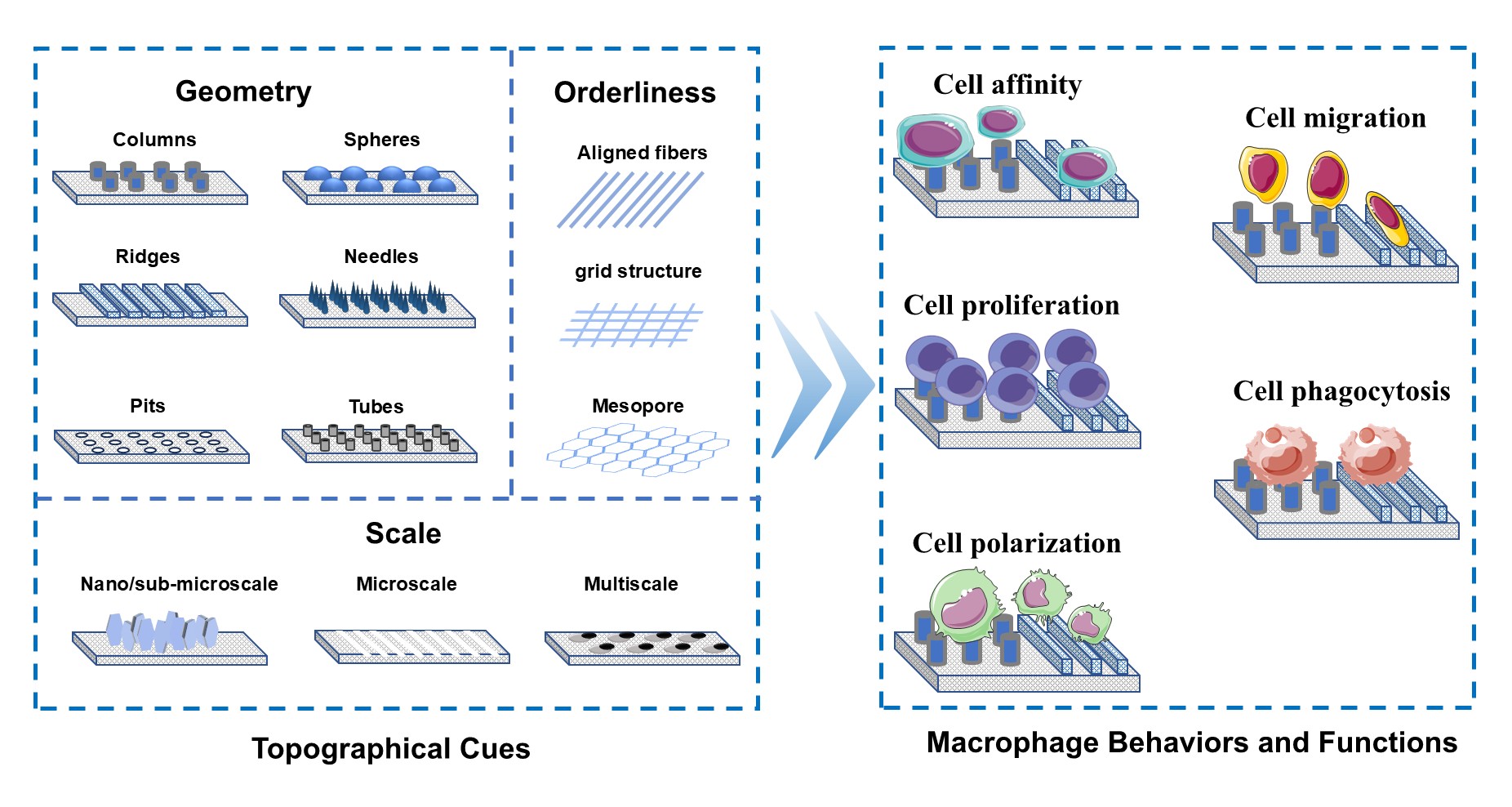
The immune response plays a critical role in determining the fate of bone biomaterials, with macrophages serving as central orchestrators of the osteoimmune network. Topographical features have emerged as a powerful physical cue that can modulate macrophage function independent of biochemical signals, offering a stable and controllable strategy for immunomodulation in bone regeneration. This review systematically summarizes recent advances in understanding how topographical features regulate macrophage behavior and the underlying mechanotransduction mechanisms. We first discuss the role of macrophages in bone homeostasis, highlighting their functional plasticity and dynamic polarization during the healing process. We then provide an overview of micro- and nanofabrication techniques for constructing topographical features on biomaterial surfaces, including top-down approaches such as photolithography, etching, as well as bottom-up strategies like electrospinning and self-assembly. Subsequently, we examine the effects of topography on key macrophage behaviors and functions, including adhesion, migration, proliferation, polarization, and phagocytosis. We further dissect the molecular mechanisms by which cells sense and transduce topographical signals, focusing on integrin-mediated focal adhesion, cytoskeletal remodeling, nuclear mechanotransduction, and downstream signaling pathways, including YAP/TAZ, MRTF-A, RhoA/ROCK, and PI3K-AKT-mTOR. Emerging evidence on epigenetic regulation by topographical cues is also discussed. Finally, we present future perspectives on dynamic topography, machine learning-assisted high-throughput screening, the modulation of macrophage subtypes, and the integration of bactericidal and immunomodulatory functions. By bridging materials science and immunology, this review aims to provide a theoretical foundation for the rational design of next-generation immunomodulatory biomaterials for bone regeneration.
- Open Access
- Review
Topographical Regulation of Macrophage-Mediated Osteoimmunomodulation for Bone Regeneration
- Wen-Jia Han 1,
- Yu-Qing Mu 2,3,4,
- Jia-Wei Xing 1,
- Bo-Wen Zheng 1,
- Yao Liu 1,
- En Luo 1,*,
- Ze He 1,2,3,4,*
Author Information
Received: 26 Mar 2026 | Revised: 14 May 2026 | Accepted: 22 May 2026 | Published: 05 Jun 2026
Abstract
Graphical Abstract
Keywords
topographical cues | macrophage | osteoimmunology | bone regeneration
References
- 1.
Wang, J.; Wu, Y.; Li, G.; et al. Engineering Large-Scale Self-Mineralizing Bone Organoids with Bone Matrix-Inspired Hydroxyapatite Hybrid Bioinks. Adv. Mater. 2024, 36, 2309875. https://doi.org/10.1002/adma.202309875.
- 2.
Xue, N.; Ding, X.; Huang, R.; et al. Bone Tissue Engineering in the Treatment of Bone Defects. Pharmaceuticals 2022, 15, 879. https://doi.org/10.3390/ph15070879.
- 3.
Yu, D.; Shen, W.; Dai, J.; et al. Treatment of Large Bone Defects in Load-Bearing Bone: Traditional and Novel Bone Grafts. J. Zhejiang Univ. Sci. B 2025, 26, 421–447. https://doi.org/10.1631/jzus.B2300669.
- 4.
Sabouri, Z.; Dequeecker, M.; Anees, H.; et al. Recent Advances in Biomaterials for Bone Regeneration: Bridging Innovation and Clinical Translation. Mater. Today Bio 2026, 36, 102685. https://doi.org/10.1016/j.mtbio.2025.102685.
- 5.
Fan, L.; Chen, S.; Yang, M.; et al. Metallic Materials for Bone Repair. Adv. Healthc. Mater. 2024, 13, 2302132. https://doi.org/10.1002/adhm.202302132.
- 6.
Kashirina, A.; Yao, Y.; Liu, Y.; et al. Biopolymers as Bone Substitutes: A Review. Biomater. Sci. 2019, 7, 3961–3983. https://doi.org/10.1039/C9BM00664H.
- 7.
Zhou, H.; Yang, L.; Gbureck, U.; et al. Monetite, an Important Calcium Phosphate Compound—Its Synthesis, Properties and Applications in Orthopedics. Acta Biomater. 2021, 127, 41–55. https://doi.org/10.1016/j.actbio.2021.03.050.
- 8.
Chung, L.; Maestas, D.R.; Housseau, F.; et al. Key Players in the Immune Response to Biomaterial Scaffolds for Regenerative Medicine. Adv. Drug Deliv. Rev. 2017, 114, 184–192. https://doi.org/10.1016/j.addr.2017.07.006.
- 9.
Chen, Z.; Klein, T.; Murray, R.Z.; et al. Osteoimmunomodulation for the Development of Advanced Bone Biomaterials. Mater. Today 2016, 19, 304–321. https://doi.org/10.1016/j.mattod.2015.11.004.
- 10.
Zhu, Y.; Liang, H.; Liu, X.; et al. Regulation of Macrophage Polarization through Surface Topography Design to Facilitate Implant-to-Bone Osteointegration. Sci. Adv. 2021, 7, eabf6654. https://doi.org/10.1126/sciadv.abf6654.
- 11.
Bi, Z.; Cai, Y.; Shi, X.; et al. Macrophage-Mediated Immunomodulation in Biomaterial-Assisted Bone Repair: Molecular Insights and Therapeutic Prospects. Chem. Eng. J. 2024, 488, 150631. https://doi.org/10.1016/j.cej.2024.150631.
- 12.
Kim, E.; Tae, G. Direct Reprogramming and Biomaterials for Controlling Cell Fate. Biomater. Res. 2016, 20, 39. https://doi.org/10.1186/s40824-016-0086-y.
- 13.
Zhang, H.; Zhang, H.; Xiong, Y.; et al. Development of Hierarchical Porous Bioceramic Scaffolds with Controlled Micro/Nano Surface Topography for Accelerating Bone Regeneration. Mater. Sci. Eng. C 2021, 130, 112437. https://doi.org/10.1016/j.msec.2021.112437.
- 14.
Wu, S.; Shan, Z.; Xie, L.; et al. Mesopore Controls the Responses of Blood Clot-Immune Complex via Modulating Fibrin Network. Adv. Sci. 2022, 9, e2103608. https://doi.org/10.1002/advs.202103608.
- 15.
Bartneck, M.; Schulte, V.A.; Paul, N.E.; et al. Induction of Specific Macrophage Subtypes by Defined Micro-Patterned Structures. Acta Biomater. 2010, 6, 3864–3872. https://doi.org/10.1016/j.actbio.2010.04.025.
- 16.
Ramaswamy, Y.; Roohani, I.; No, Y.J.; et al. Nature-Inspired Topographies on Hydroxyapatite Surfaces Regulate Stem Cells Behaviour. Bioact. Mater. 2020, 6, 1107–1117. https://doi.org/10.1016/j.bioactmat.2020.10.001.
- 17.
Capellato, P.; Camargo, S.E.A.; Sachs, D. Biological Response to Nanosurface Modification on Metallic Biomaterials. Curr. Osteoporos. Rep. 2020, 18, 790–795. https://doi.org/10.1007/s11914-020-00635-x.
- 18.
Wang, K.; Man, K.; Liu, J.; et al. Dissecting Physical and Biochemical Effects in Nanotopographical Regulation of Cell Behavior. ACS Nano 2023, 17, 2124–2133. https://doi.org/10.1021/acsnano.2c08075.
- 19.
Brammer, K.S.; Frandsen, C.J.; Jin, S. TiO2 Nanotubes for Bone Regeneration. Trends Biotechnol. 2012, 30, 315–322. https://doi.org/10.1016/j.tibtech.2012.02.005.
- 20.
Pan, H.; Zhao, J.; Fan, R.; et al. 3D Hierarchically Aligned Nanofiber Scaffolds Promote Cell Migration for Tissue Regeneration. Nat. Protoc. 2026, in press. https://doi.org/10.1038/s41596-026-01339-9.
- 21.
Shi, X.; Xu, C.; Chen, Z.; et al. Biomaterial-Mediated Macrophage Polarization Remodeling and Sequential Regulation: A Potential Strategy in Bone Infections Treatment. Bone Res. 2025, 13, 96. https://doi.org/10.1038/s41413-025-00471-8.
- 22.
Mooij, I.; Apachitei, I.; Zadpoor, A.A.; et al. Biomaterial Multiscale Geometry for Regenerative Immunoengineering of Bone Tissue. Acta Biomater. 2025, 203, 21–37. https://doi.org/10.1016/j.actbio.2025.07.036.
- 23.
Tsukasaki, M.; Takayanagi, H. Osteoimmunology: Evolving Concepts in Bone–Immune Interactions in Health and Disease. Nat. Rev. Immunol. 2019, 19, 626–642. https://doi.org/10.1038/s41577-019-0178-8.
- 24.
Wang, C.; Wu, Q.; Zhuang, L.; et al. Immunometabolism of Macrophages in the Bone Microenvironment: A New Perspective for Bone Healing Therapy. J. Adv. Res. 2026, 82, 485–506. https://doi.org/10.1016/j.jare.2025.07.046.
- 25.
Yunna, C.; Mengru, H.; Lei, W.; et al. Macrophage M1/M2 Polarization. Eur. J. Pharmacol. 2020, 877, 173090. https://doi.org/10.1016/j.ejphar.2020.173090.
- 26.
Dai, B.; Zheng, L.; Chung-Wai Cheung, J.; et al. Macrophages: Redefining Extracellular Matrix Architecture through Phenotypic Switches as Therapeutic Targets. Biomaterials 2026, 330, 124063. https://doi.org/10.1016/j.biomaterials.2026.124063.
- 27.
Hu, K.; Shang, Z.; Yang, X.; et al. Macrophage Polarization and the Regulation of Bone Immunity in Bone Homeostasis. J. Inflamm. Res. 2023, 16, 3563–3580. https://doi.org/10.2147/JIR.S423819.
- 28.
Yao, Y.; Xu, X.-H.; Jin, L. Macrophage Polarization in Physiological and Pathological Pregnancy. Front. Immunol. 2019, 10, 792. https://doi.org/10.3389/fimmu.2019.00792.
- 29.
Fernandes, T.L.; Gomoll, A.H.; Lattermann, C.; et al. Macrophage: A Potential Target on Cartilage Regeneration. Front. Immunol. 2020, 11, 111. https://doi.org/10.3389/fimmu.2020.00111.
- 30.
Toledo, B.; Zhu Chen, L.; Paniagua-Sancho, M.; et al. Deciphering the Performance of Macrophages in Tumour Microenvironment: A Call for Precision Immunotherapy. J. Hematol. Oncol. 2024, 17, 44. https://doi.org/10.1186/s13045-024-01559-0.
- 31.
Yang, T.; Fang, Z.; Zhang, J.; et al. Physical Cues in Biomaterials Modulate Macrophage Polarization for Bone Regeneration: A Review. Front. Bioeng. Biotechnol. 2025, 13, 1640560. https://doi.org/10.3389/fbioe.2025.1640560.
- 32.
Halper, J.; Dolfi, B.; Ivanov, S.; et al. Macrophages and Osteoclasts: Similarity and Divergence between Bone Phagocytes. Front. Immunol. 2025, 16, 1683872. https://doi.org/10.3389/fimmu.2025.1683872.
- 33.
Sun, Y.; Li, J.; Xie, X.; et al. Macrophage-Osteoclast Associations: Origin, Polarization, and Subgroups. Front. Immunol. 2021, 12, 778078. https://doi.org/10.3389/fimmu.2021.778078.
- 34.
Hu, L.; Liu, R.; Zhang, L. Advance in Bone Destruction Participated by JAK/STAT in Rheumatoid Arthritis and Therapeutic Effect of JAK/STAT Inhibitors. Int. Immunopharmacol. 2022, 111, 109095. https://doi.org/10.1016/j.intimp.2022.109095.
- 35.
Veis, D.J.; OʼBrien, C.A. Osteoclasts, Master Sculptors of Bone. Annu. Rev. Pathol. 2023, 18, 257–281. https://doi.org/10.1146/annurev-pathmechdis-031521-040919.
- 36.
Arai, F.; Miyamoto, T.; Ohneda, O.; et al. Commitment and Differentiation of Osteoclast Precursor Cells by the Sequential Expression of c-Fms and Receptor Activator of Nuclear Factor κB (RANK) Receptors. J. Exp. Med. 1999, 190, 1741–1754. https://doi.org/10.1084/jem.190.12.1741.
- 37.
Zha, L.; He, L.; Liang, Y.; et al. TNF-α Contributes to Postmenopausal Osteoporosis by Synergistically Promoting RANKL-Induced Osteoclast Formation. Biomed. Pharmacother. 2018, 102, 369–374. https://doi.org/10.1016/j.biopha.2018.03.080.
- 38.
Yao, Z.; Getting, S.J.; Locke, I.C. Regulation of TNF-Induced Osteoclast Differentiation. Cells 2021, 11, 132. https://doi.org/10.3390/cells11010132.
- 39.
Kandahari, A.M.; Yang, X.; Laroche, K.A.; et al. A Review of UHMWPE Wear-Induced Osteolysis: The Role for Early Detection of the Immune Response. Bone Res. 2016, 4, 16014. https://doi.org/10.1038/boneres.2016.14.
- 40.
Xiao, W.; Shen, Y.; Xu, Y. LOXG473A Induces the Formation of Osteoclasts in RAW264.7 Cells via IL-6/JAK2/STAT3 Signaling. Exp. Cell Res. 2021, 409, 112890. https://doi.org/10.1016/j.yexcr.2021.112890.
- 41.
Palmqvist, P.; Lundberg, P.; Persson, E.; et al. Inhibition of Hormone and Cytokine-Stimulated Osteoclastogenesis and Bone Resorption by Interleukin-4 and Interleukin-13 Is Associated with Increased Osteoprotegerin and Decreased RANKL and RANK in a STAT6-Dependent Pathway. J. Biol. Chem. 2006, 281, 2414–2429. https://doi.org/10.1074/jbc.M510160200.
- 42.
Williams, D.F. Biocompatibility Pathways and Mechanisms for Bioactive Materials: The Bioactivity Zone. Bioact. Mater. 2021, 10, 306–322. https://doi.org/10.1016/j.bioactmat.2021.08.014.
- 43.
Mohamed, S.G.-K.; Sugiyama, E.; Shinoda, K.; et al. Interleukin-10 Inhibits RANKL-Mediated Expression of NFATc1 in Part via Suppression of c-Fos and c-Jun in RAW264.7 Cells and Mouse Bone Marrow Cells. Bone 2007, 41, 592–602. https://doi.org/10.1016/j.bone.2007.05.016.
- 44.
Chang, M.K.; Raggatt, L.-J.; Alexander, K.A.; et al. Osteal Tissue Macrophages Are Intercalated throughout Human and Mouse Bone Lining Tissues and Regulate Osteoblast Function in Vitro and in Vivo. J. Immunol. 2008, 181, 1232–1244. https://doi.org/10.4049/jimmunol.181.2.1232.
- 45.
Pajarinen, J.; Lin, T.; Gibon, E.; et al. Mesenchymal Stem Cell-Macrophage Crosstalk and Bone Healing. Biomaterials 2019, 196, 80–89. https://doi.org/10.1016/j.biomaterials.2017.12.025.
- 46.
He, Y.; Wang, Y.; Yu, S.; et al. BMP2 Enhance the Osteogenic Effect of BMSCs-Derived Exosomes in Skull Defect of Diabetic Rats. Mater. Des. 2024, 248, 113517. https://doi.org/10.1016/j.matdes.2024.113517.
- 47.
Song, R.; Yuan, X.; Wan, Z.; et al. Oncostatin-M Functionalized Cryogel Microspheres for Promoting Diabetic Bone Defects Regeneration. J. Orthop. Transl. 2025, 53, 138–148. https://doi.org/10.1016/j.jot.2025.06.002.
- 48.
Guihard, P.; Danger, Y.; Brounais, B.; et al. Induction of Osteogenesis in Mesenchymal Stem Cells by Activated Monocytes/Macrophages Depends on Oncostatin M Signaling. Stem Cells 2012, 30, 762–772. https://doi.org/10.1002/stem.1040.
- 49.
Chen, L.; Zhu, J.; Ge, N.; et al. A Biodegradable Magnesium Alloy Promotes Subperiosteal Osteogenesis via Interleukin-10-Dependent Macrophage Immunomodulation. Biomaterials 2025, 318, 122992. https://doi.org/10.1016/j.biomaterials.2024.122992.
- 50.
Wang, Z.; Lin, M.; Pan, Y.; et al. Periostin+ Myeloid Cells Improved Long Bone Regeneration in a Mechanosensitive Manner. Bone Res. 2024, 12, 59. https://doi.org/10.1038/s41413-024-00361-5.
- 51.
Zhang, J.; Shi, H.; Zhang, N.; et al. Interleukin-4-Loaded Hydrogel Scaffold Regulates Macrophages Polarization to Promote Bone Mesenchymal Stem Cells Osteogenic Differentiation via TGF-β1/Smad Pathway for Repair of Bone Defect. Cell Prolif. 2020, 53, e12907. https://doi.org/10.1111/cpr.12907.
- 52.
Glass, G.E.; Chan, J.K.; Freidin, A.; et al. TNF-α Promotes Fracture Repair by Augmenting the Recruitment and Differentiation of Muscle-Derived Stromal Cells. Proc. Natl. Acad. Sci. USA 2011, 108, 1585–1590. https://doi.org/10.1073/pnas.1018501108.
- 53.
Osta, B.; Benedetti, G.; Miossec, P. Classical and Paradoxical Effects of TNF-α on Bone Homeostasis. Front. Immunol. 2014, 5, 48. https://doi.org/10.3389/fimmu.2014.00048.
- 54.
Jin, C.; Liang, J.; Wu, J.; et al. Temporal Immunomodulatory Hydrogel Regulating the Immune-Osteogenic Cascade for Infected Bone Defects Regeneration. Adv. Mater. 2026, 38, e14419. https://doi.org/10.1002/adma.202514419.
- 55.
Majrashi, M.; Kotowska, A.; Scurr, D.; et al. Sustained Release of Dexamethasone from 3D-Printed Scaffolds Modulates Macrophage Activation and Enhances Osteogenic Differentiation. ACS Appl. Mater. Interfaces 2023, 15, 56623–56638. https://doi.org/10.1021/acsami.3c09774.
- 56.
Lu, L.Y.; Loi, F.; Nathan, K.; et al. Pro-Inflammatory M1 Macrophages Promote Osteogenesis by Mesenchymal Stem Cells via the COX-2-Prostaglandin E2 Pathway. J. Orthop. Res. 2017, 35, 2378–2385. https://doi.org/10.1002/jor.23553.
- 57.
Horwood, N.J. Macrophage Polarization and Bone Formation: A Review. Clin. Rev. Allergy Immunol. 2016, 51, 79–86. https://doi.org/10.1007/s12016-015-8519-2.
- 58.
Loi, F.; Córdova, L.A.; Zhang, R.; et al. The Effects of Immunomodulation by Macrophage Subsets on Osteogenesis in Vitro. Stem Cell Res. Ther. 2016, 7, 15. https://doi.org/10.1186/s13287-016-0276-5.
- 59.
Zhang, Y.; Shi, J.; Zhu, J.; et al. Immunometabolic Rewiring in Macrophages for Periodontitis Treatment via Nanoquercetin-Mediated Leverage of Glycolysis and OXPHOS. Acta Pharm. Sin. B 2024, 14, 5026–5036. https://doi.org/10.1016/j.apsb.2024.07.008.
- 60.
Spiller, K.L.; Anfang, R.R.; Spiller, K.J.; et al. The Role of Macrophage Phenotype in Vascularization of Tissue Engineering Scaffolds. Biomaterials 2014, 35, 4477–4488. https://doi.org/10.1016/j.biomaterials.2014.02.012.
- 61.
Spiller, K.L.; Nassiri, S.; Witherel, C.E.; et al. Sequential Delivery of Immunomodulatory Cytokines to Facilitate the M1-to-M2 Transition of Macrophages and Enhance Vascularization of Bone Scaffolds. Biomaterials 2015, 37, 194–207. https://doi.org/10.1016/j.biomaterials.2014.10.017.
- 62.
Wu, C.-L.; Harasymowicz, N.S.; Klimak, M.A.; et al. The Role of Macrophages in Osteoarthritis and Cartilage Repair. Osteoarthritis Cartilage 2020, 28, 544–554. https://doi.org/10.1016/j.joca.2019.12.007.
- 63.
Wynn, T.A.; Vannella, K.M. Macrophages in Tissue Repair, Regeneration, and Fibrosis. Immunity 2016, 44, 450–462. https://doi.org/10.1016/j.immuni.2016.02.015.
- 64.
Jiang, S.; Li, H.; Zhang, L.; et al. Generic Diagramming Platform (GDP): A Comprehensive Database of High-Quality Biomedical Graphics. Nucleic Acids Res. 2025, 53, D1670–D1676. https://doi.org/10.1093/nar/gkae973.
- 65.
Asadi Tokmedash, M.; Kim, C.; Chavda, A.P.; et al. Engineering Multifunctional Surface Topography to Regulate Multiple Biological Responses. Biomaterials 2025, 319, 123136. https://doi.org/10.1016/j.biomaterials.2025.123136.
- 66.
Fox, C.B.; Kim, J.; Schlesinger, E.B.; et al. Fabrication of Micropatterned Polymeric Nanowire Arrays for High-Resolution Reagent Localization and Topographical Cellular Control. Nano Lett. 2015, 15, 1540–1546. https://doi.org/10.1021/nl503872p.
- 67.
Huang, N.F.; Lai, E.S.; Ribeiro, A.J.S.; et al. Spatial Patterning of Endothelium Modulates Cell Morphology, Adhesiveness and Transcriptional Signature. Biomaterials 2013, 34, 2928–2937. https://doi.org/10.1016/j.biomaterials.2013.01.017.
- 68.
Biela, S.A.; Su, Y.; Spatz, J.P.; et al. Different Sensitivity of Human Endothelial Cells, Smooth Muscle Cells and Fibroblasts to Topography in the Nano-Micro Range. Acta Biomater. 2009, 5, 2460–2466. https://doi.org/10.1016/j.actbio.2009.04.003.
- 69.
Wu, Y.; Yue, X.; Zhang, Y.; et al. Dual-Sided Centripetal Microgrooved Poly(D,L-lactide-co-caprolactone) Disk Encased in Immune-Regulating Hydrogels for Enhanced Bone Regeneration. Mater. Today Bio 2025, 30, 101436. https://doi.org/10.1016/j.mtbio.2024.101436.
- 70.
Joo, S.; Lee, C.-E.; Kang, J.; et al. Intaglio Contact Printing of Versatile Carbon Nanotube Composites and Its Applications for Miniaturizing High-Performance Devices. Small 2022, 18, 2106174. https://doi.org/10.1002/smll.202106174.
- 71.
Yu, H.; Xu, M.; Xu, W.-C.; et al. Designing Resists for Nanoimprint Lithography Enabling Functional Patterning. Chin. J. Chem. 2026, 44, 1457–1472. https://doi.org/10.1002/cjoc.70427.
- 72.
Guo, L.J. Nanoimprint Lithography: Methods and Material Requirements. Adv. Mater. 2007, 19, 495–513. https://doi.org/10.1002/adma.200600882.
- 73.
Sansen, T.; Sanchez-Fuentes, D.; Rathar, R.; et al. Mapping Cell Membrane Organization and Dynamics Using Soft Nanoimprint Lithography. ACS Appl. Mater. Interfaces 2020, 12, 29000–29012. https://doi.org/10.1021/acsami.0c05432.
- 74.
Lee, T.-Y.; Chen, P.-T.; Huang, C.-C.; et al. Advances in Core Technologies for Semiconductor Manufacturing: Applications and Challenges of Atomic Layer Etching, Neutral Beam Etching and Atomic Layer Deposition. Nanoscale Adv. 2025, 7, 2796–2817. https://doi.org/10.1039/D4NA00784K.
- 75.
Ariganello, M.B.; Bello, D.G.; Rodriguez-Contreras, A.; et al. Surface Nanocavitation of Titanium Modulates Macrophage Activity. Int. J. Nanomedicine 2018, 13, 8297–8308. https://doi.org/10.2147/IJN.S185436.
- 76.
Ødegaard, K.S.; Westhrin, M.; Afif, A.B.; et al. The Effects of Surface Treatments on Electron Beam Melted Ti-6Al-4V Disks on Osteogenesis of Human Mesenchymal Stromal Cells. Biomater. Adv. 2023, 147, 213327. https://doi.org/10.1016/j.bioadv.2023.213327.
- 77.
Hossain, N.; Mobarak, M.H.; Mimona, M.A.; et al. Advances and Significances of Nanoparticles in Semiconductor Applications—A Review. Results Eng. 2023, 19, 101347. https://doi.org/10.1016/j.rineng.2023.101347.
- 78.
Seong, H.; Higgins, S.G.; Penders, J.; et al. Size-Tunable Nanoneedle Arrays for Influencing Stem Cell Morphology, Gene Expression, and Nuclear Membrane Curvature. ACS Nano 2020, 14, 5371–5381. https://doi.org/10.1021/acsnano.9b08689.
- 79.
Roy, A.; Patil, D.; Yarlagadda, P.K.D.V.; et al. Cooperative Stiffening of Flexible High Aspect Ratio Nanostructures Impart Mechanobactericidal Activity to Soft Substrates. J. Colloid Interface Sci. 2023, 652, 2127–2138. https://doi.org/10.1016/j.jcis.2023.09.021.
- 80.
Mahara, A.; Kojima, K.; Yamamoto, M.; et al. Accelerated Tissue Regeneration in Decellularized Vascular Grafts with a Patterned Pore Structure. J. Mater. Chem. B 2022, 10, 2544–2550. https://doi.org/10.1039/D1TB02271G.
- 81.
Valverde, G.B.; Jimbo, R.; Teixeira, H.S.; et al. Evaluation of Surface Roughness as a Function of Multiple Blasting Processing Variables. Clin. Oral Implants Res. 2013, 24, 238–242. https://doi.org/10.1111/j.1600-0501.2011.02392.x.
- 82.
Meyerink, J.G.; Kota, D.; Wood, S.T.; et al. Transparent Titanium Dioxide Nanotubes: Processing, Characterization, and Application in Establishing Cellular Response Mechanisms. Acta Biomater. 2018, 79, 364–374. https://doi.org/10.1016/j.actbio.2018.08.039.
- 83.
Wang, X.; Si, Q.; Yang, N.; et al. TiO2 Nanotubes Regulate Osteo-Adipogenic Balance through SREBP1 to Determine the Fate of Bone Marrow Mesenchymal Stem Cells. Regen. Biomater. 2025, 12, rbaf061. https://doi.org/10.1093/rb/rbaf061.
- 84.
Zheng, X.; Chen, L.; Tan, J.; et al. Effect of Micro/Nano-Sheet Array Structures on the Osteo-Immunomodulation of Macrophages. Regen. Biomater. 2022, 9, rbac075. https://doi.org/10.1093/rb/rbac075.
- 85.
Shayan, M.; Padmanabhan, J.; Morris, A.H.; et al. Nanopatterned Bulk Metallic Glass-Based Biomaterials Modulate Macrophage Polarization. Acta Biomater. 2018, 75, 427–438. https://doi.org/10.1016/j.actbio.2018.05.051.
- 86.
Horii, T.; Tsujimoto, H.; Hagiwara, A.; et al. Effects of Fiber Diameter and Spacing Size of an Artificial Scaffold on the in Vivo Cellular Response and Tissue Remodeling. ACS Appl. Bio Mater. 2021, 4, 6924–6936. https://doi.org/10.1021/acsabm.1c00572.
- 87.
Jiang, S.; Zhou, J.; Zhao, C.; et al. Aligned Electrospun Fibers Inducing Cell and Nuclear Morphology Remodeling via Ras-Associated Protein 1/Yes-Associated Protein Signaling Enhances Bone Regeneration. Adv. Fiber Mater. 2025, 7, 1980–1997. https://doi.org/10.1007/s42765-025-00596-9.
- 88.
Biomimetic Hydrogel Micro-/Nanofibers for In Situ Soft Tissue Repair and Regeneration. Bioact. Mater. 2026, 55, 485–502. https://doi.org/10.1016/j.bioactmat.2025.09.035.
- 89.
Zhu, G.; Zhang, R.; Xie, Q.; et al. Shish-Kebab Structure Fiber with Nano and Micro Diameter Regulate Macrophage Polarization for Anti-Inflammatory and Bone Differentiation. Mater. Today Bio 2023, 23, 100880. https://doi.org/10.1016/j.mtbio.2023.100880.
- 90.
Zhang, X.; Hao, R.; Tong, J.; et al. A Radially Aligned Nanofiber Scaffold with Engineered Guidance Gradients for Directed Cell Migration and Accelerated Wound Healing. Biomaterials 2026, 327, 123797. https://doi.org/10.1016/j.biomaterials.2025.123797.
- 91.
Asadi Tokmedash, M.; Min, J. Designer Micro-/Nanocrumpled MXene Multilayer Coatings Accelerate Osteogenesis and Regulate Macrophage Polarization. ACS Appl. Mater. Interfaces 2024, 16, 21415–21426. https://doi.org/10.1021/acsami.3c18158.
- 92.
Ye, Z.; Xu, Z.; Zhang, Y.; et al. Microfluidic Synthesis of Discrete Chiral Gold Nanorods with Tunable Morphologies and Enantioselective Recognition. ACS Appl. Mater. Interfaces 2026, 18, 4198–4209. https://doi.org/10.1021/acsami.5c21617.
- 93.
Song, J.-N.; Liu, K.; Mei, J.; et al. Defined Surface Physicochemical Cues Inhibit M1 Polarization of Human Macrophages Using Colloidal Self-Assembled Patterns. ACS Appl. Mater. Interfaces 2023, 15, 35832–35846. https://doi.org/10.1021/acsami.3c04692.
- 94.
Wang, B.; Xiao, S.; Liao, J.; et al. Directional Biomimetic Scaffold-Mediated Cell Migration and Pathological Microenvironment Regulation Accelerate Diabetic Bone Defect Repair. ACS Nano 2025, 19, 32382–32404. https://doi.org/10.1021/acsnano.5c08238.
- 95.
Wu, B.; Yang, J.; Ye, J.; et al. Extrusion-Based 3D Printing of Cross-Scale Porous Bone Scaffolds and Their Micro-Topological Structures for Bone Repair. Biomater. Adv. 2026, 180, 214540. https://doi.org/10.1016/j.bioadv.2025.214540.
- 96.
Aboal-Castro, L.; Radziunas-Salinas, Y.; Pita-Vilar, M.; et al. Laser-Assisted Micropatterned 3D Printed Scaffolds with Customizable Surface Topography and Porosity for Modulation of Cell Function. Adv. Healthc. Mater. 2025, 14, 2403992. https://doi.org/10.1002/adhm.202403992.
- 97.
Li, J.; Jiang, X.; Li, H.; et al. Tailoring Materials for Modulation of Macrophage Fate. Adv. Mater. 2021, 33, e2004172. https://doi.org/10.1002/adma.202004172.
- 98.
Wang, C.; Chu, C.; Zhao, X.; et al. The Diameter Factor of Aligned Membranes Facilitates Wound Healing by Promoting Epithelialization in an Immune Way. Bioact. Mater. 2022, 11, 206–217. https://doi.org/10.1016/j.bioactmat.2021.09.022.
- 99.
Dong, X.; Liu, S.; Yang, Y.; et al. Aligned Microfiber-Induced Macrophage Polarization to Guide Schwann-Cell-Enabled Peripheral Nerve Regeneration. Biomaterials 2021, 272, 120767. https://doi.org/10.1016/j.biomaterials.2021.120767.
- 100.
He, Y.; Zhang, X.; Meng, F.; et al. Biomimetic Chiral Nanotopography for Manipulating Immunological Response. Adv. Funct. Mater. 2024, 34, 2313157. https://doi.org/10.1002/adfm.202313157.
- 101.
Buskermolen, A.B.C.; Ristori, T.; Mostert, D.; et al. Cellular Contact Guidance Emerges from Gap Avoidance. Cell Rep. Phys. Sci. 2020, 1, 100055. https://doi.org/10.1016/j.xcrp.2020.100055.
- 102.
Meyle, J.; Gültig, K.; Nisch, W. Variation in Contact Guidance by Human Cells on a Microstructured Surface. J. Biomed. Mater. Res. 1995, 29, 81–88. https://doi.org/10.1002/jbm.820290112.
- 103.
Wójciak-Stothard, B.; Madeja, Z.; Korohoda, W.; et al. Activation of Macrophage-Like Cells by Multiple Grooved Substrata. Topographical Control of Cell Behaviour. Cell Biol. Int. 1995, 19, 485–490. https://doi.org/10.1006/cbir.1995.1092.
- 104.
Lee, S.; Choi, J.; Shin, S.; et al. Analysis on Migration and Activation of Live Macrophages on Transparent Flat and Nanostructured Titanium. Acta Biomater. 2011, 7, 2337–2344. https://doi.org/10.1016/j.actbio.2011.01.006.
- 105.
Mohiuddin, M.; Pan, H.-A.; Hung, Y.-C.; et al. Control of Growth and Inflammatory Response of Macrophages and Foam Cells with Nanotopography. Nanoscale Res. Lett. 2012, 7, 394. https://doi.org/10.1186/1556-276X-7-394.
- 106.
Dabare, P.R.L.; Bachhuka, A.; Quek, J.Y.; et al. Nano-Roughness-Mediated Macrophage Polarization for Desired Host Immune Response. Small Sci. 2023, 3, 2300080. https://doi.org/10.1002/smsc.202300080.
- 107.
Necula, M.G.; Mazare, A.; Negrescu, A.M.; et al. Macrophage-Like Cells Are Responsive to Titania Nanotube Intertube Spacing—An in Vitro Study. Int. J. Mol. Sci. 2022, 23, 3558. https://doi.org/10.3390/ijms23073558.
- 108.
Asadi Tokmedash, M.; Robins, J.; VanEpps, J.S.; et al. Multiscale Hybrid Surface Topographies Orchestrate Immune Regulation, Antibacterial Defense, and Tissue Regeneration. Adv. Healthc. Mater. 2025, 14, e02451. https://doi.org/10.1002/adhm.202502451.
- 109.
Cicuéndez, M.; García-Lizarribar, A.; Casarrubios, L.; et al. Functionality of Macrophages Encapsulated in Porcine Decellularized Adipose Matrix Hydrogels and Interaction with Candida albicans. Biomater. Adv. 2024, 159, 213794. https://doi.org/10.1016/j.bioadv.2024.213794.
- 110.
Singh, S.; Awuah, D.; Rostam, H.M.; et al. Unbiased Analysis of the Impact of Micropatterned Biomaterials on Macrophage Behavior Provides Insights beyond Predefined Polarization States. ACS Biomater. Sci. Eng. 2017, 3, 969–978. https://doi.org/10.1021/acsbiomaterials.7b00104.
- 111.
Huo, Z.; Yang, W.; Harati, J.; et al. Biomechanics of Macrophages on Disordered Surface Nanotopography. ACS Appl. Mater. Interfaces 2024, 16, 27164–27176. https://doi.org/10.1021/acsami.4c04330.
- 112.
Changede, R.; Sheetz, M. Integrin and Cadherin Clusters: A Robust Way to Organize Adhesions for Cell Mechanics. BioEssays 2017, 39, 1–12. https://doi.org/10.1002/bies.201600123.
- 113.
Kanchanawong, P.; Shtengel, G.; Pasapera, A.M.; et al. Nanoscale Architecture of Integrin-Based Cell Adhesions. Nature 2010, 468, 580–584. https://doi.org/10.1038/nature09621.
- 114.
Oh, S.; Brammer, K.S.; Li, Y.S.J.; et al. Stem Cell Fate Dictated Solely by Altered Nanotube Dimension. Proc. Natl. Acad. Sci. USA 2009, 106, 2130–2135. https://doi.org/10.1073/pnas.0813200106.
- 115.
Xu, W.-C.; Dong, X.; Ding, J.-L.; et al. Nanotubular TiO2 Regulates Macrophage M2 Polarization and Increases Macrophage Secretion of VEGF to Accelerate Endothelialization via the ERK1/2 and PI3K/AKT Pathways. Int. J. Nanomedicine 2019, 14, 441–455. https://doi.org/10.2147/IJN.S188439.
- 116.
Li, K.; Lv, L.; Shao, D.; et al. Engineering Nanopatterned Structures to Orchestrate Macrophage Phenotype by Cell Shape. J. Funct. Biomater. 2022, 13, 31. https://doi.org/10.3390/jfb13010031.
- 117.
Luu, T.U.; Gott, S.C.; Woo, B.W.; et al. Micro- and Nanopatterned Topographical Cues for Regulating Macrophage Cell Shape and Phenotype. ACS Appl. Mater. Interfaces 2015, 7, 28665–28672. https://doi.org/10.1021/acsami.5b10589.
- 118.
Xie, J.; Wu, X.; Zheng, S.; et al. Aligned Electrospun Poly(L-lactide) Nanofibers Facilitate Wound Healing by Inhibiting Macrophage M1 Polarization via the JAK-STAT and NF-κB Pathways. J. Nanobiotechnology 2022, 20, 342. https://doi.org/10.1186/s12951-022-01549-9.
- 119.
Hao, J.; Du, L.; He, Y.; et al. Bioceramic Surface Topography Regulating Immune Osteogenesis. BME Front. 2025, 6, 0089. https://doi.org/10.34133/bmef.0089.
- 120.
Wu, J.; Feng, C.; Wang, M.; et al. Whisker of Biphasic Calcium Phosphate Ceramics: Osteo-Immunomodulatory Behaviors. Nano Res. 2022, 15, 9169–9182. https://doi.org/10.1007/s12274-022-4591-0.
- 121.
Tylek, T.; Blum, C.; Hrynevich, A.; et al. Precisely Defined Fiber Scaffolds with 40 μm Porosity Induce Elongation Driven M2-Like Polarization of Human Macrophages. Biofabrication 2020, 12, 025007. https://doi.org/10.1088/1758-5090/ab5f4e.
- 122.
Vassey, M.J.; Figueredo, G.P.; Scurr, D.J.; et al. Immune Modulation by Design: Using Topography to Control Human Monocyte Attachment and Macrophage Differentiation. Adv. Sci. 2020, 7, 1903392. https://doi.org/10.1002/advs.201903392.
- 123.
Hang, R.; Zhao, Y.; Zhang, Y.; et al. The Role of Nanopores Constructed on the Micropitted Titanium Surface in the Immune Responses of Macrophages and the Potential Mechanisms. J. Mater. Chem. B 2022, 10, 7732–7743. https://doi.org/10.1039/D2TB01263D.
- 124.
Jin, S.; Wen, J.; Zhang, Y.; et al. M2 Macrophage-Derived Exosome-Functionalized Topological Scaffolds Regulate the Foreign Body Response and the Coupling of Angio/Osteoclasto/Osteogenesis. Acta Biomater. 2024, 177, 91–106. https://doi.org/10.1016/j.actbio.2024.01.043.
- 125.
Yang, Y.; Lin, Y.; Zhang, Z.; et al. Micro/Nano-Net Guides M2-Pattern Macrophage Cytoskeleton Distribution via Src–ROCK Signalling for Enhanced Angiogenesis. Biomater. Sci. 2021, 9, 3334–3347. https://doi.org/10.1039/D1BM00116G.
- 126.
Jin, S.; Yang, R.; Chu, C.; et al. Topological Structure of Electrospun Membrane Regulates Immune Response, Angiogenesis and Bone Regeneration. Acta Biomater. 2021, 129, 148–158. https://doi.org/10.1016/j.actbio.2021.05.042.
- 127.
Narayanan, K.B. Nanotopographical Features of Polymeric Nanocomposite Scaffolds for Tissue Engineering and Regenerative Medicine: A Review. Biomimetics 2025, 10, 317. https://doi.org/10.3390/biomimetics10050317.
- 128.
Liliensiek, S.J.; Nealey, P.; Murphy, C.J. Characterization of Endothelial Basement Membrane Nanotopography in Rhesus Macaque as a Guide for Vessel Tissue Engineering. Tissue Eng. Part A 2009, 15, 2643–2651. https://doi.org/10.1089/ten.tea.2008.0284.
- 129.
Qiao, W.; Xie, H.; Fang, J.; et al. Sequential Activation of Heterogeneous Macrophage Phenotypes Is Essential for Biomaterials-Induced Bone Regeneration. Biomaterials 2021, 276, 121038. https://doi.org/10.1016/j.biomaterials.2021.121038.
- 130.
Shen, X.; Yu, Y.; Ma, P.; et al. Titania Nanotubes Promote Osteogenesis via Mediating Crosstalk between Macrophages and MSCs under Oxidative Stress. Colloids Surf. B Biointerfaces 2019, 180, 39–48. https://doi.org/10.1016/j.colsurfb.2019.04.033.
- 131.
Yin, Y.; He, X.-T.; Wang, J.; et al. Pore Size-Mediated Macrophage M1-to-M2 Transition Influences New Vessel Formation within the Compartment of a Scaffold. Appl. Mater. Today 2020, 18, 100466. https://doi.org/10.1016/j.apmt.2019.100466.
- 132.
Hong, H.; Lee, S.; Kang, C.; et al. Tuning Liganded Nanocrack Geometry for Dynamic Regulation of Host Macrophages. Chem. Eng. J. 2025, 521, 166414. https://doi.org/10.1016/j.cej.2025.166414.
- 133.
Dahri, M.; Rezaeian, M.; Sadeghzadeh, H.; et al. Nanomaterial-Driven Macrophage Polarization: Emerging Strategies for Immunomodulation and Regenerative Medicine. Biomed. Pharmacother. 2025, 190, 118360. https://doi.org/10.1016/j.biopha.2025.118360.
- 134.
Wang, J.; Meng, F.; Song, W.; et al. Nanostructured Titanium Regulates Osseointegration via Influencing Macrophage Polarization in the Osteogenic Environment. Int. J. Nanomedicine 2018, 13, 4029–4043. https://doi.org/10.2147/IJN.S163956.
- 135.
Tao, B.; Lan, H.; Zhou, X.; et al. Regulation of TiO2 Nanotubes on Titanium Implants to Orchestrate Osteo/Angio-Genesis and Osteo-Immunomodulation for Boosted Osseointegration. Mater. Des. 2023, 233, 112268. https://doi.org/10.1016/j.matdes.2023.112268.
- 136.
Guo, M.; Li, T.; Zhang, W.-C.; et al. Wetting of Cell Aggregates on Microdisk Topography Structures Achieved by Maskless Optical Projection Lithography. Small 2023, 19, e2300311. https://doi.org/10.1002/smll.202300311.
- 137.
Mei, F.; Guo, Y.; Wang, Y.; et al. Matrix Stiffness Regulates Macrophage Polarisation via the Piezo1-YAP Signalling Axis. Cell Prolif. 2024, 57, e13640. https://doi.org/10.1111/cpr.13640.
- 138.
Chen, L.; Yao, Z.; Zhang, S.; et al. Biomaterial-Induced Macrophage Polarization for Bone Regeneration. Chin. Chem. Lett. 2023, 34, 107925. https://doi.org/10.1016/j.cclet.2022.107925.
- 139.
Saino, E.; Focarete, M.L.; Gualandi, C.; et al. Effect of Electrospun Fiber Diameter and Alignment on Macrophage Activation and Secretion of Proinflammatory Cytokines and Chemokines. Biomacromolecules 2011, 12, 1900–1911. https://doi.org/10.1021/bm200248h.
- 140.
Sun, Z.; Guo, S.S.; Fässler, R. Integrin-Mediated Mechanotransduction. J. Cell Biol. 2016, 215, 445–456. https://doi.org/10.1083/jcb.201609037.
- 141.
Legerstee, K.; Houtsmuller, A.B. A Layered View on Focal Adhesions. Biology 2021, 10, 1189. https://doi.org/10.3390/biology10111189.
- 142.
Atcha, H.; Jairaman, A.; Holt, J.R.; et al. Mechanically Activated Ion Channel Piezo1 Modulates Macrophage Polarization and Stiffness Sensing. Nat. Commun. 2021, 12, 3256. https://doi.org/10.1038/s41467-021-23482-5.
- 143.
Linder, S.; Wiesner, C. Tools of the Trade: Podosomes as Multipurpose Organelles of Monocytic Cells. Cell. Mol. Life Sci. 2014, 72, 121–135. https://doi.org/10.1007/s00018-014-1731-z.
- 144.
Lukácsi, S.; Nagy-Baló, Z.; Erdei, A.; et al. The Role of CR3 (CD11b/CD18) and CR4 (CD11c/CD18) in Complement-Mediated Phagocytosis and Podosome Formation by Human Phagocytes. Immunol. Lett. 2017, 189, 64–72. https://doi.org/10.1016/j.imlet.2017.05.014.
- 145.
Sosa, B.A.; Rothballer, A.; Kutay, U.; et al. LINC Complexes Form by Binding of Three KASH Peptides to Domain Interfaces of Trimeric SUN Proteins. Cell 2012, 149, 1035–1047. https://doi.org/10.1016/j.cell.2012.03.046.
- 146.
Jain, N.; Vogel, V. Spatial Confinement Downsizes the Inflammatory Response of Macrophages. Nat. Mater. 2018, 17, 1134–1144. https://doi.org/10.1038/s41563-018-0190-6.
- 147.
Jia, H.; Zhang, H.; Mo, D.; et al. UTX Responds to Nanotopography to Suppress Macrophage Inflammatory Response by Remodeling H3K27me3 Modification. Adv. Sci. 2025, 12, e2505723. https://doi.org/10.1002/advs.202505723.
- 148.
Wang, H.; Yu, H.; Huang, T.; et al. Hippo-YAP/TAZ Signaling in Osteogenesis and Macrophage Polarization: Therapeutic Implications in Bone Defect Repair. Genes Dis. 2023, 10, 2528–2539. https://doi.org/10.1016/j.gendis.2022.12.012.
- 149.
Wei, Q.; Du, F.; Cui, J.; et al. Non-Monotonic Response of Macrophages to Mechanical Stretch Impacts Skin Wound Healing. Cell. Mol. Biol. Lett. 2025, 30, 82. https://doi.org/10.1186/s11658-025-00764-0.
- 150.
Dupont, S.; Morsut, L.; Aragona, M.; et al. Role of YAP/TAZ in Mechanotransduction. Nature 2011, 474, 179–183. https://doi.org/10.1038/nature10137.
- 151.
Fu, Y.; Jing, Z.; Chen, T.; et al. Nanotube Patterning Reduces Macrophage Inflammatory Response via Nuclear Mechanotransduction. J. Nanobiotechnology 2023, 21, 229. https://doi.org/10.1186/s12951-023-01912-4.
- 152.
Hou, Y.; Conklin, B.; Choi, H.K.; et al. Probing Nanotopography-Mediated Macrophage Polarization via Integrated Machine Learning and Combinatorial Biophysical Cue Mapping. ACS Nano 2024, 18, 25465–25477. https://doi.org/10.1021/acsnano.4c04406.
- 153.
Carrara, S.C.; Davila-Lezama, A.; Cabriel, C.; et al. 3D Topographies Promote Macrophage M2d-Subset Differentiation. Mater. Today Bio 2024, 24, 100897. https://doi.org/10.1016/j.mtbio.2023.100897.
- 154.
Ivanova, E.P.; Hasan, J.; Webb, H.K.; et al. Natural Bactericidal Surfaces: Mechanical Rupture of Pseudomonas aeruginosa Cells by Cicada Wings. Small 2012, 8, 2489–2494. https://doi.org/10.1002/smll.201200528.
- 155.
Watson, G.S.; Green, D.W.; Schwarzkopf, L.; et al. A Gecko Skin Micro/Nano Structure—A Low Adhesion, Superhydrophobic, Anti-Wetting, Self-Cleaning, Biocompatible, Antibacterial Surface. Acta Biomater. 2015, 21, 109–122. https://doi.org/10.1016/j.actbio.2015.03.007.
- 156.
Ivanova, E.P.; Linklater, D.P.; Werner, M.; et al. The Multi-Faceted Mechano-Bactericidal Mechanism of Nanostructured Surfaces. Proc. Natl. Acad. Sci. USA 2020, 117, 12598–12605. https://doi.org/10.1073/pnas.1916680117.
- 157.
Lin, N.; Berton, P.; Moraes, C.; et al. Nanodarts, Nanoblades, and Nanospikes: Mechano-Bactericidal Nanostructures and Where to Find Them. Adv. Colloid Interface Sci. 2018, 252, 55–68. https://doi.org/10.1016/j.cis.2017.12.007.
- 158.
Finbloom, J.A.; Huynh, C.; Huang, X.; et al. Bioinspired Nanotopographical Design of Drug Delivery Systems. Nat. Rev. Bioeng. 2023, 1, 139–152. https://doi.org/10.1038/s44222-022-00010-8.
- 159.
del Campo, A.; Arzt, E. Fabrication Approaches for Generating Complex Micro- and Nanopatterns on Polymeric Surfaces. Chem. Rev. 2008, 108, 911–945. https://doi.org/10.1021/cr050018y.
- 160.
Woodruff, M.A.; Hutmacher, D.W. The Return of a Forgotten Polymer—Polycaprolactone in the 21st Century. Prog. Polym. Sci. 2010, 35, 1217–1256. https://doi.org/10.1016/j.progpolymsci.2010.04.002.
- 161.
Pandey, S.; Bednarz, P.; Veiseh, O. Tuning Biomaterial Surfaces to Modulate Host-Immune Reactions. Langmuir 2025, 41, 17355–17368. https://doi.org/10.1021/acs.langmuir.5c01344.
- 162.
Camarero-Espinosa, S.; Carlos-Oliveira, M.; Liu, H.; et al. 3D Printed Dual-Porosity Scaffolds: The Combined Effect of Stiffness and Porosity in the Modulation of Macrophage Polarization. Adv. Healthc. Mater. 2022, 11, 2101415. https://doi.org/10.1002/adhm.202101415.
- 163.
Hamraoui, A. Cell Adhesion and Surface Interactions: A Comprehensive Review of Surface Energy, Wettability, and Topography Effects. AIP Adv. 2025, 15, 090702. https://doi.org/10.1063/5.0280399.
- 164.
Chen, Z.; Bachhuka, A.; Han, S.; et al. Tuning Chemistry and Topography of Nanoengineered Surfaces to Manipulate Immune Response for Bone Regeneration Applications. ACS Nano 2017, 11, 4494–4506. https://doi.org/10.1021/acsnano.6b07808.


This work is licensed under a Creative Commons Attribution 4.0 International License.

 Suite 4002 Level 4, 447 Collins Street, Melbourne, Victoria 3000, Australia
 General Inquiries: info@sciltp.com