
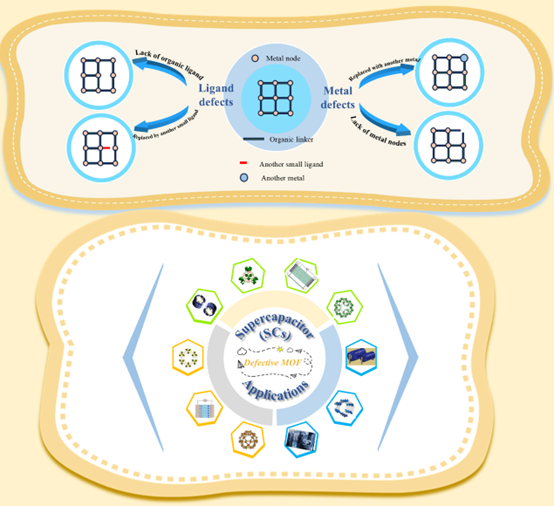
The increasing emphasis on eco-friendly energy options has accelerated the use of supercapacitors (SCs) due to their distinct advantages. Nonetheless, they face challenges, such as low power density and high self-discharge rates in practical applications. Metal-organic frameworks (MOFs) have been curated as superior candidate active components for enhancing SC performance stemming from their extensive surface areas, adjustable pore structures, and abundant accessible sites. This paper provides a thorough review of the application of multivariate defect MOFs (MTV-DMOFs) and vacancy engineering in SCs, emphasizing how various defect types (including metal and ligand defects) and their formation processes (such as etching, laser treatment, and pyrolysis) influence electrochemical performance. These defect-engineering strategies have significantly improved the energy density, power density, and cycling stability of SCs.
- Open Access
- Review
Defects-Engineered Metal-Organic Frameworks for Supercapacitor Platform
- Ruiying Fu 1,
- Lianchao Wang 1,
- Xutian Yang 1,
- Chao Li 2, *,
- Mingjun Ouyang 1,
- Hua Wu 1,
- Rui Xi 3, *,
- Kuaibing Wang 1, *
Author Information
Received: 30 Apr 2025 | Revised: 14 May 2025 | Accepted: 03 Jun 2025 | Published: 08 Jul 2025
Abstract
Graphical Abstract
Keywords
supercapacitors | metal-organic frameworks | defect engineering | energy storage | electrochemical performance
References
- 1.Abazari, R.; Sanati, S.; Fan, W.K.; et al. Design and engineering of MOF/LDH hybrid nanocomposites and LDHs derived from MOF templates for electrochemical energy conversion/storage and environmental remediation: Mechanism and future perspectives. Coord. Chem. Rev. 2025, 523, 216256. https://doi.org/10.1016/j.ccr.2024.216256.
- 2.Liu, J.; Fu, G.; Liao, Y.; et al. Electrochemical conversion of small organic molecules to value-added chemicals and hydrogen/electricity without CO2 emission: Electrocatalysts, devices and mechanisms. eScience 2025, 5, 100267. https://doi.org/10.1016/j.esci.2024.100267.
- 3.Chen, L.; Yu, C.; Dong, J.; et al. Seawater electrolysis for fuels and chemicals production: Fundamentals, achievements, and perspectives. Chem. Soc. Rev. 2024, 53, 7455–7488. https://doi.org/10.1039/D3CS00822C.
- 4.Bi, H.; Liu, J.; Wang, L.; et al. Selective contact self-assembled molecules for high-performance perovskite solar cells. eScience 2025, 5, 100329. https://doi.org/10.1016/j.esci.2024.100329.
- 5.Su, Y.; Yuan, G.; Hu, J.; et al. Thiosalicylic-Acid-Mediated Coordination Structure of Nickel Center via Thermodynamic Modulation for Aqueous Ni–Zn Batteries. Adv. Mater. 2024, 36, 2406094. https://doi.org/10.1002/adma.202406094.
- 6.Yang, S.; Li, Y.; Kang, F.; et al. Recent Progress in Organic Cocrystal-Based Superlattices and Their Optoelectronic Applications. Adv. Funct. Mater. 2025, 2504976. https://doi.org/10.1002/adfm.202504976.
- 7.Cheema, S.S.; Shanker, N.; Hsu, S.-L.; et al. Giant energy storage and power density negative capacitance superlattices. Nature 2024, 629, 803–809. https://doi.org/10.1038/s41586-024-07365-5.
- 8.Lv, J.; Xie, J.; Mohamed, A.G.A.; et al. Photoelectrochemical energy storage materials: Design principles and functional devices towards direct solar to electrochemical energy storage. Chem. Soc. Rev. 2022, 51, 1511–1528. https://doi.org/10.1039/D1CS00859E.
- 9.Kment, Š.; Bakandritsos, A.; Tantis, I.; et al. Single Atom Catalysts Based on Earth-Abundant Metals for Energy-Related Applications. Chem. Rev. 2024, 124, 11767–11847. https://doi.org/10.1021/acs.chemrev.4c00155.
- 10.Schweidler, S.; Brezesinski, T.; Breitung, B. Entropy-assisted epitaxial coating. Nat. Energy 2024, 9, 240–241. https://doi.org/10.1038/s41560-024-01468-z.
- 11.Ju, Z.; Zheng, T.; Zhang, B.; et al. Interfacial chemistry in multivalent aqueous batteries: Fundamentals, challenges, and advances. Chem. Soc. Rev. 2024, 53, 8980–9028. https://doi.org/10.1039/D4CS00474D.
- 12.Zhang, W.; Li, Y.; Zhang, C.; et al. Synchronous Regulation of Hydrophobic Molecular Architecture and Interface Engineering for Robust WORM-Type Memristor. Adv. Funct. Mater. 2024, 34, 2404625. https://doi.org/10.1002/adfm.202404625.
- 13.Zhang, G.; Feng, W.; Du, G.; et al. Thermodynamically-Driven Phase Engineering and Reconstruction Deduction of Medium-Entropy Prussian Blue Analogue Nanocrystals. Adv. Mater. 2025, 2503814. https://doi.org/10.1002/adma.202503814.
- 14.Xu, X.; Zhang, Z.; Zhang, Z.; et al. Metalion-bonded two-dimensional framework non-Van der Waals sandwich heterojunctions for fast mass transfer in flexible in-plane micro-supercapacitors. eScience 2025, in press. https://doi.org/10.1016/j.esci.2025.100404.
- 15.Giri, A.; Park, G.; Jeong, U. Layer-Structured Anisotropic Metal Chalcogenides: Recent Advances in Synthesis, Modulation, and Applications. Chem. Rev. 2023, 123, 3329–3442. https://doi.org/10.1021/acs.chemrev.2c00455.
- 16.Zhang, P.; Zhang, W.; Wang, Z.; et al. High-voltage, low-temperature supercapacitors enabled by localized “water-in- pyrrolidinium chloride” electrolyte. eScience 2023, 3, 100184. https://doi.org/10.1016/j.esci.2023.100184.
- 17.Seenivasan, S.; Adhikari, S.; Sivagurunathan, A.T.; et al. Supercapatteries: Unlocking the potential of battery- supercapacitor fusion. Energy Environ. Sci. 2025, 18, 1054–1095. https://doi.org/10.1039/D4EE04348K.
- 18.Pandey, D.; Kumar, K.S.; Thomas, J. Supercapacitor electrode energetics and mechanism of operation: Uncovering the voltage window. Prog. Mater Sci. 2024, 141, 101219. https://doi.org/10.1016/j.pmatsci.2023.101219.
- 19.Jing, C.; Tao, S.; Fu, B.; et al. Layered double hydroxide-based nanomaterials for supercapacitors and batteries: Strategies and mechanisms. Prog. Mater Sci. 2025, 150, 101410. https://doi.org/10.1016/j.pmatsci.2024.101410.
- 20.Xu, J.; Yuan, X.; Zhao, Y.; et al. One-step hydrothermal synthesis of few-layered metallic phase MoS2 for high- performance supercapacitors. Prog. Nat. Sci.-Mater. 2024, 34, 429–436. https://doi.org/10.1016/j.pnsc.2024.04.011.
- 21.Dong, W.; Xie, M.; Zhao, S.; et al. Materials design and preparation for high energy density and high power density electrochemical supercapacitors. Mater. Sci. Eng. R Rep. 2023, 152, 100713. https://doi.org/10.1016/j.mser.2022.100713.
- 22.Zheng, W.; Yang, L.; Zhang, P.; et al. Mass loading and self-discharge challenges for MXene-based aqueous supercapacitors. Energy Storage Mater. 2023, 63, 103037. https://doi.org/10.1016/j.ensm.2023.103037.
- 23.Haque, M.; Li, Q.; Rigato, C.; et al. Identification of self-discharge mechanisms of ionic liquid electrolyte based supercapacitor under high-temperature operation. J. Power Sources 2021, 485, 229328. https://doi.org/10.1016/j.jpowsour.2020.229328.
- 24.Ramulu, B.; Shaik, J.A.; Mule, A.R.; et al. Improved rate capability and energy density of high-mass hybrid supercapacitor realized through long-term cycling stability testing and selective electrode design. Mater. Sci. Eng. R Rep. 2024, 160, 100820. https://doi.org/10.1016/j.mser.2024.100820.
- 25.Flores-Diaz, N.; De Rossi, F.; Das, A.; et al. Progress of Photocapacitors. Chem. Rev. 2023, 123, 9327–9355. https://doi.org/10.1021/acs.chemrev.2c00773.
- 26.Zhou, S.; Shekhah, O.; Ramírez, A.; et al. Asymmetric pore windows in MOF membranes for natural gas valorization. Nature 2022, 606, 706–712. https://doi.org/10.1038/s41586-022-04763-5.
- 27.Navalón, S.; Dhakshinamoorthy, A.; Álvaro, M.; et al. Metal–Organic Frameworks as Photocatalysts for Solar-Driven Overall Water Splitting. Chem. Rev. 2023, 123, 445–490. https://doi.org/10.1021/acs.chemrev.2c00460.
- 28.Gong, W.; Chen, Z.; Dong, J.; et al. Chiral Metal–Organic Frameworks. Chem. Rev. 2022, 122, 9078–9144. https://doi.org/10.1021/acs.chemrev.1c00740.
- 29.Chen, T.; Deng, Z.; Lu, W.; et al. Pillar-Supported 2D Layered MOFs with Abundant Active-Site Distributions for High- Performance Alkaline Supercapacitors. Inorg. Chem. 2024, 63, 18699–18709. https://doi.org/10.1021/acs.inorgchem.4c02479.
- 30.Xu, D.; Pan, C. Glass formation, structure, relaxation, and property of metal-organic framework (MOF) glasses: A review. Prog. Nat. Sci.-Mater. 2025, 35, 98–121. https://doi.org/10.1016/j.pnsc.2024.12.006.
- 31.Yaghi, O.M.; Li, H.L. Hydrothermal Synthesis of a Metal-Organic Framework Containing Large Rectangular Channel. J. Am. Chem. Soc. 1995, 117, 10401–10402. https://doi.org/10.1021/ja00146a033.
- 32.Li, H.; Eddaoudi, M.; O’Keeffe, M.; et al. Design and synthesis of an exceptionally stable and highly porous metal- organic framework. Nature 1999, 402, 276–279. https://doi.org/10.1038/46248.
- 33.Song, A.-M.; Yang, M.-J.; Wu, Z.; et al. Rational Designed Metal–Organic Framework with Nanocavity Traps for Selectively Recognizing and Separating of Radioactive Thorium in Rare Earth Wastewater. Adv. Funct. Mater. 2024, 34, 2406932. https://doi.org/10.1002/adfm.202406932.
- 34.Lamaire, A.; Wieme, J.; Vandenhaute, S.; et al. Water motifs in zirconium metal-organic frameworks induced by nanoconfinement and hydrophilic adsorption sites. Nat. Commun. 2024, 15, 9997. https://doi.org/10.1038/s41467-024-54358-z.
- 35.Hu, L.; Wu, W.; Hu, M.; et al. Double-walled Al-based MOF with large microporous specific surface area for trace benzene adsorption. Nat. Commun. 2024, 15, 3204. https://doi.org/10.1038/s41467-024-47612-x.
- 36.Wang, Y.; Liu, Z.; Li, J.; et al. Polyaniline-on-MOF protects the MOF structure during carbonization for the construction of a portable sensor to detect tert-butylhydroquinone. Nano Energy 2025, 135, 110655. https://doi.org/10.1016/j.nanoen.2025.110655.
- 37.Xiang, Y.; Wei, S.; Wang, T.; et al. Transformation of metal-organic frameworks (MOFs) under different factors. Coord. Chem. Rev. 2025, 523, 216263. https://doi.org/10.1016/j.ccr.2024.216263.
- 38.Song, M.; Zhang, Q.; Luo, G.; et al. Coordination structure engineering of single atoms derived from MOFs for Electrocatalysis. Coord. Chem. Rev. 2025, 523, 216281. https://doi.org/10.1016/j.ccr.2024.216281.
- 39.Song, G.; Shi, Y.; Jiang, S.; et al. Recent Progress in MOF-Derived Porous Materials as Electrodes for High-Performance Lithium-Ion Batteries. Adv. Funct. Mater. 2023, 33, 2303121. https://doi.org/10.1002/adfm.202303121.
- 40.Øien-Ødegaard, S.; Shearer, G.C.; Wragg, D.S.; et al. Pitfalls in metal–organic framework crystallography: Towards more accurate crystal structures. Chem. Soc. Rev. 2017, 46, 4867–4876. https://doi.org/10.1039/C6CS00533K.
- 41.Luo, Y.; Bag, S.; Zaremba, O.; et al. MOF Synthesis Prediction Enabled by Automatic Data Mining and Machine Learning. Angew. Chem. Int. Ed. 2022, 61, e202200242. https://doi.org/10.1002/anie.202200242.
- 42.Hong, T.; Lee, C.; Bak, Y.; et al. On-Demand Tunable Electrical Conductance Anisotropy in a MOF-Polymer Composite. Small 2024, 20, 2309469. https://doi.org/10.1002/smll.202309469.
- 43.Zhang, H.; Zhang, Q.; Zeng, X. Construction of multiple heterogeneous interfaces and oxygen evolution reaction of hollow CoFe bimetallic phosphides derived from MOF template. Prog. Nat. Sci.-Mater. 2024, 34, 913–920. https://doi.org/10.1016/j.pnsc.2024.09.001.
- 44.Gao, J.; Hu, Y.; Wang, Y.; et al. MOF Structure Engineering to Synthesize Co-N-C Catalyst with Richer Accessible Active Sites for Enhanced Oxygen Reduction. Small 2021, 17, 2104684. https://doi.org/10.1002/smll.202104684.
- 45.Kim, M.; Yi, J.; Park, S.-H.; et al. Heterogenization of Molecular Electrocatalytic Active Sites through Reticular Chemistry. Adv. Mater. 2023, 35, 2203791. https://doi.org/10.1002/adma.202203791.
- 46.Zhang, S.; Gao, H.; Xu, X.; et al. MOF-derived CoN/N-C@SiO2 yolk-shell nanoreactor with dual active sites for highly efficient catalytic advanced oxidation processes. Chem. Eng. J. 2020, 381, 122670. https://doi.org/10.1016/j.cej.2019.122670.
- 47.Li, Y.; Guo, Q.; Ding, Z.; et al. MOFs-Based Materials for Solid-State Hydrogen Storage: Strategies and Perspectives. Chem. Eng. J. 2024, 485, 149665. https://doi.org/10.1016/j.cej.2024.149665.
- 48.Kim, W.-T.; Lee, W.-G.; An, H.-E.; et al. Machine learning-assisted design of metal–organic frameworks for hydrogen storage: A high-throughput screening and experimental approach. Chem. Eng. J. 2025, 507, 160766. https://doi.org/10.1016/j.cej.2025.160766.
- 49.Yang, Z.; Wang, Y.; Lin, X.; et al. Vanadium induces Ni-Co MOF formation from a NiCo LDH to catalytically enhance the MgH2 hydrogen storage performance. J. Magnes. Alloys 2025, in press. https://doi.org/10.1016/j.jma.2025.01.012.
- 50.Kim, D.W.; Jung, M.; Shin, D.Y.; et al. Fine-tuned MOF-74 type variants with open metal sites for high volumetric hydrogen storage at near-ambient temperature. Chem. Eng. J. 2024, 489, 151500. https://doi.org/10.1016/j.cej.2024.151500.
- 51.Jin, S. How to Effectively Utilize MOFs for Electrocatalysis. ACS Energy Lett. 2019, 4, 1443–1445. https://doi.org/10.1021/acsenergylett.9b01134.
- 52.Li, X.; Zhu, Q.-L. MOF-based materials for photo- and electrocatalytic CO2 reduction. EnergyChem 2020, 2, 100033. https://doi.org/10.1016/j.enchem.2020.100033.
- 53.Mamaghani, A.H.; Liu, J.W.; Zhang, Z.; et al. Promises of MOF-Based and MOF-Derived Materials for Electrocatalytic CO2 Reduction. Adv. Energy Mater. 2024, 14, 2402278. https://doi.org/10.1002/aenm.202402278.
- 54.Chauhan, N.P.S.; Perumal, P.; Chundawat, N.S.; et al. Achiral and chiral metal-organic frameworks (MOFs) as an efficient catalyst for organic synthesis. Coord. Chem. Rev. 2025, 533, 216536. https://doi.org/10.1016/j.ccr.2025.216536.
- 55.Sun, N.; Shah, S.S.A.; Lin, Z.; et al. MOF-Based Electrocatalysts: An Overview from the Perspective of Structural Design. Chem. Rev. 2025, 125, 2703–2792. https://doi.org/10.1021/acs.chemrev.4c00664.
- 56.Jin, R.; Li, R.; Ma, M.-L.; et al. Beyond Tradition: A MOF-On-MOF Cascade Z-Scheme Heterostructure for Augmented CO2 Photoreduction. Small 2025, 2409759. https://doi.org/10.1002/smll.202409759.
- 57.Li, C.; Yan, H.; Yang, H.; et al. Recent advances and future perspectives of metal-organic frameworks as efficient electrocatalysts for CO2 reduction. Sci. China Mater. 2025, 68, 21–38. https://doi.org/10.1007/s40843-024-3165-6.
- 58.Zhang, G.; Li, Y.; Du, G.; et al. Spiral-Concave Prussian Blue Crystals with Rich Steps: Growth Mechanism and Coordination Regulation. Angew. Chem. Int. Ed. 2025, 64, e202414650. https://doi.org/10.1002/anie.202414650.
- 59.Ding, M.; Liu, W.; Gref, R. Nanoscale MOFs: From synthesis to drug delivery and theranostics applications. Adv. Drug Deliver. Rev. 2022, 190, 114496. https://doi.org/10.1016/j.addr.2022.114496.
- 60.Lázaro, I.A.; Wells, C.J.R.; Forgan, R.S. Multivariate Modulation of the Zr MOF UiO-66 for Defect-Controlled Combination Anticancer Drug Delivery. Angew. Chem. Int. Ed. 2020, 59, 5211–5217. https://doi.org/10.1002/anie.201915848.
- 61.Cedrún-Morales, M.; Ceballos, M.; Soprano, E.; et al. Light-Responsive Nanoantennas Integrated into Nanoscale Metal– Organic Frameworks for Photothermal Drug Delivery. Small Sci. 2024, 4, 2400088. https://doi.org/10.1002/smsc.202400088.
- 62.Wu, M.X.; Yang, Y.W. Metal–Organic Framework (MOF)-Based Drug/Cargo Delivery and Cancer Therapy. Adv. Mater. 2017, 29, 1606134. https://doi.org/10.1002/adma.201606134.
- 63.Yu, Q.; Zhang, Q.; Wu, Z.; et al. Inhalable Metal–Organic Frameworks: A Promising Delivery Platform for Pulmonary Diseases Treatment. ACS Nano 2025, 19, 3037–3053. https://doi.org/10.1021/acsnano.4c16873.
- 64.Park, C.; Woo, J.; Jeon, M.; et al. Dual-MOF-Layered Films via Solution Shearing Approach: A Versatile Platform for Tunable Chemiresistive Sensors. ACS Nano 2025, 19, 11230–11240. https://doi.org/10.1021/acsnano.4c18848.
- 65.Wang, M.; Zhang, H.; Yan, S.; et al. Fabrication of MOF-based Nanozyme sensor arrays and their application in disease diagnosis. Coord. Chem. Rev. 2025, 532, 216506. https://doi.org/10.1016/j.ccr.2025.216506.
- 66.Jang, W.; Yoo, H.; Shin, D.; et al. Colorimetric identification of colorless acid vapors using a metal-organic framework- based sensor. Nat. Commun. 2025, 16, 385. https://doi.org/10.1038/s41467-024-55774-x.
- 67.Mohanty, B.; Kumari, S.; Yadav, P.; et al. Metal-organic frameworks (MOFs) and MOF composites based biosensors. Coord. Chem. Rev. 2024, 519, 216102. https://doi.org/10.1016/j.ccr.2024.216102.
- 68.Zhang, D.; Wang, W.; Li, S.; et al. Design strategies and energy storage mechanisms of MOF-based aqueous zinc ion battery cathode materials. Energy Storage Mater. 2024, 69, 103436. https://doi.org/10.1016/j.ensm.2024.103436.
- 69.Zhou, W.; Tang, Y.; Zhang, X.; et al. MOF derived metal oxide composites and their applications in energy storage. Coord. Chem. Rev. 2023, 477, 214949. https://doi.org/10.1016/j.ccr.2022.214949.
- 70.Polyukhov, D.M.; Kudriavykh, N.A.; Gromilov, S.A.; et al. Efficient MOF-Catalyzed Ortho–Para Hydrogen Conversion for Practical Liquefaction and Energy Storage. ACS Energy Lett. 2022, 7, 4336–4341. https://doi.org/10.1021/acsenergylett.2c02149.
- 71.Du, R.; Wu, Y.F.; Yang, Y.C.; et al. Porosity Engineering of MOF-Based Materials for Electrochemical Energy Storage. Adv. Energy Mater. 2021, 11, 2100154. https://doi.org/10.1002/aenm.202100154.
- 72.Cao, W.; Chen, Z.; Chen, J.; et al. Applications of MOF derivatives based on heterogeneous element doping in the field of electrochemical energy storage. Mater. Today 2024, 77, 118–141. https://doi.org/10.1016/j.mattod.2024.06.006.
- 73.Ji, B.; Li, W.; Zhang, F.; et al. MOF-Derived Transition Metal Phosphides for Supercapacitors. Small 2025, 21, 2409273. https://doi.org/10.1002/smll.202409273.
- 74.Wang, Y.; Liu, J.; Cao, H.; et al. Facile synthesis of porous high-entropy perovskite nanoparticles through MOF gel method for solid-state supercapacitor application. Chem. Eng. J. 2025, 509, 161246. https://doi.org/10.1016/j.cej.2025.161246.
- 75.Cheng, H.; Li, J.; Meng, T.; et al. Advances in Mn-Based MOFs and Their Derivatives for High-Performance Supercapacitor. Small 2024, 20, 2308804. https://doi.org/10.1002/smll.202308804.
- 76.Niu, L.; Wu, T.; Chen, M.; et al. Conductive Metal–Organic Frameworks for Supercapacitors. Adv. Mater. 2022, 34, 2200999. https://doi.org/10.1002/adma.202200999.
- 77.Li, H.; Liu, Y.; Zhu, X.; et al. Exploring new fields of supercapacitors by regulating metal ions in MOFs. Energy Storage Mater. 2024, 73, 103859. https://doi.org/10.1016/j.ensm.2024.103859.
- 78.Cui, S.; Gu, Y.; Tang, Y.; et al. Vacancy engineering regulating specific capacitance of supercapacitors in MOF-on-MOF derived CoSe2 quantum dots embedded in carbon and CoSe2 hollow cages. Chem. Eng. J. 2025, 512, 162326. https://doi.org/10.1016/j.cej.2025.162326.
- 79.Yanfei, Z.; Qian, L.; Guangxun, Z.; et al. Recent advances in the type, synthesis and electrochemical application of defective metal-organic frameworks. Energy Mater. 2023, 3, 300022. https://doi.org/10.20517/energymater.2023.06.
- 80.Li, S.; Han, W.; An, Q.-F.; et al. Defect Engineering of MOF-Based Membrane for Gas Separation. Adv. Funct. Mater. 2023, 33, 2303447. https://doi.org/10.1002/adfm.202303447.
- 81.Ren, J.; Ledwaba, M.; Musyoka, N.M.; et al. Structural defects in metal–organic frameworks (MOFs): Formation, detection and control towards practices of interests. Coord. Chem. Rev. 2017, 349, 169–197. https://doi.org/10.1016/j.ccr.2017.08.017.
- 82.Dai, S.; Simms, C.; Patriarche, G.; et al. Highly defective ultra-small tetravalent MOF nanocrystals. Nat. Commun. 2024, 15, 3434. https://doi.org/10.1038/s41467-024-47426-x.
- 83.Sk, S.; Islam, H.; Abraham, B.M.; et al. Defects in MOFs for Photocatalytic Water Reduction to Hydrogen Generation: From Fundamental Understanding to State-of-Art Materials. Small Methods 2024, 2401689. https://doi.org/10.1002/smtd.202401689.
- 84.Zhang, C.; Han, C.; Sholl, D.S.; et al. Computational Characterization of Defects in Metal–Organic Frameworks: Spontaneous and Water-Induced Point Defects in ZIF-8. J. Phys. Chem. Lett. 2016, 7, 459–464. https://doi.org/10.1021/acs.jpclett.5b02683.
- 85.Park, H.; Kim, S.; Jung, B.; et al. Defect Engineering into Metal–Organic Frameworks for the Rapid and Sequential Installation of Functionalities. Inorg. Chem. 2018, 57, 1040–1047. https://doi.org/10.1021/acs.inorgchem.7b02391.
- 86.An, H.; Tian, W.; Lu, X.; et al. Boosting the CO2 adsorption performance by defect-rich hierarchical porous Mg-MOF-74. Chem. Eng. J. 2023, 469, 144052. https://doi.org/10.1016/j.cej.2023.144052.
- 87.Chen, T.; Xu, H.; Li, S.; et al. Tailoring the Electrochemical Responses of MOF-74 via Dual-Defect Engineering for Superior Energy Storage. Adv. Mater. 2024, 36, 2402234. https://doi.org/10.1002/adma.202402234.
- 88.Gu, Y.; Anjali, B.A.; Yoon, S.; et al. Defect-engineered MOF-801 for cycloaddition of CO2 with epoxides. J. Mater. Chem. A 2022, 10, 10051–10061. https://doi.org/10.1039/D2TA00503D.
- 89.Liang, S.; Xiao, X.; Bai, L.; et al. Conferring Ti-Based MOFs with Defects for Enhanced Sonodynamic Cancer Therapy. Adv. Mater. 2021, 33, 2100333. https://doi.org/10.1002/adma.202100333.
- 90.Wu, J.; Dai, Q.; Zhang, H.; et al. A defect-free MOF composite membrane prepared via in-situ binder-controlled restrained second-growth method for energy storage device. Energy Storage Mater. 2021, 35, 687–694. https://doi.org/10.1016/j.ensm.2020.11.040.
- 91.Lu, Y.; Zhou, R.; Wang, N.; et al. Engineer Nanoscale Defects into Selective Channels: MOF-Enhanced Li+ Separation by Porous Layered Double Hydroxide Membrane. Nano-Micro Lett. 2023, 15, 147. https://doi.org/10.1007/s40820-023-01101-w.
- 92.Sepehrmansourie, H.; Alamgholiloo, H.; Noroozi Pesyan, N.; et al. A MOF-on-MOF strategy to construct double Z- scheme heterojunction for high-performance photocatalytic degradation. Appl. Catal. B-Environ. 2023, 321, 122082. https://doi.org/10.1016/j.apcatb.2022.122082.
- 93.Guan, Y.; Liu, T.; Wu, Y.; et al. Modulating the electronic structure of Ru using a self-reconstructed MOF-NiFeOOH heterointerface for improved electrocatalytic water splitting. J. Mater. Chem. A 2024, 12, 17404–17412. https://doi.org/10.1039/D4TA02569E.
- 94.Wang, Y.; Haidry, A.A.; Liu, Y.; et al. Enhanced electromagnetic wave absorption using bimetallic MOFs-derived TiO2/Co/C heterostructures. Carbon 2024, 216, 118497. https://doi.org/10.1016/j.carbon.2023.118497.
- 95.Li, K.; Liu, Z.-T.; Liu, Z.-W.; et al. Fast Photo- and Moisture-Driven Bidirectional Actuation of a Shape-Programmable MOF Loading Composite. Chem. Eng. J. 2025, 506, 159503. https://doi.org/10.1016/j.cej.2025.159503.
- 96.Wang, K.; Chen, C.; Li, Y.; et al. Insight into Electrochemical Performance of Nitrogen-Doped Carbon/NiCo-Alloy Active Nanocomposites. Small 2023, 19, 2300054. https://doi.org/10.1002/smll.202300054.
- 97.Deng, Z.; Wang, L.; Chen, T.; et al. Stable metal-organic frameworks with Zr6 clusters for alkaline battery-supercapacitor devices. J. Solid State Chem. 2024, 340, 125009. https://doi.org/10.1016/j.jssc.2024.125009.
- 98.Wang, Y.; Lu, W.; Wang, L.; et al. Vanadate-based Fe-MOFs as promising negative electrode for hybrid supercapacitor device. Nanotechnology 2024, 35, 205402. https://doi.org/10.1088/1361-6528/ad1d12.
- 99.Yu, X.; Hu, Y.; Luan, X.; et al. Microwave-assisted construction of MXene/MOF aerogel via N-metal bonds for efficient photodegradation of vapor acetone under high humidity. Chem. Eng. J. 2023, 476, 146878. https://doi.org/10.1016/j.cej.2023.146878.
- 100.Chen, Q.; Xue, Z.; Wei, F.; et al. Microwave-assisted rapid controllable synthesis of hexagonal prismatic CoNi-MOF-74 and its derivative for efficient oxygen evolution reaction. Int. J. Hydrogen Energy 2024, 51, 1327–1336. https://doi.org/10.1016/j.ijhydene.2023.11.081.
- 101.Yahia, M.; Lozano, L.A.; Zamaro, J.M.; et al. Microwave-assisted synthesis of metal–organic frameworks UiO-66 and MOF-808 for enhanced CO2/CH4 separation in PIM-1 mixed matrix membranes. Sep. Purif. Technol. 2024, 330, 125558. https://doi.org/10.1016/j.seppur.2023.125558.
- 102.Fan, J.; Wu, W.; Lu, Z.; et al. Rapid synthesis strategy of ultrathin UiO-66 separation membranes: Ultrasonic-assisted nucleation followed with microwave-assisted growth. J. Membr. Sci. 2022, 664, 121085. https://doi.org/10.1016/j.memsci.2022.121085.
- 103.Li, Q.; Liu, Y.; Niu, S.; et al. Microwave-assisted rapid synthesis and activation of ultrathin trimetal–organic framework nanosheets for efficient electrocatalytic oxygen evolution. J. Colloid Interface Sci. 2021, 603, 148–156. https://doi.org/10.1016/j.jcis.2021.06.102.
- 104.Wen, M.; Sun, N.; Jiao, L.; et al. Microwave-Assisted Rapid Synthesis of MOF-Based Single-Atom Ni Catalyst for CO2 Electroreduction at Ampere-Level Current. Angew. Chem. Int. Ed. 2024, 63, e202318338. https://doi.org/10.1002/anie.202318338.
- 105.Asghar, A.; Iqbal, N.; Noor, T.; et al. Efficient electrochemical synthesis of a manganese-based metal–organic framework for H2 and CO2 uptake. Green Chem. 2021, 23, 1220–1227. https://doi.org/10.1039/D0GC03292A.
- 106.Wu, W.; Decker, G.E.; Weaver, A.E.; et al. Facile and Rapid Room-Temperature Electrosynthesis and Controlled Surface Growth of Fe-MIL-101 and Fe-MIL-101-NH2. ACS Cent. Sci. 2021, 7, 1427–1433. https://doi.org/10.1021/acscentsci.1c00686.
- 107.Pei, Z.; Guo, Y.; Luan, D.; et al. Regulating the Local Reaction Microenvironment at Chromium Metal–Organic Frameworks for Efficient H2O2 Electrosynthesis in Neutral Electrolytes. Adv. Mater. 2025, 37, 2500274. https://doi.org/10.1002/adma.202500274.
- 108.Tang, D.; Yang, X.; Wang, B.; et al. One-Step Electrochemical Growth of 2D/3D Zn(II)-MOF Hybrid Nanocomposites on an Electrode and Utilization of a PtNPs@2D MOF Nanocatalyst for Electrochemical Immunoassay. ACSAppl. Mater. Inter. 2021, 13, 46225–46232. https://doi.org/10.1021/acsami.1c09095.
- 109.Wei, H.; Qin, F. Electrochemical Synthesis and Conductivity Fine Tuning of the 2D Iron-Quinoid Metal–Organic Framework. ACSAppl. Mater. Inter. 2025, 17, 2010–2017. https://doi.org/10.1021/acsami.4c17699.
- 110.Cliffe, M.J.; Hill, J.A.; Murray, C.A.; et al. Defect-dependent colossal negative thermal expansion in UiO-66(Hf) metal- organic framework. Phys. Chem. Chem. Phys. 2015, 17, 11586–11592. https://doi.org/10.1039/c5cp01307k.
- 111.Ren, J.W.; Rogers, D.E.C.; Segakweng, T.; et al. Thermal treatment induced transition from Zn3(OH)2(BDC)2 (MOF- 69c) to Zn4O(BDC)3(MOF-5). Int. J. Mater. Res. 2014, 105, 89–93. https://doi.org/10.3139/146.110994.
- 112.Borges, D.D.; Devautour-Vinot, S.; Jobic, H.; et al. Proton Transport in a Highly Conductive Porous Zirconium-Based Metal-Organic Framework: Molecular Insight. Angew. Chem. Int. Ed. 2016, 55, 3919–3924. https://doi.org/10.1002/anie.201510855.
- 113.Zhang, Y.; Liu, J.J.; Zhang, L.; et al. Particle shape characterisation and classification using automated microscopy and shape descriptors in batch manufacture of particulate solids. Particuology 2016, 24, 61–68. https://doi.org/10.1016/j.partic.2014.12.012.
- 114.Wu, D.; Yan, W.; Xu, H et al. Defect engineering of Mn-based MOFs with rod-shaped building units by organic linker fragmentation. Inorg. Chim. Acta 2017, 460, 93–98. https://doi.org/10.1016/j.ica.2016.07.022.
- 115.Wang, X.; Zhang, X.; Zhao, Y.; et al. Accelerated Multi-step Sulfur Redox Reactions in Lithium-Sulfur Batteries Enabled by Dual Defects in Metal-Organic Framework-based Catalysts. Angew. Chem. Int. Ed. 2023, 62, e202306901. https://doi.org/10.1002/anie.202306901.
- 116.Wang, Z.-D.; Zang, Y.; Liu, Z.-J.; et al. Opening catalytic sites in the copper-triazoles framework via defect chemistry for switching on the proton reduction. Appl. Catal. B-Environ. 2021, 288, 119941. https://doi.org/10.1016/j.apcatb.2021.119941.
- 117.Salman, M.; Qin, H.; Zou, Y.; et al. In-situ decoration of NiCo-thiophene based metal-organic framework on nickel foam as an efficient electrocatalyst for oxygen evolution reaction. J. Power Sources 2025, 629, 235942. https://doi.org/10.1016/j.jpowsour.2024.235942.
- 118.Li, W.-Q.; Li, Y.-M.; Hou, N.; et al. Hydroxyl-induced structural defects in metal-organic frameworks for improved photocatalytic decontamination: Accelerated exciton dissociation and hydrogen bonding interaction. J. Hazard. Mater. 2025, 487, 137149. https://doi.org/10.1016/j.jhazmat.2025.137149.
- 119.Dong, Y.; Jin, Z.; Peng, H.; et al. Size Effect and Interfacial Synergy Enhancement of 2D Ultrathin CoxZn1-x-MOF/rGO for Boosting Lithium–Sulfur Battery Performance. Small 2025, 21, 2412186. https://doi.org/10.1002/smll.202412186.
- 120.Liu, P.; Lyu, J.; Bai, P. Synthesis of mixed matrix membrane utilizing robust defective MOF for size-selective adsorption of dyes. Sep. Purif. Technol. 2025, 354, 128672. https://doi.org/10.1016/j.seppur.2024.128672.
- 121.Liu, Z.; Zhao, H.; Hua, B.; et al. Ionic Liquid-Functionalized Defective MOFs for Membrane-Based CO2 Separation: A Dual Optimization Approach for Interface and Transport. ACS Appl. Mater. Inter. 2025, 17, 6867–6877. https://doi.org/10.1021/acsami.4c16340.
- 122.Hou, X.; Wang, J.; Mousavi, B.; et al. Strategies for induced defects in metal–organic frameworks for enhancing adsorption and catalytic performance. Dalton Trans. 2022, 51, 8133–8159. https://doi.org/10.1039/D2DT01030E.
- 123.Chang, Y.-N.; Shen, C.-H.; Huang, C.-W.; et al. Defective Metal–Organic Framework Nanocrystals as Signal Amplifiers for Electrochemical Dopamine Sensing. ACS Appl. Nano Mater. 2023, 6, 3675–3684. https://doi.org/10.1021/acsanm.2c05402.
- 124.Cheng, W.; Ren, X.; Wang, X.; et al. Improving the Photoactivity of Porphyrin-Based Metal–Organic Frameworks via Constructing [Ce–O] Active Site and Vacancy. Inorg. Chem. 2024, 63, 14050–14061. https://doi.org/10.1021/acs.inorgchem.4c01836.
- 125.Baumann, A.E.; Burns, D.A.; Díaz, J.C.; et al. Lithiated Defect Sites in Zr Metal–Organic Framework for Enhanced Sulfur Utilization in Li–S Batteries. ACS Appl. Mater. Inter. 2019, 11, 2159–2167. https://doi.org/10.1021/acsami.8b19034.
- 126.Chen, T.; Bian, S.; Yang, X.; et al. A hollow urchin-like metal–organic framework with Ni–O-cluster SBUs as a promising electrode for an alkaline battery–supercapacitor device. Inorg. Chem. Front. 2023, 10, 2380–2386. https://doi.org/10.1039/D3QI00123G.
- 127.Xu, Z.; Lv, B.; Shi, X.; et al. Chemical transformation of hollow coordination polymer particles to Co3O4 nanostructures and their pseudo-capacitive behaviors. Inorg. Chim. Acta 2015, 427, 266–272. https://doi.org/10.1016/j.ica.2015.01.008.
- 128.Li, M.; Wang, J.; Wang, F.; et al. Construction of internal and external defect electrode materials based on hollow manganese-cobalt-nickel sulfide nanotube arrays. Appl. Surf. Sci. 2021, 568, 150900. https://doi.org/10.1016/j.apsusc.2021.150900.
- 129.Wang, K.-B.; Xun, Q.; Zhang, Q. Recent progress in metal-organic frameworks as active materials for supercapacitors. EnergyChem 2020, 2, 100025. https://doi.org/10.1016/j.enchem.2019.100025.
- 130.Wang, K.; Bi, R.; Huang, M.; et al. Porous Cobalt Metal–Organic Frameworks as Active Elements in Battery– Supercapacitor Hybrid Devices. Inorg. Chem. 2020, 59, 6808–6814. https://doi.org/10.1021/acs.inorgchem.0c00060.
- 131.Li, J.; Zhao, L.; Liu, P. Facile electrodepositing coral-/urchin-like polyaniline on carbon cloth in salty media as electrode for high-performance flexible supercapacitors. Prog. Nat. Sci-Mater. 2023, 33, 668–673. https://doi.org/10.1016/j.pnsc.2023.11.012.
- 132.Wang, L.; Fu, R.; Qi, X.; et al. Deashing Strategy on Biomass Carbon for Achieving High-Performance Full- Supercapacitor Electrodes. ACS Appl. Mater. Interfaces 2024, 16, 52663–52673. https://doi.org/10.1021/acsami.4c11778.
- 133.Wang, K.; Shi, X.; Zhang, Z.; et al. Size-dependent capacitance of NiO nanoparticles synthesized from Ni-based coordination polymer precursors with different crystallinity. J. Alloys Compd. 2015, 632, 361–367. https://doi.org/10.1016/j.jallcom.2015.01.252.
- 134.Liu, L.; Tian, Q.; Yao, W.; et al. All-printed ultraflexible and stretchable asymmetric in-plane solid-state supercapacitors (ASCs) for wearable electronics. J. Power Sources 2018, 397, 59–67. https://doi.org/10.1016/j.jpowsour.2018.07.013.
- 135.Deng, T.; Lu, Y.; Zhang, W.; et al. Inverted Design for High-Performance Supercapacitor Via Co(OH)2-Derived Highly Oriented MOF Electrodes. Adv. Energy Mater. 2018, 8, 1702294. https://doi.org/10.1002/aenm.201702294.
- 136.Fawad Khan, M.; Ali Marwat, M.; Abdullah; Shaheen Shah, S.; et al. Novel MoS2-sputtered NiCoMg MOFs for high- performance hybrid supercapacitor applications. Sep. Purif. Technol. 2023, 310, 123101. https://doi.org/10.1016/j.seppur.2023.123101.
- 137.Dennyson Savariraj, A.; Justin Raj, C.; Kale, A.M.; et al. Road Map for In Situ Grown Binder-Free MOFs and Their Derivatives as Freestanding Electrodes for Supercapacitors. Small 2023, 19, 2207713. https://doi.org/10.1002/smll.202207713.
- 138.Wulan Septiani, N.L.; Wustoni, S.; Failamani, F.; et al. Revealing the effect of cobalt content and ligand exchange in the bimetallic Ni–Co MOF for stable supercapacitors with high energy density. J. Power Sources 2024, 603, 234423. https://doi.org/10.1016/j.jpowsour.2024.234423.
- 139.Hong, Y.; Chen, T.; Wang, K.; et al. Supercapacitive study for electrode materials around the framework-collapse point of a Ni-based coordination polymer. CrystEngComm 2023, 25, 122–129. https://doi.org/10.1039/D2CE01236G.
- 140.Kang, L.; Zhang, M.; Zhang, J.; et al. Dual-defect surface engineering of bimetallic sulfide nanotubes towards flexible asymmetric solid-state supercapacitors. J. Mater. Chem. A 2020, 8, 24053–24064. https://doi.org/10.1039/D0TA08979F.
- 141.Darabi, R.; Karimi-Maleh, H. Hierarchical copper-1,3,5 benzenetricarboxylic acid-MOF-derived with nitrogen-doped graphene nanoribbons as a novel assembly nanocomposite for asymmetric supercapacitors. Adv. Compos. Hybrid Mater. 2023, 6, 114. https://doi.org/10.1007/s42114-023-00696-3.
- 142.Feng, W.; Liu, C.; Liu, Z.; et al. In-situ growth of N-doped graphene-like carbon/MOF nanocomposites for high- performance supercapacitor. Chin. Chem. Lett. 2024, 35, 109552. https://doi.org/10.1016/j.cclet.2024.109552.
- 143.Sun, Z.; Wang, Y.; Yang, L.; et al. RGO-Induced Flower-like Ni-MOF In Situ Self-Assembled Electrodes for High- Performance Hybrid Supercapacitors. ACS Appl. Mater. Inter. 2024, 16, 584–593. https://doi.org/10.1021/acsami.3c14046.
- 144.Feng, C.; An, Q.; Zhang, Q.; et al. Unleashing the potential of Ru/FeCo-MOF in water splitting and supercapacitors through Morphology and electronic structure control. Int. J. Hydrogen Energy 2024, 55, 189–198. https://doi.org/10.1016/j.ijhydene.2023.11.134.
- 145.Muthu, D.; Dharman, R.K.; Muthu, S.E.; et al. Recent developments in metal-organic framework-derived transition metal oxide@carbon nanostructure and carbon nanostructure for supercapacitor applications. J. Energy Storage 2025, 119, 116365. https://doi.org/10.1016/j.est.2025.116365.
- 146.Wang, J.; Li, S.; Fu, N.; et al. MOF-derived carbon-coated NiS/NiS2 yolk-shell spheres as a satisfactory positive electrode material for hybrid supercapacitors. Adv. Compos. Hybrid Mater. 2025, 8, 190. https://doi.org/10.1007/s42114-025-01257-6.
- 147.Wang, K.; Cao, X.; Wang, S.; et al. Interpenetrated and Polythreaded CoII-Organic Frameworks as a Supercapacitor Electrode Material with Ultrahigh Capacity and Excellent Energy Delivery Efficiency. ACSAppl. Mater. Interfaces 2018, 10, 9104–9115. https://doi.org/10.1021/acsami.7b16141.
- 148.Helal, A.; Yamani, Z.H.; Cordova, K.E.; et al. Multivariate metal-organic frameworks. Natl. Sci. Rev. 2017, 4, 296–298. https://doi.org/10.1093/nsr/nwx013.
- 149.Dong, W.; Liu, Z.; Sun, H.; et al. Ultrathin defect-rich nanosheets of NiFe-MOF with high specific capacitance and stability for supercapacitor. Mater. Today Chem. 2024, 36, 101938. https://doi.org/10.1016/j.mtchem.2024.101938.
- 150.Patil, S.A.; Katkar, P.K.; Kaseem, M.; et al. Cu@Fe-Redox Capacitive-Based Metal-Organic Framework Film for a High- Performance Supercapacitor Electrode. Nanomaterials 2023, 13, 1587. https://doi.org/10.3390/nano13101587.
- 151.Wang, H.; Liang, M.; Miao, Z. Engineering accordion-like Fe-doped NiS2 enabling high-performance aqueous supercapacitors and Zn-Ni batteries. Chem. Eng. J. 2023, 470, 144148. https://doi.org/10.1016/j.cej.2023.144148.
- 152.Bu, R.; Wang, Y.; Zhao, Y.; et al. “One-for-two” strategy: The construction of high performance positive and negative electrode materials via one Co-based metal organic framework precursor for boosted hybrid supercapacitor energy density. J. Power Sources 2022, 541, 231689. https://doi.org/10.1016/j.jpowsour.2022.231689.
- 153.Ren, H.; Guo, H.; Hao, Y.; et al. Defect-regulated MnS@Ni0.654Co0.155Se1.234S0.101 structures: A novel approach to unlock energy storage potential in supercapacitors. J. Colloid Interface Sci. 2025, 683, 746–758. https://doi.org/ 10.1016/j.jcis.2024.12.225.
- 154.Cao, Y.; Tian, Z.; Xiang, C.; et al. Se-doped cobalt-nickel sulfide hollow nanospheres with heterostructure and engineered defects as high-performance electrode for supercapacitors. J. Energy Storage 2024, 100, 113755. https://doi.org/10.1016/j.est.2024.113755.
- 155.Cui, S.; Tang, Y.; Cui, W.; et al. Simultaneously Improving Energy Storage and Oxygen Evolution Reaction by Causing Regional Defects in MOF-on-MOF Derived Hollow Se-Doped CoP-Fe2P Heterojunctions. ACSAppl. Mater. Inter. 2024, 16, 42230–42241. https://doi.org/10.1021/acsami.4c08244.
- 156.Nwaji, N.; Gwak, J.; Goddati, M.; et al. Defect-Engineered Fe3C@NiCo2S4 Nanospike Derived from Metal–Organic Frameworks as an Advanced Electrode Material for Hybrid Supercapacitors. ACSAppl. Mater. Inter. 2023, 15, 34779–34788. https://doi.org/10.1021/acsami.3c04635.
- 157.Mei, H.; Mei, Y.; Zhang, S.; et al. Bimetallic-MOF Derived Accordion-like Ternary Composite for High-Performance Supercapacitors. Inorg. Chem. 2018, 57, 10953–10960. https://doi.org/10.1021/acs.inorgchem.8b01574.
- 158.Liu, S.; Kang, L.; Zhang, J.; et al. Structural engineering and surface modification of MOF-derived cobalt-based hybrid nanosheets for flexible solid-state supercapacitors. Energy Storage Mater. 2020, 32, 167–177. https://doi.org/10.1016/j.ensm.2020.07.017.
- 159.Sun, J.; Xue, H.; Zhang, Y.; et al. Unraveling the Synergistic Effect of Heteroatomic Substitution and Vacancy Engineering in CoFe2O4 for Superior Electrocatalysis Performance. Nano Lett. 2022, 22, 3503–3511. https://doi.org/10.1021/acs.nanolett.1c04425.
- 160.Xu, J.; Ge, L.; Zhou, Y.; et al. Insights into N, P, S multi-doped Mo2C/C composites as highly efficient hydrogen evolution reaction catalysts. Nanoscale Adv. 2020, 2, 3334–3340. https://doi.org/10.1039/D0NA00335B.
- 161.Xu, Z.; Teng, R.; Xu, L.; et al. Assembly of Amorphizing Porous Bimetallic Metal-Organic Frameworks Spheres with Zn-O-Fe Cluster and Coordination Deficiency via Ligand Competition for Efficient Electro-Fenton Catalysis. Adv. Funct. Mater. 2024, 34, 2401248. https://doi.org/10.1002/adfm.202401248.
- 162.Shearer, G.C.; Chavan, S.; Bordiga, S.; et al. Defect Engineering: Tuning the Porosity and Composition of the Metal– Organic Framework UiO-66 via Modulated Synthesis. Chem. Mater. 2016, 28, 3749–3761. https://doi.org/10.1021/acs.chemmater.6b00602.
- 163.Yue, M.L.; Yu, C.Y.; Duan, H.H.; et al. Six Isomorphous Window-Beam MOFs: Explore the Effects o f Metal Ions on MOF-Derived Carbon for Supercapacitors. Chem. Eur. J. 2018, 24, 16160–16169. https://doi.org/10.1002/chem.201803554.
- 164.Zhang, H.; Yang, Y.; Deng, Y.; et al. Construction of 2D MOF nanosheets with missing-linker defects for enhanced supercapacitor performance. J. Alloys Compd. 2024, 999, 175049. https://doi.org/10.1016/j.jallcom.2024.175049.
- 165.Lin, S.; Guo, X.; Cai, W.; et al. Binder-Free Defective Bimetallic Metal-Organic Framework Nanostructures with Lattice Distortion as Hybrid Supercapacitor Electrodes. ACS Appl. Nano Mater. 2024, 7, 1078–1088. https://doi.org/10.1021/acsanm.3c05037.
- 166.Ferhi, N.; Desalegn Assresahegn, B.; Ardila-Suarez, C.; et al. Defective Metal–Organic Framework-808@Polyaniline Composite Materials for High Capacitance Retention Supercapacitor Electrodes. ACS Appl. Energy Mater. 2022, 5, 1235–1243. https://doi.org/10.1021/acsaem.1c03649.
- 167.Wang, J.; Deng, S.-Q.; Zhao, T.-T.; et al. A Mn(ii)–MOF with inherent missing metal-ion defects based on an imidazole- tetrazole tripodal ligand and its application in supercapacitors. Dalton Trans. 2020, 49, 12150–12155. https://doi.org/10.1039/D0DT01666G.
- 168.Salehi Rozveh, Z.; Pooriraj, M.; Rad, M.; et al. Synergistic effect of metal node engineering and mixed-linker-architected on the energy storage activities of pillar-layered Cu2(L)2(DABCO) metal-organic frameworks. Mater. Chem. Phys. 2022, 292, 126761. https://doi.org/10.1016/j.matchemphys.2022.126761.
- 169.Zhong, W.; Zhao, R.; Zhu, Y.; et al. Vacancy Engineering on MnSe Cathode Enables High-Rate and Stable Zinc-Ion Storage. Adv. Funct. Mater. 2024, 35, 2419720. https://doi.org/10.1002/adfm.202419720.
- 170.Sun, M.; Guo, W.; Wang, J.; et al. Microenvironment Reconstitution-Induced Collaborative Oxyanions-Vacancies Engineering for Enhanced High-Mass-Loading Energy Storage. Adv. Funct. Mater. 2024, 34, 2405116. https://doi.org/10.1002/adfm.202405116.
- 171.Shi, W.; Meng, Z.; Xu, Z.; et al. Controllable vacancy strategy mediated by organic ligands of nickel fluoride alkoxides for high-performance aqueous energy storage. J. Mater. Chem. A 2023, 11, 1369–1379. https://doi.org/10.1039/D2TA08004D.
- 172.Zhang, N.; Yin, L.; Chen, L.; et al. Size- and crystallinity-dependent oxygen vacancy engineering to modulate Fe active sites for enhanced reversible nitrogen fixation in Lithium-nitrogen batteries. Energy Storage Mater. 2025, 76, 104171. https://doi.org/10.1016/j.ensm.2025.104171.
- 173.Zhang, D.; Gao, H.; Li, J.; et al. Plasma-enhanced vacancy engineering for sustainable high-performance recycled silicon in lithium-ion batteries. Energy Storage Mater. 2025, 77, 104231. https://doi.org/10.1016/j.ensm.2025.104231.
- 174.Cheng, C.; Zhuo, Z.; Xia, X.; et al. Stabilized Oxygen Vacancy Chemistry toward High-Performance Layered Oxide Cathodes for Sodium-Ion Batteries. ACS Nano 2024, 18, 35052–35065. https://doi.org/10.1021/acsnano.4c14724.
- 175.Zhu, F.; Sun, L.; Liu, Y.; et al. Dual-defect site regulation on MOF-derived P-Co3O4@NC@Ov-NiMnLDH carbon arrays for high-performance supercapacitors. J. Mater. Chem. A 2022, 10, 21021–21030. https://doi.org/10.1039/D2TA05146J.
- 176.Wei, J.; Hu, F.; Lv, C.; et al. A surface defect strategy of NiCo-layered double hydroxide decorated MXene layers for durable solid-state supercapacitors. Mater. Chem. Front. 2024, 8, 3231–3241. https://doi.org/10.1039/D4QM00481G.
- 177.Chettiannan, B.; Mathan, S.; Arumugam, G.; et al. Attaining high energy density using metal-organic framework-derived NiO/Co3O4/NiCo2O4 as an electrode in asymmetric hybrid supercapacitor. J. Energy Storage 2024, 77, 110008. https://doi.org/10.1016/j.est.2023.110008.
- 178.Guo, X.; Liu, Y.; Feng, L.; et al. Zn-substituted Co3O4 crystal anchored on porous carbon nanofibers for high performance supercapacitors. Surf. Interf. 2024, 53, 105048. https://doi.org/10.1016/j.surfin.2024.105048.
- 179.Xu, D.; Xue, Z.; Han, L.; et al. Interface engineered Zn/Co-S@CeO2 heterostructured nanosheet arrays as efficient electrodes for supercapacitors. J. Alloys Compd. 2023, 946, 169399. https://doi.org/10.1016/j.jallcom.2023.169399.
- 180.Chen, C.; Zhang, H.; Yan, R.; et al. Defect engineering induced nanostructure changes of NiMo-layered double hydroxides/MOF heterostructure on battery type charge storage. J. Power Sources 2025, 639, 236685. https://doi.org/ 10.1016/j.jpowsour.2025.236685.
- 181.Mofokeng, T.P.; Ipadeola, A.K.; Tetana, Z.N.; et al. Defect-Engineered Nanostructured Ni/MOF-Derived Carbons for an Efficient Aqueous Battery-Type Energy Storage Device. ACS Omega 2020, 5, 20461–20472. https://doi.org/10.1021/acsomega.0c02563.
- 182.Yang, S.; Qian, L.; Ping, Y.; et al. Electrochemical performance ofBi2O3 supercapacitors improved by surface vacancy defects. Ceram. Int. 2021, 47, 8290–8299. https://doi.org/10.1016/j.ceramint.2020.11.190.
- 183.Wei, G.; Zhou, Z.; Zhao, X.; et al. Ultrathin Metal–Organic Framework Nanosheet-Derived Ultrathin Co3O4 Nanomeshes with Robust Oxygen-Evolving Performance and Asymmetric Supercapacitors. ACSAppl. Mater. Inter. 2018, 10, 23721–23730. https://doi.org/10.1021/acsami.8b04026.
- 184.Wang, G.; Jin, Z. Oxygen-vacancy-rich cobalt–aluminium hydrotalcite structures served as high-performance supercapacitor cathode. J. Mater. Chem. C 2021, 9, 620–632. https://doi.org/10.1039/D0TC03640D.
- 185.Wei, J.; Hu, F.; Pan, Y.; et al. Design strategy for metal–organic framework assembled on modifications of MXene layers for advanced supercapacitor electrodes. Chem. Eng. J. 2024, 481, 148793. https://doi.org/10.1016/j.cej.2024.148793.
- 186.Li, T.; Hu, Y.; Zhang, J.; et al. Doping effect and oxygen vacancy engineering in nickel-manganese layered double hydroxides for high-performance supercapacitors. Nano Energy 2024, 126, 109690. https://doi.org/10.1016/j.nanoen.2024.109690.
- 187.Tang, Y.Q.; Shen, H.M.; Cheng, J.Q et al. Fabrication of Oxygen-Vacancy Abundant NiMn-Layered Double Hydroxides for Ultrahigh Capacity Supercapacitors. Adv. Funct. Mater. 2020, 30, 1908223. https://doi.org/10.1002/adfm.201908223.
- 188.Chen, X.; Zhang, Z.; Zhou, S.; et al. In-situ growth transformation and oxygen vacancy synergistic modulation of the electronic structure of NiCo-LDH enables high-performance hybrid supercapacitors. Appl. Energy 2024, 371, 123670. https://doi.org/10.1016/j.apenergy.2024.123670.
- 189.Zhi, Z.; Wang, J.; Zhou, J.; et al. Oxygen vacancies are generated in the inner layer of the core-shell structure by in-situ electrochemical activation to promote electrochemical energy storage. J. Energy Storage 2024, 100, 113528. https://doi.org/10.1016/j.est.2024.113528.
- 190.Chen, K.; Yuan, X.; Tian, Z.; et al. A facile approach for generating ordered oxygen vacancies in metal oxides. Nat. Mater. 2025, 24, 835–842. https://doi.org/10.1038/s41563-025-02171-4.
- 191.Guo, J.; Zhao, H.; Yang, Z.; et al. Bimetallic Sulfides with Vacancy Modulation Exhibit Enhanced Electrochemical Performance. Adv. Funct. Mater. 2024, 34, 2315714. https://doi.org/10.1002/adfm.202315714.
- 192.Wang, X.; Zhou, R.; Zhang, C et al. Plasma-induced on-surface sulfur vacancies in NiCo2S4 enhance the energy storage performance of supercapatteries. J. Mater. Chem. A 2020, 8, 9278–9291. https://doi.org/10.1039/D0TA01991G.
- 193.Wang, Q.; Qu, Z.; Chen, S.; et al. Metal organic framework derived P-doping CoS@C with sulfide defect to boost high- performance asymmetric supercapacitors. J. Colloid Interface Sci. 2022, 624, 385–393. https://doi.org/10.1016/j.jcis.2022.03.053.
- 194.Nwaji, N.; Kang, H.; Goddati, M.; et al. Sulphur vacancy induced Co3S4@CoMo2S4 nanocomposites as a functional electrode for high performance supercapacitors. J. Mater. Chem. A 2023, 11, 3640–3652. https://doi.org/10.1039/D2TA08820G.
- 195.Chen, Y.; Guo, H.; Yang, F.; et al. Metal-organic frameworks (MOFs) derived hollow microspheres with rich sulfur vacancies for hybrid supercapacitors. Electrochim. Acta 2022, 434, 141319. https://doi.org/10.1016/j.electacta.2022.141319.
- 196.Huang, C.; Gao, A.; Yi, F.; et al. Metal organic framework derived hollow NiS@C with S-vacancies to boost high- performance supercapacitors. Chem. Eng. J. 2021, 419, 129643. https://doi.org/10.1016/j.cej.2021.129643.
- 197.Lai, K.; Sun, Y.; Li, N.; et al. Photocatalytic CO2-to-CH4 Conversion with Ultrahigh Selectivity of 95.93% on S-Vacancy Modulated Spatial In2S3/In2O3 Heterojunction. Adv. Funct. Mater. 2024, 34, 2409031. https://doi.org/10.1002/adfm.202409031.
- 198.Hirano, T.; Nakade, K.; Li, S.; et al. Chemical etching of a semiconductor surface assisted by single sheets of reduced graphene oxide. Carbon 2018, 127, 681–687. https://doi.org/10.1016/j.carbon.2017.11.053.
- 199.Wei, Y.; Zhu, L.; Jia, L.; et al. Study on the Influence of Etchant Composition and Etching Process on the Precision of Stainless-Steel Microchannel and Etching Mechanism. Adv. Eng. Mater. 2024, 26, 2301731. https://doi.org/10.1002/adem.202301731.
- 200.Sahoo, G.S.; Tripathy, S.P.; Joshi, D.S.; et al. Microwave induced chemical etching of CR-39 with KOH etchant: Comparison with chemical etching. Nucl. Instrum. Meth. A 2019, 935, 143–147. https://doi.org/10.1016/j.nima.2019.05.010.
- 201.Zhu, A.-X.; Dou, A.-N.; Fang, X.-D.; et al. Retracted Article: Chemical etching of a cobalt-based metal-organic framework for enhancing the electrocatalytic oxygen evolution reaction. J. Mater. Chem. A 2017. https://doi.org/10.1039/C7TA02103H.
- 202.Feng, Y.; Yao, J. Tailoring the structure and function of metal organic framework by chemical etching for diverse applications. Coord. Chem. Rev. 2022, 470, 214699. https://doi.org/10.1016/j.ccr.2022.214699.
- 203.Xu, G.; He, Q.; Huang, K.; et al. Hierarchically Ultrasmall Hf-Based MOF: Mesopore Adjustment and Reconstruction by Recycle Using Acid Etching Strategy. Chem. Eng. J. 2023, 455, 140632. https://doi.org/10.1016/j.cej.2022.140632.
- 204.Doan, H.V.; Sartbaeva, A.; Eloi, J.-C.; et al. Defective hierarchical porous copper-based metal-organic frameworks synthesised via facile acid etching strategy. Sci. Rep. 2019, 9, 10887. https://doi.org/10.1038/s41598-019-47314-1.
- 205.Gao, W.; Chen, D.; Quan, H.; et al. Fabrication of Hierarchical Porous Metal–Organic Framework Electrode for Aqueous Asymmetric Supercapacitor. ACS Sustain. Chem. Eng. 2017, 5, 4144–4153. https://doi.org/10.1021/acssuschemeng.7b00112.
- 206.Xiong, W.; Zhao, L.; Ouyang, J.; et al. Surface-modified composites of metal–organic framework and wood-derived carbon for high-performance supercapacitors. J. Colloid Interface Sci. 2025, 679, 243–252. https://doi.org/10.1016/j.jcis.2024.09.247.
- 207.Dong, H.; Li, L.; Li, C. Controlled alkali etching of MOFs with secondary building units for low-concentration CO2 capture. Chem. Sci. 2023, 14, 8507–8513. https://doi.org/10.1039/D3SC03213B.
- 208.Li, L.; Yi, J.-D.; Fang, Z.-B.; et al. Creating Giant Secondary Building Layers via Alkali-Etching Exfoliation for Precise Synthesis of Metal–Organic Frameworks. Chem. Mater. 2019, 31, 7584–7589. https://doi.org/10.1021/acs.chemmater.9b02375.
- 209.Lu, Z.; Zhu, W.; Lei, X.; et al. High pseudocapacitive cobalt carbonate hydroxide films derived from CoAl layered double hydroxides. Nanoscale 2012, 4, 3640–3643. https://doi.org/10.1039/C2NR30617D.
- 210.Yue, P.; Zhang, Y.; Wu, X. Defective ZnCoNiP nanosheets derived from metal-organic-frameworks as electrodes for high-performance supercapacitors. J. Energy Storage 2023, 58, 106320. https://doi.org/10.1016/j.est.2022.106320.
- 211.Hassan, H.; Umar, E.; Iqbal, M.W.; et al. Effect of electrolyte optimization on nitrogen-doped MXene (Ti3C2Tx) coupled with Cu–BTC MOF for a supercapattery and the hydrogen evolution reaction. New J. Chem. 2024, 48, 6277–6295. https://doi.org/10.1039/D3NJ05510H.
- 212.Huang, Q.; Hu, L.; Chen, X.; et al. Metal–Organic Framework-Derived N-Doped Carbon with Controllable Mesopore Sizes for Low-Pt Fuel Cells. Adv. Funct. Mater. 2023, 33, 2302582. https://doi.org/10.1002/adfm.202302582.
- 213.Feng, L.; Yuan, S.; Zhang, L.-L.; et al. Creating Hierarchical Pores by Controlled Linker Thermolysis in Multivariate Metal–Organic Frameworks. J. Am. Chem. Soc. 2018, 140, 2363–2372. https://doi.org/10.1021/jacs.7b12916.
- 214.Chen, J.S.; Sun, X.Y.; Kong, W.Q.; et al. N-doped bimetallic sulfides hollow spheres derived from MOF as battery-type electrode for asymmetric supercapacitors. J. Energy Storage 2023, 73, 109164. https://doi.org/10.1016/j.est.2023.109164.
- 215.Aashi; Rani, R.; Alagar, S.; Sharma, J.; et al. Laser-Induced Crafting of Modulated Structural Defects in MOF-Based Supercapacitor for Energy Storage Application. ACS Mater. Lett. 2024, 6, 1769–1778. https://doi.org/10.1021/acsmaterialslett.4c00206.
- 216.Cao, X.; Cui, L.; Liu, B.; et al. Reverse synthesis of star anise-like cobalt doped Cu-MOF/Cu2+1O hybrid materials based on a Cu(OH)2 precursor for high performance supercapacitors. J. Mater. Chem. A 2019, 7, 3815–3827. https://doi.org/10.1039/C8TA11396C.
- 217.Zheng, K.; Tan, H.; Wang, L.H.; et al. Vertically Oriented Cu2+1O@Cu-MOFs Hybrid Clusters for High-Performance Electrochemical Capacitors. Adv. Mater. Interfaces 2021, 8, 2002145. https://doi.org/10.1002/admi.202002145.
- 218.Gao, J.; Zhuang, Z.; Zhou, X.; et al. Reversible Mn2+/Mn4+ and Mn4+/Mn6+ double-electron redoxes in heterostructure MnS2/MnSe2@HCMs boost high energy storage for hybrid supercapacitors. Chem. Eng. J. 2024, 485, 149520. https://doi.org/10.1016/j.cej.2024.149520.
- 219.Wu, Y.-F.; Kuo, T.-R.; Lin, L.-Y.; et al. Investigating energy storage ability of MIL101-(Fe) derivatives prepared using successive carbonization and oxidation for supercapacitors. J. Energy Storage 2022, 55, 105420. https://doi.org/10.1016/j.est.2022.105420.
- 220.Su, Y.-Z.; Lin, T.-C.; Tsai, C.-S.; et al. Growth of Metal–Organic Framework within Macroporous PEDOT:PSS Aerogels Prepared by Directional Freezing for Supercapacitors. ACS Appl. Energy Mater. 2025, 8, 122–133. https://doi.org/10.1021/acsaem.4c02153.
- 221.Li, J.; Pan, D.; Xu, P.; et al. Rational design of porous nest-like basic Co-Ni carbonates on carbon cloth with optimized electrode process for efficient electrochemical energy storage. Nano Energy 2024, 128, 109954. https://doi.org/10.1016/j.nanoen.2024.109954.

How to Cite
Fu, R.; Wang, L.; Yang, X.; Li, C.; Ouyang, M.; Wu, H.; Xi, R.; Wang, K. Defects-Engineered Metal-Organic Frameworks for Supercapacitor Platform. Sustainable Engineering Novit 2025, 1 (1), 2. https://doi.org/10.53941/sen.2025.100002.
RIS
BibTex
Copyright & License

Copyright (c) 2025 by the authors.
This work is licensed under a Creative Commons Attribution 4.0 International License.
Article Metrics
692
Article Views
11
Citations
Contents
References

 Suite 4002 Level 4, 447 Collins Street, Melbourne, Victoria 3000, Australia
 General Inquiries: info@sciltp.com