
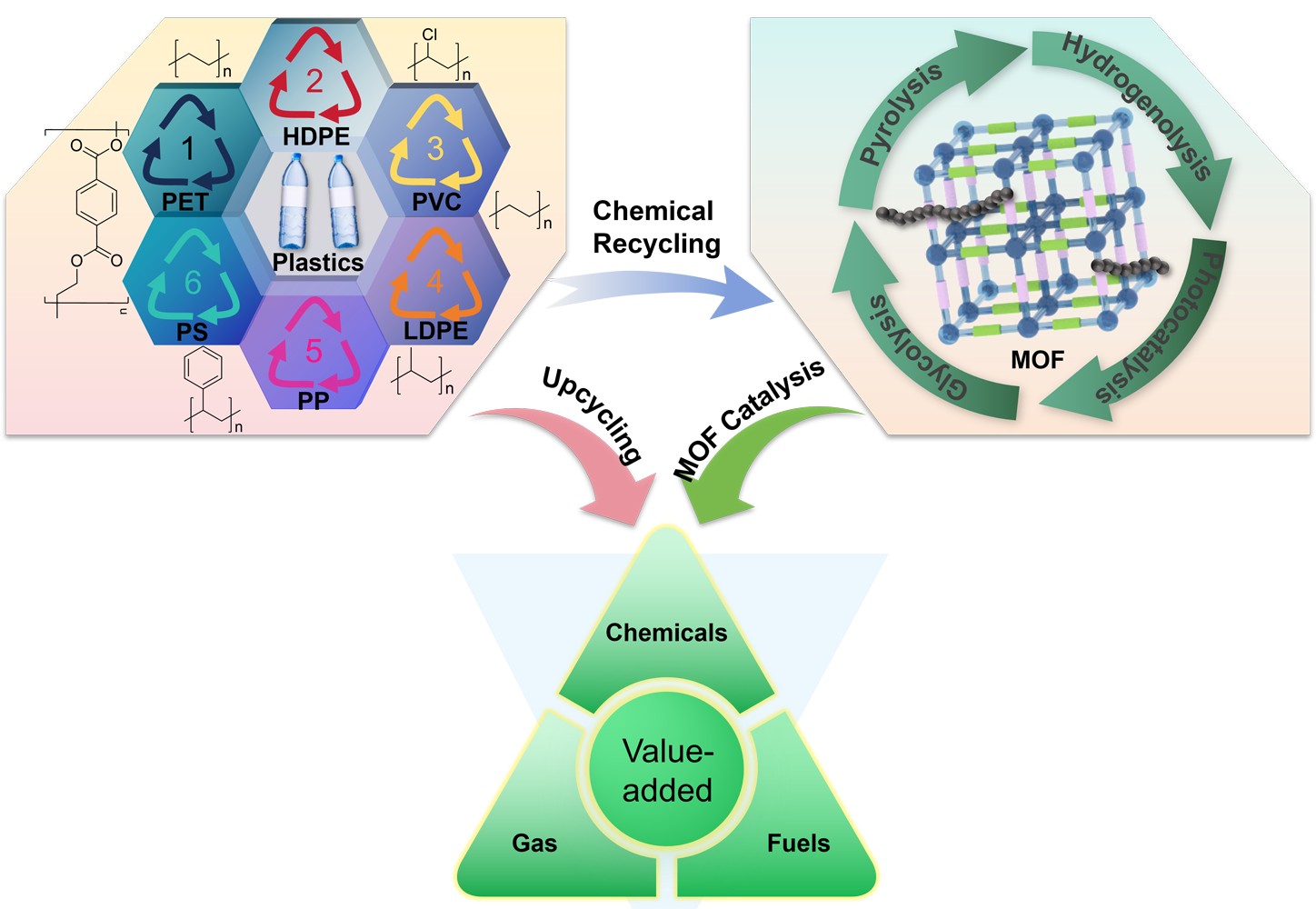
The global plastic waste crisis urgently calls for innovative strategies that move beyond conventional disposal methods. Against this backdrop, establishing a circular pathway for plastic waste—effectively converting end-of-life products into valuable resources—has become a critical objective for sustainable development. Metal–organic frameworks (MOFs) have emerged as a revolutionary catalytic platform, offering unique advantages such as structural tunability, ultrahigh surface area, and precisely designable active sites, thereby opening new possibilities for achieving this goal. This review highlights the great potential of MOF-based catalysts in addressing key challenges during plastic valorization and explores their role as ideal drivers for such a circular plastic pathway. It systematically summarizes synthesis strategies for MOFs and recent advances in their catalytic applications, covering pathways for converting plastics into high-value monomers or chemicals, as well as efficient microplastic degradation. The core objective is to demonstrate how MOF-enabled catalysis can bridge waste plastics and renewable resources, thereby providing strategic support for building a circular plastic economy.
- Open Access
- Review
Unlocking the Potential of MOFs for Waste Plastic Resource Utilization and Microplastic Pollution Control
- Yichun Su 1,†,
- Yuxin Shi 2,†,
- Liujun Jin 1,3,
- Yuan Lu 1,
- Jinpeng Wang 4,
- Hyeonseok Yoon 5,*,
- Ping Liu 1,3,*
Author Information
Received: 24 Nov 2025 | Revised: 06 Jan 2026 | Accepted: 27 Jan 2026 | Published: 06 Mar 2026
Abstract
Graphical Abstract
Keywords
MOFs | circular economy | plastics | chemical recycling | adsorption
References
- 1.
Lahive, C.W.; Dempsey, S.H.; Reiber, S.E.; et al. Acetolysis for Epoxy-Amine Carbon Fibre-Reinforced Polymer Recycling. Nature 2025, 642, 605–612.
- 2.
Mao, Y.; Wang, P.; Cao, R.; et al. Catalytic Cascade Depolymerization for Sustainable Recycling of Waste Polyvinyl Chloride. Nat. Sustain. 2025, 8, 1513–1523.
- 3.
Seo, H.; Hong, H.; Park, J.; et al. Landscape Profiling of PET Depolymerases Using a Natural Sequence Cluster Framework. Science 2025, 387, eadp5637.
- 4.
Wang, H.S.; Agrachev, M.; Kim, H.; et al. Visible Light–Triggered Depolymerization of Commercial Polymethacrylates. Science 2025, 387, 874–880.
- 5.
Chu, M.; Tu, W.; Zhang, Q.; et al. Co-recycling of Plastics and Other Waste Materials. Nat. Rev. Clean Technol. 2025, 1, 320–332.
- 6.
de Witt, J.; Luthe, T.; Wiechert, J.; et al. Upcycling of Polyamides through Chemical Hydrolysis and Engineered Pseudomonas putida. Nat. Microbiol. 2025, 10, 667–680.
- 7.
Ellis, L.D.; Rorrer, N.A.; Sullivan, K.P.; et al. Chemical and Biological Catalysis for Plastics Recycling and Upcycling. Nat. Catal. 2021, 4, 539–556.
- 8.
Geyer, R.; Jambeck, J.R.; Law, K.L. Production, Use, and Fate of All Plastics Ever Made. Sci. Adv. 2017, 3, e1700782.
- 9.
Wang, C.; Chu, H.; Wang, C. Converting Waste PET Plastics to High Value-Added MOFs-Based Functional Materials: A State of the Art Review. Coord. Chem. Rev. 2024, 518, 216106.
- 10.
Jehanno, C.; Alty, J.W.; Roosen, M.; et al. Critical Advances and Future Opportunities in Upcycling Commodity Polymers. Nature 2022, 603, 803–814.
- 11.
Conk, R.J.; Stahler, J.F.; Shi, J.X.; et al. Polyolefin Waste to Light Olefins with Ethylene and Base-Metal Heterogeneous Catalysts. Science 2024, 385, 1322–1327.
- 12.
Liu, X.; Hu, Z.; Rettner, E.M.; et al. Catalytic Closed-Loop Recycling of Polyethylene-like Materials Produced by Acceptorless Dehydrogenative Polymerization of Bio-Derived Diols. Nat. Chem. 2025, 17, 500–506.
- 13.
Nguyen, B.-N.T.; Tan, T.T.Y.; Otake, K.-I.; et al. MOF Catalysts for Plastic Depolymerization. Angew. Chem. Int. Ed. 2025, 64, e202504017.
- 14.
Xing, C.; Mao, C.; Wang, S.; et al. Ambient Solar Thermal Catalysis for Polyolefin Upcycling Using Copper Encapsulated in Silicon Nanosheets and Chloroaluminate Ionic Liquid. Nat. Catal. 2025, 8, 556–568.
- 15.
Tournier, V.; Duquesne, S.; Guillamot, F.; et al. Enzymes’ Power for Plastics Degradation. Chem. Rev. 2023, 123, 5612–5701.
- 16.
Ciccia, N.R.; Shi, J.X.; Pal, S.; et al. Diverse Functional Polyethylenes by Catalytic Amination. Science 2023, 381, 1433–1440.
- 17.
Huang, X.; Li, Y.; Shu, Z.; et al. High-Efficiency Degradation of PET Plastics by Glutathione S-Transferase under Mild Conditions. Environ. Sci. Technol. 2024, 58, 13358–13369.
- 18.
Lu, B.; Takahashi, K.; Zhou, J.; et al. Mild Catalytic Degradation of Crystalline Polyethylene Units in a Solid State Assisted by Carboxylic Acid Groups. J. Am. Chem. Soc. 2024, 146, 19599–19608.
- 19.
Rahimi, A.; García, J.M. Chemical Recycling of Waste Plastics for New Materials Production. Nat. Rev. Chem. 2017, 1, 0046.
- 20.
Lei, H.; Wang, Z.; Li, S.; et al. Recent Advancements in the Chemical Recycling and Biodegradation of Post-Consumer Polystyrene Waste. Green Chem. 2025, 27, 9357–9413.
- 21.
Qin, J.; Wu, F.; Dou, Y.; et al. Advanced Catalysts for the Chemical Recycling of Plastic Waste. Adv. Mater. 2025, 37, 2418138.
- 22.
Ran, H.; Sun, X.; Zheng, M.; et al. Synergistic Catalysis for Recycling and Upcycling of Plastics. ACS Catal. 2025, 15, 8551–8585.
- 23.
Zhang, W.; Kim, S.; Wahl, L.; et al. Low-Temperature Upcycling of Polyolefins into Liquid Alkanes via Tandem Cracking-Alkylation. Science 2023, 379, 807–811.
- 24.
Gao, Z.; Wang, Y.; Yuan, L.; et al. Room-Temperature Co-Upcycling of Polyvinyl Chloride and Polypropylene. Nat. Sustain. 2024, 7, 1691–1698.
- 25.
Du, J.; Zeng, L.; Yan, T.; et al. Efficient Solvent- and Hydrogen-Free Upcycling of High-Density Polyethylene into Separable Cyclic Hydrocarbons. Nat. Nanotechnol. 2023, 18, 772–779.
- 26.
Khopade, K.V.; Chikkali, S.H.; Barsu, N. Metal-Catalyzed Plastic Depolymerization. Cell Rep. Phys. Sci. 2023, 4, 101341.
- 27.
Cen, Z.; Han, X.; Lin, L.; et al. Upcycling of Polyethylene to Gasoline through a Self-Supplied Hydrogen Strategy in a Layered Self-Pillared Zeolite. Nat. Chem. 2024, 16, 871–880.
- 28.
Dong, Z.; Chen, W.; Xu, K.; et al. Understanding the Structure–Activity Relationships in Catalytic Conversion of Polyolefin Plastics by Zeolite-Based Catalysts: A Critical Review. ACS Catal. 2022, 12, 14882–14901.
- 29.
Pingale, N.D.; Palekar, V.S.; Shukla, S.R. Glycolysis of Postconsumer Polyethylene Terephthalate Waste. J. Appl. Polym. Sci. 2010, 115, 249–254.
- 30.
Wu, P.; Guo, M.; Zhang, R.-W.; et al. When Microplastics/Plastics Meet Metal–Organic Frameworks: Turning Threats into Opportunities. Chem. Sci. 2024, 15, 17781–17798.
- 31.
Li, H.; Tipton, B.W.; Aboukeila, H.; et al. Upcycling of Waste Plastics into Carboxylic Acids for Biodegradable Surfactants. Angew. Chem. Int. Ed. 2025, 137, e202517471.
- 32.
Gan, L.; Dong, Z.; Xu, H.; et al. Beyond Conventional Degradation: Catalytic Solutions for Polyolefin Upcycling. CCS Chem. 2024, 6, 313–333.
- 33.
Wang, Y.; Liu, F.; Chen, J.; et al. Scale-Up Upcycling of Waste Polyethylene Terephthalate Plastics to Biodegradable Polyglycolic Acid Plastics. Nat. Commun. 2025, 16, 4440.
- 34.
Yaghi, O.M.; O’Keeffe, M.; Ockwig, N.W.; et al. Reticular Synthesis and the Design of New Materials. Nature 2003, 423, 705–714.
- 35.
Deng, S.; Xiong, Y.; Chen, C.; et al. Achieving Diverse CO2 Conversions through On-Demand Installation of Multivariate Catalytic Sites into One Prototypical Metal–Organic Framework. J. Am. Chem. Soc. 2025, 147, 19996–20007.
- 36.
Xu, Q.; Wang, X.; Liu, Y.; et al. Unlocking Precision in Biomass Conversion through Functional Ligand Engineering of Lewis Acidic MOFs. Angew. Chem. Int. Ed. 2025, 64, e202508256.
- 37.
Wei, J.; Li, C.; Sun, Z.; et al. Nitrogen-Rich MOF-Material-Derived Metal Dual-Atom Platforms for Efficient Electrochemical Nitrate Reduction. Angew. Chem. Int. Ed. 2025, 137, e202517259.
- 38.
Yu, Y.; Jiao, D.; Yi, L.; et al. Unique Electronic Regulation in Bimetallic MOF for Efficient Electrochemical Synthesis of H2O2 at 500 mA cm−2. Nano Energy 2025, 141, 111096.
- 39.
Zou, X.; Shi, Q.; Cheng, M.; et al. Metal–Organic Framework-Based Materials for Photocatalytic Hydrogen Peroxide Production: Insights into Mechanism, Modification Strategies, and Environmental Applications. Adv. Energy Mater. 2025, 15, 2501424.
- 40.
Sun, N.; Shah, S.S.A.; Lin, Z.; et al. MOF-Based Electrocatalysts: An Overview from the Perspective of Structural Design. Chem. Rev. 2025, 125, 2703–2792.
- 41.
Wang, H.; Yang, L.; Yang, Y.; et al. Multifunctional Bimetallic MOF Engineering: Innovative Synthesis and Versatile Applications in Adsorption, Catalysis, Sensing, and Energy. Coord. Chem. Rev. 2026, 547, 217114.
- 42.
Su, Y.; Hu, J.; Yuan, G.; et al. Regulating Intramolecular Electron Transfer of Nickel-Based Coordinations through Ligand Engineering for Aqueous Batteries. Adv. Mater. 2023, 35, 2307003.
- 43.
Baerlocher, C.; McCusker, L.B.; Olson, D.H.; et al. Atlas of Zeolite Framework Types, 6th ed.; Baerlocher, C., McCusker, L.B., Olson, D.H., Eds.; Elsevier Science B.V.: Amsterdam, The Netherlands, 2007; pp. 1–2. https://doi.org/10.1016/B978-044453064-6/50186-9.
- 44.
Shu, L.; Peng, Y.; Song, H.; et al. Modular Customization and Regulation of Metal–Organic Frameworks for Efficient Membrane Separations. Angew. Chem. Int. Ed. 2023, 62, e202315057.
- 45.
Yu, C.; Cen, X.; Zhang, Z.; et al. Step-Nucleation In situ Self-Repair to Prepare Rollable Large-Area Ultrathin MOF Membranes. Adv. Mater. 2023, 35, 2307013.
- 46.
Gutiérrez, M.; Zhang, Y.; Tan, J. Confinement of Luminescent Guests in Metal–Organic Frameworks: Understanding Pathways from Synthesis and Multimodal Characterization to Potential Applications of LG@MOF Systems. Chem. Rev. 2022, 122, 10438–10483.
- 47.
Li, C.; Chen, Z.; Sun, C.; et al. Topology-Tuned Structural Flexibility toward Customized Piezofluorochromism in Stable Zirconium MOFs. Angew. Chem. Int. Ed. 2025, 137, e16124.
- 48.
Muralirajan, K.; Khan, I.S.; Garzon-Tovar, L.; et al. Ba/Ti MOF: A Versatile Heterogeneous Photoredox Catalyst for Visible-Light Metallaphotocatalysis. Adv. Mater. 2025, 37, 2405646.
- 49.
Han, Z.; Yang, Y.; Rushlow, J.; et al. Development of the Design and Synthesis of Metal–Organic Frameworks (MOFs)—From Large Scale Attempts, Functional Oriented Modifications, to Artificial Intelligence (AI) Predictions. Chem. Soc. Rev. 2025, 54, 367–395.
- 50.
Liang, R.; Fu, Y.; Han, Z.; et al. A Robust Pyrazolate Metal–Organic Framework for Integrated Perfluorooctanoic Acid Concentration and Degradation. Nat. Water 2024, 2, 1218–1225.
- 51.
Hu, G.; Liu, Q.; Deng, H. Space Exploration of Metal–Organic Frameworks in the Mesopore Regime. Acc. Chem. Res. 2025, 58, 73–86.
- 52.
Moghadam, P.Z.; Chung, Y.G.; Snurr, R.Q. Progress toward the Computational Discovery of New Metal–Organic Framework Adsorbents for Energy Applications. Nat. Energy 2024, 9, 121–133.
- 53.
Greed, S.; Yaghi, O.M. The Man of MOFs and More. Nat. Rev. Chem. 2025, 9, 135–137.
- 54.
Artsiusheuski, M.A.; Casati, N.P.M.; Clark, A.H.; et al. Controlling the Mechanism of Nucleation and Growth Enables Synthesis of UiO-66 Metal–Organic Framework with Desired Macroscopic Properties. Angew. Chem. Int. Ed. 2025, 64, e202415919.
- 55.
Li, Q.; Zhang, Y.; Guo, X.; et al. Nucleation and Growth Mechanisms of Micro/Nano Structural Manganese-Trimesic Acid Coordinations for Aqueous Zinc-Ion Batteries. Angew. Chem. Int. Ed. 2025, 64, e202509741.
- 56.
Cleeton, C.; Sarkisov, L. Inverse Design of Metal-Organic Frameworks Using Deep Dreaming Approaches. Nat. Commun. 2025, 16, 4806.
- 57.
Han, Z.; Wang, K.-Y.; Liang, R.-R.; et al. Modular Construction of Multivariate Metal–Organic Frameworks for Luminescent Sensing. J. Am. Chem. Soc. 2025, 147, 3866–3873.
- 58.
Snyder, B.E.R.; Turkiewicz, A.B.; Furukawa, H.; et al. A Ligand Insertion Mechanism for Cooperative NH3 Capture in Metal–Organic Frameworks. Nature 2023, 613, 287–291.
- 59.
O’Shaughnessy, M.; Glover, J.; Hafizi, R.; et al. Porous Isoreticular Non-Metal Organic Frameworks. Nature 2024, 630, 102–108.
- 60.
Liu, B.; Wu, Y.; Wang, L.; et al. Covalent Organic Frameworks as Infinite Building Units for Metal–Organic Frameworks with Compartmentalized Pores. Nat. Chem. 2025, 18, 164–172.
- 61.
Jin, H.; Zhao, P.; Qian, Y.; et al. Metal–Organic Frameworks for Organic Transformations by Photocatalysis and Photothermal Catalysis. Chem. Soc. Rev. 2024, 53, 9378–9418.
- 62.
Wang, W.; Chen, D.; Li, F.; et al. Metal-Organic-Framework-Based Materials as Platforms for Energy Applications. Chem 2024, 10, 86–133.
- 63.
Lin, Z.; Richardson, J.J.; Zhou, J.; et al. Direct Synthesis of Amorphous Coordination Polymers and Metal–Organic Frameworks. Nat. Rev. Chem. 2023, 7, 273–286.
- 64.
Wu, K.; Zhao, W.; Huang, L.; et al. Aqueous-Phase Synthesis of Cyclic Trinuclear Cluster-Based Metal–Organic Frameworks. J. Am. Chem. Soc. 2025, 147, 13711–13720.
- 65.
Liu, C.; Wang, J.; Wan, J.; et al. MOF-on-MOF Hybrids: Synthesis and Applications. Coord. Chem. Rev. 2021, 432, 213743.
- 66.
Chen, W.; Ma, B.; Zou, R. Rational Design and Controlled Synthesis of MOF-Derived Single-Atom Catalysts. Acc. Mater. Res. 2025, 6, 210–220.
- 67.
Huang, G.; Ma, J.; Chen, J.; et al. Controllable Strategy of Metal–Organic Framework Structural Stability: Regulation of Ligand Electronegativity by Esterification. Adv. Sci. 2025, 12, 2413853.
- 68.
Song, B.; Song, W.; Liang, Y.; et al. Direct Synthesis of Topology-Controlled BODIPY and CO2-Based Zirconium Metal-Organic Frameworks for Efficient Photocatalytic CO2 Reduction. Angew. Chem. Int. Ed. 2025, 64, e202421248.
- 69.
Zhang, W.; Wu, X.; Peng, X.; et al. Solution Processable Metal–Organic Frameworks: Synthesis Strategy and Applications. Adv. Mater. 2025, 37, 2412708.
- 70.
Zhang, P.; Kang, X.; Tao, L.; et al. A New Route for the Rapid Synthesis of Metal–Organic Frameworks at Room Temperature. CCS Chem. 2023, 5, 1462–1469.
- 71.
Chen, X.; Zhang, X.; Leng, C.; et al. Helical Polymer Metal–Organic Framework Hybrids. Nat. Synth. 2025, 5, 46–54. https://doi.org/10.1038/s44160-025-00909-1.
- 72.
Koley, P.; Shit, S.C.; Yoshida, T.; et al. Metal Organic Framework Derived In2O3/ZrO2 Heterojunctions with Interfacial Oxygen Vacancies for Highly Selective CO2-to-Methanol Hydrogenation. Nat. Commun. 2025, 16, 8903.
- 73.
Zeng, M.; Li, J.; Fan, S.; et al. Internally Extended Growth of Hierarchical MOF-on-MOF Nanostructures for Adsorption. ACS Appl. Nano Mater. 2025, 8, 11437–11446.
- 74.
Cai, Z.; Xia, Y.; Ito, Y.; et al. General Synthesis of MOF Nanotubes via Hydrogen-Bonded Organic Frameworks toward Efficient Hydrogen Evolution Electrocatalysts. ACS Nano 2022, 16, 20851–20864.
- 75.
Wang, J.; Jiang, Y.; Zhu, F.; et al. Design and Assembly of Continuous Macro-Micro-Porous Metal-Organic Framework Film Assisted by Atomic Layer Deposition for Biosensing. Adv. Funct. Mater. 2025, 35, 2419775.
- 76.
Yuan, A.; Du, J.; Zheng, Y.; et al. Construction of 2D CoFe-MOF Derived from LDH Electrocatalyst for Efficient Oxygen and Urea Evolution. J. Colloid Interface Sci. 2025, 684, 243–250.
- 77.
Xu, H.; Han, J.; Zhao, B.; et al. A Facile Dual-Template-Directed Successive Assembly Approach to Hollow Multi-Shell Mesoporous Metal–Organic Framework Particles. Nat. Commun. 2023, 14, 8062.
- 78.
Shen, K.; Zhang, L.; Chen, X.; et al. Ordered Macro-Microporous Metal-Organic Framework Single Crystals. Science 2018, 359, 206–210.
- 79.
Guo, Y.; Feng, L.; Wu, C.; et al. Confined Pyrolysis Transformation of ZIF-8 to Hierarchically Ordered Porous Zn-N-C Nanoreactor for Efficient CO2 Photoconversion under Mild Conditions. J. Catal. 2020, 390, 213–223.
- 80.
Yao, W.; Hu, A.; Ding, J.; et al. Hierarchically Ordered Macro–Mesoporous Electrocatalyst with Hydrophilic Surface for Efficient Oxygen Reduction Reaction. Adv. Mater. 2023, 35, 2301894.
- 81.
Shen, L.; Zhang, X.; He, H.; et al. Template-Assisted In situ Synthesis of Superaerophobic Bimetallic MOF Composites with Tunable Morphology for Boosted Oxygen Evolution Reaction. J. Colloid Interface Sci. 2024, 676, 238–248.
- 82.
Zou, Z.; Du, Z.; Dai, L.; et al. A Universal Approach for High-Yield Synthesis of Single-Crystalline Ordered Macro-Microporous Metal–Organic Frameworks. J. Am. Chem. Soc. 2024, 146, 31186–31197.
- 83.
Liang, T.-W.; Chen, C.; Kusaka, S.; et al. Mesoporous Metal–Organic Framework from Templated Synthesis as Mechanical Metamaterials. J. Am. Chem. Soc. 2025, 147, 23608–23616.
- 84.
Inagaki, S.; Guan, S.; Ohsuna, T.; et al. An Ordered Mesoporous Organosilica Hybrid Material with a Crystal-Like Wall Structure. Nature 2002, 416, 304–307.
- 85.
Liu, T.; Zhao, Y.; Song, M.; et al. Ordered Macro–Microporous Single Crystals of Covalent Organic Frameworks with Efficient Sorption of Iodine. J. Am. Chem. Soc. 2023, 145, 2544–2552.
- 86.
Xiao, Y.; Chen, Y.; Wang, W.; et al. Simultaneous Control of Flexibility and Rigidity in Pore-Space-Partitioned Metal–Organic Frameworks. J. Am. Chem. Soc. 2023, 145, 10980–10986.
- 87.
Huang, C.; Sun, W.; Jin, Y.; et al. A General Synthesis of Nanostructured Conductive Metal–Organic Frameworks from Insulating MOF Precursors for Supercapacitors and Chemiresistive Sensors. Angew. Chem. Int. Ed. 2024, 63, e202313591.
- 88.
Zhao, Z.; Zhao, Y.; Lin, R.; et al. Modular Super-Assembly of Hierarchical Superstructures from Monomicelle Building Blocks. Sci. Adv. 2022, 8, eabo0283.
- 89.
Lv, Z.; Liu, M.; Yang, Y.; et al. Hierarchical Engineering of Single-Crystalline Mesoporous Metal–Organic Frameworks with Hollow Structures. J. Am. Chem. Soc. 2025, 147, 14585–14594.
- 90.
Wang, X.; Zhang, S.; Li, M.; et al. Tailored Design of Mesoporous Metal Organic Framework Single Crystals by Kinetics-Mediated Micelle Assembly for Efficient Asymmetrical Single-Atom Catalysis. Adv. Mater. 2025, 37, 2500370.
- 91.
Wu, T.; Chen, G.; Han, J.; et al. Construction of Three-Dimensional Dendritic Hierarchically Porous Metal–Organic Framework Nanoarchitectures via Noncentrosymmetric Pore–Induced Anisotropic Assembly. J. Am. Chem. Soc. 2023, 145, 16498–16507.
- 92.
Yu, L.; Li, S.; Zhou, X.; et al. Building Ultramicroporous Zirconium Metal–Organic Frameworks with Ligands of High Coordination Density through a Reticular Approach. Nat. Chem. 2025, 17, 1207–1215.
- 93.
Miao, J.; Ullah, S.; Sun, X.; et al. Constructing Alkali Metal–Organic Frameworks with High Porosity Utilizing a High-Connectivity Organic Linker. J. Am. Chem. Soc. 2025, 147, 26926–26933.
- 94.
Yang, J.; Zhang, Z.; Jiang, Y.; et al. Net-Coded Organic Building Blocks for the Reticular Assembly of High-Connectivity Metal–Organic Frameworks. J. Am. Chem. Soc. 2025, 147, 20218–20224.
- 95.
Shi, L.; Zhong, Y.; Cao, H.; et al. A Hetero-Supermolecular-Building-Block Strategy for the Assembly of Porous (3,12,24)-Connected Uru Metal–Organic Frameworks. Nat. Synth. 2024, 3, 1560–1566.
- 96.
Yuan, S.; Chen, Y.-P.; Qin, J.-S.; et al. Linker Installation: Engineering Pore Environment with Precisely Placed Functionalities in Zirconium MOFs. J. Am. Chem. Soc. 2016, 138, 8912–8919.
- 97.
Yuan, S.; Zou, L.; Qin, J.; et al. Construction of Hierarchically Porous Metal–Organic Frameworks through Linker Labilization. Nat. Commun. 2017, 8, 15356.
- 98.
Li, Z.; Yao, B.; Cheng, C.; et al. Versatile Structural Engineering of Metal–Organic Frameworks Enabling Switchable Catalytic Selectivity. Adv. Mater. 2024, 36, 2308427.
- 99.
Fonseca, J.; Meng, L.; Imaz, I.; et al. Self-Assembly of Colloidal Metal–Organic Framework (MOF) Particles. Chem. Soc. Rev. 2023, 52, 2528–2543.
- 100.
Han, Y.; Huang, W.; He, M.; et al. Trace Benzene Capture by Decoration of Structural Defects in Metal–Organic Framework Materials. Nat. Mater. 2024, 23, 1531–1538.
- 101.
Huang, N.; Chu, B.; Chen, D.; et al. Rational Design of a Quasi-Metal–Organic Framework by Ligand Engineering for Efficient Biomass Upgrading. J. Am. Chem. Soc. 2025, 147, 8832–8840.
- 102.
Chen, T.; Li, H.; Shi, X.; et al. Robust Homochiral Polycrystalline Metal–Organic Framework Membranes for High-Performance Enantioselective Separation. J. Am. Chem. Soc. 2024, 146, 14433–14438.
- 103.
Xie, S.; Tan, X.; Xue, Z.; et al. Cathodic Deposition-Assisted Synthesis of Thin Glass MOF Films for High-Performance Gas Separations. Angew. Chem. Int. Ed. 2024, 63, e202401817.
- 104.
Mandal, S.; Natarajan, S.; Mani, P.; et al. Post-Synthetic Modification of Metal–Organic Frameworks toward Applications. Adv. Funct. Mater. 2021, 31, 2006291.
- 105.
Ouyang, J.; Tao, H.; Yang, Z.; et al. Modulator Engineering of Bifunctional Metal-Organic Framework for Synergistic Catalysis. Chem Catal. 2025, 5, 101155.
- 106.
Biswas, A.; Lemcoff, N.; Shelonchik, O.; et al. Molecular Light-to-Heat Conversion Promotes Orthogonal Synthesis and Assembly of Metal-Organic Frameworks. Nat. Commun. 2025, 16, 2758.
- 107.
Zeng, L.; Huang, L.; Wang, Z.; et al. Self-Assembled Metal–Organic Framework Stabilized Organic Cocrystals for Biological Phototherapy. Angew. Chem. Int. Ed. 2021, 60, 23569–23573.
- 108.
Huang, H.; Li, J.; Yuan, M.; et al. Large-Scale Self-Assembly of MOFs Colloidosomes for Bubble-Propelled Micromotors and Stirring-Free Environmental Remediation. Angew. Chem. Int. Ed. 2022, 61, e202211163.
- 109.
Lyu, D.; Xu, W.; Payong, J.E.L.; et al. Low-Dimensional Assemblies of Metal-Organic Framework Particles and Mutually Coordinated Anisotropy. Nat. Commun. 2022, 13, 3980.
- 110.
Ji, Y.; Lin, Y.; Qiao, Y. Interfacial Assembly of Biomimetic MOF-Based Porous Membranes on Coacervates to Build Complex Protocells and Prototissues. Nat. Chem. 2025, 17, 986–996.
- 111.
Li, Z.; He, M.; Wang, Y.; et al. Advances in Biocompatible Metal-Organic Frameworks for Biomedical Applications. Adv. Mater. 2025, 37, 2503946.
- 112.
Wu, X.; Gao, Y.; Wang, H.; et al. Hydrophobized Metal–Organic Frameworks as Versatile Building Blocks for Tailored Nanocrystal Superlattices. J. Am. Chem. Soc. 2025, 147, 6361–6366.
- 113.
Ayata, M.; Fedoryshyn, Y.; Heni, W.; et al. High-Speed Plasmonic Modulator in a Single Metal Layer. Science 2017, 358, 630–632.
- 114.
Balaur, E.; O’ Toole, S.; Spurling, A.J.; et al. Colorimetric Histology Using Plasmonically Active Microscope Slides. Nature 2021, 598, 65–71.
- 115.
Lu, Y.; Zhang, X.; Zhao, L.; et al. Metal-Organic Framework Template-Guided Electrochemical Lithography on Substrates for SERS Sensing Applications. Nat. Commun. 2023, 14, 5860.
- 116.
Song, Y.; Song, X.; Wang, X.; et al. Two-Dimensional Metal–Organic Framework Superstructures from Ice-Templated Self-Assembly. J. Am. Chem. Soc. 2022, 144, 17457–17467.
- 117.
Han, W.; Shi, M.; Jiang, H.-L. Scalable and Low-Energy Synthesis of Metal–Organic Frameworks by a Seed-Mediated Approach. Angew. Chem. Int. Ed. 2025, 64, e202421942.
- 118.
Liu, M.; Lv, Z.; Peng, Y.; et al. Unlocking Advanced Architectures of Single-Crystal Metal–Organic Frameworks. Angew. Chem. Int. Ed. 2025, 64, e202423939.
- 119.
Łuczak, J.; Kroczewska, M.; Baluk, M.; et al. Morphology Control through the Synthesis of Metal-Organic Frameworks. Adv. Colloid Interface Sci. 2023, 314, 102864.
- 120.
Su, Y.; Zhang, Y.; Feng, W.; et al. Monocarboxylic Acid Structural Analogues Facilitate In situ Composite of Functional Complexes for Aqueous Batteries. Angew. Chem. Int. Ed. 2025, 64, e202502752.
- 121.
Zhou, T.; Liu, H.; Xia, T.; et al. Optimizing *CO/CO Supply by Atomically Dispersed Fe Sites for High-Rate CO2-to-C2H4 Conversion under Visible Light. Angew. Chem. Int. Ed. 2025, 64, e202517013.
- 122.
Gao, Y.; Sun, M.; Jing, Y.; et al. Electrocatalytic C–S Cross-Coupling via Engineered Frustrated Lewis Acid-Base Pairs for High-Efficiency Methanesulfonate Synthesis. Angew. Chem. Int. Ed. 2025, 64, e202509851.
- 123.
Li, L.; Zhao, X.; Tang, M.; et al. Highly Efficient CO2 Electroreduction in Artificial Seawater Electrolyte Catalyzed by Strong-Acid/Base-Resistant MOF. Angew. Chem. Int. Ed. 2025, 64, e202512100.
- 124.
Wang, X.; Zhou, W.; Zhai, S.; et al. Metal-Organic Frameworks: Direct Synthesis by Organic Acid-Etching and Reconstruction Disclosure as Oxygen Evolution Electrocatalysts. Angew. Chem. Int. Ed. 2024, 63, e202400323.
- 125.
Tang, C.; Rao, H.; Li, S.; et al. A Review of Metal–Organic Frameworks Derived Hollow-Structured Photocatalysts: Synthesis and Applications. Small 2024, 20, 2405533.
- 126.
Kan, X.; Zhang, G.; Ma, J.; et al. Multiscale Co-Assembly to Meso-Macroporous Foamed Single-Crystal Metal–Organic Frameworks for the Supported Capture of Sulfur Dioxide. Adv. Funct. Mater. 2024, 34, 2312044.
- 127.
Ji, Z.; Mukherjee, S.; Andreo, J.; et al. Electrostatic Atlas of Non-Covalent Interactions Built into Metal–Organic Frameworks. Nat. Chem. 2025, 17, 1920–1927.
- 128.
Lv, Z.; Lin, R.; Yang, Y.; et al. Uniform Single-Crystal Mesoporous Metal–Organic Frameworks. Nat. Chem. 2025, 17, 177–185.
- 129.
Jiang, N.; Darù, A.; Kunstelj, Š.; et al. Catalytic, Spectroscopic, and Theoretical Studies of Fe4S4-Based Coordination Polymers as Heterogenous Coupled Proton–Electron Transfer Mediators for Electrocatalysis. J. Am. Chem. Soc. 2024, 146, 12243–12252.
- 130.
Xie, J.; Wang, L.; Anderson, J.S. Heavy Chalcogenide-Transition Metal Clusters as Coordination Polymer Nodes. Chem. Sci. 2020, 11, 8350–8372.
- 131.
Gillen, J.H.; Moore, C.A.; Vuong, M.; et al. Synthesis and Disassembly of an Organometallic Polymer Comprising Redox-Active Co4S4 Clusters and Janus Biscarbene Linkers. Chem. Commun. 2022, 58, 4885–4888.
- 132.
Kalaj, M.; Cohen, S.M. Postsynthetic Modification: An Enabling Technology for the Advancement of Metal–Organic Frameworks. ACS Cent. Sci. 2020, 6, 1046–1057.
- 133.
Xie, H.; Khoshooei, M.A.; Mandal, M.; et al. Introducing Metal–Sulfur Active Sites in Metal–Organic Frameworks via Post-Synthetic Modification for Hydrogenation Catalysis. Nat. Chem. 2025, 17, 1795.
- 134.
Su, Y.; Yuan, G.; Hu, J.; et al. Thiosalicylic-Acid-Mediated Coordination Structure of Nickel Center via Thermodynamic Modulation for Aqueous Ni–Zn Batteries. Adv. Mater. 2024, 36, 2406094.
- 135.
Smith, K.T.; Yadav, A.K.; Stylianou, K.C. Uncapping Energy Transfer Pathways in Metal-Organic Frameworks through Heterogeneous Structures. Nat. Commun. 2025, 16, 7986.
- 136.
He, Y.; Tilocca, A.; Dulub, O.; et al. Local Ordering and Electronic Signatures of Submonolayer Water on Anatase TiO2(101). Nat. Mater. 2009, 8, 585–589.
- 137.
Castells-Gil, J.; Padial, N.M.; Almora-Barrios, N.; et al. De Novo Synthesis of Mesoporous Photoactive Titanium(iv)–Organic Frameworks with MIL-100 Topology. Chem. Sci. 2019, 10, 4313–4321.
- 138.
Han, G.; Sun, M.; Zhao, R.; et al. Defect Engineered Ti-MOFs and Their Applications. Chem. Soc. Rev. 2025, 54, 5081–5107.
- 139.
Serre, C.; Groves, J.A.; Lightfoot, P.; et al. Synthesis, Structure and Properties of Related Microporous N,N’-Piperazinebismethylenephosphonates of Aluminum and Titanium. Chem. Mater. 2006, 18, 1451–1457.
- 140.
Rozes, L.; Steunou, N.; Fornasieri, G.; et al. Titanium-Oxo Clusters, Versatile Nanobuilding Blocks for the Design of Advanced Hybrid Materials. Monatshefte Für Chem. Chem. Mon. 2006, 137, 501–528.
- 141.
Wang, S.; Kitao, T.; Guillou, N.; et al. A Phase Transformable Ultrastable Titanium-Carboxylate Framework for Photoconduction. Nat. Commun. 2018, 9, 1660.
- 142.
Fu, Y.; Sun, D.; Chen, Y.; et al. An Amine-Functionalized Titanium Metal–Organic Framework Photocatalyst with Visible-Light-Induced Activity for CO2 Reduction. Angew. Chem. Int. Ed. 2012, 51, 3364–3367.
- 143.
Hendon, C.H.; Tiana, D.; Fontecave, M.; et al. Engineering the Optical Response of the Titanium-MIL-125 Metal–Organic Framework through Ligand Functionalization. J. Am. Chem. Soc. 2013, 135, 10942–10945.
- 144.
Rozes, L.; Sanchez, C. Titanium Oxo-Clusters: Precursors for a Lego-like Construction of Nanostructured Hybrid Materials. Chem. Soc. Rev. 2011, 40, 1006–1030.
- 145.
Wang, S.; Cabrero-Antonino, M.; Navalón, S.; et al. A Robust Titanium Isophthalate Metal-Organic Framework for Visible-Light Photocatalytic CO2 Methanation. Chem 2020, 6, 3409–3427.
- 146.
Yuan, S.; Liu, T.; Feng, D.; et al. A Single Crystalline Porphyrinic Titanium Metal–Organic Framework. Chem. Sci. 2015, 6, 3926–3930.
- 147.
Bryant, J.T.; Logan, M.W.; Chen, Z.; et al. Synergistic Steric and Electronic Effects on the Photoredox Catalysis by a Multivariate Library of Titania Metal–Organic Frameworks. J. Am. Chem. Soc. 2023, 145, 4589–4600.
- 148.
Gao, L.; Zhang, Z.; Li, J.; et al. Thermal Crystal-to-Crystal Transformation Unlocks Ti8O10(OOC)12-Cluster-Based Metal–Organic Frameworks. J. Am. Chem. Soc. 2025, 147, 26616–26625.
- 149.
Wu, Y.; Jiang, W.; Xu, W.; et al. Hydroxyl Spillover in Fe–Se Dual-Site Catalysts for Mixed Plastics Assay. J. Am. Chem. Soc. 2025, 147, 1356–1363.
- 150.
Zhang, W.; Yang, B.; Jackson, B.A.; et al. Integrated Low-Temperature PVC and Polyolefin Upgrading. Science 2025, 390, 88–94.
- 151.
Zhao, J.; Liu, B.; Xiong, L.; et al. Highly Selective Upcycling of Plastic Mixture Waste by Microwave-Assisted Catalysis over Zn/b-ZnO. Nat. Commun. 2025, 16, 1726.
- 152.
Wang, M.; Gao, Y.; Yuan, S.; et al. Complete Hydrogenolysis of Mixed Plastic Wastes. Nat. Chem. Eng. 2024, 1, 376–384.
- 153.
Xiong, D.; He, X.; Liu, X.; et al. Manipulating Dual-Metal Catalytic Activities toward Organic Upgrading in Upcycling Plastic Wastes with Inhibited Oxygen Evolution. ACS Nano 2024, 18, 20340–20352.
- 154.
Ren, S.; Xu, X.; Hu, K.; et al. Salt-Templated Transformation of Waste Plastics into Single-Atom Catalysts for Environmental and Energy Applications. Nat. Commun. 2025, 16, 8194.
- 155.
Xiong, D.; He, X.; Zhu, Z.; et al. Upcycling Polybutylene Succinate Waste to Succinic Acid via Paired Electrocatalytic Using Thiol-Engineered MOFs and a CO2-Assisted Precipitation System. Adv. Funct. Mater. 2025, e18434. https://doi.org/10.1002/adfm.202518434.
- 156.
He, D.; Huang, G.; Zhou, Z.; et al. Recent Progress for Designing of Catalysts for Photothermal Conversion of Plastic Wastes. Adv. Funct. Mater. 2024, 36, 2419801.
- 157.
Ran, H.; Zhang, S.; Ni, W.; et al. Precise Activation of C–C Bonds for Recycling and Upcycling of Plastics. Chem. Sci. 2024, 15, 795–831.
- 158.
Zhao, J.; Hu, Q.; Wang, Y.; et al. Tandem Catalysis to Mitigate Coke Formation in the Upcycling of Mixed Polyolefin Wastes. J. Am. Chem. Soc. 2025, 147, 30768–30776.
- 159.
Healy, C.; Patil, K.M.; Wilson, B.H.; et al. The Thermal Stability of Metal-Organic Frameworks. Coord. Chem. Rev. 2020, 419, 213388.
- 160.
An, Y.; Lv, X.; Jiang, W.; et al. The Stability of MOFs in Aqueous Solutions—Research Progress and Prospects. Green Chem. Eng. 2024, 5, 187–204.
- 161.
Wu, K.; Liu, X.; Cheng, P.; et al. Linker Engineering for Reactive Oxygen Species Generation Efficiency in Ultra-Stable Nickel-Based Metal–Organic Frameworks. J. Am. Chem. Soc. 2023, 145, 18931–18938.
- 162.
Yue, K.; Lu, R.; Gao, M.; et al. Polyoxometalated Metal-Organic Framework Superstructure for Stable Water Oxidation. Science 2025, 388, 430–436.
- 163.
Soni, V.K.; Singh, G.; Vijayan, B.K.; et al. Thermochemical Recycling of Waste Plastics by Pyrolysis: A Review. Energy Fuels 2021, 35, 12763–12808.
- 164.
Hussain, I.; Aitani, A.; Malaibari, Z.; et al. Chemical Upcycling of Waste Plastics to High Value-Added Products via Pyrolysis: Current Trends, Future Perspectives, and Techno-Feasibility Analysis. Chem. Rec. 2023, 23, e202200294.
- 165.
Li, H.; Wu, J.; Jiang, Z.; et al. Hydroformylation of Pyrolysis Oils to Aldehydes and Alcohols from Polyolefin Waste. Science 2023, 381, 660–666.
- 166.
Cannavacciuolo, F.D.; Yadav, R.; Esper, A.; et al. A High-Throughput Approach to Repurposing Olefin Polymerization Catalysts for Polymer Upcycling. Angew. Chem. Int. Ed. 2022, 61, e202202258.
- 167.
Chen, S.; Tennakoon, A.; You, K.-E.; et al. Ultrasmall Amorphous Zirconia Nanoparticles Catalyse Polyolefin Hydrogenolysis. Nat. Catal. 2023, 6, 161–173.
- 168.
Klet, R.C.; Tussupbayev, S.; Borycz, J.; et al. Single-Site Organozirconium Catalyst Embedded in a Metal–Organic Framework. J. Am. Chem. Soc. 2015, 137, 15680–15683.
- 169.
Ji, P.; Solomon, J.B.; Lin, Z.; et al. Transformation of Metal–Organic Framework Secondary Building Units into Hexanuclear Zr-Alkyl Catalysts for Ethylene Polymerization. J. Am. Chem. Soc. 2017, 139, 11325–11328.
- 170.
Uemura, T.; Yanai, N.; Kitagawa, S. Polymerization Reactions in Porous Coordination Polymers. Chem. Soc. Rev. 2009, 38, 1228–1236.
- 171.
Heng, J.Z.X.; Tan, T.T.Y.; Li, X.; et al. Pyrolytic Depolymerization of Polyolefins Catalysed by Zirconium-Based UiO-66 Metal–Organic Frameworks. Angew. Chem. Int. Ed. 2024, 63, e202408718.
- 172.
Artetxe, M.; Lopez, G.; Amutio, M.; et al. Cracking of High Density Polyethylene Pyrolysis Waxes on HZSM-5 Catalysts of Different Acidity. Ind. Eng. Chem. Res. 2013, 52, 10637–10645.
- 173.
Wang, Y.; Cheng, L.; Gu, J.; et al. Catalytic Pyrolysis of Polyethylene for the Selective Production of Monocyclic Aromatics over the Zinc-Loaded ZSM-5 Catalyst. ACS Omega 2022, 7, 2752–2765.
- 174.
Hou, Q.; Zhen, M.; Qian, H.; et al. Upcycling and Catalytic Degradation of Plastic Wastes. Cell Rep. Phys. Sci. 2021, 2, 100514.
- 175.
Guo, Z.; Zhang, H.; Chen, H.; et al. Hydrogenating Polyethylene Terephthalate into Degradable Polyesters. Angew. Chem. Int. Ed. 2025, 64, e202418157.
- 176.
Wen, X.; Niu, R.; Tang, T.; et al. Atmospheric, Continuous Degradation of Poly(ethylene terephthalate) Waste by ZnO. Appl. Catal. B Environ. 2025, 377, 125485.
- 177.
Thiounn, T.; Smith, R.C. Advances and Approaches for Chemical Recycling of Plastic Waste. J. Polym. Sci. 2020, 58, 1347–1364.
- 178.
Cao, J.; Liang, H.; Yang, J.; et al. Depolymerization Mechanisms and Closed-Loop Assessment in Polyester Waste Recycling. Nat. Commun. 2024, 15, 6266.
- 179.
Qin, M.; Huang, P.; Zhang, M.; et al. Binuclear Metal-Based Covalent Organic Framework Mimicking Metallohydrolases for Direct Photoreforming of PET Plastic. J. Am. Chem. Soc. 2025, 147, 29232–29240.
- 180.
Wu, B.; Zhong, B.; Zheng, L.; et al. Harnessing Protein Language Model for Structure-Based Discovery of Highly Efficient and Robust PET Hydrolases. Nat. Commun. 2025, 16, 6211.
- 181.
Robles-Martín, A.; Amigot-Sánchez, R.; Fernandez-Lopez, L.; et al. Sub-Micro- and Nano-Sized Polyethylene Terephthalate Deconstruction with Engineered Protein Nanopores. Nat. Catal. 2023, 6, 1174–1185.
- 182.
Zhang, S.; Xu, W.; Zhao, X.; et al. Adjustable Upcycling of Polyethylene Terephthalate to Biodegradable Polymer Monomers by Mn-Catalyzed Solvent Switching Strategy. Angew. Chem. Int. Ed. 2025, 64, e202505490.
- 183.
Chen, X.; Guo, Z.; Wang, L.; et al. Directional-Path Modification Strategy Enhances PET Hydrolase Catalysis of Plastic Degradation. J. Hazard. Mater. 2022, 433, 128816.
- 184.
Cao, Y.; Xiang, L.; Nikodinovic-Runic, J.; et al. Improving Enzymatic Degradation of Unpretreated Poly(ethylene terephthalate). Chin. J. Catal. 2025, 71, 375–389.
- 185.
Jin, S.; Kwon, C.; Bugaev, A.; et al. Atom-by-Atom Design of Cu/ZrOx Clusters on MgO for CO2 Hydrogenation Using Liquid-Phase Atomic Layer Deposition. Nat. Catal. 2024, 7, 1199–1212.
- 186.
Chen, S.; Zhu, Z.; Song, K.; et al. Engineering Cu/Ru Heterointerface-Shelled Nanocavities by the Kirkendall Effect for Highly Efficient Nitrate Electroreduction to Ammonia. J. Am. Chem. Soc. 2025, 147, 36494–36507.
- 187.
Trickett, C.A.; Osborn Popp, T.M.; Su, J.; et al. Identification of the Strong Brønsted Acid Site in a Metal–Organic Framework Solid Acid Catalyst. Nat. Chem. 2019, 11, 170–176.
- 188.
Kirlikovali, K.O.; Chen, Z.; Islamoglu, T.; et al. Zirconium-Based Metal–Organic Frameworks for the Catalytic Hydrolysis of Organophosphorus Nerve Agents. ACS Appl. Mater. Interfaces 2020, 12, 14702–14720.
- 189.
Li, J.; Huang, J.; Zhao, Z.; et al. Low-Coordination Indium Single-Atom Sites Anchored on a Metal-Organic Framework Single-Layer Boosts Electroreduction of CO2 into Formic Acid. Angew. Chem. Int. Ed. 2025, 64, e202511132.
- 190.
Chi, H.; Song, S.; Zhao, K.; et al. Non-Van-der-Waals Oriented Two-Dimensional UiO-66 Films by Rapid Aqueous Synthesis at Room Temperature. J. Am. Chem. Soc. 2025, 147, 7255–7263.
- 191.
Bai, Y.; Dou, Y.; Xie, L.; et al. Zr-Based Metal–Organic Frameworks: Design, Synthesis, Structure, and Applications. Chem. Soc. Rev. 2016, 45, 2327–2367.
- 192.
Xiong, X.; Song, L.; Wang, W.; et al. Synthesis and Modification of Formate Zr-MOF (ZrFA) toward Scalable and Cost-Cutting Gas Separation. Angew. Chem. Int. Ed. 2025, 64, e202505978.
- 193.
Wu, Y.; Wang, X.; Kirlikovali, K.O.; et al. Catalytic Degradation of Polyethylene Terephthalate Using a Phase-Transitional Zirconium-Based Metal–Organic Framework. Angew. Chem. Int. Ed. 2022, 61, e202117528.
- 194.
Guillerm, V.; Ragon, F.; Dan-Hardi, M.; et al. A Series of Isoreticular, Highly Stable, Porous Zirconium Oxide Based Metal–Organic Frameworks. Angew. Chem. Int. Ed. 2012, 51, 9267–9271.
- 195.
Kratish, Y.; Li, J.; Liu, S.; et al. Polyethylene Terephthalate Deconstruction Catalyzed by a Carbon-Supported Single-Site Molybdenum-Dioxo Complex. Angew. Chem. Int. Ed. 2020, 59, 19857–19861.
- 196.
Xu, M.; Chen, Q.; Xie, L.; et al. Exchange Reactions in Metal-Organic Frameworks: New Advances. Coord. Chem. Rev. 2020, 421, 213421.
- 197.
Wei, X.; Qiu, J.; Wang, H.; et al. Efficient Glycolysis of Poly(ethylene terephthalate) to Bis(hydroxyethyl) Terephthalate Catalyzed by Non-Metallic Deep Eutectic Solvent. Chem. Eng. J. 2025, 508, 161115.
- 198.
Wu, Y.; Tang, X.; Qian, S.; et al. Efficient Chemical Recycling of Mixed Plastics by Intramolecular Glycolysis. AIChE J. 2025, 71, e70064.
- 199.
Barnard, E.; Rubio Arias, J.J.; Thielemans, W. Chemolytic Depolymerisation of PET: A Review. Green Chem. 2021, 23, 3765–3789.
- 200.
Jo, Y.; Kim, E.J.; Kim, J.; et al. Efficient Fe3O4 Nanoparticle Catalysts for Depolymerization of Polyethylene Terephthalate. Green Chem. 2023, 25, 8160–8171.
- 201.
Chiao, Y.-W.; Liao, W.; Krisbiantoro, P.A.; et al. Waste-Battery-Derived Multifunctional Zinc Catalysts for Glycolysis and Decolorization of Polyethylene Terephthalate. Appl. Catal. B 2023, 325, 122302.
- 202.
Suo, Q.; Zi, J.; Bai, Z.; et al. The Glycolysis of Poly(ethylene terephthalate) Promoted by Metal Organic Framework (MOF) Catalysts. Catal. Lett. 2017, 147, 240–252.
- 203.
Ghaemy, M.; Mossaddegh, K. Depolymerisation of Poly(ethylene terephthalate) Fibre Wastes Using Ethylene Glycol. Polym. Degrad. Stab. 2005, 90, 570–576.
- 204.
Han, N.; Lee, K.; Lee, J.; et al. Dual-Porous ZIF-8 Heterogeneous Catalysts with Increased Reaction Sites for Efficient PET Glycolysis. Chemosphere 2024, 364, 143187.
- 205.
Yang, R.; Bieh, Y.; Chen, C.H.; et al. Heterogeneous Metal Azolate Framework-6 (MAF-6) Catalysts with High Zinc Density for Enhanced Polyethylene Terephthalate (PET) Conversion. ACS Sustain. Chem. Eng. 2021, 9, 6541–6550.
- 206.
Park, K.S.; Ni, Z.; Côté, A.P.; et al. Exceptional Chemical and Thermal Stability of Zeolitic Imidazolate Frameworks. Proc. Natl. Acad. Sci. USA 2006, 103, 10186–10191.
- 207.
Apicella, B.; Di Serio, M.; Fiocca, L.; et al. Kinetic and Catalytic Aspects of the Formation of Poly(ethylene terephthalate) (PET) Investigated with Model Molecules. J. Appl. Polym. Sci. 1998, 69, 2423–2433.
- 208.
Reinoso, D.M.; Ferreira, M.L.; Tonetto, G.M. Study of the Reaction Mechanism of the Transesterification of Triglycerides Catalyzed by Zinc Carboxylates. J. Mol. Catal. A Chem. 2013, 377, 29–41.
- 209.
Liu, B.; Fu, W.; Lu, X.; et al. Lewis Acid–Base Synergistic Catalysis for Polyethylene Terephthalate Degradation by 1,3-Dimethylurea/Zn(OAc)2 Deep Eutectic Solvent. ACS Sustain. Chem. Eng. 2019, 7, 3292–3300.
- 210.
Cao, J.; Chen, W.; Jiang, W.; et al. Sustainable Closed-Loop Recycling of Polyester Waste Using Reconstructed Defective-Metal–Organic Frameworks. Angew. Chem. Int. Ed. 2025, 64, e202504743.
- 211.
Wang, A.; Zhang, L.; Rahimi, M.G.; et al. Defect Engineering of ZnO for Electron Transfer in O3 Catalytic Decomposition. Appl. Catal. B 2020, 277, 119223.
- 212.
An, Z.; Zhang, Z.; Huang, Z.; et al. Pt1 Enhanced C–H Activation Synergistic with Ptn Catalysis for Glycerol Cascade Oxidation to Glyceric Acid. Nat. Commun. 2022, 13, 5467.
- 213.
Liu, K.; Gao, X.; Liu, C.-X.; et al. Energy-Saving Hydrogen Production by Seawater Splitting Coupled with PET Plastic Upcycling. Adv. Energy Mater. 2024, 14, 2304065.
- 214.
Yang, S.; Li, Y.; Nie, M.; et al. Lifecycle Management for Sustainable Plastics: Recent Progress from Synthesis, Processing to Upcycling. Adv. Mater. 2024, 36, 2404115.
- 215.
Chu, S.; Zhang, B.; Zhao, X.; et al. Photocatalytic Conversion of Plastic Waste: From Photodegradation to Photosynthesis. Adv. Energy Mater. 2022, 12, 2200435.
- 216.
Jiao, X.; Zheng, K.; Chen, Q.; et al. Photocatalytic Conversion of Waste Plastics into C2 Fuels under Simulated Natural Environment Conditions. Angew. Chem. Int. Ed. 2020, 59, 15497–15501.
- 217.
Deng, X.; Zhang, J.; Qi, K.; et al. Ultrafast Electron Transfer at the In2O3/Nb2O5 S-Scheme Interface for CO2 Photoreduction. Nat. Commun. 2024, 15, 4807.
- 218.
Jiang, M.; Li, J.; Wan, X.; et al. Floatable Organic-Inorganic Hybrid-TiO2 Unlocks Superoxide Radicals for Plastic Photoreforming in Neutral Solution. Nat. Commun. 2025, 16, 4136.
- 219.
Zhou, X.; Cao, K.; Huang, S.; et al. Synergistic Conversion of Hydrogen Peroxide and Benzaldehyde in Air by Silver Single-Atom Modified Thiophene-Functionalized g-C3N4. Angew. Chem. Int. Ed. 2025, 64, e202505532.
- 220.
Su, Y.; Yuan, G.; Hu, J.; et al. Recent Progress in Strategies for Preparation of Metal-Organic Frameworks and Their Hybrids with Different Dimensions. Chem. Synth. 2023, 3, 1.
- 221.
Munyaneza, N.E.; Ji, R.; DiMarco, A.; et al. Chain-Length-Controllable Upcycling of Polyolefins to Sulfate Detergents. Nat. Sustain. 2024, 7, 1681–1690.
- 222.
Sun, B.; Zou, J.; Qiu, W.; et al. Chemical Transformation of Polyurethane into Valuable Polymers. Natl. Sci. Rev. 2024, 12, nwae393.
- 223.
Kang, Y.; Lee, W.; Bae, T.; et al. Harnessing Large Language Models to Collect and Analyze Metal–Organic Framework Property Data Set. J. Am. Chem. Soc. 2025, 147, 3943–3958.
- 224.
Wang, C.; Zhang, Z.; Yi, X. MOFs-Based Functional Materials for Aqueous Micro/Nanoplastics Elimination. Chin. Chem. Lett. 2023, 34, 108182.
- 225.
Zhang, W.; Han, Y.; Yang, F.; et al. A Customized Self-Assembled Synergistic Biocatalyst for Plastic Depolymerization. J. Hazard. Mater. 2024, 477, 135380.
- 226.
Chen, K.; Lu, G.; Duan, X.; et al. MOFs-Derived Porous Co-NC for Rapid and High-Capacity Removal of Nanoplastics. Sep. Purif. Technol. 2025, 363, 132008.
- 227.
Qin, J.; Zhou, J.; Ma, J.; et al. Breaking Symmetry of Active Sites in Metal-Organic Frameworks for Efficient Photocatalytic Valorization of Polyester Plastics. Angew. Chem. Int. Ed. 2025, 64, e202505786.
- 228.
Qin, J.; Dou, Y.; Zhou, J.; et al. Photocatalytic Valorization of Plastic Waste over Zinc Oxide Encapsulated in a Metal–Organic Framework. Adv. Funct. Mater. 2023, 33, 2214839.
- 229.
Zhou, A.; Dou, Y.; Zhao, C.; et al. A Leaf-Branch TiO2/Carbon@MOF Composite for Selective CO2 Photoreduction. Appl. Catal. B 2020, 264, 118519.
- 230.
Thompson, R.C.; Olsen, Y.; Mitchell, R.P.; et al. Lost at Sea: Where is All the Plastic? Science 2004, 304, 838.
- 231.
Lin, J.; Hu, K.; Wang, Y.; et al. Tandem Microplastic Degradation and Hydrogen Production by Hierarchical Carbon Nitride-Supported Single-Atom Iron Catalysts. Nat. Commun. 2024, 15, 8769.
- 232.
Sun, Y.; Peng, M.; Zhang, Q.; et al. Aging of Microplastics and Its Photo-Catalytic Degradation of Coexisting Tetracycline. Sep. Purif. Technol. 2025, 355, 129605.
- 233.
Yang, C.; Duan, J.; Song, J.; et al. New Insights for Microplastic Degradation: Synergistic Degradation Mechanisms of Microplastics and Atrazine in Sediments. Water Res. 2025, 287, 124396.
- 234.
Zhang, S.; Li, P.; Hu, Q.; et al. Diatomic Zn-Functionalized Carbon Sphere for Microplastics Remediation in Natural Seawater at Environmentally Relevant Concentration. Adv. Mater. 2025, 37, e08428.
- 235.
Feng, Y.; Yu, Y.; Xi, T.; et al. Scalable Bamboo Fiber/Microfibrillated Cellulose Foam via Solvent-Exchange-Assisted Ambient Drying for Highly Efficient Microplastics Capture. Adv. Funct. Mater. 2025, e14273. https://doi.org/10.1002/adfm.202514273.
- 236.
Wu, Y.; Chen, S.; Wu, J.; et al. Revivable Self-Assembled Supramolecular Biomass Fibrous Framework for Efficient Microplastic Removal. Sci. Adv. 2024, 10, eadn8662.
- 237.
Chen, Z.; Wei, W.; Ni, B.-J. Prioritizing Capture and Utilization for Microplastic Management in Water Systems. Nat. Rev. Clean Technol. 2025, 1, 525–527.
- 238.
Kim, J.; Jang, J.; Hilberath, T.; et al. Photoelectrocatalytic Biosynthesis Fuelled by Microplastics. Nat. Synth. 2022, 1, 776–786.
- 239.
Zandieh, M.; Liu, J. Removal and Degradation of Microplastics Using the Magnetic and Nanozyme Activities of Bare Iron Oxide Nanoaggregates. Angew. Chem. Int. Ed. 2022, 61, e202212013.
- 240.
Ni, R.; Zhang, L.; Ma, J.; et al. Versatile Keratin Fibrous Adsorbents with Rapid-Response Shape-Memory Features for Sustainable Water Remediation. Nano Lett. 2024, 24, 12891–12899.
- 241.
Song, Y.; Zhu, W.; Wang, C.; et al. Nanoarchitectonics of Metal–Organic Framework and Nanocellulose Composites for Multifunctional Environmental Remediation. Adv. Mater. 2025, 37, 2504364.
- 242.
Bayo, J.; López-Castellanos, J.; Doval-Miñarro, M.; et al. Eco-Labeled Composts Reduce Microplastic Contamination and Mitigate Heavy Metal Bioavailability in Agricultural Ecosystems. Sci. Rep. 2025, 15, 32793.
- 243.
Yang, A.; Pei, H.; Zhang, M.; et al. Molecular Mechanisms by Which Polyethylene Terephthalate (PET) Microplastic and PET Leachate Promote the Growth of Benthic Cyanobacteria. Water Res. 2025, 280, 123476.
- 244.
Jiang, X.; Gu, G.; Liu, Y.; et al. Binary Transport of PS and PET Microplastics in Saturated Quartz Sand: Effect of Sand Particle Size and PET Shape. J. Hazard. Mater. 2025, 496, 139265.
- 245.
Li, Y.; Zhang, J.; Xu, L.; et al. Leaf Absorption Contributes to Accumulation of Microplastics in Plants. Nature 2025, 641, 666–673.
- 246.
Yu, T.; Huang, X.; Zhang, X.F.; et al. A Review of Nanomaterials with Excellent Purification Potential for the Removal of Micro- and Nanoplastics from Liquid. DeCarbon 2024, 5, 100064.
- 247.
Zhou, G.; Xu, H.; Song, H.; et al. Photocatalysis toward Microplastics Conversion: A Critical Review. ACS Catal. 2024, 14, 8694–8719.
- 248.
Ho, K.L.; Yeap, S.P.; Lee, K.M. A Critical Review of Microplastics and Nanoplastics in Wastewater: Insights into Adsorbent-Based Remediation Strategies. Environ. Pollut. 2025, 382, 126658.
- 249.
Huang, K.; Xie, L.; Gu, X.; et al. Comprehensive Assessment of Various Digestion Protocols for Extraction Microplastics from Organic-Rich Environmental Matrices. Water Res. 2025, 282, 123935.
- 250.
Huang, Y.; Wang, Q.; Xin, Q.; et al. Enhancement Mechanism of Chitosan/Tannic Acid Curing and Functional Group Modification on Uranium Adsorption in Five Types of Wastewater by Cu-MOF. J. Hazard. Mater. 2025, 492, 138185.
- 251.
Wan, H.; Wang, J.; Sheng, X.; et al. Removal of Polystyrene Microplastics from Aqueous Solution Using the Metal–Organic Framework Material of ZIF-67. Toxics 2022, 10, 70.
- 252.
Cong, S.; Sun, S.; Zhang, Y.; et al. Regulating the Growth Orientation of ZIF-L Membrane for H2/CO2 Separation. Adv. Funct. Mater. 2025, 36, e15548.
- 253.
Lin, Z.; Liu, G.; Sheng, B.; et al. Capture and Removal of Nanoplastics Using ZIF-Derived Defective Nanoframework: Structure-Performance Correlation, Theoretical Calculation and Application. Nano Today 2024, 58, 102418.
- 254.
Chen, Y.-J.; Chen, Y.; Miao, C.; et al. Metal–Organic Framework-Based Foams for Efficient Microplastics Removal. J. Mater. Chem. A 2020, 8, 14644–14652.
- 255.
Pasanen, F.; Fuller, R.O.; Maya, F. Fast and Simultaneous Removal of Microplastics and Plastic-Derived Endocrine Disruptors Using a Magnetic ZIF-8 Nanocomposite. Chem. Eng. J. 2023, 455, 140405.
- 256.
Feng, J.; Dong, Y.; Li, H.; et al. Engineered Magnetic Metal-Organic Frameworks for Efficient and Broad-Spectrum Adsorption of Micro/Nanoplastics in Beverages. J. Hazard. Mater. 2025, 495, 139040.
- 257.
Jiang, H.; Moosavi, S.M.; Czaban-Jóźwiak, J.; et al. Reticular Chemistry for the Rational Design of Mechanically Robust Mesoporous Merged-Net Metal-Organic Frameworks. Matter 2023, 6, 285–295.
- 258.
Chen, H.; Zhao, Z.; Huang, N.; et al. Rational Design and Synthesis of a Metal–Organic Framework Featuring Cu(I)–Carbon Bonds for Enhanced Artificial Photosynthesis. J. Am. Chem. Soc. 2025, 147, 38484–38491.
- 259.
Wang, K.; Zhang, Y.; Gong, Z.; et al. Monolayered Metal–Organic Framework Unlocks Integration of Shaped Nanoparticles for Synergistic Photocatalysis. J. Am. Chem. Soc. 2025, 147, 24241–24247.
- 260.
Liu, S.; Tian, L.; Han, L.; et al. Bimetallic Co/Fe-MOF Derived from Poly(butylene adipate-co-terephthalate) (PBAT) Plastic Wastes for Efficient Interfacial Solar Steam Generation. Desalination 2025, 614, 119118.
- 261.
Qu, W.; Jin, T.; Huang, K.; et al. Metal–Organic Frameworks-Driven Atomic Precision in Advanced Oxidation for Pollution Control. Adv. Mater. 2025, 38, e12877.
- 262.
Song, X.; Jallow, J.; Basheer, C.; et al. Microdroplet-Driven Synthesis of a Metal–Organic Framework Catalyst. Angew. Chem. Int. Ed. 2025, 64, e202515006.
- 263.
Ni, Y.; Xie, W.; Yan, Z.; et al. Spatially-Directed C–C Coupling Inside Three-Dimensional Metal-Organic Frameworks for CO2 Electroreduction to C2 Products. Angew. Chem. Int. Ed. 2025, 64, e202518398.
- 264.
Bai, W.; Shao, Q.; Ji, Y.; et al. Pd–N4 Sites in MOFs Modulate Oxygen Reduction Pathways for 100% Selective Photocatalytic CO2-to-CH4 Conversion from Oxygenated Flue Gas. Angew. Chem. Int. Ed. 2025, 137, e202513157.
- 265.
Li, Z.; Wang, Y.; Wei, X.; et al. Kg-Scale Synthesis of Ultrathin Single-Crystalline MOF/GO/MOF Sandwich Nanosheets with Elevated Electrochemical Performance. Adv. Mater. 2025, 37, 2505700.

This work is licensed under a Creative Commons Attribution 4.0 International License.

 Suite 4002 Level 4, 447 Collins Street, Melbourne, Victoria 3000, Australia
 General Inquiries: info@sciltp.com