
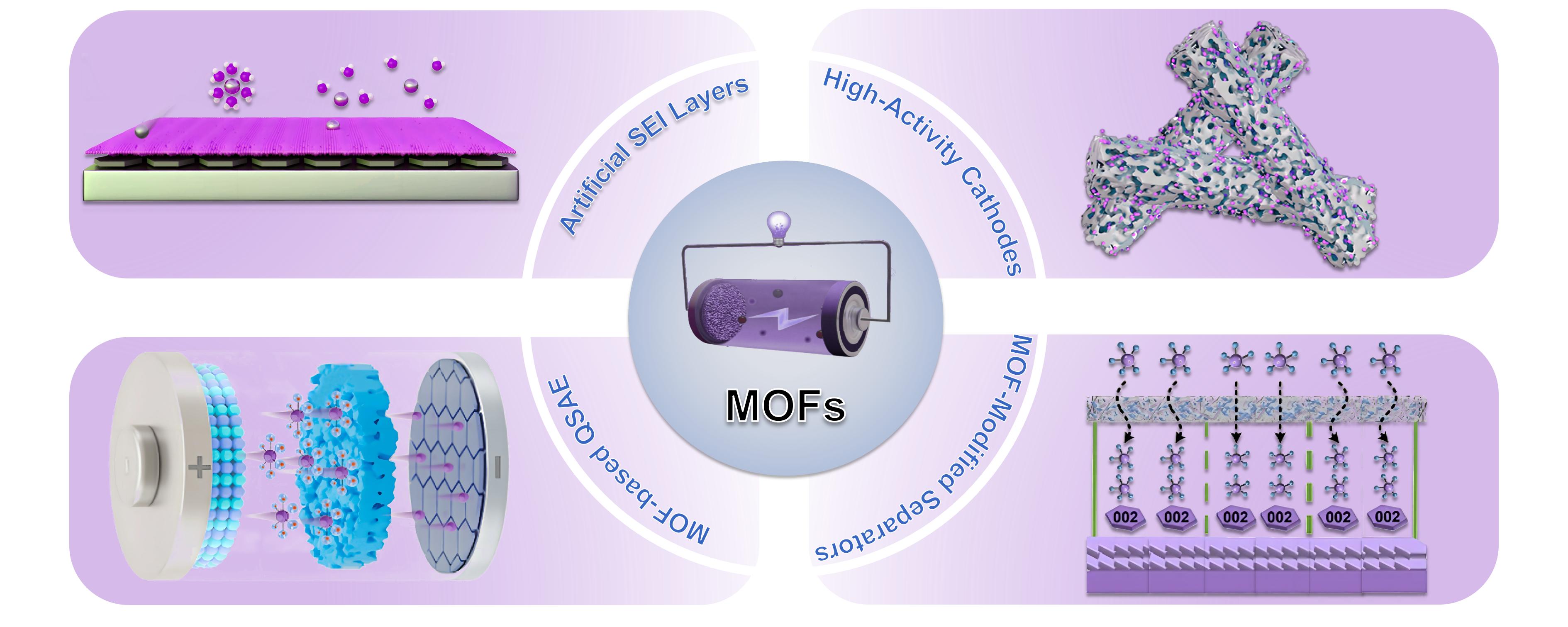
In the face of growing global energy demands, the development of efficient and safe energy storage technologies is of critical importance. Aqueous zinc-based batteries (AZBs) demonstrate promising potential for large-scale energy storage due to their inherent safety, abundant zinc reserves, low cost, and relatively high energy density. However, the widespread application of AZBs is hindered by several challenges, including dendrite growth and side reactions on the zinc anode, as well as dissolution and structural degradation of cathode materials. Metal-organic frameworks (MOFs), characterized by their well-defined and controllable crystal structures, tunable pore environments, and highly designable chemical compositions, present a versatile solution for tackling these challenges. This review systematically summarizes recent progress in the application of MOFs and their derivatives in AZBs, focusing on design strategies and underlying mechanisms for performance optimization when they are employed as high-performance electrode materials, multifunctional interfacial protective layers, separator modifiers, and solid-state electrolytes. Finally, this review discusses the existing challenges and controversies in current research and offers forward-looking perspectives and suggestions for the future development of MOF-based advanced AZBs.
- Open Access
- Review
Recent Progress of Metal-Organic Frameworks and Derivatives for High-Performance Aqueous Zinc-Based Batteries
- Zijun Liang 1,
- Jinhao Xie 1,
- Qiyu Liu 1,
- Siyu Cai 2,*,
- Yi Wang 2,
- Haozhe Zhang 3,*,
- Xihong Lu 1,*
Author Information
Received: 31 Dec 2025 | Revised: 02 Feb 2026 | Accepted: 09 Feb 2026 | Published: 25 Feb 2026
Abstract
Graphical Abstract
Keywords
aqueous zinc-based batteries | metal-organic frameworks | design strategies | high-performance cathode | anode materials
References
- 1.
Du, W.; Ang, E.; Yang, Y.; et al. Challenges in the material and structural design of zinc anode towards high-performance aqueous zinc-ion batteries. Energy Environ. Sci. 2020, 13, 3330–3360.
- 2.
Yuan, L.; Hao, J.; Kao, C.; et al. Regulation methods for the Zn/electrolyte interphase and the effectiveness evaluation in aqueous Zn-ion batteries. Energy Environ. Sci. 2021, 14, 5669–5689.
- 3.
Zhu, Z.; Jiang, T.; Ali, M.; et al. Rechargeable batteries for grid scale energy storage. Chem. Rev. 2022, 122, 16610–16751.
- 4.
Guerra, O. Beyond short-duration energy storage. Nat. Energy 2021, 6, 460–461.
- 5.
Harper, G.; Sommerville, R.; Kendrick, E.; et al. Recycling lithium-ion batteries from electric vehicles. Nature 2019, 575, 75–86.
- 6.
Dunn, B.; Kamath, H.; Tarascon, J. Electrical energy storage for the grid: A battery of choices. Science 2011, 334, 928–935.
- 7.
Li, M.; Lu, J.; Chen, Z.; et al. 30 years of lithium-ion batteries. Adv. Mater. 2018, 30, 1800561.
- 8.
Chang, Z.; Qiao, Y.; Deng, H.; et al. A liquid electrolyte with de-solvated lithium ions for lithium-metal battery. Joule 2020, 4, 1776–1789.
- 9.
Ji, H.; Wang, J.; Ma, J.; et al. Fundamentals, status and challenges of direct recycling technologies for lithium ion batteries. Chem. Soc. Rev. 2023, 52, 8194–8244.
- 10.
Wang, Q.S.; Mao, B.B.; Stoliarov, S.I.; et al. A review of lithium ion battery failure mechanisms and fire prevention strategies. Prog. Energy Combust. Sci. 2019, 73, 95–131.
- 11.
Yu, J.; Wang, X.; Zhou, M.; et al. A redox targeting-based material recycling strategy for spent lithium ion batteries. Energy Environ. Sci. 2019, 12, 2672–2677.
- 12.
Innocenti, A.; Bresser, D.; Garche, J.; et al. A critical discussion of the current availability of lithium and zinc for use in batteries. Nat. Commun. 2024, 15, 4068–4073.
- 13.
Chen, W.; Chen, T.; Fu, J. Pivotal role of organic materials in aqueous zinc-based batteries: Regulating cathode, anode, electrolyte, and separator. Adv. Funct. Mater. 2024, 34, 2308015.
- 14.
Ju, Z.N.; Zhao, Q.; Chao, D.L.; et al. Energetic Aqueous Batteries. Adv. Energy Mater. 2022, 12, 2201074.
- 15.
Zhang, Y.; Ji, X.; Xie, C.; et al. Aqueous secondary batteries: Status and challenges. Energy Storage Mater. 2025, 77, 104186.
- 16.
Liang, Y.; Yao, Y. Designing modern aqueous batteries. Nat. Rev. Mater. 2023, 8, 109–122.
- 17.
Zhang, F.; He, B.; Xin, Y.; et al. Emerging chemistry for wide-temperature sodium-ion batteries. Chem. Rev. 2024, 124, 4778–4821.
- 18.
Hwang, J.; Myung, S.; Sun, Y. Sodium-ion batteries: Present and future. Chem. Soc. Rev. 2017, 46, 3529–3614.
- 19.
Gao, Y.; Zhang, H.; Peng, J.; et al. A 30-year overview of sodium-ion batteries. Carbon Energy 2024, 6, e464.
- 20.
Zhao, Y.; Kang, Y.; Wozny, J.; et al. Recycling of sodium-ion batteries. Nat. Rev. Mater. 2023, 8, 623–634.
- 21.
Fang, Y.; Xiao, L.; Chen, Z.; et al. Recent advances in sodium-ion battery materials. Electrochem. Energy Rev. 2018, 1, 294–323.
- 22.
Xu, Y.; Du, Y.; Chen, H.; et al. Recent advances in rational design for high-performance potassium-ion batteries. Chem. Soc. Rev. 2024, 53, 7202–7298.
- 23.
Min, X.; Xiao, J.; Fang, M.; et al. Potassium-ion batteries: Outlook on present and future technologies. Energy Environ. Sci. 2021, 14, 2186–2243.
- 24.
Pramudita, J.; Sehrawat, D.; Goonetilleke, D.; et al. An initial review of the status of electrode materials for potassium-ion batteries. Adv. Energy Mater. 2017, 7, 1602911.
- 25.
Li, M.; Wang, C.; Wang, C.; et al. 10 Years development of potassium-ion batteries. Adv. Mater. 2025, 37, 2416717.
- 26.
Wu, X.; Qiu, S.; Liu, Y.; et al. The quest for stable potassium-ion battery chemistry. Adv. Mater. 2022, 34, 2106876.
- 27.
Yang, Q.; Jiang, N.; Li, X.X.; et al. Electrochemical engineering in aqueous metal-ion batteries. Sci. Bull. 2025, 70, 2157–2172.
- 28.
Heo, J.; Dong, D.; Wang, Z.Y.; et al. Electrolyte design for aqueous Zn batteries. Joule 2025, 9, 101844.
- 29.
Shin, J.; Choi, J. Opportunities and Reality of Aqueous Rechargeable Batteries. Adv. Energy Mater. 2020, 10, 2001386.
- 30.
Ran, Y.; Dong, F.; Sun, S.; et al. Aqueous Zinc-Based Batteries: Active Materials, Device Design, and Future Perspectives. Adv. Energy Mater. 2025, https://doi.org/10.1002/aenm.202406139.
- 31.
Kundu, D.; Vajargah, S.; Wan, L.; et al. Aqueous vs. nonaqueous Zn-ion batteries: Consequences of the desolvation penalty at the interface. Energy Environ. Sci. 2018, 11, 881–892.
- 32.
Song, M.; Tan, H.; Chao, D.; et al. Recent advances in Zn-ion batteries. Adv. Funct. Mater. 2018, 28, 1802564.
- 33.
Posada, J.; Rennie, A.; Villar, S.; et al. Aqueous batteries as grid scale energy storage solutions. Renew. Sustain. Energy Rev. 2017, 68, 1174–1182.
- 34.
Zeng, Y.; Lin, Z.; Meng, Y.; et al. Flexible Ultrafast Aqueous Rechargeable Ni//Bi Battery Based on Highly Durable Single-Crystalline Bismuth Nanostructured Anode. Adv. Mater. 2016, 28, 9188–9195.
- 35.
Zeng, Y.; Wang, M.; He, W.; et al. Engineering high reversibility and fast kinetics of Bi nanoflakes by surface modulation for ultrastable nickel-bismuth batteries. Chem. Sci. 2019, 10, 3602–3607.
- 36.
Wei, S.; Yang, Y.; Chen, J.; et al. A Fast-Charging and Ultra-Stable Sodium-Ion Battery Anode Enabled by N-Doped Bi/BiOCl in a Carbon Framework. Adv. Energy Mater. 2024, 14, 2401825.
- 37.
Wang, Q.; Wang, M.; Wen, L.; et al. A New (De)Intercalation MXene/Bi Cathode for Ultrastable Aqueous Zinc-Ion Battery. Adv. Funct. Mater. 2024, 34, 2214506.
- 38.
Wang, A.; Hong, W.; Yang, L.; et al. Bi-Based Electrode Materials for Alkali Metal-Ion Batteries. Small 2020, 16, 2004022.
- 39.
Kim, Y.; An, J.; Kim, S.; et al. Enabling 100C Fast-Charging Bulk Bi Anodes for Na-Ion Batteries. Adv. Mater. 2022, 34, 2201446.
- 40.
García, M.; Serrano, D.; Carrasco, J.; et al. A Ni-Cd battery model considering state of charge and hysteresis effects. J. Power Sources 2015, 275, 595–604.
- 41.
Li, S.; Zheng, Y.; Meng, J.T.; et al. A dibutylhydroquinone/dibutylbenzoquinone-Cd2+/Cd self-stratified Battery. Energy Storage Mater. 2022, 53, 873–880.
- 42.
Song, H.; Cui, Y.; Zhao, N.; et al. Rechargeable Cadmium Metal Batteries Enabled by an Aqueous CdSO4 Electrolyte. ACS Nano 2025, 19, 12170–12181.
- 43.
Wang, H.; Liang, Y.; Gong, M.; et al. An ultrafast nickel-iron battery from strongly coupled inorganic nanoparticle/nanocarbon hybrid materials. Nat. Commun. 2012, 3, 917–924.
- 44.
Luo, R.; Hu, X.; Zhang, N.X.; et al. Toward Highly Stable Anode for Secondary Batteries: Employing TiO2 Shell as Elastic Buffering Marix for FeOx Nanoparticles. Small 2022, 18, 2105713.
- 45.
Ma, J.; Guo, X.; Yan, Y.; et al. FeOx-Based Materials for Electrochemical Energy Storage. Adv. Sci. 2018, 5, 1700986.
- 46.
Guo, C.; Li, C. Molecule-confined FeOx nanocrystals mounted on carbon as stable anode material for high energy density nickel-iron batteries. Nano Energy 2017, 42, 166–172.
- 47.
Chen, J.; Wang, X.; Jin, E.; et al. Synthesis of carbon-coated FeOx nanoparticles via spray solidification as anode materials for high-performance lithium-ion batteries. Appl. Surf. Sci. 2023, 611, 155647.
- 48.
Shin, J.; Lee, J.; Park, Y.; et al. Aqueous zinc ion batteries: Focus on zinc metal anodes. Chem. Sci. 2020, 11, 2028–2044.
- 49.
Lee, M.; Choi, I.; Kim, A.; et al. Supramolecular Metal-Organic Framework for the High Stability of Aqueous Rechargeable Zinc Batteries. ACS Nano 2024, 18, 22586–22595.
- 50.
Rao, R.; Chen, J.; Bai, M.; et al. A triflate porous layer stabilizing Zn anodes for high-performance Zn-ion batteries. Chem. Commun. 2025, 61, 492–495.
- 51.
Liu, M.; Yang, L.; Liu, H.; et al. Artificial Solid-Electrolyte Interface Facilitating Dendrite-Free Zinc Metal Anodes via Nanowetting Effect. ACS Appl. Mater. Inter. 2019, 11, 32046–32051.
- 52.
Cao, L.; Li, D.; Deng, T.; et al. Hydrophobic Organic-Electrolyte-Protected Zinc Anodes for Aqueous Zinc Batteries. Angew. Chem. Int. Ed. 2020, 59, 19292–19296.
- 53.
Yang, H.; Chang, Z.; Qiao, Y.; et al. Constructing a Super-Saturated Electrolyte Front Surface for Stable Rechargeable Aqueous Zinc Batteries. Angew. Chem. Int. Ed. 2020, 59, 9377–9381.
- 54.
Ren, J.; Li, C.; Li, P.; et al. Amorphous MOF as smart artificial solid/electrolyte interphase for highly-stable Zn-ion batteries. Chem. Eng. J. 2023, 462, 142270.
- 55.
Shi, Y.; Yang, A.F.; Cao, C.S.; et al. Applications of MOFs: Recent advances in photocatalytic hydrogen production from water. Coord. Chem. Rev. 2019, 390, 50–75.
- 56.
Zhao, L.; Wang, J.; Wu, Y.; et al. Unlocking the multidimensional application and optimization mechanism of MOFs materials in aqueous zinc ion batteries. J. Energy Chem. 2025, 111, 249–273.
- 57.
Li, Z.; Zhao, G.; Chu, X.; et al. Vertically Aligned Metal-Organic Framework Arrays as Protective Layers for Durable Zinc Anodes with Low Overpotentials. Angew. Chem. Int. Ed. 2026, 138, e19208.
- 58.
Wang, K.; Li, Y.; Xie, L.; et al. Construction and application of base-stable MOFs: A critical review. Chem. Soc. Rev. 2022, 51, 6417–6441.
- 59.
Kirchon, A.; Feng, L.; Drake, H.F.; et al. From fundamentals to applications: A toolbox for robust and multifunctional MOF materials. Chem. Soc. Rev. 2018, 47, 8611–8638.
- 60.
Younas, M.; Rezakazemi, M.; Daud, M.; et al. Recent progress and remaining challenges in post-combustion CO2 capture using metal-organic frameworks (MOFs). Prog. Energy Combust. Sci. 2020, 80, 100849.
- 61.
Pramanik, B.; Sahoo, R.; Das, M. pH-stable MOFs: Design principles and applications. Coord. Chem. Rev. 2023, 493, 215301.
- 62.
Espallargas, G.; Coronado, E. Magnetic functionalities in MOFs: From the framework to the pore. Chem. Soc. Rev. 2018, 47, 533–557.
- 63.
Ansari, K.; Singh, A.; Younas, M.; et al. Progress in metal-organic frameworks (MOFs) as multifunctional material: Design, synthesis and anticorrosion performance techniques. Coord. Chem. Rev. 2025, 523, 216294.
- 64.
Ahmed, M.; Shen, Y.; Wang, Z.; et al. MOFs and their derivatives: Functionalization strategy and applications as sensitive electrode materials for environmental EDCs analysis. Coord. Chem. Rev. 2025, 531, 216504.
- 65.
Ye, Z.; Jiang, Y.; Li, L.; et al. Rational design of MOF-based materials for next-generation rechargeable batteries. Nano-Micro Lett. 2021, 13, 203–239.
- 66.
Gong, X.; Song, Y.; Zhao, N.; et al. Mofs hybridized carbon matrix as multi-functional cathodic interlayer for lithium-sulfur batteries. Coord. Chem. Rev. 2024, 512, 215877.
- 67.
Zhang, Q.; Jiang, S.; Lv, T.; et al. Application of Conductive MOF in Zinc-Based Batteries. Adv. Mater. 2023, 35, 2305532.
- 68.
Li, C.; Liu, L.; Kang, J.; et al. Pristine MOF and COF materials for advanced batteries. Energy Storage Mater. 2020, 31, 115–134.
- 69.
Banerjee, R.; Phan, A.; Wang, B.; et al. High-throughput synthesis of zeolitic imidazolate frameworks and application to CO2 capture. Science 2008, 319, 939–943.
- 70.
Lu, Z.; Wang, N.; Zhang, Y.; et al. Metal-organic framework-derived sea-cucumber-like FeS2@C nanorods with outstanding pseudocapacitive Na-ion storage properties. ACS Appl. Energy Mater. 2018, 1, 6234–6241.
- 71.
Wu, J.; Guo, X. Nanostructured metal-organic framework (MOF)-derived solid electrolytes realizing fast lithium ion transportation kinetics in solid-state batteries. Small 2019, 15, 1804413.
- 72.
Liang, Z.; Dong, F.; Ye, L.; et al. Introducing halogen-bonded gates into zeolitic frameworks for efficient benzene/cyclohexene/cyclohexane separation. Chem. Sci. 2025, 16, 3307–3312.
- 73.
Dutta, A.; Pan, Y.; Liu, J.; et al. Multicomponent isoreticular metal-organic frameworks: Principles, current status and challenges. Coord. Chem. Rev. 2021, 445, 214074.
- 74.
Jiang, X.; Kou, H. Solid state reconstructive phase transition from porous supramolecular network to porous coordination polymer. Chem. Commun. 2016, 52, 2952–2955.
- 75.
Zhao, R.; Liang, Z.; Zou, R.; et al. Metal-organic frameworks for batteries. Joule 2018, 2, 2235–2259.
- 76.
Zhao, T.; Xiao, P.; Nie, S.; et al. Recent progress of metal-organic frameworks based high performance batteries separators: A review. Coord. Chem. Rev. 2024, 502, 215592.
- 77.
Deng, X.; Zheng, S.; Zhong, Y.; et al. Conductive MOFs based on Thiol-functionalized Linkers: Challenges, Opportunities, and Recent Advances. Coord. Chem. Rev. 2022, 450, 241235.
- 78.
Reddy, R.; Lin, J.; Chen, Y.Y.; et al. Progress of nanostructured metal oxides derived from metal-organic frameworks as anode materials for lithium-ion batteries. Coord. Chem. Rev. 2020, 420, 213434.
- 79.
Sun, H.; Hu, Y.; Li, N.; et al. A Seamless Metal-Organic Framework Interphase with Boosted Zn2+ Flux and Deposition Kinetics for Long-Living Rechargeable Zn Batteries. Nano Lett. 2023, 23, 1726–1734.
- 80.
Wang, F.; Lu, H.; Li, H.; et al. Demonstrating U-shaped zinc deposition with 2D metal-organic framework nanoarrays for dendrite-free zinc batteries. Energy Storage Mater. 2022, 50, 641–647.
- 81.
Wu, P.; Cao, Y.; Cao, H.; et al. An in-situ grown high-efficiency Zn-terephthalate metal-organic framework/ZnO hybrid interface protection layer to achieve highly reversible dendrite-free Zn anodes. Chem. Eng. J. 2023, 474, 145955.
- 82.
Liu, X.; Yang, F.; Xu, W.; et al. Zeolitic Imidazolate Frameworks as Zn2+ Modulation Layers to Enable Dendrite-Free Zn Anodes. Adv. Sci. 2020, 7, 2002173.
- 83.
Yang, H.; Zhu, K.; Xie, W.; et al. MOF nanosheets as ion carriers for self-optimized zinc anodes. Energy Environ. Sci. 2023, 16, 4549–4560.
- 84.
Lei, L.; Chen, F.; Wu, Y.; et al. Surface coatings of two-dimensional metal-organic framework nanosheets enable stable zinc anodes. Sci. China Chem. 2022, 65, 2205–2213.
- 85.
Wang, Y.; Liu, Y.; Wang, H.; et al. MOF-based ionic sieve interphase for regulated Zn2+ flux toward dendrite-free aqueous zinc-ion batteries. J. Mater. Chem. A 2022, 10, 4366–4375.
- 86.
Zhang, K.; Li, C.; Liu, J.; et al. Defect-Rich functional HfO2-x for highly reversible Zn metal anode. Small 2024, 20, 2306406.
- 87.
Zhang, W.; Qi, W.; Yang, K.; et al. Boosting tough metal Zn anode by MOF layer for high-performance zinc-ion batteries. Energy Storage Mater. 2024, 71, 103616.
- 88.
Xin, W.; Xiao, J.; Li, J.; et al. Metal-organic frameworks with carboxyl functionalized channels as multifunctional ion-conductive interphase for highly reversible Zn anode. Energy Storage Mater. 2023, 56, 76–86.
- 89.
Han, K.; Ma, X.; Li, H.; et al. A Biomimetic Copper Silicate-MOF Hybrid for Highly Stable Zn Metal Anode. Adv. Mater. 2025, 37, 2503046.
- 90.
Chen, M.; Fu, W.; Hou, C.; et al. Tailored electronegative-driven MOF channels with bimetallic coordination for synergistic Zn2+ transport enabling dendrite-free Zn anodes. Energy Storage Mater. 2025, 80, 104380.
- 91.
Cao, Z.; Zhang, H.; Song, B.; et al. Angstrom-Level Ionic Sieve 2D-MOF Membrane for High Power Aqueous Zinc Anode. Adv. Funct. Mater. 2023, 33, 2300339.
- 92.
Bao, P.; Cheng, L.; Yan, X.; et al. 2D Conjugated Metal-Organic Frameworks Bearing Large Pore Apertures and Multiple Active Sites for High-Performance Aqueous Dual-Ion Batteries. Angew. Chem. Int. Ed. 2024, 63, e202405168.
- 93.
Deng, S.; Xu, B.; Zhao, J.; et al. Unlocking Double Redox Reaction of Metal-Organic Framework for Aqueous Zinc-Ion Battery. Angew. Chem. Int. Ed. 2024, 63, e202401996.
- 94.
Sun, K.; Shen, Y.; Min, J.; et al. MOF-derived Zn/Co co-doped MnO/C microspheres as cathode and Ti3C2@Zn as anode for aqueous zinc-ion full battery. Chem. Eng. J. 2023, 454, 140394.
- 95.
Yin, C.; Wang, H.; Pan, C.; et al. Constructing MOF-derived V2O5 as advanced cathodes for aqueous zinc ion batteries. J. Energy Storage 2023, 73, 109045.
- 96.
Li, N.; Yang, Z.; Li, Y.; et al. Size Confinement Strategy Effect Enables Advanced Aqueous Zinc-Iodine Batteries. Adv. Energy Mater. 2024, 14, 2402846.
- 97.
Chen, T.; Wang, F.; Cao, S.; et al. In Situ Synthesis of MOF-74 Family for High Areal Energy Density of Aqueous Nickel-Zinc Batteries. Adv. Mater. 2022, 34, 2201779.
- 98.
Zhang, J.; Liu, Y.; Wang, T.; et al. Manganese-based MOF interconnected carbon nanotubes as a high-performance cathode for rechargeable aqueous zinc-ion batteries. J. Energy Storage 2024, 76, 109873.
- 99.
Feng, S.; Liu, J.; Zhao, L.; et al. Low-Curvature Wood-Derived Thick Electrodes with High Capacity via In Situ Grown Nanoflower-Like Ni/Co Bimetallic MOFs for Aqueous Nickel-Zinc Battery. Adv. Funct. Mater. 2025, https://doi.org/10.1002/adfm.202522595.
- 100.
Xiang, Y.; Pan, H.; Jiang, Y.; et al. Shackling the aqueous electrolyte via metal-organic frameworks to realize high energy density zinc-ion batteries. Nano Energy 2023, 117, 108873.
- 101.
Huang, C.; Li, H.; Teng, Z.; et al. MOF-modified dendrite-free gel polymer electrolyte for zinc-ion batteries. RSC Adv. 2024, 14, 15337–15346.
- 102.
Li, Q.; Bai, M.; Wang, X.; et al. A MOF@ZnIn2S4 Composite Quasi-Solid Electrolyte for Highly Reversible Zn-Ion Batteries. Adv. Funct. Mater. 2025, 35, 2502344.
- 103.
Song, Y.; Ruan, P.; Mao, C.; et al. Metal-Organic Frameworks Functionalized Separators for Robust Aqueous Zinc-Ion Batteries. Nano-Micro Lett. 2022, 14, 218–231.
- 104.
Chen, R.; Zhang, G.; Zhou, H.; et al. Robust Zinc Anode Enabled by Sulfonate-Rich MOF-Modified Separator. Small 2024, 20, 2305687.
- 105.
Yang, P.; Zhang, K.; Liu, S.; et al. Ionic Selective Separator Design Enables Long-Life Zinc-Iodine Batteries via Synergistic Anode Stabilization and Polyiodide Shuttle Suppression. Adv. Funct. Mater. 2024, 34, 2410712.
- 106.
Wang, L.; Guan, J.; Li, N.; et al. Amine-Functionalized MIL-125 Separator and MOF-Derived Carbon Host for High-Performance Aqueous Zinc-Iodine Batteries. Adv. Energy Mater. 2025, 15, e04201.
- 107.
Di, H.; An, Y.; Yang, J.; et al. Fluorine Modified Zeolitic Imidazolate Framework Enables Long-Life Zn-I2 Batteries by Suppression of Polyiodide Shuttle. Angew. Chem. Int. Ed. 2025, 64, e202513312.
- 108.
Li, C.; Shyamsunder, A.; Hoane, A.G.; et al. Highly reversible Zn anode with a practical areal capacity enabled by a sustainable electrolyte and superacid interfacial chemistry. Joule 2022, 6, 1103–1120.
- 109.
Deng, Y.; Liang, R.; Jiang, G.; et al. The current state of aqueous Zn-based rechargeable batteries. ACS Energy Lett. 2020, 5, 1665–1675.
- 110.
Higashi, S.; Lee, S.; Lee, J.; et al. Avoiding short circuits from zinc metal dendrites in anode by backside-plating configuration. Nat. Commun. 2016, 7, 11801–11806.
- 111.
Yang, Q.; Li, Q.; Liu, Z.; et al. Dendrites in Zn-Based Batteries. Adv. Mater. 2020, 32, e2001854.
- 112.
Jia, H.; Wang, Z.; Tawiah, B.; et al. Recent advances in zinc anodes for high-performance aqueous Zn-ion batteries. Nano Energy 2020, 70, 104523.
- 113.
Tang, B.; Shan, L.; Liang, S.; et al. Issues and opportunities facing aqueous zinc-ion batteries. Energy Environ. Sci. 2019, 12, 3288–3304.
- 114.
Yu, P.; Zeng, Y.; Zhang, H.; et al. Flexible Zn-Ion Batteries: Recent Progresses and Challenges. Small 2019, 15, 1804760.
- 115.
Lu, W.; Xie, C.; Zhang, H.; et al. Inhibition of zinc dendrite growth in zinc-based batteries. ChemSusChem 2018, 11, 3996–4006.
- 116.
Hao, J.; Li, X.; Zeng, X.; et al. Deeply understanding the Zn anode behaviour and corresponding improvement strategies in different aqueous Zn-based batteries. Energy Environ. Sci. 2020, 13, 3917–3949.
- 117.
Yang, Q.; Liang, G.; Guo, Y.; et al. Do zinc dendrites exist in neutral zinc batteries: A developed electrohealing strategy to in situ rescue in-service batteries. Adv. Mater. 2019, 31, 1903778.
- 118.
Kasemchainan, J.; Zekoll, S.; Spencer Jolly, D.; et al. Critical stripping current leads to dendrite formation on plating in lithium anode solid electrolyte cells. Nat. Mater. 2019, 18, 1105–1111.
- 119.
Zheng, J.; Zhao, Q.; Tang, T.; et al. Reversible epitaxial electrodeposition of metals in battery anodes. Science 2019, 366, 645–648.
- 120.
Zhang, M.; Xu, W.; Han, X.; et al. Unveiling the mechanism of the dendrite nucleation and growth in aqueous zinc ion batteries. Adv. Energy Mater. 2024, 14, 2303737.
- 121.
Kim, H.; Kim, S.; Heo, K.; et al. Nature of Zinc-Derived Dendrite and Its Suppression in Mildly Acidic Aqueous Zinc-Ion Battery. Adv. Energy Mater. 2023, 13, 2203189.
- 122.
Chen, M.; Chen, J.; Zhou, W.; et al. Realizing an all-round hydrogel electrolyte toward environmentally adaptive dendrite-free aqueous Zn-MnO2 batteries. Adv. Mater. 2021, 33, 2007559.
- 123.
Wang, B.; Guan, C.; Zhou, Q.; et al. Screening Anionic Groups Within Zwitterionic Additives for Eliminating Hydrogen Evolution and Dendrites in Aqueous Zinc Ion Batteries. Nano-Micro Lett. 2025, 17, 314–325.
- 124.
Wippermann, K.; Schultze, J.; Kessel, R.; et al. The inhibition of zinc corrosion by bisaminotriazole and other triazole derivatives. Corros. Sci. 1991, 32, 205–230.
- 125.
Fu, J.; Cano, Z.; Park, M.; et al. Electrically rechargeable zinc-air batteries: Progress, challenges, and perspectives. Adv. Mater. 2017, 29, 1604685.
- 126.
Li, Y.; Dai, H. Recent advances in zinc-air batteries. Chem. Soc. Rev. 2014, 43, 5257–5275.
- 127.
Hoang, T.; Sun, K.; Chen, P. Corrosion chemistry and protection of zinc&zinc alloys by polymer-containing materials for potential use in rechargeable aqueous batteries. Rsc Adv. 2015, 5, 41677–41691.
- 128.
Han, C.; Li, W.; Liu, H.; et al. Principals and strategies for constructing a highly reversible zinc metal anode in aqueous batteries. Nano Energy 2020, 74, 104880.
- 129.
Guo, J.; Ming, J.; Lei, Y.; et al. Artificial Solid Electrolyte Interphase for Suppressing Surface Reactions and Cathode Dissolution in Aqueous Zinc Ion Batteries. ACS Energy Lett. 2019, 4, 2776–2781.
- 130.
Yi, T.; Qiu, L.; Qu, J.; et al. Towards high-performance cathodes: Design and energy storage mechanism of vanadium oxides-based materials for aqueous Zn-ion batteries. Coord. Chem. Rev. 2021, 446, 214124.
- 131.
Wang, J.; Huang, W.; Pei, A.; et al. Improving cyclability of Li metal batteries at elevated temperatures and its origin revealed by cryo-electron microscopy. Nat. Energy 2019, 4, 664–670.
- 132.
Yang, G.; Zhang, Q.; Liu, Z.; et al. Pore Sieving and Surficial Charge-Driven Desolvation for High Spatial Charge Density Carbon Cathodes in Zinc-Ion Hybrid Capacitors. Adv. Energy Mater. 2025, 15, 2501358.
- 133.
Guo, A.; Wang, Z.; Chen, L.; et al. A comprehensive review of the mechanism and modification strategies of V2O5 cathodes for aqueous zinc-ion batteries. ACS Nano 2024, 18, 27261–27286.
- 134.
Pu, X.; Jiang, B.; Wang, X.; et al. High-Performance Aqueous Zinc-Ion Batteries Realized by MOF Materials. Nano-Micro Lett. 2020, 12, 152–165.
- 135.
Yin, C.; Pan, C.; Liao, X.; et al. Coordinately Unsaturated Manganese-Based Metal-Organic Frameworks as a High-Performance Cathode for Aqueous Zinc-Ion Batteries. ACS Appl. Mater. Inter. 2021, 13, 35837–35847.
- 136.
Tan, Q.; Li, X.; Zhang, B.; et al. Valence engineering via in situ carbon reduction on octahedron sites Mn3O4 for ultra-long cycle life aqueous Zn-ion battery. Adv. Energy Mater. 2020, 10, 2001050.
- 137.
Liu, Q.; Tan, G.; Wang, P.; et al. Revealing mechanism responsible for structural reversibility of single-crystal VO2 nanorods upon lithiation/delithiation. Nano Energy 2017, 36, 197–205.
- 138.
Deng, S.; Yuan, Z.; Tie, Z.; et al. Electrochemically induced metal-organic-framework-derived amorphous V2O5 for superior rate aqueous zinc-ion batteries. Angew. Chem. Int. Ed. 2020, 59, 22002–22006.
- 139.
Zhou, W.; Chen, J.; Chen, M.; et al. Rod-like anhydrous V2O5 assembled by tiny nanosheets as a high-performance cathode material for aqueous zinc-ion batteries. Rsc Adv. 2019, 9, 30556–30564.
- 140.
Ding, Y.; Peng, Y.; Chen, W.; et al. V-MOF derived porous V2O5 nanoplates for high performance aqueous zinc ion battery. Appl. Surf. Sci. 2019, 493, 368–374.
- 141.
Liu, Z.; Pulletikurthi, G.; Endres, F. A prussian blue/zinc secondary battery with a bio-ionic liquid-water mixture as electrolyte. ACS Appl. Mater. Inter. 2016, 8, 12158–12164.
- 142.
Li, Y.; Zhao, J.; Hu, Q.; et al. Prussian blue analogs cathodes for aqueous zinc ion batteries. Mater. Today Energy 2022, 29, 101095.
- 143.
Zeng, Y.; Lu, X.; Zhang, S.; et al. Construction of Co-Mn Prussian blue analog hollow spheres for efficient aqueous Zn-ion batteries. Angew. Chem. Int. Ed. 2021, 60, 22189–22194.
- 144.
Zhang, L.; Huang, J.; Guo, H.; et al. Tuning ion transport at the anode-electrolyte interface via a sulfonate-rich ion-exchange layer for durable zinc-iodine batteries. Adv. Energy Mater. 2023, 13, 2203790.
- 145.
Kar, M.; Pozo, C. Enhancing the Cycle Life of Zinc-Iodine Batteries in Ionic Liquid-Based Electrolytes. Angew. Chem. Int. Ed. 2024, 63, e202405244.
- 146.
Liang, Y.; Jing, Y.; Gheytani, S.; et al. Universal quinone electrodes for long cycle life aqueous rechargeable batteries. Nat. Mater. 2017, 16, 841–848.
- 147.
Kundu, D.; Oberholzer, P.; Glaros, C.; et al. Organic cathode for aqueous Zn-ion batteries: Taming a unique phase evolution toward stable electrochemical cycling. Chem. Mater. 2018, 30, 3874–3881.
- 148.
Mathew, V.; Sambandam, B.; Kim, S.; et al. Manganese and Vanadium Oxide Cathodes for Aqueous Rechargeable Zinc-Ion Batteries: A Focused View on Performance, Mechanism, and Developments. ACS Energy Lett. 2020, 5, 2376–2400.
- 149.
Yong, B.; Ma, D.; Wang, Y.; et al. Understanding the design principles of advanced aqueous zinc-ion battery cathodes: From transport kinetics to structural engineering, and future perspectives. Adv. Energy Mater. 2020, 10, 2002354.
- 150.
Chen, X.; Ruan, P.; Wu, X.; et al. Crystal structures, reaction mechanisms, and optimization strategies of MnO2 cathode for aqueous rechargeable zinc batteries. Acta Phys. Chim. Sin. 2022, 38, 2111003.
- 151.
Li, X.; Chen, Z.; Yang, Y.; et al. The phosphate cathodes for aqueous zinc-ion batteries. Inorg. Chem. Front. 2022, 9, 3986–3998.
- 152.
Ma, J.; Liu, M.; He, Y.; et al. Iodine redox chemistry in rechargeable batteries. Angew. Chem. Int. Ed. 2021, 60, 12636–12647.
- 153.
Li, J.; Chen, Y.; Guo, J.; et al. Graphdiyne Oxide-Based High-Performance Rechargeable Aqueous Zn-MnO2 Battery. Adv. Funct. Mater. 2020, 30, 2004115.
- 154.
Liang, R.; Fu, J.; Deng, Y.; et al. Parasitic electrodeposition in Zn-MnO2 batteries and its suppression for prolonged cyclability. Energy Storage Mater. 2021, 36, 478–484.
- 155.
Wen, H.; Wen, H.; Sun, Y.; et al. The Frontiers of Aqueous Zinc-Iodine Batteries: A Comprehensive Review on Mechanisms, Optimization, and Industrial Prospects. Adv. Funct. Mater. 2025, 35, 2500323.
- 156.
Hou, Y.Z.; Kong, F.G.; Wang, Z.R.; et al. High performance rechargeable aqueous zinc-iodine batteries via a double iodine species fixation strategy with mesoporous carbon and modified separator. J. Colloid Interface Sci. 2023, 629, 279–287.
- 157.
Xing, H.; Han, Y.; Huang, X.; et al. Recent Progress of Low-Dimensional Metal-Organic Frameworks for Aqueous Zinc-Based Batteries. Small 2024, 20, 2402998.
- 158.
Yi, Z.; Chen, G.; Hou, F.; et al. Strategies for the Stabilization of Zn Metal Anodes for Zn-Ion Batteries. Adv. Energy Mater. 2021, 11, 2003065.
- 159.
Zeng, X.; Hao, J.; Wang, Z.; et al. Recent progress and perspectives on aqueous Zn-based rechargeable batteries with mild aqueous electrolytes. Energy Storage Mater. 2019, 20, 410–437.
- 160.
Zhang, N.; Huang, S.; Yuan, Z.; et al. Direct self-assembly of MXene on Zn anodes for dendrite-free aqueous zinc-ion batteries. Angew. Chem. Int. Ed. 2021, 133, 2897–2901.
- 161.
Zhang, N.; Chen, X.; Yu, M.; et al. Materials chemistry for rechargeable zinc-ion batteries. Chem. Soc. Rev. 2020, 49, 4203–4219.
- 162.
Hu, L.; Xiao, P.; Xue, L.; et al. The rising zinc anodes for high-energy aqueous batteries. EnergyChem 2021, 3, 100052.
- 163.
Zhao, T.; Wu, H.; Wen, X.; et al. Recent advances in MOFs/MOF derived nanomaterials toward high-efficiency aqueous zinc ion batteries. Coord. Chem. Rev. 2022, 468, 214642.
- 164.
Lei, L.; Dong, J.; Ke, S.; et al. Porous framework materials for stable Zn anodes in aqueous zinc-ion batteries. Inorg. Chem. Front. 2023, 10, 5555–5572.
- 165.
Liu, Y.; Wu, X.; Bando, Y. Toward highly durable aqueous zinc ion batteries: A review of MOFs/MOF-derived cathode materials. Inorg. Chem. Front. 2025, 12, 3959–3980.
- 166.
Gao, X.; Dong, Y.; Li, S.W.; et al. MOFs and COFs for Batteries and Supercapacitors. Electrochem. Energy Rev. 2020, 3, 81–126.
- 167.
Peng, Y.; Xu, J.; Xu, J.; et al. Metal-organic framework (MOF) composites as promising materials for energy storage applications. Adv. Colloid Interface Sci. 2022, 307, 102732.
- 168.
Bi, D.; Zhao, T.; Lai, Q.; et al. In situ preparation of MOF-74 for compact zincophilic surfaces enhancing the stability of aqueous zinc-ion battery anodes. J. Alloys Compd. 2024, 1002, 175448.
- 169.
Ji, Y.; Shen, Y.; Cheng, F.; et al. Mastering in-situ Zn-MOF anode growth via capture-and-deposit strategy for stable K/Zn dual-ion batteries. Chin. Chem. Lett. 2025, https://doi.org/10.1016/j.cclet.2025.111326.
- 170.
Tan, H.; Zhou, Y.; Qiao, S.; et al. Metal organic framework (MOF) in aqueous energy devices. Mater. Today 2021, 48, 270–284.
- 171.
Chuhadiya, S.; Himanshu; Suthar, D.; et al. Metal organic frameworks as hybrid porous materials for energy storage and conversion devices: A review. Coord. Chem. Rev. 2021, 446, 214115.
- 172.
Huang, Q.; Xie, T.; Luo, Y.; et al. A Comprehensive Review on Zinc-Based MOFs and Their Derivatives for Alkali-Ion Batteries: Synthesis, Applications, and Future Prospects. Adv. Funct. Mater. 2025, 35, 2508749.
- 173.
An, Y.; Lv, X.; Jiang, W.; et al. The stability of MOFs in aqueous solutions-research progress and prospects. Green Chem. Eng. 2024, 5, 187–204.
- 174.
He, L.; Wang, Z.; Wang, H.; et al. Are MOFs ready for environmental applications: Assessing stability against natural stressors? Coord. Chem. Rev. 2025, 526, 216361.
- 175.
Sinha, R.; Xie, X.; Yang, Y.; et al. Failure Mechanisms and Strategies for Vanadium Oxide-Based Cathode in Aqueous Zinc Batteries. Adv. Energy Mater. 2025, 15, 2404815.
- 176.
Liu, S.; Kang, L.; Kim, J.M.; et al. Recent advances in vanadium-based aqueous rechargeable zinc-ion batteries. Adv. Energy Mater. 2020, 10, 2000477.
- 177.
Chen, M.; Liu, Q.; Hu, Z.; et al. Designing advanced vanadium-based materials to achieve electrochemically active multielectron reactions in sodium/potassium-ion batteries. Adv. Energy Mater. 2020, 10, 2002244.
- 178.
Guo, Q.; Wang, H.; Sun, X.; et al. In situ synthesis of cathode materials for aqueous high-rate and durable Zn-I2 batteries. ACS Mater. Lett. 2022, 4, 1872–1881.
- 179.
Man, P.; He, B.; Zhang, Q.; et al. A one-dimensional channel self-standing MOF cathode for ultrahigh-energy-density flexible Ni-Zn batteries. J. Mater. Chem. A 2019, 7, 27217–27224.
- 180.
Nam, K.; Park, S.; Dos, R.; et al. Conductive 2D metal-organic framework for high-performance cathodes in aqueous rechargeable zinc batteries. Nat. Commun. 2019, 10, 4948–4957.
- 181.
Ruan, P.; Liang, S.; Lu, B.; et al. Design strategies for high-energy-density aqueous zinc batteries. Angew. Chem. Int. Ed. 2022, 134, e202200598.
- 182.
Ruan, P.; Xu, X.; Zheng, D.; et al. Promoting reversible dissolution/deposition of MnO2 for high-energy-density zinc batteries via enhancing cut-off voltage. ChemSusChem 2022, 15, e202201118.
- 183.
Mahmood, A.; Zheng, Z.; Chen, Y. Zinc-bromine batteries: Challenges, prospective solutions, and future. Adv. Sci. 2024, 11, 2305561.
- 184.
Li, X.; Xu, W.; Zhi, C. Halogen-powered static conversion chemistry. Nat. Rev. Chem. 2024, 8, 359–375.
- 185.
Li, X.; Yang, X.; Xue, H.; et al. Metal-organic frameworks as a platform for clean energy applications. EnergyChem 2020, 2, 100027.
- 186.
Wang, W.; Gao, Z.; Cao, L.; et al. Heterostructured microspheres of MOF-derived (Zn,Mn)S/C coated manganese sulfide for aqueous zinc ion batteries. J. Electroanal. Chem. 2024, 952, 117994.
- 187.
Gou, L.; Li, J.; Liang, K.; et al. Bi-MOF Modulating MnO2 Deposition Enables Ultra-Stable Cathode-Free Aqueous Zinc-Ion Batteries. Small 2023, 19, 2208233.
- 188.
Song, J.; Ji, L.; Chen, J.; et al. Recent development and electrochemical applications of conductive MOFs with proton, electron, and ion transfer. Coord. Chem. Rev. 2026, 549, 217271.
- 189.
Guo, L.; Sun, J.; Wei, J.; et al. Conductive metal-organic frameworks: Recent advances in electrochemical energy-related applications and perspectives. Carbon Energy 2020, 2, 203–222.
- 190.
Tao, S.; Wang, J.; Zhang, J. Conductive Metal-Organic Frameworks and Their Electrocatalysis Applications. ACS Nano 2025, 19, 9484–9512.
- 191.
Mao, M.; Wu, X.; Hu, Y.; et al. Charge storage mechanism of MOF-derived Mn2O3 as high performance cathode of aqueous zinc-ion batteries. J. Energy Chem. 2021, 52, 277–283.
- 192.
Yin, C.; Chen, J.; Pan, C.; et al. MOF-Derived Mn3O4@C Hierarchical Nanospheres as Cathodes for Aqueous Zinc-Ion Batteries. ACS Appl. Energy Mater. 2022, 5, 14144–14154.
- 193.
Wang, Y.; Song, J.; Wong, W. Constructing 2D Sandwich-like MOF/MXene Heterostructures for Durable and Fast Aqueous Zinc-Ion Batteries. Angew. Chem. Int. Ed. 2023, 62, e202218343.
- 194.
Yang, S.; Lv, H.; Wang, Y.; et al. Regulating Exposed Facets of Metal-Organic Frameworks for High-rate Alkaline Aqueous Zinc Batteries. Angew. Chem. Int. Ed. 2022, 61, e202209794.
- 195.
Guo, G.; Dai, Q.; Li, W.; et al. Intercatenation weaves MOFs with conductive networks as iodine hosts for zinc-iodine batteries. Chem. Eng. J. 2025, 514, 163100.
- 196.
Mensah, K.; Ampong, D; Dzikunu, P.; et al. Multi-metallic organic framework-derived materials for electrocatalytic CO2 reduction reaction. Fuel 2023, 335, 127056.
- 197.
Ye, H.; Cao, Y.; Jin, X.; et al. Self-Bonded Wood Composites with Efficient Heat Dissipation Enabled by In-Situ Grown Co/Zn Bimetallic MOFs. Adv. Funct. Mater. 2025, 35, 2424747.
- 198.
Fonseca, J.; Gong, T. Fabrication of metal-organic framework architectures with macroscopic size: A review. Coord. Chem. Rev. 2022, 462, 214520.
- 199.
Lim, H.; Lee, G.; Lee, J.; et al. Compositional Complexity of Metal-Organic Frameworks with Programmable Spatial Arrangement of Multi-Metallic Components. Small 2025, 21, 2408119.
- 200.
Sun, Y.Y.; Li, F.; Hou, P.Y. Research progress on the interfaces of solid-state lithium metal batteries. J. Mater. Chem. A 2021, 9, 9481–9505.
- 201.
Xiao, P.; Yun, X.; Chen, Y.; et al. Insights into the solvation chemistry in liquid electrolytes for lithium-based rechargeable batteries. Chem. Soc. Rev. 2023, 52, 5255–5316.
- 202.
Li, C.; Yun, X.; Chen, Y.; et al. Unravelling the proton hysteresis mechanism in vacancy modified vanadium oxides for High-Performance aqueous zinc ion battery. Chem. Eng. J. 2023, 477, 146901.
- 203.
Pan, Y.; Liu, Z.; Liu, S.; et al. Quasi-Decoupled Solid-Liquid Hybrid Electrolyte for Highly Reversible Interfacial Reaction in Aqueous Zinc-Manganese Battery. Adv. Energy Mater. 2023, 13, 2203766.
- 204.
Yang, J.; Yin, B.; Sun, Y.; et al. Zinc Anode for Mild Aqueous Zinc-Ion Batteries: Challenges, Strategies, and Perspectives. Nano-Micro Lett. 2022, 14, 42–88.
- 205.
Yang, B.; Shi, Y.; Kang, D.; et al. Architectural design and electrochemical performance of MOF-based solid-state electrolytes for high-performance secondary batteries. Interd. Mater. 2023, 2, 475–510.
- 206.
Xue, T.; Guan, J.; Mu, Y.; et al. Quasi-Solid-State Electrolytes: Bridging the gap between solid and liquid electrolytes for Zinc-Ion batteries. Chem. Eng. J. 2025, 514, 162994.
- 207.
Liu, F.; Wang, J.; Chen, W.; et al. Polymer-Ion Interaction Prompted Quasi-Solid Electrolyte for Room-Temperature High-Performance Lithium-Ion Batteries. Adv. Mater. 2024, 36, 2409838.
- 208.
Ge, H.; Xie, X.; Xie, X.; et al. Critical challenges and solutions: Quasi-solid-state electrolytes for zinc-based batteries. Energy Environ. Sci. 2024, 17, 3270–3306.
- 209.
Gong, X.; Wang, J.; Shi, Y.; et al. Inhibiting dendrites on Zn anode by ZIF-8 as solid electrolyte additive for aqueous zinc ion battery. Colloid. Surface. A 2023, 656, 130255.
- 210.
Wang, Z.; Hu, J.; Han, L.; et al. A MOF-based single-ion Zn2+ solid electrolyte leading to dendrite-free rechargeable Zn batteries. Nano Energy 2019, 56, 92–99.
- 211.
Tang, J.; Wang, D.; Qin, W.; et al. In-situ solvent-free preparation of MOF/polymer composite electrolytes with highly dispersed and defected MOF nanoparticles for lithium-metal batteries. Chem. Eng. J. 2025, 513, 163082.
- 212.
Fu, X.; Hurlock, M.; Ding, C.; et al. MOF-Enabled Ion-Regulating Gel Electrolyte for Long-Cycling Lithium Metal Batteries Under High Voltage. Small 2022, 18, 2106225.
- 213.
Dong, H.; Hu, X.; Liu, R.; et al. Bio-inspired polyanionic electrolytes for highly stable zinc-ion batteries. Angew. Chem. Int. Ed. 2023, 135, e202311268.
- 214.
Gao, X.; Dai, Y.; Zhang, C.; et al. When it’s heavier: Interfacial and solvation chemistry of isotopes in aqueous electrolytes for Zn-ion batteries. Angew. Chem. Int. Ed. 2023, 135, e202300608.
- 215.
Li, R.; Pan, L.; Peng, Z.; et al. Regulating interfacial behavior of zinc metal anode via metal-organic framework functionalized separator. J. Energy Chem. 2024, 93, 213–220.
- 216.
Wang, Z.; Dong, L.; Huang, W.; et al. Simultaneously Regulating Uniform Zn2+ Flux and Electron Conduction by MOF/rGO Interlayers for High-Performance Zn Anodes. Nano-Micro Lett. 2021, 13, 73–83.
- 217.
Liu, C.; Wang, Y.; Liu, H.; et al. Channel engineering strategy of precisely modified MOF/nanofiber composite separator for advanced aqueous zinc ion batteries. Compos. Part B Eng. 2024, 272, 111227.
- 218.
Cheng, Z.; Lian, J.; Zhang, J.; et al. Pristine MOF Materials for Separator Application in Lithium-Sulfur Battery. Adv. Sci. 2024, 11, 2404834.
- 219.
He, Y.B.; Qiao, Y.; Chang, Z.; et al. The potential of electrolyte filled MOF membranes as ionic sieves in rechargeable batteries. Energy Environ. Sci. 2019, 12, 2327–2344.
- 220.
Hu, Z.; Wang, X.; Du, W.; et al. Crowding effect-induced zinc-enriched/water-lean polymer interfacial layer toward practical Zn-iodine batteries. ACS Nano 2023, 17, 23207–23219.
- 221.
Liu, Y.; Li, L.; Wen, A.; et al. A Janus MXene/MOF separator for the all-in-one enhancement of lithium-sulfur batteries. Energy Storage Mater. 2023, 55, 652–659.
- 222.
Yang, H.; Qiao, Y.; Chang, Z.; et al. A Metal-Organic Framework as a Multifunctional Ionic Sieve Membrane for Long-Life Aqueous Zinc-Iodide Batteries. Adv. Mater. 2020, 32, 2004240.
- 223.
Liu, W.; Ma, H.; Zhao, L.; et al. Anionically-Reinforced Nanocellulose Separator Enables Dual Suppression of Zinc Dendrites and Polyiodide Shuttle for Long-Cycle Zn-I2 Batteries. Nano-Micro Lett. 2025, 18, 59–73.
- 224.
Zhou, L.Y.; Pan, H.W.; Yin, G.J.; et al. Tailoring the Function of Battery Separators via the Design of MOF Coatings. Adv. Funct. Mater. 2024, 34, 2314246.
- 225.
Du, H.; Yi, Z.; Li, H.; et al. Separator design strategies to advance rechargeable aqueous zinc ion batteries. Chem. Eur. J. 2024, 30, e202303461.


This work is licensed under a Creative Commons Attribution 4.0 International License.

 Suite 4002 Level 4, 447 Collins Street, Melbourne, Victoria 3000, Australia
 General Inquiries: info@sciltp.com