
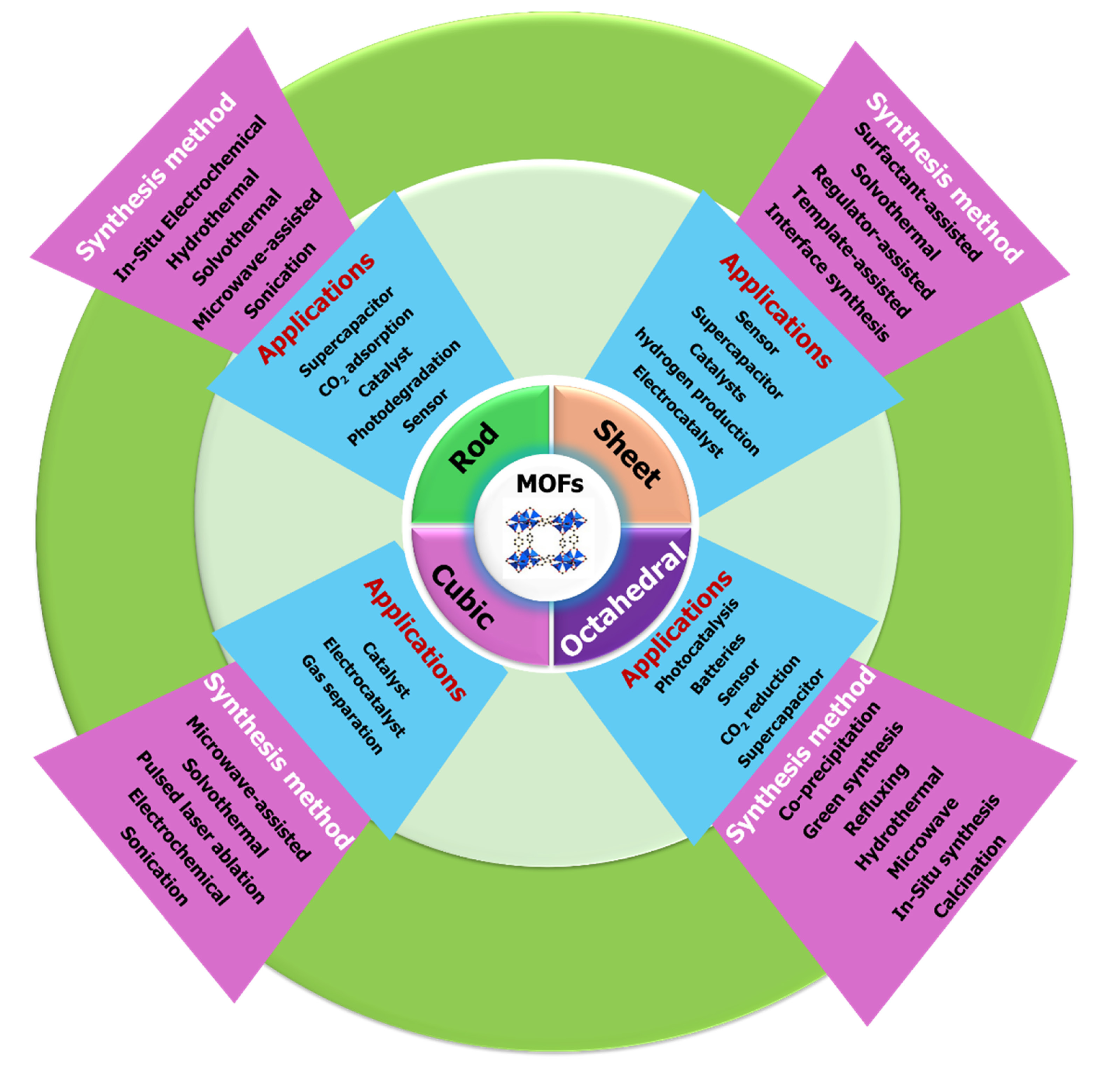
Metal–Organic Frameworks (MOFs) have emerged as versatile crystalline materials morphology significantly governs their physicochemical properties. The novelty of morphological diversity in MOFs is particularly evident in their 1D, 2D and 3D frameworks, each offering unique structural advantages and functional opportunities. Each morphology is explored in terms of its structural functionality, synthetic strategies and application potential. The rod like morphologies for directional transport and anisotropic growth. The sheet like forms for their ultrathin, high surface area characteristics. Cubic frameworks are highlighted for their uniform porosity and stability. Similarly, octahedral structures for their enhanced surface exposure and synthesis pathways are discussed, emphasizing morphology control through ligand design, solvent modulation and templating approaches. It reveals the shape dependent properties determine performance. In this study, introduces a comparative perspective on morphology driven advantages, bridging fundamental insights with practical device engineering. The MOFs based different morphology was used in several applications. The MOFs morphology as a primary parameter, it positions morphology as a central design principle for next generation MOF based devices. In future point of view, the MOFs synthesis and their properties were unique and applied in various applications. This comprehensive framework establishes morphology as a key axis for innovation in MOFs research. It paves the way for tailored applications in energy, environment and materials science.
- Open Access
- Review
Metal–Organic Frameworks: Morphological Diversity and Applications of Rod, Sheet, Cubic and Octahedral Structures
- Surulivel Gokul Eswaran 1,2,
- Yajun Gao 1,*,
- Aijian Wang 3
Author Information
Received: 30 Jan 2026 | Revised: 14 Mar 2026 | Accepted: 18 Mar 2026 | Published: 27 Mar 2026
Abstract
Graphical Abstract
Keywords
MOFs | morphology | rod | sheet | cubic | octahedral
References
- 1.
Wu, J.; Xu, F.; Li, S.; et al. Porous Polymers as Multifunctional Material Platforms toward Task-Specific Applications. Adv. Mater. 2019, 31, 1802922.
- 2.
Khakbaz, M.; Ghaemi, A.; Sadeghi, G.M.M.; et al. Synthesis Methods of Microporous Organic Polymeric Adsorbents: A Review. Polym. Chem. 2021, 12, 6962–6997.
- 3.
Bhunia, S.; Deo, K.A.; Gaharwar, A.K.; et al. 2D Covalent Organic Frameworks for Biomedical Applications. Adv. Funct. Mater. 2020, 30, 2002046.
- 4.
Kidanemariam, A.; Lee, J.; Park, J.; et al. Recent Innovation of Metal-Organic Frameworks for Carbon Dioxide Photocatalytic Reduction. Polymers 2019, 11, 2090.
- 5.
Luo, Y.; Mei, Y.; Xu, Y.; et al. Hyper-Crosslinked Porous Organic Nanomaterials: Structure-Oriented Design and Catalytic Applications. Nanomaterials 2023, 13, 2514.
- 6.
Tang, J.; Yang, M.; Dong, W.; et al. Highly Porous Carbons Derived from MOFs for Shape-Stabilized Phase Change Materials with High Storage Capacity and Thermal Conductivity. RSC Adv. 2016, 6, 40106–40114.
- 7.
Lü, Y.; Zhan, W.; He, Y.; et al. MOF-Templated Synthesis of Porous Co3O4 Concave Nanocubes with High Specific Surface Area and Their Gas Sensing Properties. ACS Appl. Mater. Interfaces 2014, 6, 4186–4195.
- 8.
Shahnawaz Khan, M.; Li, Y.; Li, D.S.; et al. A Review of Metal–Organic Framework (MOF) Materials as an Effective Photocatalyst for Degradation of Organic Pollutants. Nanoscale Adv. 2023, 5, 6318–6348.
- 9.
Espallargas, G.M.; Coronado, E. Magnetic Functionalities in MOFs: From the Framework to the Pore. Chem. Soc. Rev. 2018, 47, 533–557.
- 10.
Song, X.; Liu, J.; Zhang, T.; et al. 2D Conductive Metal-Organic Frameworks for Electronics and Spintronics. Sci. China Chem. 2020, 63, 1391–1401.
- 11.
Kalita, R.; Thadhani, C.; Manna, K.; et al. Architecting Metal–Organic Framework-Based/Derived Catalysts for Methane Functionalization. ACS Catal. 2026, 16, 882–909.
- 12.
Deng, W.-H.; Xiao, K.; Cheng, Z.; et al. Dimensionally Engineered MOF Films for Chemiresistive Sensors. Chem. Soc. Rev. 2026, 55, 910–940.
- 13.
Yaghi, O.M. Reticular Chemistry—Construction, Properties, and Precision Reactions of Frameworks. J. Am. Chem. Soc. 2016, 138, 15507–15509.
- 14.
Kitagawa, S. Metal–Organic Frameworks (MOFs). Chem. Soc. Rev. 2014, 43, 5415–5418.
- 15.
Gregan, T.; Gregan, J. Artificial Intelligence at the Intersection of Chemistry and Materials Science. AI 2026, 7, 89.
- 16.
Ye, G.; Chen, C.; Lin, J.; et al. Alkaline Earth-Based Metal–Organic Frameworks for Biomedical Applications. Dalton Trans. 2021, 50, 17438–17454.
- 17.
Felix Sahayaraj, A.; Joy Prabu, H.; Maniraj, J.; et al. Metal–Organic Frameworks (MOFs): The Next Generation of Materials for Catalysis, Gas Storage, and Separation. J. Inorg. Organomet. Polym. 2023, 33, 1757–1781.
- 18.
Lu, X.; Zhang, P.; Pan, H.; et al. Ionic Porous Materials: From Synthetic Strategies to Applications in Gas Separation and Catalysis. Chem. Soc. Rev. 2025, 54, 3061–3139.
- 19.
Hwang, J.; Ejsmont, A.; Freund, R.; et al. Controlling the Morphology of Metal–Organic Frameworks and Porous Carbon Materials: Metal Oxides as Primary Architecture-Directing Agents. Chem. Soc. Rev. 2020, 49, 3348–3422.
- 20.
Xu, S.; Dong, A.; Hu, Y.; et al. Multidimensional MOF-Derived Carbon Nanomaterials for Multifunctional Applications. J. Mater. Chem. A 2023, 11, 9721–9747.
- 21.
Mansingh, S.; Subudhi, S.; Sultana, S.; et al. Cerium-Based Metal–Organic Framework Nanorods Nucleated on CeO2 Nanosheets for Photocatalytic N2 Fixation and Water Oxidation. ACS Appl. Nano Mater. 2021, 4, 9635–9652.
- 22.
Wang, Y.; Ma, J.; Jin, F.; et al. Recent Advances in the Synthesis and Application of Monolayer 2D Metal-Organic Framework Nanosheets. Small Sci. 2024, 4, 2400132.
- 23.
Chen, C.; Shen, L.; Wang, B.; et al. Environmental Applications of Metal–Organic Framework-Based Three-Dimensional Macrostructures: A Review. Chem. Soc. Rev. 2025, 54, 2208–2245.
- 24.
Bhosale, R.; Gupta, S.; Kandasubramanian, B. Advances in Metal-Organic Frameworks for Use in 3D Printing Techniques. ChemistrySelect 2025, 10, e202404898.
- 25.
Ndlwana, L.; Raleie, N.; Dimpe, K.M.; et al. Sustainable Hydrothermal and Solvothermal Synthesis of Advanced Carbon Materials in Multidimensional Applications: A Review. Materials 2021, 14, 5094.
- 26.
Saleh, H.M.; Hassan, A.I. Synthesis and Characterization of Nanomaterials for Application in Cost-Effective Electrochemical Devices. Sustainability 2023, 15, 10891.
- 27.
Jiang, Q.; Zhou, C.; Meng, H.; et al. Two-Dimensional Metal–Organic Framework Nanosheets: Synthetic Methodologies and Electrocatalytic Applications. J. Mater. Chem. A 2020, 8, 15271–15301.
- 28.
Cao, W.; Liu, Y.; Xu, F.; et al. In Situ Electrochemical Synthesis of Rod-Like Ni-MOFs as Battery-Type Electrode for High Performance Hybrid Supercapacitor. J. Electrochem. Soc. 2019, 167, 050503.
- 29.
Yang, Y.; Xu, D.; Lyu, L.; et al. Synthesis of MOF-Derived Fe7S8/C Rod-like Composites by Controlled Proportion of Carbon for Highly Efficient Electromagnetic Wave Absorption. Compos. Part A Appl. Sci. Manuf. 2021, 142, 106246.
- 30.
Wu, Y.; Pang, H.; Yao, W.; et al. Synthesis of Rod-like Metal-Organic Framework (MOF-5) Nanomaterial for Efficient Removal of U(VI): Batch Experiments and Spectroscopy Study. Sci. Bull. 2018, 63, 831–839.
- 31.
Sun, L.; Yin, M.; Li, Z.; et al. Facile Microwave-Assisted Solvothermal Synthesis of Rod-like Aluminum Terephthalate [MIL-53(Al)] for CO2 Adsorption. Ind. Eng. Chem. Res. 2022, 112, 279–286.
- 32.
Yang, H.; Zhao, Y.; Guo, Y.; et al. Surfactant-Mediated Crystalline Structure Evolution Enabling the Ultrafast Green Synthesis of Bismuth-MOF in Aqueous Condition. Small 2024, 20, 2307484.
- 33.
Noa, F.M.A.; Abrahamsson, M.; Ahlberg, E.; et al. A Unified Topology Approach to Dot-, Rod-, and Sheet-MOFs. Chem 2021, 7, 2491–2512.
- 34.
Li, R.-J.; Li, M.; Zhou, X.-P.; et al. A Highly Stable MOF with a Rod SBU and a Tetracarboxylate Linker: Unusual Topology and CO2 Adsorption Behaviour under Ambient Conditions. Chem. Commun. 2014, 50, 4047–4049.
- 35.
Won, S.; Jeong, S.; Kim, D.; et al. Transformation of a Cluster-Based Metal–Organic Framework to a Rod Metal–Organic Framework. Chem. Mater. 2022, 34, 273–278.
- 36.
Li, R.-J.; Li, M.; Zhou, X.-P.; et al. ROD-8, a Rod MOF with a Pyrene-Cored Tetracarboxylate Linker: Framework Disorder, Derived Nets and Selective Gas Adsorption. CrystEngComm 2014, 16, 6291–6295.
- 37.
Hoot, N.; Sheikhhosseini, E.; Ahmadi, S.A.; et al. Synthesis of Pyridone Derivatives Using 2D Rod like Bifunctional Fe Based MOF and CuO Nanocomposites as a Novel Heterogeneous Catalyst. Sci. Rep. 2023, 13, 15753.
- 38.
Mukherjee, A.; Dhak, P.; Dhak, D. The Solvothermal Synthesis of a 3D Rod-like Fe–Al Bimetallic Metal–Organic-Framework for Efficient Fluoride Adsorption and Photodegradation of Water-Soluble Carcinogenic Dyes. Environ. Sci. Adv. 2022, 1, 121–137.
- 39.
Xiao, Y.; Lin, Z.-H.; Li, M.; et al. Ultrafast Scale-up Synthesis of Calcium Rod/Layer MOFs and Luminescence Detection of Water in Organic Solvents. Mater. Adv. 2020, 1, 689–697.
- 40.
Zhao, M.; Wang, Y.; Ma, Q.; et al. Ultrathin 2D Metal–Organic Framework Nanosheets. Adv. Mater. 2015, 27, 7372–7378.
- 41.
Pham, M.-H.; Vuong, G.-T.; Fontaine, F.-G.; et al. Rational Synthesis of Metal–Organic Framework Nanocubes and Nanosheets Using Selective Modulators and Their Morphology-Dependent Gas-Sorption Properties. Cryst. Growth Des. 2012, 12, 3091–3095.
- 42.
Xue, Y.; Zhao, G.; Yang, R.; et al. 2D Metal–Organic Framework-Based Materials for Electrocatalytic, Photocatalytic and Thermocatalytic Applications. Nanoscale 2021, 13, 3911–3936.
- 43.
Liu, Y.-L.; Liu, X.-Y.; Feng, L.; et al. Two-Dimensional Metal–Organic Framework Nanosheets: Synthesis and Applications in Electrocatalysis and Photocatalysis. ChemSusChem 2022, 15, e202102603.
- 44.
Huang, C.; Sun, W.; Jin, Y.; et al. A General Synthesis of Nanostructured Conductive Metal–Organic Frameworks from Insulating MOF Precursors for Supercapacitors and Chemiresistive Sensors. Angew. Chem. Int. Ed. 2024, 63, e202313591.
- 45.
Xie, Y.; Wu, X.; Shi, Y.; et al. Recent Progress in 2D Metal-Organic Framework-Related Materials. Small 2024, 20, 2305548.
- 46.
Wang, G.; Lu, J.; Fang, C.; et al. Ultrathin Metal–Organic Framework Nanosheets as Building Blocks of Lamellar Nanofilms for Ultrafast Molecular Sieving. Nanoscale 2022, 14, 17670–17680.
- 47.
Doustkhah, E.; Hassandoost, R.; Khataee, A.; et al. Hard-Templated Metal–Organic Frameworks for Advanced Applications. Chem. Soc. Rev. 2021, 50, 2927–2953.
- 48.
Huang, L.; Zhang, X.; Han, Y.; et al. In Situ Synthesis of Ultrathin Metal–Organic Framework Nanosheets: A New Method for 2D Metal-Based Nanoporous Carbon Electrocatalysts. J. Mater. Chem. A 2017, 5, 18610–18617.
- 49.
Wang, L.; Saji, S.E.; Wu, L.; et al. Emerging Synthesis Strategies of 2D MOFs for Electrical Devices and Integrated Circuits. Small 2022, 18, 2201642.
- 50.
Zacher, D.; Schmid, R.; Wöll, C.; et al. Surface Chemistry of Metal–Organic Frameworks at the Liquid–Solid Interface. Angew. Chem. Int. Ed. 2011, 50, 176–199.
- 51.
Ohata, T.; Nomoto, A.; Watanabe, T.; et al. Air/Liquid Interfacial Formation Process of Conductive Metal–Organic Framework Nanosheets. J. Colloid Interface Sci. 2023, 651, 769–784.
- 52.
Wang, M.; Dong, X.; Meng, Z.; et al. An Efficient Interfacial Synthesis of Two-Dimensional Metal–Organic Framework Nanosheets for Electrochemical Hydrogen Peroxide Production. Angew. Chem. Int. Ed. 2021, 60, 11190–11195.
- 53.
Gumilar, G.; Valentino Kaneti, Y.; Henzie, J.; et al. General Synthesis of Hierarchical Sheet/Plate-like M-BDC (M = Cu, Mn, Ni, and Zr) Metal–Organic Frameworks for Electrochemical Non-Enzymatic Glucose Sensing. Chem. Sci. 2020, 11, 3644–3655.
- 54.
Chang, Y.; Zhang, J.; Lu, R.; et al. Sheet-on-Sheet Architectural Assembly of MOF/Graphene for High-Stability NO Sensing at Room Temperature. J. Mater. Chem. C 2024, 12, 7520–7531.
- 55.
Zhan, G.; Zeng, H.C. Synthesis and Functionalization of Oriented Metal–Organic-Framework Nanosheets: Toward a Series of 2D Catalysts. Adv. Funct. Mater. 2016, 26, 3268–3281.
- 56.
Zhao, Y.; Wang, J.; Pei, R. Micron-Sized Ultrathin Metal–Organic Framework Sheet. J. Am. Chem. Soc. 2020, 142, 10331–10336.
- 57.
Cao, X.; Zhang, L.; Chen, T.; et al. MOF Based Sheet-Assembled Flowers CdS-MoS2 Composite for Enhanced Visible-Light Hydrogen Production. Appl. Surf. Sci. 2020, 511, 145355.
- 58.
Li, F.-L.; Wang, P.; Huang, X.; et al. Large-Scale, Bottom-Up Synthesis of Binary Metal–Organic Framework Nanosheets for Efficient Water Oxidation. Angew. Chem. 2019, 131, 7125–7130.
- 59.
Liu, Y.; He, X.; Wang, Y.; et al. Controlled Synthesis of MOF-Derived Nano–Microstructure toward Lightweight and Wideband Microwave Absorption. Small 2023, 19, 2302633.
- 60.
Qu, Y.; Shi, C.; Cao, H.; et al. Synthesis of Ni-MOF/Ti3C2Tx Hybrid Nanosheets via Ultrasonific Method for Supercapacitor Electrodes. Mater. Lett. 2020, 280, 128526.
- 61.
Wang, Z.; Zhu, J.; Xu, S.; et al. Graphene-like MOF Nanosheets Stabilize Graphene Oxide Membranes Enabling Selective Molecular Sieving. J. Membr. Sci. 2021, 633, 119397.
- 62.
Phan, P.T.; Hong, J.; Tran, N.; et al. The Properties of Microwave-Assisted Synthesis of Metal–Organic Frameworks and Their Applications. Nanomaterials 2023, 13, 352.
- 63.
Zhu, Y.-J.; Chen, F. Microwave-Assisted Preparation of Inorganic Nanostructures in Liquid Phase. Chem. Rev. 2014, 114, 6462–6555.
- 64.
Mishra, R.K.; Yadav, A.; Mishra, V.; et al. Fundamental Theory of Electromagnetic Spectrum, Dielectric and Magnetic Properties, Molecular Rotation, and the Green Chemistry of Microwave Heating Equipment. In Green Chemical Synthesis with Microwaves and Ultrasound; John Wiley & Sons: Hoboken, NJ, USA, 2024; pp. 21–67.
- 65.
Babu, R.; Roshan, R.; Kathalikkattil, A.C.; et al. Rapid, Microwave-Assisted Synthesis of Cubic, Three-Dimensional, Highly Porous MOF-205 for Room Temperature CO2 Fixation via Cyclic Carbonate Synthesis. ACS Appl. Mater. Interfaces 2016, 8, 33723–33731.
- 66.
Ataei, F.; Dorranian, D.; Motakef-Kazemi, N. Synthesis of MOF-5 Nanostructures by Laser Ablation Method in Liquid and Evaluation of Its Properties. J. Mater. Sci. Mater. Electron. 2021, 32, 3819–3833.
- 67.
Greer, H.F.; Liu, Y.; Greenaway, A.; et al. Synthesis and Formation Mechanism of Textured MOF-5. Cryst. Growth Des. 2016, 16, 2104–2111.
- 68.
Fazio, E.; Gökce, B.; Giacomo, A.D.; et al. Nanoparticles Engineering by Pulsed Laser Ablation in Liquids: Concepts and Applications. Nanomaterials 2020, 10, 2317.
- 69.
Kim, J.H.; Choi, H.W. Review on Principal and Applications of Temporal and Spatial Beam Shaping for Ultrafast Pulsed Laser. Photonics 2024, 11, 1140.
- 70.
Varsha, M.V.; Nageswaran, G. Review—Direct Electrochemical Synthesis of Metal Organic Frameworks. J. Electrochem. Soc. 2020, 167, 155527.
- 71.
Xiao, X.; Zou, L.; Pang, H.; et al. Synthesis of Micro/Nanoscaled Metal–Organic Frameworks and Their Direct Electrochemical Applications. Chem. Soc. Rev. 2020, 49, 301–331.
- 72.
Yang, H.M.; Song, X.L.; Yang, T.L.; et al. Electrochemical Synthesis of Flower Shaped Morphology MOFs in an Ionic Liquid System and Their Electrocatalytic Application to the Hydrogen Evolution Reaction. RSC Adv. 2014, 4, 15720–15726.
- 73.
Bang, J.H.; Suslick, K.S. Applications of Ultrasound to the Synthesis of Nanostructured Materials. Adv. Mater. 2010, 22, 1039–1059.
- 74.
Safarifard, V.; Morsali, A. Facile Preparation of Nanocubes Zinc-Based Metal-Organic Framework by an Ultrasound-Assisted Synthesis Method; Precursor for the Fabrication of Zinc Oxide Octahedral Nanostructures. Ultrason. Sonochem. 2018, 40, 921–928.
- 75.
Guo, Z.; Zhao, X.; Chen, G.; et al. Controllable Synthesis of Magic Cube-like Ce-MOF-Derived Pt/CeO2 Catalysts for Formaldehyde Oxidation. Nanoscale 2022, 14, 12713–12721.
- 76.
Kimitsuka, Y.; Hosono, E.; Ueno, S.; et al. Fabrication of Porous Cubic Architecture of ZnO Using Zn-Terephthalate MOFs with Characteristic Microstructures. Inorg. Chem. 2013, 52, 14028–14033.
- 77.
Lammert, M.; Glißmann, C.; Reinsch, H.; et al. Synthesis and Characterization of New Ce(IV)-MOFs Exhibiting Various Framework Topologies. Cryst. Growth Des. 2017, 17, 1125–1131.
- 78.
Das, M.C.; Xu, H.; Xiang, S.; et al. A New Approach to Construct a Doubly Interpenetrated Microporous Metal–Organic Framework of Primitive Cubic Net for Highly Selective Sorption of Small Hydrocarbon Molecules. Chem. Eur. J. 2011, 17, 7817–7822.
- 79.
Koolivand, M.; Nikoorazm, M.; Ghorbani-Choghamarani, A.; et al. A Novel Cubic Zn-Citric Acid-Based MOF as a Highly Efficient and Reusable Catalyst for the Synthesis of Pyranopyrazoles and 5-Substituted 1H-Tetrazoles. Appl. Organomet. Chem. 2022, 36, e6656.
- 80.
Zhang, C.; Wang, P.; Li, W.; et al. MOF-Assisted Synthesis of Octahedral Carbon-Supported PtCu Nanoalloy Catalysts for an Efficient Hydrogen Evolution Reaction. J. Mater. Chem. A 2020, 8, 19348–19356.
- 81.
Reinsch, H. “Green” Synthesis of Metal-Organic Frameworks. Eur. J. Inorg. Chem. 2016, 2016, 4290–4299.
- 82.
Dai, S.; Nouar, F.; Zhang, S.; et al. One-Step Room-Temperature Synthesis of Metal(IV) Carboxylate Metal—Organic Frameworks. Angew. Chem. 2021, 133, 4328–4334.
- 83.
Zou, F.; Hu, X.; Li, Z.; et al. MOF-Derived Porous ZnO/ZnFe2O4/C Octahedra with Hollow Interiors for High-Rate Lithium-Ion Batteries. Adv. Mater. 2014, 26, 6622–6628.
- 84.
Wu, R.; Qian, X.; Yu, F.; et al. MOF-Templated Formation of Porous CuO Hollow Octahedra for Lithium-Ion Battery Anode Materials. J. Mater. Chem. A 2013, 1, 11126–11129.
- 85.
Minh, T.T.; Tu, N.T.T.; Van Thi, T.T.; et al. Synthesis of Porous Octahedral ZnO/CuO Composites from Zn/Cu-Based MOF-199 and Their Applications in Visible-Light-Driven Photocatalytic Degradation of Dyes. J. Nanomater. 2019, 2019, 5198045.
- 86.
Song, M.; Song, X.; Liu, X.; et al. Enhancing Photocatalytic CO2 Reduction Activity of ZnIn2S4/MOF-808 Microsphere with S-Scheme Heterojunction by in Situ Synthesis Method. Chin. J. Catal. 2023, 51, 180–192.
- 87.
Yang, Y.; Dong, H.; Wang, Y.; et al. Synthesis of Octahedral like Cu-BTC Derivatives Derived from MOF Calcined under Different Atmosphere for Application in CO Oxidation. J. Solid State Chem. 2018, 258, 582–587.
- 88.
Chimupala, Y.; Kaeosamut, N.; Yimklan, S. Octahedral to Tetrahedral Conversion upon a Ligand-Substitution-Induced Single-Crystal to Single-Crystal Transformation in a Rectangular Zn(II) Metal–Organic Framework and Its Photocatalysis. Cryst. Growth Des. 2021, 21, 5373–5382.
- 89.
Hu, S.; Liu, M.; Li, K.; et al. Solvothermal Synthesis of NH2-MIL-125(Ti) from Circular Plate to Octahedron. CrystEngComm 2014, 16, 9645–9650.
- 90.
Shi, W.; Li, T.; Chu, N.; et al. Nano-Octahedral Bimetallic Fe/Eu-MOF Preparation and Dual Model Sensing of Serum Alkaline Phosphatase (ALP) Based on Its Peroxidase-like Property and Fluorescence. Mater. Sci. Eng. C 2021, 129, 112404.
- 91.
Zhao, P.; Qin, F.; Huang, Z.; et al. MOF-Derived Hollow Porous Ni/CeO2 Octahedron with High Efficiency for N2O Decomposition. Chem. Eng. J. 2018, 349, 72–81.
- 92.
Wu, R.; Wang, D.P.; Kumar, V.; et al. MOFs-Derived Copper Sulfides Embedded within Porous Carbon Octahedra for Electrochemical Capacitor Applications. Chem. Commun. 2015, 51, 3109–3112.
- 93.
Nangia, A.K.; Desiraju, G.R. Crystal Engineering: An Outlook for the Future. Angew. Chem. Int. Ed. 2019, 58, 4100–4107.
- 94.
Raganati, F.; Miccio, F.; Ammendola, P. Adsorption of Carbon Dioxide for Post-Combustion Capture: A Review. Energy Fuels 2021, 35, 12845–12868.
- 95.
Li, B.; Ma, J.-G.; Cheng, P. Integration of Metal Nanoparticles into Metal–Organic Frameworks for Composite Catalysts: Design and Synthetic Strategy. Small 2019, 15, 1804849.
- 96.
Ha, J.; Hwa Lee, J.; Ri Moon, H. Alterations to Secondary Building Units of Metal–Organic Frameworks for the Development of New Functions. Inorg. Chem. Front. 2020, 7, 12–27.
- 97.
Zhu, H.; Liu, D. The Synthetic Strategies of Metal–Organic Framework Membranes, Films and 2D MOFs and Their Applications in Devices. J. Mater. Chem. A 2019, 7, 21004–21035.
- 98.
Xu, D.; Ding, Q.; Li, J.; et al. A Sheet-like MOF-Derived Phosphorus-Doped Porous Carbons for Supercapacitor Electrode Materials. Inorg. Chem. Commun. 2020, 119, 108141.
- 99.
Peng, Y.; Sanati, S.; Morsali, A.; et al. Metal–Organic Frameworks as Electrocatalysts. Angew. Chem. Int. Ed. 2023, 62, e202214707.
- 100.
Lu, Z.; Luo, W.; Huang, X.; et al. Highly-Stable Cobalt Metal Organic Framework with Sheet-like Structure for Ultra-Efficient Water Oxidation at High Current Density. J. Colloid Interface Sci. 2022, 611, 599–608.
- 101.
Kudapa, V.K.; Paliyal, P.S.; Mondal, A.; et al. A Critical Review of Fabrication Strategies, Separation Techniques, Challenges, and Future Prospects for the Hydrogen Separation Membrane. Fusion Sci. Technol. 2024, 80, 803–825.


This work is licensed under a Creative Commons Attribution 4.0 International License.

 Suite 4002 Level 4, 447 Collins Street, Melbourne, Victoria 3000, Australia
 General Inquiries: info@sciltp.com