
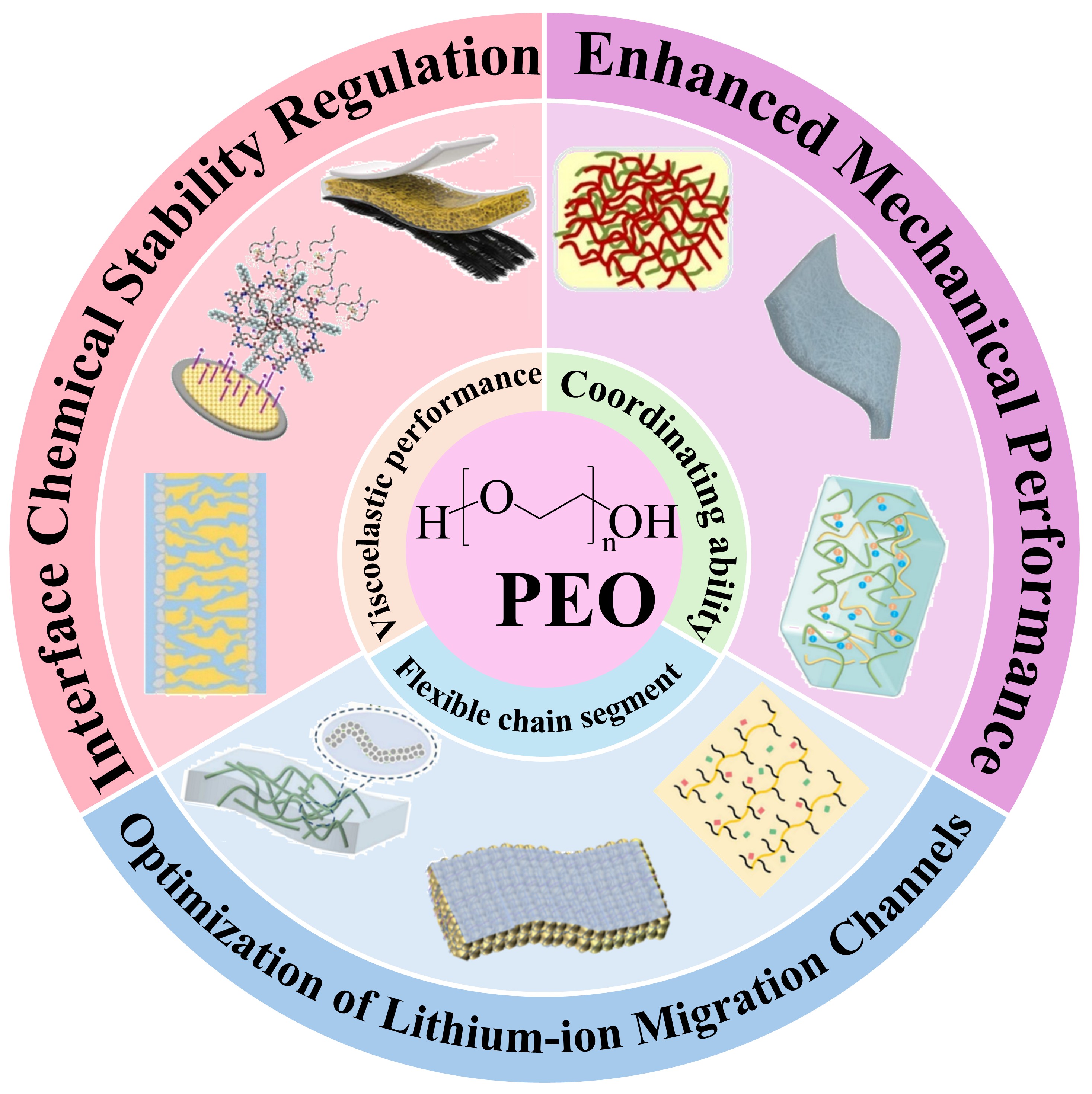
Unstable solid-solid interfaces present a major challenge for all-solid-state lithium batteries. Poly (ethylene oxide)-based electrolytes offer good processability and intrinsic compatibility with electrodes. However, their narrow electrochemical stability window and low room-temperature ionic conductivity limit practical application. Recent work reveals a transition in interfacial engineering. The field is moving from passive physical barriers to ultrathin, actively regulated multifunctional interfacial layers. This review summarizes recent advances in PEO-based ultrathin interfacial modification layers. These layers are fabricated by in situ polymerization, atomic layer deposition, and self-assembly. The discussion focuses on three core interfacial regulation mechanisms. The first mechanism is the controlled formation and compositional tuning of solid electrolyte interphase and cathode electrolyte interphase layers. The second mechanism is viscoelastic mechanical adaptation. This adaptation suppresses stress accumulation and lithium dendrite penetration. The third mechanism is homogenized lithium-ion transport. It enhances interfacial charge-transfer kinetics. The synergistic integration of these functions effectively stabilizes the lithium metal anode and high-voltage cathode interfaces. Emerging strategies involving smart-responsive interfaces and bio-inspired multilayer architectures are also discussed. This review provides a concise and mechanism-oriented framework. It guides the rational design of PEO-based interfacial layers and supports the development of high-energy-density, high-safety all-solid-state lithium batteries.
- Open Access
- Review
Interfacial Engineering with PEO-Based Ultrathin Layers for Stable All-Solid-State Lithium Batteries: From Passive Protection to Active Regulation
- Laibin Li 1,†,
- Zhuodi Chen 2,†,
- Shengen Gong 1,*,
- Akif Zeb 3,
- Reddivari Chenna Krishna Reddy 4,
- Yongbo Wu 5,6,
- Dawei Wang 2,*,
- Xiaoming Lin 1,*
Author Information
Received: 08 Mar 2026 | Revised: 29 Mar 2026 | Accepted: 07 May 2026 | Published: 24 Aug 2026
Abstract
Graphical Abstract
Keywords
ultrathin interfacial modification layer | in situ polymerization | atomic layer deposition | self-assembly
References
- 1.
Reddy, R.C.; Lin, X.; Zeb, A.; et al. Metal–organic frameworks and their derivatives as cathodes for lithium-ion battery applications: A review. Electrochem. Energy Rev. 2022, 5, 312–347.
- 2.
Zhou, J.-E.; Li, Y.; Zou, M.; et al. Self-sacrificial templated lithium manganese oxide as a longevous cathode: The intermarriage of oxygen defects and zeolitic imidazolate framework glass. Adv. Funct. Mater. 2025, 35, 2501603.
- 3.
Meng, S.; Liu, D.; Feng, J.; et al. Prussian blue analogs for zinc hybrid ion batteries: A promising and competitive alternative to aqueous zinc-ion batteries. Exploration 2025, 5, 20240180.
- 4.
Zhang, H.; Huang, Z.; Du, Y.; et al. Manganese dioxide as cathode for aqueous zinc-ion batteries: Reaction mechanisms, optimization strategies and further prospects. Microstructures 2025, 5, 2025091.
- 5.
Chen, D.; Ma, X.; Xu, W.; et al. Disrupting hydrogen bond network connectivity with a double-site additive for long-life aqueous zinc metal batteries. Exploration 2025, 5, 20240007.
- 6.
Guo, Q.; Qiu, C.; Zhang, Y.; et al. Manipulating stable four-electron zinc-iodine batteries via the introduction of diamine ligand sites. Microstructures 2025, 5, 2025078.
- 7.
Lin, X.; Lin, J.; Lu, X.; et al. Vacancy-engineered LiMn2O4 embedded in dual-heteroatom-doped carbon via metal-organic framework-mediated synthesis towards longevous lithium ion battery. Mater. Futures 2025, 4, 025101.
- 8.
Zhou, J.-E.; Li, Y.; Lin, X.; et al. Prussian blue analogue-templated nanocomposites for alkali-ion batteries: Progress and perspective. Nano-Micro Lett. 2025, 17, 9.
- 9.
Li, Z.; Chen, G.; Hu, D.; et al. A hierarchical host microstructure enables regulated inner Li deposition for stable Li metal electrodes. Microstructures 2024, 4, 2024059.
- 10.
Chen, Y.; Qian, J.; Wang, K.; et al. Electron-funnel mediated anion confinement enables ultra-reversible interphases in solid-state batteries. eScience 2026, 6, 100452.
- 11.
Huang, Z.; Sun, W.; He, S.; et al. Elucidating and optimizing I occupation in lithium argyrodite solid electrolytes for advanced all-solid-state Li metal batteries. Exploration 2025, 5, 20240050.
- 12.
Wu, Q.; Esping, E.; Afiandika, M.; et al. Understanding the electro-chemo-mechanics of lithium metal anodes. eScience 2026, 6, 100429.
- 13.
Huang, Y.; Shao, B.; Han, F. Interfacial challenges in all-solid-state lithium batteries. Curr. Opin. Electrochem. 2022, 33, 100933.
- 14.
Qian, H.; Liu, Y.; Chen, H.; et al. Emerging bismuth-based materials: From fundamentals to electrochemical energy storage applications. Energy Storage Mater. 2023, 58, 232–270.
- 15.
Qi, S.; Liu, J.; He, J.; et al. Structurally tunable characteristics of ionic liquids for optimizing lithium platin/stripping via electrolyte engineering. J. Energy Chem. 2021, 63, 270–277.
- 16.
Xu, R.; Cheng, X.-B.; Yan, C.; et al. Artificial interphases for highly stable lithium metal anode. Matter 2019, 1, 317–344.
- 17.
Wang, F.; Gao, J.; Liu, Y.; et al. An amorphous ZnO and oxygen vacancy modified nitrogen-doped carbon skeleton with lithiophilicity and ionic conductivity for stable lithium metal anodes. J. Mater. Chem. A 2022, 10, 17395–17405.
- 18.
Li, Y.; Ding, P.; Cai, L.; et al. Eco-friendly soy protein-based solid-state electrolyte exhibiting stable high-rate cyclic performances by molecular regulation design. Adv. Energy Mater. 2025, 15, 2501056.
- 19.
Ningappa, N.G.; Madikere Raghunatha Reddy, A.K.; Zaghib, K. Advanced polymer electrolytes in solid-state batteries. Batteries 2024, 10, 454.
- 20.
Fu, Y.; Yang, K.; Xue, S.; et al. Surface defects reinforced polymer-ceramic interfacial anchoring for high-rate flexible solid-state batteries. Adv. Funct. Mater. 2023, 33, 2210845.
- 21.
Yue, L.; Ma, J.; Zhang, J.; et al. All solid-state polymer electrolytes for high-performance lithium ion batteries. Energy Storage Mater. 2016, 5, 139–164.
- 22.
Xu, R.C.; Xia, X.H.; Zhang, S.Z.; et al. Interfacial challenges and progress for inorganic all-solid-state lithium batteries. Electrochim. Acta 2018, 284, 177–187.
- 23.
Chen, L.; Fang, J.; Lin, J.; et al. The progress and promise for metal-organic framework-mediated synthesis of lithium-ion battery cathode materials. Mater. Futures 2025, 4, 032101.
- 24.
Lu, J.; Sheng, B.; Fang, Q.; et al. Spatially surface ion-aggregated solid polymer electrolyte with robust mechanical properties for lithium metal batteries. eScience 2026, 6, 100462.
- 25.
Yang, X.; Jiang, M.; Gao, X.; et al. Determining the limiting factor of the electrochemical stability window for PEO-based solid polymer electrolytes: Main chain or terminal –OH group? Energy Environ. Sci. 2020, 13, 1318–1325.
- 26.
Yang, J.; Cao, Z.; Chen, Y.; et al. Dry-processable polymer electrolytes for solid manufactured batteries. ACS Nano 2023, 17, 19903–19913.
- 27.
Yao, P.; Zhu, B.; Zhai, H.; et al. PVDF/Palygorskite nanowire composite electrolyte for 4 V rechargeable lithium batteries with high energy density. Nano Lett. 2018, 18, 6113–6120.
- 28.
Li, X.; Wang, L.; Lu, Y. Three-dimensional disordered alloy metamaterials: A new platform of structure-function integration. Mater. Futures 2025, 4, 012001.
- 29.
Wang, C.; Zhang, H.; Li, J.; et al. The interfacial evolution between polycarbonate-based polymer electrolyte and Li-metal anode. J. Power Sources 2018, 397, 157–161.
- 30.
Devaux, D.; Bouchet, R.; Glé, D.; et al. Mechanism of ion transport in PEO/LiTFSI complexes: Effect of temperature, molecular weight and end groups. Solid. State Ion. 2012, 227, 119–127.
- 31.
Rey, I.; Lassègues, J.C.; Grondin, J.; et al. Infrared and raman study of the PEO-LiTFSI polymer electrolyte. Electrochim. Acta 1998, 43, 1505–1510.
- 32.
Dong, S.; Sheng, L.; Wang, L.; et al. Challenges and prospects of all-solid-state electrodes for solid-state lithium batteries. Adv. Funct. Mater. 2023, 33, 2304371.
- 33.
Wang, C.; Fu, K.; Kammampata, S.P.; et al. Garnet-type solid-state electrolytes: Materials, interfaces, and batteries. Chem. Rev. 2020, 120, 4257–4300.
- 34.
Ushakova, E.E.; Frolov, A.; Reveguk, A.A.; et al. Solid electrolyte interface formation between lithium and PEO-based electrolyte. Appl. Surf. Sci. 2022, 589, 153014.
- 35.
Chen, X.; Jiang, M.; Du, X.; et al. Li2O-enhanced solid electrolyte interphase surpassing LiF-only SEI for high-performance all-solid-state Li batteries. Adv. Energy Mater. 2025, 15, 2502589.
- 36.
Cao, Y.; Liu, Y.; Cheng, L.; et al. Non-flammable, ultra-thin, high-performance PEO-based polymer electrolyte for lithium metal batteries. Chem. Eng. J. 2025, 524, 169042.
- 37.
He, Y.; Dong, Y.; Qiao, L.; et al. Recent progress in ultra-thin solid polymeric electrolytes for next-generation lithium batteries. Energy Storage Mater. 2024, 67, 103329.
- 38.
Nguyen, M.C.; Nguyen, H.L.; Duong, T.P.M.; et al. Highly Safe, ultra-thin MOF-based solid polymer electrolytes for superior all-solid-state lithium-metal battery performance. Adv. Funct. Mater. 2024, 34, 2406987.
- 39.
Yang, Q.; Ma, Y.; Ye, Q.; et al. Prussian blue analogues derived MO/MFe2O4 (M= Ni, Cu, Zn) nanoparticles as a high-performance anode material for enhanced lithium storage. Chin. J. Struct. Chem. 2025, 44, 100631.
- 40.
Xiong, J.; Huang, B.; Zhang, Y.; et al. MOF-derived carbon-encapsulated ZnS/MnO porous microspheres for high-performance lithium storage. Chin. J. Struct. Chem. 2025, 45, 100795.
- 41.
Wang, S.; Li, J.; Li, T.; et al. Li+ affinity ultra-thin solid polymer electrolyte for advanced all-solid-state lithium-ion battery. Chem. Eng. J. 2023, 461, 141995.
- 42.
Xie, K.; Shi, L. Ultrathin PEO based electrolyte for high voltage lithium metal batteries enabled by polymer host-plasticizer interactions. J. Energy Storage 2023, 68, 107640.
- 43.
Wan, J.; Xie, J.; Kong, X.; et al. Ultrathin, flexible, solid polymer composite electrolyte enabled with aligned nanoporous host for lithium batteries. Nat. Nanotechnol. 2019, 14, 705–711.
- 44.
Chen, X.; Li, X.; Luo, L.; et al. Practical application of all-solid-state lithium batteries based on high-voltage cathodes: Challenges and progress. Adv. Energy Mater. 2023, 13, 2301230.
- 45.
Fu, F.; Zheng, Y.; Jiang, N.; et al. A dual-salt PEO-based polymer electrolyte with cross-linked polymer network for high-voltage lithium metal batteries. Chem. Eng. J. 2022, 450, 137776.
- 46.
Zhang, N.; Li, W.; Li, R.; et al. Slurry casted ultrathin Li3Zr2Si2PO12 electrolyte film for solid-state lithium metal batteries. Small 2024, 20, 2402164.
- 47.
Li, S.; Wang, S.; Du, G.; et al. Ultrathin inorganic-organic solid-state electrolyte reinforced by a pre-fiberized LAGP continuous skeleton. Sci. China Mater. 2024, 68, 199–206.
- 48.
Zhang, X.; Chu, Y.; Cui, X.; et al. An ultra-thin polymer electrolyte based on single-helical-structured agarose for high performance solid-state lithium batteries. J. Mater. Chem. A 2021, 9, 26939–26948.
- 49.
Li, S.; Lu, J.; Geng, Z.; et al. Solid polymer electrolyte reinforced with a Li1.3Al0.3Ti1.7(PO4)3-coated separator for all-solid-state lithium batteries. ACS Appl. Mater. Interfaces 2022, 14, 1195–1202.
- 50.
Liu, T.; Zhong, Y.; Gao, X.; et al. Enhancing the interfacial stability of thin solid polymer electrolyte with fluorinated covalent organic framework nanosheets. Nano Lett. 2025, 25, 2103–2111.
- 51.
Liu, L.; Mo, J.; Zhou, R.; et al. Ultrathin solid composite electrolytes for long-life lithium metal batteries. J. Energy Storage 2025, 114, 115777.
- 52.
Feng, J.; Wang, J.; Gu, Q.; et al. Room-temperature all-solid-state lithium metal batteries based on ultrathin polymeric electrolytes. J. Mater. Chem. A 2022, 10, 13969–13977.
- 53.
Liu, Y.; Han, L.; Liao, C.; et al. Ultra-thin, non-combustible PEO polymer solid electrolyte for high safety polymer lithium metal batteries. Chem. Eng. J. 2023, 468, 143222.
- 54.
Huang, M.; Xu, Z.; Lin, X. Mechanistic analysis of Co2VO4/X (X = Ni, C) heterostructures as anode materials of lithium-ion batteries. Chin. J. Struct. Chem. 2024, 43, 100309.
- 55.
Li, W.; Song, Q.; Dong, Q.; et al. Proton storage chemistry in aqueous Zinc-inorganic batteries with moderate electrolytes. Adv. Mater. 2025, 37, 2414019.
- 56.
Wang, X.; Song, Y.; Jiang, X.; et al. Constructing interfacial nanolayer stabilizes 4.3 V high-voltage all-solid-state lithium batteries with PEO-based solid-state electrolyte. Adv. Funct. Mater. 2022, 32, 2113068.
- 57.
Han, L.; Liu, Y.; Liao, C.; et al. Noncombustible 7 µm-thick solid polymer electrolyte for highly energy density solid state lithium batteries. Nano Energy 2023, 112, 108448.
- 58.
Qian, H.; Li, X.; Chen, Q.; et al. LiZn/Li2O induced chemical confinement enabling dendrite-free Li-metal anode. Adv. Funct. Mater. 2024, 34, 2470108.
- 59.
Qin, W.; Yang, Q.; He, Y.; et al. Finite elastic-viscoplastic deformation behaviour of PEO-based solid polymer electrolyte: Experimental investigation and constitutive modelling. Mech. Mater. 2023, 185, 104773.
- 60.
Cheng, J.; Hou, G.; Chen, Q.; et al. Sheet-like garnet structure design for upgrading PEO-based electrolyte. Chem. Eng. J. 2022, 429, 132343.
- 61.
Kirtley, J.R.; Mannhart, J. When TTF met TCNQ. Nat. Mater. 2008, 7, 520–521.
- 62.
Ning, C.; Zhou, Z.; Tan, G.; et al. Electroactive polymers for tissue regeneration: Developments and perspectives. Prog. Polym. Sci. 2018, 81, 144–162.
- 63.
Bruce, P.G.; Freunberger, S.A.; Hardwick, L.J.; et al. Li-O2 and Li-S batteries with high energy storage. Nat. Mater. 2012, 11, 19–29.
- 64.
Janek, J.; Zeier, W.G. A solid future for battery development. Nat. Energy 2016, 1, 1–4.
- 65.
Chen, J.; Zhou, Q.; Xu, X.; et al. Organic polymer framework enhanced PEO-based electrolyte for fast Li+ migration in all-solid-state lithium-ion batteries. Chin. J. Chem. 2024, 42, 3308–3316.
- 66.
Jeanne-Brou, R.; Deseure, J.; Phan, T.N.T.; et al. Anisotropic ionic transport properties in solid PEO based electrolytes. Electrochim. Acta 2022, 434, 141268.
- 67.
He, C.; Ying, H.; Cai, L.; et al. Tailoring stable PEO-based electrolyte/electrodes interfaces via molecular coordination regulating enables 4.5 V solid-state lithium metal batteries. Adv. Funct. Mater. 2024, 34, 2410350.
- 68.
Dong, P.; Zhang, X.; Han, K.S.; et al. Deep eutectic solvent-based polymer electrolyte for solid-state lithium metal batteries. J. Energy Chem. 2022, 70, 363–372.
- 69.
Cheng, X.-B.; Zhang, R.; Zhao, C.-Z.; et al. Toward safe lithium metal anode in rechargeable batteries: A review. Chem. Rev. 2017, 117, 10403–10473.
- 70.
Wei, Y.-M.; Qiu, A.; Wang, J.; et al. Influence of lithium salt anions on the interfacial properties of PEO-based solid-state electrolytes. Electrochem. Commun. 2025, 177, 107979.
- 71.
Zhang, M.; Gomes, M.B.; Yusuf, A.; et al. Flame-retardant reinforced halloysite nanotubes as multi-functional fillers for PEO-based polymer electrolytes. Eur. Polym. J. 2024, 215, 113246.
- 72.
Han, X.; Wu, T.; Gu, L.; et al. A Li-based MOF-derived multifunctional PEO polymer solid-state electrolyte for lithium energy storage. New J. Chem. 2022, 46, 3747–3753.
- 73.
Polu, A.R.; Rhee, H.-W. Ionic liquid doped PEO-based solid polymer electrolytes for lithium-ion polymer batteries. Int. J. Hydrog. Energy 2017, 42, 7212–7219.
- 74.
Sun, J.; Zhang, S.; Li, J.; et al. Robust transport: An artificial solid electrolyte interphase design for anode-free lithium-metal batteries. Adv. Mater. 2023, 35, 2209404.
- 75.
Wang, S.; Zhang, J.; Hua, W.; et al. Solvation-enhanced electrolyte on layered oxide cathode tailoring even and stable CEI for durable sodium storage. Carbon. Neutrality 2023, 2, 20.
- 76.
Zhou, C.; Dong, C.; Wang, W.; et al. An ultrathin and crack-free metal-organic framework film for effective polysulfide inhibition in lithium–sulfur batteries. Interdiscip. Mater. 2024, 3, 306–315.
- 77.
Chen, C.; Liang, Q.; Wang, G.; et al. Grain-boundary-rich artificial SEI layer for high-rate lithium metal anodes. Adv. Funct. Mater. 2022, 32, 2107249.
- 78.
Zhao, B.; Xing, C.; Shi, Y.; et al. Construction of high elastic artificial SEI for air-stable and long-life lithium metal anode. J. Colloid. Interface Sci. 2023, 642, 193–203.
- 79.
Zhong, Y.; Chen, Y.; Cheng, Y.; et al. Li alginate-based artificial SEI layer for stable lithium metal anodes. ACS Appl. Mater. Interfaces 2019, 11, 37726–37731.
- 80.
Liu, Y.; Fu, F.; Sun, C.; et al. Enabling stable interphases via in situ two-step synthetic bilayer polymer electrolyte for solid-state lithium metal batteries. Inorganics 2022, 10, 42.
- 81.
Hu, J.K.; Gao, Y.C.; Yang, S.J.; et al. High energy density solid-state lithium metal batteries enabled by in situ polymerized integrated ultrathin solid electrolyte/cathode. Adv. Funct. Mater. 2024, 34, 2311633.
- 82.
Zhou, X.; Yang, T.; Jia, S.; et al. In situ-polymerized high-entropy-driven solid polymer electrolyte for safer solid-state lithium metal batteries. ACS Appl. Mater. Interfaces 2025, 17, 29478–29487.
- 83.
Liu, Q.; Wang, L.; He, X. Toward practical solid-state polymer lithium batteries by in situ polymerization process: A review. Adv. Energy Mater. 2023, 13, 2300798.
- 84.
Cai, X.; Bao, W.; Zhao, L.; et al. Investigation of electrochemical stability of ALD grown Li3PO4 thin films and its application in high-voltage PEO-based all-solid-state lithium batteries. Adv. Sustain. Syst. 2025, 9, 2300392.
- 85.
Li, Q.; Zhang, X.; Peng, J.; et al. Engineering a high-voltage durable cathode/electrolyte interface for all-solid-state lithium metal batteries via in situ electropolymerization. ACS Appl. Mater. Interfaces 2022, 14, 21018–21027.
- 86.
Zhang, T.; Wang, T.; Zheng, Y.; et al. Atomic layer deposition for sodium-ion batteries. Adv. Energy Mater. 2025, 15, e01760.
- 87.
Wang, Z.; Ouyang, L.; Li, H.; et al. Layer-by-layer assembly of strong thin films with high lithium ion conductance for batteries and beyond. Small 2021, 17, 2100954.
- 88.
Lu, G.; Wu, X.; Huang, M.; et al. A self-adsorption molecule passivated interface enables efficient and stable lithium metal batteries. Energy Environ. Sci. 2024, 17, 9555–9565.
- 89.
Tolganbek, N.; Sarsembina, M.; Nurpeissova, A.; et al. Effect of a layer-by-layer assembled ultra-thin film on the solid electrolyte and Li interface. Nanoscale Adv. 2022, 4, 4606–4616.
- 90.
Liu, Y.; Tao, X.; Wang, Y.; et al. Self-assembled monolayers direct a LiF-rich interphase toward long-life lithium metal batteries. Science 2022, 375, 739–745.
- 91.
Yao, S.; Kalami, S.; Nam, S.; et al. Development of an electrophoretic deposition method for the in situ fabrication of ultra-thin composite-polymer electrolytes for solid-state lithium-metal batteries. Small 2023, 19, 2208252.
- 92.
Fang, R.; Xu, B.; Grundish, N.S.; et al. Li2S6-integrated PEO-based polymer electrolytes for all-solid-state lithium-metal batteries. Angew. Chem. Int. Ed. 2021, 60, 17701–17706.
- 93.
Chen, X.; Li, Y.; Lu, Y.; et al. LATP-coated LiNi0.8Co0.1Mn0.1O2 cathode with compatible interface with ultrathin PVDF-reinforced PEO-LLZTO electrolyte for stable solid-state lithium batteries. J. Mater. 2024, 10, 682–693.
- 94.
Moshonov, M.; Kauffmann, Y.; Frey, G.L. Self-assembled block copolymer templates for atomic layer deposition: The effect of processing solvent. Polymer 2016, 105, 214–220.
- 95.
Bao, W.; Zhao, L.; Zhao, H.; et al. Vapor phase infiltration of ZnO quantum dots for all-solid-state PEO-based lithium batteries. Energy Storage Mater. 2021, 43, 258–265.
- 96.
Liang, J.; Sun, Y.; Zhao, Y.; et al. Engineering the conductive carbon/PEO interface to stabilize solid polymer electrolytes for all-solid-state high voltage LiCoO2 batteries. J. Mater. Chem. A 2020, 8, 2769–2776.
- 97.
Zhang, H.; Xu, Z.; Shi, B.; et al. Enhanced cyclability of Cr8O21 cathode for PEO-based all-solid-state lithium-ion batteries by atomic layer deposition of Al2O3. Materials 2021, 14, 5380.
- 98.
Xu, H.; Liu, S.; Li, Z.; et al. Ti3C2T MXene enhanced PEO/SN-based solid electrolyte for high-performance Li metal battery. J. Mater. Sci. Technol. 2025, 219, 101–112.
- 99.
Yang, D.; Liu, Y.; Yang, T.; et al. Anti-corrosion lithium anode interface by Li6.4La3Zr1.4Ta0.6O12 modified buffer layer for stable cycling of room-temperature solid-state lithium metal batteries. J. Colloid. Interface Sci. 2025, 689, 137225.
- 100.
Wang, G.; Chen, C.; Chen, Y.; et al. Self-stabilized and strongly adhesive supramolecular polymer protective layer enables ultrahigh-rate and large-capacity lithium-metal anode. Angew. Chem. Int. Ed. 2020, 59, 2055–2060.
- 101.
Liu, W.; Lee, S.W.; Lin, D.; et al. Enhancing ionic conductivity in composite polymer electrolytes with well-aligned ceramic nanowires. Nat. Energy 2017, 2, 17035.
- 102.
Zhang, F.; Qian, J.-W.; Dong, W.-X.; et al. Integration of confinement crosslinking and in situ grafting for constructing artificial interphases toward stabilized zinc anodes. Energy Environ. Sci. 2024, 17, 7258–7270.
- 103.
Sun, M.; Zeng, Z.; Zhong, W.; et al. In-situ polymerization methods for polymer-based solid-state lithium batteries. Batter. Supercaps 2022, 5, e202200338.
- 104.
Zou, S.; Yang, Y.; Wang, J.; et al. In situ polymerization of solid-state polymer electrolytes for lithium metal batteries: A review. Energy Environ. Sci. 2024, 17, 4426–4460.
- 105.
Zheng, J.; Jiang, H.; Xu, X.; et al. In situ partial-cyclized polymerized acrylonitrile-coated NCM811 cathode for high-temperature ≥100 °C stable solid-state lithium metal batteries. Nano-Micro Lett. 2025, 17, 195.
- 106.
Wu, N.; Li, Y.; Dolocan, A.; et al. In situ formation of Li3P layer enables fast Li+ conduction across Li/solid polymer electrolyte interface. Adv. Funct. Mater. 2020, 30, 2000831.
- 107.
Aniagbaoso, K.I.; Bitenc, J.; Pellerin, V.; et al. In situ fabrication of quasi-solid polymer electrolytes for lithium metal battery via photopolymerization-induced microphase separation. ACS Appl. Mater. Interfaces 2024, 17, 3876–3886.
- 108.
Tagliazucchi, M.; Müller, M. Morphology-transport coupling and dissipative structures in PEO-PS+LiTFSI electrolytes in-operando conditions. ACS Appl. Mater. Interfaces 2025, 17, 9278–9288.
- 109.
Deng, T.; Cao, L.; He, X.; et al. In situ formation of polymer-inorganic solid-electrolyte interphase for stable polymeric solid-state lithium-metal batteries. Chem 2021, 7, 3052–3068.
- 110.
Huang, S.; Cui, Z.; Qiao, L.; et al. An in-situ polymerized solid polymer electrolyte enables excellent interfacial compatibility in lithium batteries. Electrochim. Acta 2019, 299, 820–827.
- 111.
Vijayakumar, V.; Anothumakkool, B.; Kurungot, S.; et al. In situ polymerization process: An essential design tool for lithium polymer batteries. Energy Environ. Sci. 2021, 14, 2708–2788.
- 112.
Ye, M.; Chen, J.; Deng, H.; et al. In-situ electrochemical passivation for constructing high-voltage PEO-based solid-state lithium battery. Chem. Eng. J. 2024, 488, 151108.
- 113.
Luo, J.; Sun, Q.; Liang, J.; et al. Rapidly in situ cross-linked poly(butylene oxide) electrolyte interface enabling halide-based all-solid-state lithium metal batteries. ACS Energy Lett. 2023, 8, 3676–3684.
- 114.
Liang, X.; Luo, M.; Chen, L.; et al. In situ polymerized hybrid nanofiber membranes boost high-voltage stability of solid-state lithium metal batteries. ACS Nano 2025, 19, 27620–27633.
- 115.
Cheng, Q.; Jin, T.; Miao, Y.; et al. Stabilizing lithium plating in polymer electrolytes by concentration-polarization-induced phase transformation. Joule 2022, 6, 2372–2389.
- 116.
Wang, K.; Xu, J.; Xu, M.; et al. Dynamic interface regulation in solid-state lithium-metal batteries by in situ polymerized highly elastic ultrathin layers. Energy Storage Mater. 2025, 81, 104469.
- 117.
Ling, F.; Diao, J.; Yao, Y.; et al. Enabling long-life all-solid-state sodium metal batteries via in situ construction of a stable solid electrolyte interphase. Adv. Funct. Mater. 2025, 35, 2419970.
- 118.
Tiurin, O.; Ein-Eli, Y. A critical review: The impact of the battery electrode material substrate on the composition and properties of atomic layer deposition (ALD) coatings. Adv. Mater. Interfaces 2019, 6, 1901455.
- 119.
Go, D.; Shin, J.W.; Lee, S.; et al. Atomic layer deposition for thin film solid-state battery and capacitor. Int. J. Precis. Eng. Manuf. -Green Technol. 2023, 10, 851–873.
- 120.
Chen, G.; Liu, X.; Liu, Z.; et al. Novel “sandwich” configuration with ALD-coating layers on electrode/electrolyte interfaces for durable all-solid-state lithium metal batteries with high-voltage cathodes. Energy Mater. 2025, 5, 500064.
- 121.
Liu, J.; Sun, X. Elegant design of electrode and electrode/electrolyte interface in lithium-ion batteries by atomic layer deposition. Nanotechnology 2015, 26, 024001.
- 122.
Mattelaer, F.; Vereecken, P.M.; Dendooven, J.; et al. The influence of ultrathin amorphous ALD alumina and Titania on the rate capability of anatase TiO2 and LiMn2O4 Lithium ion battery electrodes. Adv. Mater. Interfaces 2017, 4, 1601237.
- 123.
George, S.M. Atomic layer deposition: An overview. Chem. Rev. 2010, 110, 111–131.
- 124.
Elam, J.; Routkevitch, D.; Mardilovich, P.; et al. Conformal coating on ultrahigh-aspect-ratio nanopores of anodic alumina by atomic layer deposition. Chem. Mater. 2003, 15, 3507–3517.
- 125.
Ma, L.; Nuwayhid, R.B.; Wu, T.; et al. Atomic layer deposition for lithium-based batteries. Adv. Mater. Interfaces 2016, 3, 1600564.
- 126.
Zhao, Y.; Zheng, K.; Sun, X. Addressing interfacial issues in liquid-based and solid-state batteries by atomic and molecular layer deposition. Joule 2018, 2, 2583–2604.
- 127.
Wang, B.; Liu, J.; Norouzi Banis, M.; et al. Atomic layer deposited lithium silicates as solid-state electrolytes for all-solid-state batteries. ACS Appl. Mater. Interfaces 2017, 9, 31786–31793.
- 128.
Liu, J.; Zhu, H.; Shiraz, M.H. Toward 3D solid-state batteries via atomic layer deposition approach. Front. Energy Res. 2018, 6, 10.
- 129.
Woo, J.H.; Trevey, J.E.; Cavanagh, A.S.; et al. Nanoscale interface modification of LiCoO2 by Al2O3 atomic layer deposition for solid-state Li batteries. J. Electrochem. Soc. 2012, 159, A1120–A1124.
- 130.
Jim, S.R.; Foroughi-Abari, A.; Krause, K.M.; et al. Ultrathin-layer chromatography nanostructures modified by atomic layer deposition. J. Chromatogr. A 2013, 1299, 118–125.
- 131.
Wang, X.; Sun, J.; Li, T.; et al. Folic acid self-assembly synthesis of ultrathin N-doped carbon nanosheets with single-atom metal catalysts. Energy Storage Mater. 2021, 36, 409–416.
- 132.
Knoll, W. Self-assembled microstructures at interfaces. Curr. Opin. Colloid Interface Sci. 1996, 1, 137–143.
- 133.
Lin, Y.-H.; Wu, L.-T.; Zhan, Y.-T.; et al. Self-assembly formation of solid-electrolyte interphase in gel polymer electrolytes for high performance lithium metal batteries. Energy Storage Mater. 2023, 61, 102868.
- 134.
Ding, F.; Liu, S.; Xu, H.; et al. Vinylidene carbonate drived ultra-stable artificial SEI for lithium metal anode with ultra-long life. Chem. Eng. J. 2025, 518, 164411.
- 135.
Hong, H.; Yoo, J.; Noh, H.; et al. Enhanced ionic conductivity and interfacial compatibility in BH4-based lithium argyrodite solid electrolytes via Cu+ doping. Electrochim. Acta 2025, 540, 147185.
- 136.
Dai, Y.; Hou, Z.; Luo, G.; et al. Improving the interfacial stability of ultrahigh-nickel cathodes with PEO-based electrolytes by targeted chemical reactions. Chem. Sci. 2024, 15, 12964–12972.
- 137.
Stalin, S.; Chen, P.; Li, G.; et al. Ultrathin zwitterionic polymeric interphases for stable lithium metal anodes. Matter 2021, 4, 3753–3773.
- 138.
Li, X.-A.; Xu, Y.; Zhu, K.; et al. A facile construction of LiF interlayer and F-doping via PECVD for LATP-based hybrid electrolytes: Enhanced Li-ion transport kinetics and superior lithium metal compatibility. Mater. Today 2025, 91, 1–12.
- 139.
Wang, Y.; Liang, J.; Shen, T.; et al. Self-assembled o-carborane clusters enabling ambient/electrochemical dual-stable interphases for dendrite-free and high-rate lithium metal batteries. ACS Nano 2025, 19, 38760–38772.
- 140.
Chen, P.; Jin, S.; Hong, S.; et al. Adaptive ion channels formed in ultrathin and semicrystalline polymer interphases for stable aqueous batteries. J. Am. Chem. Soc. 2024, 146, 3136–3146.
- 141.
Lee, Y.-G.; An, S.Y.; Matyjaszewski, K.; et al. Ionically conductive polymer cathode interface interlayer for high-performance all-solid-state lithium battery. ACS Energy Lett. 2025, 10, 4866–4871.
- 142.
He, H.; Shang, J.; Li, S.; et al. Enabling interfacially compatible and high-voltage-tolerant lithium metal batteries with gradient composited solid-state electrolytes. J. Mater. Chem. A 2024, 12, 22971–22980.
- 143.
Mangani, L.R.; Devaux, D.; Benayad, A.; et al. Tuning ceramic surface to minimize the ionic resistance at the interface between PEO- and LATP-based ceramic electrolyte. ACS Appl. Mater. Interfaces 2024, 16, 45713–45723.
- 144.
Grotkopp, N.L.; Horst, M.; Batzer, M.; et al. Flexible freestanding thin polyethylene oxide-based film as artificial solid-electrolyte interface to protect lithium metal in lithium-sulfur batteries. Adv. Energy Sustain. Res. 2022, 4, 2200146.
- 145.
Chen, Q.; Gao, B.; Yang, Z.; et al. Macroscopically uniform interface layer with Li+ conductive channels for high-performance Li metal batteries. Nat. Commun. 2024, 15, 10045.
- 146.
Huang, J.; Feng, Q.; Luo, C. Fast Li-ion battery chemistry enabled by small-sized solvent. Carbon. Neutrality 2024, 3, 20.
- 147.
Xia, S.; Zhang, X.; Jiang, Z.; et al. Ultrathin polymer electrolyte with fast ion transport and stable interface for practical solid-state lithium metal batteries. Adv. Mater. 2025, 37, 2510376.
- 148.
Wu, J.; Rao, Z.; Cheng, Z.; et al. Ultrathin, flexible polymer electrolyte for cost-effective fabrication of all-solid-state lithium metal batteries. Adv. Energy Mater. 2019, 9, 1902767.
- 149.
Zhao, X.; Wang, C.; Fan, X.; et al. Addressing the interface issues of all-solid-state lithium batteries by ultra-thin composite solid-state electrolyte combined with the integrated preparation technology. InfoMat 2025, 7, e70012.
- 150.
Li, S.; Wang, Y.; Anguita, J.; et al. Constructing vertically aligned Li+ transport pathways in a flexible solid polymer composite electrolyte by a soft template approach. Nanoscale 2025, 17, 6833–6840.
- 151.
Lu, S.; He, K.; Zhou, L.; et al. The regulation of ion transport microenvironment in micropores to precisely construct porous polymer electrolytes for solid-state lithium-metal batteries. ACS Nano 2025, 19, 23450–23464.
- 152.
Wu, Y.; Zhu, T.; Lv, Y.; et al. “Polymer in ceramic” type LLZTO/PEO/PVDF composite electrolyte with high lithium migration number for solid-state lithium batteries. Ionics 2023, 30, 787–798.
- 153.
Yao, M.; Yu, T.; Ruan, Q.; et al. High-voltage and wide-temperature lithium metal batteries enabled by ultrathin MOF-derived solid polymer electrolytes with modulated ion transport. ACS Appl. Mater. Interfaces 2021, 13, 47163–47173.
- 154.
Han, Q.; Wang, S.; Kong, W.; et al. Composite polymer electrolyte reinforced by graphitic carbon nitride nanosheets for room-temperature all-solid-state lithium batteries. Chin. J. Chem. Eng. 2023, 54, 257–263.
- 155.
Tleukenov, Y.-T.; Raiymbekov, Y.; Yegamkulov, M.; et al. Asymmetric Li-coated PEO–PVDF-co-HFP membrane with graphene oxide as next-generation gel polymer electrolytes for Li-ion batteries. Materialia 2025, 44, 102559.
- 156.
Li, X.; Pan, Y.; Liu, Y.; et al. Understanding steric hindrance effect of solvent molecule in localized high-concentration electrolyte for lithium metal batteries. Carbon Neutrality 2023, 2, 34.
- 157.
Zhang, D.; Shen, Z.; Li, D.; et al. Poly (ethylene oxide)-based composite solid electrolyte for long cycle life solid-state lithium metal batteries: Improvement of interface stability through a dual mechanism. J. Colloid. Interface Sci. 2024, 670, 385–394.
- 158.
Wang, C.; Wen, Z.; Chen, W.; et al. Additives tailored design for more durable polyethylene oxide-based solid electrolytes: A crucial review. ChemSusChem 2025, 18, e202500445.
- 159.
Du, J.; Luo, H.; Zhang, Q.; et al. Asymmetric coordination enables decoupled dynamics of Li+ transport for high-performance PEO-based solid electrolytes. ACS Appl. Energy Mater. 2025, 8, 11362–11372.
- 160.
Xu, K. Electrolytes and interphases in Li-ion batteries and beyond. Chem. Rev. 2014, 114, 11503–11618.
- 161.
Zhang, H.; Deng, J.; Xu, H.; et al. Molecule crowding strategy in polymer electrolytes inducing stable interfaces for all-solid-state lithium batteries. Adv. Mater. 2024, 36, 2403848.
- 162.
Ma, B.; Zhong, L.; Huang, S.; et al. Covalent organic framework enhanced solid polymer electrolyte for lithium metal batteries. Molecules 2024, 29, 1759.
- 163.
Cong, Y.; Li, J.; Su, H.; et al. Electrospun PEO-based composite polymer electrolyte with MOF modified LLZTO for solid-state lithium batteries. Ind. Eng. Chem. 2025, 64, 7956–7964.
- 164.
Wang, W.; Yang, Z.; Zhang, Y.; et al. Highly stable lithium metal anode enabled by lithiophilic and spatial-confined spherical-covalent organic framework. Energy Storage Mater. 2022, 46, 374–383.
- 165.
Kou, W.; Zhang, Y.; Wu, W.; et al. Thin polymer electrolyte with MXene functional layer for uniform Li+ deposition in all-solid-state lithium battery. Green. Energy Environ. 2024, 9, 71–80.
- 166.
Kuai, Y.; Wang, Y. Innovative COF@MXene composites for high performance energy applications. Carbon Neutrality 2024, 3, 36.
- 167.
Zegeye, T.A.; Su, W.-N.; Fenta, F.W.; et al. Ultrathin Li6.75La3Zr1.75Ta0.25O12-based composite solid electrolytes laminated on anode and cathode surfaces for anode-free lithium metal batteries. ACS Appl. Energy Mater. 2020, 3, 11713–11723.
- 168.
Wang, Y.; Ding, J.; Liu, X.X.; et al. An ultrathin conformal layer of dry-coated Li+-conductive glass-ceramic for single-crystalline nickel-rich cathode towards all-solid-state lithium batteries. Chem. Eng. J. 2025, 503, 158152.
- 169.
Chen, L.; Qiu, X.; Bai, Z.; et al. Enhancing interfacial stability in solid-state lithium batteries with polymer/garnet solid electrolyte and composite cathode framework. J. Energy Chem. 2021, 52, 210–217.
- 170.
Yang, Q.; Kong, D.; Fu, L.; et al. Investigation on the mechanical integrity of a PEO-based polymer electrolyte in all-solid-state lithium batteries. Phys. Chem. Chem. Phys. 2024, 26, 8125–8140.
- 171.
Walle, K.Z.; Musuvadhi Babulal, L.; Wu, S.H.; et al. Electrochemical characteristics of a polymer/garnet trilayer composite electrolyte for solid-state lithium-metal batteries. ACS Appl. Mater. Interfaces 2021, 13, 2507–2520.
- 172.
Cheng, A.; Sun, L.; Menga, N.; et al. Interfacial performance evolution of ceramics-in-polymer composite electrolyte in solid-state lithium metal batteries. Int. J. Eng. Sci. 2024, 204, 104137.
- 173.
Xue, Z.; Zhang, Y.; Zhao, Z.; et al. Completely amorphous poly (ethylene oxide)-based electrolyte enables high ionic conductivity for room-temperature all-solid-state lithium metal batteries. ACS Appl. Energy Mater. 2023, 6, 12343–12352.
- 174.
Peters, F.; Langer, F.; Hillen, N.; et al. Correlation of mechanical and electrical behavior of polyethylene oxide-based solid electrolytes for all-solid state lithium-ion batteries. Batteries 2019, 5, 26.
- 175.
Xu, R.; Xu, S.; Wang, F.; et al. Double crosslinked polymer electrolyte by C-S-C group and metal-organic framework for solid-state lithium batteries. Small Struct. 2023, 4, 2200206.
- 176.
Zagórski, J.; López del Amo, J.M.; Cordill, M.J.; et al. Garnet-polymer composite electrolytes: New insights on local Li-ion dynamics and electrodeposition stability with Li metal anodes. ACS Appl. Energy Mater. 2019, 2, 1734–1746.
- 177.
Wang, L.; Yan, J.; Shen, W.; et al. Boosting the mechanical strength and electrochemical performance of PEO/LiTFSI polymeric solid electrolyte via nylon nanofibers. Ionics 2022, 28, 5341–5350.
- 178.
Lehmann, M.L.; Yang, G.; Gilmer, D.; et al. Tailored crosslinking of poly(ethylene oxide) enables mechanical robustness and improved sodium-ion conductivity. Energy Storage Mater. 2019, 21, 85–96.
- 179.
Ordaz, M.V.; Pavlin, N.; Gastaldi, M.; et al. Protective coating for stable cycling of Li-metal batteries based on cellulose and single-ion conducting polymer. ACS Appl. Mater. Interfaces 2024, 16, 68237–68246.
- 180.
Zhao, H.; Liu, Y.; Huang, L.; et al. Ultra-thin ePTFE-enforced electrolyte and electrolyte-electrode(s) assembly for high-performance solid-state lithium batteries. Energy Storage Mater. 2024, 71, 103625.
- 181.
Sharma, S.K.; Mor, J. Free volume mediated decoupling of ionic conduction from segmental relaxation leading to enhancement in ionic conductivity of polymer electrolytes at low temperatures. ACS Macro Lett. 2024, 13, 1211–1217.
- 182.
Zhang, Y.; Yu, J.; Shi, H.; et al. Fiber-reinforced ultrathin solid polymer electrolyte for solid-state lithium-metal batteries. Adv. Funct. Mater. 2025, 35, 2421054.
- 183.
Wang, R.; Tian, C.; Li, X.; et al. Designing PEO-based electrolytes via entropy-enthalpy engineering for high-voltage solid-state lithium metal batteries. Adv. Funct. Mater. 2026, 36, e16074.
- 184.
Hou, J.; Sun, W.; Yuan, Q.; et al. Multiscale engineered bionic solid-state electrolytes breaking the stiffness-damping trade-off. Angew. Chem. Int. Ed. 2025, 64, e202421427.
- 185.
Mauger, A.; Julien, C.M.; Paolella, A.; et al. Building better batteries in the solid state: A review. Mater. 2019, 12, 3892.
- 186.
Zhang, Z.; Zhao, Y.; Chen, S.; et al. An advanced construction strategy of all-solid-state lithium batteries with excellent interfacial compatibility and ultralong cycle life. J. Mater. Chem. A 2017, 5, 16984–16993.
- 187.
Da, X.; Chen, J.; Qin, Y.; et al. CO2-assisted induced self-assembled aramid nanofiber aerogel composite solid polymer electrolyte for all-solid-state lithium-metal batteries. Adv. Energy Mater. 2024, 14, 2303527.
- 188.
Wu, X.; Zheng, Y.; Li, W.; et al. Solid electrolytes reinforced by infinite coordination polymer nano-network for dendrite-free lithium metal batteries. Energy Storage Mater. 2021, 41, 436–447.
- 189.
Li, L.; Hu, Y.; Duan, H.; et al. A thin composite polymer electrolyte functionalized by a novel antihydrolysis additive to enable all-solid-state lithium battery with excellent rate and cycle performance. Small Methods 2023, 7, 2300314.
- 190.
Wang, C.; Zhang, H.; Dong, S.; et al. High polymerization conversion and stable high-voltage chemistry underpinning an in situ formed solid electrolyte. Chem. Mater. 2020, 32, 9167–9175.
- 191.
Wang, J.; Chen, L.; Li, H.; et al. Anode interfacial issues in solid-state Li batteries: Mechanistic understanding and mitigating strategies. Energy Environ. Mater. 2023, 6, e12613.
- 192.
Qian, J.; Adams, B.D.; Zheng, J.; et al. Anode-free rechargeable lithium metal batteries. Adv. Funct. Mater. 2016, 26, 7094–7102.
- 193.
Mezzomo, L.; Lorenzi, R.; Mauri, M.; et al. Unveiling the role of PEO-capped TiO2 nanofiller in stabilizing the anode interface in lithium metal batteries. Nano Lett. 2022, 22, 8509–8518.
- 194.
Wang, Z.; Yu, X.; Liu, Y.; et al. An integrated ultrathin, tip-electrostatic-shielding and inorganic interphase-promoting polymeric electrolyte design for high-performance all-solid-state lithium metal batteries. Nano Energy 2025, 134, 110582.
- 195.
Cai, X.; Ding, J.; Chi, Z.; et al. Rearrangement of ion transport path on nano-cross-linker for all-solid-state electrolyte with high room temperature ionic conductivity. ACS Nano 2021, 15, 20489–20503.
- 196.
Yang, Q.; Huang, J.; Li, Y.; et al. Surface-protected LiCoO2 with ultrathin solid oxide electrolyte film for high-voltage lithium ion batteries and lithium polymer batteries. J. Power Sources 2018, 388, 65–70.
- 197.
Feng, W.; Li, J.; Liu, H.; et al. In-situ modification of ultrathin and uniform layer on LiCoO2 particles for 4.2 V poly(ethylene oxide) based solid-state lithium batteries with excellent cycle performance. Electrochim. Acta 2022, 421, 140473.
- 198.
Xiang, J.; Wei, Y.; Zhong, Y.; et al. Building practical high-voltage cathode materials for lithium-ion batteries. Adv. Mater. 2022, 34, 2200912.
- 199.
Dai, Y.; Tan, J.; Hou, Z.; et al. Customized Li+ solvation sheath at the poly (ethylene oxide)-based electrolyte/ultrahigh-nickel cathode interface toward room-temperature solid-state lithium batteries. ACS Nano 2024, 18, 22518–22532.
- 200.
Tang, X.; Xu, X.; Bai, M.; et al. Ultrafast laser-induced cathode/electrolyte interphase for high-voltage poly (ethylene oxide)-based solid batteries. Adv. Funct. Mater. 2023, 33, 2210465.
- 201.
Kong, Z.-X.; Xiong, Z.; Wu, J.-F.; et al. Suppressing ionic-to-electronic conduction transition on cathode interface enables 4.4 V poly (ethylene oxide)-based all-solid-state batteries. ACS Energy Lett. 2024, 10, 287–295.
- 202.
Huang, Y.; Cao, B.; Xu, X.; et al. Construction of sulfone-based polymer electrolyte interface enables the high cyclic stability of 4.6 V LiCoO2 cathode by in situ polymerization. Adv. Energy Mater. 2024, 14, 2400943.


This work is licensed under a Creative Commons Attribution 4.0 International License.

 Suite 4002 Level 4, 447 Collins Street, Melbourne, Victoria 3000, Australia
 General Inquiries: info@sciltp.com